It was once proposed to use a 2 km vertical Sudbury mine shaft for microgravity experiments in a vacuum. How much time would scientists have to do an experiment during one drop?
- A. 20 s
- B. 63 s
- C. 0.64 s
- D. 198 s
Topic: Newtonian Mechanics Metodi: Kinematic Equations Competenze: Physical Reasoning Objects: — Fonte: Testo (PDF) — p.1
Una volta fu proposto di utilizzare un pozzo di mina di Sudbury verticale di 2 km per esperimenti di microgravità in vuoto. Quanto tempo gli scienziati avrebbero da fare per fare un esperimento durante una goccia?
- A. 20 s
- B. 63 s
- C. 0.64 s
- D. 198 s
Topic: Newtonian Mechanics Metodi: Kinematic Equations Competenze: Physical Reasoning Objects: — Fonte: Testo (PDF) — p.1
If the moon were twice as massive as it is now, and it stayed at the same orbital radius about the earth as it has now, its new orbital period (in terms of its current orbital period ) would be,
- A.
- B.
- C.
- D.
Topic: Gravitation Metodi: Kepler’s Laws, Newton’s Law of Gravitation Competenze: Physical Reasoning Objects: Planet Fonte: Testo (PDF) — p.1
Se la luna fosse due volte più massiccia di quanto sia ora, e rimanesse allo stesso raggio orbitale intorno alla Terra come lo è ora, il suo nuovo periodo orbitale (in termini del suo periodo orbitale attuale ) sarebbe,
- A.
- B.
- C.
- D.
Topic: Gravitation Metodi: Kepler’s Laws, Newton’s Law of Gravitation Competenze: Physical Reasoning Objects: Planet Fonte: Testo (PDF) — p.1
In the following circuit composed of identical capacitors, across which terminals would you connect a battery in order for all the capacitors to charge up?
- A. AB
- B. AC
- C. BD
- D. None of the above.
 Capacitor network with nodes A B C D
Topic: Circuits, Electrostatics Metodi: Equivalent Circuit Reduction, Kirchhoff’s Laws Competenze: Diagrammatic Reasoning Objects: Capacitor, Battery Fonte: Testo (PDF) — p.1
Nel circuito seguente composto da condensatori identici, attraverso quali terminali collegare una batteria per poter caricare tutti i condensatori?
- A. AB
- B. AC
- C. BD
- D. Nessuna delle seguenti.
Rete di condensatori con nodi A B C D
Topic: Circuits, Electrostatics Metodi: Equivalent Circuit Reduction, Kirchhoff’s Laws Competenze: Diagrammatic Reasoning Objects: Capacitor, Battery Fonte: Testo (PDF) — p.1
Two cylindrical resistors, one of length and radius , and the other of length and radius , are made of the same materials. If the resistance of the smaller one is , what is the resistance of the larger one?
- A.
- B.
- C.
- D.
Topic: Circuits Metodi: Physical Modeling, Dimensional Analysis Competenze: Physical Reasoning Objects: Resistor Fonte: Testo (PDF) — p.1
Due resistori cilindrici, uno di lunghezza e di raggio , e l’altro di lunghezza e di raggio , sono realizzati con gli stessi materiali. Se la resistenza di una più piccola è , qual è la resistenza di una più grande?
- A.
- B.
- C.
- D.
Topic: Circuits Metodi: Physical Modeling, Dimensional Analysis Competenze: Physical Reasoning Objects: Resistor Fonte: Testo (PDF) — p.1
A simple pendulum consists of a mass attached to a light string of length . If the system is oscillating through small angles, which of the following is true?
- A. The frequency is independent of the acceleration due to gravity, .
- B. The period depends on the amplitude of the oscillation.
- C. The period is independent of the mass .
- D. The period is independent of the length .
Topic: Oscillations & Waves Metodi: Simple Harmonic Motion Analysis, Small-Angle Approximation Competenze: Physical Reasoning Objects: Pendulum Fonte: Testo (PDF) — p.1
Un semplice pendolo è costituito da una massa attaccata a una stringa leggera di lunghezza . Se il sistema oscilla attraverso angoli piccoli, quale delle seguenti cose è vero?
- A. La frequenza è indipendente dall’accelerazione dovuta alla gravità, .
- B. Il periodo dipende dall’ampiezza dell’oscillazione.
- C. Il periodo è indipendente dalla massa .
- D. Il periodo è indipendente dalla lunghezza .
Topic: Oscillations & Waves Metodi: Simple Harmonic Motion Analysis, Small-Angle Approximation Competenze: Physical Reasoning Objects: Pendulum Fonte: Testo (PDF) — p.1
An astronaut in the space shuttle orbiting the earth performs a trick for a television audience. She inflates a helium filled balloon within the shuttle’s controlled atmosphere and lets go of it. To the astonishment of all watching, the balloon
- A. hovers in place where it was released.
- B. rises noticeably away from the earth.
- C. falls noticeably towards the earth.
- D. drifts backwards opposite to the direction of the shuttle’s velocity.
Topic: Newtonian Mechanics, Fluid Mechanics Metodi: Free-Body Diagram, Physical Modeling Competenze: Physical Reasoning Objects: Satellite, Bubble Fonte: Testo (PDF) — p.2
Un astronauta nella navetta spaziale che orbita la Terra esegue un trucco per un pubblico televisivo. Si gonfia un pallone pieno di elio nell’atmosfera controllata dello shuttle e lo lascia andare. Per la sorpresa di tutti gli osservatori, il palloncino
- A. si trova sul luogo in cui è stato rilasciato.
- B. si alza notevolmente lontano dalla terra.
- C. cade sensibilmente verso la terra.
- D. si allontana verso l’indietro, opposto alla direzione della velocità della navetta.
Topic: Newtonian Mechanics, Fluid Mechanics Metodi: Free-Body Diagram, Physical Modeling Competenze: Physical Reasoning Objects: Satellite, Bubble Fonte: Testo (PDF) — p.2
A boat has a green light (with wavelength nm) on its mast. What wavelength would be measured and what colour would be observed for this light as seen by a diver submerged in water (index of refraction ) by the side of the boat?
- A. Green nm
- B. Red nm
- C. green nm
- D. UV nm
Topic: Wave Optics, Geometric Optics Metodi: Snell’s Law, Physical Modeling Competenze: Physical Reasoning Objects: — Fonte: Testo (PDF) — p.2
Un’imbarcazione ha un verde (con lunghezza d’onda nm) sul suo masto. Quale lunghezza d’onda sarebbe misurata e quale colore sarebbe osservato per questa luce osservata da un subacqueo immerso in acqua (indice di rifrazione ) sul lato della barca?
- A. Verde nm
- B. Rossa nm
- C. verde nm
- D. UV nm
Topic: Wave Optics, Geometric Optics Metodi: Snell’s Law, Physical Modeling Competenze: Physical Reasoning Objects: — Fonte: Testo (PDF) — p.2
A radio station transmits using a vertical mast. The antenna in your radio is a coil (solenoid) wrapped around a ferrite (iron) rod. What orientation must this antenna have for optimum reception?
- A. Rod pointing at mast.
- B. Rod parallel to mast.
- C. Horizontal rod pointing 90° from the line of the mast.
- D. Horizontally oriented rod directly above the mast.
Topic: Electromagnetism, Oscillations & Waves Metodi: Faraday’s Law of Induction, Physical Modeling Competenze: Physical Reasoning Objects: Solenoid, Coil, Rod Fonte: Testo (PDF) — p.2
Una stazione radio trasmette usando un mastro verticale. L’antenna della radio è una bobina (solenoide) avvolta intorno a una canna di ferrite (ferro). Che orientamento deve avere questa antenna per una ricezione ottimale?
- A. Rod puntando al masto.
- B. Rod parallelo al masto.
- C. Stacca orizzontale che punta 90° dalla linea del masto.
- D. Vertice orizzontale direttamente sopra il masto.
Topic: Electromagnetism, Oscillations & Waves Metodi: Faraday’s Law of Induction, Physical Modeling Competenze: Physical Reasoning Objects: Solenoid, Coil, Rod Fonte: Testo (PDF) — p.2
You have ten identical filters. One is placed in front of a white light and the light appears red. When all ten are placed in front of the light, it appears to be a dim green colour. Which of the following is a possible transmission characteristic for one of the filters?
- A. [Graph: high transmission T at Green wavelength G, dropping to near zero at Red R and beyond]
- B. [Graph: T starts high, has a notch (zero) at G, rises to high at R and remains high]
- C. [Graph: T is high at G, moderate at R, with a sharp feature at G]
- D. [Graph: T is low (flat) at G, rises sharply between G and R, high for wavelengths > R]
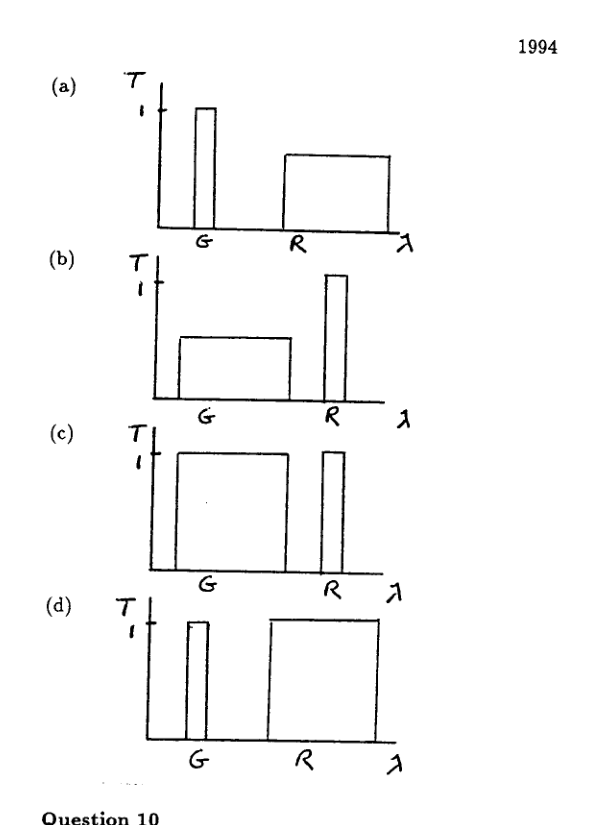 Four T vs wavelength filter graphs (a)-(d)
Topic: Wave Optics Metodi: Superposition Principle, Physical Modeling Competenze: Physical Reasoning, Diagrammatic Reasoning Objects: — Fonte: Testo (PDF) — p.2
Hai dieci filtri identici. Uno viene posto davanti a una luce bianca e la luce appare rossa. Quando tutti e dieci sono messi davanti alla luce, appare un colore verde scuro. Qual è una delle caratteristiche di trasmissione possibili per uno dei filtri?
- A. [Grafica: trasmissione alta T alla lunghezza d’onda verde G, scendendo a zero a R rosso e oltre]
- B. [Grafica: T inizia in alto, ha un punto (zero) a G, sale in alto a R e rimane in alto]
- C. [Grafica: T è alto a G, moderato a R, con una caratteristica nitida a G]
- D. [Grafica: T è basso (piatto) a G, aumenta fortemente tra G e R, elevato per le lunghezze d’onda > R]
*Quattro grafici di filtro T vs lunghezza d’onda (a) - (d) *
Topic: Wave Optics Metodi: Superposition Principle, Physical Modeling Competenze: Physical Reasoning, Diagrammatic Reasoning Objects: — Fonte: Testo (PDF) — p.2
Two atoms interact with each other according to the following force , and potential diagrams. What is their equilibrium separation?
- A. The separation which is equal to
- B. The separation which is equal to
- C. The separation which is equal to
- D. The separation which is equal to
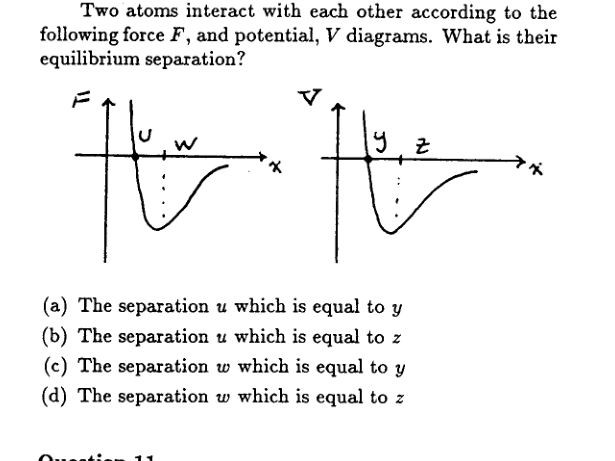 Force F and potential V vs separation u with points w x y z
Topic: Newtonian Mechanics, Modern-Quantum Physics Metodi: Conservation of Energy, Physical Modeling Competenze: Diagrammatic Reasoning, Physical Reasoning Objects: Atom Fonte: Testo (PDF) — p.2
Due atomi interagiscono tra loro secondo i seguenti diagrammi di forza e potenziale . Qual è la loro separazione di equilibrio?
- A. La separazione che è uguale a
- B. La separazione che è uguale a
- C. La separazione che è uguale a
- D. La separazione che è uguale a
Forza F e potenziale V vs separazione u con punti w x y z
Topic: Newtonian Mechanics, Modern-Quantum Physics Metodi: Conservation of Energy, Physical Modeling Competenze: Diagrammatic Reasoning, Physical Reasoning Objects: Atom Fonte: Testo (PDF) — p.2
A ball is thrown into the air with an initial speed . The time interval taken for the ball to rise to its maximum height is . The time interval taken for it to fall back down from this maximum height to its original position is . Under “real life” conditions, which of the following is satisfied by and ?
- A.
- B.
- C.
- D. if is great enough.
Topic: Newtonian Mechanics Metodi: Kinematic Equations, Free-Body Diagram Competenze: Physical Reasoning Objects: Ball, Projectile Fonte: Testo (PDF) — p.3
Una palla viene lanciata in aria con una velocità iniziale . L’intervallo di tempo necessario per far salire la palla alla sua altezza massima è . L’intervallo di tempo necessario per la sua caduta da questa altezza massima alla sua posizione iniziale è . In condizioni “reali”, quale delle seguenti condizioni è soddisfatta da e ?
- A.
- B.
- C.
- D. se è sufficientemente grande.
Topic: Newtonian Mechanics Metodi: Kinematic Equations, Free-Body Diagram Competenze: Physical Reasoning Objects: Ball, Projectile Fonte: Testo (PDF) — p.3
An airplane flies a straight path from town A to town B, 500 km away. Town B is due east of town A and a strong wind blows from north to south at 300 km/hr. If the plane’s airspeed is 900 km/hr, which of the following statements is true?
- A. Trip time is hr.
- B. Plane’s ground speed is 600 km/hr.
- C. Plane’s heading is 30° North of East.
- D. None of the above.
Topic: Newtonian Mechanics Metodi: Vector Decomposition, Kinematic Equations Competenze: Mathematical Modeling, Physical Reasoning Objects: — Fonte: Testo (PDF) — p.3
Un aereo vola in un percorso diretto dalla città A alla città B, a 500 km di distanza. La città B è a est della città A e un forte vento soffia da nord a sud a 300 km/h. Se la velocità di volo dell’aereo è di 900 km/h, quale delle seguenti affermazioni è vera?
- A. Il tempo di viaggio è ore.
- B. La velocità di terra dell’aereo è di 600 km/h.
- C. La direzione del velivolo è 30° Nord-Est.
- D. Nessuna delle seguenti.
Topic: Newtonian Mechanics Metodi: Vector Decomposition, Kinematic Equations Competenze: Mathematical Modeling, Physical Reasoning Objects: — Fonte: Testo (PDF) — p.3
Microwaves of wavelength cm, and intensity , are split and recombined by the metallic mirror system shown. What should be so that the intensity of the microwaves at the point P (the detector) is zero?
- A. 0.88 cm
- B. 3.54 cm
- C. 6.04 cm
- D. 3.02 cm
 Microwave mirror system with adjustable path x and detector P
Topic: Oscillations & Waves, Wave Optics Metodi: Interference & Diffraction Analysis, Superposition Principle Competenze: Mathematical Modeling, Physical Reasoning Objects: Mirror Fonte: Testo (PDF) — p.3
Le microonde di lunghezza d’onda cm e di intensità sono suddivise e ricombinate dal sistema di specchi metallici mostrato. Qual è la affinché l’intensità delle microonde al punto P (il rilevatore) sia zero?
- A. 0.88 cm
- B. 3.54 cm
- C. 6.04 cm
- D. 3.02 cm
Sistema di specchio a microonde con percorso regolabile x e rilevatore P
Topic: Oscillations & Waves, Wave Optics Metodi: Interference & Diffraction Analysis, Superposition Principle Competenze: Mathematical Modeling, Physical Reasoning Objects: Mirror Fonte: Testo (PDF) — p.3
Which of the following is a possible expression for the Rydberg, a unit of energy?
- A.
- B.
- C.
- D.
Topic: Modern-Quantum Physics Metodi: Dimensional Analysis, Bohr Model & Quantization Competenze: Physical Reasoning Objects: — Fonte: Testo (PDF) — p.3
Quale delle seguenti è una possibile espressione per il Rydberg, un’unità di energia?
- A.
- B.
- C.
- D.
Topic: Modern-Quantum Physics Metodi: Dimensional Analysis, Bohr Model & Quantization Competenze: Physical Reasoning Objects: — Fonte: Testo (PDF) — p.3
Consider the network of identical resistors shown. The equivalent resistance between the points A and B is,
- A.
- B.
- C.
- D.
 Resistor network between nodes A and B
Topic: Circuits Metodi: Equivalent Circuit Reduction, Kirchhoff’s Laws Competenze: Diagrammatic Reasoning, Mathematical Modeling Objects: Resistor Fonte: Testo (PDF) — p.3
Considerate la rete di resistori identici mostrata. La resistenza equivalente tra i punti A e B è:
- A.
- B.
- C.
- D.
Rete di resistore tra i nodi A e B
Topic: Circuits Metodi: Equivalent Circuit Reduction, Kirchhoff’s Laws Competenze: Diagrammatic Reasoning, Mathematical Modeling Objects: Resistor Fonte: Testo (PDF) — p.3
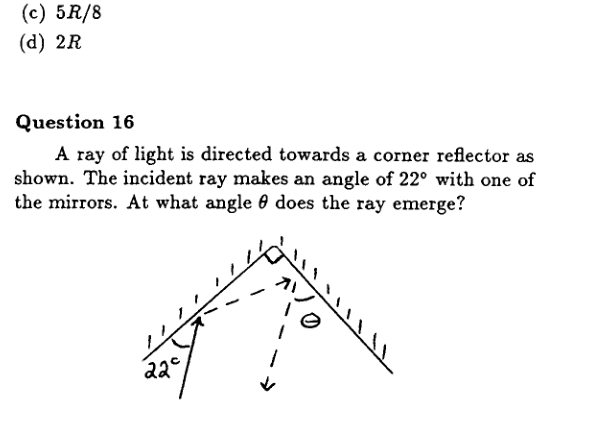
A ray of light is directed towards a corner reflector as shown. The incident ray makes an angle of 22° with one of the mirrors. At what angle does the ray emerge?
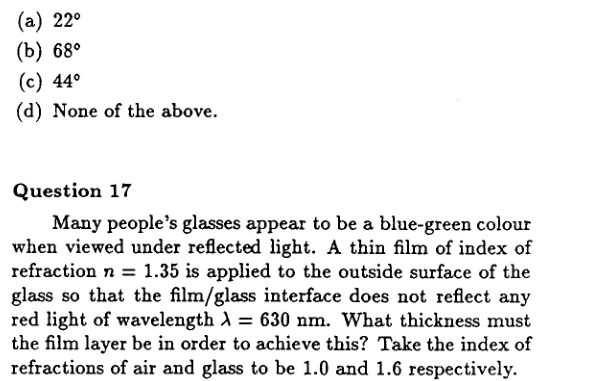
- A. 22°
- B. 68°
- C. 44°
- D. None of the above.
 Corner reflector with incident ray at 22 degrees
Topic: Geometric Optics Metodi: Ray Tracing Competenze: Diagrammatic Reasoning, Physical Reasoning Objects: Mirror Fonte: Testo (PDF) — p.3
Un raggio di luce è diretto verso un riflettore angolare come mostrato. Il raggio incidente fa un angolo di 22° con uno degli specchi. A quale angolo emerge il raggio?
- A. 22°
- B. 68°
- C. 44°
- D. Nessuna delle seguenti.
Reflettore angolare con raggi incidenti a 22 gradi
Topic: Geometric Optics Metodi: Ray Tracing Competenze: Diagrammatic Reasoning, Physical Reasoning Objects: Mirror Fonte: Testo (PDF) — p.3
Many people’s glasses appear to be a blue-green colour when viewed under reflected light. A thin film of index of refraction is applied to the outside surface of the glass so that the film/glass interface does not reflect any red light of wavelength nm. What thickness must the film layer be in order to achieve this? Take the index of refractions of air and glass to be 1.0 and 1.6 respectively.
- A. 157.5 nm
- B. 315.0 nm
- C. 233.3 nm
- D. 116.7 nm
Topic: Wave Optics Metodi: Interference & Diffraction Analysis Competenze: Mathematical Modeling, Physical Reasoning Objects: — Fonte: Testo (PDF) — p.3
Molte persone hanno gli occhiali di colore blu-verde quando si vedono sotto la luce riflessa. La superficie esterna del vetro è applicata con un sottile film di indice di rifrazione in modo che l’interfaccia film/vetro non rifletta alcuna luce rossa di lunghezza d’onda nm. Qual è lo spessore del film per ottenere questo risultato? Prendiamo l’indice di rifrazioni dell’aria e del vetro rispettivamente di 1,0 e 1,6.
- A. 157.5 nm
- B. 315.0 nm
- C. 233.3 nm
- D. 116.7 nm
Topic: Wave Optics Metodi: Interference & Diffraction Analysis Competenze: Mathematical Modeling, Physical Reasoning Objects: — Fonte: Testo (PDF) — p.3
A mass has the same kinetic energy as a mass . The ratio of their momenta, , is,
- A.
- B.
- C.
- D.
Topic: Newtonian Mechanics, Conservation of Momentum Metodi: Conservation of Energy, Conservation of Momentum Competenze: Mathematical Modeling, Physical Reasoning Objects: — Fonte: Testo (PDF) — p.4
Una massa ha la stessa energia cinetica di una massa . Il rapporto dei loro momenti, , è:
- A.
- B.
- C.
- D.
Topic: Newtonian Mechanics, Conservation of Momentum Metodi: Conservation of Energy, Conservation of Momentum Competenze: Mathematical Modeling, Physical Reasoning Objects: — Fonte: Testo (PDF) — p.4
A stream of water droplets, each of mass kg, are fired horizontally at a velocity of 10 m/s towards a steel plate where they collide. The droplets are spaced equidistantly with a spacing of 1 cm. What is the approximate average force exerted on the plate by the water droplets assuming that they do not rebound after their collision.
- A. 10 N
- B. 100 N
- C. 1 N
- D. 0.1 N
Topic: Newtonian Mechanics, Conservation of Momentum Metodi: Impulse-Momentum Theorem, Order-of-Magnitude Estimation Competenze: Estimation & Approximation, Physical Reasoning Objects: Droplet Fonte: Testo (PDF) — p.4
Un flusso di goccioline d’acqua, ciascuna di massa kg, viene sparato orizzontalmente a una velocità di 10 m/s verso una piastra in acciaio dove si scontrano. Le gocce sono spaziate equidistantemente con un spazio di 1 cm. Qual è la forza media approssimativa esercitata sulla piastra dalle goccioline d’acqua, se si suppone che non rimbalzino dopo la collisione.
- A. 10 N
- B. 100 N
- C. 1 N
- D. 0.1 N
Topic: Newtonian Mechanics, Conservation of Momentum Metodi: Impulse-Momentum Theorem, Order-of-Magnitude Estimation Competenze: Estimation & Approximation, Physical Reasoning Objects: Droplet Fonte: Testo (PDF) — p.4
Three identical balls are thrown from the top of a cliff and some time later land at the base of the cliff. Ball A is thrown downwards with speed , Ball B is thrown downwards with speed , and Ball C is thrown at speed and at an angle of 45° above the horizontal. Comparing the speeds , , and with which the balls hit the ground at the base of the cliff (and ignoring air resistance), you find,
- A.
- B.
- C.
- D.
Topic: Newtonian Mechanics, Conservation of Energy Metodi: Conservation of Energy, Kinematic Equations Competenze: Physical Reasoning Objects: Ball, Projectile Fonte: Testo (PDF) — p.4
Tre palle identiche vengono lanciate dalla cima di una scogliera e qualche tempo dopo atterrano alla base della scogliera. La palla A viene lanciata verso il basso con velocità , la palla B viene lanciata verso il basso con velocità e la palla C viene lanciata a velocità e ad un angolo di 45° sopra l’orizzontale. Confrontando le velocità , e con cui le palle colpiscono il terreno alla base della scogliera (e ignorando la resistenza dell’aria), si scopre:
- A.
- B.
- C.
- D.
Topic: Newtonian Mechanics, Conservation of Energy Metodi: Conservation of Energy, Kinematic Equations Competenze: Physical Reasoning Objects: Ball, Projectile Fonte: Testo (PDF) — p.4
Part B — Question 1
In this question we will investigate a possible navigational aid for aircraft approaching an airport. Suppose at one end of a runway there are two radio transmitting towers, one on either side of the runway, separated by a distance m. The two radio towers are each transmitting a radio signal of frequency MHz in phase with each other. An aircraft with a ground speed of is flying towards the airport such that its velocity makes an angle with the runway as shown. The aircraft, still very far from the airport, has locked onto the signals and is heading directly for the midpoint of the towers.
(a) At the aircraft’s current position, the intensity of the signal from each tower separately would be . Find the intensity of the combined signal from both towers received by the aircraft for headings of and .
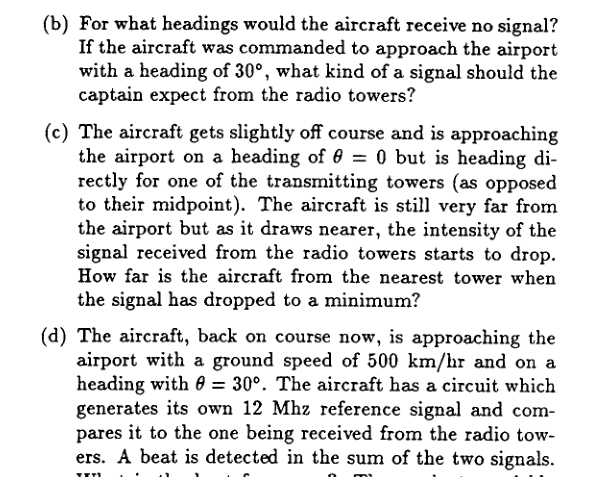
(b) For what headings would the aircraft receive no signal? If the aircraft was commanded to approach the airport with a heading of 30°, what kind of a signal should the captain expect from the radio towers?
(c) The aircraft gets slightly off course and is approaching the airport on a heading of but is heading directly for one of the transmitting towers (as opposed to their midpoint). The aircraft is still very far from the airport but as it draws nearer, the intensity of the signal received from the radio towers starts to drop. How far is the aircraft from the nearest tower when the signal has dropped to a minimum?
(d) Back on course now, is approaching the airport with a ground speed of 500 km/h and on a heading with . The aircraft has a circuit which generates its own 12 MHz reference signal and compares it to the one being received from the radio towers. A beat is detected in the sum of the two signals. What is the beat frequency? The navigator quickly programs the on-board computer to calculate the aircraft’s ground speed in terms of this beat frequency . When the beat frequency is 10 Hz and the signal received from the tower is lower than the 12 MHz on-board reference signal, what is the plane’s ground speed?
 Two radio towers with aircraft approaching at angle theta
Topic: Oscillations & Waves, Electromagnetism Metodi: Interference & Diffraction Analysis, Superposition Principle, Wave Equation Competenze: Mathematical Modeling, Physical Reasoning Objects: — Fonte: Testo (PDF) — p.4
Parte B Domanda 1
In questa domanda esamineremo un possibile aiuto di navigazione per gli aerei che si avvicinano ad un aeroporto. Supponiamo che ad una estremità di una pista ci siano due torri di trasmissione radio, una su entrambi i lati della pista, separate da una distanza m. Le due torri radio trasmettono ciascuna un segnale radio di frequenza MHz in fase con l’altra. Un aeromobile con una velocità di terra vola verso l’aeroporto in modo tale che la sua velocità fa un angolo con la pista come mostrato. L’aeromobile, ancora molto lontano dall’aeroporto, si è bloccato sui segnali e si dirige direttamente verso il punto medio delle torri.
a) Nella posizione corrente dell’aeromobile, l’intensità del segnale da ciascuna torre separatamente sarebbe . Indicare l’intensità del segnale combinato proveniente da entrambe le torri ricevute dall’aeromobile per le voci e .
b) Per quali punti l’aeromobile non riceverà alcun segnale? Se l’aeromobile è stato ordinato di avvicinarsi all’aeroporto con un segnale 30°, che tipo di segnale dovrebbe aspettarsi il capitano dalle torri radio?
c) L’aeromobile si allontana leggermente dalla rotta e si avvicina all’aeroporto in direzione ma si dirige direttamente verso una delle torri di trasmissione (in contrasto con il loro punto medio). L’aeromobile è ancora molto lontano dall’aeroporto ma, mentre si avvicina, l’intensità del segnale ricevuto dalle torri radio inizia a diminuire. Quanto è lontano l’aereo dalla torre più vicina quando il segnale è scesa al minimo?
d) Torna a rotta, si avvicina all’aeroporto con una velocità di terra di 500 km/h e in direzione con . L’aeromobile dispone di un circuito che genera il proprio segnale di riferimento di 12 MHz e lo confronta a quello ricevuto dalle torri radio. Un battito viene rilevato nella somma dei due segnali. Qual è la frequenza dei battiti? Il navigatore programma rapidamente il computer a bordo per calcolare la velocità di terra dell’aeromobile in termini di questa frequenza . Quando la frequenza di battito è di 10 Hz e il segnale ricevuto dalla torre è inferiore al segnale di riferimento a bordo di 12 MHz, qual è la velocità di terra dell’aereo?
Due torri radio con aeromobili che si avvicinano all’angolo theta
Topic: Oscillations & Waves, Electromagnetism Metodi: Interference & Diffraction Analysis, Superposition Principle, Wave Equation Competenze: Mathematical Modeling, Physical Reasoning Objects: — Fonte: Testo (PDF) — p.4
Part B — Question 2
Consider the circuit shown with the two switches and . The battery has an emf of V and the resistor has a resistance of . The bottom wire is encased in an insulated wrapping of mass kg which carries a positive static charge of mC. Assume that the masses of all other wires and components are very small as compared to this charge bearing wrapping. The dimensions of the circuit are cm square. The bridge (or middle connecting) wire, with in it, is above the bottom wire. The contraption is suspended in such a way that it may pivot about the top wire on the axis AB; the circuit maintains its shape regardless of the switch configuration. A magnetic field, T, and an electric field, N/C, both point out of the page.
(a) With both switches open, find the equilibrium angle that the plane of the circuit makes with the vertical as it swings upwards due to the presence of the electric field.
(b) With closed and open, find the equilibrium angle .
(c) Now with open and closed, the circuit is swung from hanging straight down, , to being horizontal, , in a time of ms. Estimate the work required to perform this operation.
(d) The circuit is released from the horizontal with both switches open. Describe the motion of the circuit and calculate any relevant parameters necessary to backup your description. What would be the effect of closing during this motion?
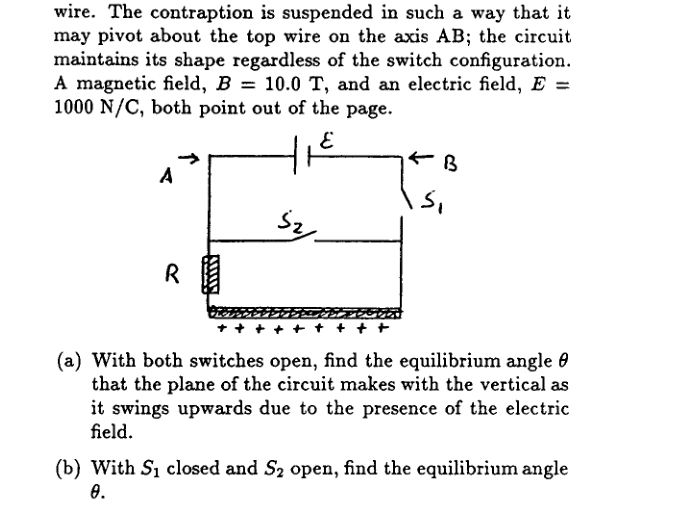 Pivoting circuit with switches S1 S2 in B and E fields
Topic: Circuits, Electromagnetism, Electromagnetic Induction Metodi: Faraday’s Law of Induction, Kirchhoff’s Laws, Free-Body Diagram, Energy Conservation Method Competenze: Mathematical Modeling, Physical Reasoning Objects: Battery, Resistor, Wire, Switch Fonte: Testo (PDF) — p.4
Parte B Domanda 2
Considera il circuito mostrato con i due interruttori e . La batteria ha un emf di V e la resistenza è di . Il filo inferiore è incollato in un rivestimento isolato di massa kg che porta una carica statica positiva di mC. Supponiamo che le masse di tutti gli altri fili e componenti siano molto piccole rispetto a questo avvolgimento di cuscinetti a carica. Le dimensioni del circuito sono cm quadrati. Il filo di ponte (o di collegamento medio), con in esso, è sopra il filo inferiore. L’apparecchio è sospeso in modo tale che possa ruotare intorno al filo superiore sull’asse AB; il circuito mantiene la sua forma indipendentemente dalla configurazione dello switch. Un campo magnetico, T, e un campo elettrico, N/C, entrambi puntano fuori dalla pagina.
(a) Con entrambi gli interruttori aperti, si trova l’angolo di equilibrio che il piano del circuito fa con la verticale mentre oscilla verso l’alto a causa della presenza del campo elettrico.
b) Con chiuso e aperto, si trova l’angolo di equilibrio .
(c) Ora con aperto e chiuso, il circuito viene svoltato dal pendolo a destra verso il basso, , ad essere orizzontale, , in un tempo di ms. Estimare il lavoro necessario per eseguire questa operazione.
d) Il circuito viene rilasciato dall’orizzontale con entrambi gli interruttori aperti. Descrivere il movimento del circuito e calcolare i parametri pertinenti necessari per fare backup alla descrizione. What would be the effect of closing during this motion?
Circuito di rotazione con interruttori S1 S2 nei campi B e E
Topic: Circuits, Electromagnetism, Electromagnetic Induction Metodi: Faraday’s Law of Induction, Kirchhoff’s Laws, Free-Body Diagram, Energy Conservation Method Competenze: Mathematical Modeling, Physical Reasoning Objects: Battery, Resistor, Wire, Switch Fonte: Testo (PDF) — p.4
Part B — Question 3
Design a spherical spacecraft which could be carried out of the solar system by the pressure of solar radiation alone. Discuss constraints on the materials used. You may assume that the craft can be initially launched from the earth using a conventional rocket so that it may start its journey already having escaped the earth’s pull.
The momentum of a photon is given by where is the energy of the photon and is the speed of light. The intensity of the solar radiation at the radius of the earth’s orbit about the sun is given by the solar constant, W/m².
Topic: Astrophysics, Modern-Quantum Physics Metodi: Physical Modeling, Order-of-Magnitude Estimation, Photon Energy Relation Competenze: Estimation & Approximation, Mathematical Modeling Objects: Satellite, Photon, Star Fonte: Testo (PDF) — p.5
Parte B Domanda 3
Progettare una sonda spaziale sferica che possa essere trasportata dal sistema solare solo con la pressione della radiazione solare. Discutere dei limiti relativi ai materiali utilizzati. Potreste pensare che l’astronave possa essere lanciata inizialmente dalla terra utilizzando un razzo convenzionale in modo che possa iniziare il suo viaggio già sfuggendo alla forza di attrazione terrestre.
Il momento di un fotone è dato da dove è l’energia del fotone e è la velocità della luce. L’intensità della radiazione solare nel raggio di orbita terrestre attorno al sole è data dalla costante solare, W/m2.
Topic: Astrophysics, Modern-Quantum Physics Metodi: Physical Modeling, Order-of-Magnitude Estimation, Photon Energy Relation Competenze: Estimation & Approximation, Mathematical Modeling Objects: Satellite, Photon, Star Fonte: Testo (PDF) — p.5