A toy for firing a ball vertically consists of a vertical spring which is compressed by 0.10 m. A force of 10.0 N is needed to hold the spring at that compression. If a ball of mass 0.050 kg is placed on the compressed spring and the spring is released, the ball will reach a height (above its initial position) of:
- A. 1.0 m
- B. 1.2 m
- C. 1.4 m
- D. 1.6 m
Topic: Conservation of Energy, Oscillations & Waves Metodi: Conservation of Energy, Hooke’s Law Competenze: Physical Reasoning, Mathematical Modeling Objects: Spring, Ball Fonte: Testo (PDF) — p.1
Un giocattolo per il colpo verticale di una palla è costituito da una molla verticale compressa di 0,10 m. Per mantenere la molla a tale compressione è necessaria una forza di 10,0 N. Se una palla di massa di 0,050 kg viene posta sulla molla compressa e la molla viene rilasciata, la palla raggiungerà un’altezza (oltre la sua posizione iniziale) di:
- A. 1.0 m
- B. 1.2 m
- C. 1.4 m
- D. 1.6 m
Topic: Conservation of Energy, Oscillations & Waves Metodi: Conservation of Energy, Hooke’s Law Competenze: Physical Reasoning, Mathematical Modeling Objects: Spring, Ball Fonte: Testo (PDF) — p.1
A rescue plane is flying horizontally with a speed of 30 m/s and at an altitude of 125 m above the sea when it drops a warning flare. Neglecting air resistance and assuming that the plane does not change its course, speed, or altitude, how far from the plane is the flare when it hits the water?
- A. 146 m
- B. 195 m
- C. 125 m
- D. 150 m
Topic: Newtonian Mechanics Metodi: Kinematic Equations, Free-Body Diagram Competenze: Physical Reasoning, Mathematical Modeling Objects: Projectile Fonte: Testo (PDF) — p.1
Un aereo di salvataggio vola orizzontalmente a una velocità di 30 m/s e ad un’altitudine di 125 m sopra il mare quando lancia un’allarme. Ignorando la resistenza dell’aria e supponendo che l’aereo non cambi il suo corso, velocità o altitudine, quanto è lontano dall’aereo la fiamma quando colpisce l’acqua?
- A. 146 m
- B. 195 m
- C. 125 m
- D. 150 m
Topic: Newtonian Mechanics Metodi: Kinematic Equations, Free-Body Diagram Competenze: Physical Reasoning, Mathematical Modeling Objects: Projectile Fonte: Testo (PDF) — p.1
A loudspeaker is placed over the open end of a pipe. By changing the frequency of the sound from the speaker, it is found that the pipe has resonances at 700 Hz and 900 Hz but not 800 Hz. This means that:
- A. The pipe is closed at one end and the fundamental is 100 Hz.
- B. The pipe is closed at one end and the fundamental is 200 Hz.
- C. The pipe is open at both ends and the fundamental is 200 Hz.
- D. The pipe is open at both ends and the fundamental is 100 Hz.
Topic: Oscillations & Waves Metodi: Wave Equation, Physical Modeling Competenze: Physical Reasoning, Mathematical Modeling Objects: Tube Fonte: Testo (PDF) — p.1
Un altoparlante è posizionato sopra l’estremità aperta di un tubo. Cambiando la frequenza del suono dal altoparlante, si scopre che il tubo ha risonanze a 700 Hz e 900 Hz ma non a 800 Hz. Ciò significa che:
- A. Il tubo è chiuso da una parte e il fondamento è di 100 Hz.
- B. Il tubo è chiuso da una parte e il fondamento è di 200 Hz.
- C. Il tubo è aperto alle due estremità e il fondamento è di 200 Hz.
- D. Il tubo è aperto alle due estremità e il fondamento è di 100 Hz.
Topic: Oscillations & Waves Metodi: Wave Equation, Physical Modeling Competenze: Physical Reasoning, Mathematical Modeling Objects: Tube Fonte: Testo (PDF) — p.1
In a television tube, electrons are accelerated from rest through a potential difference of 1600 V. What is the speed of the electrons after this acceleration?
- A. 16,000 km/s
- B. 20,000 km/s
- C. 24,000 km/s
- D. 25,000 km/s
Topic: Electrostatics, Modern-Quantum Physics Metodi: Energy Conservation Method, Electric Potential Method Competenze: Physical Reasoning, Mathematical Modeling Objects: Electron Fonte: Testo (PDF) — p.1
In un tubo televisivo, gli elettroni vengono accelerati dal riposo attraverso una differenza potenziale di 1600 V. Qual è la velocità degli elettroni dopo questa accelerazione?
- A. 16,000 km/s
- B. 20,000 km/s
- C. 24,000 km/s
- D. 25,000 km/s
Topic: Electrostatics, Modern-Quantum Physics Metodi: Energy Conservation Method, Electric Potential Method Competenze: Physical Reasoning, Mathematical Modeling Objects: Electron Fonte: Testo (PDF) — p.1
The electron-volt is a measure of:
- A. charge
- B. current
- C. electric field strength
- D. energy
Topic: Electrostatics Metodi: Dimensional Analysis Competenze: Physical Reasoning, Unit Conversion Objects: — Fonte: Testo (PDF) — p.1
L’elettron-voltage è una misura di:
- A. carico
- B. corrente
- C. resistenza del campo elettrico
- D. energia
Topic: Electrostatics Metodi: Dimensional Analysis Competenze: Physical Reasoning, Unit Conversion Objects: — Fonte: Testo (PDF) — p.1
A current of 5 A passes along a wire of length 1.0 m. The wire is at right angles to a uniform magnetic field of strength 0.15 T. The force acting on the wire is:
- A. 0
- B. 0.75 N
- C. 33 N
- D. 0.03 N
Topic: Magnetism, Electromagnetism Metodi: Lorentz Force Analysis Competenze: Physical Reasoning, Mathematical Modeling Objects: Wire Fonte: Testo (PDF) — p.2
Una corrente di 5 A passa lungo un filo di lunghezza di 1,0 m. Il filo è ad angolo retto ad un campo magnetico uniforme di forza 0,15 T. La forza che agisce sul filo è:
- A. 0
- B. 0.75 N
- C. 33 N
- D. 0.03 N
Topic: Magnetism, Electromagnetism Metodi: Lorentz Force Analysis Competenze: Physical Reasoning, Mathematical Modeling Objects: Wire Fonte: Testo (PDF) — p.2
An 8 F capacitor is charged to a potential of 120 V. How much work was required to do this?
- A. J
- B. J
- C. J
- D. J
Topic: Electrostatics, Circuits Metodi: Energy Conservation Method, Electric Potential Method Competenze: Physical Reasoning, Mathematical Modeling Objects: Capacitor Fonte: Testo (PDF) — p.2
Un condensatore 8 F è caricato a un potenziale di 120 V. Quanto lavoro ci è stato richiesto per fare questo?
- A. J
- B. J
- C. J
- D. J
Topic: Electrostatics, Circuits Metodi: Energy Conservation Method, Electric Potential Method Competenze: Physical Reasoning, Mathematical Modeling Objects: Capacitor Fonte: Testo (PDF) — p.2
A flashlight is operated on four batteries placed in series. Each battery has an internal resistance . If one of the batteries is accidentally placed the wrong way around, the total internal resistance of the four cells will now be:
- A.
- B.
- C.
- D.
Topic: Circuits Metodi: Kirchhoff’s Laws, Equivalent Circuit Reduction Competenze: Physical Reasoning, Diagrammatic Reasoning Objects: Battery Fonte: Testo (PDF) — p.2
Una torcia è alimentata da quattro batterie in serie. Ogni batteria ha una resistenza interna . Se una delle batterie viene accidentalmente collocata in modo sbagliato, la resistenza interna totale delle quattro celle sarà ora:
- A.
- B.
- C.
- D.
Topic: Circuits Metodi: Kirchhoff’s Laws, Equivalent Circuit Reduction Competenze: Physical Reasoning, Diagrammatic Reasoning Objects: Battery Fonte: Testo (PDF) — p.2
A ray of light is passing from air into glass. If the angle of incidence, with respect to the normal to the interface, is increased:
- A. Total internal reflection will occur when the angle of incidence equals the critical angle.
- B. Total internal reflection will occur when the angle of incidence is less than the critical angle.
- C. Total internal reflection will occur when the angle of incidence is greater than the critical angle.
- D. The refractive angle will increase but there will be no total internal reflection.
Topic: Geometric Optics Metodi: Snell’s Law, Ray Tracing Competenze: Physical Reasoning, Diagrammatic Reasoning Objects: — Fonte: Testo (PDF) — p.2
Un raggio di luce passa dall’aria al vetro. Se l’angolo di incidenza, rispetto al normale all’interfaccia, è aumentato:
- A. Si verificerà la riflessione interna totale quando l’angolo di incidenza è uguale all’angolo critico.
- B. Si verificerà una riflessione interna totale quando l’ angolo di incidenza è inferiore all’ angolo critico.
- C. Si verificerà una riflessione interna totale quando l’ angolo di incidenza è maggiore dell’ angolo critico.
- D. L’angolo di rifrazione aumenterà ma non vi sarà riflessione interna totale.
Topic: Geometric Optics Metodi: Snell’s Law, Ray Tracing Competenze: Physical Reasoning, Diagrammatic Reasoning Objects: — Fonte: Testo (PDF) — p.2
A mass of 20 g is hung from the end of a light vertical spring and is set oscillating with an amplitude of 10 cm. Its total energy is found to be 4 J. If the mass is now replaced with a mass of 40 g and it is again set oscillating with an amplitude of 10 cm, its total energy is now:
- A. 2 J
- B. 4 J
- C. 5.6 J
- D. 8 J
Topic: Oscillations & Waves, Conservation of Energy Metodi: Simple Harmonic Motion Analysis, Energy Conservation Method Competenze: Physical Reasoning, Mathematical Modeling Objects: Spring Fonte: Testo (PDF) — p.2
Una massa di 20 g è appesa all’estremità di una leggera molla verticale e è impostata oscillante con un’ampiezza di 10 cm. La sua energia totale è stata riscontrata a 4 J. Se la massa viene sostituita con una massa di 40 g e viene di nuovo impostata oscillante con un’ampiezza di 10 cm, la sua energia totale è ora:
- A. 2 J
- B. 4 J
- C. 5.6 J
- D. 8 J
Topic: Oscillations & Waves, Conservation of Energy Metodi: Simple Harmonic Motion Analysis, Energy Conservation Method Competenze: Physical Reasoning, Mathematical Modeling Objects: Spring Fonte: Testo (PDF) — p.2
A 65 kg girl, riding in an elevator, weighs herself by standing on a scale. What is the reading of the scale if the elevator is accelerating downwards at 2 m/s²?
- A. 65.0 kg
- B. 0 kg
- C. 51.7 kg
- D. 78.3 kg
Topic: Newtonian Mechanics Metodi: Free-Body Diagram, Kinematic Equations Competenze: Physical Reasoning, Mathematical Modeling Objects: — Fonte: Testo (PDF) — p.2
Una ragazza di 65 kg, in ascensore, si pesa in piedi su una scala. Qual è la lettura della scala se l’ascensore accelera verso il basso a 2 m/s2?
- A. 65.0 kg
- B. 0 kg
- C. 51.7 kg
- D. 78.3 kg
Topic: Newtonian Mechanics Metodi: Free-Body Diagram, Kinematic Equations Competenze: Physical Reasoning, Mathematical Modeling Objects: — Fonte: Testo (PDF) — p.2
A highway curve of radius 30 m is banked so that a car travelling at 40 km/hr can travel around it without slipping even if there is no friction between the car’s tires and the road surface. Without friction, a car travelling faster than this will slide up the curve, while a car travelling slower will slide down the curve. Find the angle of elevation of the banked highway curve.
- A. 67°.
- B. 23°.
- C. 45°.
- D. 90°.
Topic: Newtonian Mechanics, Rotational Dynamics Metodi: Free-Body Diagram, Vector Decomposition Competenze: Physical Reasoning, Mathematical Modeling Objects: — Fonte: Testo (PDF) — p.2
Una curva di strada di 30 m di raggio è fissata in modo che un’auto che viaggia a 40 km/h possa girarla senza scivolare, anche se non vi è attrito tra le gomme dell’auto e la superficie della strada. Senza attrito, un’auto che viaggia più velocemente di questa scivolerà la curva, mentre un’auto che viaggia più lentamente scivolerà la curva. Trova l’angolo di elevazione della curva della strada bancata.
- A. 67°.
- B. 23°.
- C. 45°.
- D. 90°.
Topic: Newtonian Mechanics, Rotational Dynamics Metodi: Free-Body Diagram, Vector Decomposition Competenze: Physical Reasoning, Mathematical Modeling Objects: — Fonte: Testo (PDF) — p.2
A ball is thrown upwards into the air rising to a height . Accounting for the “real life” condition of air resistance, the time that the ball takes to rise to its maximum height and the time that it takes to fall back down to its initial position obey:
- A.
- B.
- C.
- D.
Topic: Newtonian Mechanics Metodi: Kinematic Equations, Free-Body Diagram Competenze: Physical Reasoning, Mathematical Modeling Objects: Ball Fonte: Testo (PDF) — p.2
Una palla viene lanciata in aria verso l’alto, raggiungendo un’altezza . Tenendo conto della condizione “reale” di resistenza all’aria, il tempo necessario per salire alla sua altezza massima e il tempo necessario per tornare alla sua posizione iniziale, obbedire:
- A.
- B.
- C.
- D.
Topic: Newtonian Mechanics Metodi: Kinematic Equations, Free-Body Diagram Competenze: Physical Reasoning, Mathematical Modeling Objects: Ball Fonte: Testo (PDF) — p.2
An airplane flies northwards from town to town and then back again. There is a steady wind blowing towards the north so that for the first stage of the trip, the airplane is flying in the same direction as the wind and for the return half of the journey, the airplane is flying directly into the wind. The total trip time , as compared to the total trip time in the absence of any wind , obeys:
- A.
- B.
- C.
- D.
Topic: Newtonian Mechanics Metodi: Kinematic Equations, Approximation & Series Expansion Competenze: Physical Reasoning, Mathematical Modeling Objects: — Fonte: Testo (PDF) — p.2
Un aereo vola a nord dalla città alla città e poi torna di nuovo. Viene un vento costante che soffia verso nord, in modo che per la prima fase del viaggio, l’aereo vola nella stessa direzione del vento e per la metà del viaggio di ritorno, l’aereo vola direttamente nel vento. Il tempo totale di viaggio , rispetto al tempo totale di viaggio in assenza di vento , è conforme a:
- A.
- B.
- C.
- D.
Topic: Newtonian Mechanics Metodi: Kinematic Equations, Approximation & Series Expansion Competenze: Physical Reasoning, Mathematical Modeling Objects: — Fonte: Testo (PDF) — p.2
The space shuttle moves in a circular orbit about the earth at a constant speed. To change the orbit radius, the crew temporarily activates the main engine which accelerates the space shuttle in the direction of its motion. After the main engine is switched off again, the shuttle will be in an elliptical orbit with:
- A. a larger average radius and a higher average speed.
- B. a larger average radius and a lower average speed.
- C. a smaller average radius and a higher average speed.
- D. a smaller average radius and a lower average speed.
Topic: Gravitation, Newtonian Mechanics Metodi: Conservation Laws, Kepler’s Laws Competenze: Physical Reasoning, Diagrammatic Reasoning Objects: Satellite, Planet Fonte: Testo (PDF) — p.3
Lo navetta spaziale si muove in orbita circolare intorno alla Terra a velocità costante. Per cambiare il raggio orbitale, l’equipaggio attiva temporaneamente il motore principale che accelera la navetta spaziale nella direzione del suo movimento. Dopo aver spento di nuovo il motore principale, la navetta sarà in orbita ellittica con:
- A. un raggio medio più grande e una velocità media più elevata.
- B. un raggio medio maggiore e una velocità media inferiore.
- C. un raggio medio più piccolo e una velocità media più elevata.
- D. un raggio medio più piccolo e una velocità media inferiore.
Topic: Gravitation, Newtonian Mechanics Metodi: Conservation Laws, Kepler’s Laws Competenze: Physical Reasoning, Diagrammatic Reasoning Objects: Satellite, Planet Fonte: Testo (PDF) — p.3
Which of the following expressions has the correct units to represent the radius of a hydrogen atom in its ground state? (only one expression is correct)
- A.
- B.
- C.
- D.
Topic: Modern-Quantum Physics Metodi: Dimensional Analysis, Bohr Model & Quantization Competenze: Physical Reasoning, Unit Conversion Objects: Atom Fonte: Testo (PDF) — p.3
Quale delle seguenti espressioni ha le corrette unità per rappresentare il raggio di un atomo di idrogeno nello stato di base? (solo una espressione è corretta)
- A.
- B.
- C.
- D.
Topic: Modern-Quantum Physics Metodi: Dimensional Analysis, Bohr Model & Quantization Competenze: Physical Reasoning, Unit Conversion Objects: Atom Fonte: Testo (PDF) — p.3
If the electric field is zero within some region of space, the electric potential within that region:
- A. must be zero.
- B. must be positive.
- C. must be negative.
- D. must be a constant value.
Topic: Electrostatics Metodi: Electric Potential Method, Symmetry Argument Competenze: Physical Reasoning, Diagrammatic Reasoning Objects: — Fonte: Testo (PDF) — p.3
Se il campo elettrico è zero all’interno di una certa regione dello spazio, il potenziale elettrico all’interno di tale regione:
- A. deve essere zero.
- B. deve essere positivo.
- C. deve essere negativo.
- D. deve essere un valore costante.
Topic: Electrostatics Metodi: Electric Potential Method, Symmetry Argument Competenze: Physical Reasoning, Diagrammatic Reasoning Objects: — Fonte: Testo (PDF) — p.3
In comparing the properties of visible light waves to microwaves, which of the following statements is FALSE?
- A. Visible light waves travel at the same speed in glass as do microwaves.
- B. Visible light waves have a higher frequency in glass than do microwaves.
- C. Visible light waves travel at the same speed in vacuum as do microwaves.
- D. Both visible light waves and microwaves can be refracted by glass.
Topic: Oscillations & Waves, Geometric Optics Metodi: Wave Equation, Snell’s Law Competenze: Physical Reasoning, Diagrammatic Reasoning Objects: — Fonte: Testo (PDF) — p.3
Per confrontare le proprietà delle onde di luce visibile con le microonde, quale delle seguenti affermazioni è FALSE?
- A. Le onde di luce visibile viaggiano nella vetra alla stessa velocità delle microonde.
- B. Le onde di luce visibile hanno una frequenza superiore nel vetro rispetto alle microonde.
- C. Le onde di luce visibili viaggiano nello stesso ritmo in vuoto delle microonde.
- D. Sia le onde di luce visibili che le microonde possono essere rifractate dal vetro.
Topic: Oscillations & Waves, Geometric Optics Metodi: Wave Equation, Snell’s Law Competenze: Physical Reasoning, Diagrammatic Reasoning Objects: — Fonte: Testo (PDF) — p.3
A boy sits at the top of a hemispherical mound of ice of radius . He begins to slide (from rest) downwards without friction. At what height above the ground does he leave contact with the ice?
- A. The boy does not leave contact with the ice.
- B.
- C.
- D.
Topic: Newtonian Mechanics, Conservation of Energy Metodi: Free-Body Diagram, Conservation of Energy Competenze: Physical Reasoning, Mathematical Modeling Objects: — Fonte: Testo (PDF) — p.3
Un ragazzo siede in cima ad un mucchio di ghiaccio emisfero di raggio . Comincia a scivolare (dal riposo) verso il basso senza attrito. A che altezza al di sopra del suolo lascia contatto con il ghiaccio?
- A. Il ragazzo non lascia contatto con il ghiaccio.
- B.
- C.
- D.
Topic: Newtonian Mechanics, Conservation of Energy Metodi: Free-Body Diagram, Conservation of Energy Competenze: Physical Reasoning, Mathematical Modeling Objects: — Fonte: Testo (PDF) — p.3
A rocket for mining the asteroid belt is designed like a large scoop. It is approaching asteroids at a velocity of m/s. The asteroids are much smaller than the rocket. If the rocket scoops asteroids at the rate of 100 kg/s, what thrust (force) must the rocket’s engines provide in order for the rocket to maintain a constant velocity? Ignore any variation in the rocket’s mass due to the burning of fuel.
- A. N
- B. N
- C. N
- D. N
Topic: Newtonian Mechanics, Conservation of Momentum Metodi: Impulse-Momentum Theorem, Conservation of Momentum Competenze: Physical Reasoning, Mathematical Modeling Objects: Satellite Fonte: Testo (PDF) — p.3
Un razzo per la estrazione della cintura di asteroidi è progettato come un grande scoop. Si avvicina agli asteroidi a una velocità di m/s. Gli asteroidi sono molto più piccoli del razzo. Se il razzo scorta asteroidi a velocità di 100 kg/s, quale spinta (forza) devono fornire i motori del razzo per mantenere una velocità costante? Ignorare qualsiasi variazione della massa del razzo a causa della combustione del carburante.
- A. N
- B. N
- C. N
- D. N
Topic: Newtonian Mechanics, Conservation of Momentum Metodi: Impulse-Momentum Theorem, Conservation of Momentum Competenze: Physical Reasoning, Mathematical Modeling Objects: Satellite Fonte: Testo (PDF) — p.3
The sensitivity of the human ear is greatest near 3000 Hz. This result is best explained by the fact that:
- A. the ear canal is a resonant cavity with a fundamental frequency near 3000 Hz.
- B. at a frequency of 3000 Hz the wavelength of sound is approximately the distance between the ears.
- C. 3000 Hz is the frequency at which the skull resonates.
- D. none of the above statements explains the result.
Topic: Oscillations & Waves Metodi: Wave Equation, Physical Modeling Competenze: Physical Reasoning, Estimation & Approximation Objects: — Fonte: Testo (PDF) — p.3
La sensibilità dell’orecchio umano è maggiore nei pressi di 3000 Hz. Questo risultato è meglio spiegato dal fatto che:
- A. il canale uditivo è una cavità risonante con una frequenza fondamentale vicino a 3000 Hz.
- ** B.** a una frequenza di 3000 Hz la lunghezza d’onda del suono è approssimativamente la distanza tra le orecchie.
- C. 3000 Hz è la frequenza con cui il cranio risona.
- D. nessuna delle dichiarazioni sopra indicate spiega il risultato.
Topic: Oscillations & Waves Metodi: Wave Equation, Physical Modeling Competenze: Physical Reasoning, Estimation & Approximation Objects: — Fonte: Testo (PDF) — p.3
A long piece of rubber is wider than it is thick. When it is stretched in length by some amount:
- A. its thickness decreases but its width increases.
- B. its thickness decreases but its width remains constant.
- C. its thickness increases but its width decreases.
- D. both its thickness and width decrease.
Topic: Elasticity & Materials Metodi: Stress-Strain Analysis, Physical Modeling Competenze: Physical Reasoning, Diagrammatic Reasoning Objects: — Fonte: Testo (PDF) — p.3
Un pezzo di gomma lungo è più largo di quanto lo sia. Quando è esteso in lunghezza di una certa quantità:
- A. il suo spessore diminuisce ma la sua larghezza aumenta.
- B. il suo spessore diminuisce ma la sua larghezza rimane costante.
- C. il suo spessore aumenta ma la sua larghezza diminuisce.
- D. diminuisce sia lo spessore che la larghezza.
Topic: Elasticity & Materials Metodi: Stress-Strain Analysis, Physical Modeling Competenze: Physical Reasoning, Diagrammatic Reasoning Objects: — Fonte: Testo (PDF) — p.3
A new medical procedure to cure near-sightedness involves changing the shape of the eye’s lens using a precisely controlled laser beam. A near-sighted eye cannot focus clearly on distant objects. To improve the vision of the patient, we must:
- A. uniformly decrease the thickness of the lens.
- B. uniformly increase the thickness of the lens.
- C. make the middle of the lens thinner.
- D. make the outer rim of the lens thinner.
Topic: Geometric Optics Metodi: Thin Lens & Mirror Equation, Ray Tracing Competenze: Physical Reasoning, Diagrammatic Reasoning Objects: Lens Fonte: Testo (PDF) — p.3
Una nuova procedura medica per curare la miopia consiste nel cambiare la forma della lente dell’occhio con un raggio laser controllato con precisione. Un occhio miope non può concentrarsi chiaramente su oggetti lontani. Per migliorare la visione del paziente, dobbiamo:
- A. diminuiscono uniformemente lo spessore della lente.
- B. aumenta uniformemente lo spessore della lente.
- C. rende più sottile il centro della lente.
- D. rende più sottile il bordo esterno della lente.
Topic: Geometric Optics Metodi: Thin Lens & Mirror Equation, Ray Tracing Competenze: Physical Reasoning, Diagrammatic Reasoning Objects: Lens Fonte: Testo (PDF) — p.3
A proton travels in a circular orbit of radius 1 cm in a magnetic field of strength 0.5 T. The kinetic energy of the proton is:
- A. J
- B. J
- C. J
- D. J
Topic: Magnetism, Newtonian Mechanics Metodi: Lorentz Force Analysis, Energy Conservation Method Competenze: Physical Reasoning, Mathematical Modeling Objects: Point Charge Fonte: Testo (PDF) — p.4
Un protone viaggia in un’orbita circolare di 1 cm di raggio in un campo magnetico di forza 0,5 T. L’energia cinetica del protone è:
- A. J
- B. J
- C. J
- D. J
Topic: Magnetism, Newtonian Mechanics Metodi: Lorentz Force Analysis, Energy Conservation Method Competenze: Physical Reasoning, Mathematical Modeling Objects: Point Charge Fonte: Testo (PDF) — p.4
A metal rod 30 cm long moves at 8 m/s in a plane perpendicular to a magnetic field of 0.05 T. The velocity of the rod is in a direction perpendicular to its length. The potential difference induced between the ends of the rod is:
- A. 48 V
- B. V
- C. 120 mV
- D. A potential difference will not be induced in this case.
Topic: Electromagnetic Induction, Magnetism Metodi: Faraday’s Law of Induction, Lorentz Force Analysis Competenze: Physical Reasoning, Mathematical Modeling Objects: Rod Fonte: Testo (PDF) — p.4
Una canna di metallo di 30 cm di lunghezza si muove a 8 m/s in un piano perpendicolare a un campo magnetico di 0,05 T. La velocità della canna è in direzione perpendicolare alla sua lunghezza. La differenza potenziale indotta tra le estremità della canna è:
- A. 48 V
- B. V
- C. 120 mV
- D. In questo caso non verrà indotta una differenza potenziale.
Topic: Electromagnetic Induction, Magnetism Metodi: Faraday’s Law of Induction, Lorentz Force Analysis Competenze: Physical Reasoning, Mathematical Modeling Objects: Rod Fonte: Testo (PDF) — p.4
The study of the acceleration due to gravity of the earth can be very interesting. A variety of factors, such as the earth’s spin and altitude, result in variations of "". In this question, we shall investigate these variations.
(a) First let’s assume that the earth is a non-spinning sphere. Find an expression for "" at the earth’s surface in terms of the earth’s mass , radius and , the gravitational constant.
- B. Modify your expression from part
- A. to give the acceleration due to gravity at an altitude of above the earth’s surface. Simplify your expression in the limit that (the altitude is much less than the radius of the earth). Compare the weights of a 90 kg mountaineer at sea level and at the top of Everest at an altitude of about 8000 m. Hint: you may use the approximation that if .
(c) The acceleration due to gravity depends on latitude because the earth is spinning. Find the percentage difference between at the poles and at the equator due to the earth’s spin. Hint: consider the weight of an object at the two locations.
(d) Find an expression for the magnitude of the freefall acceleration of an object near the surface of the earth as a function of the latitude . Assume that the earth is spherical and spinning.
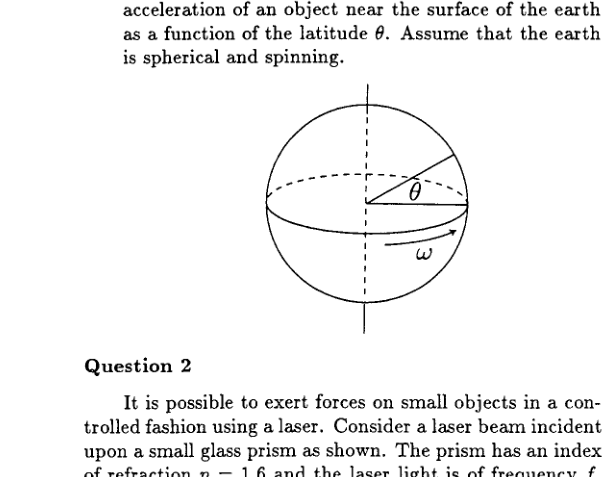 Spinning Earth with latitude angle θ and ω
Topic: Gravitation, Newtonian Mechanics, Rotational Dynamics Metodi: Newton’s Law of Gravitation, Free-Body Diagram, Approximation & Series Expansion Competenze: Mathematical Modeling, Physical Reasoning Objects: Planet Fonte: Testo (PDF) — p.4
Lo studio dell’accelerazione dovuta alla gravità della terra può essere molto interessante. Una varietà di fattori, come la rotazione e l’altitudine della terra, provocano variazioni di "". In questa domanda esamineremo queste variazioni.
(a) Supponiamo prima che la terra sia una sfera non rotante. Trova un’espressione per "" sulla superficie terrestre in termini di massa terrestre , raggio e , costante gravitazionale.
- B. Modificare l’espressione da parte
- A. per dare l’accelerazione dovuta alla gravità ad un’altitudine di sopra la superficie terrestre. Semplifica la tua espressione nel limite di (l’altitudine è molto inferiore al raggio della terra). Confronta il peso di un alpinista di 90 kg al livello del mare e della cima dell’Everest ad un’altitudine di circa 8000 m. Suggerimento: si può usare l’approssimazione se .
(c) L’accelerazione dovuta alla gravità dipende dalla latitudine perché la terra ruota. Trova la differenza percentuale tra ai poli e all’equatore a causa della rotazione terrestre. Suggerimento: considera il peso di un oggetto nelle due posizioni.
d) Trova un’espressione per la magnitudine dell’accelerazione della caduta libera di un oggetto vicino alla superficie terrestre come funzione della latitudine . Supponiamo che la terra sia sferica e ruotante.
Terra in rotazione con angolo di latitudine θ e ω
Topic: Gravitation, Newtonian Mechanics, Rotational Dynamics Metodi: Newton’s Law of Gravitation, Free-Body Diagram, Approximation & Series Expansion Competenze: Mathematical Modeling, Physical Reasoning Objects: Planet Fonte: Testo (PDF) — p.4
It is possible to exert forces on small objects in a controlled fashion using a laser. Consider a laser beam incident upon a small glass prism as shown. The prism has an index of refraction and the laser light is of frequency . The prism is isosceles with a base of , a height and a base angle of .
(a) Sketch the possible paths for a ray of laser light entering the top half of the prism.
(b) Find the range of values for the angle so that the light will exit from the long side of the prism as shown and find an expression for the deflection angle (you might want to do this first!). Only an approximate numerical value for is required. Henceforth, you may assume that the angle satisfies this condition.
(c) The momentum of a photon is related to its energy by where is the speed of light. Find the vertical force exerted on the prism by a stream of photons per second incident upon its top half. You may express your answer in terms of the deflection angle .
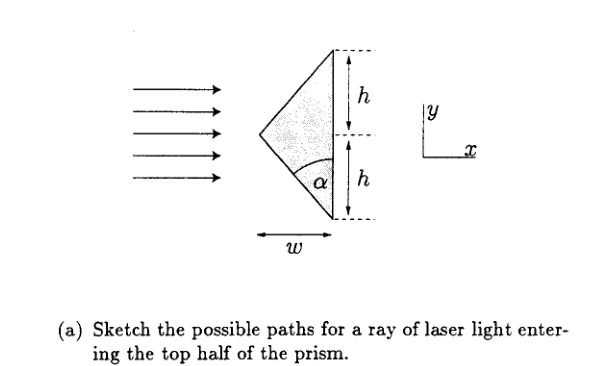 Laser beam incident on isosceles prism, axes x-y
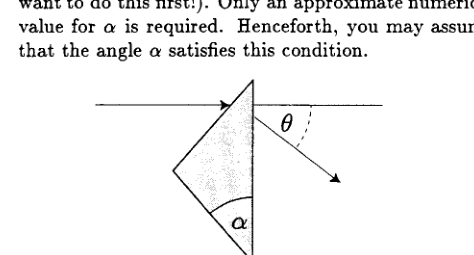 Prism deflecting beam by angle θ
Topic: Geometric Optics, Modern-Quantum Physics, Wave Optics Metodi: Snell’s Law, Ray Tracing, Photon Energy Relation Competenze: Mathematical Modeling, Diagrammatic Reasoning Objects: Prism, Photon Fonte: Testo (PDF) — p.4
È possibile esercitare forze su piccoli oggetti in modo controllato utilizzando un laser. Considerate un incidente di fascio laser su un piccolo prisma di vetro come mostrato. Il prisma ha un indice di rifrazione e la luce laser ha una frequenza . Il prisma è uguale a una base di , ad un’altezza e ad un angolo di base .
a) Segnare i percorsi possibili per un raggio di luce laser che entra nella metà superiore del prisma.
b) Trova l’intervallo di valori per l’angolo in modo che la luce esci dal lato lungo del prisma come mostrato e trova un’espressione per l’angolo di deflessione (potresti volerlo fare prima!). È necessario un valore numerica approssimativo solo per . Da ora in poi, si può presumere che l’angolo soddisfi questa condizione.
c) La dinamica di un fotone è correlata alla sua energia da dove è la velocità della luce. Trova la forza verticale esercitata sul prisma da un flusso di fotoni per secondo di incidente sulla sua metà superiore. La risposta può essere espressa in termini di angolo di deflessione .
incidente del fascio laser sul prisma di parice, assi x-y
Fonte di deflezione prismica per angolo θ
Topic: Geometric Optics, Modern-Quantum Physics, Wave Optics Metodi: Snell’s Law, Ray Tracing, Photon Energy Relation Competenze: Mathematical Modeling, Diagrammatic Reasoning Objects: Prism, Photon Fonte: Testo (PDF) — p.4
In some large lakes, typically ones that are long and narrow, a strange phenomenon occurs. The water will oscillate up and down slowly first being high at one end and low at the other and then later reversing itself. It is much like the water in a bathtub sloshing back and forth and is not to be confused with regular waves on the water’s surface. The phenomenon is called “seiching”.
(a) How can seiching be initiated and how might it decay?
(b) Make a physical model for seiching and find an expression for a lake’s period of oscillation. Possible factors include the lake’s length , width , depth , and amplitude of oscillation . Most simple models might begin by considering the lake to be a rectangular tank of water with the following geometry.
An exact solution is not expected for this question. Rather, a simpler system that you can imagine and that has characteristics in common with this problem can be used to model seiching and to estimate a period of oscillation.
You may compare your model with data from Lake Geneva in Switzerland and Lake Vättern in Sweden. Lake Geneva has a length of 60 km and an average depth of 150 m. Its oscillation period is 76 minutes with amplitudes of up to 2 m. Seiching on Lake Geneva can last for up to a week. Lake Vättern is 123 km long, has an average depth of 50 m and seiches with a period of about 3 hours.
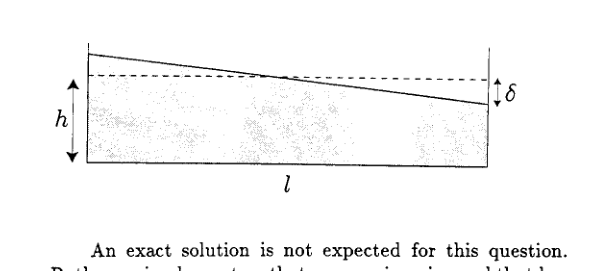 Rectangular lake cross-section with depth h, length l, amplitude δ
Topic: Oscillations & Waves, Fluid Mechanics Metodi: Physical Modeling, Dimensional Analysis, Wave Equation Competenze: Estimation & Approximation, Mathematical Modeling Objects: Container Fonte: Testo (PDF) — p.5
In alcuni grandi laghi, in genere lunghi e stretti, si verifica un strano fenomeno. L’acqua oscilla lentamente su e giù, prima di essere alta ad una estremità e bassa all’altra e poi poi si inverte. È molto simile all’acqua in una vasca da bagno che va avanti e indietro e non deve essere confusa con le onde regolari sulla superficie dell’acqua. Il fenomeno si chiama “seiching”.
(a) Come può essere iniziata la sequitura e come potrebbe decadere?
b) Realizzare un modello fisico per la sequenza e trovare un’espressione per il periodo di oscillazione di un lago. I fattori possibili includono la lunghezza del lago , la larghezza , la profondità e l’ampiezza di oscillazione . La maggior parte dei modelli semplici potrebbe iniziare considerando il lago come un serbatoio rettangolare di acqua con la seguente geometria.
Non si aspetta una soluzione esatta a questa domanda. Invece, un sistema più semplice che si possa immaginare e che abbia caratteristiche comuni con questo problema può essere utilizzato per modellare la sequenza e per stimare un periodo di oscillazione.
Si può confrontare il modello con i dati del lago di Ginevra in Svizzera e del lago di Vättern in Svezia. Il lago di Ginevra ha una lunghezza di 60 km e una profondità media di 150 m. Il suo periodo di oscillazione è di 76 minuti con amplitudini fino a 2 m. La sequoia sul lago di Ginevra può durare fino a una settimana. Il lago Vättern ha una lunghezza di 123 km, una profondità media di 50 m e siiches con un periodo di circa 3 ore.
Sezione trasversale del lago rettangolare con profondità h, lunghezza l, amplitudine δ
Topic: Oscillations & Waves, Fluid Mechanics Metodi: Physical Modeling, Dimensional Analysis, Wave Equation Competenze: Estimation & Approximation, Mathematical Modeling Objects: Container Fonte: Testo (PDF) — p.5