What mechanical power is required to move an object of mass against an opposing force at a constant velocity ?
- A.
- B.
- C.
- D.
Topic: Newtonian Mechanics Metodi: Physical Modeling, Kinematic Equations Competenze: Physical Reasoning Objects: — Fonte: Testo (PDF) — p.1
Qual è la potenza meccanica necessaria per muovere un oggetto di massa contro una forza opposta a una velocità costante ?
- A.
- B.
- C.
- D.
Topic: Newtonian Mechanics Metodi: Physical Modeling, Kinematic Equations Competenze: Physical Reasoning Objects: — Fonte: Testo (PDF) — p.1
A rocket generates a thrust force by ejecting hot gases from an engine. If it takes 1 ms to combust 1 kg of fuel, ejecting it at a speed of 1000 m/s, what thrust is generated?
- A. 1000 N
- B. 10,000 N
- C. 100,000 N
- D. 1,000,000 N
Topic: Newtonian Mechanics Metodi: Impulse-Momentum Theorem, Conservation of Momentum Competenze: Physical Reasoning Objects: Gas Fonte: Testo (PDF) — p.1
Un razzo genera una forza di spinta espellendo gas caldi dal motore. Se ci vuole 1 ms per bruciare 1 kg di carburante, espulsionandolo a una velocità di 1000 m/s, quale spinta viene generata?
- A. 1000 N
- B. 10,000 N
- C. 100,000 N
- D. 1,000,000 N
Topic: Newtonian Mechanics Metodi: Impulse-Momentum Theorem, Conservation of Momentum Competenze: Physical Reasoning Objects: Gas Fonte: Testo (PDF) — p.1
A rubber band (two parallel strands of elastic material) has a spring constant of 10 N/m. If the band is cut in one place such that it now forms a single long strand of elastic material, what is its new spring constant?
- A. 20 N/m
- B. 40 N/m
- C. 5 N/m
- D. 2.5 N/m
Topic: Elasticity & Materials, Oscillations & Waves Metodi: Hooke’s Law, Physical Modeling Competenze: Physical Reasoning Objects: Spring Fonte: Testo (PDF) — p.1
Una banda di gomma (due fili parallele di materiale elastico) ha una costante di molla di 10 N/m. Se la fascia viene tagliata in un solo luogo in modo che ora forma un unico lungo filo di materiale elastico, qual è la sua nuova costante di primavera?
- A. 20 N/m
- B. 40 N/m
- C. 5 N/m
- D. 2.5 N/m
Topic: Elasticity & Materials, Oscillations & Waves Metodi: Hooke’s Law, Physical Modeling Competenze: Physical Reasoning Objects: Spring Fonte: Testo (PDF) — p.1
A ball rests upon a flat piece of paper on a table top. The paper is pulled quickly and horizontally to the right as shown. Relative to its initial position with respect to the table, the ball initially:
- A. moves to the right.
- B. moves to the left.
- C. remains stationary.
- D. its motion depends on the speed at which the paper was removed.
 Ball on paper pulled to the right
Topic: Newtonian Mechanics Metodi: Free-Body Diagram, Physical Modeling Competenze: Physical Reasoning, Diagrammatic Reasoning Objects: Ball Fonte: Testo (PDF) — p.1
Una palla si posa su un pezzo di carta piatto su un tavolo. La carta viene tirata rapidamente e orizzontalmente a destra come mostrato. Relativamente alla sua posizione iniziale rispetto alla tabella, la palla inizia:
- A. si sposta a destra.
- B. si sposta a sinistra.
- C. rimane fermo.
- D. il suo movimento dipende dalla velocità con cui la carta è stata rimossa.
Palla su carta tirata a destra
Topic: Newtonian Mechanics Metodi: Free-Body Diagram, Physical Modeling Competenze: Physical Reasoning, Diagrammatic Reasoning Objects: Ball Fonte: Testo (PDF) — p.1
Two small spheres with masses and hang on weightless, insulating threads with lengths and . The two spheres carry a charge of and respectively. The spheres hang such that they are level with one another and the threads are inclined to the vertical at angles and .
Which of the following conditions is required if ?
- A.
- B.
- C.
- D. none of the above
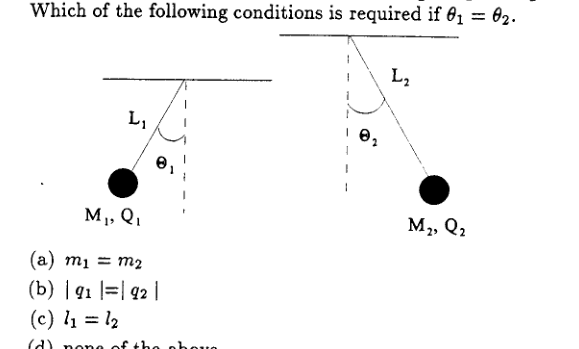 Two charged spheres on insulating threads
Topic: Electrostatics, Newtonian Mechanics Metodi: Free-Body Diagram, Coulomb’s Law Competenze: Physical Reasoning, Diagrammatic Reasoning Objects: Sphere, String Fonte: Testo (PDF) — p.2
Due piccole sfere di massa e appoggiate su fili isolanti senza peso con lunghezze e . Le due sfere hanno una carica rispettivamente di e . Le sfere sono appese in modo tale che siano a livello l’una dell’altra e i fili sono inclinati verso la verticale agli angoli e .
Qual è la condizione di se:
- A.
- B.
- C.
- D. nessuna delle seguenti:
Due sfere cariche su fili isolanti
Topic: Electrostatics, Newtonian Mechanics Metodi: Free-Body Diagram, Coulomb’s Law Competenze: Physical Reasoning, Diagrammatic Reasoning Objects: Sphere, String Fonte: Testo (PDF) — p.2
An astronaut aboard the space shuttle, which is in orbit about the earth, is said to be weightless because:
- A. there is no force of gravity on her.
- B. a radially outwards force acts on her which cancels the force of gravity.
- C. she is falling in the earth’s gravitational field.
- D. she is at such a position between the earth and the moon that their forces of gravity cancel each other.
Topic: Gravitation, Newtonian Mechanics Metodi: Newton’s Law of Gravitation, Physical Modeling Competenze: Physical Reasoning Objects: Satellite, Planet Fonte: Testo (PDF) — p.2
Si dice che un astronauta a bordo della navetta spaziale, che è in orbita attorno alla Terra, sia senza peso perché:
- Non c’è forza di gravità su di lei.
- B. una forza radialmente esterna agisce su di lei che annulla la forza di gravità.
- C. sta cadendo nel campo gravitazionale terrestre.
- D. si trova in una posizione tale tra la terra e la luna che le loro forze di gravità si annullano.
Topic: Gravitation, Newtonian Mechanics Metodi: Newton’s Law of Gravitation, Physical Modeling Competenze: Physical Reasoning Objects: Satellite, Planet Fonte: Testo (PDF) — p.2
Beats are heard when the A strings of two violins are played. The beat frequency decreases as the tension in the A string of violin 1 is slowly increased. Which of the following statements is correct?
- A. The fundamental frequency of the A string in violin 1 is less than that for violin 2.
- B. The fundamental frequency of the A string in violin 1 is greater than that for violin 2.
- C. The fundamental frequency of the A string in violin 1 may be greater or less than that for violin 2 depending on the linear mass densities of the two strings.
- D. The fundamental frequency of the A string in violin 1 may be greater or less than that for violin 2 depending on the temperature.
Topic: Oscillations & Waves Metodi: Wave Equation, Superposition Principle Competenze: Physical Reasoning Objects: String Fonte: Testo (PDF) — p.2
I battiti si sentono quando si suonano le corde A di due violini. La frequenza dei battiti diminuisce con l’aumento lentamente della tensione nella corda A del violino 1. Quale delle seguenti affermazioni è corretta?
- A. La frequenza fondamentale della corda A nel violino 1 è inferiore a quella del violino 2.
- B. La frequenza fondamentale della corda A del violino 1 è superiore a quella del violino 2.
- C. La frequenza fondamentale della corda A nel violino 1 può essere maggiore o inferiore a quella del violino 2 a seconda delle densità di massa lineare delle due corde.
- D. La frequenza fondamentale della corda A nel violino 1 può essere maggiore o inferiore a quella del violino 2 a seconda della temperatura.
Topic: Oscillations & Waves Metodi: Wave Equation, Superposition Principle Competenze: Physical Reasoning Objects: String Fonte: Testo (PDF) — p.2
A proton (mass , charge ) and a deuteron (mass , charge ) are initially at rest and are accelerated through the same potential difference . Which of the following is true concerning the final properties of the two particles?
- A. They have the same speed.
- B. They have the same momentum.
- C. They have the same kinetic energy.
- D. They have been subjected to the same impulse.
Topic: Electrostatics, Modern-Quantum Physics Metodi: Energy Conservation Method, Electric Potential Method Competenze: Physical Reasoning Objects: Nucleus Fonte: Testo (PDF) — p.2
Un protone (massa , carica ) e un deuteron (massa , carica ) sono inizialmente a riposo e sono accelerati attraverso la stessa differenza di potenziale . Quale delle seguenti cose è vero riguardo alle proprietà finali delle due particelle?
- A. Hanno la stessa velocità.
- B. Hanno lo stesso impulso.
- C. Hanno la stessa energia cinetica.
- D. Sono stati sottoposti allo stesso impulso.
Topic: Electrostatics, Modern-Quantum Physics Metodi: Energy Conservation Method, Electric Potential Method Competenze: Physical Reasoning Objects: Nucleus Fonte: Testo (PDF) — p.2
An ideal battery is connected to a circuit of four resistors as shown. If the resistance of is increased, then:
- A. The current through decreases.
- B. The potential difference across increases.
- C. The potential difference across increases.
- D. The potential difference across decreases.
 Circuit with four resistors and battery
Topic: Circuits Metodi: Kirchhoff’s Laws, Equivalent Circuit Reduction Competenze: Physical Reasoning, Diagrammatic Reasoning Objects: Battery, Resistor Fonte: Testo (PDF) — p.2
Una batteria ideale è collegata a un circuito di quattro resistori come mostrato. Se la resistenza di è aumentata, allora:
- A. La corrente attraverso diminuisce.
- B. La differenza potenziale tra aumenta.
- C. La differenza potenziale tra aumenta.
- D. La differenza potenziale tra diminuisce.
Circuito con quattro resistori e batteria
Topic: Circuits Metodi: Kirchhoff’s Laws, Equivalent Circuit Reduction Competenze: Physical Reasoning, Diagrammatic Reasoning Objects: Battery, Resistor Fonte: Testo (PDF) — p.2
A ray of light is incident upon an air/water interface (it passes from air into water) at an angle of 45°. Which of the following properties:
(1) wavelength (2) frequency (3) speed of propagation (4) direction of propagation
change as the light enters the water?
- A. 1, 3 only
- B. 3, 4 only
- C. 1, 2, 4 only
- D. 1, 3, 4 only
Topic: Geometric Optics, Wave Optics Metodi: Snell’s Law, Physical Modeling Competenze: Physical Reasoning Objects: — Fonte: Testo (PDF) — p.2
Un raggio di luce si incide su un’interfaccia aria/acqua (passa dall’aria all’acqua) ad un angolo di 45°. Quali delle seguenti proprietà:
(1) lunghezza d’onda (2) frequenza (3) velocità di propagazione (4) direzione di propagazione
cambiano quando la luce entra nell’acqua?
- A. 1, 3 solo
- B. 3, 4 solo
- C. 1, 2, 4 solo
- D. 1, 3, 4 solo
Topic: Geometric Optics, Wave Optics Metodi: Snell’s Law, Physical Modeling Competenze: Physical Reasoning Objects: — Fonte: Testo (PDF) — p.2
Three freight cars, each of mass , are being pulled by an engine exerting a force on the lead car. What is the force exerted on the trailing car by the middle one?
- A.
- B.
- C.
- D.
Topic: Newtonian Mechanics Metodi: Free-Body Diagram, Kinematic Equations Competenze: Physical Reasoning Objects: Cart Fonte: Testo (PDF) — p.2
Tre veicoli da trasporto, ognuno di massa , sono trainati da un motore che esercita una forza sulla vettura principale. Qual è la forza esercitata sulla macchina in ritardo da quella centrale?
- A.
- B.
- C.
- D.
Topic: Newtonian Mechanics Metodi: Free-Body Diagram, Kinematic Equations Competenze: Physical Reasoning Objects: Cart Fonte: Testo (PDF) — p.2
The lowest frequency to resonate in a pipe, closed at one end and open at the other, is 300 Hz. Which of the following frequencies will not resonate in this particular pipe?
- A. 900 Hz
- B. 2,100 Hz
- C. 3,300 Hz
- D. 3,600 Hz
Topic: Oscillations & Waves Metodi: Wave Equation, Physical Modeling Competenze: Physical Reasoning Objects: Tube Fonte: Testo (PDF) — p.3
La frequenza più bassa da risonare in un tubo, chiuso da un lato e aperto dall’altro, è di 300 Hz. Quale delle seguenti frequenze non risonerà in questo tubo particolare?
- A. 900 Hz
- B. 2,100 Hz
- C. 3,300 Hz
- D. 3,600 Hz
Topic: Oscillations & Waves Metodi: Wave Equation, Physical Modeling Competenze: Physical Reasoning Objects: Tube Fonte: Testo (PDF) — p.3
A long metal bar, 30.0 cm in length, is aligned along a north-south line and moves eastwards at a speed of 10.0 m/s. A uniform magnetic field of 4.00 T points downwards. If the south end of the bar has a potential of 0 V, the induced potential at the north end of the bar is:
- A. +12 V
- B. −12 V
- C. 0 V
- D. cannot be determined since there is no closed circuit.
Topic: Electromagnetic Induction, Magnetism Metodi: Faraday’s Law of Induction, Lorentz Force Analysis Competenze: Physical Reasoning Objects: Rod Fonte: Testo (PDF) — p.3
Una lunga barra di metallo, lunga 30,0 cm, è allineata lungo una linea nord-sud e si muove verso est a una velocità di 10,0 m/s. Un campo magnetico uniforme di 4,00 T punta verso il basso. Se l’estremità meridionale della barra ha un potenziale di 0 V, il potenziale indotto all’estremità settentrionale della barra è:
- A. +12 V
- B. −12 V
- C. 0 V
- D. non può essere determinato poiché non esiste un circuito chiuso.
Topic: Electromagnetic Induction, Magnetism Metodi: Faraday’s Law of Induction, Lorentz Force Analysis Competenze: Physical Reasoning Objects: Rod Fonte: Testo (PDF) — p.3
A proton is moving in a uniform electric field , of unknown magnitude and direction. There is a uniform magnetic field of 0.01 T pointing in the -direction. The proton moves in the -direction at a constant velocity of 10 km/s. All directions are with respect to the usual right-handed -- coordinate system. Which of the following is correct?
- A. V/m, in the -direction.
- B. V/m, in the negative -direction.
- C. V/m, in the -direction.
- D. V/m, in the negative -direction.
Topic: Electromagnetism, Electrostatics Metodi: Lorentz Force Analysis, Vector Decomposition Competenze: Physical Reasoning Objects: Point Charge Fonte: Testo (PDF) — p.3
Un protone si muove in un campo elettrico uniforme , di magnitudo e direzione sconosciute. C’è un campo magnetico uniforme di 0,01 T che punta nella direzione . Il protone si muove nella direzione a una velocità costante di 10 km/s. Tutte le indicazioni sono relative al solito sistema di coordinate a destra --. Quale di queste parole è corretta?
- A. V/m, nella direzione .
- B. V/m, nella direzione negativa .
- C. V/m, nella direzione .
- D. V/m, nella direzione negativa .
Topic: Electromagnetism, Electrostatics Metodi: Lorentz Force Analysis, Vector Decomposition Competenze: Physical Reasoning Objects: Point Charge Fonte: Testo (PDF) — p.3
An aluminum block has a cavity within it which is completely closed. The block is placed in a region permeated by a uniform electric field which is directed upwards. Which of the following is a correct statement describing conditions in the interior of the block’s cavity?
- A. The electric field in the cavity is directed upwards.
- B. The electric field in the cavity is directed downwards.
- C. There is no electric field in the cavity.
- D. The electric field in the cavity is of varying magnitude and is zero at the exact center.
Topic: Electrostatics Metodi: Gauss’s Law, Symmetry Argument Competenze: Physical Reasoning Objects: Block Fonte: Testo (PDF) — p.3
Un blocco di alluminio ha una cavità che è completamente chiusa. Il blocco è posizionato in una regione permeata da un campo elettrico uniforme che è diretto verso l’alto. Qual è la dichiarazione corretta che descrive le condizioni all’interno della cavità del blocco?
- A. Il campo elettrico nella cavità è diretto verso l’alto.
- B. Il campo elettrico nella cavità è diretto verso il basso.
- C. Non c’è campo elettrico nella cavità.
- D. Il campo elettrico nella cavità è di magnitudo variabile ed è zero al centro esatto.
Topic: Electrostatics Metodi: Gauss’s Law, Symmetry Argument Competenze: Physical Reasoning Objects: Block Fonte: Testo (PDF) — p.3
Two copper spheres, A and B, are identical in all respects but A carries a charge of C whereas B is charged to C. The two are brought together until they touch and then separated so that they are nearby but otherwise insulated. Which of the following is true concerning the electrostatic force between the two spheres?
- A. as one of the spheres is uncharged.
- B. as both of the spheres are uncharged.
- C. is attractive.
- D. is repulsive.
Topic: Electrostatics Metodi: Coulomb’s Law, Physical Modeling Competenze: Physical Reasoning Objects: Conducting Sphere Fonte: Testo (PDF) — p.3
Due sfere di rame, A e B, sono identiche in tutti i punti di vista, ma A ha una carica di C mentre B è carica di C. Le due sono unite fino a quando si toccano e poi separate in modo che siano vicine ma altrimenti isolate. Qual è la verità riguardo alla forza elettrostatica tra le due sfere?
- A. quando una delle sfere non è carica.
- B. poiché entrambe le sfere sono scaricate.
- C. è attraente.
- D. è repulsivo.
Topic: Electrostatics Metodi: Coulomb’s Law, Physical Modeling Competenze: Physical Reasoning Objects: Conducting Sphere Fonte: Testo (PDF) — p.3
A real battery has an emf and an internal resistance . A variable resistor is connected across the terminals of the battery. A current is drawn from the battery and the potential difference across the terminals of the battery is . If is slowly decreased to zero, which of the following best describes and ?
- A. decreases to zero; approaches .
- B. approaches an infinite value; decreases to zero.
- C. approaches ; approaches .
- D. approaches ; decreases to zero.
Topic: Circuits Metodi: Kirchhoff’s Laws, Equivalent Circuit Reduction Competenze: Physical Reasoning Objects: Battery, Resistor Fonte: Testo (PDF) — p.3
Una batteria reale ha un emf e una resistenza interna . Un resistore variabile è collegato tra i terminali della batteria. La batteria viene ricavata una corrente e la differenza potenziale tra i terminali della batteria è . Se viene lentamente ridotta a zero, quale delle seguenti descrive meglio e ?
- A. si riduce a zero; si avvicina a .
- B. si avvicina a un valore infinito; si riduce a zero.
- C. si avvicina a ; si avvicina a .
- D. si avvicina a ; si riduce a zero.
Topic: Circuits Metodi: Kirchhoff’s Laws, Equivalent Circuit Reduction Competenze: Physical Reasoning Objects: Battery, Resistor Fonte: Testo (PDF) — p.3
Three resistors are connected together as shown. A current flows into A and out of B. What is the power dissipated by the resistor ?
- A.
- B.
- C.
- D.
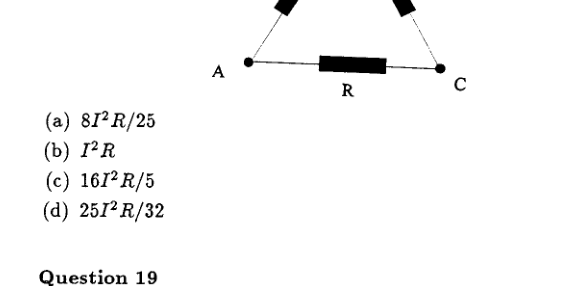 Three resistors connected between A and B
Topic: Circuits Metodi: Kirchhoff’s Laws, Equivalent Circuit Reduction Competenze: Physical Reasoning, Diagrammatic Reasoning Objects: Resistor Fonte: Testo (PDF) — p.3
Tre resistori sono collegati tra loro come mostrato. Una corrente scorre in A e fuori da B. Qual è la potenza dissipata dalla resistenza ?
- A.
- B.
- C.
- D.
Tre resistori collegati tra A e B
Topic: Circuits Metodi: Kirchhoff’s Laws, Equivalent Circuit Reduction Competenze: Physical Reasoning, Diagrammatic Reasoning Objects: Resistor Fonte: Testo (PDF) — p.3
Light enters one end of an optical fibre as shown. The uniform index of refraction of the cylindrical fibre is . What is the maximum angle that the incident light may have so that the light ray is totally internally reflected within the fibre? Take the index of refraction of air to be unity; all results shown to two significant digits.
- A. 78°
- B. 46°
- C. 44°
- D. 12°
 Optical fibre with incident ray angle theta
Topic: Geometric Optics Metodi: Snell’s Law, Ray Tracing Competenze: Physical Reasoning, Mathematical Modeling Objects: — Fonte: Testo (PDF) — p.3
La luce entra in una estremità di una fibra ottica come mostrato. L’indice uniforme di rifrazione della fibra cilindrica è . Qual è l’angolo massimo che la luce incidentale può avere in modo che il raggio luminoso sia totalmente riflesso internamente all’interno della fibra? Prendiamo l’indice di rifrazione dell’aria per unità; tutti i risultati mostrati a due cifre significative.
- A. 78°
- B. 46°
- C. 44°
- D. 12°
Fibra ottica con angolo di raggi di incidenza theta
Topic: Geometric Optics Metodi: Snell’s Law, Ray Tracing Competenze: Physical Reasoning, Mathematical Modeling Objects: — Fonte: Testo (PDF) — p.3
Two balls of the same mass are dropped from the same height onto the floor. The first ball bounces upwards from the floor elastically. The second ball sticks to the floor. The first applies an impulse to the floor of and the second applies an impulse . The two impulses obey:
- A. .
- B. .
- C. .
- D. .
Topic: Newtonian Mechanics, Conservation of Momentum Metodi: Impulse-Momentum Theorem, Conservation of Momentum Competenze: Physical Reasoning Objects: Ball Fonte: Testo (PDF) — p.4
Due palle della stessa massa vengono gettate sul pavimento dalla stessa altezza. La prima palla rimbalza verso l’alto dal pavimento in modo elastico. La seconda palla si attacca al pavimento. Il primo impone un impulso al pavimento di e il secondo impone un impulso . I due impulsi obbediscono:
- A. .
- B. .
- C. .
- D. .
Topic: Newtonian Mechanics, Conservation of Momentum Metodi: Impulse-Momentum Theorem, Conservation of Momentum Competenze: Physical Reasoning Objects: Ball Fonte: Testo (PDF) — p.4
A glass of water has an ice cube floating in it. The level of the water is marked on the glass with a grease-pencil. Once the ice cube has completely melted, and assuming that there has been no evaporation, the water level, relative to the initial marking, has:
- A. gone up.
- B. gone down.
- C. remained the same.
- D. cannot say based on the above information.
Topic: Fluid Mechanics Metodi: Hydrostatic Equilibrium, Physical Modeling Competenze: Physical Reasoning Objects: Container Fonte: Testo (PDF) — p.4
Un bicchiere d’acqua ha un cubo di ghiaccio che galleggia. Il livello dell’acqua è segnato sul vetro con una matita. Una volta che il cubo di ghiaccio si è completamente sciolto, e presumendo che non sia avvenuta evaporazione, il livello dell’acqua, rispetto al marchio iniziale, ha:
- **A ** è aumentato.
- ** B.** è diminuito.
- C. è rimasto lo stesso.
- D. non può dire in base alle informazioni sopra indicate.
Topic: Fluid Mechanics Metodi: Hydrostatic Equilibrium, Physical Modeling Competenze: Physical Reasoning Objects: Container Fonte: Testo (PDF) — p.4
A bit of mud stuck to a bicycle’s front wheel detaches and is flung horizontally forward when it is at the top of the wheel’s rotation (directly above the wheel’s hub). The bicycle is moving forward at a speed and the bicycle is rolling along without slipping. At the instant that the bit of mud hits the ground, how far in front of the bicycle’s front wheel hub is it? (Ignore air resistance.)
- A.
- B.
- C.
- D.
Topic: Newtonian Mechanics Metodi: Kinematic Equations, Physical Modeling Competenze: Physical Reasoning, Mathematical Modeling Objects: Wheel, Projectile Fonte: Testo (PDF) — p.4
Un po’ di fango attaccato alla ruota anteriore di una bicicletta si stacca e viene gettato orizzontalmente in avanti quando si trova in cima alla rotazione della ruota (direttamente sopra l’hub della ruota). La bicicletta si muove in avanti a una velocità e la bicicletta si rulla senza scivolare. Nel momento in cui il pezzo di fango colpisce il terreno, quanto lontano è davanti al nodo della ruota anteriore della bicicletta? (Ignorare la resistenza dell’aria.)
- A.
- B.
- C.
- D.
Topic: Newtonian Mechanics Metodi: Kinematic Equations, Physical Modeling Competenze: Physical Reasoning, Mathematical Modeling Objects: Wheel, Projectile Fonte: Testo (PDF) — p.4
An exploratory rocket of mass is in orbit about the sun at a radius of (one tenth of the radius of the earth’s orbit about the sun). To exit this orbit, it fires its engine over a short period of time. This quickly doubles the velocity of the rocket while halving its mass (due to fuel consumption). Immediately after the burn, what is the kinetic energy of the rocket?
- A.
- B.
- C.
- D.
Topic: Gravitation, Newtonian Mechanics Metodi: Energy Conservation Method, Kepler’s Laws, Newton’s Law of Gravitation Competenze: Physical Reasoning, Mathematical Modeling Objects: Satellite, Star Fonte: Testo (PDF) — p.4
Un razzo esploratorio di massa è in orbita attorno al Sole ad un raggio di (uno decimo del raggio dell’orbita terrestre attorno al Sole). Per uscire da questa orbita, il motore viene attivato in un breve periodo di tempo. Questo raddoppia rapidamente la velocità del razzo riducendo di metà la sua massa (a causa del consumo di carburante). Immediatamente dopo l’incendio, qual è l’energia cinetica del razzo?
- A.
- B.
- C.
- D.
Topic: Gravitation, Newtonian Mechanics Metodi: Energy Conservation Method, Kepler’s Laws, Newton’s Law of Gravitation Competenze: Physical Reasoning, Mathematical Modeling Objects: Satellite, Star Fonte: Testo (PDF) — p.4
A light bulb shines light along the -axis and through two parallel ideal polarizing filters, one with a fixed polarizing axis, and one with an axis that rotates about the -axis and in the -plane. Looking towards the light bulb through the combined filtering system, you see:
- A. A bulb almost disappearing twice per revolution, and reaching a maximum intensity twice per revolution. The maximum brightness is not as bright as looking at an unfiltered bulb.
- B. As in (A) but once per revolution.
- C. As in (A) but with a maximum brightness as bright as an unfiltered bulb.
- D. As in (A) but with a bulb that disappears completely.
Topic: Wave Optics, Electromagnetism Metodi: Superposition Principle, Physical Modeling Competenze: Physical Reasoning Objects: — Fonte: Testo (PDF) — p.4
Una lampadina illumina lungo l’asse e attraverso due filtri polarizzanti ideali paralleli, uno con un asse polarizzante fisso e uno con un asse che ruota intorno all’asse e nel piano . Guardando verso l’ampolla attraverso il sistema di filtraggio combinato, si vede:
- A. Una lampadina quasi scomparsa due volte per rivoluzione, e raggiunge una intensità massima due volte per rivoluzione. La luminosità massima non è così brillante come guardare una lampadina non filtrata.
- B. Come in (A) ma una volta per rivoluzione.
- C. Come in (A) ma con una luminosità massima luminosa come una lampadina non filtrata.
- D. Come in (A) ma con una lampadina che scompare completamente.
Topic: Wave Optics, Electromagnetism Metodi: Superposition Principle, Physical Modeling Competenze: Physical Reasoning Objects: — Fonte: Testo (PDF) — p.4
Two identical metallic spheres are both charged to . The spheres are fixed in place, with their centers apart from one another. They are joined by a light, inflexible rod. Sliding back and forth on the rod (ignore friction) is a small disk of mass charged to . The disk is in equilibrium when it is halfway between the spheres. If the disk is displaced by a small amount from its equilibrium point, it will oscillate with a period of:
- A.
- B.
- C.
- D.
Topic: Electrostatics, Oscillations & Waves Metodi: Coulomb’s Law, Simple Harmonic Motion Analysis, Approximation & Series Expansion Competenze: Physical Reasoning, Mathematical Modeling Objects: Conducting Sphere, Rod, Disk Fonte: Testo (PDF) — p.4
Due sfere metalliche identiche sono entrambi cariche a . Le sfere sono fissate in posizione, con i loro centri separati l’uno dall’altro. Sono unite da una canna leggera e inflessibile. Il disco di massa , caricato a , si scorre avanti e indietro sulla canna (ignore l’attrito). Il disco è in equilibrio quando è a metà strada tra le sfere. Se il disco è spostato di una piccola quantità dal suo punto di equilibrio, oscilla con un periodo di:
- A.
- B.
- C.
- D.
Topic: Electrostatics, Oscillations & Waves Metodi: Coulomb’s Law, Simple Harmonic Motion Analysis, Approximation & Series Expansion Competenze: Physical Reasoning, Mathematical Modeling Objects: Conducting Sphere, Rod, Disk Fonte: Testo (PDF) — p.4
A ball of mass kg is dropped from a height m above a hard table top. It rebounds to a height . The coefficient of restitution between the ball and the table is . The radius of the ball is cm.
(a) What is the ratio of the ball’s kinetic energy just after it has bounced to that just before it bounces?
(b) If the duration of the collision between the ball and the table top is s, what is the average force exerted on the ball by the table?
(c) From what height, , above the table top and directly above the first ball, must a second ball be dropped so that it collides with the first ball immediately after the first ball has finished its bounce from the table top. The second ball is identical to the first but with a mass of 100 g.
If the coefficient of restitution between the two balls is 1.0, find the rebound height, , of the second ball above the table top.
Topic: Newtonian Mechanics, Conservation of Momentum Metodi: Conservation of Energy, Impulse-Momentum Theorem, Kinematic Equations Competenze: Physical Reasoning, Mathematical Modeling Objects: Ball Fonte: Testo (PDF) — p.4
Una palla di massa kg viene abbassata da un’altezza m sopra un tavolo rigido. Rimbolga ad un’altezza . Il coefficiente di restituzione tra la palla e la tavola è . Il raggio di radio della palla è cm.
(a) Qual è il rapporto tra l’energia cinetica della palla appena dopo aver rimbalzato a quella poco prima di rimbalzare?
b) Se la durata della collisione tra la palla e la tavola è s, qual è la forza media esercitata sulla palla dalla tavola?
c) Da quale altezza, , sopra la tavola e direttamente sopra la prima palla, deve essere scaricata una seconda palla in modo che colpisca la prima palla immediatamente dopo che la prima palla ha terminato il suo rimbalzo dalla tavola. La seconda palla è identica alla prima ma ha una massa di 100 g.
Se il coefficiente di restituzione tra le due palle è di 1,0, si trova l’altezza di rimbalzo, , della seconda palla sopra la parte superiore del tavolo.
Topic: Newtonian Mechanics, Conservation of Momentum Metodi: Conservation of Energy, Impulse-Momentum Theorem, Kinematic Equations Competenze: Physical Reasoning, Mathematical Modeling Objects: Ball Fonte: Testo (PDF) — p.4
Suppose that a beam of light of intensity shines upon a laminar interface with a small angle of incidence . The interface is a laminar sandwich made of two layers. There is a thick substrate layer, with an index of refraction , and a thin mid-layer, with an index of refraction . The index of refraction of air, , may be taken to be unity. The thickness of the mid-layer is large enough so that interference effects are not an issue.
(a) Find the angle that light refracted through the air/mid-layer interface makes with the normal. Hence, find the angle of incidence for light impinging upon the substrate. Finally, find the refracted angle for light passing through the mid-layer/substrate interface.
Note: For unpolarized light incident upon an interface with an incident angle , the fraction of the incident light reflected is given by: The fraction of light transmitted is .
(b) Using your angles from part (a), calculate values for and for reflection and transmission at the air/mid-layer, mid-layer/substrate, and mid-layer/air interfaces.
(c) Find an expression for the intensity of the light which is reflected from the laminar interface. Evaluate your expression to as many significant figures as possible.
Topic: Geometric Optics, Wave Optics Metodi: Snell’s Law, Ray Tracing, Superposition Principle Competenze: Physical Reasoning, Mathematical Modeling Objects: — Fonte: Testo (PDF) — p.5
Supponiamo che un fascio di luce di intensità brilla su un’interfaccia laminare con un angolo di incidenza piccolo . L’interfaccia è un sandwich laminato fatto di due strati. Si tratta di uno strato di substrato spessore, con un indice di rifrazione , e di uno strato medio sottile, con un indice di rifrazione . L’indice di rifrazione dell’aria, , può essere considerato unità. Lo spessore del strato medio è sufficientemente grande da non causare problemi di interferenza.
(a) Trova l’angolo che la luce rifractata attraverso l’interfaccia aria/strato medio fa con la normale. Quindi, trovare l’angolo di incidenza della luce che colpisce il substrato. Infine, trovare l’angolo di rifrazione per la luce che passa attraverso l’interfaccia strato medio/sottostrato.
Nota: per un incidente di luce non polarizzata su un’interfaccia con un angolo di incidente , la frazione della luce incidente riflessa è data da: La frazione di luce trasmessa è .
b) Con l’uso degli angoli della parte a), calcolare i valori per e per la riflessione e la trasmissione alle interfacce aria/schiamo medio, strato medio/sottostrato e strato medio/aria.
c) Trova un’espressione per l’intensità della luce riflessa dall’interfaccia laminare. Valutare la tua espressione per quanti più cifre significative possibile.
Topic: Geometric Optics, Wave Optics Metodi: Snell’s Law, Ray Tracing, Superposition Principle Competenze: Physical Reasoning, Mathematical Modeling Objects: — Fonte: Testo (PDF) — p.5
A hummingbird has a mass of g. It hovers in much the same manner as a helicopter except that instead of rotating, its wings sweep back and forth, developing lift on both parts of the stroke. The vertical, cross sectional area that the wings sweep through is m².
(a) Estimate the mechanical power output the hummingbird needs to generate for hovering.
(b) Estimate the mass of sugar the hummingbird needs to ingest (as nectar) in order to hover for one hour.
Note: This question requires you to make assumptions and to estimate physical quantities. Marks are awarded for the quality of these assumptions and estimations so please explain them clearly.
Topic: Fluid Mechanics, Newtonian Mechanics Metodi: Physical Modeling, Order-of-Magnitude Estimation, Bernoulli’s Equation Competenze: Estimation & Approximation, Physical Reasoning Objects: — Fonte: Testo (PDF) — p.5
Un colibrì ha una massa g. Si muove in modo molto simile a quello di un elicottero, tranne che, invece di girare, le sue ali si spazzano avanti e indietro, sviluppando un sollevamento su entrambe le parti del colpo. L’area verticale e trasversale attraverso la quale le ali attraversano è m2.
a) Calcolare la potenza meccanica di produzione che il colibri deve generare per la sua galleggiatura.
b) Calcolare la massa di zucchero che il colibri deve ingerire (come nettare) per poter svolgere un’ora.
Nota: Questa domanda richiede che tu faccia ipotesi e stimi le quantità fisiche. I marchi sono assegnati per la qualità di tali ipotesi e stime, quindi si prega di spiegare chiaramente.
Topic: Fluid Mechanics, Newtonian Mechanics Metodi: Physical Modeling, Order-of-Magnitude Estimation, Bernoulli’s Equation Competenze: Estimation & Approximation, Physical Reasoning Objects: — Fonte: Testo (PDF) — p.5