The time dependence of the acceleration of a car is as shown. Which time corresponds to the maximum speed of the car?
- A.
- B.
- C.
- D.
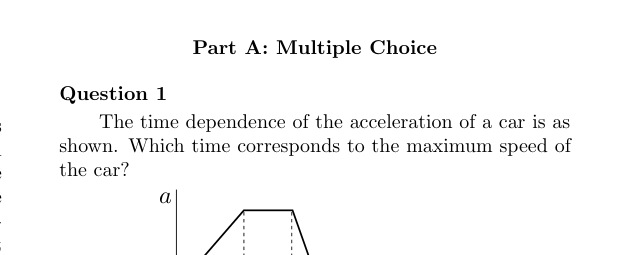 acceleration vs time graph for car
Topic: Newtonian Mechanics Metodi: Kinematic Equations Competenze: Physical Reasoning, Diagrammatic Reasoning Objects: — Fonte: Testo (PDF) — p.1
La dipendenza temporale dell’accelerazione di un’auto è come mostrato. Qual è l’ora corrispondente alla velocità massima dell’auto?
- A.
- B.
- C.
- D.
accelerazione vs grafico temporale per auto
Topic: Newtonian Mechanics Metodi: Kinematic Equations Competenze: Physical Reasoning, Diagrammatic Reasoning Objects: — Fonte: Testo (PDF) — p.1
Two identical loudspeakers are supplied with identical sinusoidal signals. They are placed close to one another in a room and it is noted that there are regions of increased and decreased sound intensity in the vicinity of the speakers.
Which of the following actions will not change this pattern?
- A. Moving one of the speakers.
- B. Changing the amplitude of the signal.
- C. Changing the frequency of the signal.
- D. Replacing the air in the room with Helium gas.
Topic: Oscillations & Waves Metodi: Superposition Principle Competenze: Physical Reasoning Objects: — Fonte: Testo (PDF) — p.1
Due altoparlanti identici sono forniti con segnali sinusoidali identici. Sono posizionate vicine l’una all’altra in una stanza e si osserva che vi sono regioni di intensità sonora aumentata e diminuita nelle vicinanze degli altoparlanti.
Quale delle seguenti azioni ** non ** cambierà questo modello?
- A. Movere uno degli altoparlanti.
- B. Cambiare l’ampiezza del segnale.
- C. Cambiare la frequenza del segnale.
- D. Sostituire l’aria della stanza con gas elio.
Topic: Oscillations & Waves Metodi: Superposition Principle Competenze: Physical Reasoning Objects: — Fonte: Testo (PDF) — p.1
Two black objects of the same diameter, a sphere and a disc, are placed in front of a uniform beam of light. The plane of the disc is perpendicular to the light rays. The force acting upon them by the light is:
- A. zero
- B. bigger on the disc.
- C. bigger on the sphere.
- D. the same on both.
Topic: Modern-Quantum Physics, Newtonian Mechanics Metodi: Physical Modeling Competenze: Physical Reasoning Objects: Sphere, Disk Fonte: Testo (PDF) — p.1
Due oggetti neri dello stesso diametro, una sfera e un disco, sono posti davanti a un fascio di luce uniforme. Il piano del disco è perpendicolare ai raggi di luce. La forza che agisce su di loro dalla luce è:
- A. zero
- ** B.** più grande sul disco.
- C. più grande sulla sfera.
- D. uguale su entrambe le parti.
Topic: Modern-Quantum Physics, Newtonian Mechanics Metodi: Physical Modeling Competenze: Physical Reasoning Objects: Sphere, Disk Fonte: Testo (PDF) — p.1
A 1 kg mass rests on the ground, at sea-level and at the equator. What would its weight be if the earth were spinning ten times faster than is presently the case?
- A. 9.80 N
- B. 3.37 N
- C. 6.43 N
- D. 9.76 N
Topic: Newtonian Mechanics, Gravitation Metodi: Kinematic Equations, Free-Body Diagram Competenze: Mathematical Modeling, Physical Reasoning Objects: Planet Fonte: Testo (PDF) — p.1
Una massa di 1 kg si trova a terra, a livello del mare e all’equatore. Qual sarebbe il suo peso se la terra girasse dieci volte più velocemente di quanto sia attualmente?
- A. 9.80 N
- B. 3.37 N
- C. 6.43 N
- D. 9.76 N
Topic: Newtonian Mechanics, Gravitation Metodi: Kinematic Equations, Free-Body Diagram Competenze: Mathematical Modeling, Physical Reasoning Objects: Planet Fonte: Testo (PDF) — p.1
An ideal Ammeter — a device to measure current in an electrical circuit — should have an internal resistance which is,
- A. zero.
- B. infinite.
- C. equal to the resistance of the circuit’s load.
- D. equal to the internal resistance of the circuit’s power source.
Topic: Circuits Metodi: Kirchhoff’s Laws Competenze: Physical Reasoning Objects: Galvanometer Fonte: Testo (PDF) — p.2
Un ammetro ideale un dispositivo per misurare la corrente in un circuito elettrico dovrebbe avere una resistenza interna che è:
- A. zero.
- B. infinito.
- C. pari alla resistenza del carico del circuito.
- D. pari alla resistenza interna della fonte di alimentazione del circuito.
Topic: Circuits Metodi: Kirchhoff’s Laws Competenze: Physical Reasoning Objects: Galvanometer Fonte: Testo (PDF) — p.2
A 100,000 kg aircraft drops a 1000 kg package of supplies over an arctic research station. What approximate force is felt by the 100 kg pilot at the instant of the release?
- A. 1 N
- B. 10 N
- C. 100 N
- D. zero
Topic: Newtonian Mechanics Metodi: Free-Body Diagram, Conservation of Momentum Competenze: Physical Reasoning, Estimation & Approximation Objects: — Fonte: Testo (PDF) — p.2
Un aereo da 100.000 kg scende un pacchetto di 1000 kg di forniture su una stazione di ricerca artica. Qual è la forza approssimativa che il pilota di 100 kg prova all’istante del rilascio?
- A. 1 N
- B. 10 N
- C. 100 N
- D. zero
Topic: Newtonian Mechanics Metodi: Free-Body Diagram, Conservation of Momentum Competenze: Physical Reasoning, Estimation & Approximation Objects: — Fonte: Testo (PDF) — p.2
A converging lens forms an image of an object on a screen. The image is real and has twice the size of the object. If the positions of the screen and the object are interchanged, leaving the lens in its original position, what is the new image size on the screen?
- A. Twice the object size.
- B. Same as the object size.
- C. Half the object size.
- D. Can’t say as it depends on the focal length of the lens.
Topic: Geometric Optics Metodi: Thin Lens & Mirror Equation, Ray Tracing Competenze: Physical Reasoning, Diagrammatic Reasoning Objects: Lens, Screen Fonte: Testo (PDF) — p.2
Una lente convergente forma un’immagine di un oggetto su uno schermo. L’immagine è reale e ha il doppio delle dimensioni dell’oggetto. Se le posizioni dello schermo e dell’oggetto sono scambiate, lasciando l’obiettivo nella sua posizione originale, quale sarà la nuova dimensione dell’immagine sullo schermo?
- A. Il doppio della dimensione dell’oggetto.
- B. Stessa dimensione dell’oggetto.
- C. Metà della dimensione dell’oggetto.
- D. Non si può dire perché dipende dalla lunghezza focale dell’obiettivo.
Topic: Geometric Optics Metodi: Thin Lens & Mirror Equation, Ray Tracing Competenze: Physical Reasoning, Diagrammatic Reasoning Objects: Lens, Screen Fonte: Testo (PDF) — p.2
A bucket full of water is attached to the end of a rope and allowed to swing back and forth as a pendulum from a fixed support. The bucket has a hole in its bottom that allows water to leak out. How does the period of motion change with the loss of water?
- A. The period does not change.
- B. The period continuously decreases.
- C. The period continuously increases.
- D. The period increases to some maximum and then decreases again.
Topic: Oscillations & Waves Metodi: Simple Harmonic Motion Analysis Competenze: Physical Reasoning Objects: Pendulum, String Fonte: Testo (PDF) — p.2
Un secchio pieno di acqua è attaccato alla fine di una corda e si lascia svingere avanti e indietro come un pendolo da un supporto fisso. Il secchio ha un buco in fondo che consente all’acqua di fuoriuscire. Come cambia il periodo di movimento con la perdita di acqua?
- A. Il periodo non cambia.
- B. Il periodo diminuisce continuamente.
- C. Il periodo aumenta continuamente.
- D. Il periodo aumenta fino a un certo massimo e poi diminuisce di nuovo.
Topic: Oscillations & Waves Metodi: Simple Harmonic Motion Analysis Competenze: Physical Reasoning Objects: Pendulum, String Fonte: Testo (PDF) — p.2
A pencil is placed vertically on a table top with its pointy end up and its sticky eraser end down. As it falls over from this unstable position, its point of contact with the table remains stationary. During its fall, the acceleration of its tip,
- A. remains less than at all times.
- B. exceeds at some point.
- C. becomes just before hitting the table.
- D. is constant.
Topic: Rotational Dynamics, Newtonian Mechanics Metodi: Torque & Angular Momentum Analysis, Free-Body Diagram Competenze: Physical Reasoning, Diagrammatic Reasoning Objects: Rod Fonte: Testo (PDF) — p.2
Una matita viene posta verticalmente su un tavolo con la sua punta punta e la sua collante borsa fine verso il basso. Quando cade da questa posizione instabile, il suo punto di contatto con il tavolo rimane fermo. Durante la sua caduta, l’accelerazione della sua punta,
- A. rimane sempre inferiore a .
- B. supera a un certo punto .
- C. diventa poco prima di arrivare al tavolo.
- D. è costante.
Topic: Rotational Dynamics, Newtonian Mechanics Metodi: Torque & Angular Momentum Analysis, Free-Body Diagram Competenze: Physical Reasoning, Diagrammatic Reasoning Objects: Rod Fonte: Testo (PDF) — p.2
Two 20 g worms climb over a 10 cm high, very thin, wall. One worm is thin and 20 cm long. The other is fat (but still thin compared to its length) and only 10 cm long. What is the ratio of the potential energy of the thin worm as compared to that of the fat worm when each is half way over the top of the wall?
- A. 1:1
- B. 2:1
- C. 2:3
- D. 1:2
Topic: Newtonian Mechanics, Conservation of Energy Metodi: Energy Conservation Method Competenze: Physical Reasoning, Mathematical Modeling Objects: — Fonte: Testo (PDF) — p.2
Due vermi da 20 g si arrampicano su un muro molto sottile alto 10 cm. Un verme è sottile e lungo 20 cm. L’altro è grasso (ma ancora sottile rispetto alla sua lunghezza) e lungo solo 10 cm. Qual è il rapporto tra la potenza energetica del verme sottile e quella del verme grasso quando ognuno è a metà strada sopra la parete?
- A. 1:1
- B. 2:1
- C. 2:3
- D. 1:2
Topic: Newtonian Mechanics, Conservation of Energy Metodi: Energy Conservation Method Competenze: Physical Reasoning, Mathematical Modeling Objects: — Fonte: Testo (PDF) — p.2
Suppose that the “Man Who Skied Down Everest” went straight down an incline of to the horizontal and subject to a coefficient of kinetic friction of 0.10. Starting from rest, how long did it take him to reach a speed of 50 km/hr (Ignore air resistance)?
- A. 2.5 s
- B. 9.0 s
- C. s
- D. 2.0 s
Topic: Newtonian Mechanics Metodi: Kinematic Equations, Free-Body Diagram Competenze: Mathematical Modeling, Physical Reasoning Objects: Inclined Plane Fonte: Testo (PDF) — p.2
Supponiamo che l‘“Uomo che sciò giù l’Everest” sia andato dritto in discesa di una pendenza di verso l’orizzontale e soggetto a un coefficiente di attrito cinetico di 0,10. A partire dal riposo, quanto tempo gli è voluto per raggiungere una velocità di 50 km/h (ignorare la resistenza dell’aria)?
- A. 2.5 s
- B. 9.0 s
- C. s
- D. 2.0 s
Topic: Newtonian Mechanics Metodi: Kinematic Equations, Free-Body Diagram Competenze: Mathematical Modeling, Physical Reasoning Objects: Inclined Plane Fonte: Testo (PDF) — p.2
A stone is thrown vertically downward from the edge of a cliff with an initial speed of 10 m/s. Just before hitting the ground, it has a final speed of 30 m/s. If instead, the stone were thrown horizontally outwards from the top of the cliff with the same initial speed as before, what final speed would it have immediately before hitting the ground?
- A. 10 m/s
- B. 20 m/s
- C. 30 m/s
- D. 40 m/s
Topic: Newtonian Mechanics, Conservation of Energy Metodi: Kinematic Equations, Energy Conservation Method Competenze: Physical Reasoning, Mathematical Modeling Objects: Projectile Fonte: Testo (PDF) — p.2
Una pietra viene lanciata verticalmente verso il basso dal bordo di una scogliera con una velocità iniziale di 10 m/s. Poco prima di colpire il terreno, ha una velocità finale di 30 m/s. Se invece la pietra venisse lanciata orizzontalmente verso l’esterno dalla cima della scogliera con la stessa velocità iniziale che prima, quale velocità finale avrebbe subito prima di colpire il terreno?
- A. 10 m/s
- B. 20 m/s
- C. 30 m/s
- D. 40 m/s
Topic: Newtonian Mechanics, Conservation of Energy Metodi: Kinematic Equations, Energy Conservation Method Competenze: Physical Reasoning, Mathematical Modeling Objects: Projectile Fonte: Testo (PDF) — p.2
Two objects of equal mass, and heading towards each other with equal speeds, undergo a head-on collision. Which of the following statements is correct?
- A. Their final velocities must be zero.
- B. Their final velocities may be zero.
- C. Each must have a final velocity equal to the other’s initial velocity.
- D. Their velocities must be reduced in magnitude.
Topic: Newtonian Mechanics, Conservation of Momentum Metodi: Conservation of Momentum, Conservation Laws Competenze: Physical Reasoning Objects: — Fonte: Testo (PDF) — p.2
Due oggetti di massa uguale, e che si dirigono l’uno verso l’altro con velocità uguali, subiscono una collisione faccia a faccia. Quale delle seguenti affermazioni è corretta?
- A. Le loro velocità finali devono essere zero.
- B. Le loro velocità finali possono essere zero.
- C. Ciascuno deve avere una velocità finale uguale alla velocità iniziale dell’altro.
- D. Le loro velocità devono essere ridotte in magnitudine.
Topic: Newtonian Mechanics, Conservation of Momentum Metodi: Conservation of Momentum, Conservation Laws Competenze: Physical Reasoning Objects: — Fonte: Testo (PDF) — p.2
A positive point charge is placed at and a negative point charge is placed at . The magnitude of the electrostatic force between the two is . If another point charge is placed at , the net force on the charge at the origin () is,
- A. in the negative -direction.
- B. in the positive -direction.
- C. in the positive -direction.
- D. in the positive -direction.
Topic: Electrostatics Metodi: Coulomb’s Law, Superposition Principle, Vector Decomposition Competenze: Mathematical Modeling, Physical Reasoning Objects: Point Charge Fonte: Testo (PDF) — p.3
Si colloca una carica di punto positiva a e una carica di punto negativa a . La grandezza della forza elettrostatica tra i due è . Se un’altra carica di punto è posta a , la forza netta della carica all’origine () è:
- A. nella direzione negativa .
- B. nella direzione positiva .
- C. nella direzione positiva .
- D. nella direzione positiva .
Topic: Electrostatics Metodi: Coulomb’s Law, Superposition Principle, Vector Decomposition Competenze: Mathematical Modeling, Physical Reasoning Objects: Point Charge Fonte: Testo (PDF) — p.3
A simple circuit contains an ideal battery and a resistance . If a second resistor is placed in parallel with the first,
- A. the potential across will decrease.
- B. the current through will decrease.
- C. the current delivered by the battery will increase.
- D. the power dissipated by will increase.
Topic: Circuits Metodi: Kirchhoff’s Laws, Equivalent Circuit Reduction Competenze: Physical Reasoning Objects: Battery, Resistor Fonte: Testo (PDF) — p.3
Un circuito semplice contiene una batteria ideale e una resistenza . Se una seconda resistenza è collocata in parallelo con la prima,
- A. il potenziale in diminuirà.
- B. la corrente attraverso diminuirà.
- C. la corrente fornita dalla batteria aumenterà.
- D. la potenza dissipata da aumenterà.
Topic: Circuits Metodi: Kirchhoff’s Laws, Equivalent Circuit Reduction Competenze: Physical Reasoning Objects: Battery, Resistor Fonte: Testo (PDF) — p.3
A positively charged insulator is brought near (but does not touch) two metallic spheres that are in contact. The metallic spheres are then separated. The sphere which was initially farthest from the insulator will have,
- A. no net charge.
- B. a negative charge.
- C. a positive charge.
- D. either a positive or negative charge.
Topic: Electrostatics Metodi: Physical Modeling Competenze: Physical Reasoning, Diagrammatic Reasoning Objects: Sphere Fonte: Testo (PDF) — p.3
Un isolante carico positivo viene portato vicino (ma non tocca) due sfere metalliche che sono in contatto. Le sfere metalliche vengono poi separate. La sfera che inizialmente era più lontana dall’isolatore avrà:
- A. non è applicata alcuna tassa netta.
- B. carica negativa.
- C. una carica positiva.
- D. carica positiva o negativa.
Topic: Electrostatics Metodi: Physical Modeling Competenze: Physical Reasoning, Diagrammatic Reasoning Objects: Sphere Fonte: Testo (PDF) — p.3
A uniform electric field is as shown. How many of the labelled points have the same electric potential as the shaded point?
- A. 2
- B. 3
- C. 4
- D. 8
 uniform electric field with labelled points
Topic: Electrostatics Metodi: Electric Potential Method, Superposition Principle Competenze: Diagrammatic Reasoning, Physical Reasoning Objects: — Fonte: Testo (PDF) — p.3
Un campo elettrico uniforme è come mostrato. Quanti dei punti etichettati hanno lo stesso potenziale elettrico del punto ombroso?
- A. 2
- B. 3
- C. 4
- D. 8
campo elettrico uniforme con punti etichettati
Topic: Electrostatics Metodi: Electric Potential Method, Superposition Principle Competenze: Diagrammatic Reasoning, Physical Reasoning Objects: — Fonte: Testo (PDF) — p.3
A spherical capacitor is formed by two metallic and concentric spherical shells. The capacitor is then charged so that the outer shell carries a positive charge and the inner shell carries an equal but negative charge. Even if the capacitor is not connected to any circuit, the charge will eventually leak away due to the small conductivity of the material between the shells. What is the character of the magnetic field induced by this leakage current?
- A. Radially outwards from the inner shell to the outer shell.
- B. Radially inwards from the outer shell to the inner shell.
- C. Circular field lines between the shells and perpendicular to the radial direction.
- D. No magnetic field is induced.
Topic: Electromagnetism, Electrostatics Metodi: Ampère’s Law, Symmetry Argument Competenze: Physical Reasoning Objects: Capacitor Fonte: Testo (PDF) — p.3
Un condensatore sferico è formato da due conchiglie sferiche metalliche e concentriche. Il condensatore viene poi caricato in modo che la conchiglia esterna porti una carica positiva e la conchiglia interna una carica uguale ma negativa. Anche se il condensatore non è collegato a alcun circuito, la carica finirà per fuoriuscire a causa della piccola conducibilità del materiale tra le conchiglie. Qual è il carattere del campo magnetico indotto da questa corrente di perdita?
- A. Radialmente verso l’esterno dalla conchiglia interna alla conchiglia esterna.
- B. Radialmente verso l’interno dalla conchiglia esterna alla conchiglia interna.
- C. Linee di campo circolari tra le conchiglie e perpendicolari alla direzione radial.
- D. Non viene indotto campo magnetico.
Topic: Electromagnetism, Electrostatics Metodi: Ampère’s Law, Symmetry Argument Competenze: Physical Reasoning Objects: Capacitor Fonte: Testo (PDF) — p.3
Which of the following has units of magnetic field?
- A.
- B.
- C.
- D.
Topic: Magnetism Metodi: Dimensional Analysis Competenze: Physical Reasoning, Unit Conversion Objects: — Fonte: Testo (PDF) — p.3
Quale delle seguenti ha unità di campo magnetico?
- A.
- B.
- C.
- D.
Topic: Magnetism Metodi: Dimensional Analysis Competenze: Physical Reasoning, Unit Conversion Objects: — Fonte: Testo (PDF) — p.3
Near the geographic north pole is the magnetic north pole which is, in fact, a south magnetic pole. At this point, the earth’s magnetic field points straight down. An electron is projected southwards and horizontally from the magnetic north pole. The magnetic force on the electron will cause it to be deflected to the,
- A. Up
- B. Down
- C. East
- D. West
Topic: Magnetism, Electromagnetism Metodi: Lorentz Force Analysis, Vector Decomposition Competenze: Physical Reasoning, Diagrammatic Reasoning Objects: Electron Fonte: Testo (PDF) — p.3
Vicino al polo nord geografico si trova il polo nord magnetico che è, in realtà, un polo magnetico sud. A questo punto il campo magnetico della Terra punta dritto verso il basso. Un elettrone è proiettato verso sud e orizzontalmente dal polo nord magnetico. La forza magnetica sull’elettrone farà deviare il suo orientamento verso il
- A. Up
- B. In basso
- C. Est
- D. Occidente
Topic: Magnetism, Electromagnetism Metodi: Lorentz Force Analysis, Vector Decomposition Competenze: Physical Reasoning, Diagrammatic Reasoning Objects: Electron Fonte: Testo (PDF) — p.3
A diffraction grating has 300 “lines” per mm etched upon it. When light of wavelength 550 nm is normally incident upon the grating, how many bright spots appear on a screen a short distance away?
- A. 1
- B. 6
- C. 12
- D. 13
Topic: Wave Optics Metodi: Interference & Diffraction Analysis Competenze: Mathematical Modeling, Physical Reasoning Objects: Diffraction Grating, Screen Fonte: Testo (PDF) — p.3
Una griglia di diffrazione ha 300 “linee” per mm incise su di essa. Quando la luce di lunghezza d’onda 550 nm si incide normalmente sulla griglia, quante macchie luminose appaiono su uno schermo a breve distanza?
- A. 1
- B. 6
- C. 12
- D. 13
Topic: Wave Optics Metodi: Interference & Diffraction Analysis Competenze: Mathematical Modeling, Physical Reasoning Objects: Diffraction Grating, Screen Fonte: Testo (PDF) — p.3
A drop of oil () is on a glass () sheet and is observed from directly above by reflected white light. A number of circular constructive interference bands are observed for each colour in the visible spectrum. Approximately how thick is the oil film where one observes the third blue band from the outside edge of the drop. The wavelength of blue light may be taken to be nm.
- A. 482 nm
- B. 675 nm
- C. 1125 nm
- D. 1350 nm
 cross-section oil film on glass sheet
Topic: Wave Optics Metodi: Interference & Diffraction Analysis, Superposition Principle Competenze: Mathematical Modeling, Physical Reasoning Objects: Droplet Fonte: Testo (PDF) — p.4
Una goccia di olio () è su un foglio di vetro () e viene osservata direttamente dall’alto dalla luce bianca riflessa. Per ogni colore dello spettro visibile sono osservate diverse bande di interferenza costruttiva circolare. Circa quanto è spessa la pellicola di olio quando si osserva la terza banda blu dal bordo esterno della goccia. La lunghezza d’onda della luce blu può essere presa a nm.
- A. 482 nm
- B. 675 nm
- C. 1125 nm
- D. 1350 nm
film di olio di sezione incrociata su lamiera di vetro
Topic: Wave Optics Metodi: Interference & Diffraction Analysis, Superposition Principle Competenze: Mathematical Modeling, Physical Reasoning Objects: Droplet Fonte: Testo (PDF) — p.4
A uniform, horizontal beam of light is incident upon a prism as shown. The prism is in the shape of a quarter-cylinder, of radius cm, and has the index of refraction . A patch on the tabletop for a distance from the cylinder is unilluminated. The value of is,
- A. 1.71 cm
- B. 2.24 cm
- C. 2.50 cm
- D. 5.00 cm
 quarter-cylinder prism with unilluminated patch
Topic: Geometric Optics Metodi: Snell’s Law, Ray Tracing Competenze: Mathematical Modeling, Diagrammatic Reasoning Objects: Prism Fonte: Testo (PDF) — p.4
Un raggio uniforme di luce orizzontale incide su un prisma come mostrato. Il prisma è a forma di quarto cilindro, di raggio cm e ha l’indice di rifrazione . Un patch sul tavolo per una distanza dal cilindro non è illuminato. Il valore di è:
- A. 1.71 cm
- B. 2.24 cm
- C. 2.50 cm
- D. 5.00 cm
prisma a quarto cilindro con lampadino non illuminato
Topic: Geometric Optics Metodi: Snell’s Law, Ray Tracing Competenze: Mathematical Modeling, Diagrammatic Reasoning Objects: Prism Fonte: Testo (PDF) — p.4
Consider the following types of electromagnetic radiation: radio waves, infra-red, visible light. Which of the following statements are true?
(i) only radio waves can be used to transmit audio information. (ii) only infra-red radiation is emitted by very hot objects. (iii) only visible light can be detected by humans.
- A. only i is true.
- B. only ii is true.
- C. only iii is true.
- D. None of the statements are true.
Topic: Oscillations & Waves, Modern-Quantum Physics Metodi: Physical Modeling Competenze: Physical Reasoning Objects: — Fonte: Testo (PDF) — p.4
Consideriamo i seguenti tipi di radiazioni elettromagnetiche: onde radio, infrarossi, luce visibile. Quali delle seguenti affermazioni sono vere?
-
solo le onde radio possono essere utilizzate per trasmettere informazioni audio.
-
solo le radiazioni a infrarossi sono emesse da oggetti molto caldi.
-
la luce visibile può essere rilevata solo dagli esseri umani.
-
A. solo i è vero.
-
B. solo ii è vero.
-
C. solo iii è vero.
-
D. Nessuna delle affermazioni è vera.
Topic: Oscillations & Waves, Modern-Quantum Physics Metodi: Physical Modeling Competenze: Physical Reasoning Objects: — Fonte: Testo (PDF) — p.4
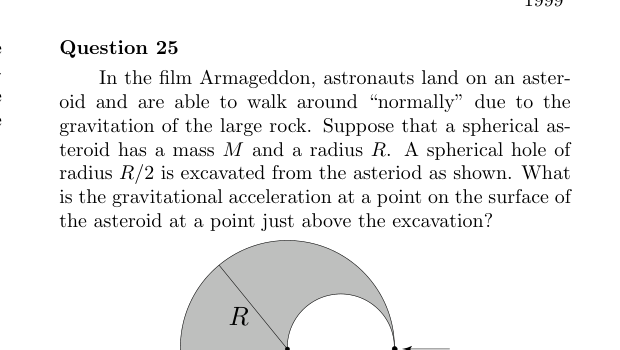
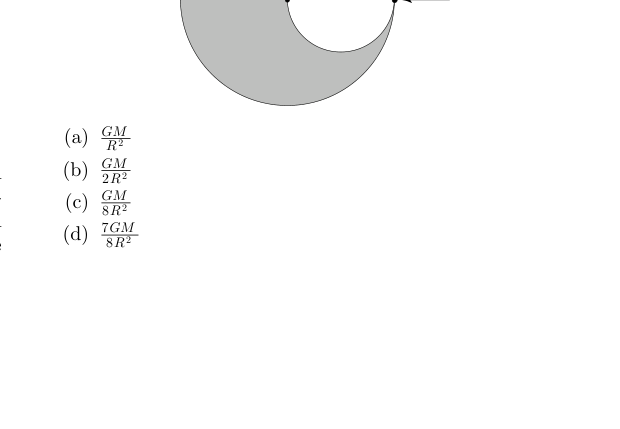
In the film Armageddon, astronauts land on an asteroid and are able to walk around “normally” due to the gravitation of the large rock. Suppose that a spherical asteroid has a mass and a radius . A spherical hole of radius is excavated from the asteroid as shown. What is the gravitational acceleration at a point on the surface of the asteroid at a point just above the excavation?
(A)
(B)
(C)
(D)
 sphere with hemispherical excavation of radius R/2
Topic: Gravitation, Newtonian Mechanics Metodi: Newton’s Law of Gravitation, Superposition Principle Competenze: Mathematical Modeling, Physical Reasoning Objects: Planet Fonte: Testo (PDF) — p.4
Nel film Armageddon, gli astronauti atterrano su un asteroide e sono in grado di camminare “normalmente” a causa della gravità della grande roccia. Supponiamo che un asteroide sferico abbia una massa e un raggio . Un buco sferico di raggio viene scavato dall’asteroide come mostrato. Qual è l’accelerazione gravitazionale di un punto sulla superficie dell’asteroide in un punto appena sopra l’escavazione?
(A)
(B)
(C)
(D)
sfera con scavo emisferico di raggio R/2
Topic: Gravitation, Newtonian Mechanics Metodi: Newton’s Law of Gravitation, Superposition Principle Competenze: Mathematical Modeling, Physical Reasoning Objects: Planet Fonte: Testo (PDF) — p.4
Four charges, each of charge , are at the four corners of a square of side cm. The four charges are fixed in place and are considered to be of point-size. Gravity plays no role in this question.
(a) Sketch a diagram of the electric field due to this charge system.
(b) What is the net force acting upon one of the charges?
(c) What is the electrostatic potential energy of this charge system?
(d) Now suppose that two of the charges are protons and the other two are positrons. A positron is the electron’s anti-particle. It has the same mass as an electron but a charge of . The four charges are suddenly released. What are their speeds when they are a significant distance apart from one another?
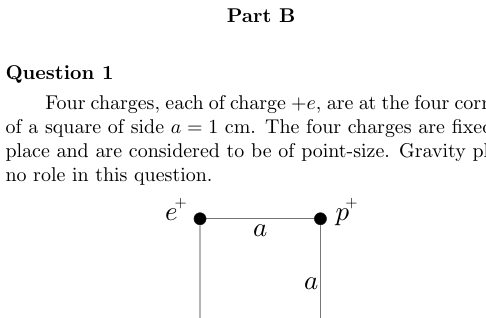 four charges at corners of square
Topic: Electrostatics, Conservation of Energy Metodi: Coulomb’s Law, Superposition Principle, Electric Potential Method, Energy Conservation Method Competenze: Mathematical Modeling, Diagrammatic Reasoning Objects: Point Charge Fonte: Testo (PDF) — p.5
Quattro cariche, ciascuna di carica , sono situate nei quattro angoli di un quadrato di lato cm. Le quattro cariche sono fissate e considerate di dimensioni di punto. La gravità non gioca un ruolo in questa domanda.
a) Segnare un diagramma del campo elettrico dovuto a questo sistema di carica.
b) Qual è la forza netta che agisce su una delle cariche?
c) Qual è l’energia potenziale elettrostatica di questo sistema di carica?
(d) Supponiamo che due delle cariche siano protoni e gli altri due positroni. Un positrone è l’antiparticella dell’elettrone. Ha la stessa massa di un elettrone ma una carica di . Le quattro accuse sono state rilasciate improvvisamente. Quali sono le loro velocità quando sono a una distanza significativa l’uno dall’altro?
quattro cariche in angoli di quadrato
Topic: Electrostatics, Conservation of Energy Metodi: Coulomb’s Law, Superposition Principle, Electric Potential Method, Energy Conservation Method Competenze: Mathematical Modeling, Diagrammatic Reasoning Objects: Point Charge Fonte: Testo (PDF) — p.5
Suppose that we have a string of equally spaced beads of mass , their surfaces being separated by a distance , that are free to slide without friction on a thin wire. Suppose that a constant force acts on the first bead, initially at rest, causing it to accelerate along the wire as shown. This force acts only on the first bead and might be created by a well directed, steady stream of air. The first bead will collide with the second, which will in turn collide with the third, and so on. Suppose that all collisions are elastic.
(a) What is the speed of the first bead immediately before and immediately after its collision with the second bead?
(b) What is the speed of the second bead immediately before and immediately after its collision with the third bead?
(c) Remember that the constant force is always acting upon the first bead. What is the time interval between subsequent collisions between the first and second beads? What then is the average speed of the first bead? What is the speed of the “shock wave” that travels down the wire?
(d) If the whole process is repeated, but with collisions which are perfectly inelastic, what is the terminal speed of the shock wave formed?
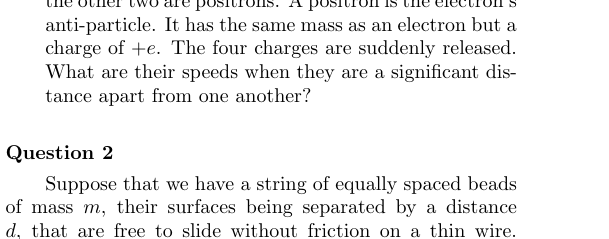 beads on wire with force F on first bead
Topic: Newtonian Mechanics, Conservation of Momentum, Conservation of Energy Metodi: Conservation of Momentum, Conservation Laws, Kinematic Equations, Impulse-Momentum Theorem Competenze: Mathematical Modeling, Physical Reasoning Objects: Wire, Block Fonte: Testo (PDF) — p.5
Supponiamo che abbiamo una catena di perle di massa , la loro superficie è separata da una distanza , che sono libere di scivolare senza attrito su un filo sottile. Supponiamo che una forza costante agisca sulla prima perla, inizialmente a riposo, causando un’accelerazione lungo il filo come mostrato. Questa forza agisce solo sul primo perlo e potrebbe essere creata da un flusso di aria ben diretto e costante. La prima perla colpirà con la seconda, che a sua volta colpirà con la terza, e così via. Supponiamo che tutte le collisioni siano elastiche.
a) Qual è la velocità della prima perla subito prima e subito dopo la collisione con la seconda perla?
b) Qual è la velocità della seconda perla subito prima e subito dopo la collisione con la terza perla?
(c) Ricordate che la forza costante agisce sempre sulla prima perla. Qual è l’intervallo di tempo tra le collisioni successive tra la prima e la seconda perla? Qual è la velocità media della prima perla? Qual è la velocità dell‘“onda di shock” che scorre lungo il filo?
d) Se l’intero processo viene ripetuto, ma con collisioni perfettamente inelasche, quale è la velocità terminale dell’onda d’urto formata?
perle su filo con forza F su prima perla
Topic: Newtonian Mechanics, Conservation of Momentum, Conservation of Energy Metodi: Conservation of Momentum, Conservation Laws, Kinematic Equations, Impulse-Momentum Theorem Competenze: Mathematical Modeling, Physical Reasoning Objects: Wire, Block Fonte: Testo (PDF) — p.5
From everyday experience and observations, estimate the brightness of a full moon as compared to the noon day sun. Brightness is defined as the luminous intensity as measured in units of power per unit area. To arrive at a reasonable numerical estimate, you will need to estimate some physical parameters. It is essential that you explain the reasoning behind your estimates and include detailed drawings and explanations to support your arguments.
Topic: Astrophysics, Order-of-Magnitude Estimation Metodi: Order-of-Magnitude Estimation, Physical Modeling Competenze: Estimation & Approximation, Physical Reasoning Objects: Satellite, Star Fonte: Testo (PDF) — p.5
Dall’esperienza e dalle osservazioni quotidiane, stima la luminosità di una luna piena rispetto al sole di mezzogiorno. La luminosità è definita come l’intensità luminosa misurata in unità di potenza per unità di area. Per arrivare a una stima numerica ragionevole, dovrai stimare alcuni parametri fisici. È essenziale che spieghi il ragionamento alla base delle tue stime e che includa dettagliati disegni e spiegazioni per sostenere i tuoi argomenti.
Topic: Astrophysics, Order-of-Magnitude Estimation Metodi: Order-of-Magnitude Estimation, Physical Modeling Competenze: Estimation & Approximation, Physical Reasoning Objects: Satellite, Star Fonte: Testo (PDF) — p.5