Un computer portatile esegue circa 30 milioni di somme al secondo.
Qual è l’ordine di grandezza delle somme che il computer riesce a fare nel tempo che tu hai a disposizione per rispondere al questionario?
- A.
- B.
- C.
- D.
- E. Topic: Order-of-Magnitude Estimation Metodi: Order-of-Magnitude Estimation, Dimensional Analysis Competenze: Estimation & Approximation Objects: — Fonte: Testo (PDF) — p.3 Risposta: B · Soluzioni (PDF)
A laptop performs about 30 million additions per second.
What is the order of magnitude of the additions that the computer can do in the time you have available to answer the questionnaire?
- A.
- B.
- C.
- D.
- E. Answer: B · Soluzioni (PDF)
Due carrelli si muovono lungo una retta e si urtano. I dati relativi sono rappresentati nella figura (in alto). Dopo la collisione i due carrelli si muovono come si vede nella parte in basso della figura.
Qual è il modulo della velocità del carrello da 2 kg dopo l’urto?
- A.
- B.
- C.
- D.
- E.
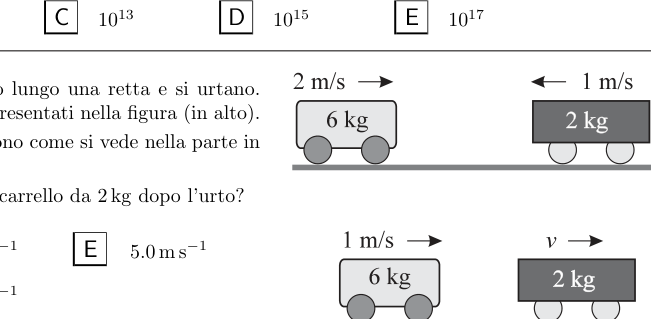 Before/after collision, two carts
Topic: Conservation of Momentum, Newtonian Mechanics Metodi: Conservation of Momentum, Free-Body Diagram Competenze: Physical Reasoning, Mathematical Modeling Objects: Cart Fonte: Testo (PDF) — p.3 Risposta: C · Soluzioni (PDF)
Two carts move along a straight line and collide. The relevant data are shown in the figure (at the top). After the collision the two carts move as shown in the lower part of the figure.
What is the magnitude of the velocity of the 2 kg cart after the collision?
- A.
- B.
- C.
- D.
- E.
Before/after collision, two carts
Answer: C · Soluzioni (PDF)
Un oggetto si trova ad una distanza da una lente convergente di focale .
Trovare a che distanza dall’oggetto si forma l’immagine.
- A. 5 cm
- B. 10 cm
- C. 15 cm
- D. 20 cm
- E. 25 cm Topic: Geometric Optics Metodi: Thin Lens & Mirror Equation Competenze: Mathematical Modeling, Physical Reasoning Objects: Lens Fonte: Testo (PDF) — p.3 Risposta: A · Soluzioni (PDF)
An object is located at a distance from a converging lens with focal length .
Find at what distance from the object the image is formed.
- A. 5 cm
- B. 10 cm
- C. 15 cm
- D. 20 cm
- E. 25 cm Answer: A · Soluzioni (PDF)
Il diagramma rappresenta l’andamento velocità-tempo di cinque automobili diverse, A, B, C, D ed E.
Qual è l’automobile che ha l’accelerazione più grande in modulo, nell’intervallo di tempo che va da 10 s a 15 s?
- A. A
- B. B
- C. C
- D. D
- E. E
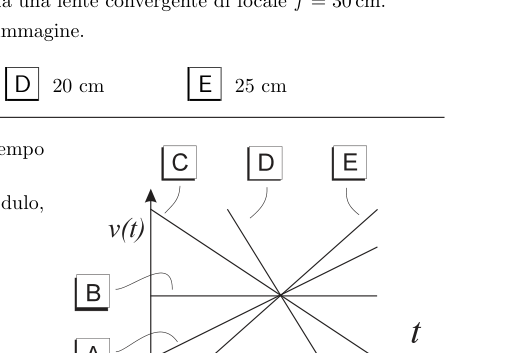 Velocity-time graph for five cars
Topic: Newtonian Mechanics Metodi: Kinematic Equations, Graph Linearization Competenze: Diagrammatic Reasoning, Physical Reasoning Objects: — Fonte: Testo (PDF) — p.3 Risposta: D · Soluzioni (PDF)
The diagram represents the velocity-time trend of five different cars, A, B, C, D and E.
Which car has the greatest acceleration in magnitude, in the time interval from 10 s to 15 s?
- A. A
- B. B
- C. C
- D. D
- E. E
Velocity-time graph for five cars
Answer: D · Soluzioni (PDF)
Un palloncino, dopo essere stato gonfiato a fiato, viene lasciato cadere dal soffitto di una palestra della scuola fino al pavimento, 10 metri sottostante.
Quale dei grafici seguenti rappresenta meglio la sua velocità in funzione del tempo?
- A. A
- B. B
- C. C
- D. D
- E. E
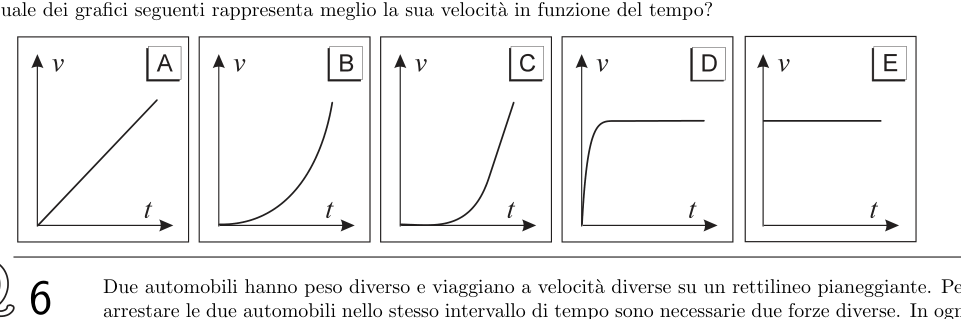 Five v(t) graphs for falling balloon
Topic: Newtonian Mechanics, Fluid Mechanics Metodi: Kinematic Equations, Free-Body Diagram Competenze: Diagrammatic Reasoning, Physical Reasoning Objects: Ball Fonte: Testo (PDF) — p.3 Risposta: D · Soluzioni (PDF)
A balloon, after being inflated by mouth, is dropped from the ceiling of a school gymnasium to the floor, 10 meters below.
Which of the following graphs best represents its velocity as a function of time?
- A. A
- B. B
- C. C
- D. D
- E. E
Five v(t) graphs for falling balloon
Answer: D · Soluzioni (PDF)
Due automobili hanno peso diverso e viaggiano a velocità diverse su un rettilineo pianeggiante. Per arrestare le due automobili nello stesso intervallo di tempo sono necessarie due forze diverse. In ogni caso, la forza maggiore è quella richiesta per fermare l’automobile che ha maggiore …
- A. … energia cinetica.
- B. … massa.
- C. … peso.
- D. … quantità di moto.
- E. … velocità. Topic: Newtonian Mechanics, Conservation of Momentum Metodi: Impulse-Momentum Theorem, Free-Body Diagram Competenze: Physical Reasoning Objects: — Fonte: Testo (PDF) — p.3 Risposta: D · Soluzioni (PDF)
Two cars have different weights and travel at different speeds on a flat straight road. To stop the two cars in the same time interval, two different forces are needed. In any case, the greater force is the one required to stop the car that has greater …
- A. … kinetic energy.
- B. … mass.
- C. … weight.
- D. … momentum.
- E. … speed. Answer: D · Soluzioni (PDF)
Una sciatrice di 50 kg si lascia andare, dal fianco di una collinetta (punto A in figura), ad un’altezza , superando un secondo rilievo alto ed arrivando in piano nel punto C. In tutto questo percorso l’attrito si può considerare trascurabile.
Qual è la velocità della sciatrice nel punto più alto (B) del secondo rilievo?
- A.
- B.
- C.
- D.
- E.
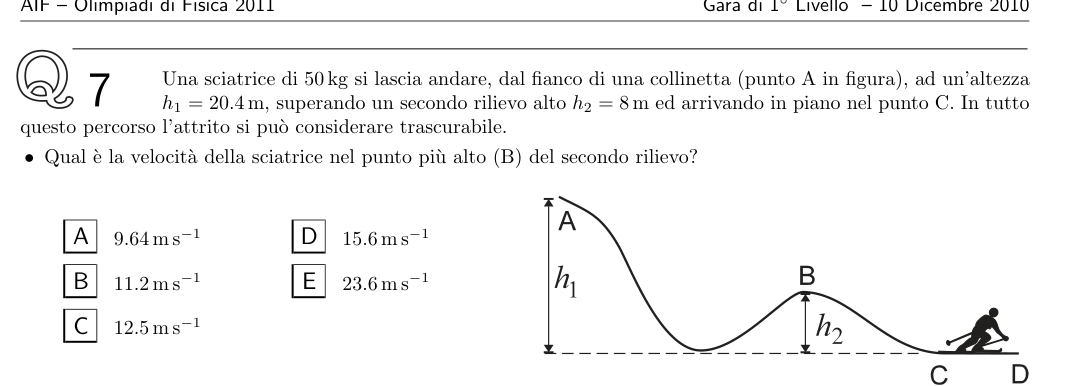 Ski slope with points A, B, C
Topic: Conservation of Energy, Newtonian Mechanics Metodi: Energy Conservation Method, Kinematic Equations Competenze: Physical Reasoning, Mathematical Modeling Objects: — Fonte: Testo (PDF) — p.4 Risposta: D · Soluzioni (PDF)
A 50 kg skier lets herself go, from the side of a small hill (point A in the figure), at a height , passing over a second rise of height and arriving on flat ground at point C. Along this entire path, friction can be considered negligible.
What is the skier’s speed at the highest point (B) of the second rise?
- A.
- B.
- C.
- D.
- E.
Ski slope with points A, B, C
Answer: D · Soluzioni (PDF)
Con riferimento al quesito precedente, arrivata nel punto C, la sciatrice frena e si ferma dopo 48 m, nel punto D.
Quanto vale il valor medio della forza frenante nel tratto CD?
- A. 86.1 N
- B. 208 N
- C. 282 N
- D. 328 N
- E. 490 N Topic: Conservation of Energy, Newtonian Mechanics Metodi: Energy Conservation Method, Free-Body Diagram Competenze: Physical Reasoning, Mathematical Modeling Objects: — Fonte: Testo (PDF) — p.4 Risposta: B · Soluzioni (PDF)
With reference to the previous question, once she has reached point C, the skier brakes and stops after 48 m, at point D.
What is the average value of the braking force over the segment CD?
- A. 86.1 N
- B. 208 N
- C. 282 N
- D. 328 N
- E. 490 N Answer: B · Soluzioni (PDF)
Nel circuito elettrico mostrato in figura, alimentato da una batteria che può essere trattata come un generatore ideale, la corrente attraverso il resistore da è di 3 A.
Quanto vale la f.e.m. della batteria?
- A. 51 V
- B. 42 V
- C. 36 V
- D. 24 V
- E. 21 V
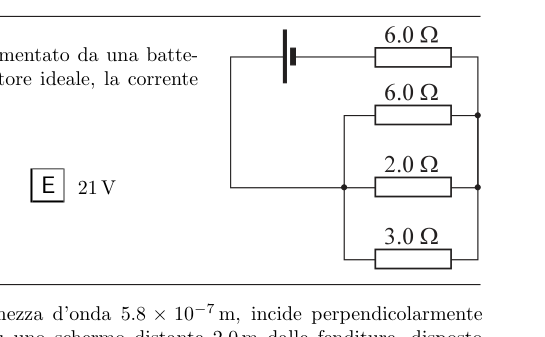 Resistor network with battery
Topic: Circuits Metodi: Kirchhoff’s Laws, Equivalent Circuit Reduction Competenze: Physical Reasoning, Mathematical Modeling Objects: Resistor, Battery, Wire Fonte: Testo (PDF) — p.4 Risposta: B · Soluzioni (PDF)
In the electrical circuit shown in the figure, powered by a battery that can be treated as an ideal generator, the current through the resistor from is 3 A.
How much is the f.e.m. worth? della batteria?
- A. 51 V
- B. 42 V
- C. 36 V
- D. 24 V
- E. 21 V
Resistor network with battery
Topic: Circuits Metodi: Kirchhoff’s Laws, Equivalent Circuit Reduction Competenze: Physical Reasoning, Mathematical Modeling Objects: Resistor, Battery, Wire Fonte: Testo (PDF) — p.4 Risposta: B · Soluzioni (PDF)
Un raggio di luce monocromatico, di lunghezza d’onda , incide perpendicolarmente su due fenditure distanti . Su uno schermo distante 2.0 m dalle fenditure, disposto parallelamente al piano delle fenditure, si forma una figura d’interferenza.
Qual è, sullo schermo, la distanza tra il massimo centrale e quello del primo ordine?
- A.
- B.
- C.
- D.
- E. Topic: Wave Optics Metodi: Interference & Diffraction Analysis, Superposition Principle Competenze: Mathematical Modeling, Physical Reasoning Objects: Slit, Screen Fonte: Testo (PDF) — p.4 Risposta: C · Soluzioni (PDF)
A monochromatic light ray, with wavelength , strikes perpendicularly two slits that are apart. On a screen 2.0 m from the slits, placed parallel to the plane of the slits, an interference pattern is formed.
What is, on the screen, the distance between the central maximum and the first-order one?
- A.
- B.
- C.
- D.
- E. Answer: C · Soluzioni (PDF)
Un’automobile di massa accelera uniformemente, su un tratto rettilineo di strada, da a in 5 s.
Quanto vale l’intensità della forza risultante che ha agito sull’automobile durante questo intervallo di tempo?
- A.
- B.
- C.
- D.
- E. Topic: Newtonian Mechanics Metodi: Kinematic Equations, Free-Body Diagram Competenze: Mathematical Modeling, Physical Reasoning Objects: — Fonte: Testo (PDF) — p.4 Risposta: B · Soluzioni (PDF)
A car of mass accelerates uniformly, on a straight stretch of road, from to in 5 s.
What is the magnitude of the resultant force that acted on the car during this time interval?
- A.
- B.
- C.
- D.
- E. Answer: B · Soluzioni (PDF)
Una bombola d’aria utilizzata da un sommozzatore è riempita ad una pressione di 20 MPa, alla temperatura di 20°C. La valvola di sicurezza della bombola è tarata in modo da aprirsi quando la pressione raggiunge i 24.5 MPa. La bombola, piena, viene lasciata al sole.
La valvola entrerebbe in funzione se la bombola raggiungesse una temperatura di …
- A. … 62°C
- B. … 86°C
- C. … 104°C
- D. … 125°C
- E. … 137°C Topic: Thermodynamics, Kinetic Theory Metodi: Ideal Gas Law Competenze: Mathematical Modeling, Physical Reasoning Objects: Container, Gas Fonte: Testo (PDF) — p.4 Risposta: B · Soluzioni (PDF)
An air cylinder used by a diver is filled at a pressure of 20 MPa, at a temperature of 20°C. The safety valve of the cylinder is set to open when the pressure reaches 24.5 MPa. The full cylinder is left in the sun.
The valve would activate if the cylinder reached a temperature of …
- A. … 62°C
- B. … 86°C
- C. … 104°C
- D. … 125°C
- E. … 137°C Answer: B · Soluzioni (PDF)
Un oggetto, rappresentato schematicamente da una freccia, è collocato davanti ad uno specchio concavo. Sia C il centro di curvatura dello specchio, ed F il fuoco.
Quale diagramma mostra correttamente il punto (Im) in cui si forma l’immagine della punta della freccia?
- A. A
- B. B
- C. C
- D. D
- E. E
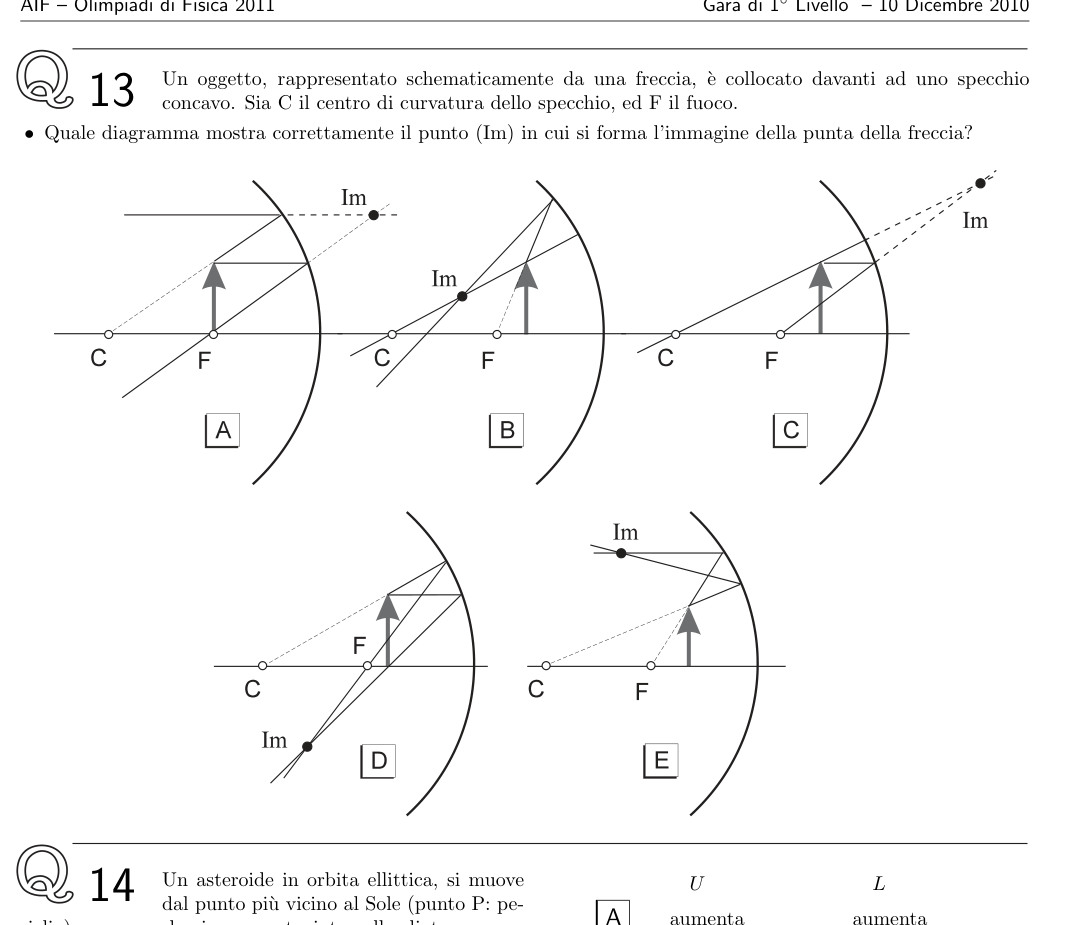 Five concave mirror ray diagrams
Topic: Geometric Optics Metodi: Ray Tracing, Thin Lens & Mirror Equation Competenze: Diagrammatic Reasoning, Physical Reasoning Objects: Mirror Fonte: Testo (PDF) — p.5 Risposta: C · Soluzioni (PDF)
An object, schematically represented by an arrow, is placed in front of a concave mirror. Let C be the center of curvature of the mirror, and F the focus.
Which diagram correctly shows the point (Im) at which the image of the tip of the arrow forms?
- A. A
- B. B
- C. C
- D. D
- E. E
Five concave mirror ray diagrams
Answer: C · Soluzioni (PDF)
Un asteroide in orbita ellittica, si muove dal punto più vicino al Sole (punto P: perielio) percorrendo, in un certo intervallo di tempo, un quarto della sua orbita fino al punto Q.
Quali cambiamenti avvengono alla sua energia potenziale gravitazionale e al modulo del suo momento angolare (calcolato rispetto al Sole) tra i punti P e Q?
- A. | aumenta | aumenta |
- B. | diminuisce | rimane invariato |
- C. | rimane invariata | diminuisce |
- D. | aumenta | rimane invariato |
- E. | diminuisce | aumenta |
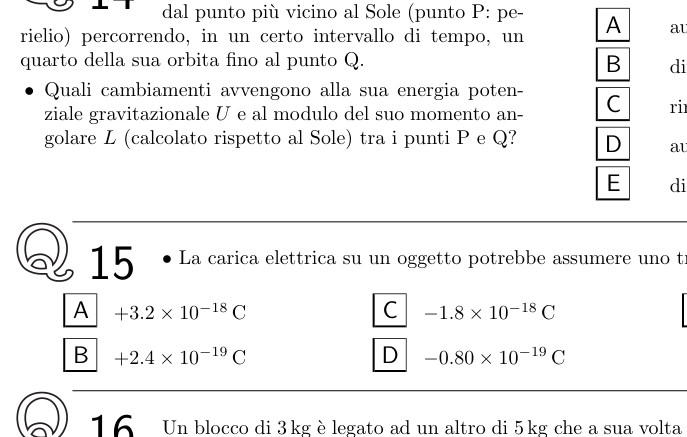 Elliptical orbit with perihelion P and point Q
Topic: Gravitation, Conservation of Momentum Metodi: Conservation Laws, Kepler’s Laws, Newton’s Law of Gravitation Competenze: Physical Reasoning, Diagrammatic Reasoning Objects: Planet, Star Fonte: Testo (PDF) — p.5 Risposta: D · Soluzioni (PDF)
An asteroid in an elliptical orbit moves from the point closest to the Sun (point P: perihelion), traveling, in a certain time interval, a quarter of its orbit to point Q.
What changes occur in its gravitational potential energy and in the magnitude of its angular momentum (calculated with respect to the Sun) between points P and Q?
- A. | increases | increases |
- B. | decreases | remains unchanged |
- C. | remains unchanged | decreases |
- D. | increases | remains unchanged |
- E. | decreases | increases |
Elliptical orbit with perihelion P and point Q
Answer: D · Soluzioni (PDF)
La carica elettrica su un oggetto potrebbe assumere uno tra i seguenti valori. Quale?
- A.
- B.
- C.
- D.
- E. Topic: Electrostatics, Modern-Quantum Physics Metodi: Coulomb’s Law Competenze: Physical Reasoning, Unit Conversion Objects: Point Charge Fonte: Testo (PDF) — p.5 Risposta: A · Soluzioni (PDF)
The electric charge on an object could take one of the following values. Which one?
- A.
- B.
- C.
- D.
- E. Answer: A · Soluzioni (PDF)
Un blocco di 3 kg è legato ad un altro di 5 kg che a sua volta è tirato da una forza orizzontale che fa muovere i due blocchi su un piano privo di attrito. L’accelerazione dei due blocchi è di .
Quanto vale il modulo della forza?
- A. 3.6 N
- B. 5.4 N
- C. 7.2 N
- D. 9.0 N
- E. 14.4 N
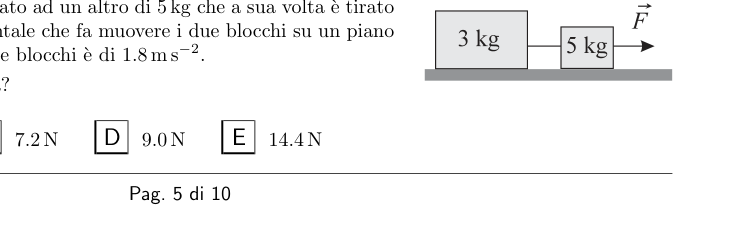 Two blocks connected with horizontal force
Topic: Newtonian Mechanics Metodi: Free-Body Diagram, Kinematic Equations Competenze: Physical Reasoning, Mathematical Modeling Objects: Block Fonte: Testo (PDF) — p.5 Risposta: E · Soluzioni (PDF)
A 3 kg block is tied to another 5 kg block which in turn is pulled by a horizontal force that makes the two blocks move on a frictionless plane. The acceleration of the two blocks is .
What is the magnitude of the force?
- A. 3.6 N
- B. 5.4 N
- C. 7.2 N
- D. 9.0 N
- E. 14.4 N
Two blocks connected with horizontal force
Answer: E · Soluzioni (PDF)
Un campione solido viene riscaldato e si osserva che la sua temperatura aumenta, ma il solido non fonde.
Quale, tra le affermazioni seguenti, descrive meglio come variano l’energia cinetica media e l’energia potenziale media delle molecole del campione durante il riscaldamento?
- A. L’energia potenziale diminuisce e l’energia cinetica aumenta.
- B. L’energia potenziale aumenta e l’energia cinetica rimane costante.
- C. L’energia potenziale rimane costante e l’energia cinetica diminuisce.
- D. L’energia potenziale rimane costante e l’energia cinetica aumenta.
- E. Sia l’energia potenziale che l’energia cinetica decrescono. Topic: Thermodynamics, Kinetic Theory Metodi: Kinetic Theory of Gases, First Law of Thermodynamics Competenze: Physical Reasoning Objects: — Fonte: Testo (PDF) — p.6 Risposta: D · Soluzioni (PDF)
A solid sample is heated and its temperature is observed to increase, but the solid does not melt.
Which of the following statements best describes how the average kinetic energy and the average potential energy of the molecules of the sample vary during heating?
- A. The potential energy decreases and the kinetic energy increases.
- B. The potential energy increases and the kinetic energy remains constant.
- C. The potential energy remains constant and the kinetic energy decreases.
- D. The potential energy remains constant and the kinetic energy increases.
- E. Both the potential energy and the kinetic energy decrease. Answer: D · Soluzioni (PDF)
Due punte di plastica sono uguali ed entrambe ugualmente cariche con carica negativa; esse sono disposte ad uguale distanza da una sferetta carica positivamente, come mostrato in figura.
Quale dei seguenti vettori rappresenta meglio la forza elettrostatica agente sulla sferetta?
- A. A
- B. B
- C. C
- D. D
- E. E
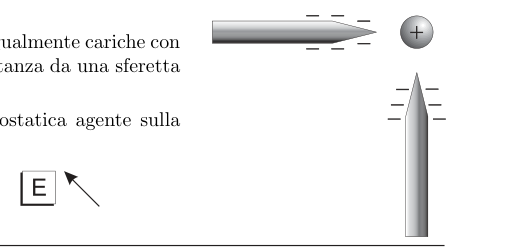 Two negative charges and positive sphere
Topic: Electrostatics Metodi: Coulomb’s Law, Vector Decomposition, Superposition Principle Competenze: Diagrammatic Reasoning, Physical Reasoning Objects: Point Charge Fonte: Testo (PDF) — p.6 Risposta: D · Soluzioni (PDF)
Two plastic tips are identical and both equally charged with negative charge; they are arranged at equal distance from a positively charged small sphere, as shown in the figure.
Which of the following vectors best represents the electrostatic force acting on the small sphere?
- A. A
- B. B
- C. C
- D. D
- E. E
Two negative charges and positive sphere
Answer: D · Soluzioni (PDF)
Fotoni con un’energia di 7.9 eV incidono su una lastra di zinco, provocando l’emissione di elettroni la cui energia cinetica ha un valore massimo di 4.0 eV.
Il lavoro di estrazione dello zinco …
- A. … è 11.9 eV.
- B. … è 7.9 eV.
- C. … è 4.0 eV.
- D. … è 3.9 eV.
- E. … non può essere determinato con i dati a disposizione. Topic: Modern-Quantum Physics Metodi: Photon Energy Relation Competenze: Physical Reasoning, Mathematical Modeling Objects: Photon, Electron Fonte: Testo (PDF) — p.6 Risposta: D · Soluzioni (PDF)
Photons with an energy of 7.9 eV strike a zinc plate, causing the emission of electrons whose kinetic energy has a maximum value of 4.0 eV.
The work function of zinc …
- A. … is 11.9 eV.
- B. … is 7.9 eV.
- C. … is 4.0 eV.
- D. … is 3.9 eV.
- E. … cannot be determined with the available data. Answer: D · Soluzioni (PDF)
1.5 L d’acqua si trovano alla pressione atmosferica e alla temperatura di 20°C. Successivamente l’acqua viene scaldata da un bollitore che le fornisce 2.2 kJ di energia al secondo. Si supponga di poter trascurare il calore disperso e l’evaporazione dell’acqua che avviene al di sotto del punto di ebollizione.
Dopo 20 minuti …
- A. … la temperatura dell’acqua è arrivata a 22.4°C.
- B. … la temperatura dell’acqua è arrivata a 84.3°C.
- C. … l’acqua sta bollendo e rimangono 550 cm³ di liquido.
- D. … l’acqua sta bollendo e rimangono 50 cm³ di liquido.
- E. … tutta l’acqua è passata allo stato di vapore. Topic: Thermodynamics Metodi: First Law of Thermodynamics, Ideal Gas Law Competenze: Mathematical Modeling, Physical Reasoning Objects: — Fonte: Testo (PDF) — p.6 Risposta: C · Soluzioni (PDF)
1.5 L of water are at atmospheric pressure and at a temperature of 20°C. Subsequently the water is heated by a kettle that supplies it with 2.2 kJ of energy per second. Assume that the heat lost and the evaporation of the water that occurs below the boiling point can be neglected.
After 20 minutes …
- A. … the temperature of the water has reached 22.4°C.
- B. … the temperature of the water has reached 84.3°C.
- C. … the water is boiling and 550 cm³ of liquid remain.
- D. … the water is boiling and 50 cm³ of liquid remain.
- E. … all the water has turned into steam. Answer: C · Soluzioni (PDF)
La figura mostra un’onda progressiva su una corda.
Quale coppia di punti si muove in fase?
- A. A, D
- B. A, G
- C. C, K
- D. D, I
- E. F, H
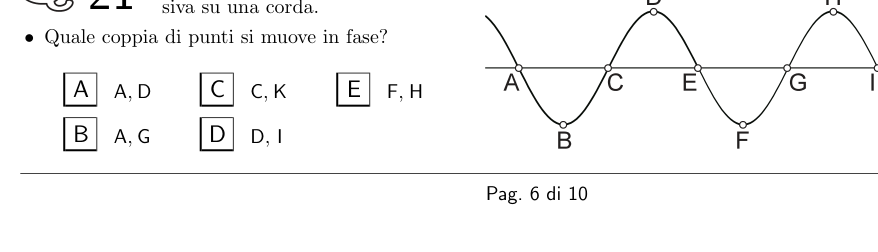 Progressive wave on string with labeled points
Topic: Oscillations & Waves Metodi: Wave Equation, Superposition Principle Competenze: Diagrammatic Reasoning, Physical Reasoning Objects: String Fonte: Testo (PDF) — p.6 Risposta: C · Soluzioni (PDF)
The figure shows a progressive wave on a string.
Which pair of points moves in phase?
- A. A, D
- B. A, G
- C. C, K
- D. D, I
- E. F, H
Progressive wave on string with labeled points
Answer: C · Soluzioni (PDF)
La porta di un forno industriale ha un coefficiente di conducibilità termica ed uno spessore di 3 mm. La porta viene sostituita da un’altra porta di conducibilità termica e spessore 9 mm.
A parità di temperatura dell’ambiente esterno e del forno, la sostituzione ha moltiplicato la potenza termica dispersa attraverso la porta di un fattore …
- A. … 0.15
- B. … 0.79
- C. … 1
- D. … 1.38
- E. … 1.84 Topic: Thermodynamics Metodi: Physical Modeling, Dimensional Analysis Competenze: Mathematical Modeling, Physical Reasoning Objects: — Fonte: Testo (PDF) — p.7 Risposta: B · Soluzioni (PDF)
The door of an industrial oven has a thermal conductivity coefficient and a thickness of 3 mm. The door is replaced by another door with thermal conductivity and thickness 9 mm.
With the external environment and oven temperature unchanged, the replacement multiplied the thermal power dissipated through the door by a factor of …
- A. … 0.15
- B. … 0.79
- C. … 1
- D. … 1.38
- E. … 1.84 Answer: B · Soluzioni (PDF)
Un uccello si posa esattamente nel punto medio di un filo lungo 6 m, di massa trascurabile, teso tra due supporti; in quel punto a causa del suo peso, l’uccello fa abbassare il filo di 10 cm.
Sapendo che la tensione del filo è di 70 N, determinare la massa dell’uccello.
- A. 121 g
- B. 232 g
- C. 365 g
- D. 476 g
- E. 554 g
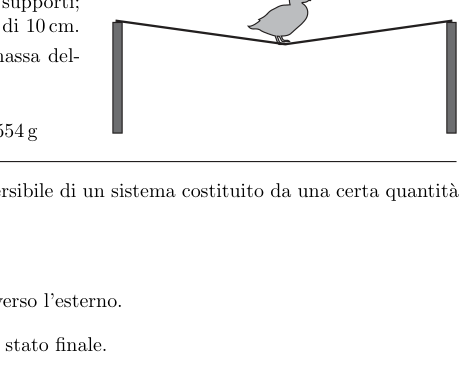 Bird on wire with sag geometry
Topic: Rigid Body Statics, Newtonian Mechanics Metodi: Free-Body Diagram, Vector Decomposition Competenze: Mathematical Modeling, Physical Reasoning Objects: String Fonte: Testo (PDF) — p.7 Risposta: D · Soluzioni (PDF)
A bird lands exactly at the midpoint of a 6 m long wire, of negligible mass, stretched between two supports; at that point, due to its weight, the bird makes the wire sag by 10 cm.
Knowing that the tension of the wire is 70 N, determine the mass of the bird.
- A. 121 g
- B. 232 g
- C. 365 g
- D. 476 g
- E. 554 g
Bird on wire with sag geometry
Answer: D · Soluzioni (PDF)
Si consideri una trasformazione adiabatica reversibile di un sistema costituito da una certa quantità di gas perfetto.
Quale delle seguenti affermazioni è falsa?
- A. Non c’è flusso di calore dall’esterno del sistema, né verso l’esterno.
- B. L’entropia dello stato iniziale è uguale a quella dello stato finale.
- C. La variazione di energia interna del gas è pari a .
- D. Il lavoro meccanico fatto dal gas è dato da .
- E. La temperatura del gas rimane costante. Topic: Thermodynamics Metodi: Thermodynamic Cycle Analysis, First Law of Thermodynamics Competenze: Physical Reasoning Objects: Gas Fonte: Testo (PDF) — p.7 Risposta: E · Soluzioni (PDF)
Consider a reversible adiabatic transformation of a system consisting of a certain amount of ideal gas.
Which of the following statements is false?
- A. There is no heat flow from outside the system, nor toward the outside.
- B. The entropy of the initial state is equal to that of the final state.
- C. The change in internal energy of the gas is equal to .
- D. The mechanical work done by the gas is given by .
- E. The temperature of the gas remains constant. Answer: E · Soluzioni (PDF)
La figura mostra un raggio di luce che passa da un mezzo ad un altro.
Quando la luce passa dal mezzo A al mezzo B:
- A. sia la velocità sia la frequenza diminuiscono.
- B. la velocità diminuisce, la frequenza non cambia.
- C. sia la velocità sia la frequenza restano inalterate.
- D. sia la velocità sia la frequenza aumentano.
- E. la velocità aumenta, la frequenza non cambia.
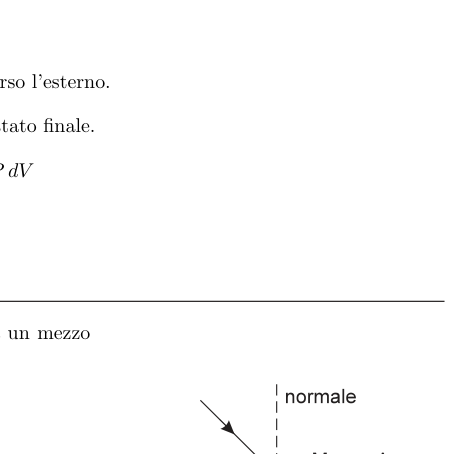 Light ray passing from medium A to B
Topic: Geometric Optics, Wave Optics Metodi: Snell’s Law, Ray Tracing Competenze: Diagrammatic Reasoning, Physical Reasoning Objects: — Fonte: Testo (PDF) — p.7 Risposta: B · Soluzioni (PDF)
The figure shows a light ray passing from one medium to another.
When light passes from medium A to medium B:
- A. both the speed and the frequency decrease.
- B. the speed decreases, the frequency does not change.
- C. both the speed and the frequency remain unchanged.
- D. both the speed and the frequency increase.
- E. the speed increases, the frequency does not change.
Light ray passing from medium A to B
Answer: B · Soluzioni (PDF)
Un fluido omogeneo e non comprimibile scorre in regime stazionario entro una tubazione disposta orizzontalmente che, come in figura, presenta un restringimento.
Quali, tra le seguenti relazioni di velocità e pressione, nei due punti indicati in figura, sono entrambe corrette?
- A. e
- B. e
- C. e
- D. e
- E. e
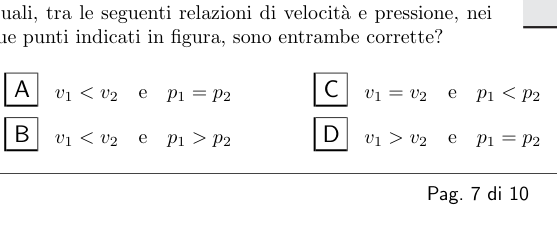 Horizontal tube with constriction
Topic: Fluid Mechanics Metodi: Bernoulli’s Equation, Continuity Equation Competenze: Physical Reasoning, Diagrammatic Reasoning Objects: Tube Fonte: Testo (PDF) — p.7 Risposta: B · Soluzioni (PDF)
A homogeneous and incompressible fluid flows in steady state within a horizontally arranged pipe that, as in the figure, has a narrowing.
Which, among the following relations of velocity and pressure, at the two points indicated in the figure, are both correct?
- A. and
- B. and
- C. and
- D. and
- E. and
Horizontal tube with constriction
Answer: B · Soluzioni (PDF)
Un camioncino viene pesato su una bilancia stradale: il peso è 10000 N e di questo 8000 N gravano sull’asse posteriore.
Sapendo che la distanza tra gli assi è di 3 m determinare la distanza in orizzontale ( in figura) tra l’asse posteriore e il centro di massa del camioncino.
- A. 0.6 m
- B. 0.8 m
- C. 1.2 m
- D. 2.0 m
- E. 3.0 m
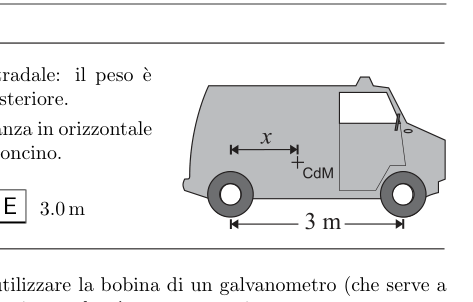 Truck on scale with axle forces
Topic: Rigid Body Statics Metodi: Torque & Angular Momentum Analysis, Free-Body Diagram Competenze: Mathematical Modeling, Physical Reasoning Objects: Wheel Fonte: Testo (PDF) — p.8 Risposta: A · Soluzioni (PDF)
A small truck is weighed on a road scale: the weight is 10000 N and of this 8000 N bears on the rear axle.
Knowing that the distance between the axles is 3 m, determine the horizontal distance ( in the figure) between the rear axle and the center of mass of the small truck.
- A. 0.6 m
- B. 0.8 m
- C. 1.2 m
- D. 2.0 m
- E. 3.0 m
Truck on scale with axle forces
Answer: A · Soluzioni (PDF)
Per costruire un voltmetro si può pensare di utilizzare la bobina di un galvanometro (che serve a misurare piccole correnti che lo attraversano) insieme ad un’opportuna resistenza.
- A. Occorre una grande resistenza in serie al galvanometro.
- B. Occorre una piccola resistenza in serie al galvanometro.
- C. Occorre una grande resistenza in parallelo al galvanometro.
- D. Occorre una piccola resistenza in parallelo al galvanometro.
- E. Non si può ottenere un voltmetro usando un galvanometro. Topic: Circuits, Electromagnetism Metodi: Kirchhoff’s Laws, Equivalent Circuit Reduction Competenze: Physical Reasoning Objects: Galvanometer, Resistor, Coil Fonte: Testo (PDF) — p.8 Risposta: A · Soluzioni (PDF)
To build a voltmeter, one can consider using the coil of a galvanometer (which is used to measure small currents passing through it) together with a suitable resistance.
- A. A large resistance in series with the galvanometer is needed.
- B. A small resistance in series with the galvanometer is needed.
- C. A large resistance in parallel with the galvanometer is needed.
- D. A small resistance in parallel with the galvanometer is needed.
- E. A voltmeter cannot be obtained using a galvanometer. Answer: A · Soluzioni (PDF)
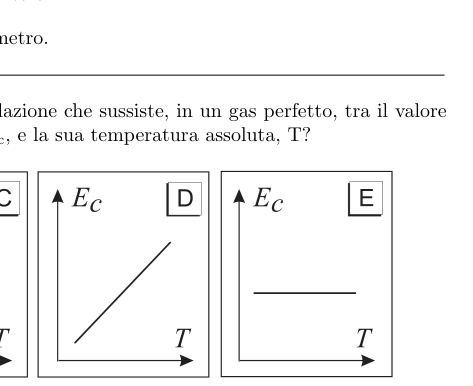
Quale, tra i grafici mostrati, rappresenta la relazione che sussiste, in un gas perfetto, tra il valore medio dell’energia cinetica di una molecola, , e la sua temperatura assoluta, ?
- A. A
- B. B
- C. C
- D. D
- E. E
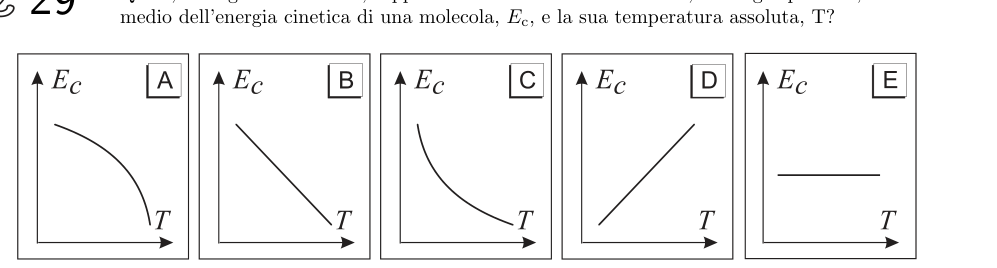 Five graphs of Ec vs temperature
Topic: Kinetic Theory, Thermodynamics Metodi: Kinetic Theory of Gases, Graph Linearization Competenze: Diagrammatic Reasoning, Physical Reasoning Objects: Gas Fonte: Testo (PDF) — p.8 Risposta: D · Soluzioni (PDF)
Which, among the graphs shown, represents the relationship that exists, in a perfect gas, between the average value of the kinetic energy of a molecule, , and its absolute temperature, ?
- A. A
- B. B
- C. C
- D. D
- E. E
Five graphs of Ec vs temperature
Answer: D · Soluzioni (PDF)
Il grafico in figura rappresenta, in funzione del tempo, la posizione di un oggetto che si muove lungo l’asse .
In quale tratto, tra quelli indicati con A, B, C, D od E, la velocità del corpo è positiva mentre la sua accelerazione è negativa?
- A. A
- B. B
- C. C
- D. D
- E. E
 Position vs time graph with labeled segments
Topic: Newtonian Mechanics Metodi: Kinematic Equations, Graph Linearization Competenze: Diagrammatic Reasoning, Physical Reasoning Objects: — Fonte: Testo (PDF) — p.8 Risposta: E · Soluzioni (PDF)
The graph in the figure represents, as a function of time, the position of an object moving along the axis.
In which segment, among those indicated with A, B, C, D or E, is the velocity of the body positive while its acceleration is negative?
- A. A
- B. B
- C. C
- D. D
- E. E
Position vs time graph with labeled segments
Answer: E · Soluzioni (PDF)
Il grafico rappresenta la forza elastica di una molla in funzione dell’allungamento della molla stessa.
Quanto lavoro si compie per allungare questa molla di 40 cm?
- A. 4.8 J
- B. 6.0 J
- C. 9.6 J
- D. 9.8 J
- E. 24 J
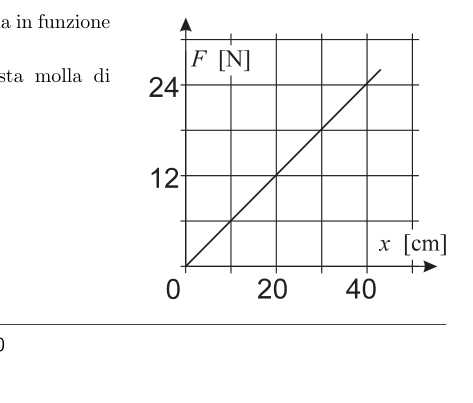 Spring force vs elongation graph
Topic: Oscillations & Waves, Conservation of Energy Metodi: Hooke’s Law, Energy Conservation Method Competenze: Diagrammatic Reasoning, Mathematical Modeling Objects: Spring Fonte: Testo (PDF) — p.8 Risposta: A · Soluzioni (PDF)
The graph represents the elastic force of a spring as a function of the elongation of the spring itself.
How much work is done to stretch this spring by 40 cm?
- A. 4.8 J
- B. 6.0 J
- C. 9.6 J
- D. 9.8 J
- E. 24 J
Spring force vs elongation graph
Answer: A · Soluzioni (PDF)
Una studentessa deve determinare la densità di un liquido. Le misure eseguite sono le seguenti:
- Volume di liquido in un becher: 20.0 mL
- Massa del becher vuoto: 30.0 g
- Massa del becher pieno: 45.0 g
La densità del liquido è
- A.
- B.
- C.
- D.
- E. Topic: Fluid Mechanics, Order-of-Magnitude Estimation Metodi: Dimensional Analysis, Experimental Data Analysis Competenze: Measurement & Instrumentation, Unit Conversion Objects: Container Fonte: Testo (PDF) — p.9 Risposta: C · Soluzioni (PDF)
A student must determine the density of a liquid. The measurements taken are the following:
- Volume of liquid in a beaker: 20.0 mL
- Mass of the empty beaker: 30.0 g
- Mass of the full beaker: 45.0 g
The density of the liquid is
- A.
- B.
- C.
- D.
- E. Answer: C · Soluzioni (PDF)
Un’automobile di 900 kg percorre lentamente una curva a raggio costante di 25 m, essendo la strada scivolosa. Il modulo della sua velocità è pari a mentre il coefficiente d’attrito tra le ruote e la strada è 0.51.
Quanto vale la forza d’attrito tra le ruote e la strada, se l’automobile riesce a completare la curva?
- A.
- B.
- C.
- D.
- E. Topic: Newtonian Mechanics Metodi: Free-Body Diagram, Kinematic Equations Competenze: Physical Reasoning, Mathematical Modeling Objects: Wheel Fonte: Testo (PDF) — p.9 Risposta: E · Soluzioni (PDF)
A 900 kg car slowly travels around a curve with a constant radius of 25 m, the road being slippery. The magnitude of its speed is equal to while the coefficient of friction between the wheels and the road is 0.51.
What is the value of the friction force between the wheels and the road, if the car manages to complete the curve?
- A.
- B.
- C.
- D.
- E. Answer: E · Soluzioni (PDF)
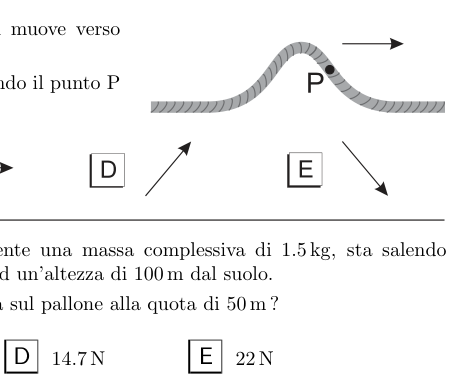
La figura mostra un impulso trasversale che si muove verso destra su una corda. P è un punto della corda.
Quale vettore indica la direzione e il verso in cui si sta muovendo il punto P in questo istante?
- A. A
- B. B
- C. C
- D. D
- E. E
 Transverse pulse on string with point P
Topic: Oscillations & Waves Metodi: Wave Equation Competenze: Diagrammatic Reasoning, Physical Reasoning Objects: String Fonte: Testo (PDF) — p.9 Risposta: A · Soluzioni (PDF)
The figure shows a transverse pulse moving to the right along a string. P is a point on the string.
Which vector indicates the direction and sense in which point P is moving at this instant?
- A. A
- B. B
- C. C
- D. D
- E. E
Transverse pulse on string with point P
Answer: A · Soluzioni (PDF)
Un pallone aerostatico, riempito di elio ed avente una massa complessiva di 1.5 kg, sta salendo velocemente, a velocità verticale costante, fino ad un’altezza di 100 m dal suolo.
Quale, tra i valori indicati, può esprimere la spinta idrostatica sul pallone alla quota di 50 m?
- A. 0 N
- B. 1.47 N
- C. 2.2 N
- D. 14.7 N
- E. 22 N Topic: Fluid Mechanics, Newtonian Mechanics Metodi: Hydrostatic Equilibrium, Free-Body Diagram Competenze: Physical Reasoning, Mathematical Modeling Objects: — Fonte: Testo (PDF) — p.9 Risposta: E · Soluzioni (PDF)
A helium-filled hot-air balloon, with a total mass of 1.5 kg, is rising quickly, at a constant vertical speed, up to a height of 100 m from the ground.
Which of the indicated values can express the buoyant force on the balloon at a height of 50 m?
- A. 0 N
- B. 1.47 N
- C. 2.2 N
- D. 14.7 N
- E. 22 N Answer: E · Soluzioni (PDF)
Un satellite di massa orbita attorno alla Terra. L’orbita è circolare ed ha raggio .
Se al satellite è applicata solo la forza gravitazionale , la sua velocità è data da:
- A.
- B.
- C.
- D.
- E. Topic: Gravitation, Newtonian Mechanics Metodi: Newton’s Law of Gravitation, Kinematic Equations, Dimensional Analysis Competenze: Mathematical Modeling, Physical Reasoning Objects: Satellite, Planet Fonte: Testo (PDF) — p.9 Risposta: A · Soluzioni (PDF)
A satellite of mass orbits around the Earth. The orbit is circular and has radius .
If only the gravitational force is applied to the satellite, its speed is given by:
- A.
- B.
- C.
- D.
- E. Answer: A · Soluzioni (PDF)
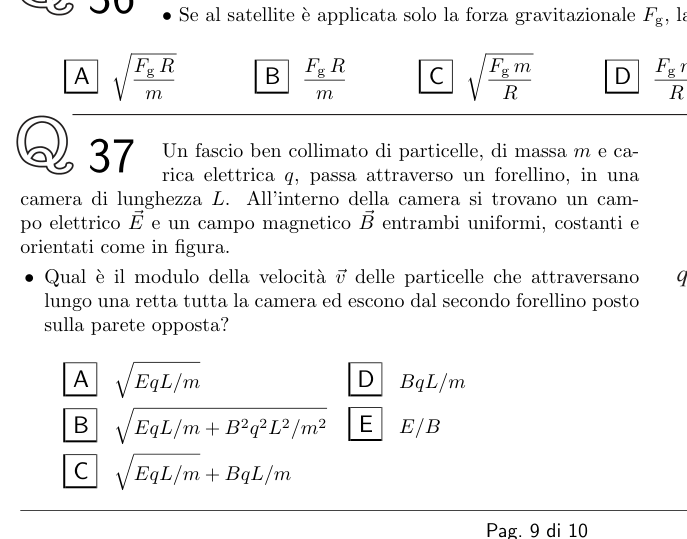
Un fascio ben collimato di particelle, di massa e carica elettrica , passa attraverso un forellino, in una camera di lunghezza . All’interno della camera si trovano un campo elettrico e un campo magnetico entrambi uniformi, costanti e orientati come in figura.
Qual è il modulo della velocità delle particelle che attraversano lungo una retta tutta la camera ed escono dal secondo forellino posto sulla parete opposta?
- A.
- B.
- C.
- D.
- E.
 Velocity selector chamber with E and B fields
Topic: Electromagnetism, Magnetism Metodi: Lorentz Force Analysis, Free-Body Diagram Competenze: Physical Reasoning, Mathematical Modeling Objects: Particle Beam Fonte: Testo (PDF) — p.9 Risposta: E · Soluzioni (PDF)
A well-collimated beam of particles, of mass and electric charge , passes through a small hole, into a chamber of length . Inside the chamber there are an electric field and a magnetic field , both uniform, constant and oriented as in the figure.
What is the magnitude of the velocity of the particles that travel along a straight line through the entire chamber and exit from the second small hole on the opposite wall?
- A.
- B.
- C.
- D.
- E.
Velocity selector chamber with E and B fields
Answer: E · Soluzioni (PDF)
Sul pianeta X, privo di atmosfera, un corpo ha massa e peso . Si lascia andare il corpo in caduta libera in una zona prossima alla superficie del pianeta.
Si vuol sapere qual è l’accelerazione dell’oggetto dopo essere caduto per 6.0 s.
- A.
- B.
- C.
- D.
- E.
 Hydrogen absorption spectra, 5 options
Topic: Newtonian Mechanics, Gravitation Metodi: Free-Body Diagram, Kinematic Equations Competenze: Physical Reasoning, Mathematical Modeling Objects: Planet Fonte: Testo (PDF) — p.10 Risposta: B · Soluzioni (PDF)
On planet X, which has no atmosphere, a body has mass and weight . The body is released in free fall in an area near the surface of the planet.
We want to know what the acceleration of the object is after it has fallen for 6.0 s.
- A.
- B.
- C.
- D.
- E.
Hydrogen absorption spectra, 5 options
Answer: B · Soluzioni (PDF)
Il grafico mostra la relazione che si è trovata tra la carica di un corpo e il lavoro compiuto da una forza esterna, quando il corpo viene spostato tra due punti fissati A e B, in un campo elettrostatico (in assenza di altri tipi di interazione).
Che cosa rappresenta la pendenza di questo grafico?
- A. La potenza
- B. La corrente elettrica
- C. Il modulo della forza elettrica
- D. L’intensità del campo elettrico
- E. La differenza di potenziale
Work vs charge in electrostatic field
Topic: Electrostatics Metodi: Electric Potential Method, Graph Linearization Competenze: Diagrammatic Reasoning, Physical Reasoning Objects: Point Charge Fonte: Testo (PDF) — p.10 Risposta: E · Soluzioni (PDF)
The graph shows the relationship that was found between the charge of a body and the work done by an external force, when the body is moved between two fixed points A and B, in an electrostatic field (in the absence of other types of interaction).
What does the slope of this graph represent?
- A. Power
- B. Electric current
- C. The magnitude of the electric force
- D. The strength of the electric field
- E. The potential difference
Work vs charge in electrostatic field
Answer: E · Soluzioni (PDF)
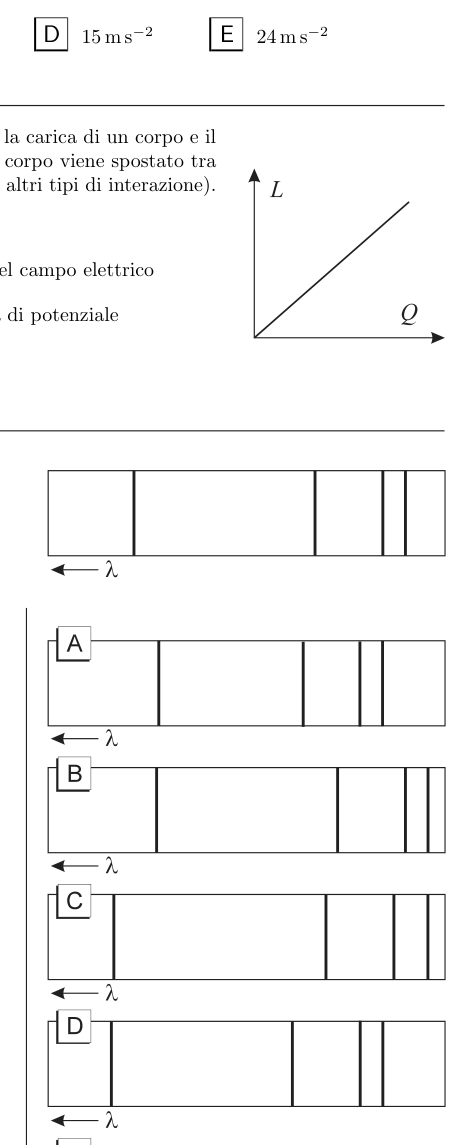
Il diagramma a destra mostra quattro righe di assorbimento ottenute con uno spettroscopio, facendo passare della luce bianca attraverso un recipiente contenente atomi di idrogeno, in un laboratorio.
Osservando una certa stella che si sta allontanando dalla Terra viene registrato un analogo spettro dovuto all’assorbimento della luce emessa, da parte dell’idrogeno presente nell’atmosfera di quella stella.
Tenendo conto che nel disegnare i successivi 5 diagrammi, identificati con le lettere A, B, C, D ed E, è stato considerato il medesimo intervallo in lunghezza d’onda ed è stata utilizzata esattamente la stessa scala (crescente verso sinistra), quale di questi può rappresentare lo spettro osservato della stella?
- A. A
- B. B
- C. C
- D. D
- E. E Topic: Modern-Quantum Physics, Astrophysics, Special Relativity Metodi: Photon Energy Relation, Bohr Model & Quantization Competenze: Physical Reasoning, Diagrammatic Reasoning Objects: Atom, Star, Photon Fonte: Testo (PDF) — p.10 Risposta: D · Soluzioni (PDF)
The diagram on the right shows four absorption lines obtained with a spectroscope, by passing white light through a container containing hydrogen atoms, in a laboratory.
Observing a certain star that is moving away from the Earth, an analogous spectrum is recorded due to the absorption of the emitted light by the hydrogen present in the atmosphere of that star.
Taking into account that in drawing the subsequent 5 diagrams, identified with the letters A, B, C, D and E, the same wavelength interval was considered and exactly the same scale was used (increasing toward the left), which of these can represent the observed spectrum of the star?
- A. A
- B. B
- C. C
- D. D
- E. E Answer: D · Soluzioni (PDF)