Qual è il valore approssimativo della massa di una normale matita di legno nuova?
- A. kg
- B. kg
- C. kg
- D. kg
- E. kg Topic: Order-of-Magnitude Estimation Metodi: Order-of-Magnitude Estimation Competenze: Estimation & Approximation Objects: — Fonte: Testo (PDF) — p.3 Risposta: B · Soluzioni (PDF)
What is the approximate value of the mass of a normal new wooden pencil?
- A. kg
- B. kg
- C. kg
- D. kg
- E. kg Answer: B · Soluzioni (PDF)
Un trasformatore viene adoperato per alimentare correttamente una lampadina da 24 W, 6 V, utilizzando una tensione con un valore efficace di 240 V, come in figura. Si suppone che il trasformatore abbia un rendimento del 100%.
• Quale delle seguenti affermazioni NON è corretta?
- A. La tensione è alternata.
- B. Il valore efficace della corrente nel circuito secondario è 4 A.
- C. Il valore efficace della corrente nel circuito primario è 0.1 A.
- D. La resistenza della lampadina è .
- E. Il rapporto fra il numero di spire nel circuito primario e in quello secondario del trasformatore è 10:1.
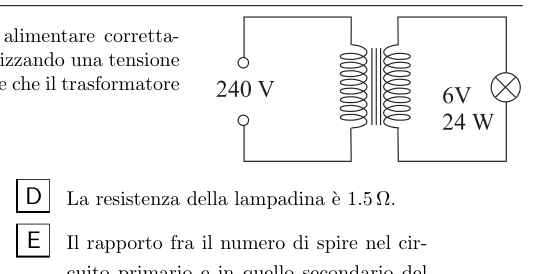 Transformer circuit feeding 6V bulb
Topic: Circuits, Electromagnetic Induction Metodi: Kirchhoff’s Laws, Equivalent Circuit Reduction Competenze: Physical Reasoning Objects: Coil Fonte: Testo (PDF) — p.3 Risposta: E · Soluzioni (PDF)
A transformer is used to correctly power a 24 W, 6 V light bulb, using a voltage with an effective value of 240 V, as in the figure. The transformer is assumed to have an efficiency of 100%.
• Which of the following statements is NOT correct?
- A. The voltage is alternating.
- B. The effective value of the current in the secondary circuit is 4 A.
- C. The effective value of the current in the primary circuit is 0.1 A.
- D. The resistance of the light bulb is .
- E. The ratio between the number of turns in the primary circuit and in the secondary circuit of the transformer is 10:1.
Transformer circuit feeding 6V bulb
Answer: E · Soluzioni (PDF)
In un filo teso XY si è stabilita un’onda stazionaria, come in figura.
• In quale o quali punti l’oscillazione risulta in verso opposto rispetto a P?
- A. Tutti e tre: 1, 2 e 3.
- B. Solo 1 e 2.
- C. Solo 2 e 3.
- D. Solo 2.
- E. Solo 3.
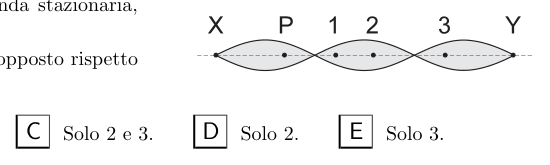 Standing wave on stretched string XY
Topic: Oscillations & Waves Metodi: Superposition Principle, Wave Equation Competenze: Diagrammatic Reasoning Objects: String Fonte: Testo (PDF) — p.3 Risposta: B · Soluzioni (PDF)
A standing wave has formed on a stretched string XY, as in the figure.
• At which point or points is the oscillation in the opposite direction compared with P?
- A. All three: 1, 2 and 3.
- B. Only 1 and 2.
- C. Only 2 and 3.
- D. Only 2.
- E. Only 3.
Standing wave on stretched string XY
Answer: B · Soluzioni (PDF)
In una stanza di dimensioni , è contenuta aria alla pressione di Pa e alla temperatura di . Si tenga presente che nell’aria, in prima approssimazione, l’80% delle molecole è d’azoto e il 20% d’ossigeno. Le masse molari dell’azoto e dell’ossigeno valgono rispettivamente g mol e g mol. Si tratti l’aria come un gas perfetto.
• Determinare le masse d’azoto e d’ossigeno contenute nella stanza.
- A. kg; kg
- B. kg; kg
- C. kg; kg
- D. kg; kg
- E. kg; kg Topic: Kinetic Theory, Thermodynamics Metodi: Ideal Gas Law Competenze: Mathematical Modeling Objects: Gas Fonte: Testo (PDF) — p.3 Risposta: E · Soluzioni (PDF)
In a room with dimensions , air is contained at a pressure of Pa and at a temperature of . Keep in mind that in air, to a first approximation, 80% of the molecules are nitrogen and 20% oxygen. The molar masses of nitrogen and oxygen are respectively g mol and g mol. Treat the air as an ideal gas.
• Determine the masses of nitrogen and oxygen contained in the room.
- A. kg; kg
- B. kg; kg
- C. kg; kg
- D. kg; kg
- E. kg; kg Answer: E · Soluzioni (PDF)
Si consideri una situazione in cui un fascio di luce, incidendo sulla superficie di un metallo, provoca l’emissione di elettroni (questo avviene se nella radiazione sono presenti componenti con frequenza superiore ad un certo valore di soglia, tipico del metallo). Si varia la durata dell’illuminazione, ma non l’intensità del fascio di luce.
• Quale grafico rappresenta meglio la dipendenza funzionale tra il numero di elettroni emessi e la durata dell’illuminazione?
(A) (B) (C) (D) (E) — vedi grafici in figura
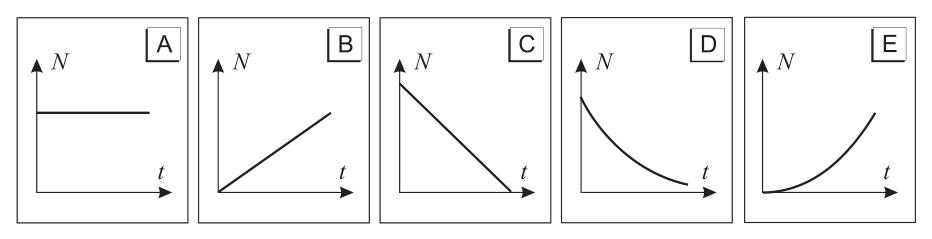 Five candidate N vs t graphs, photoelectric effect
Topic: Modern-Quantum Physics Metodi: Photon Energy Relation Competenze: Diagrammatic Reasoning, Physical Reasoning Objects: Photon, Electron Fonte: Testo (PDF) — p.3 Risposta: B · Soluzioni (PDF)
Consider a situation in which a beam of light, striking the surface of a metal, causes the emission of electrons (this occurs if the radiation contains components with a frequency above a certain threshold value, typical of the metal). The duration of illumination is varied, but not the intensity of the light beam.
• Which graph best represents the functional dependence between the number of emitted electrons and the duration of illumination?
(A) (B) (C) (D) (E) — see graphs in the figure
Five candidate N vs t graphs, photoelectric effect
Answer: B · Soluzioni (PDF)
Due blocchi di massa rispettivamente kg e kg sono collegati con una fune inestensibile attraverso una puleggia, come mostrato in figura. Quando vengono lasciati liberi, il secondo blocco accelera verso il basso sollevando il primo blocco.
• Detti rispettivamente e i moduli delle forze risultanti che agiscono sui due blocchi, quanto vale il rapporto ?
- A. 3/10
- B. 4/10
- C. 3/7
- D. 3/4
- E. 1
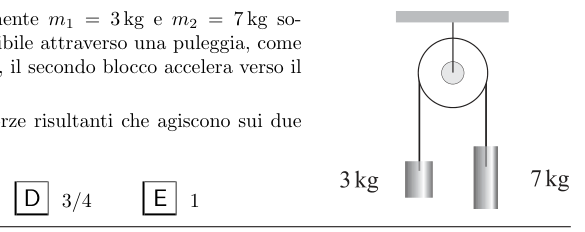 Atwood machine two masses and pulley
Topic: Newtonian Mechanics Metodi: Free-Body Diagram, Newton’s Law of Gravitation Competenze: Physical Reasoning, Mathematical Modeling Objects: Block, String, Pulley Fonte: Testo (PDF) — p.4 Risposta: C · Soluzioni (PDF)
Two blocks of mass kg and kg respectively are connected by an inextensible rope over a pulley, as shown in the figure. When they are released, the second block accelerates downward, lifting the first block.
• Denoting by and respectively the magnitudes of the resultant forces acting on the two blocks, what is the value of the ratio ?
- A. 3/10
- B. 4/10
- C. 3/7
- D. 3/4
- E. 1
Atwood machine two masses and pulley
Answer: C · Soluzioni (PDF)
Una particella carica, che si muove alla velocità di m s, entra in un campo magnetico uniforme, di modulo T, perpendicolare alla direzione da cui proviene la particella. All’interno del campo, la particella subisce una forza di modulo N.
• Di che particella si tratta, tra queste?
- A. Elettrone
- B. Particella α
- C. Nucleo di idrogeno
- D. Neutrone
- E. Atomo di ossigeno ionizzato tre volte Topic: Magnetism, Electromagnetism Metodi: Lorentz Force Analysis Competenze: Physical Reasoning, Mathematical Modeling Objects: Point Charge Fonte: Testo (PDF) — p.4 Risposta: B · Soluzioni (PDF)
A charged particle, moving at a speed of m s, enters a uniform magnetic field, with magnitude T, perpendicular to the direction from which the particle comes. Inside the field, the particle experiences a force of magnitude N.
• Which particle is it, among these?
- A. Electron
- B. α particle
- C. Hydrogen nucleus
- D. Neutron
- E. Oxygen atom ionized three times Answer: B · Soluzioni (PDF)
Una studentessa si trova su una bilancia a molla all’interno di un ascensore. La bilancia indica un valore maggiore della massa reale della ragazza.
• Questo potrebbe essere dovuto al fatto che l’ascensore si sta muovendo…
- A. … verso l’alto a velocità crescente.
- B. … verso l’alto a velocità costante.
- C. … verso l’alto a velocità decrescente.
- D. … verso il basso a velocità crescente.
- E. … verso il basso a velocità costante. Topic: Newtonian Mechanics Metodi: Free-Body Diagram, Kinematic Equations Competenze: Physical Reasoning Objects: Spring Fonte: Testo (PDF) — p.4 Risposta: A · Soluzioni (PDF)
A student is standing on a spring scale inside an elevator. The scale shows a value greater than the girl’s actual mass.
• This could be due to the fact that the elevator is moving…
- A. … upward at increasing speed.
- B. … upward at constant speed.
- C. … upward at decreasing speed.
- D. … downward at increasing speed.
- E. … downward at constant speed. Answer: A · Soluzioni (PDF)
Due resistori da sono collegati in serie ad una batteria da 120 V. Un voltmetro con una resistenza interna da è connesso ai capi di uno dei due resistori, come mostrato nella figura.
• Quale valore segna il voltmetro?
- A. 120 V
- B. 80 V
- C. 60 V
- D. 40 V
- E. 30 V
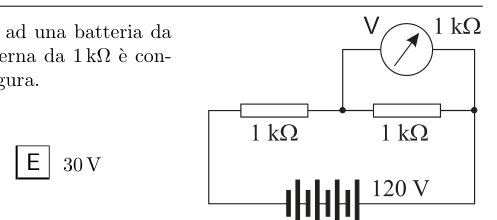 Voltmeter across one of two series resistors
Topic: Circuits Metodi: Kirchhoff’s Laws, Equivalent Circuit Reduction Competenze: Mathematical Modeling, Physical Reasoning Objects: Resistor, Battery Fonte: Testo (PDF) — p.4 Risposta: D · Soluzioni (PDF)
Two resistors are connected in series to a 120 V battery. A voltmeter with an internal resistance of is connected across one of the two resistors, as shown in the figure.
• What value does the voltmeter read?
- A. 120 V
- B. 80 V
- C. 60 V
- D. 40 V
- E. 30 V
Voltmeter across one of two series resistors
Answer: D · Soluzioni (PDF)
Una persona è all’ombra in un’amaca in un giorno estivo in cui la temperatura è di , uguale a quella del suo corpo. In queste condizioni, il processo migliore grazie al quale il suo corpo smaltisce il calore prodotto dal suo metabolismo (ad un tasso di 130 W) è la traspirazione. Il calore di vaporizzazione dell’acqua alla temperatura di è kJ kg.
• Il volume di sudore che evapora in un’ora è circa uguale a
- A.
- B.
- C.
- D.
- E. Topic: Thermodynamics Metodi: First Law of Thermodynamics, Order-of-Magnitude Estimation Competenze: Estimation & Approximation, Mathematical Modeling Objects: — Fonte: Testo (PDF) — p.4 Risposta: C · Soluzioni (PDF)
A person is in the shade in a hammock on a summer day when the temperature is , equal to that of their body. Under these conditions, the best process by which their body dissipates the heat produced by its metabolism (at a rate of 130 W) is perspiration. The heat of vaporization of water at the temperature of is kJ kg.
• The volume of sweat that evaporates in one hour is approximately equal to
- A.
- B.
- C.
- D.
- E. Answer: C · Soluzioni (PDF)
Un blocco di massa 2 kg scivola su un piano orizzontale. Due forze, di modulo rispettivamente N e N, agiscono l’una applicata orizzontalmente e l’altra verticalmente, come mostrato in figura.
• Se il coefficiente d’attrito dinamico tra il piano ed il blocco è 0.2, il modulo della forza d’attrito esercitata sul blocco vale
- A. 1 N
- B. 3 N
- C. 4 N
- D. 5 N
- E. 7 N
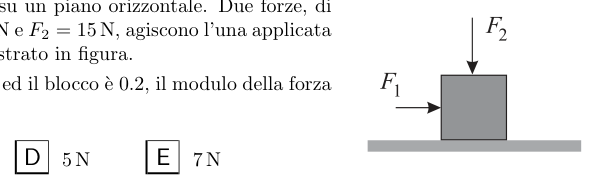 Block on surface with horizontal and vertical forces
Topic: Newtonian Mechanics Metodi: Free-Body Diagram, Vector Decomposition Competenze: Mathematical Modeling, Physical Reasoning Objects: Block Fonte: Testo (PDF) — p.4 Risposta: E · Soluzioni (PDF)
A block of mass 2 kg slides on a horizontal plane. Two forces, with magnitudes respectively N and N, act one applied horizontally and the other vertically, as shown in the figure.
• If the coefficient of kinetic friction between the plane and the block is 0.2, the magnitude of the friction force exerted on the block is
- A. 1 N
- B. 3 N
- C. 4 N
- D. 5 N
- E. 7 N
Block on surface with horizontal and vertical forces
Answer: E · Soluzioni (PDF)
Una pallina rotola su una guida inclinata partendo da ferma. Ogni 10 cm c’è un sensore che determina l’istante del suo passaggio, a partire dall’istante in cui essa inizia a muoversi. I tempi registrati dai vari sensori sono affetti da incertezze statistiche non trascurabili, fino a 0.05 s. I risultati che si ottengono sono nella tabella.
| Posizione [cm] | Tempo [s] |
|---|---|
| 0 | 0 |
| 10 | 0.29 |
| 20 | 0.48 |
| 30 | 0.54 |
| 40 | 0.67 |
| 50 | 0.65 |
| 60 | 0.72 |
| 70 | 0.83 |
• Qual è il valore più attendibile dell’accelerazione della pallina?
- A. 1.2 m s
- B. 1.6 m s
- C. 2.1 m s
- D. 2.5 m s
- E. 9.8 m s
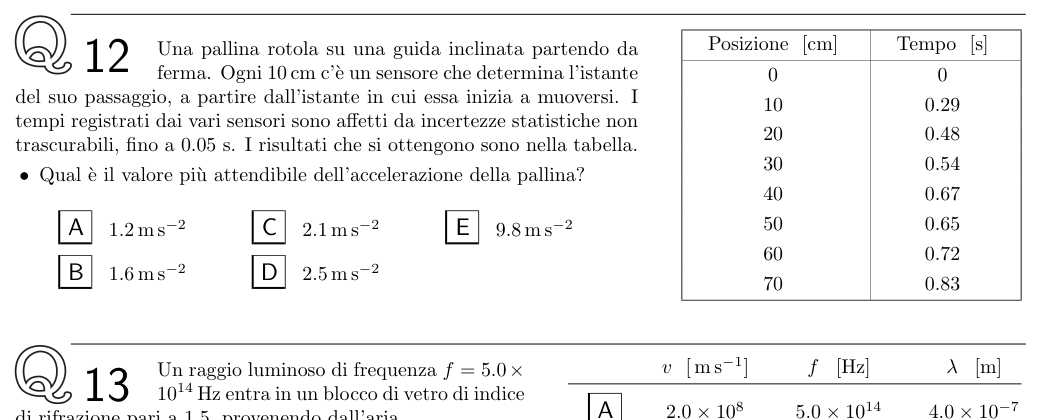 Inclined track with sensors and data table
Topic: Newtonian Mechanics Metodi: Graph Linearization, Experimental Data Analysis, Kinematic Equations Competenze: Experimental Data Analysis, Graph Linearization Objects: Ball, Inclined Plane Fonte: Testo (PDF) — p.5 Risposta: C · Soluzioni (PDF)
A ball rolls on an inclined track starting from rest. Every 10 cm there is a sensor that determines the instant of its passage, starting from the instant at which it begins to move. The times recorded by the various sensors are affected by non-negligible statistical uncertainties, up to 0.05 s. The results obtained are in the table.
| Position [cm] | Time [s] |
|---|---|
| 0 | 0 |
| 10 | 0.29 |
| 20 | 0.48 |
| 30 | 0.54 |
| 40 | 0.67 |
| 50 | 0.65 |
| 60 | 0.72 |
| 70 | 0.83 |
• What is the most reliable value of the ball’s acceleration?
- A. 1.2 m s
- B. 1.6 m s
- C. 2.1 m s
- D. 2.5 m s
- E. 9.8 m s
Inclined track with sensors and data table
Answer: C · Soluzioni (PDF)
Un raggio luminoso di frequenza Hz entra in un blocco di vetro di indice di rifrazione pari a 1.5, provenendo dall’aria.
• Quale riga, nella tabella, indica i valori corretti per la velocità , la frequenza e la lunghezza d’onda della luce nel vetro?
| [m s] | [Hz] | [m] | |
|---|---|---|---|
| A | |||
| B | |||
| C | |||
| D | |||
| E |
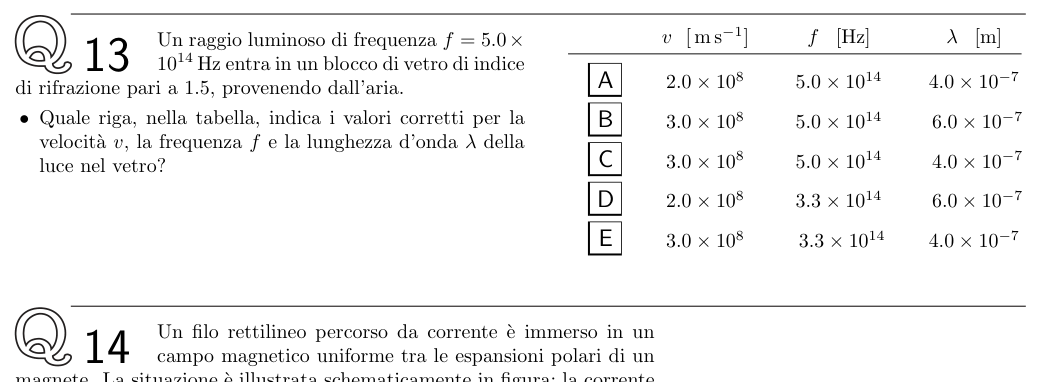 Table of v, f, lambda for light in glass
Topic: Geometric Optics, Wave Optics Metodi: Snell’s Law Competenze: Physical Reasoning, Mathematical Modeling Objects: — Fonte: Testo (PDF) — p.5 Risposta: A · Soluzioni (PDF)
A light ray of frequency Hz enters a block of glass with refractive index equal to 1.5, coming from air.
• Which row, in the table, indicates the correct values for the speed , the frequency and the wavelength of the light in the glass?
| [m s] | [Hz] | [m] | |
|---|---|---|---|
| A | |||
| B | |||
| C | |||
| D | |||
| E |
Table of v, f, lambda for light in glass
Answer: A · Soluzioni (PDF)
Un filo rettilineo percorso da corrente è immerso in un campo magnetico uniforme tra le espansioni polari di un magnete. La situazione è illustrata schematicamente in figura; la corrente elettrica ha verso entrante nel foglio.
• Il campo magnetico esercita sul filo un forza diretta…
- A. … verso il punto A.
- B. … verso il punto B.
- C. … verso il punto C.
- D. … verso il punto D.
- E. … lungo il filo.
Current-carrying wire in magnetic field N-S poles
Topic: Magnetism, Electromagnetism Metodi: Lorentz Force Analysis, Biot-Savart Law Competenze: Diagrammatic Reasoning, Physical Reasoning Objects: Wire, Magnet Fonte: Testo (PDF) — p.5 Risposta: C · Soluzioni (PDF)
A straight wire carrying a current is immersed in a uniform magnetic field between the pole pieces of a magnet. The situation is shown schematically in the figure; the electric current is directed into the page.
• The magnetic field exerts on the wire a force directed…
- A. … toward point A.
- B. … toward point B.
- C. … toward point C.
- D. … toward point D.
- E. … along the wire.
Current-carrying wire in magnetic field N-S poles
Answer: C · Soluzioni (PDF)
L’elettroscopio a foglie è un dispositivo usato per rivelare cariche elettriche. È formato da un pomello metallico ed un’asta metallica al fondo della quale sono appese due foglioline metalliche che possono oscillare liberamente. La figura mostra un elettroscopio a foglie caricato con cariche elettriche positive.
• Se una bacchetta di vetro carica positivamente viene avvicinata al pomello, senza toccarlo, …
- A. … la carica elettrica del pomello diminuisce e così pure la separazione tra le foglioline metalliche.
- B. … la carica elettrica del pomello diminuisce mentre aumenta la separazione tra le foglioline metalliche.
- C. … la carica elettrica del pomello aumenta e così pure la separazione tra le foglioline metalliche.
- D. … la carica elettrica del pomello aumenta mentre diminuisce la separazione tra le foglioline metalliche.
- E. … non cambia nulla. Topic: Electrostatics Metodi: Coulomb’s Law, Symmetry Argument Competenze: Physical Reasoning, Diagrammatic Reasoning Objects: Rod Fonte: Testo (PDF) — p.5 Risposta: B · Soluzioni (PDF)
The leaf electroscope is a device used to detect electric charges. It consists of a metal knob and a metal rod at the bottom of which two metal leaves are suspended that can swing freely. The figure shows a leaf electroscope charged with positive electric charges.
• If a positively charged glass rod is brought near the knob, without touching it, …
- A. … the electric charge of the knob decreases and so does the separation between the metal leaves.
- B. … the electric charge of the knob decreases while the separation between the metal leaves increases.
- C. … the electric charge of the knob increases and so does the separation between the metal leaves.
- D. … the electric charge of the knob increases while the separation between the metal leaves decreases.
- E. … nothing changes. Answer: B · Soluzioni (PDF)
La figura (non in scala!) rappresenta un esperimento in cui una radiazione luminosa monocromatica passa attraverso due fenditure parallele e distanti m e incide su uno schermo distante 1 m dalle fenditure. I punti P, Q e R sono in corrispondenza di massimi consecutivi nella figura d’interferenza che si osserva sullo schermo e sono distanti 3.4 mm uno dall’altro.
• Qual è la lunghezza d’onda della luce incidente?
- A. m
- B. m
- C. m
- D. m
- E. m
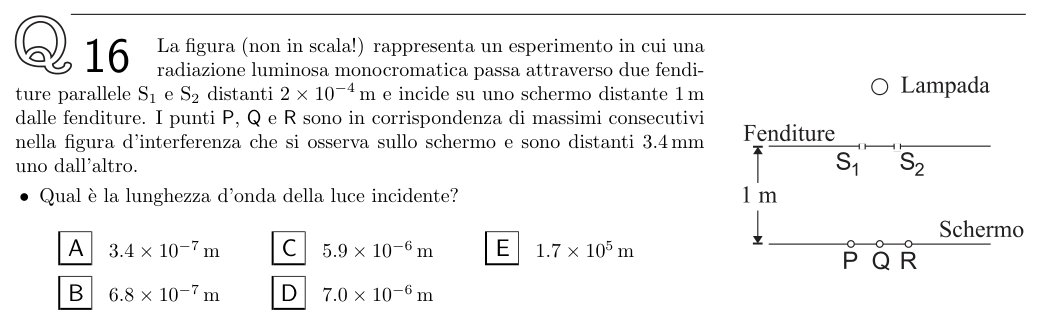 Double slit S1 S2 interference pattern on screen
Topic: Wave Optics Metodi: Interference & Diffraction Analysis, Superposition Principle Competenze: Mathematical Modeling, Physical Reasoning Objects: Slit, Screen Fonte: Testo (PDF) — p.6 Risposta: B · Soluzioni (PDF)
The figure (not to scale!) represents an experiment in which monochromatic light radiation passes through two parallel slits and at a distance m apart and strikes a screen 1 m away from the slits. The points P, Q and R correspond to consecutive maxima in the interference pattern observed on the screen and are 3.4 mm apart from one another.
• What is the wavelength of the incident light?
- A. m
- B. m
- C. m
- D. m
- E. m
Double slit S1 S2 interference pattern on screen
Answer: B · Soluzioni (PDF)
La tabella contiene i valori di massa e periodo orbitale di 5 satelliti artificiali, che si muovono su orbite circolari attorno alla Terra.
• Quale di questi è più vicino alla Terra?
| Satellite | Massa [kg] | Periodo [ore] |
|---|---|---|
| A | 500 | 4 |
| B | 500 | 2 |
| C | 100 | 6 |
| D | 100 | 3 |
| E | 700 | 6 |
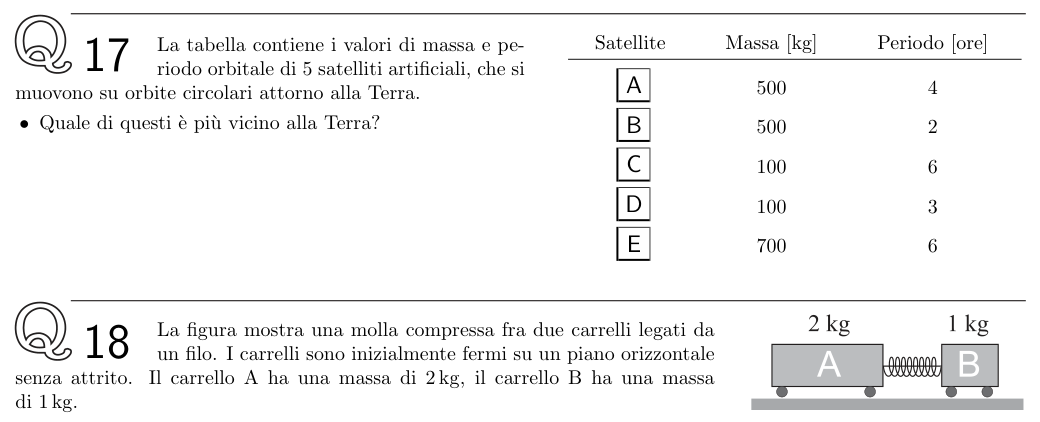 Table of satellite masses and orbital periods
Topic: Gravitation, Astrophysics Metodi: Kepler’s Laws, Newton’s Law of Gravitation Competenze: Physical Reasoning, Mathematical Modeling Objects: Satellite, Planet Fonte: Testo (PDF) — p.6 Risposta: B · Soluzioni (PDF)
The table contains the values of mass and orbital period of 5 artificial satellites, which move on circular orbits around the Earth.
• Which of these is closest to the Earth?
| Satellite | Mass [kg] | Period [hours] |
|---|---|---|
| A | 500 | 4 |
| B | 500 | 2 |
| C | 100 | 6 |
| D | 100 | 3 |
| E | 700 | 6 |
Table of satellite masses and orbital periods
Answer: B · Soluzioni (PDF)
La figura mostra una molla compressa fra due carrelli legati da un filo. I carrelli sono inizialmente fermi su un piano orizzontale senza attrito. Il carrello A ha una massa di 2 kg, il carrello B ha una massa di 1 kg.
• Che cosa succede quando il filo viene tagliato e i carrelli si allontanano muovendosi in verso opposto?
- A. L’intervallo di tempo durante il quale la forza agisce sul carrello A è il doppio di quello durante il quale la forza agisce sul carrello B.
- B. L’intensità della forza che agisce sul carrello A è la metà dell’intensità della forza che agisce sul carrello B.
- C. L’impulso della forza che agisce sul carrello A è il doppio dell’impulso della forza che agisce sul carrello B.
- D. L’energia cinetica acquistata dal carrello A è il doppio dell’energia acquistata dal carrello B.
- E. L’accelerazione del carrello A è metà dell’accelerazione del carrello B.
Compressed spring between two carts A and B
Topic: Newtonian Mechanics, Conservation of Momentum Metodi: Conservation of Momentum, Impulse-Momentum Theorem Competenze: Physical Reasoning, Mathematical Modeling Objects: Spring, Cart Fonte: Testo (PDF) — p.6 Risposta: E · Soluzioni (PDF)
The figure shows a compressed spring between two carts tied by a string. The carts are initially at rest on a horizontal frictionless plane. Cart A has a mass of 2 kg, cart B has a mass of 1 kg.
• What happens when the string is cut and the carts move apart in opposite directions?
- A. The time interval during which the force acts on cart A is twice that during which the force acts on cart B.
- B. The magnitude of the force acting on cart A is half the magnitude of the force acting on cart B.
- C. The impulse of the force acting on cart A is twice the impulse of the force acting on cart B.
- D. The kinetic energy acquired by cart A is twice the energy acquired by cart B.
- E. The acceleration of cart A is half the acceleration of cart B.
Compressed spring between two carts A and B
Answer: E · Soluzioni (PDF)
Un arciere usa lo stesso arco e la stessa forza per lanciare due frecce uguali. La prima viene lanciata ad un angolo di con il piano orizzontale, la seconda ad un angolo di .
• Rispetto alla freccia lanciata a , quella lanciata a …
- A. … ha un tempo di volo più lungo e raggiunge una distanza maggiore sul piano orizzontale.
- B. … ha un tempo di volo più lungo e raggiunge una distanza minore sul piano orizzontale.
- C. … ha un tempo di volo più breve e raggiunge una distanza maggiore sul piano orizzontale.
- D. … ha un tempo di volo più breve e raggiunge una distanza minore sul piano orizzontale.
- E. … ha lo stesso tempo di volo e raggiunge la stessa distanza sul piano orizzontale. Topic: Newtonian Mechanics Metodi: Kinematic Equations, Vector Decomposition Competenze: Mathematical Modeling, Physical Reasoning Objects: Projectile Fonte: Testo (PDF) — p.6 Risposta: C · Soluzioni (PDF)
An archer uses the same bow and the same force to launch two identical arrows. The first is launched at an angle of with the horizontal plane, the second at an angle of .
• Compared to the arrow launched at , the one launched at …
- A. … has a longer flight time and reaches a greater distance on the horizontal plane.
- B. … has a longer flight time and reaches a shorter distance on the horizontal plane.
- C. … has a shorter flight time and reaches a greater distance on the horizontal plane.
- D. … has a shorter flight time and reaches a shorter distance on the horizontal plane.
- E. … has the same flight time and reaches the same distance on the horizontal plane. Answer: C · Soluzioni (PDF)
La figura mostra un oggetto O e la sua immagine I che si forma quando nel punto X viene posto uno dei seguenti componenti.
• Si dica qual è il componente giusto.
- A. Una lente convergente.
- B. Una lente divergente.
- C. Uno specchio concavo.
- D. Uno specchio convesso.
- E. Una lastra di vetro a facce piane e parallele.
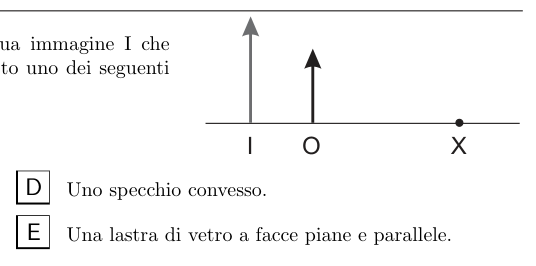 Object O and image I with optical component at X
Topic: Geometric Optics Metodi: Thin Lens & Mirror Equation, Ray Tracing Competenze: Diagrammatic Reasoning, Physical Reasoning Objects: Lens Fonte: Testo (PDF) — p.7 Risposta: A · Soluzioni (PDF)
The figure shows an object O and its image I that forms when one of the following components is placed at point X.
• State which is the correct component.
- A. A converging lens.
- B. A diverging lens.
- C. A concave mirror.
- D. A convex mirror.
- E. A glass plate with plane-parallel faces.
Object O and image I with optical component at X
Answer: A · Soluzioni (PDF)
In uno scaldacqua a gas, l’acqua entra alla temperatura di ed esce alla temperatura di . In un certo intervallo di tempo circolano 9.8 L d’acqua e vengono bruciati 27 L di gas. L’azienda fornitrice del gas indica che il potere calorico del gas è di 37.44 MJ m.
• Il rendimento dello scaldacqua è:
- A. 45%
- B. 62%
- C. 70%
- D. 77%
- E. 83% Topic: Thermodynamics Metodi: First Law of Thermodynamics, Energy Conservation Method Competenze: Mathematical Modeling, Physical Reasoning Objects: — Fonte: Testo (PDF) — p.7 Risposta: D · Soluzioni (PDF)
In a gas water heater, water enters at a temperature of and exits at a temperature of . In a certain time interval, 9.8 L of water circulate and 27 L of gas are burned. The gas supply company states that the calorific value of the gas is 37.44 MJ m.
• The efficiency of the water heater is:
- A. 45%
- B. 62%
- C. 70%
- D. 77%
- E. 83% Answer: D · Soluzioni (PDF)
Una pattinatrice su ghiaccio ha un momento d’inerzia, calcolato rispetto ad un asse di rotazione verticale, di 4.0 kg m quando le sue braccia sono allargate. Se sta ruotando alla velocità angolare di 3.0 rad s con le braccia allargate, e poi avvicina le braccia al busto, la sua velocità angolare aumenta fino a 7.0 rad s in 0.5 s. Si supponga di poter trascurare l’attrito tra pattini e ghiaccio e quello dell’aria.
• Qual è il momento totale delle forze che agiscono sulla pattinatrice, rispetto all’asse di rotazione, mentre avvicina le braccia al busto?
- A. 1.0 N m
- B. 1.6 N m
- C. 2.7 N m
- D. 5.3 N m
- E. 0 N m Topic: Rotational Dynamics Metodi: Torque & Angular Momentum Analysis, Conservation Laws Competenze: Physical Reasoning, Mathematical Modeling Objects: — Fonte: Testo (PDF) — p.7 Risposta: E · Soluzioni (PDF)
An ice skater has a moment of inertia, calculated with respect to a vertical axis of rotation, of 4.0 kg m when her arms are outstretched. If she is rotating at an angular velocity of 3.0 rad s with her arms outstretched, and then brings her arms close to her torso, her angular velocity increases to 7.0 rad s in 0.5 s. Assume that the friction between the skates and the ice and that of the air can be neglected.
• What is the total moment of the forces acting on the skater, with respect to the axis of rotation, while she brings her arms close to her torso?
- A. 1.0 N m
- B. 1.6 N m
- C. 2.7 N m
- D. 5.3 N m
- E. 0 N m Answer: E · Soluzioni (PDF)
Un blocco di massa kg è collegato ad un secondo blocco di massa kg con una fune inestensibile e di massa trascurabile. I due blocchi sono appoggiati su una superficie orizzontale senza attrito, e sul secondo blocco agisce una forza come mostrato in figura. L’accelerazione del secondo blocco vale m s.
• Quanto vale la tensione della fune che collega i due blocchi?
- A. 0.54 N
- B. 1.44 N
- C. 5.4 N
- D. 9.0 N
- E. 14.4 N
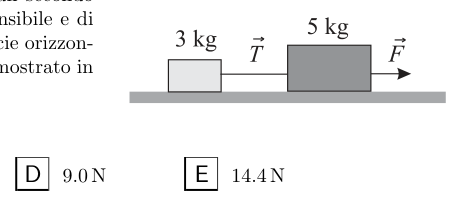 Two blocks connected by rope, force F on block m2
Topic: Newtonian Mechanics Metodi: Free-Body Diagram, Kinematic Equations Competenze: Mathematical Modeling, Physical Reasoning Objects: Block, String Fonte: Testo (PDF) — p.7 Risposta: C · Soluzioni (PDF)
A block of mass kg is connected to a second block of mass kg by an inextensible rope of negligible mass. The two blocks rest on a frictionless horizontal surface, and a force acts on the second block as shown in the figure. The acceleration of the second block is m s.
• What is the tension in the rope connecting the two blocks?
- A. 0.54 N
- B. 1.44 N
- C. 5.4 N
- D. 9.0 N
- E. 14.4 N
Two blocks connected by rope, force F on block m2
Answer: C · Soluzioni (PDF)
Il grafico illustra l’andamento della temperatura di un corpo omogeneo, inizialmente allo stato solido, che viene riscaldato, in funzione del tempo di riscaldamento. La massa del corpo è 5 kg e il calore che assorbe ogni minuto – ad un tasso costante – è 41.9 kJ.
• Qual è la quantità di calore assorbita da 1 kg del corpo tra l’istante in cui inizia la fusione e quello in cui termina l’ebollizione?
- A. 105 kJ
- B. 210 kJ
- C. 419 kJ
- D. 1050 kJ
- E. 2560 kJ
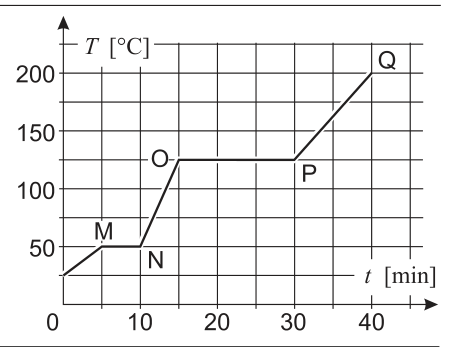 Temperature vs time graph for heating solid body
Topic: Thermodynamics Metodi: First Law of Thermodynamics, Thermodynamic Cycle Analysis Competenze: Graph Linearization, Mathematical Modeling Objects: — Fonte: Testo (PDF) — p.7 Risposta: B · Soluzioni (PDF)
The graph illustrates the trend of the temperature of a homogeneous body, initially in the solid state, which is heated, as a function of the heating time. The mass of the body is 5 kg and the heat it absorbs every minute – at a constant rate – is 41.9 kJ.
• What is the amount of heat absorbed by 1 kg of the body between the instant when melting begins and the instant when boiling ends?
- A. 105 kJ
- B. 210 kJ
- C. 419 kJ
- D. 1050 kJ
- E. 2560 kJ
Temperature vs time graph for heating solid body
Answer: B · Soluzioni (PDF)
Un’automobile si sta muovendo alla velocità di modulo costante m s su di una pista circolare da corsa, orizzontale, non rialzata, di raggio m. Si trascuri ogni possibile spinta verticale dell’aria sull’automobile.
• Quanto vale il minimo coefficiente d’attrito statico tra i pneumatici e l’asfalto necessario affinché l’automobile riesca a percorrere la pista circolare?
- A. 0.53
- B. 0.61
- C. 0.78
- D. 0.89
- E. 0.93
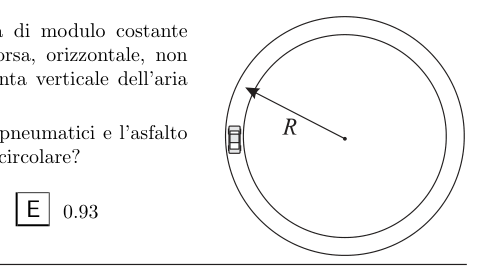 Car on circular horizontal track radius R
Topic: Newtonian Mechanics Metodi: Free-Body Diagram, Kinematic Equations Competenze: Mathematical Modeling, Physical Reasoning Objects: — Fonte: Testo (PDF) — p.8 Risposta: C · Soluzioni (PDF)
A car is moving at a constant speed of magnitude m s on a circular, horizontal, unbanked racetrack of radius m. Neglect any possible vertical lift of the air on the car.
• What is the minimum coefficient of static friction between the tires and the asphalt required for the car to be able to travel around the circular track?
- A. 0.53
- B. 0.61
- C. 0.78
- D. 0.89
- E. 0.93
Car on circular horizontal track radius R
Answer: C · Soluzioni (PDF)
Un contatore Geiger indica un tasso di conteggi pari a 1000 al secondo quando è messo ad una certa distanza da una sorgente radioattiva. Si supponga di inserire una lastra metallica tra la sorgente ed il rivelatore. Se lo spessore della lastra è pari a 20 mm il tasso di conteggi viene dimezzato.
• Quale dovrebbe essere lo spessore della lastra affinché il tasso di conteggi sia di 125 s?
- A. 25 mm
- B. 40 mm
- C. 60 mm
- D. 80 mm
- E. 160 mm Topic: Nuclear & Particle Physics Metodi: Radioactive Decay Law Competenze: Mathematical Modeling, Physical Reasoning Objects: — Fonte: Testo (PDF) — p.8 Risposta: C · Soluzioni (PDF)
A Geiger counter indicates a count rate of 1000 per second when it is placed at a certain distance from a radioactive source. Suppose a metal plate is inserted between the source and the detector. If the thickness of the plate is 20 mm, the count rate is halved.
• What should the thickness of the plate be for the count rate to be 125 s?
- A. 25 mm
- B. 40 mm
- C. 60 mm
- D. 80 mm
- E. 160 mm Answer: C · Soluzioni (PDF)
Un gas perfetto alla temperatura e pressione si trova in una parte di un recipiente termicamente isolante, separato dall’altra parte del recipiente, inizialmente vuota, da un setto divisorio rigido. Il setto divisorio viene improvvisamente rimosso, ed il gas può espandersi liberamente, occupando l’intero recipiente. Siano e la temperatura e la pressione ad equilibrio raggiunto.
• Si ha allora:
- A. e
- B. e
- C. e
- D. e
- E. e Topic: Thermodynamics, Kinetic Theory Metodi: First Law of Thermodynamics, Ideal Gas Law Competenze: Physical Reasoning Objects: Gas, Container Fonte: Testo (PDF) — p.8 Risposta: C · Soluzioni (PDF)
A perfect gas at temperature and pressure is in one part of a thermally insulating container, separated from the other part of the container, initially empty, by a rigid dividing partition. The dividing partition is suddenly removed, and the gas can expand freely, occupying the entire container. Let and be the temperature and pressure at the equilibrium reached.
• Then we have:
- A. and
- B. and
- C. and
- D. and
- E. and Answer: C · Soluzioni (PDF)
Un giocatore di golf colpisce una pallina lanciandola con un certo angolo rispetto al suolo. La pallina segue la traiettoria schematizzata in figura. I grafici sotto la figura mostrano le componenti orizzontale e verticale della velocità in funzione del tempo, per tutta la durata del volo.
• Qual è il modulo della velocità della pallina nell’istante in cui arriva a terra?
- A. 10 m s
- B. 30 m s
- C. 40 m s
- D. 50 m s
- E. 70 m s
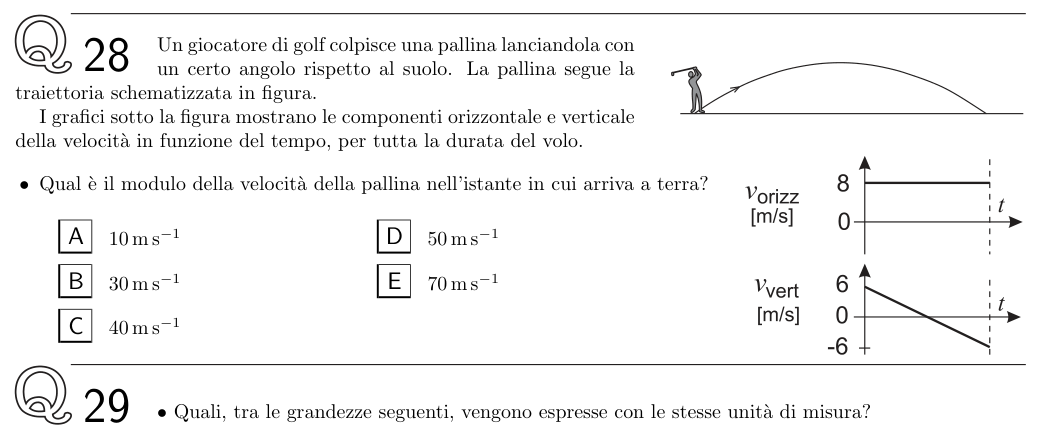 Golf ball trajectory and vx vy vs time graphs
Topic: Newtonian Mechanics Metodi: Kinematic Equations, Vector Decomposition Competenze: Graph Linearization, Diagrammatic Reasoning Objects: Ball, Projectile Fonte: Testo (PDF) — p.8 Risposta: A · Soluzioni (PDF)
A golfer hits a ball, launching it at a certain angle with respect to the ground. The ball follows the trajectory sketched in the figure. The graphs below the figure show the horizontal and vertical components of the velocity as a function of time, for the entire duration of the flight.
• What is the magnitude of the ball’s velocity at the instant it lands?
- A. 10 m s
- B. 30 m s
- C. 40 m s
- D. 50 m s
- E. 70 m s
Golf ball trajectory and vx vy vs time graphs
Answer: A · Soluzioni (PDF)
• Quali, tra le grandezze seguenti, vengono espresse con le stesse unità di misura?
- A. Energia e potenza.
- B. Lavoro e potenza.
- C. Impulso e potenza.
- D. Calore ed energia meccanica.
- E. Quantità di moto e lavoro. Topic: Newtonian Mechanics Metodi: Dimensional Analysis Competenze: Physical Reasoning, Unit Conversion Objects: — Fonte: Testo (PDF) — p.8 Risposta: D · Soluzioni (PDF)
• Which of the following quantities are expressed with the same units of measurement?
- A. Energy and power.
- B. Work and power.
- C. Impulse and power.
- D. Heat and mechanical energy.
- E. Momentum and work. Answer: D · Soluzioni (PDF)
Un ragazzo alto 1.60 m, stando in piedi davanti ad uno specchio ad una distanza m da questo, può vedere tutto il suo corpo riflesso dallo specchio.
• Lo specchio deve avere un’altezza almeno pari a
- A. 3.00 m
- B. 1.60 m
- C. 1.00 m
- D. 0.80 m
- E. 0.40 m Topic: Geometric Optics Metodi: Ray Tracing Competenze: Physical Reasoning, Diagrammatic Reasoning Objects: Mirror Fonte: Testo (PDF) — p.8 Risposta: D · Soluzioni (PDF)
A boy 1.60 m tall, standing in front of a mirror at a distance of m from it, can see his whole body reflected in the mirror.
• The mirror must have a height at least equal to
- A. 3.00 m
- B. 1.60 m
- C. 1.00 m
- D. 0.80 m
- E. 0.40 m Answer: D · Soluzioni (PDF)
Un disco di massa , che si muove con velocità di modulo , urta frontalmente un secondo disco di massa e velocità di modulo , come mostrato in figura; i due dischi stanno scivolando su di un piano orizzontale con attrito trascurabile.
• Se dopo l’urto i due dischi rimangono attaccati, la loro velocità ha modulo
- A. 0
- B.
- C.
- D.
- E.
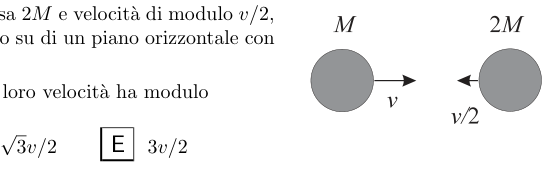 Two disks of mass M and 2M colliding head-on
Topic: Conservation of Momentum, Newtonian Mechanics Metodi: Conservation of Momentum, Impulse-Momentum Theorem Competenze: Mathematical Modeling, Physical Reasoning Objects: Disk Fonte: Testo (PDF) — p.9 Risposta: A · Soluzioni (PDF)
A disk of mass , which is moving with speed , collides head-on with a second disk of mass and speed , as shown in the figure; the two disks are sliding on a horizontal plane with negligible friction.
• If after the collision the two disks remain stuck together, their speed has magnitude
- A. 0
- B.
- C.
- D.
- E.
Two disks of mass M and 2M colliding head-on
Answer: A · Soluzioni (PDF)
Le cariche elettriche che si trovano alla base di una nuvola distano dal terreno 1.0 km. L’intensità del campo elettrico (supposto uniforme e diretto verticalmente) tra la base della nuvola e il terreno è di N C.
• Qual è la differenza di potenziale tra la base della nuvola e il terreno?
- A. V
- B. V
- C. V
- D. V
- E. V Topic: Electrostatics Metodi: Electric Potential Method, Gauss’s Law Competenze: Mathematical Modeling, Physical Reasoning Objects: — Fonte: Testo (PDF) — p.9 Risposta: D · Soluzioni (PDF)
The electric charges located at the base of a cloud are 1.0 km from the ground. The strength of the electric field (assumed uniform and directed vertically) between the base of the cloud and the ground is N C.
• What is the potential difference between the base of the cloud and the ground?
- A. V
- B. V
- C. V
- D. V
- E. V Answer: D · Soluzioni (PDF)
Due blocchi, il primo di massa e il secondo di massa , sono appoggiati su un piano orizzontale senza attrito e sono inizialmente fermi. A ciascun blocco viene applicata la stessa forza orizzontale, di modulo , per lo stesso intervallo tempo, .
• Qual è il rapporto tra l’energia cinetica del secondo blocco e quella del primo, quando la forza ha cessato di agire?
- A. 0.0625
- B. 0.125
- C. 0.25
- D. 0.5
- E. 1 Topic: Newtonian Mechanics, Conservation of Energy Metodi: Impulse-Momentum Theorem, Energy Conservation Method Competenze: Mathematical Modeling, Physical Reasoning Objects: Block Fonte: Testo (PDF) — p.9 Risposta: D · Soluzioni (PDF)
Two blocks, the first with mass and the second with mass , rest on a frictionless horizontal plane and are initially at rest. The same horizontal force, with magnitude , is applied to each block for the same time interval, .
• What is the ratio of the kinetic energy of the second block to that of the first, when the force has stopped acting?
- A. 0.0625
- B. 0.125
- C. 0.25
- D. 0.5
- E. 1 Answer: D · Soluzioni (PDF)
Una palla viene lanciata dalla superficie della Terra verso l’alto con una velocità di 50 m s e raggiunge la massima altezza dopo un certo intervallo di tempo. La stessa palla, lanciata dalla superficie del pianeta X nello stesso modo e con la stessa velocità, trascorso lo stesso tempo, si muove ancora verso l’alto alla velocità di 31 m s.
• Qual è il rapporto tra l’accelerazione di gravità sul pianeta X e quella sulla Terra?
- A. 0.16
- B. 0.38
- C. 0.53
- D. 1.59
- E. 2.63 Topic: Newtonian Mechanics, Gravitation Metodi: Kinematic Equations, Newton’s Law of Gravitation Competenze: Mathematical Modeling, Physical Reasoning Objects: Ball, Planet Fonte: Testo (PDF) — p.9 Risposta: B · Soluzioni (PDF)
A ball is thrown from the surface of the Earth upward with a speed of 50 m s and reaches its maximum height after a certain time interval. The same ball, thrown from the surface of planet X in the same way and with the same speed, after the same time has elapsed, is still moving upward at a speed of 31 m s.
• What is the ratio of the acceleration of gravity on planet X to that on Earth?
- A. 0.16
- B. 0.38
- C. 0.53
- D. 1.59
- E. 2.63 Answer: B · Soluzioni (PDF)
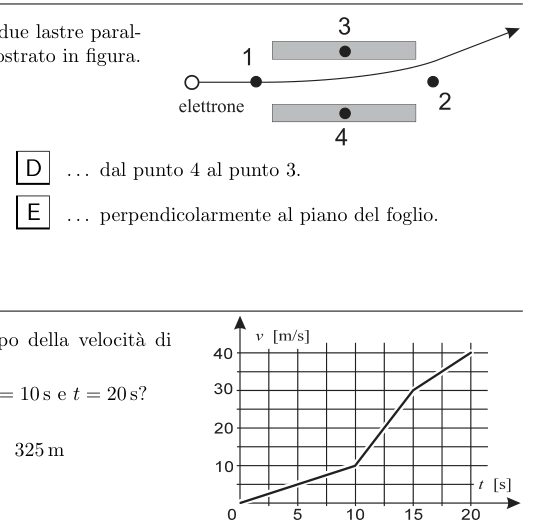
Un elettrone in moto viene deflesso da due lastre parallele, caricate di segno opposto, come mostrato in figura.
• Il campo elettrico tra le lastre è diretto…
- A. … dal punto 1 al punto 2.
- B. … dal punto 2 al punto 1.
- C. … dal punto 3 al punto 4.
- D. … dal punto 4 al punto 3.
- E. … perpendicolarmente al piano del foglio.
 Electron deflected by parallel charged plates
Topic: Electrostatics, Newtonian Mechanics Metodi: Lorentz Force Analysis, Electric Potential Method Competenze: Diagrammatic Reasoning, Physical Reasoning Objects: Electron, Capacitor Fonte: Testo (PDF) — p.9 Risposta: C · Soluzioni (PDF)
An electron in motion is deflected by two parallel plates, charged with opposite signs, as shown in the figure.
• The electric field between the plates is directed…
- A. … from point 1 to point 2.
- B. … from point 2 to point 1.
- C. … from point 3 to point 4.
- D. … from point 4 to point 3.
- E. … perpendicular to the plane of the sheet.
Electron deflected by parallel charged plates
Answer: C · Soluzioni (PDF)
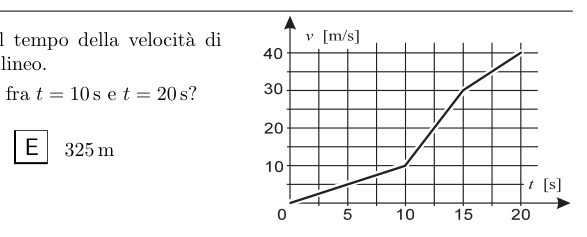
Il grafico mostra l’andamento nel tempo della velocità di un’auto che viaggia lungo un rettilineo.
• Quanta strada percorre nell’intervallo di tempo fra s e s?
- A. 210 m
- B. 250 m
- C. 275 m
- D. 300 m
- E. 325 m
 Velocity vs time graph for car on straight road
Topic: Newtonian Mechanics Metodi: Kinematic Equations, Calculus-Integration Competenze: Graph Linearization, Mathematical Modeling Objects: — Fonte: Testo (PDF) — p.9 Risposta: C · Soluzioni (PDF)
The graph shows the trend over time of the velocity of a car traveling along a straight road.
• How much distance does it cover in the time interval between s and s?
- A. 210 m
- B. 250 m
- C. 275 m
- D. 300 m
- E. 325 m
Velocity vs time graph for car on straight road
Answer: C · Soluzioni (PDF)
Un ciclista che si muove alla velocità di 4 m s accelera con un’accelerazione costante di 1.5 m s.
• Qual è la sua velocità dopo aver percorso un tratto di 11 m?
- A. 5.5 m s
- B. 7.0 m s
- C. 9.0 m s
- D. 16.5 m s
- E. 49 m s
 Light ray at plexiglas-air interface, critical angle
Topic: Newtonian Mechanics Metodi: Kinematic Equations Competenze: Mathematical Modeling Objects: — Fonte: Testo (PDF) — p.10 Risposta: B · Soluzioni (PDF)
A cyclist moving at a speed of 4 m s accelerates with a constant acceleration of 1.5 m s.
• What is his speed after covering a distance of 11 m?
- A. 5.5 m s
- B. 7.0 m s
- C. 9.0 m s
- D. 16.5 m s
- E. 49 m s
Light ray at plexiglas-air interface, critical angle
Answer: B · Soluzioni (PDF)
In un calorimetro di capacità termica 80 J K a , contenente 200 cm d’acqua alla stessa temperatura, si versano 300 g d’acqua a .
• Se non ci sono dispersioni di calore, qual è la temperatura raggiunta all’equilibrio?
- A.
- B.
- C.
- D.
- E. Topic: Thermodynamics Metodi: First Law of Thermodynamics, Energy Conservation Method Competenze: Mathematical Modeling, Physical Reasoning Objects: Calorimeter Fonte: Testo (PDF) — p.10 Risposta: B · Soluzioni (PDF)
In a calorimeter with heat capacity 80 J K at , containing 200 cm of water at the same temperature, 300 g of water at are poured in.
• If there are no heat losses, what is the temperature reached at equilibrium?
- A.
- B.
- C.
- D.
- E. Answer: B · Soluzioni (PDF)
Una ragazza lancia un sasso verso l’alto. La velocità iniziale del sasso ha modulo 7.5 m s e forma un angolo con la direzione orizzontale pari a . L’attrito con l’aria è trascurabile.
• Qual è la massima altezza raggiunta dal sasso rispetto al piano di lancio?
- A. 1.2 m
- B. 1.7 m
- C. 2.4 m
- D. 2.9 m
- E. 3.4 m Topic: Newtonian Mechanics Metodi: Kinematic Equations, Vector Decomposition Competenze: Mathematical Modeling, Physical Reasoning Objects: Projectile Fonte: Testo (PDF) — p.10 Risposta: B · Soluzioni (PDF)
A girl throws a stone upward. The initial velocity of the stone has magnitude 7.5 m s and forms an angle with the horizontal direction equal to . Air friction is negligible.
• What is the maximum height reached by the stone relative to the launch plane?
- A. 1.2 m
- B. 1.7 m
- C. 2.4 m
- D. 2.9 m
- E. 3.4 m Answer: B · Soluzioni (PDF)
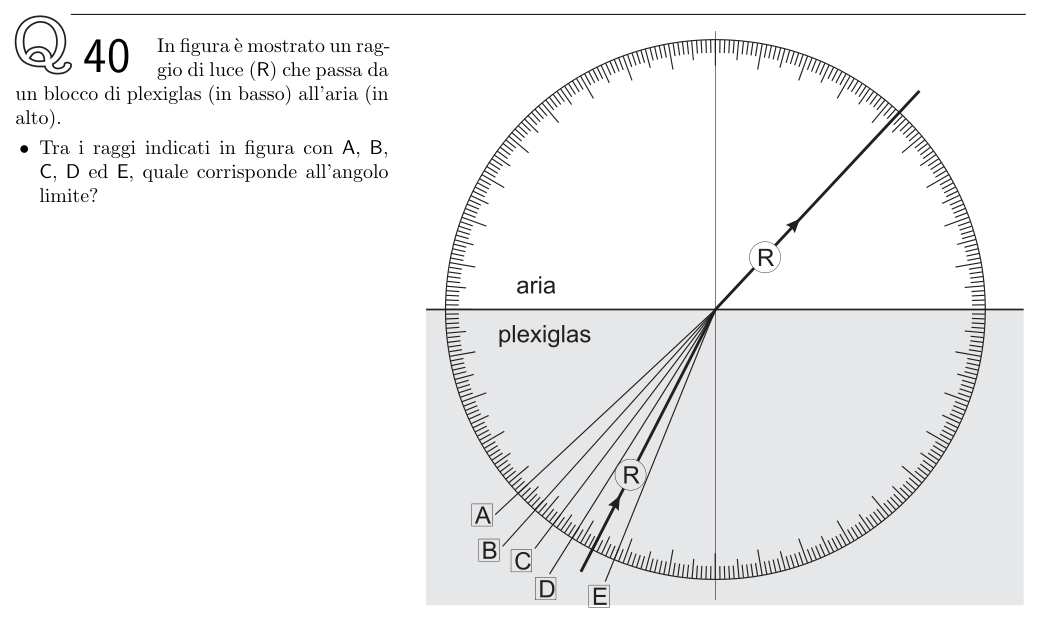
In figura è mostrato un raggio di luce (R) che passa da un blocco di plexiglas (in basso) all’aria (in alto).
• Tra i raggi indicati in figura con A, B, C, D ed E, quale corrisponde all’angolo limite?
Topic: Geometric Optics Metodi: Snell’s Law, Ray Tracing Competenze: Diagrammatic Reasoning, Physical Reasoning Objects: — Fonte: Testo (PDF) — p.10 Risposta: B · Soluzioni (PDF)
The figure shows a ray of light (R) passing from a block of plexiglass (at the bottom) to the air (at the top).
• Among the rays indicated in the figure with A, B, C, D and E, which one corresponds to the critical angle?
Answer: B · Soluzioni (PDF)