Un’automobile che a un certo istante viaggia alla velocità di 58 km/h accelera fino a una velocità di 72 km/h in 1.9 s.
Quanto vale l’accelerazione media dell’automobile?
- A.
- B.
- C.
- D.
- E. Topic: Newtonian Mechanics Metodi: Kinematic Equations Competenze: Physical Reasoning Objects: — Fonte: Testo (PDF) — p.3 Risposta: C · Soluzioni (PDF)
A car that at a certain instant is traveling at a speed of 58 km/h accelerates to a speed of 72 km/h in 1.9 s.
What is the average acceleration of the car?
- A.
- B.
- C.
- D.
- E. Answer: C · Soluzioni (PDF)
Si considerino i seguenti cicli termodinamici rappresentati in un piano -.
In quale ciclo è maggiore la quantità di calore scambiato dalla sostanza termodinamica con l’ambiente?
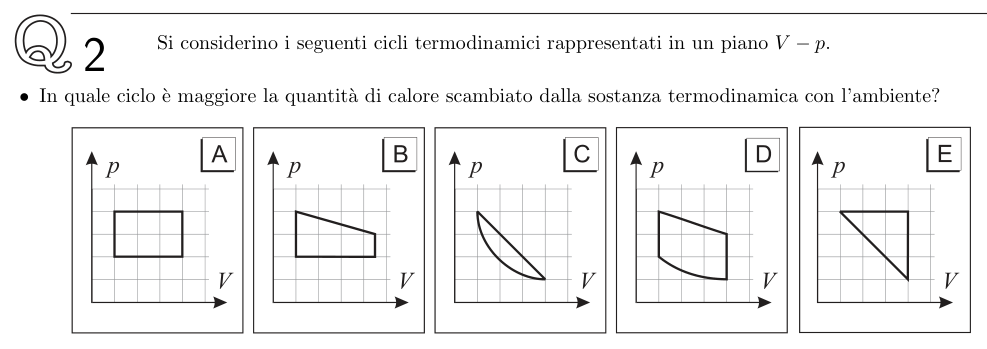 V-p diagrams of thermodynamic cycles
Topic: Thermodynamics Metodi: Thermodynamic Cycle Analysis Competenze: Diagrammatic Reasoning Objects: Gas Fonte: Testo (PDF) — p.3 Risposta: D · Soluzioni (PDF)
Consider the following thermodynamic cycles represented in a - plane.
In which cycle is the amount of heat exchanged by the thermodynamic substance with the environment greater?
V-p diagrams of thermodynamic cycles
Answer: D · Soluzioni (PDF)
Un fascio di luce bianca (b in figura) incide su un prisma di vetro posto in aria e ne emerge disperso nei vari colori dal rosso (r) al violetto (v), indicati in figura.
Quale delle seguenti figure rappresenta meglio un possibile percorso della luce attraverso il prisma?
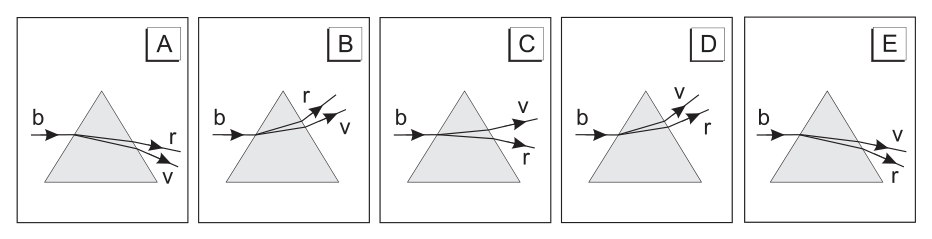 Light path through dispersing prism
Topic: Geometric Optics Metodi: Snell’s Law, Ray Tracing Competenze: Diagrammatic Reasoning Objects: Prism Fonte: Testo (PDF) — p.3 Risposta: A · Soluzioni (PDF)
A beam of white light (b in the figure) strikes a glass prism placed in air and emerges dispersed into the various colors from red (r) to violet (v), indicated in the figure.
Which of the following figures best represents a possible path of the light through the prism?
Light path through dispersing prism
Answer: A · Soluzioni (PDF)
Viene applicata una differenza di potenziale tra le piastre di un condensatore piano, distanti 0.10 m; una particella di carica , inizialmente ferma, viene lasciata libera di muoversi partendo dalla piastra positiva, come mostrato in figura. Si supponga non vengano esercitate altre forze sulla particella ad esclusione di quella elettrostatica.
Quanto vale l’energia cinetica della carica immediatamente prima che urti la piastra negativa del condensatore?
- A.
- B.
- C.
- D.
- E.
Positive charge between capacitor plates
Topic: Electrostatics Metodi: Electric Potential Method, Energy Conservation Method Competenze: Physical Reasoning Objects: Capacitor, Point Charge Fonte: Testo (PDF) — p.3 Risposta: D · Soluzioni (PDF)
A potential difference is applied between the plates of a parallel-plate capacitor, 0.10 m apart; a particle with charge , initially at rest, is left free to move starting from the positive plate, as shown in the figure. Assume that no other forces are exerted on the particle except the electrostatic one.
What is the kinetic energy of the charge immediately before it strikes the negative plate of the capacitor?
- A.
- B.
- C.
- D.
- E.
Positive charge between capacitor plates
Answer: D · Soluzioni (PDF)
Il grafico a fianco mostra l’allungamento rispetto alla posizione di equilibrio per due molle A e B in funzione della forza applicata.
Il rapporto fra la costante elastica della molla B e quella della molla A vale
- A.
- B.
- C.
- D.
- E.
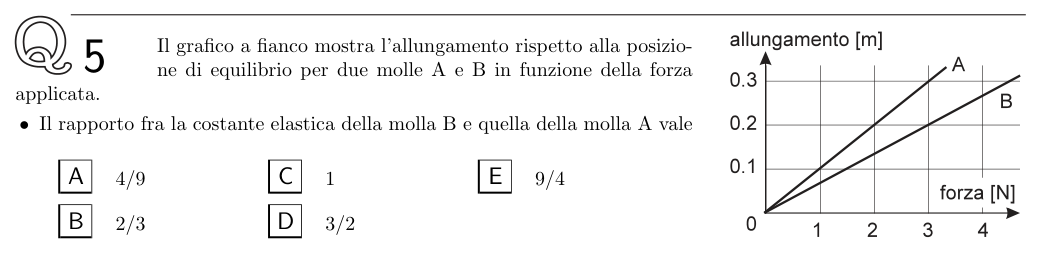 Extension vs force graph for springs A and B
Topic: Oscillations & Waves, Newtonian Mechanics Metodi: Hooke’s Law Competenze: Diagrammatic Reasoning Objects: Spring Fonte: Testo (PDF) — p.3 Risposta: D · Soluzioni (PDF)
The graph alongside shows the extension relative to the equilibrium position for two springs A and B as a function of the applied force.
The ratio between the spring constant of spring B and that of spring A is
- A.
- B.
- C.
- D.
- E.
Extension vs force graph for springs A and B
Answer: D · Soluzioni (PDF)
Un blocco di massa 3 kg è attaccato mediante un filo ad un altro blocco di massa 5 kg a cui è applicata una forza . I due blocchi si muovono su un piano orizzontale con un’accelerazione di .
Qual è il modulo della risultante di tutte le forze agenti sul blocco da 5 kg?
- A.
- B.
- C.
- D.
- E.
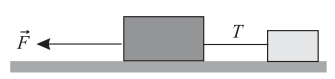 Two blocks connected by string on horizontal plane
Topic: Newtonian Mechanics Metodi: Free-Body Diagram, Kinematic Equations Competenze: Physical Reasoning Objects: Block, String Fonte: Testo (PDF) — p.4 Risposta: B · Soluzioni (PDF)
A block of mass 3 kg is attached by a string to another block of mass 5 kg to which a force is applied. The two blocks move on a horizontal plane with an acceleration of .
What is the magnitude of the resultant of all the forces acting on the 5 kg block?
- A.
- B.
- C.
- D.
- E.
Two blocks connected by string on horizontal plane
Answer: B · Soluzioni (PDF)
Facendo incidere normalmente un fascio di luce monocromatica su una fenditura stretta, si osserva, su uno schermo al di là della fenditura, una figura (detta di diffrazione) costituita da massimi e minimi, cioè una riga luminosa al centro, affiancata, sui due lati, da righe chiare e scure alternate.
Se si raddoppia la lunghezza d’onda della radiazione incidente, , e contemporaneamente si dimezza la larghezza fenditura, , tutta la figura…
- A. …diventa quattro volte più stretta.
- B. …diventa due volte più stretta.
- C. …rimane inalterata.
- D. …diventa due volte più larga.
- E. …diventa quattro volte più larga. Topic: Wave Optics Metodi: Interference & Diffraction Analysis Competenze: Physical Reasoning Objects: Slit, Screen Fonte: Testo (PDF) — p.4 Risposta: E · Soluzioni (PDF)
When a beam of monochromatic light is incident normally on a narrow slit, a pattern (called a diffraction pattern) is observed on a screen beyond the slit, consisting of maxima and minima, that is, a bright line at the center, flanked, on both sides, by alternating bright and dark lines.
If the wavelength of the incident radiation is doubled, , and at the same time the slit width is halved, , the entire pattern…
- A. …becomes four times narrower.
- B. …becomes two times narrower.
- C. …remains unchanged.
- D. …becomes two times wider.
- E. …becomes four times wider. Answer: E · Soluzioni (PDF)
L’angolo di 1 secondo d’arco (1”) è molto difficile da immaginare. Allontanando una moneta da 1 Euro la sua dimensione “apparente”, cioè l’angolo sotto cui si vede la moneta dal punto O (occhio dell’osservatore), diminuisce.
A quale, tra queste distanze, va posta la moneta se si vuole che tale angolo sia approssimativamente di un secondo d’arco?
- A.
- B.
- C.
- D.
- E.
 Coin viewed from eye at distance, angle alpha
Topic: Order-of-Magnitude Estimation, Geometric Optics Metodi: Order-of-Magnitude Estimation, Small-Angle Approximation Competenze: Estimation & Approximation Objects: — Fonte: Testo (PDF) — p.4 Risposta: E · Soluzioni (PDF)
The angle of 1 arcsecond (1”) is very difficult to imagine. By moving a 1 Euro coin away, its “apparent” size, that is, the angle under which the coin is seen from point O (the observer’s eye), decreases.
At which of these distances must the coin be placed if one wants this angle to be approximately one arcsecond?
- A.
- B.
- C.
- D.
- E.
Coin viewed from eye at distance, angle alpha
Answer: E · Soluzioni (PDF)
La molla di un’automobilina giocattolo viene caricata spingendo l’automobilina all’indietro con una forza media di 15 N per una distanza di 0.5 m.
Trascurando l’attrito, quanta energia potenziale elastica viene immagazzinata nella molla in questo processo?
- A.
- B.
- C.
- D.
- E. Topic: Newtonian Mechanics, Conservation of Energy Metodi: Energy Conservation Method, Hooke’s Law Competenze: Physical Reasoning Objects: Spring, Cart Fonte: Testo (PDF) — p.4 Risposta: C · Soluzioni (PDF)
The spring of a toy car is loaded by pushing the toy car backward with an average force of 15 N over a distance of 0.5 m.
Neglecting friction, how much elastic potential energy is stored in the spring in this process?
- A.
- B.
- C.
- D.
- E. Answer: C · Soluzioni (PDF)
Un recipiente con le pareti rigide contiene una certa quantità di un gas perfetto a .
Se la temperatura del gas viene portata a di quanto è variata percentualmente la sua pressione?
- A.
- B.
- C.
- D.
- E. Topic: Thermodynamics, Kinetic Theory Metodi: Ideal Gas Law Competenze: Physical Reasoning Objects: Gas, Container Fonte: Testo (PDF) — p.4 Risposta: D · Soluzioni (PDF)
A container with rigid walls contains a certain amount of an ideal gas at .
If the temperature of the gas is brought to , by what percentage has its pressure changed?
- A.
- B.
- C.
- D.
- E. Answer: D · Soluzioni (PDF)
Uno stuntman su una moto supera con un salto un canale largo 3.2 m. Il bordo della riva su cui atterra si trova 0.5 m al di sotto di quella da cui si stacca (v. figura).
La sua velocità, al momento del distacco, vale almeno
- A.
- B.
- C.
- D.
- E.
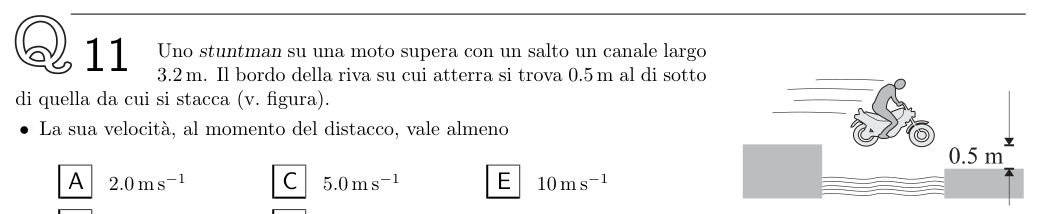 Stuntman on motorcycle jumping across canal
Topic: Newtonian Mechanics Metodi: Kinematic Equations, Free-Body Diagram Competenze: Physical Reasoning Objects: Projectile Fonte: Testo (PDF) — p.4 Risposta: E · Soluzioni (PDF)
A stuntman on a motorcycle clears a 3.2 m wide canal with a jump. The edge of the bank on which he lands is 0.5 m below the one from which he takes off (see figure).
His speed, at the moment of takeoff, is at least
- A.
- B.
- C.
- D.
- E.
Stuntman on motorcycle jumping across canal
Answer: E · Soluzioni (PDF)
Quanto tempo impiega una lampadina da 100 W per utilizzare 10 J di energia elettrica?
- A.
- B.
- C.
- D.
- E. Topic: Newtonian Mechanics, Circuits Metodi: Dimensional Analysis Competenze: Physical Reasoning Objects: — Fonte: Testo (PDF) — p.5 Risposta: B · Soluzioni (PDF)
How long does a 100 W light bulb take to use 10 J of electrical energy?
- A.
- B.
- C.
- D.
- E. Answer: B · Soluzioni (PDF)
Applicando una forza orizzontale di intensità a un oggetto posto su un piano orizzontale, esso non si muove a causa dell’attrito.
Qual è l’intensità della forza di attrito agente sull’oggetto?
- A.
- B. Maggiore di 0 ma minore di 12 N
- C.
- D. Maggiore di 12 N
- E. Non si può calcolare perché non si conosce né il peso dell’oggetto né il coefficiente d’attrito. Topic: Newtonian Mechanics Metodi: Free-Body Diagram Competenze: Physical Reasoning Objects: Block Fonte: Testo (PDF) — p.5 Risposta: C · Soluzioni (PDF)
Applying a horizontal force of magnitude to an object placed on a horizontal plane, it does not move due to friction.
What is the magnitude of the friction force acting on the object?
- A.
- B. Greater than 0 but less than 12 N
- C.
- D. Greater than 12 N
- E. It cannot be calculated because neither the weight of the object nor the coefficient of friction is known. Answer: C · Soluzioni (PDF)
La figura mostra una puleggia utilizzata per sollevare un blocco di peso 72 N per 5 m. Per questo scopo si applica una forza che compie un lavoro di 400 J. All’inizio e alla fine del sollevamento, il blocco è fermo.
Qual è il lavoro fatto dalla forza d’attrito?
- A.
- B.
- C.
- D.
- E.
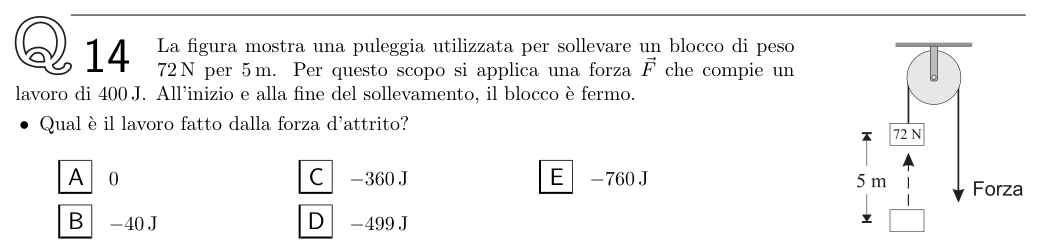 Pulley system lifting a block
Topic: Newtonian Mechanics, Conservation of Energy Metodi: Energy Conservation Method, Free-Body Diagram Competenze: Physical Reasoning Objects: Pulley, Block Fonte: Testo (PDF) — p.5 Risposta: B · Soluzioni (PDF)
The figure shows a pulley used to lift a block of weight 72 N by 5 m. For this purpose, a force is applied which does 400 J of work. At the beginning and at the end of the lifting, the block is at rest.
What is the work done by the friction force?
- A.
- B.
- C.
- D.
- E.
Pulley system lifting a block
Answer: B · Soluzioni (PDF)
Una spira circolare metallica scende verticalmente a velocità costante e attraversa una regione in cui si trova un campo magnetico orizzontale e uniforme; durante il moto l’asse della spira si mantiene parallelo al campo magnetico.
Quale dei grafici seguenti rappresenta meglio l’intensità della corrente indotta nella spira in funzione del tempo, tra l’istante in cui la spira inizia ad entrare nella regione di campo magnetico e quello in cui ne esce completamente?
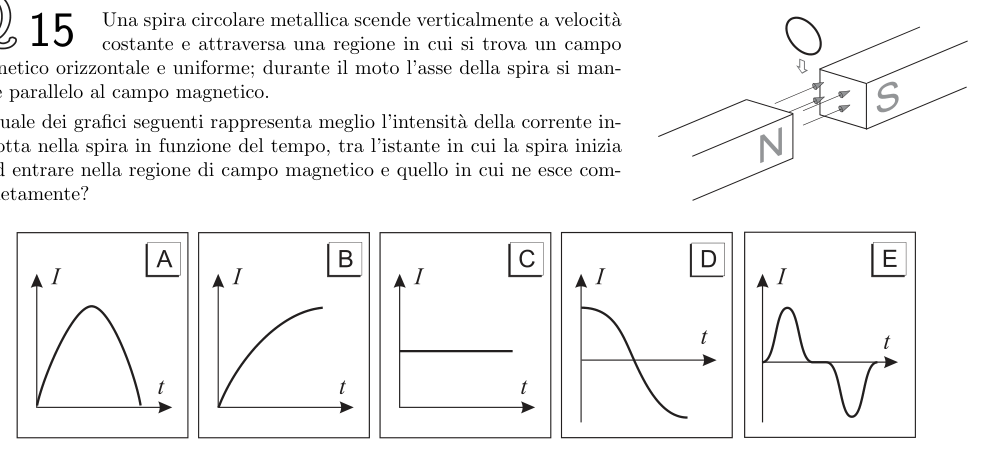 Graphs of induced current vs time options
Topic: Electromagnetic Induction Metodi: Faraday’s Law of Induction, Lenz’s Law Competenze: Diagrammatic Reasoning Objects: Coil Fonte: Testo (PDF) — p.5 Risposta: E · Soluzioni (PDF)
A circular metal loop descends vertically at constant speed and passes through a region in which there is a horizontal and uniform magnetic field; during the motion the axis of the loop remains parallel to the magnetic field.
Which of the following graphs best represents the intensity of the induced current in the loop as a function of time, between the instant in which the loop begins to enter the region of the magnetic field and the one in which it exits it completely?
Graphs of induced current vs time options
Answer: E · Soluzioni (PDF)
Qual è la potenza media sviluppata da un motore quando solleva una massa di 400 kg a velocità costante per un’altezza di 10 m in 8 s? (si trascurino le perdite dovute all’attrito)
- A.
- B.
- C.
- D.
- E. Topic: Newtonian Mechanics, Conservation of Energy Metodi: Energy Conservation Method Competenze: Physical Reasoning Objects: — Fonte: Testo (PDF) — p.5 Risposta: C · Soluzioni (PDF)
What is the average power developed by a motor when it lifts a mass of 400 kg at constant speed to a height of 10 m in 8 s? (ignore losses due to friction)
- A.
- B.
- C.
- D.
- E. Answer: C · Soluzioni (PDF)
Qual è l’ordine di grandezza del numero di elettroni nel Sole?
- A.
- B.
- C.
- D.
- E. Topic: Order-of-Magnitude Estimation, Astrophysics Metodi: Order-of-Magnitude Estimation Competenze: Estimation & Approximation Objects: Electron, Star Fonte: Testo (PDF) — p.5 Risposta: B · Soluzioni (PDF)
What is the order of magnitude of the number of electrons in the Sun?
- A.
- B.
- C.
- D.
- E. Answer: B · Soluzioni (PDF)
Un blocco di massa 3 kg scivola partendo da fermo dalla cima di un piano inclinato lungo 1.5 m. La sua accelerazione è .
Qual è la velocità del blocco alla fine del piano inclinato?
- A.
- B.
- C.
- D.
- E. Non si può calcolare perché non si conosce l’inclinazione del piano e non si sa se c’è attrito. Topic: Newtonian Mechanics Metodi: Kinematic Equations Competenze: Physical Reasoning Objects: Block, Inclined Plane Fonte: Testo (PDF) — p.6 Risposta: B · Soluzioni (PDF)
A 3 kg block slides starting from rest from the top of a 1.5 m long inclined plane. Its acceleration is .
What is the speed of the block at the end of the inclined plane?
- A.
- B.
- C.
- D.
- E. It cannot be calculated because the inclination of the plane is not known and it is not known whether there is friction. Answer: B · Soluzioni (PDF)
Un oggetto pesa 100 N a livello del suolo.
Se viene portato ad un’altezza pari a due raggi terrestri sopra il livello del suolo, il suo peso diventa
- A.
- B.
- C.
- D.
- E. Topic: Gravitation, Newtonian Mechanics Metodi: Newton’s Law of Gravitation Competenze: Physical Reasoning Objects: Planet Fonte: Testo (PDF) — p.6 Risposta: B · Soluzioni (PDF)
An object weighs 100 N at ground level.
If it is taken to a height equal to two Earth radii above ground level, its weight becomes
- A.
- B.
- C.
- D.
- E. Answer: B · Soluzioni (PDF)
Un’auto di 1200 kg che viaggia alla velocità di urta un albero e si ferma bruscamente in .
Quanto vale l’intensità media della forza che agisce sull’auto per fermarla?
- A.
- B.
- C.
- D.
- E. Topic: Newtonian Mechanics, Conservation of Momentum Metodi: Impulse-Momentum Theorem Competenze: Physical Reasoning Objects: — Fonte: Testo (PDF) — p.6 Risposta: D · Soluzioni (PDF)
A 1200 kg car traveling at a speed of hits a tree and stops abruptly in .
What is the average magnitude of the force acting on the car to stop it?
- A.
- B.
- C.
- D.
- E. Answer: D · Soluzioni (PDF)
Nel circuito in figura la resistenza vale e i condensatori hanno capacità e , con ; la carica iniziale di entrambi i condensatori è , nel verso indicato.
Subito dopo la chiusura dell’interruttore, la corrente che scorre nel circuito è
- A. 120 mA, in verso orario
- B. 120 mA, in verso antiorario
- C. 40 mA, in verso orario
- D. 40 mA, in verso antiorario
- E. Nessuna delle precedenti
 RC circuit with two capacitors and switch
Topic: Circuits, Electrostatics Metodi: Kirchhoff’s Laws, Equivalent Circuit Reduction Competenze: Physical Reasoning Objects: Capacitor, Resistor, Switch Fonte: Testo (PDF) — p.6 Risposta: C · Soluzioni (PDF)
In the circuit in the figure, the resistance is and the capacitors have capacitance and , with ; the initial charge of both capacitors is , in the direction indicated.
Immediately after the switch is closed, the current flowing in the circuit is
- A. 120 mA, in the clockwise direction
- B. 120 mA, in the counterclockwise direction
- C. 40 mA, in the clockwise direction
- D. 40 mA, in the counterclockwise direction
- E. None of the above
RC circuit with two capacitors and switch
Answer: C · Soluzioni (PDF)
Il diagramma a destra indica l’andamento della temperatura in funzione del calore assorbito da un oggetto di 3 kg di una sostanza pura inizialmente in fase solida. Tale sostanza riceve calore da una sorgente termica ad un tasso costante nel tempo.
Nella tabella seguente sono raccolte alcune proprietà caratteristiche di cinque sostanze.
Sapendo che la sostanza considerata è una di quelle in tabella, di quale si tratta?
| Sostanza | Calore Specifico | Calore latente | Temperatura di fusione |
|---|---|---|---|
| (A) Ferro | 440 | 234 | 1808 |
| (B) Mercurio | 140 | 12 | 234 |
| (C) Piombo | 129 | 24 | 601 |
| (D) Rame | 385 | 212 | 1358 |
| (E) Zinco | 390 | 101 | 693 |
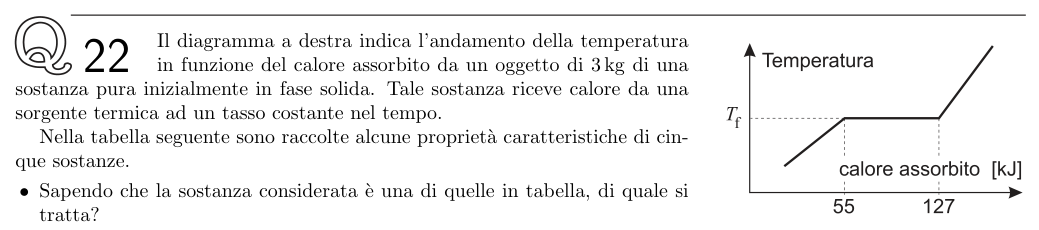 Temperature vs heat absorbed phase diagram
Topic: Thermodynamics Metodi: First Law of Thermodynamics, Experimental Data Analysis Competenze: Diagrammatic Reasoning, Physical Reasoning Objects: — Fonte: Testo (PDF) — p.6 Risposta: C · Soluzioni (PDF)
The diagram on the right shows the temperature trend in relation to the heat absorbed by an object of 3 kg of a pure substance initially in the solid phase. Such a substance receives heat from a heat source at a constant rate over time.
The following table summarises some characteristic properties of five substances.
Knowing that the substance in question is one of those in the table, what is it?
| Sostanza | Calore Specifico | Calore latente | Temperatura di fusione |
|---|---|---|---|
| I’m not going to be able to do this. | |||
| You know, I’m not going to say that. | |||
| This is the first time that I’ve ever seen this. | |||
| I’m not going to be able to do this. | |||
| ♪ I’m not going to be able to do this ♪ |
Temperature vs heat absorbed phase diagram
Topic: Thermodynamics Metodi: First Law of Thermodynamics, Experimental Data Analysis Competenze: Diagrammatic Reasoning, Physical Reasoning Objects: — Fonte: Testo (PDF) — p.6 Risposta: C · Soluzioni (PDF)
Due palline, una bianca e una nera, vengono lanciate orizzontalmente: la prima da un’altezza rispetto al suolo, con velocità , la seconda da un’altezza con velocità ; si trascuri la resistenza dell’aria.
Qual è il rapporto tra il tempo di caduta della pallina nera e di quella bianca?
- A.
- B.
- C.
- D.
- E. Topic: Newtonian Mechanics Metodi: Kinematic Equations Competenze: Physical Reasoning Objects: Ball, Projectile Fonte: Testo (PDF) — p.7 Risposta: D · Soluzioni (PDF)
Two balls, one white and one black, are thrown horizontally: the first from a height with respect to the ground, with speed , the second from a height with speed ; air resistance is to be neglected.
What is the ratio between the fall time of the black ball and that of the white ball?
- A.
- B.
- C.
- D.
- E. Answer: D · Soluzioni (PDF)
Si consideri l’immagine reale formata da una lente sottile convergente al variare della posizione dell’oggetto.
Quale dei seguenti grafici rappresenta la relazione tra la dimensione trasversale dell’immagine e la sua distanza dalla lente?
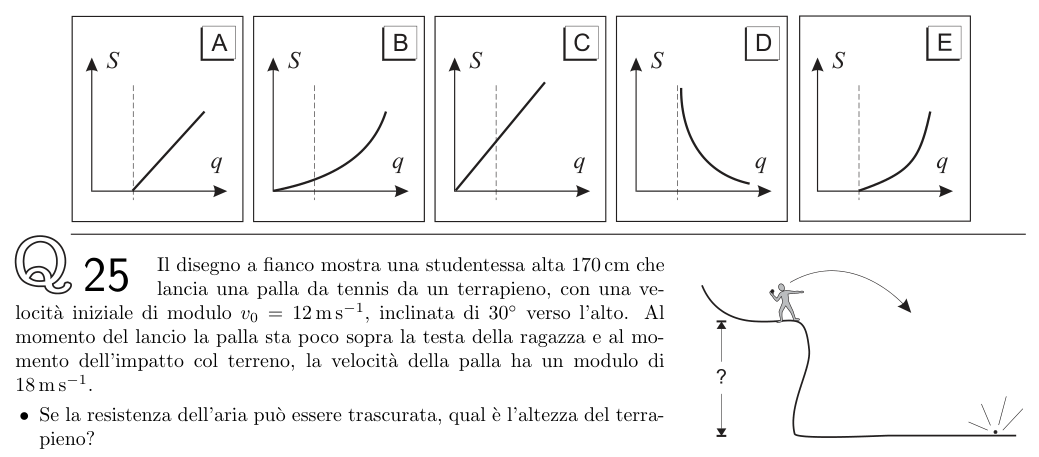 Graphs of image size S vs distance q from lens
Topic: Geometric Optics Metodi: Thin Lens & Mirror Equation Competenze: Diagrammatic Reasoning Objects: Lens Fonte: Testo (PDF) — p.7 Risposta: A · Soluzioni (PDF)
Consider the real image formed by a thin converging lens as the position of the object varies.
Which of the following graphs represents the relationship between the transverse size of the image and its distance from the lens?
Graphs of image size S vs distance q from lens
Answer: A · Soluzioni (PDF)
Il disegno a fianco mostra una studentessa alta 170 cm che lancia una palla da tennis da un terrapieno, con una velocità iniziale di modulo , inclinata di verso l’alto. Al momento del lancio la palla sta poco sopra la testa della ragazza e al momento dell’impatto col terreno, la velocità della palla ha un modulo di .
Se la resistenza dell’aria può essere trascurata, qual è l’altezza del terrapieno?
NOTA: il disegno non intende fornire una riproduzione in scala della situazione.
- A.
- B.
- C.
- D.
- E.
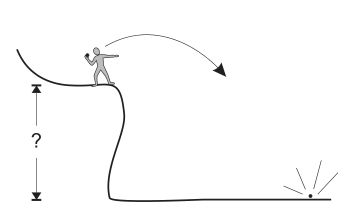 Student throwing ball from embankment
Topic: Newtonian Mechanics, Conservation of Energy Metodi: Kinematic Equations, Energy Conservation Method Competenze: Physical Reasoning Objects: Ball, Projectile Fonte: Testo (PDF) — p.7 Risposta: D · Soluzioni (PDF)
The drawing alongside shows a 170 cm tall female student throwing a tennis ball from an embankment, with an initial speed of magnitude , inclined at upward. At the moment of the throw the ball is just above the girl’s head, and at the moment of impact with the ground, the ball’s speed has a magnitude of .
If air resistance can be neglected, what is the height of the embankment?
NOTE: the drawing is not intended to provide a to-scale reproduction of the situation.
- A.
- B.
- C.
- D.
- E.
Student throwing ball from embankment
Answer: D · Soluzioni (PDF)
Due automobili, A e B, si trovano ad una distanza e si avvicinano viaggiando in verso opposto lungo una strada rettilinea. I veicoli si muovono rispettivamente con una velocità di e di .
Dopo quanto tempo i veicoli si incroceranno?
- A.
- B.
- C.
- D.
- E. Topic: Newtonian Mechanics Metodi: Kinematic Equations Competenze: Physical Reasoning Objects: — Fonte: Testo (PDF) — p.7 Risposta: A · Soluzioni (PDF)
Two cars, A and B, are at a distance and approach each other traveling in opposite directions along a straight road. The vehicles move respectively with a speed of and of .
After how much time will the vehicles cross each other?
- A.
- B.
- C.
- D.
- E. Answer: A · Soluzioni (PDF)
La figura mostra due forze di 4 N e 6 N che vengono applicate contemporaneamente a un corpo in punti e direzioni diverse.
In quale dei cinque casi mostrati in figura la risultante delle due forze ha la massima intensità?
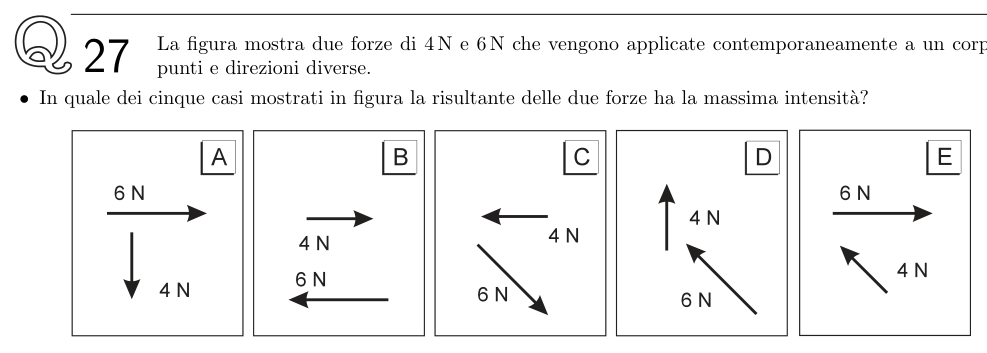 Five cases of two force vectors applied to a body
Topic: Newtonian Mechanics Metodi: Vector Decomposition, Free-Body Diagram Competenze: Diagrammatic Reasoning Objects: — Fonte: Testo (PDF) — p.7 Risposta: D · Soluzioni (PDF)
The figure shows two forces of 4 N and 6 N that are applied simultaneously to a body at different points and in different directions.
In which of the five cases shown in the figure does the resultant of the two forces have the maximum magnitude?
Five cases of two force vectors applied to a body
Answer: D · Soluzioni (PDF)
Il diagramma a fianco rappresenta due onde, A e B, che si propagano da sinistra a destra.
La differenza di fase tra le due onde è
- A.
- B.
- C.
- D.
- E.
 Two waves A and B propagating, phase comparison
Topic: Oscillations & Waves Metodi: Wave Equation, Superposition Principle Competenze: Diagrammatic Reasoning Objects: — Fonte: Testo (PDF) — p.8 Risposta: C · Soluzioni (PDF)
The diagram alongside represents two waves, A and B, propagating from left to right.
The phase difference between the two waves is
- A.
- B.
- C.
- D.
- E.
Two waves A and B propagating, phase comparison
Answer: C · Soluzioni (PDF)
Quale dei seguenti grafici posizione–tempo può rappresentare il moto di un oggetto che si muove lungo una retta con velocità che in modulo cresce nel tempo?
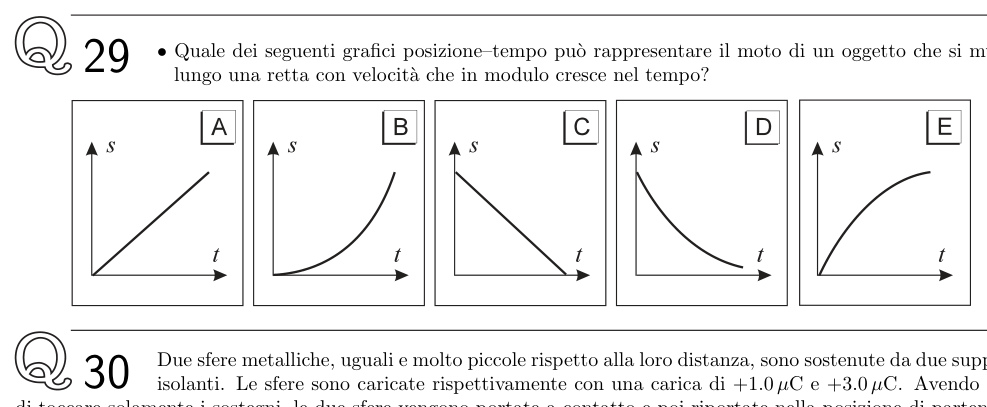 Position-time graph options for accelerating object
Topic: Newtonian Mechanics Metodi: Kinematic Equations Competenze: Diagrammatic Reasoning Objects: — Fonte: Testo (PDF) — p.8 Risposta: B · Soluzioni (PDF)
Which of the following position–time graphs can represent the motion of an object moving along a straight line with speed that increases in magnitude over time?
Position-time graph options for accelerating object
Answer: B · Soluzioni (PDF)
Due sfere metalliche, uguali e molto piccole rispetto alla loro distanza, sono sostenute da due supporti isolanti. Le sfere sono caricate rispettivamente con una carica di e . Avendo cura di toccare solamente i sostegni, le due sfere vengono portate a contatto e poi riportate nella posizione di partenza.
Come effetto di questa operazione la forza elettrostatica agente tra di esse cambia dal valore iniziale 27 mN al valore
- A.
- B.
- C.
- D.
- E. Topic: Electrostatics Metodi: Coulomb’s Law Competenze: Physical Reasoning Objects: Conducting Sphere Fonte: Testo (PDF) — p.8 Risposta: D · Soluzioni (PDF)
Two metal spheres, identical and very small compared to their distance, are supported by two insulating supports. The spheres are charged respectively with a charge of and . Taking care to touch only the supports, the two spheres are brought into contact and then returned to their starting position.
As an effect of this operation, the electrostatic force acting between them changes from the initial value 27 mN to the value
- A.
- B.
- C.
- D.
- E. Answer: D · Soluzioni (PDF)
In una certa regione dello spazio l’intensità del campo magnetico vale 0.1 T. Uno ione positivo, che si sta muovendo ad una velocità di in direzione perpendicolare al campo magnetico, entra in questa regione e subisce l’azione di una forza di intensità .
La carica elettrica dello ione vale
- A.
- B.
- C.
- D.
- E. Topic: Magnetism, Electromagnetism Metodi: Lorentz Force Analysis Competenze: Physical Reasoning Objects: Point Charge Fonte: Testo (PDF) — p.8 Risposta: C · Soluzioni (PDF)
In a certain region of space the magnetic field strength is 0.1 T. A positive ion, which is moving at a speed of in a direction perpendicular to the magnetic field, enters this region and experiences a force of magnitude .
The electric charge of the ion is
- A.
- B.
- C.
- D.
- E. Answer: C · Soluzioni (PDF)
Il grafico a destra mostra la relazione fra la differenza di potenziale ai capi di un conduttore metallico e la corrente che lo attraversa quando il conduttore si trova alla temperatura uniforme .
Quale dei seguenti grafici mostra meglio la relazione fra differenza di potenziale e corrente quando lo stesso conduttore è mantenuto a temperatura uniforme ?
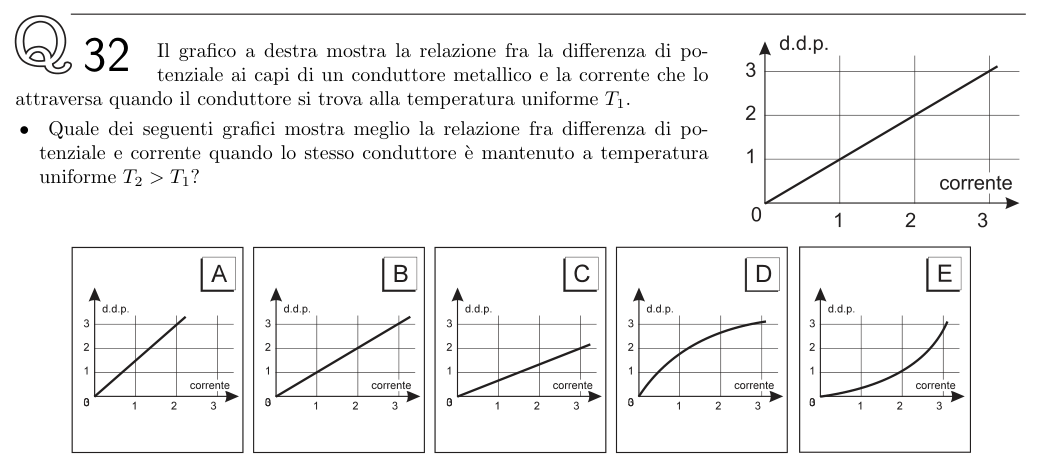 V-I graphs for conductor at different temperatures
Topic: Circuits Metodi: Kirchhoff’s Laws Competenze: Diagrammatic Reasoning, Physical Reasoning Objects: Resistor, Wire Fonte: Testo (PDF) — p.8 Risposta: A · Soluzioni (PDF)
The graph on the right shows the relationship between the potential difference across a metallic conductor and the current flowing through it when the conductor is at a uniform temperature .
Which of the following graphs best shows the relationship between potential difference and current when the same conductor is kept at a uniform temperature ?
V-I graphs for conductor at different temperatures
Answer: A · Soluzioni (PDF)
Nel grafico è riportato lo spostamento in funzione del tempo di una particella di un mezzo uniforme quando questo viene attraversato da un’onda.
Qual è la frequenza dell’onda?
- A.
- B.
- C.
- D.
- E.
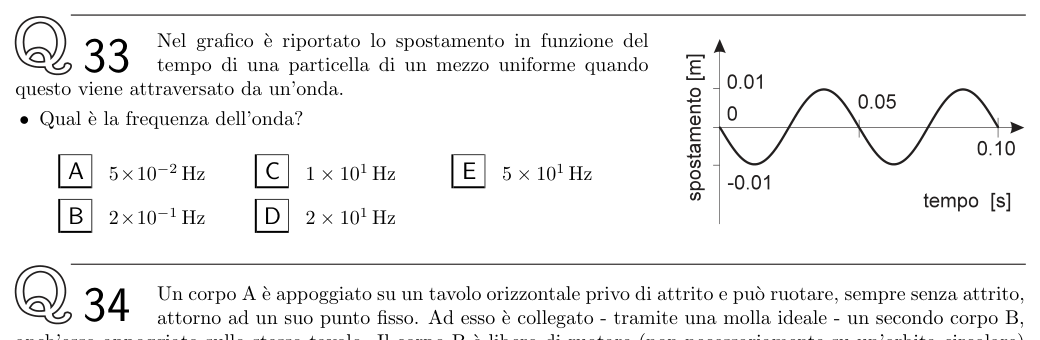 Displacement vs time graph of a wave particle
Topic: Oscillations & Waves Metodi: Wave Equation, Simple Harmonic Motion Analysis Competenze: Diagrammatic Reasoning Objects: — Fonte: Testo (PDF) — p.9 Risposta: D · Soluzioni (PDF)
The graph shows the displacement as a function of time of a particle in a uniform medium when a wave passes through it.
What is the frequency of the wave?
- A.
- B.
- C.
- D.
- E.
Displacement vs time graph of a wave particle
Answer: D · Soluzioni (PDF)
Un corpo A è appoggiato su un tavolo orizzontale privo di attrito e può ruotare, sempre senza attrito, attorno ad un suo punto fisso. Ad esso è collegato — tramite una molla ideale — un secondo corpo B, anch’esso appoggiato sullo stesso tavolo. Il corpo B è libero di ruotare (non necessariamente su un’orbita circolare) attorno ad A.
Durante il moto del corpo B si studia l’andamento delle grandezze , ed , che sono rispettivamente l’energia meccanica, la quantità di moto e il momento angolare totali del sistema dei due corpi, quest’ultimo calcolato rispetto alla posizione di A.
Si considerino le seguenti affermazioni:
1 – L’energia meccanica del sistema si conserva. 2 – La quantità di moto del sistema si conserva. 3 – Il momento angolare del sistema, calcolato rispetto alla posizione di A, si conserva.
Quali sono corrette?
- A. Nessuna delle tre.
- B. Solo la 1.
- C. Solo la 2.
- D. Solo la 1 e la 3.
- E. Tutte e tre. Topic: Newtonian Mechanics, Rotational Dynamics, Conservation of Energy, Conservation of Momentum Metodi: Conservation Laws, Torque & Angular Momentum Analysis Competenze: Physical Reasoning Objects: Spring, Block Fonte: Testo (PDF) — p.9 Risposta: D · Soluzioni (PDF)
A body A rests on a frictionless horizontal table and can rotate, also without friction, about a fixed point of it. Connected to it — by means of an ideal spring — is a second body B, also resting on the same table. Body B is free to rotate (not necessarily on a circular orbit) around A.
During the motion of body B, the behavior of the quantities , and is studied, which are respectively the mechanical energy, the momentum and the total angular momentum of the system of the two bodies, the latter calculated with respect to the position of A.
Consider the following statements:
1 – The mechanical energy of the system is conserved. 2 – The momentum of the system is conserved. 3 – The angular momentum of the system, calculated with respect to the position of A, is conserved.
Which are correct?
- A. None of the three.
- B. Only 1.
- C. Only 2.
- D. Only 1 and 3.
- E. All three. Answer: D · Soluzioni (PDF)
Un motore di Carnot funziona tra le temperature e . In ogni ciclo sviluppa 6.1 kJ di lavoro.
Quanto calore assorbe?
- A.
- B.
- C.
- D.
- E. Topic: Thermodynamics Metodi: Thermodynamic Cycle Analysis, First Law of Thermodynamics Competenze: Physical Reasoning Objects: Heat Engine Fonte: Testo (PDF) — p.9 Risposta: D · Soluzioni (PDF)
A Carnot engine operates between the temperatures and . In each cycle it develops 6.1 kJ of work.
How much heat does it absorb?
- A.
- B.
- C.
- D.
- E. Answer: D · Soluzioni (PDF)
La superficie di un certo metallo viene investita da un fascio luminoso di frequenza opportuna ed emette elettroni. La velocità massima e l’energia cinetica massima degli elettroni emessi sono rispettivamente ed .
Se la stessa superficie viene investita da un fascio luminoso della stessa frequenza, ma di intensità luminosa doppia, quali tra le seguenti affermazioni sono corrette?
1 – Viene emesso un numero doppio di elettroni al secondo. 2 – La velocità degli elettroni più veloci vale . 3 – L’energia cinetica degli elettroni più veloci vale .
- A. Solo la 1.
- B. Solo la 2.
- C. Solo la 3.
- D. Solo la 1 e la 2.
- E. Tutte e tre. Topic: Modern-Quantum Physics Metodi: Photon Energy Relation Competenze: Physical Reasoning Objects: Photon, Electron Fonte: Testo (PDF) — p.9 Risposta: A · Soluzioni (PDF)
The surface of a certain metal is struck by a light beam of suitable frequency and emits electrons. The maximum speed and the maximum kinetic energy of the emitted electrons are respectively and .
If the same surface is struck by a light beam of the same frequency, but with double light intensity, which of the following statements are correct?
1 – Twice as many electrons are emitted per second. 2 – The speed of the fastest electrons is . 3 – The kinetic energy of the fastest electrons is .
- A. Only 1.
- B. Only 2.
- C. Only 3.
- D. Only 1 and 2.
- E. All three. Answer: A · Soluzioni (PDF)
Due carrelli si trovano su una rotaia orizzontale con attrito trascurabile. Il primo, che ha massa e si muove con velocità , urta contro il secondo, inizialmente fermo, che ha massa e resta attaccato ad esso.
Qual è la velocità dei due carrelli dopo l’urto?
- A.
- B.
- C.
- D.
- E. Topic: Newtonian Mechanics, Conservation of Momentum Metodi: Conservation of Momentum Competenze: Physical Reasoning Objects: Cart Fonte: Testo (PDF) — p.9 Risposta: E · Soluzioni (PDF)
Two carts are on a horizontal track with negligible friction. The first, which has mass and moves with velocity , collides with the second, initially at rest, which has mass and remains attached to it.
What is the velocity of the two carts after the collision?
- A.
- B.
- C.
- D.
- E. Answer: E · Soluzioni (PDF)
Un lingotto di piombo di massa viene portato alla temperatura di e poi immerso in 2 L d’acqua a .
Se si considerano trascurabili le dispersioni di calore, la temperatura del lingotto, una volta stabilito l’equilibrio, è
- A.
- B.
- C.
- D.
- E.
 Two speakers and interference pattern with points P and R
Topic: Thermodynamics Metodi: First Law of Thermodynamics Competenze: Physical Reasoning Objects: — Fonte: Testo (PDF) — p.10 Risposta: A · Soluzioni (PDF)
A lead ingot of mass is brought to the temperature of and then immersed in 2 L of water at .
If heat losses are considered negligible, the temperature of the ingot, once equilibrium is established, is
- A.
- B.
- C.
- D.
- E.
Two speakers and interference pattern with points P and R
Answer: A · Soluzioni (PDF)
Per rinfrescare una bevanda si possono aggiungere 10 g d’acqua a oppure 10 g di ghiaccio sempre a .
Quale tra questi due metodi consente di raffreddare di più la bevanda?
- A. Il secondo, perché il ghiaccio fonde lentamente e la bevanda resta fresca più a lungo.
- B. Il secondo, perché il ghiaccio assorbe dell’energia.
- C. Il secondo, perché il ghiaccio resta in superficie e ciò riduce il riscaldamento da parte dell’ambiente.
- D. Il secondo, perché l’acqua di fusione del ghiaccio scende sul fondo del bicchiere e assicura un raffreddamento più omogeneo.
- E. I due metodi sono equivalenti. Topic: Thermodynamics Metodi: First Law of Thermodynamics Competenze: Physical Reasoning Objects: — Fonte: Testo (PDF) — p.10 Risposta: B · Soluzioni (PDF)
To cool a drink, one can add 10 g of water at or 10 g of ice also at .
Which of these two methods allows the drink to be cooled more?
- A. The second, because the ice melts slowly and the drink stays cool longer.
- B. The second, because the ice absorbs energy.
- C. The second, because the ice stays on the surface and this reduces heating from the environment.
- D. The second, because the meltwater from the ice goes down to the bottom of the glass and ensures more uniform cooling.
- E. The two methods are equivalent. Answer: B · Soluzioni (PDF)
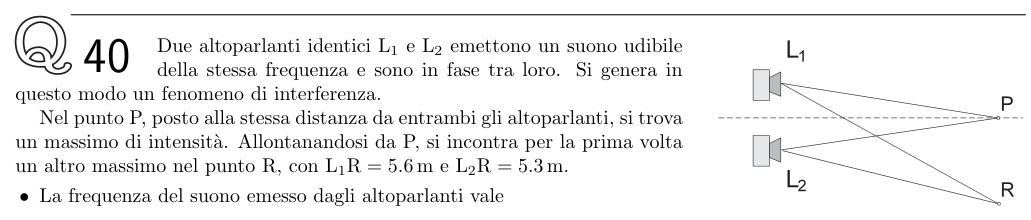
Due altoparlanti identici e emettono un suono udibile della stessa frequenza e sono in fase tra loro. Si genera in questo modo un fenomeno di interferenza.
Nel punto P, posto alla stessa distanza da entrambi gli altoparlanti, si trova un massimo di intensità. Allontanandosi da P, si incontra per la prima volta un altro massimo nel punto R, con e .
La frequenza del suono emesso dagli altoparlanti vale
- A.
- B.
- C.
- D.
- E. Topic: Oscillations & Waves, Wave Optics Metodi: Interference & Diffraction Analysis, Superposition Principle Competenze: Physical Reasoning Objects: — Fonte: Testo (PDF) — p.10 Risposta: D · Soluzioni (PDF)
Two identical loudspeakers and emit an audible sound of the same frequency and are in phase with each other. In this way, an interference phenomenon is generated.
At point P, located at the same distance from both loudspeakers, there is an intensity maximum. Moving away from P, one encounters another maximum for the first time at point R, with and .
The frequency of the sound emitted by the loudspeakers is
- A.
- B.
- C.
- D.
- E. Answer: D · Soluzioni (PDF)