Qual è l’energia necessaria per modificare la temperatura di 200 g di piombo (il cui calore specifico è circa ) da a ?
- A.
- B.
- C.
- D.
- E. Topic: Thermodynamics Metodi: First Law of Thermodynamics Competenze: Physical Reasoning Objects: — Fonte: Testo (PDF) — p.3 Risposta: A · Soluzioni (PDF)
What is the energy required to change the temperature of 200 g of lead (whose specific heat is about ) from to ?
- A.
- B.
- C.
- D.
- E. Answer: A · Soluzioni (PDF)
Il grafico mostra come varia nel tempo la velocità di un corpo di massa pari a spostato su una superficie piana.
La forza risultante applicata al corpo nel tratto DE è:
- A. nulla
- B.
- C.
- D.
- E.
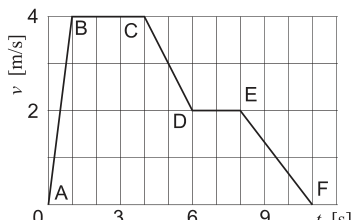 velocity–time graph DE segment
Topic: Newtonian Mechanics Metodi: Kinematic Equations, Free-Body Diagram Competenze: Physical Reasoning, Diagrammatic Reasoning Objects: Block Fonte: Testo (PDF) — p.3 Risposta: A · Soluzioni (PDF)
The graph shows how the velocity of a body of mass equal to moved on a flat surface varies over time.
The resultant force applied to the body in the segment DE is:
- A. zero
- B.
- C.
- D.
- E.
velocity–time graph DE segment
Answer: A · Soluzioni (PDF)
Una spira rettangolare è percorsa da una corrente continua che circola in senso antiorario. Accanto, nello stesso piano della spira e parallelamente a due lati del rettangolo, si trova un filo infinitamente lungo percorso da una corrente continua diretta verso l’alto, come mostrato in figura. I lati della spira paralleli al filo distano rispettivamente e dal filo, e hanno lunghezza .
La forza risultante applicata alla spira è:
- A. diretta verso destra
- B. diretta verso sinistra
- C. diretta verso sinistra
- D. diretta verso destra
- E.
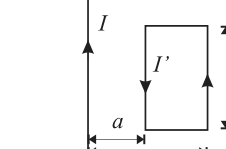 rectangular loop near infinite wire
Topic: Magnetism Metodi: Biot-Savart Law, Ampère’s Law Competenze: Physical Reasoning, Mathematical Modeling Objects: Coil, Wire Fonte: Testo (PDF) — p.3 Risposta: A · Soluzioni (PDF)
A rectangular loop carries a direct current circulating counterclockwise. Next to it, in the same plane as the loop and parallel to two sides of the rectangle, there is an infinitely long wire carrying a direct current directed upward, as shown in the figure. The sides of the loop parallel to the wire are at distances and from the wire, respectively, and have length .
The resultant force applied to the loop is:
- A. directed to the right
- B. directed to the left
- C. directed to the left
- D. directed to the right
- E.
rectangular loop near infinite wire
Answer: A · Soluzioni (PDF)
Due gusci conduttori sferici sono concentrici e isolati. La sfera più interna ha raggio e carica netta ; la sfera più esterna ha raggio e carica netta . Si consideri un punto P posto a distanza dal centro delle due sfere, con .
Ponendo a zero il potenziale a distanza infinita dalle sfere, il potenziale nel punto P è:
- A.
- B.
- C.
- D.
- E. Topic: Electrostatics Metodi: Gauss’s Law, Electric Potential Method Competenze: Physical Reasoning Objects: Conducting Sphere Fonte: Testo (PDF) — p.3 Risposta: D · Soluzioni (PDF)
Two concentric spherical conducting shells are insulated. The innermost sphere has radius and net charge ; the outermost sphere has radius and net charge . Consider a point P located at distance from the center of the two spheres, with .
Setting the potential to zero at an infinite distance from the spheres, the potential at point P is:
- A.
- B.
- C.
- D.
- E. Answer: D · Soluzioni (PDF)
La figura rappresenta due impulsi di uguale lunghezza che hanno uguale ampiezza e la stessa lunghezza d’onda . Essi si propagano su una lunga corda elastica omogenea, entrambi verso il punto P che si trova ad uguale distanza dai due impulsi.
Nell’intervallo di tempo in cui i due impulsi si sovrappongono, il punto P della corda oscilla con ampiezza:
- A. in orizzontale
- B. in verticale
- C. in verticale
- D. in verticale
- E. nulla (non oscilla)
two wave pulses approaching point P
Topic: Oscillations & Waves Metodi: Superposition Principle Competenze: Physical Reasoning, Diagrammatic Reasoning Objects: String Fonte: Testo (PDF) — p.3 Risposta: E · Soluzioni (PDF)
The figure represents two pulses of equal length that have equal amplitude and the same wavelength . They propagate along a long homogeneous elastic cord, both toward point P which is at equal distance from the two pulses.
In the time interval in which the two pulses overlap, point P of the cord oscillates with amplitude:
- A. horizontally
- B. vertically
- C. vertically
- D. vertically
- E. zero (it does not oscillate)
two wave pulses approaching point P
Answer: E · Soluzioni (PDF)
In una macchina elettrostatica una cinghia di larghezza , che trasporta carica con densità superficiale uniforme , si muove a velocità . In un certo punto la carica distribuita sulla cinghia viene rimossa e convogliata in un filo conduttore determinando una corrente elettrica.
In condizioni stazionarie qual è l’intensità di corrente nel filo?
- A.
- B.
- C.
- D.
- E.
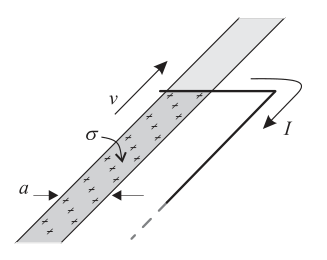 belt conveying charge into wire
Topic: Electrostatics, Circuits Metodi: Dimensional Analysis, Physical Modeling Competenze: Physical Reasoning, Unit Conversion Objects: Wire Fonte: Testo (PDF) — p.4 Risposta: C · Soluzioni (PDF)
In an electrostatic machine, a belt of width , which carries charge with uniform surface density , moves at speed . At a certain point the charge distributed on the belt is removed and conveyed into a conducting wire, producing an electric current.
Under steady-state conditions, what is the current intensity in the wire?
- A.
- B.
- C.
- D.
- E.
belt conveying charge into wire
Answer: C · Soluzioni (PDF)
Un sistema costituito da un gas perfetto compie il ciclo termodinamico rappresentato in figura. La trasformazione è un’isoterma. La trasformazione è un’isocora e la trasformazione è un’adiabatica. Durante l’intero ciclo viene compiuto un lavoro . Durante la trasformazione , l’energia interna diminuisce di . Durante la trasformazione , viene fatto un lavoro di sul sistema.
| Ciclo |
Quanto calore viene somministrato al sistema nella trasformazione ?
- A.
- B.
- C.
- D.
- E.
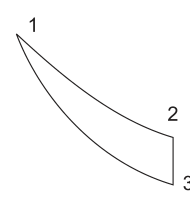 p-V thermodynamic cycle diagram
Topic: Thermodynamics Metodi: First Law of Thermodynamics, Thermodynamic Cycle Analysis, Conservation Laws Competenze: Physical Reasoning, Mathematical Modeling Objects: Gas Fonte: Testo (PDF) — p.4 Risposta: D · Soluzioni (PDF)
A system made up of a perfect gas completes the thermodynamic cycle shown in the figure. The transformation is an isotherm. The transformation is an isocore and the transformation is an adiabatic. A work is performed throughout the cycle. During the transformation, the internal energy decreases by . During the transformation, work is done on the system.
| Ciclo |
How much heat is delivered to the system in the transformation?
- A.
- B.
- C.
- D.
- E.
p-V thermodynamic cycle diagram
Topic: Thermodynamics Metodi: First Law of Thermodynamics, Thermodynamic Cycle Analysis, Conservation Laws Competenze: Physical Reasoning, Mathematical Modeling Objects: Gas Fonte: Testo (PDF) — p.4 Risposta: D · Soluzioni (PDF)
La figura mostra una piattaforma circolare orizzontale. Sul bordo si trova un blocco di massa attaccato ad un’estremità di un filo in cui è inserito un dinamometro. L’altro estremo del filo è fisso al centro della piattaforma. Il blocco ruota (con attrito trascurabile) lungo il bordo della piattaforma, ad una distanza dal centro, con velocità di modulo costante .
Quale valore si legge, approssimativamente, sul dinamometro?
- A.
- B.
- C.
- D.
- E.
rotating block on circular platform with dynamometer
Topic: Newtonian Mechanics Metodi: Free-Body Diagram, Kinematic Equations Competenze: Physical Reasoning Objects: Block, String Fonte: Testo (PDF) — p.4 Risposta: D · Soluzioni (PDF)
The figure shows a horizontal circular platform. On the edge there is a block of mass attached to one end of a string in which a dynamometer is inserted. The other end of the string is fixed to the center of the platform. The block rotates (with negligible friction) along the edge of the platform, at a distance from the center, with a constant speed of magnitude .
What value is read, approximately, on the dynamometer?
- A.
- B.
- C.
- D.
- E.
rotating block on circular platform with dynamometer
Answer: D · Soluzioni (PDF)
In un ciclo di Carnot vengono prelevati di energia da una sorgente alla temperatura di .
La quantità di calore ceduta al termostato freddo alla temperatura di è, in modulo:
- A.
- B.
- C.
- D.
- E. Topic: Thermodynamics Metodi: Thermodynamic Cycle Analysis, Conservation Laws Competenze: Physical Reasoning Objects: Heat Engine Fonte: Testo (PDF) — p.4 Risposta: D · Soluzioni (PDF)
In a Carnot cycle, of energy is taken from a source at a temperature of .
The amount of heat released to the cold reservoir at a temperature of is, in magnitude:
- A.
- B.
- C.
- D.
- E. Answer: D · Soluzioni (PDF)
Due dischi identici possono ruotare senza attrito attorno ad un asse comune. All’inizio il disco inferiore ruota con velocità angolare ed energia cinetica mentre il disco superiore è fermo. Quest’ultimo viene lasciato cadere e aderisce a quello inferiore senza rimbalzare.
Qual è l’energia cinetica totale del sistema dopo l’urto?
- A.
- B.
- C.
- D.
- E.
two coaxial discs before collision
Topic: Rotational Dynamics Metodi: Conservation of Momentum, Torque & Angular Momentum Analysis Competenze: Physical Reasoning, Mathematical Modeling Objects: Disk Fonte: Testo (PDF) — p.4 Risposta: B · Soluzioni (PDF)
Two identical discs can rotate without friction around a common axis. Initially, the lower disc rotates with angular velocity and kinetic energy while the upper disc is stationary. The latter is dropped and sticks to the lower one without bouncing.
What is the total kinetic energy of the system after the collision?
- A.
- B.
- C.
- D.
- E.
two coaxial discs before collision
Answer: B · Soluzioni (PDF)
Un blocco di massa è appoggiato su un piano orizzontale senza attrito ed è attaccato ad una molla ideale di costante elastica avente l’altro estremo fisso. Il blocco viene spostato comprimendo la molla di rispetto alla posizione di equilibrio e lasciato.
Qual è la massima energia cinetica raggiunta dal blocco?
- A.
- B.
- C.
- D.
- E. Topic: Oscillations & Waves, Conservation of Energy Metodi: Hooke’s Law, Energy Conservation Method Competenze: Physical Reasoning Objects: Block, Spring Fonte: Testo (PDF) — p.5 Risposta: A · Soluzioni (PDF)
A block of mass rests on a frictionless horizontal plane and is attached to an ideal spring with spring constant whose other end is fixed. The block is displaced by compressing the spring by relative to the equilibrium position and then released.
What is the maximum kinetic energy reached by the block?
- A.
- B.
- C.
- D.
- E. Answer: A · Soluzioni (PDF)
Un’automobile di massa che viaggia alla velocità costante (in modulo) svolta ad un incrocio. L’auto segue una traiettoria orizzontale lungo una circonferenza di raggio arrivando nel punto P. In questo punto una lastra di ghiaccio fa perdere completamente l’aderenza al terreno all’automobile.
Quale traiettoria segue il mezzo sul ghiaccio? (le opzioni sono rappresentate graficamente in figura)
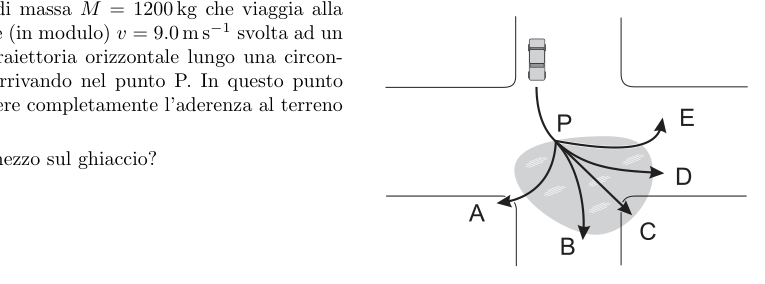 car trajectory options after losing grip
Topic: Newtonian Mechanics Metodi: Kinematic Equations, Free-Body Diagram Competenze: Diagrammatic Reasoning, Physical Reasoning Objects: — Fonte: Testo (PDF) — p.5 Risposta: C · Soluzioni (PDF)
A car of mass traveling at constant speed (in magnitude) turns at an intersection. The car follows a horizontal trajectory along a circle of radius , arriving at point P. At this point a sheet of ice causes the car to completely lose its grip on the ground.
Which trajectory does the vehicle follow on the ice? (the options are represented graphically in the figure)
car trajectory options after losing grip
Answer: C · Soluzioni (PDF)
Una carica è distribuita uniformemente in tutto il volume di un cilindro infinitamente lungo, non conduttore, di raggio .
Quale dei seguenti grafici rappresenta meglio l’intensità del campo elettrico in funzione della distanza dall’asse del cilindro? (le opzioni sono rappresentate graficamente in figura)
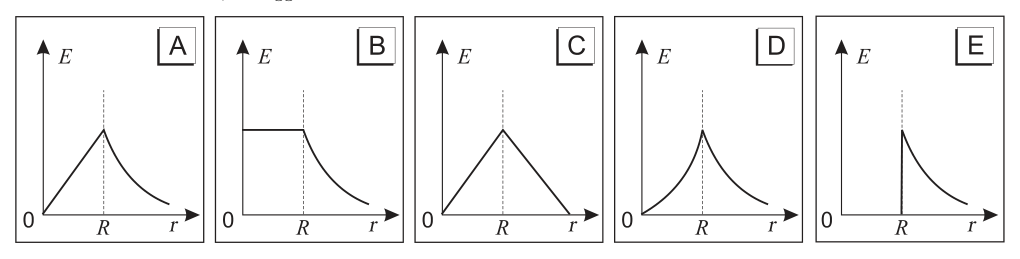 five E vs r graph options for charged cylinder
Topic: Electrostatics Metodi: Gauss’s Law, Physical Modeling Competenze: Diagrammatic Reasoning, Physical Reasoning Objects: Cylinder Fonte: Testo (PDF) — p.5 Risposta: A · Soluzioni (PDF)
A charge is distributed uniformly throughout the volume of an infinitely long, non-conducting cylinder of radius .
Which of the following graphs best represents the magnitude of the electric field as a function of the distance from the axis of the cylinder? (the options are represented graphically in the figure)
five E vs r graph options for charged cylinder
Answer: A · Soluzioni (PDF)
Due blocchetti di materiale diverso, uniti tra loro, sono attraversati da un raggio di luce, come mostrato in figura.
Quanto vale l’angolo limite sulla superficie di separazione tra i due blocchetti?
- A.
- B.
- C.
- D.
- E.
light ray through two different material blocks
Topic: Geometric Optics Metodi: Snell’s Law, Ray Tracing Competenze: Diagrammatic Reasoning, Physical Reasoning Objects: Block Fonte: Testo (PDF) — p.5 Risposta: A · Soluzioni (PDF)
Two small blocks of different material, joined together, are crossed by a ray of light, as shown in the figure.
What is the value of the critical angle at the interface between the two blocks?
- A.
- B.
- C.
- D.
- E.
light ray through two different material blocks
Answer: A · Soluzioni (PDF)
Una palla di massa viene lanciata verticalmente verso l’alto. L’attrito con l’aria non è trascurabile e lo si assuma proporzionale alla velocità e di verso opposto ad essa.
Nel punto più alto della traiettoria l’accelerazione della palla è:
- A.
- B. minore di
- C.
- D. maggiore di
- E. inversamente proporzionale alla massa Topic: Newtonian Mechanics Metodi: Free-Body Diagram Competenze: Physical Reasoning Objects: Ball Fonte: Testo (PDF) — p.5 Risposta: C · Soluzioni (PDF)
A ball of mass is thrown vertically upward. The friction with the air is not negligible and is assumed to be proportional to the velocity and in the opposite direction to it.
At the highest point of the trajectory the acceleration of the ball is:
- A.
- B. less than
- C.
- D. greater than
- E. inversely proportional to the mass Answer: C · Soluzioni (PDF)
Due sorgenti emettono onde della stessa lunghezza d’onda , in fase tra loro. Le due sorgenti sono poste a una distanza tra di loro e distano rispettivamente e da un punto P posto a distanza dall’asse fra le due sorgenti, come mostrato in figura. La grandezza esprime dunque la differenza tra i cammini delle onde emesse dalle due sorgenti.
Per quale, fra i seguenti valori di l’interferenza è sempre costruttiva?
- A.
- B.
- C.
- D.
- E.
two coherent sources and point P geometry
Topic: Wave Optics, Oscillations & Waves Metodi: Interference & Diffraction Analysis, Superposition Principle Competenze: Physical Reasoning, Mathematical Modeling Objects: — Fonte: Testo (PDF) — p.6 Risposta: E · Soluzioni (PDF)
Two sources emit waves of the same wavelength , in phase with each other. The two sources are placed at a distance from each other and are respectively at distances and from a point P located at a distance from the axis between the two sources, as shown in the figure. The quantity therefore expresses the difference between the paths of the waves emitted by the two sources.
For which of the following values of is the interference always constructive?
- A.
- B.
- C.
- D.
- E.
two coherent sources and point P geometry
Answer: E · Soluzioni (PDF)
Il grafico a destra rappresenta la relazione tra la forza applicata ad una molla e la sua lunghezza.
Quanto vale la costante elastica della molla?
- A.
- B.
- C.
- D.
- E.
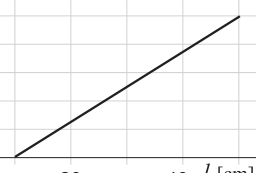 force vs length graph for spring
Topic: Oscillations & Waves, Newtonian Mechanics Metodi: Hooke’s Law, Graph Linearization Competenze: Diagrammatic Reasoning, Physical Reasoning Objects: Spring Fonte: Testo (PDF) — p.6 Risposta: E · Soluzioni (PDF)
The graph on the right represents the relationship between the force applied to a spring and its length.
What is the spring constant of the spring?
- A.
- B.
- C.
- D.
- E.
force vs length graph for spring
Answer: E · Soluzioni (PDF)
Si considerino le seguenti situazioni:
- Un satellite che percorre un’orbita circolare a velocità costante intorno alla Terra.
- Un’automobile che frena.
- Una bicicletta che si muove a velocità costante su una strada rettilinea in salita.
In quali di queste situazioni la forza risultante sul corpo è uguale a zero?
- A. Solo nella prima
- B. Solo nella seconda
- C. Solo nella terza
- D. Nella prima e nella terza
- E. In nessuna Topic: Newtonian Mechanics Metodi: Free-Body Diagram Competenze: Physical Reasoning Objects: Satellite, Planet Fonte: Testo (PDF) — p.6 Risposta: C · Soluzioni (PDF)
Consider the following situations:
- A satellite moving in a circular orbit at constant speed around the Earth.
- A car braking.
- A bicycle moving at constant speed on a straight uphill road.
In which of these situations is the resultant force on the body equal to zero?
- A. Only in the first
- B. Only in the second
- C. Only in the third
- D. In the first and in the third
- E. In none Answer: C · Soluzioni (PDF)
Un’asta ST è sospesa orizzontalmente mediante due sottili fili verticali attaccati agli estremi, come mostrato in figura. Se le tensioni nei fili fissati in S e in T valgono rispettivamente e , si può concludere che:
- il peso dell’asta è .
- il baricentro dell’asta è più vicino a S che a T.
- l’asta continuerebbe a rimanere in equilibrio orizzontale anche se i fili fossero tolti e l’asta venisse appesa ad un altro filo fissato nel suo punto medio X.
- A. Tutte e tre
- B. Solo la prima e la seconda
- C. Solo la seconda e la terza
- D. Solo la prima
- E. Solo la terza Topic: Rigid Body Statics Metodi: Torque & Angular Momentum Analysis, Free-Body Diagram Competenze: Physical Reasoning Objects: Rod, String Fonte: Testo (PDF) — p.6 Risposta: D · Soluzioni (PDF)
A rod ST is suspended horizontally by two thin vertical wires attached at its ends, as shown in the figure. If the tensions in the wires fixed at S and at T are respectively and , one can conclude that:
- the weight of the rod is .
- the center of gravity of the rod is closer to S than to T.
- the rod would continue to remain in horizontal equilibrium even if the wires were removed and the rod were hung from another wire fixed at its midpoint X.
- A. All three
- B. Only the first and the second
- C. Only the second and the third
- D. Only the first
- E. Only the third Answer: D · Soluzioni (PDF)
La velocità quadratica media dell’ossigeno a temperatura ambiente è .
Qual è la velocità quadratica media dell’idrogeno alla stessa temperatura?
- A.
- B.
- C.
- D.
- E. Topic: Kinetic Theory Metodi: Kinetic Theory of Gases, Statistical Averaging Competenze: Physical Reasoning Objects: Gas Fonte: Testo (PDF) — p.6 Risposta: B · Soluzioni (PDF)
The root mean square speed of oxygen at room temperature is .
What is the root mean square speed of hydrogen at the same temperature?
- A.
- B.
- C.
- D.
- E. Answer: B · Soluzioni (PDF)
Un treno sta ripartendo da una stazione con un’accelerazione costante . Mentre si sta muovendo con velocità pari a un passeggero lascia cadere una moneta verso il basso. La moneta tocca il pavimento dopo . Si consideri il punto H del pavimento del treno, sulla verticale del punto di rilascio.
Rispetto al punto H, il punto in cui la moneta arriva a terra si trova:
- A. verso la coda del treno
- B. verso la coda del treno
- C. verso la coda del treno
- D. direttamente sul punto H
- E. verso la testa del treno Topic: Newtonian Mechanics Metodi: Kinematic Equations, Vector Decomposition Competenze: Physical Reasoning, Mathematical Modeling Objects: — Fonte: Testo (PDF) — p.7 Risposta: C · Soluzioni (PDF)
A train is leaving a station with a constant acceleration . While it is moving with a speed equal to , a passenger drops a coin downward. The coin touches the floor after . Consider point H on the train floor, on the vertical line through the release point.
Relative to point H, the point where the coin lands is located:
- A. toward the rear of the train
- B. toward the rear of the train
- C. toward the rear of the train
- D. directly on point H
- E. toward the front of the train Answer: C · Soluzioni (PDF)
Nelle seguenti figure sono rappresentati i diagrammi pressione–densità corrispondenti a diverse trasformazioni termodinamiche di un gas perfetto di massa totale fissata.
Quale dei grafici rappresenta una trasformazione isoterma? (le opzioni sono rappresentate graficamente in figura)
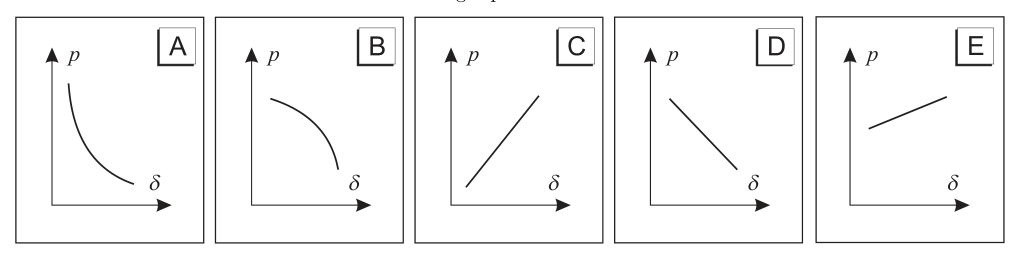 five p-density diagrams for thermodynamic transformations
Topic: Thermodynamics Metodi: Ideal Gas Law, Physical Modeling Competenze: Diagrammatic Reasoning, Physical Reasoning Objects: Gas Fonte: Testo (PDF) — p.7 Risposta: C · Soluzioni (PDF)
The following figures show pressure–density diagrams corresponding to various thermodynamic transformations of a perfect gas of fixed total mass.
Which of the graphs represents an isothermal transformation? (the options are represented graphically in the figure)
five p-density diagrams for thermodynamic transformations
Answer: C · Soluzioni (PDF)
Quando la corda di una chitarra viene pizzicata si produce un’onda stazionaria.
Quale caratteristica di quest’onda diminuisce col passare del tempo?
- A. Velocità
- B. Lunghezza d’onda
- C. Frequenza
- D. Periodo
- E. Ampiezza Topic: Oscillations & Waves Metodi: Wave Equation Competenze: Physical Reasoning Objects: String Fonte: Testo (PDF) — p.7 Risposta: E · Soluzioni (PDF)
When a guitar string is plucked, a standing wave is produced.
Which characteristic of this wave decreases as time passes?
- A. Speed
- B. Wavelength
- C. Frequency
- D. Period
- E. Amplitude Answer: E · Soluzioni (PDF)
Quanto pesa approssimativamente un sacchetto contenente tutti in monetine da un centesimo di euro?
- A.
- B.
- C.
- D.
- E. Topic: Order-of-Magnitude Estimation Metodi: Order-of-Magnitude Estimation, Physical Modeling Competenze: Estimation & Approximation Objects: — Fonte: Testo (PDF) — p.7 Risposta: C · Soluzioni (PDF)
Approximately how much does a bag containing weigh, all in one-cent euro coins?
- A.
- B.
- C.
- D.
- E. Answer: C · Soluzioni (PDF)
Una radiazione monocromatica di frequenza incide su una lastra di zinco e per effetto fotoelettrico vengono emessi degli elettroni (comunemente chiamati “fotoelettroni”). La lastra di zinco viene sostituita con un’altra lastra, fatta di un metallo che ha un minore lavoro di estrazione e viene investita da una radiazione ultravioletta di frequenza .
Rispetto alla lastra di zinco, quali delle seguenti proposizioni sono vere per la seconda lastra?
- Se l’energia cinetica massima dei fotoelettroni è maggiore.
- Se la velocità massima dei fotoelettroni è maggiore.
- L’emissione avviene anche se è minore di , indipendentemente dal valore di .
- A. Solo la prima
- B. Solo la seconda
- C. Solo la terza
- D. Solo la prima e la seconda
- E. Tutte e tre Topic: Modern-Quantum Physics Metodi: Photon Energy Relation, Physical Modeling Competenze: Physical Reasoning Objects: Photon, Electron Fonte: Testo (PDF) — p.7 Risposta: D · Soluzioni (PDF)
A monochromatic radiation of frequency strikes a zinc plate and, due to the photoelectric effect, electrons (commonly called “photoelectrons”) are emitted. The zinc plate is replaced with another plate, made of a metal that has a lower work function, and is struck by ultraviolet radiation of frequency .
Compared with the zinc plate, which of the following statements are true for the second plate?
- If the maximum kinetic energy of the photoelectrons is greater.
- If the maximum speed of the photoelectrons is greater.
- Emission occurs even if is less than , regardless of the value of .
- A. Only the first
- B. Only the second
- C. Only the third
- D. Only the first and the second
- E. All three Answer: D · Soluzioni (PDF)
Tre carrellini possono muoversi in linea retta senza attrito, come mostrato in figura. Inizialmente il carrellino X, che ha massa , si muove verso destra con velocità mentre Y e Z, che hanno rispettivamente massa e , sono fermi. In questa situazione avvengono degli urti che possono essere considerati elastici. La velocità finale di Z è pari a verso destra.
Le velocità finali dei carrellini X e Y valgono:
- A. X: a sinistra; Y: fermo
- B. X: a sinistra; Y: fermo
- C. X: a sinistra; Y: a sinistra
- D. X: a sinistra; Y: a sinistra
- E. X: a sinistra; Y: a destra
three carts X Y Z on frictionless track
Topic: Conservation of Momentum, Newtonian Mechanics Metodi: Conservation of Momentum, Conservation Laws Competenze: Mathematical Modeling, Physical Reasoning Objects: Cart Fonte: Testo (PDF) — p.8 Risposta: A · Soluzioni (PDF)
Three carts can move in a straight line without friction, as shown in the figure. Initially, cart X, which has mass , moves to the right with speed while Y and Z, which have masses and respectively, are stationary. In this situation, collisions occur that can be considered elastic. The final speed of Z is equal to to the right.
The final speeds of carts X and Y are:
- A. X: to the left; Y: stationary
- B. X: to the left; Y: stationary
- C. X: to the left; Y: to the left
- D. X: to the left; Y: to the left
- E. X: to the left; Y: to the right
three carts X Y Z on frictionless track
Answer: A · Soluzioni (PDF)
Da qualche parte, nell’universo, un pianeta X ha raggio doppio di quello della Terra e densità media uguale a quella della Terra.
Qual è il valore dell’accelerazione di gravità sulla superficie del pianeta X, in termini del valore terrestre ?
- A.
- B.
- C.
- D.
- E. Topic: Gravitation Metodi: Newton’s Law of Gravitation, Physical Modeling Competenze: Physical Reasoning, Mathematical Modeling Objects: Planet Fonte: Testo (PDF) — p.8 Risposta: B · Soluzioni (PDF)
Somewhere in the universe, a planet X has twice the radius of Earth and an average density equal to that of Earth.
What is the value of the gravitational acceleration on the surface of planet X, in terms of the Earth value ?
- A.
- B.
- C.
- D.
- E. Answer: B · Soluzioni (PDF)
Una barretta magnetica e un avvolgimento di filo elettrico sono disposti uno di fronte all’altra nella posizione mostrata in figura.
Fra le alternative seguenti, in quale caso si induce una forza elettromotrice nell’avvolgimento?
- Allontanare il magnete dall’avvolgimento.
- Avvicinare il magnete all’avvolgimento.
- Ruotare l’avvolgimento intorno a un asse verticale.
- A. Solo nel primo
- B. Solo nel secondo
- C. Solo nel terzo
- D. Nel primo e nel secondo
- E. In tutti e tre Topic: Electromagnetic Induction Metodi: Faraday’s Law of Induction, Lenz’s Law Competenze: Physical Reasoning Objects: Magnet, Coil, Wire Fonte: Testo (PDF) — p.8 Risposta: E · Soluzioni (PDF)
A magnetic bar and a coil of electrical wire are arranged facing each other in the position shown in the figure.
Among the following alternatives, in which case is an electromotive force induced in the coil?
- Moving the magnet away from the coil.
- Moving the magnet closer to the coil.
- Rotating the coil around a vertical axis.
- A. Only in the first
- B. Only in the second
- C. Only in the third
- D. In the first and the second
- E. In all three Answer: E · Soluzioni (PDF)
A quale altezza – rispetto al piano stradale – un motore con una potenza massima di può sollevare un carico di in ?
- A.
- B.
- C.
- D.
- E. Topic: Newtonian Mechanics, Conservation of Energy Metodi: Conservation of Energy, Kinematic Equations Competenze: Physical Reasoning Objects: — Fonte: Testo (PDF) — p.8 Risposta: D · Soluzioni (PDF)
At what height – relative to the road surface – can an engine with a maximum power of lift a load of in ?
- A.
- B.
- C.
- D.
- E. Answer: D · Soluzioni (PDF)
Resistori identici di resistenza sono connessi tramite fili conduttori di resistenza trascurabile allo stesso generatore ideale di f.e.m. .
Quale dei circuiti rappresentati dissipa più potenza? (le opzioni sono rappresentate graficamente in figura)
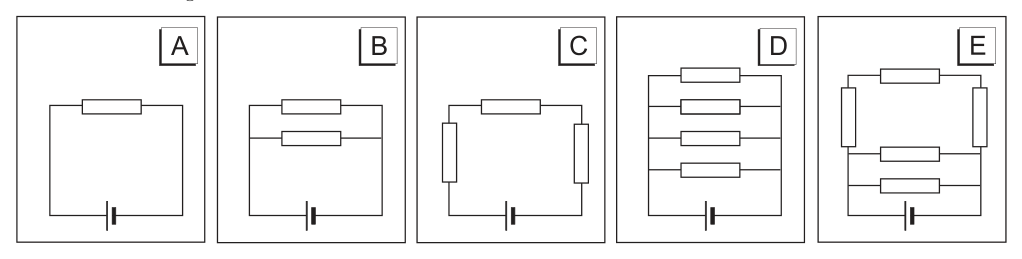 five resistor circuit configurations to compare
Topic: Circuits Metodi: Kirchhoff’s Laws, Equivalent Circuit Reduction Competenze: Diagrammatic Reasoning, Physical Reasoning Objects: Resistor, Wire, Battery Fonte: Testo (PDF) — p.8 Risposta: D · Soluzioni (PDF)
Identical resistors of resistance are connected by conducting wires of negligible resistance to the same ideal generator of electromotive force .
Which of the circuits shown dissipates the most power? (the options are shown graphically in the figure)
five resistor circuit configurations to compare
Answer: D · Soluzioni (PDF)
Un arciere punta un bersaglio posto a di distanza, il cui centro è esattamente alla stessa altezza della freccia. L’arciere lascia partire la freccia orizzontalmente, e questa si pianta in un punto a sotto il centro del bersaglio.
Supponendo di poter trascurare la resistenza dell’aria, qual è la velocità iniziale della freccia?
- A.
- B.
- C.
- D.
- E. Topic: Newtonian Mechanics Metodi: Kinematic Equations, Free-Body Diagram Competenze: Physical Reasoning, Mathematical Modeling Objects: Projectile Fonte: Testo (PDF) — p.9 Risposta: D · Soluzioni (PDF)
An archer aims at a target placed at a distance of , whose center is exactly at the same height as the arrow. The archer releases the arrow horizontally, and it sticks into a point below the center of the target.
Assuming air resistance can be neglected, what is the initial speed of the arrow?
- A.
- B.
- C.
- D.
- E. Answer: D · Soluzioni (PDF)
Qual è la velocità della luce in un mezzo che ha indice di rifrazione assoluto pari a ?
- A.
- B.
- C.
- D.
- E. Topic: Geometric Optics Metodi: Snell’s Law Competenze: Physical Reasoning Objects: — Fonte: Testo (PDF) — p.9 Risposta: B · Soluzioni (PDF)
What is the speed of light in a medium that has an absolute refractive index equal to ?
- A.
- B.
- C.
- D.
- E. Answer: B · Soluzioni (PDF)
L’unità di misura equivale a:
- A.
- B.
- C.
- D.
- E. Topic: Electrostatics Metodi: Dimensional Analysis Competenze: Unit Conversion Objects: — Fonte: Testo (PDF) — p.9 Risposta: E · Soluzioni (PDF)
The unit of measurement is equivalent to:
- A.
- B.
- C.
- D.
- E. Answer: E · Soluzioni (PDF)
Quali tra le seguenti caratteristiche sono comuni sia alle onde sonore nell’aria sia alla luce?
- A. Sono onde longitudinali
- B. Sono onde trasversali
- C. Trasferiscono energia
- D. Si propagano nel vuoto
- E. Possono essere polarizzate Topic: Oscillations & Waves, Wave Optics Metodi: Physical Modeling Competenze: Physical Reasoning Objects: — Fonte: Testo (PDF) — p.9 Risposta: C · Soluzioni (PDF)
Which of the following characteristics are common to both sound waves in air and light?
- A. They are longitudinal waves
- B. They are transverse waves
- C. They transfer energy
- D. They propagate in a vacuum
- E. They can be polarized Answer: C · Soluzioni (PDF)
Il circuito mostrato in figura è acceso da molto tempo e la batteria presenta una f.e.m. costante di .
La tensione ai capi del condensatore è:
- A.
- B.
- C.
- D.
- E.
RC circuit with battery at steady state
Topic: Circuits Metodi: Kirchhoff’s Laws, Equivalent Circuit Reduction Competenze: Diagrammatic Reasoning, Physical Reasoning Objects: Battery, Resistor, Capacitor Fonte: Testo (PDF) — p.9 Risposta: D · Soluzioni (PDF)
The circuit shown in the figure has been on for a long time and the battery has an f.e.m. costante di .
The voltage at the capacitor heads is:
- A.
- B.
- C.
- D.
- E.
RC circuit with battery at steady state
Topic: Circuits Metodi: Kirchhoff’s Laws, Equivalent Circuit Reduction Competenze: Diagrammatic Reasoning, Physical Reasoning Objects: Battery, Resistor, Capacitor Fonte: Testo (PDF) — p.9 Risposta: D · Soluzioni (PDF)
In una linea ad alta tensione, ad un dato istante, la corrente elettrica sta scorrendo verso est.
Che direzione e verso ha il campo magnetico prodotto da quella corrente, in un punto del terreno posto esattamente sotto la linea?
- A. Orizzontale verso nord.
- B. Orizzontale verso est.
- C. Orizzontale verso sud.
- D. Orizzontale verso ovest.
- E. Verticale verso il basso. Topic: Magnetism Metodi: Ampère’s Law, Biot-Savart Law Competenze: Physical Reasoning Objects: Wire Fonte: Testo (PDF) — p.9 Risposta: A · Soluzioni (PDF)
In a high-voltage line, at a given instant, the electric current is flowing toward the east.
What direction and orientation does the magnetic field produced by that current have, at a point on the ground located exactly below the line?
- A. Horizontal toward the north.
- B. Horizontal toward the east.
- C. Horizontal toward the south.
- D. Horizontal toward the west.
- E. Vertical downward. Answer: A · Soluzioni (PDF)
Una gru sta sollevando un blocco di pietra a velocità costante portandolo a di altezza. Il lavoro fatto dalla gru è di .
Qual è la massa del blocco?
- A.
- B.
- C.
- D.
- E. Topic: Newtonian Mechanics, Conservation of Energy Metodi: Energy Conservation Method Competenze: Physical Reasoning Objects: Block Fonte: Testo (PDF) — p.9 Risposta: C · Soluzioni (PDF)
A crane is lifting a block of stone at constant speed, bringing it to a height of . The work done by the crane is .
What is the mass of the block?
- A.
- B.
- C.
- D.
- E. Answer: C · Soluzioni (PDF)
Nelle figure seguenti viene rappresentata una pentola a pressione contenente dell’acqua, con o senza coperchio inserito.
In quale situazione l’acqua ha il più alto punto di ebollizione? (le opzioni sono rappresentate graficamente in figura)
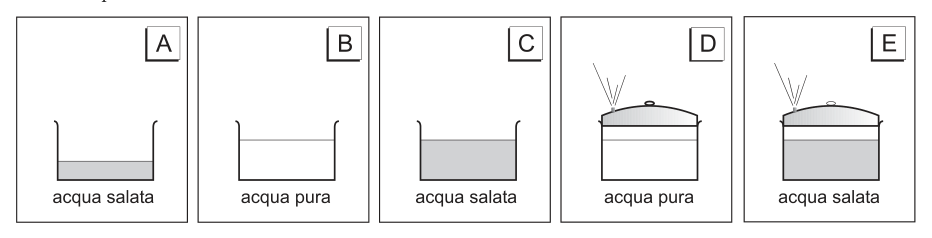 pressure cooker with/without lid configurations
Topic: Thermodynamics, Fluid Mechanics Metodi: Ideal Gas Law, Physical Modeling Competenze: Physical Reasoning, Diagrammatic Reasoning Objects: Container Fonte: Testo (PDF) — p.10 Risposta: E · Soluzioni (PDF)
In the following figures, a pressure cooker containing water is shown, with or without the lid inserted.
In which situation does the water have the highest boiling point? (the options are represented graphically in the figure)
pressure cooker with/without lid configurations
Answer: E · Soluzioni (PDF)
Si consideri la reazione nucleare:
Cosa rappresenta il simbolo ?
- A. Un protone
- B. Un fotone
- C. Una particella
- D. Un elettrone
- E. Un positrone Topic: Nuclear & Particle Physics Metodi: Conservation Laws, Physical Modeling Competenze: Physical Reasoning Objects: Nucleus Fonte: Testo (PDF) — p.10 Risposta: B · Soluzioni (PDF)
Consider the nuclear reaction:
What does the symbol represent?
- A. A proton
- B. A photon
- C. A particle
- D. An electron
- E. A positron Answer: B · Soluzioni (PDF)
Si hanno a disposizione un oggetto e due lenti, una convergente di focale e una divergente di focale .
Usando una sola lente, quale disposizione, tra quelle indicate qui sotto, produce un’immagine virtuale ingrandita dell’oggetto?
- A. Si pone l’oggetto a dalla lente convergente.
- B. Si pone l’oggetto a dalla lente convergente.
- C. Si pone l’oggetto a dalla lente convergente.
- D. Si pone l’oggetto a dalla lente divergente.
- E. Si pone l’oggetto a dalla lente divergente. Topic: Geometric Optics Metodi: Thin Lens & Mirror Equation, Ray Tracing Competenze: Physical Reasoning, Mathematical Modeling Objects: Lens Fonte: Testo (PDF) — p.10 Risposta: A · Soluzioni (PDF)
An object and two lenses are available, one converging with focal length and one diverging with focal length .
Using only one lens, which arrangement, among those indicated below, produces a magnified virtual image of the object?
- A. The object is placed at from the converging lens.
- B. The object is placed at from the converging lens.
- C. The object is placed at from the converging lens.
- D. The object is placed at from the diverging lens.
- E. The object is placed at from the diverging lens. Answer: A · Soluzioni (PDF)