Q1. Una carabina ad aria compressa di massa spara piombini di massa aventi una quantità di moto iniziale di modulo . Si consideri trascurabile la forza con cui l’atleta tiene fermo il fucile rispetto a quella, impulsiva, dello sparo. Qual è, in modulo, la quantità di moto con cui rincula il fucile immediatamente dopo? A) ; B) ; C) ; D) ; E) .
circuito con condensatore e interruttore
Topic: Conservation of Momentum Metodi: Conservation of Momentum Competenze: Physical Reasoning Objects: Projectile Fonte: Testo (PDF) — p.3 Risposta: C · Soluzioni (PDF)
Q1. An air rifle of mass fires pellets of mass having an initial momentum of magnitude . The force with which the athlete holds the rifle still is considered negligible compared to the impulsive force of the shot. What is, in magnitude, the momentum with which the rifle recoils immediately afterward? A) ; B) ; C) ; D) ; E) .
circuit with capacitor and switch
Answer: C · Soluzioni (PDF)
Q2. Una forza è applicata verticalmente verso l’alto a un blocco di massa . L’accelerazione del blocco è circa… A) ; B) ; C) ; D) ; E) .
Topic: Newtonian Mechanics Metodi: Free-Body Diagram Competenze: Physical Reasoning Objects: Block Fonte: Testo (PDF) — p.3 Risposta: A · Soluzioni (PDF)
Q2. A force is applied vertically upward to a block of mass . The acceleration of the block is approximately… A) ; B) ; C) ; D) ; E) .
Answer: A · Soluzioni (PDF)
Q3. Quale grafico rappresenta meglio la relazione fra le resistenze e le lunghezze di diversi fili di rame di uguale sezione, alla stessa temperatura? [Cinque grafici A–E; , retta per l’origine.]
Topic: Circuits Metodi: Graph Linearization Competenze: Diagrammatic Reasoning Objects: Wire, Resistor Fonte: Testo (PDF) — p.3 Risposta: A · Soluzioni (PDF)
Q3. Which graph best represents the relationship between the resistances and the lengths of several copper wires of equal cross-section, at the same temperature? [Five graphs A–E; , straight line through the origin.]
Answer: A · Soluzioni (PDF)
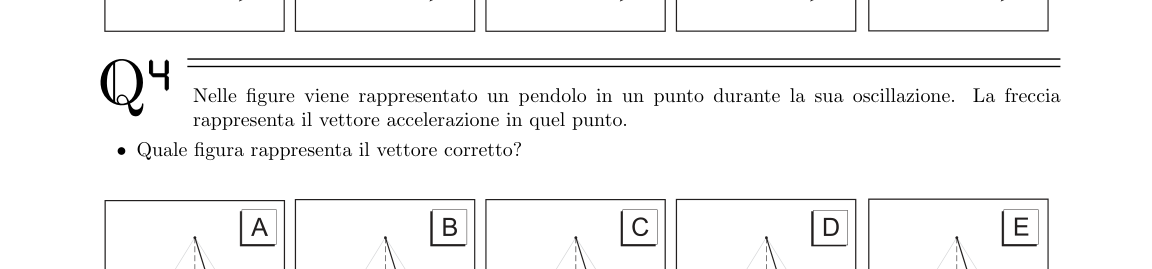
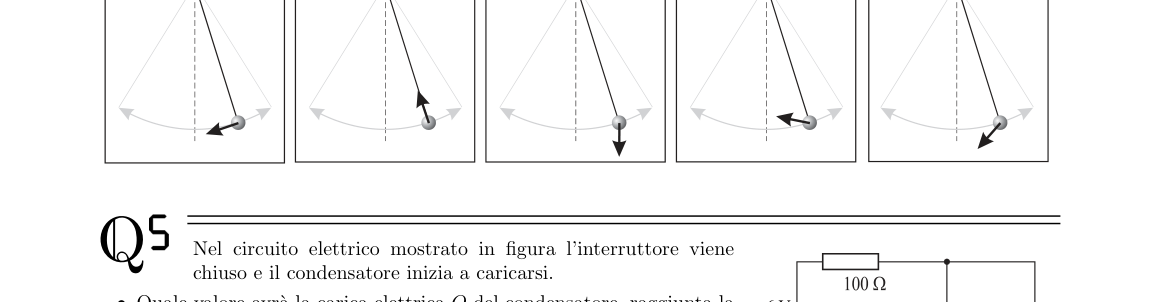
Q4. Le figure rappresentano un pendolo in un punto durante la sua oscillazione; la freccia rappresenta il vettore accelerazione in quel punto. Quale figura rappresenta il vettore corretto? [Cinque figure A–E del pendolo con diversi vettori accelerazione: A solo tangenziale, B solo centripeta, C/E con componente centrifuga, D con componente centripeta + tangenziale verso il centro.]
Topic: Oscillations & Waves Metodi: Free-Body Diagram Competenze: Diagrammatic Reasoning Objects: Pendulum Fonte: Testo (PDF) — p.3 Risposta: D · Soluzioni (PDF)
Q4. The figures represent a pendulum at one point during its oscillation; the arrow represents the acceleration vector at that point. Which figure represents the correct vector? [Five figures A–E of the pendulum with different acceleration vectors: A tangential only, B centripetal only, C/E with centrifugal component, D with centripetal + tangential component toward the center.]
Answer: D · Soluzioni (PDF)
Q5. Nel circuito mostrato l’interruttore viene chiuso e il condensatore si carica. Raggiunta la condizione stazionaria, quale valore avrà la carica del condensatore? [Circuito con , , , condensatore .] A) ; B) ; C) ; D) ; E) .
Topic: Circuits Metodi: Kirchhoff’s Laws Competenze: Physical Reasoning Objects: Switch, Capacitor, Resistor Fonte: Testo (PDF) — p.3 Risposta: D · Soluzioni (PDF)
Q5. In the circuit shown, the switch is closed and the capacitor is charged. If the stationary condition is reached, what is the charge of the capacitor? [Circuito con , , , condensatore .] A) ; B) ; C) ; D) ; E) .
Topic: Circuits Metodi: Kirchhoff’s Laws Competenze: Physical Reasoning Objects: Switch, Capacitor, Resistor Fonte: Testo (PDF) — p.3 Risposta: D · Soluzioni (PDF)
Q6. In quale delle seguenti reazioni nucleari potrebbe rappresentare un neutrone? A) ; B) ; C) ; D) ; E) .
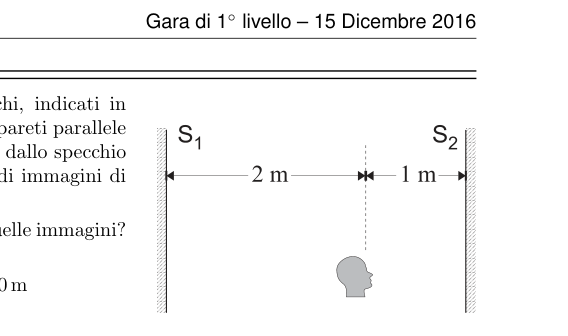
Quesito 11 — due specchi S1 S2 con distanze
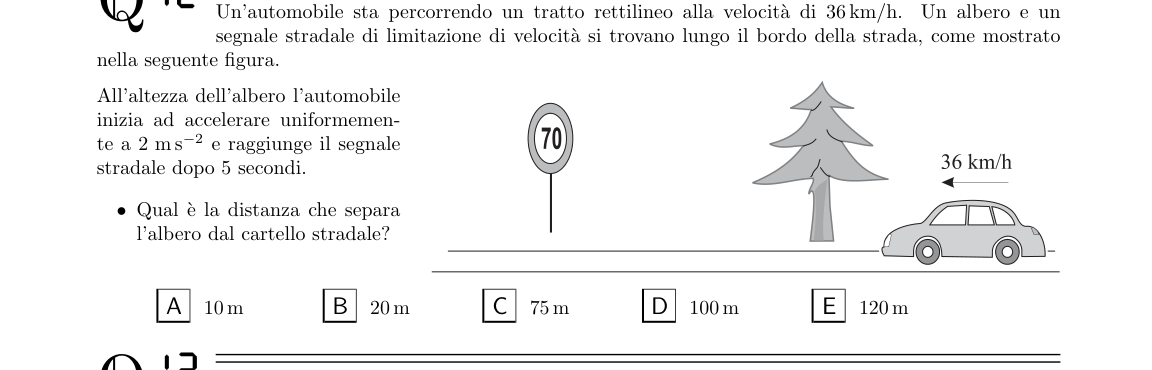
Quesito 12 — strada con segnale velocità e albero
Quesito 14 — assi cartesiani con quadranti I II III IV
Topic: Nuclear & Particle Physics Metodi: — Competenze: Physical Reasoning Objects: Nucleus Fonte: Testo (PDF) — p.5 Risposta: C · Soluzioni (PDF)
Q6. In which of the following nuclear reactions could represent a neutron? A) ; B) ; C) ; D) ; E) .
Question 11 — two mirrors S1 S2 with distances
Question 12 — road with speed sign and tree
Question 14 — Cartesian axes with quadrants I II III IV
Topic: Nuclear & Particle Physics Metodi: — Competenze: Physical Reasoning Objects: Nucleus Fonte: Testo (PDF) — p.5 Risposta: C · Soluzioni (PDF)
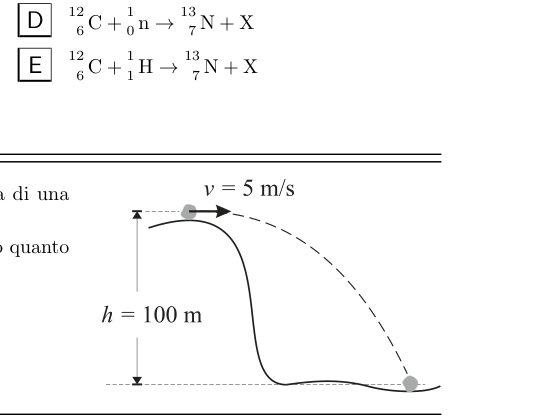
Q7. Un sasso viene lanciato in orizzontale dalla cima di una rupe alta con velocità . Trascurando l’attrito dell’aria, dopo quanto tempo il sasso tocca terra? A) ; B) ; C) ; D) ; E) .
Topic: Newtonian Mechanics Metodi: Kinematic Equations Competenze: Mathematical Modeling Objects: Projectile Fonte: Testo (PDF) — p.3 Risposta: B · Soluzioni (PDF)
Q7. A stone is thrown horizontally from the top of a cliff of height with speed . Neglecting air friction, after how much time does the stone hit the ground? A) ; B) ; C) ; D) ; E) .
Answer: B · Soluzioni (PDF)
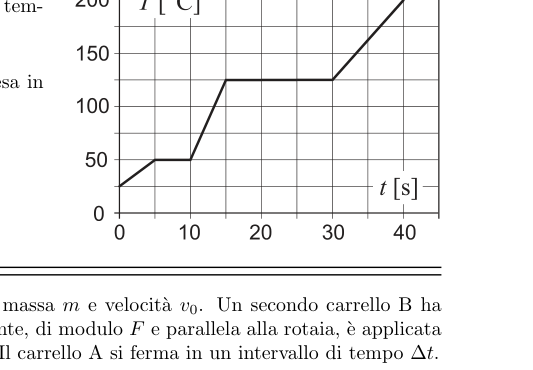
Q8. Una sostanza viene riscaldata fornendo energia a tasso costante; il grafico mostra la temperatura in funzione del tempo (due soste termiche a e ). Qual è la temperatura di ebollizione della sostanza? A) ; B) ; C) ; D) ; E) .
Quesito 7 — traiettoria parabolica palla, h vs x
Quesito 8 — grafico temperatura T vs tempo t
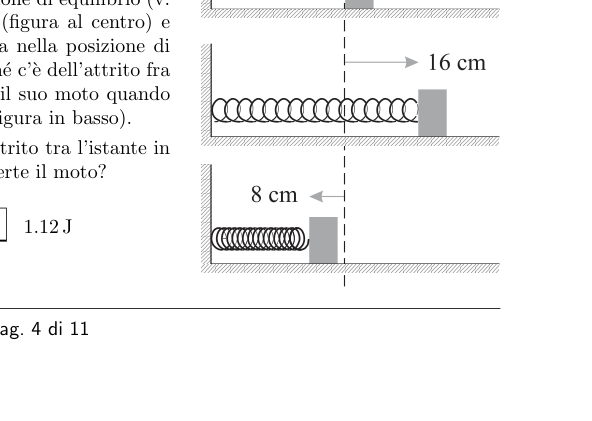
Quesito 10 — blocco su superficie con molla, dimensioni
Topic: Thermodynamics Metodi: — Competenze: Diagrammatic Reasoning Objects: — Fonte: Testo (PDF) — p.4 Risposta: D · Soluzioni (PDF)
Q8. A substance is heated by supplying energy at a constant rate; the graph shows temperature as a function of time (two thermal plateaus at and ). What is the boiling temperature of the substance? A) ; B) ; C) ; D) ; E) .
Problem 7 — parabolic trajectory of a ball, h vs x
Problem 8 — graph of temperature T vs time t
Problem 10 — block on a surface with a spring, dimensions
Answer: D · Soluzioni (PDF)
Q9. Un carrello A ha massa e velocità ; un carrello B ha massa e velocità . Un’identica forza costante parallela alla rotaia è applicata separatamente a ciascun carrello fino a fermarlo. Il carrello A si ferma in un intervallo di tempo . Il tempo necessario al carrello B per fermarsi vale: A) ; B) ; C) ; D) ; E) .
Topic: Newtonian Mechanics Metodi: Impulse-Momentum Theorem Competenze: Physical Reasoning Objects: Cart Fonte: Testo (PDF) — p.3 Risposta: C · Soluzioni (PDF)
Q9. A cart A has mass and speed ; a cart B has mass and speed . An identical constant force parallel to the track is applied separately to each cart until it stops. Cart A stops in a time interval . The time needed for cart B to stop is: A) ; B) ; C) ; D) ; E) .
Answer: C · Soluzioni (PDF)
Q10. Un blocco di massa attaccato a una molla (di massa trascurabile) è appoggiato su un tavolo. Spostato di verso destra e lasciato andare, il sistema possiede inizialmente energia potenziale . Per l’attrito, il blocco inverte il moto quando si trova a sinistra dell’equilibrio. Quanta energia meccanica viene dissipata per attrito fra l’inizio del moto e l’inversione? A) ; B) ; C) ; D) ; E) .
Topic: Conservation of Energy Metodi: Energy Conservation Method, Hooke’s Law Competenze: Mathematical Modeling Objects: Block, Spring Fonte: Testo (PDF) — p.3 Risposta: D · Soluzioni (PDF)
Q10. A block of mass attached to a spring (of negligible mass) rests on a table. Moved by to the right and let go, the system initially has potential energy . Due to friction, the block reverses its motion when it is to the left of equilibrium. How much mechanical energy is dissipated by friction between the start of the motion and the reversal? A) ; B) ; C) ; D) ; E) .
Answer: D · Soluzioni (PDF)
Q11. In un corridoio ci sono due grandi specchi paralleli e posti su pareti distanti . Una persona a dallo specchio di destra guarda verso di esso e vede una serie di immagini di sé. A che distanza dalla persona si trova la seconda di quelle immagini? A) ; B) ; C) ; D) ; E) .
Topic: Geometric Optics Metodi: Ray Tracing Competenze: Physical Reasoning Objects: Mirror Fonte: Testo (PDF) — p.4 Risposta: C · Soluzioni (PDF)
Q11. In a corridor there are two large parallel mirrors and placed on walls apart. A person at from the right-hand mirror looks toward it and sees a series of images of himself. At what distance from the person is the second of those images? A) ; B) ; C) ; D) ; E) .
Answer: C · Soluzioni (PDF)
Q12. Un’automobile percorre un tratto rettilineo a . All’altezza di un albero inizia ad accelerare uniformemente a e raggiunge un segnale stradale dopo . Qual è la distanza fra l’albero e il cartello? A) ; B) ; C) ; D) ; E) .
Topic: Newtonian Mechanics Metodi: Kinematic Equations Competenze: Mathematical Modeling Objects: — Fonte: Testo (PDF) — p.3 Risposta: C · Soluzioni (PDF)
Q12. A car travels along a straight stretch at . At the height of a tree it begins to accelerate uniformly at and reaches a road sign after . What is the distance between the tree and the sign? A) ; B) ; C) ; D) ; E) .
Answer: C · Soluzioni (PDF)
Q13. Quale grafico rappresenta meglio la relazione fra l’energia cinetica media delle molecole di un gas perfetto e la temperatura misurata nella scala Celsius? [Cinque grafici A–E; la relazione è , retta con intercetta positiva sull’asse delle energie.]
Topic: Kinetic Theory Metodi: Graph Linearization Competenze: Diagrammatic Reasoning Objects: Gas Fonte: Testo (PDF) — p.4 Risposta: A · Soluzioni (PDF)
Q13. Which graph best represents the relationship between the average kinetic energy of the molecules of a perfect gas and the temperature measured on the Celsius scale? [Five graphs A–E; the relationship is , a straight line with a positive intercept on the energy axis.]
Answer: A · Soluzioni (PDF)
Q14. Due fili rettilinei indefiniti, disposti perpendicolarmente, sono percorsi da correnti uguali (versi indicati), praticamente sullo stesso piano ma non in contatto. Il campo magnetico è nullo… A) solo in un punto del quadrante I; B) solo in un punto del quadrante II; C) in più punti dei quadranti I e II; D) in più punti dei quadranti I e IV; E) in più punti dei quadranti II e IV.
Topic: Magnetism Metodi: Superposition Principle, Biot-Savart Law Competenze: Physical Reasoning Objects: Wire Fonte: Testo (PDF) — p.3 Risposta: E · Soluzioni (PDF)
Q14. Two infinite straight wires, arranged perpendicularly, carry equal currents (directions indicated), practically on the same plane but not in contact. The magnetic field is zero… A) only at one point in quadrant I; B) only at one point in quadrant II; C) at multiple points in quadrants I and II; D) at multiple points in quadrants I and IV; E) at multiple points in quadrants II and IV.
Answer: E · Soluzioni (PDF)
Q15. Qual è approssimativamente l’energia di legame di un nucleo di elio che ha una massa di ? A) ; B) ; C) ; D) ; E) .
Topic: Nuclear & Particle Physics Metodi: Mass-Energy Equivalence Competenze: Mathematical Modeling Objects: Nucleus Fonte: Testo (PDF) — p.5 Risposta: D · Soluzioni (PDF)
Q15. What is approximately the binding energy of a helium nucleus that has a mass of ? A) ; B) ; C) ; D) ; E) .
Answer: D · Soluzioni (PDF)
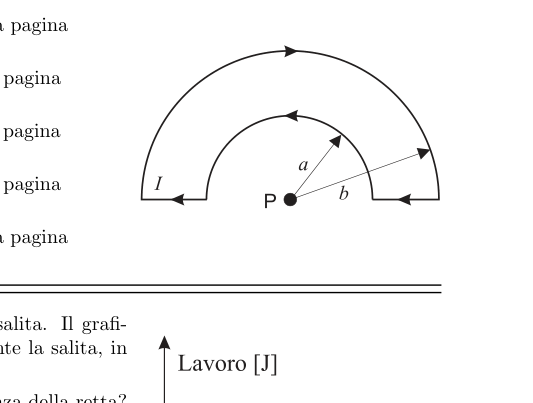
Q16. Qual è l’espressione corretta del campo magnetico nel punto P? [Circuito formato da due semicirconferenze concentriche di raggi e e due tratti rettilinei; suggerimento: al centro di una spira di raggio il campo vale .] A) entrante; B) uscente; C) uscente; D) uscente; E) entrante.
Quesito 16 — arco circolare con punto P e raggio R
Topic: Magnetism Metodi: Biot-Savart Law, Superposition Principle Competenze: Mathematical Modeling Objects: Wire Fonte: Testo (PDF) — p.3 Risposta: B · Soluzioni (PDF)
Q16. What is the correct expression for the magnetic field at point P? [Circuit formed by two concentric semicircles with radii and and two straight segments; hint: at the center of a loop of radius the field is .] A) inward; B) outward; C) outward; D) outward; E) inward.
Question 16 — circular arc with point P and radius R
Answer: B · Soluzioni (PDF)
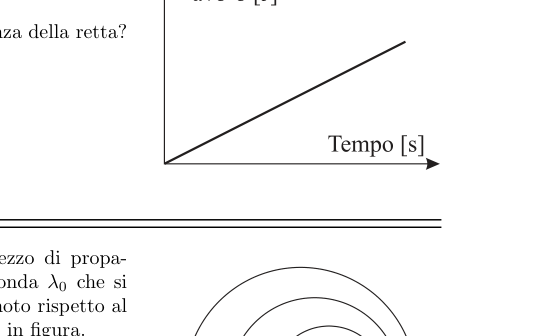
Q17. Uno studente percorre una strada in salita; il grafico riporta il lavoro fatto durante la salita in funzione del tempo. Qual è l’unità di misura della pendenza della retta in questo grafico? A) Non ha unità di misura; B) joule; C) grado; D) secondo; E) watt.
Quesito 17 — grafico lavoro vs tempo
Topic: Newtonian Mechanics Metodi: — Competenze: Diagrammatic Reasoning, Physical Reasoning Objects: — Fonte: Testo (PDF) — p.5 Risposta: E · Soluzioni (PDF)
Q17. A student travels along an uphill road; the graph shows the work done during the climb as a function of time. What is the unit of measurement of the slope of the line in this graph? A) It has no unit of measurement; B) joule; C) degree; D) second; E) watt.
Question 17 — work vs time graph
Answer: E · Soluzioni (PDF)
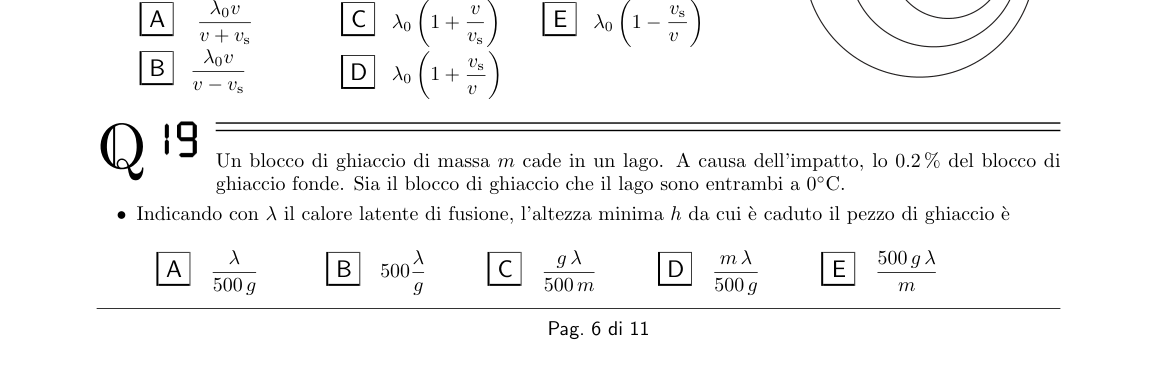
Q18. Una sorgente sonora in quiete rispetto al mezzo emette onde sferiche di lunghezza d’onda , che si propagano con velocità . La sorgente viene messa in moto con velocità verso destra. La distanza tra due creste adiacenti immediatamente dietro la sorgente è: A) ; B) ; C) ; D) ; E) . (la risposta corretta è .)
Quesito 18 — orbita circolare con Sole S e velocità
Topic: Oscillations & Waves Metodi: — Competenze: Physical Reasoning Objects: — Fonte: Testo (PDF) — p.4 Risposta: D · Soluzioni (PDF)
Q18. A sound source at rest with respect to the medium emits spherical waves of wavelength , which propagate with speed . The source is set in motion with speed toward the right. The distance between two adjacent crests immediately behind the source is: A) ; B) ; C) ; D) ; E) . (the correct answer is .)
Question 18 — circular orbit with Sun S and velocity
Answer: D · Soluzioni (PDF)
Q19. Un blocco di ghiaccio di massa cade in un lago; per l’impatto fonde lo del blocco. Ghiaccio e lago sono a . Indicando con il calore latente di fusione, l’altezza minima da cui è caduto il ghiaccio è: A) ; B) ; C) ; D) ; E) .
Topic: Conservation of Energy Metodi: Energy Conservation Method Competenze: Mathematical Modeling Objects: Block Fonte: Testo (PDF) — p.4 Risposta: A · Soluzioni (PDF)
Q19. A block of ice of mass falls into a lake; upon impact it melts of the block. The ice and the lake are at . Denoting by the latent heat of fusion, the minimum height from which the ice fell is: A) ; B) ; C) ; D) ; E) .
Answer: A · Soluzioni (PDF)
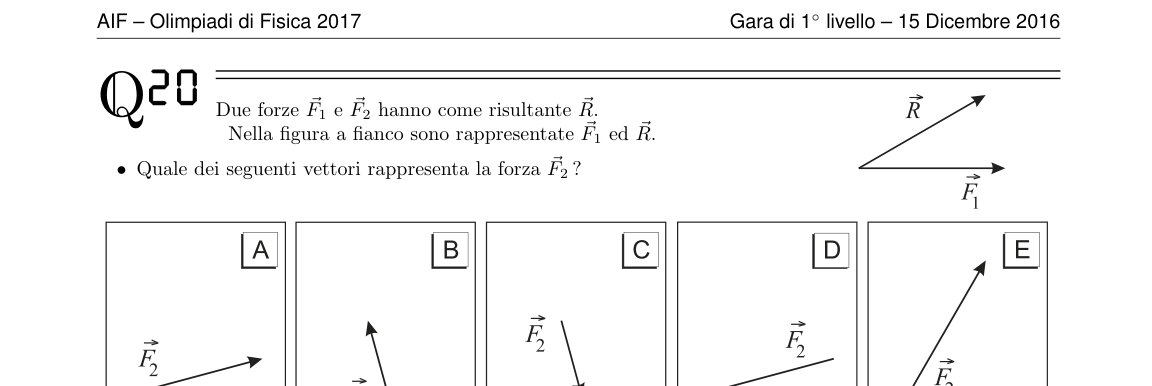
Q20. Due forze e hanno come risultante . Nella figura sono rappresentate e . Quale dei vettori rappresenta la forza ? [Cinque vettori A–E; la risposta corretta soddisfa .]
Quesito 20 — cinque diagrammi vettori forza F1 F2
Topic: Newtonian Mechanics Metodi: Vector Decomposition Competenze: Diagrammatic Reasoning Objects: — Fonte: Testo (PDF) — p.3 Risposta: B · Soluzioni (PDF)
Q20. Two forces and have as their resultant. In the figure, and are represented. Which of the vectors represents the force ? [Five vectors A–E; the correct answer satisfies .]
Problem 20 — five diagrams of force vectors F1 F2
Answer: B · Soluzioni (PDF)
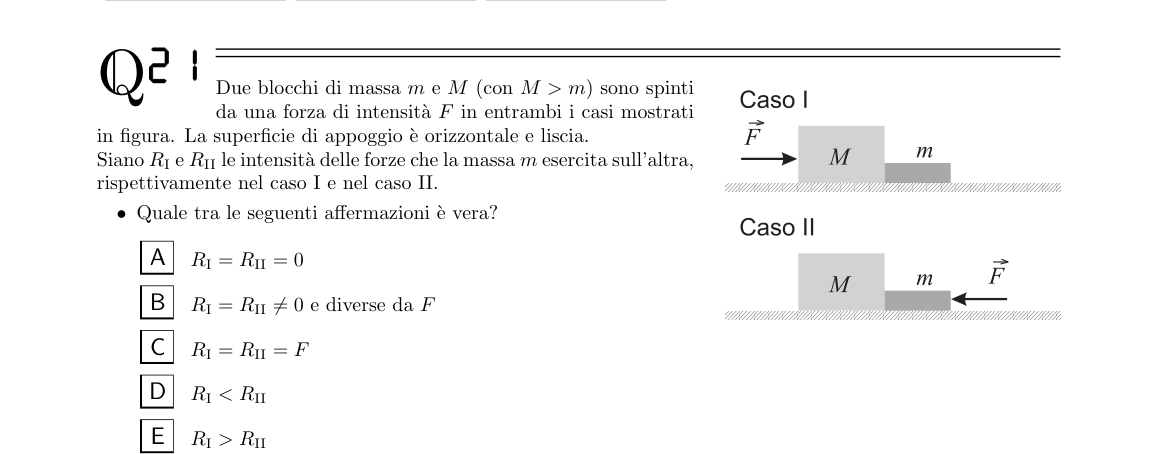
Q21. Due blocchi di massa e (con ) sono spinti da una forza in due casi (superficie liscia). Siano e le intensità delle forze che la massa esercita sull’altra nei due casi. Quale affermazione è vera? A) ; B) e diverse da ; C) ; D) ; E) .
Quesito 21 — due casi blocco con forza applicata
Topic: Newtonian Mechanics Metodi: Free-Body Diagram Competenze: Physical Reasoning Objects: Block Fonte: Testo (PDF) — p.3 Risposta: D · Soluzioni (PDF)
Q21. Two blocks of mass and (with ) are pushed by a force in two cases (flat surface). The intensities of the forces exerted by the mass on the other in both cases are and . What statement is true? A) ; B) e diverse da ; C) ; D) ; E) .
Quesito 21 — due casi blocco con forza applicata
Topic: Newtonian Mechanics Metodi: Free-Body Diagram Competenze: Physical Reasoning Objects: Block Fonte: Testo (PDF) — p.3 Risposta: D · Soluzioni (PDF)
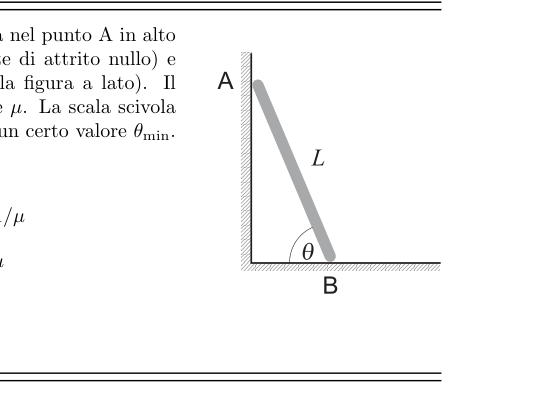
Q22. Una scala uniforme di lunghezza si appoggia in alto (A) a una parete liscia e in basso (B) a un pavimento ruvido (coefficiente d’attrito statico ). La scala scivola se l’angolo col pavimento è minore di . Quale relazione è corretta? A) ; B) ; C) ; D) ; E) .
Quesito 22 — scala inclinata lunghezza L e angolo theta
Topic: Rigid Body Statics Metodi: Torque & Angular Momentum Analysis, Free-Body Diagram Competenze: Mathematical Modeling Objects: Rod Fonte: Testo (PDF) — p.3 Risposta: C · Soluzioni (PDF)
Q22. A uniform ladder of length rests at the top (A) against a smooth wall and at the bottom (B) on a rough floor (coefficient of static friction ). The ladder slips if the angle with the floor is less than . Which relation is correct? A) ; B) ; C) ; D) ; E) .
Question 22 — inclined ladder length L and angle theta
Answer: C · Soluzioni (PDF)
Q23. Un tizzone ardente di brace irraggia energia con potenza alla temperatura assoluta . Approssimando l’irraggiamento con quello di un corpo nero, quanto vale la potenza irradiata quando la temperatura scende a ? A) ; B) ; C) ; D) ; E) .
Topic: Thermodynamics Metodi: — Competenze: Physical Reasoning Objects: — Fonte: Testo (PDF) — p.4 Risposta: E · Soluzioni (PDF)
Q23. A burning ember radiates energy with power at absolute temperature . Approximating the radiation as that of a black body, what is the radiated power when the temperature drops to ? A) ; B) ; C) ; D) ; E) .
Answer: E · Soluzioni (PDF)
Q24. Una lente forma un’immagine reale, tre volte più grande dell’oggetto, a distanza di dalla lente. A quale distanza dalla lente si trova l’oggetto? A) ; B) ; C) ; D) ; E) .
Topic: Geometric Optics Metodi: Thin Lens & Mirror Equation Competenze: Mathematical Modeling Objects: Lens Fonte: Testo (PDF) — p.4 Risposta: D · Soluzioni (PDF)
Q24. A lens forms a real image, three times larger than the object, at a distance of from the lens. At what distance from the lens is the object located? A) ; B) ; C) ; D) ; E) .
Answer: D · Soluzioni (PDF)
Q25. Una spira di area , nel piano della pagina, è in un campo magnetico uniforme perpendicolare al piano, entrante. Il modulo del campo diminuisce a tasso costante . Quanto vale e come è diretta la f.e.m. indotta? A) orario; B) antiorario; C) antiorario; D) antiorario; E) orario.
Topic: Electromagnetic Induction Metodi: Faraday’s Law of Induction, Lenz’s Law Competenze: Mathematical Modeling Objects: Coil Fonte: Testo (PDF) — p.3 Risposta: A · Soluzioni (PDF)
Q25. A sphere of area , in the plane of the page, is in a uniform magnetic field perpendicular to the plane, entering. The field modulus decreases at a constant rate . How much is the f.e.m. worth and how is it directed? - What? A) orario; B) antiorario; C) antiorario; D) antiorario; E) orario.
Topic: Electromagnetic Induction Metodi: Faraday’s Law of Induction, Lenz’s Law Competenze: Mathematical Modeling Objects: Coil Fonte: Testo (PDF) — p.3 Risposta: A · Soluzioni (PDF)
Q26. La canna di uno strumento musicale (lunghezza molto maggiore del diametro), aperta alle due estremità, risuona alla frequenza fondamentale di . Se la stessa canna fosse chiusa a un estremo, risuonerebbe alla frequenza fondamentale di: A) ; B) ; C) ; D) ; E) .
Topic: Oscillations & Waves Metodi: — Competenze: Physical Reasoning Objects: Tube Fonte: Testo (PDF) — p.4 Risposta: B · Soluzioni (PDF)
Q26. The pipe of a musical instrument (length much greater than the diameter), open at both ends, resonates at the fundamental frequency of . If the same pipe were closed at one end, it would resonate at the fundamental frequency of: A) ; B) ; C) ; D) ; E) .
Answer: B · Soluzioni (PDF)
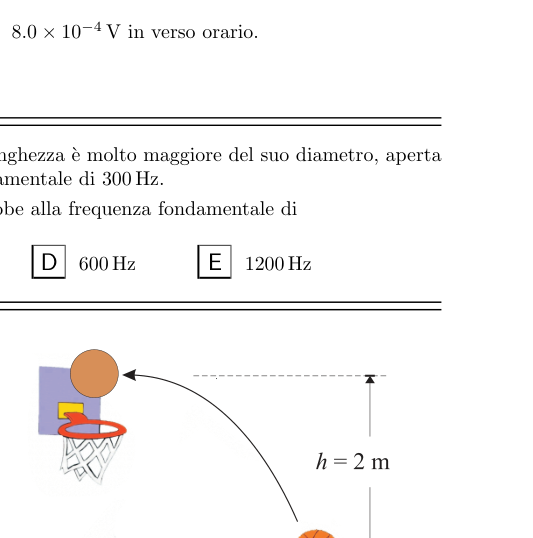
Q27. Uno studente tira una palla verso il canestro e la manda a stamparsi orizzontalmente sul tabellone, con velocità . Per quanto tempo la palla è stata in volo? A) circa ; B) circa ; C) circa ; D) circa ; E) circa . (N.B.: quesito speculare al Q7, col verso del moto invertito.)
Quesito 27 — illustrazione lancio pallone con figura
Topic: Newtonian Mechanics Metodi: Kinematic Equations Competenze: Estimation & Approximation Objects: Ball Fonte: Testo (PDF) — p.3 Risposta: B · Soluzioni (PDF)
Q27. A student throws a ball toward the basket and sends it to hit the backboard horizontally, with speed . For how long was the ball in flight? A) about ; B) about ; C) about ; D) about ; E) about . (N.B.: question mirroring Q7, with the direction of motion reversed.)
Question 27 — illustration of ball throw with figure
Answer: B · Soluzioni (PDF)
Q28. Tre carrelli di uguale massa su rotaia a cuscino d’aria: i carrelli 2 e 3 sono fermi, il carrello 1 si muove a velocità . Il carrello 1 urta il 2 (rimangono attaccati), poi la coppia urta il 3 con urto elastico. La velocità del carrello 3 sarà prossima a: A) ; B) ; C) ; D) ; E) .
Quesito 28 — tre carrelli numerati su binario
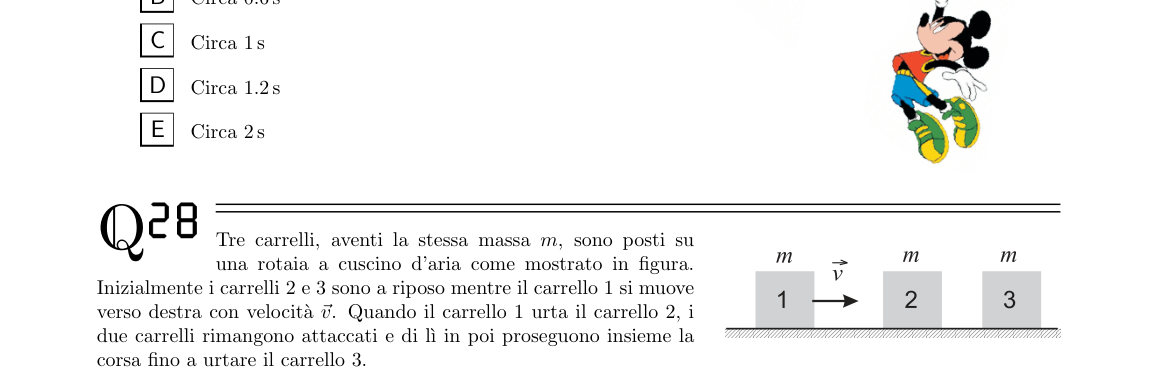
Topic: Conservation of Momentum Metodi: Conservation of Momentum, Conservation of Energy Competenze: Mathematical Modeling Objects: Cart Fonte: Testo (PDF) — p.3 Risposta: C · Soluzioni (PDF)
Q28. Three carts of equal mass on an air cushion track: carts 2 and 3 are stationary, cart 1 moves at speed . Cart 1 hits cart 2 (they remain attached), then the pair hits cart 3 in an elastic collision. The speed of cart 3 will be closest to: A) ; B) ; C) ; D) ; E) .
Question 28 — three numbered carts on a track
Answer: C · Soluzioni (PDF)
Q29. Un fascio di luce attraversa due fenditure sottili producendo frange d’interferenza su uno schermo. In aria, un massimo (differenza di percorso pari a una lunghezza d’onda) si forma nel punto P all’angolo . Se tutto l’apparato è posto in acqua, l’angolo corrispondente allo stesso massimo… A) rimane lo stesso; B) diminuisce perché diminuisce la frequenza; C) diminuisce perché diminuisce la lunghezza d’onda; D) aumenta perché aumenta la frequenza; E) aumenta perché aumenta la lunghezza d’onda.
Quesito 29 — doppia fenditura con raggi r1 r2
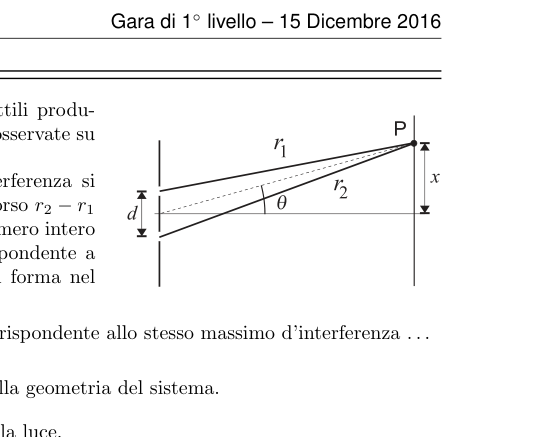
Topic: Wave Optics Metodi: Interference & Diffraction Analysis Competenze: Physical Reasoning Objects: Slit, Screen Fonte: Testo (PDF) — p.4 Risposta: C · Soluzioni (PDF)
Q29. A beam of light passes through two thin slits, producing interference fringes on a screen. In air, a maximum (path difference equal to one wavelength) forms at point P at angle . If the entire apparatus is placed in water, the angle corresponding to the same maximum… A) remains the same; B) decreases because the frequency decreases; C) decreases because the wavelength decreases; D) increases because the frequency increases; E) increases because the wavelength increases.
Question 29 — double slit with rays r1 r2
Answer: C · Soluzioni (PDF)
Q30. Qual è la tensione del cavo mentre un corpo da viene sollevato a velocità costante tramite una carrucola sostenuta da due tratti di cavo?A) ; B) ; C) ; D) ; E) .
Quesito 30 — fune con massa 1 kg appesa
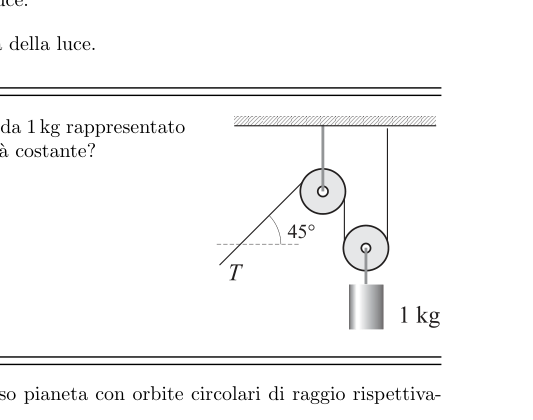
Topic: Newtonian Mechanics Metodi: Free-Body Diagram Competenze: Physical Reasoning Objects: Pulley, String Fonte: Testo (PDF) — p.3 Risposta: B · Soluzioni (PDF)
Q30. What is the tension of the cable while a body of is lifted at constant speed by means of a pulley supported by two sections of cable?A) ; B) ; C) ; D) ; E) .
Problem 30 — rope with mass 1 kg hanging
Answer: B · Soluzioni (PDF)
Q31. Due satelliti orbitano lo stesso pianeta con orbite circolari di raggio e . Se è la velocità orbitale del primo, la velocità del secondo sarà: A) ; B) ; C) ; D) ; E) .
Topic: Gravitation Metodi: Newton’s Law of Gravitation Competenze: Mathematical Modeling Objects: Satellite, Planet Fonte: Testo (PDF) — p.3 Risposta: B · Soluzioni (PDF)
Q31. Two satellites orbit the same planet with circular orbits of radius and . If is the orbital speed of the first, the speed of the second will be: A) ; B) ; C) ; D) ; E) .
Answer: B · Soluzioni (PDF)
Q32. Un guscio sferico conduttore ha superficie interna di raggio ed esterna di raggio . Una carica è al centro e una carica è posta sul guscio. Come si distribuisce la carica all’equilibrio? A) nulla sull’interna, sull’esterna; B) sull’interna, sull’esterna; C) sull’interna, sull’esterna; D) sull’interna, sull’esterna; E) ripartita proporzionalmente ai quadrati dei raggi.
Quesito 32 — sfere concentriche con carica Q
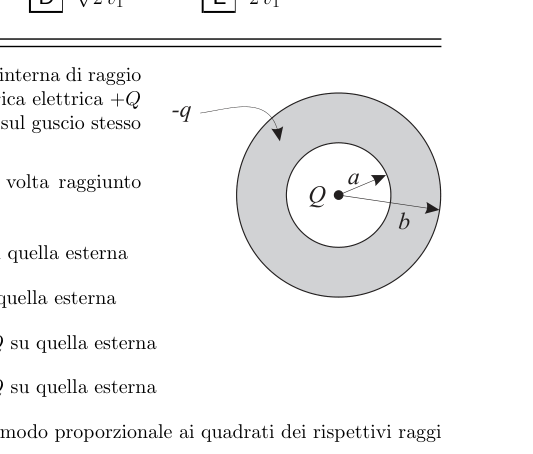
Topic: Electrostatics Metodi: Gauss’s Law Competenze: Physical Reasoning Objects: Conducting Sphere, Point Charge Fonte: Testo (PDF) — p.3 Risposta: C · Soluzioni (PDF)
Q32. A conducting spherical shell has an inner surface of radius and an outer surface of radius . A charge is at the center and a charge is placed on the shell. How is the charge distributed at equilibrium? A) zero on the inner surface, on the outer surface; B) on the inner surface, on the outer surface; C) on the inner surface, on the outer surface; D) on the inner surface, on the outer surface; E) distributed proportionally to the squares of the radii.
Problem 32 — concentric spheres with charge Q
Answer: C · Soluzioni (PDF)
Q33. In una regione senza gravità, due sferette uguali uniformemente cariche sono fisse a distanza ; massa , carica . Una terza sferetta uguale, inizialmente ferma vicino al punto medio, viene lasciata andare. Qual è la sua velocità a grande distanza? A) ; B) ; C) ; D) ; E) .
Topic: Electrostatics Metodi: Energy Conservation Method, Electric Potential Method Competenze: Mathematical Modeling Objects: Conducting Sphere Fonte: Testo (PDF) — p.3 Risposta: B · Soluzioni (PDF)
Q33. In a region without gravity, two identical uniformly charged small spheres are fixed at a distance ; mass , charge . A third identical small sphere, initially at rest near the midpoint, is let go. What is its speed at a large distance? A) ; B) ; C) ; D) ; E) .
Answer: B · Soluzioni (PDF)
Q34. Quando un’onda armonica incide sull’interfaccia fra due mezzi diversi, si può trasmettere un’onda nel secondo mezzo. Quali caratteristiche possono essere diverse fra onda incidente e onda trasmessa? (1) velocità ; (2) periodo ; (3) lunghezza d’onda . A) e , ma non ; B) e , ma non ; C) e , ma non ; D) solo , ma non e ; E) tutte e tre.
 grafici F vs L, cinque opzioni
Topic: Oscillations & Waves Metodi: — Competenze: Physical Reasoning Objects: — Fonte: Testo (PDF) — p.4 Risposta: C · Soluzioni (PDF)
Q34. When a harmonic wave strikes the interface between two different media, a wave can be transmitted into the second medium. Which characteristics can differ between the incident wave and the transmitted wave? (1) speed ; (2) period ; (3) wavelength . A) and , but not ; B) and , but not ; C) and , but not ; D) only , but not and ; E) all three.
F vs L graphs, five options
Answer: C · Soluzioni (PDF)
Q35. Un motociclista viaggia da Siena a Bologna: nella prima metà del percorso la velocità media è , nella seconda metà . Qual è la velocità media sull’intero percorso? A) ; B) ; C) ; D) ; E) .
Topic: Newtonian Mechanics Metodi: — Competenze: Mathematical Modeling Objects: — Fonte: Testo (PDF) — p.3 Risposta: B · Soluzioni (PDF)
Q35. A motorcyclist travels from Siena to Bologna: over the first half of the route the average speed is , over the second half . What is the average speed over the entire route? A) ; B) ; C) ; D) ; E) .
Answer: B · Soluzioni (PDF)
Q36. Un gas perfetto è riscaldato a volume costante con assorbendo . A pressione costante, per lo stesso , occorrono . In un terzo caso (trasformazione diversa, stesso stato iniziale) la variazione di temperatura è ancora . Quanto vale la variazione di energia interna nella terza trasformazione? A) ; B) ; C) ; D) ; E) Non ci sono dati sufficienti.
Topic: Thermodynamics Metodi: First Law of Thermodynamics Competenze: Physical Reasoning Objects: Gas Fonte: Testo (PDF) — p.4 Risposta: B · Soluzioni (PDF)
Q36. Un gas perfetto è riscaldato a volume costante con assorbendo . At constant pressure, is required for the same . In a third case (different transformation, same initial state) the temperature change is still . What’s the change in internal energy in the third transformation worth? A) ; B) ; C) ; D) ; E) Non ci sono dati sufficienti.
Topic: Thermodynamics Metodi: First Law of Thermodynamics Competenze: Physical Reasoning Objects: Gas Fonte: Testo (PDF) — p.4 Risposta: B · Soluzioni (PDF)
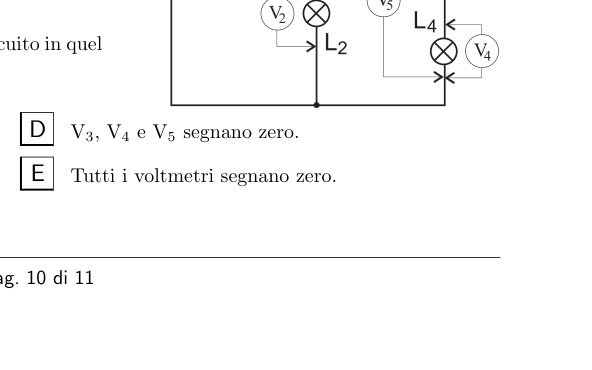
Q37. Nel circuito, sono quattro lampadine identiche e cinque voltmetri ideali. Se la lampadina si brucia (interrompendo il circuito in quel punto), quale o quali voltmetri segnano zero? A) Nessun voltmetro; B) Solo ; C) Solo ; D) ; E) Tutti.
Quesito 37 — circuito con induttori e voltmetri
Topic: Circuits Metodi: Kirchhoff’s Laws Competenze: Diagrammatic Reasoning Objects: Resistor, Wire Fonte: Testo (PDF) — p.3 Risposta: C · Soluzioni (PDF)
Q37. In the circuit, are four identical light bulbs and five ideal voltmeters. If bulb burns out (breaking the circuit at that point), which voltmeter or voltmeters read zero? A) No voltmeter; B) Only ; C) Only ; D) ; E) All.
Problem 37 — circuit with inductors and voltmeters
Answer: C · Soluzioni (PDF)
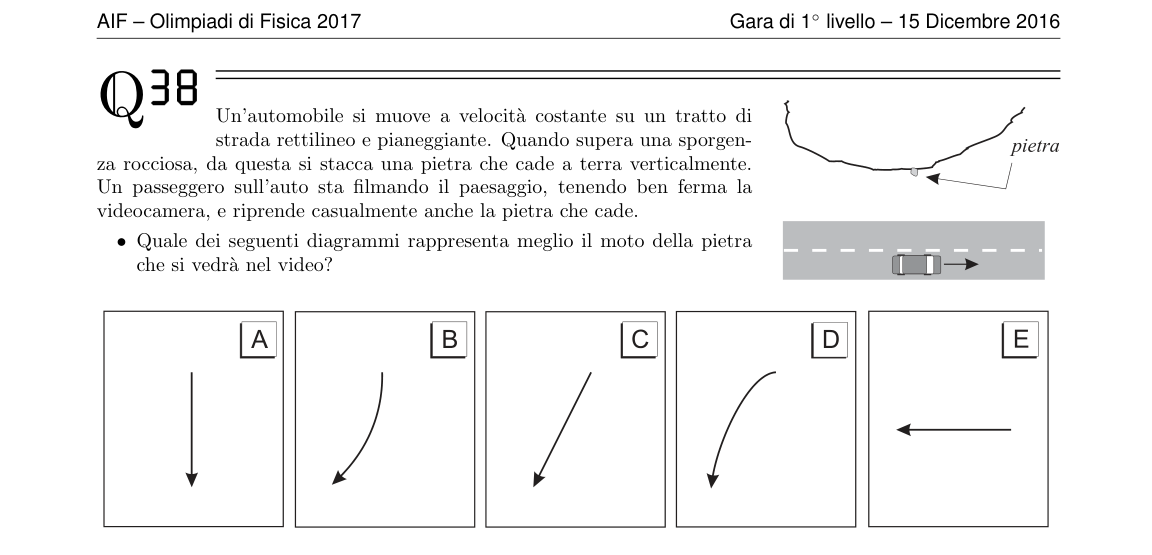
Q38. Un’automobile si muove a velocità costante su strada rettilinea pianeggiante. Quando supera una sporgenza rocciosa, da questa si stacca una pietra che cade verticalmente. Un passeggero filma tenendo ferma la videocamera e riprende la pietra. Quale diagramma rappresenta meglio il moto della pietra nel video? [Cinque diagrammi A–E; il moto nel riferimento dell’auto è una parabola con velocità iniziale orizzontale.]
Quesito 38 — cinque traiettorie auto e sasso
Topic: Newtonian Mechanics Metodi: Kinematic Equations Competenze: Diagrammatic Reasoning Objects: Projectile Fonte: Testo (PDF) — p.3 Risposta: D · Soluzioni (PDF)
Q38. A car moves at constant speed on a straight, level road. When it goes over a rocky protrusion, a stone detaches from it and falls vertically. A passenger films while holding the video camera still and records the stone. Which diagram best represents the motion of the stone in the video? [Five diagrams A–E; the motion in the car’s reference frame is a parabola with initial horizontal velocity.]
Problem 38 — five trajectories of car and stone
Answer: D · Soluzioni (PDF)
Q39. La pressione di una certa quantità di gas perfetto viene aumentata comprimendolo a temperatura costante. La densità del gas è… A) direttamente proporzionale a ; B) inversamente proporzionale a ; C) direttamente proporzionale a ; D) inversamente proporzionale a ; E) costante.
Topic: Thermodynamics Metodi: Ideal Gas Law Competenze: Physical Reasoning Objects: Gas Fonte: Testo (PDF) — p.4 Risposta: A · Soluzioni (PDF)
Q39. The pressure of a certain quantity of ideal gas is increased by compressing it at constant temperature . The density of the gas is… A) directly proportional to ; B) inversely proportional to ; C) directly proportional to ; D) inversely proportional to ; E) constant.
Answer: A · Soluzioni (PDF)
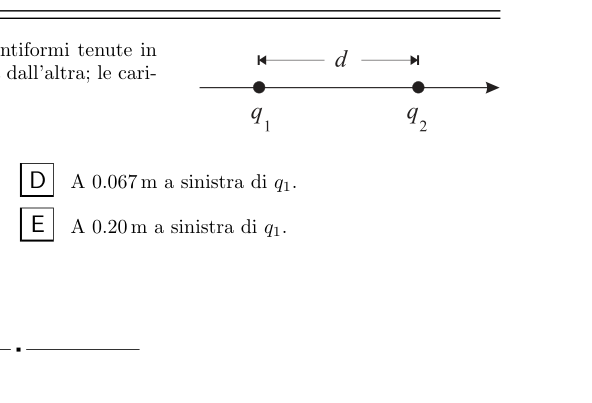
Q40. Due cariche puntiformi fisse a distanza : , . In quale punto il campo elettrico è nullo? A) a destra di ; B) a destra di ; C) a destra di ; D) a sinistra di ; E) a sinistra di .
 pendolo in oscillazione, cinque posizioni
Quesito 40 — due cariche q1 q2 con distanza d
Topic: Electrostatics Metodi: Coulomb’s Law, Superposition Principle Competenze: Mathematical Modeling Objects: Point Charge Fonte: Testo (PDF) — p.3 Risposta: E · Soluzioni (PDF)
Q40. Two point charges fixed at a distance : , . At which point is the electric field zero? A) to the right of ; B) to the right of ; C) to the right of ; D) to the left of ; E) to the left of .
pendulum oscillating, five positions
Problem 40 — two charges q1 q2 with distance d
Answer: E · Soluzioni (PDF)