Q1. Un oggetto di massa viene sollevato verticalmente a velocità costante di . Qual è la potenza minima necessaria? A) ; B) ; C) ; D) ; E) .
Topic: Newtonian Mechanics Metodi: Free-Body Diagram Competenze: Physical Reasoning Objects: Block Fonte: Testo (PDF) — p.3 Risposta: D · Soluzioni (PDF)
Q1. An object of mass is lifted vertically at a constant speed of . What is the minimum power required? A) ; B) ; C) ; D) ; E) .
Answer: D · Soluzioni (PDF)
Q2. Quale coppia è costituita da una grandezza scalare e una vettoriale? A) accelerazione e spostamento; B) energia cinetica e massa; C) quantità di moto e velocità; D) energia potenziale e lavoro; E) potenza e peso.
Topic: Newtonian Mechanics Metodi: — Competenze: Physical Reasoning Objects: — Fonte: Testo (PDF) — p.3 Risposta: E · Soluzioni (PDF)
Q2. Which pair consists of a scalar quantity and a vector quantity? A) acceleration and displacement; B) kinetic energy and mass; C) momentum and velocity; D) potential energy and work; E) power and weight.
Answer: E · Soluzioni (PDF)
Q3. Un carrello si muove a velocità verso una parete lontana, trasportando una sorgente sonora a frequenza e un rivelatore; il suono è riflesso dalla parete e ricevuto dal rivelatore. Se la velocità del suono in aria è , il rivelatore riceve un suono di frequenza: A) ; B) ; C) ; D) ; E) .
Topic: Oscillations & Waves Metodi: Physical Modeling Competenze: Physical Reasoning Objects: Cart Fonte: Testo (PDF) — p.3 Risposta: E · Soluzioni (PDF)
Q3. A cart moves at speed toward a distant wall, carrying a sound source with frequency and a detector; the sound is reflected by the wall and received by the detector. If the speed of sound in air is , the detector receives a sound with frequency: A) ; B) ; C) ; D) ; E) .
Answer: E · Soluzioni (PDF)
Q4. Su una rotaia a cuscino d’aria orizzontale, il carrello A ha massa e velocità , il carrello B massa e velocità . La stessa forza costante parallela alla rotaia li arresta entrambi. Il carrello A percorre una distanza . Prima di arrestarsi, il carrello B percorre: A) ; B) ; C) ; D) ; E) .
Topic: Newtonian Mechanics Metodi: Conservation of Energy, Kinematic Equations Competenze: Physical Reasoning, Mathematical Modeling Objects: Cart Fonte: Testo (PDF) — p.3 Risposta: E · Soluzioni (PDF)
Q4. On a horizontal air cushion rail, the carriage A has mass and speed , the carriage B has mass and speed . La stessa forza costante parallela alla rotaia li arresta entrambi. The A-carriage shall cover a distance of . Before stopping, cart B shall travel through: A) ; B) ; C) ; D) ; E) .
Topic: Newtonian Mechanics Metodi: Conservation of Energy, Kinematic Equations Competenze: Physical Reasoning, Mathematical Modeling Objects: Cart Fonte: Testo (PDF) — p.3 Risposta: E · Soluzioni (PDF)
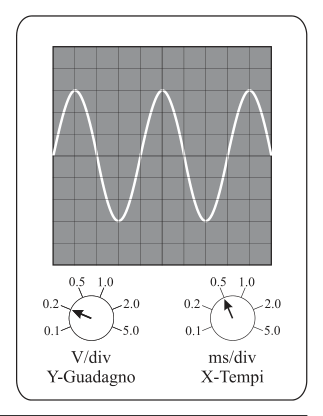
Q5. Un segnale sinusoidale è visualizzato su un oscilloscopio; la scala dei tempi è per quadretto e il periodo è di quattro quadretti. Qual è la frequenza del segnale? A) ; B) ; C) ; D) ; E) .
Topic: Oscillations & Waves Metodi: Experimental Data Analysis Competenze: Measurement & Instrumentation Objects: — Fonte: Testo (PDF) — p.3 Risposta: E · Soluzioni (PDF)
Q5. A sinusoidal signal is displayed on an oscilloscope; the time scale is per division and the period is four divisions. What is the frequency of the signal? A) ; B) ; C) ; D) ; E) .
Answer: E · Soluzioni (PDF)
Q6. Da una terrazza ad altezza una palla è lanciata verticalmente verso il basso a ; nello stesso istante un’altra palla è lanciata verticalmente verso l’alto con uguale velocità dalla strada. A che altezza dal livello della strada le due palle si incrociano? A) ; B) ; C) ; D) ; E) .
Topic: Newtonian Mechanics Metodi: Kinematic Equations Competenze: Mathematical Modeling Objects: Ball Fonte: Testo (PDF) — p.3 Risposta: C · Soluzioni (PDF)
Q6. From a terrace at height a ball is thrown vertically downward at ; at the same instant another ball is thrown vertically upward with the same speed from the street. At what height from street level do the two balls cross? A) ; B) ; C) ; D) ; E) .
Answer: C · Soluzioni (PDF)
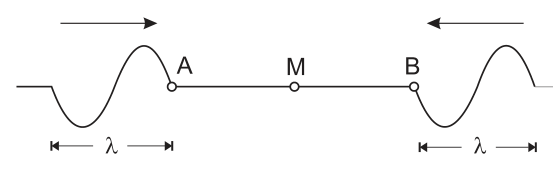
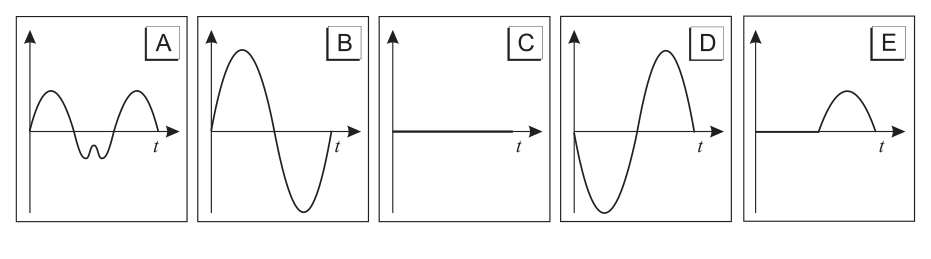
Q7. Due impulsi di uguale ampiezza e lunghezza si muovono lungo una fune l’uno verso l’altro con la stessa velocità. Quale grafico rappresenta l’evoluzione nel tempo del punto , punto medio di ? [Cinque grafici A–E; gli impulsi sono opposti (uno positivo, uno negativo).]
Topic: Oscillations & Waves Metodi: Superposition Principle Competenze: Diagrammatic Reasoning Objects: String Fonte: Testo (PDF) — p.3 Risposta: C · Soluzioni (PDF)
Q7. Two pulses of equal amplitude and length move along a rope toward each other with the same speed. Which graph represents the evolution over time of point , the midpoint of ? [Five graphs A–E; the pulses are opposite (one positive, one negative).]
Answer: C · Soluzioni (PDF)
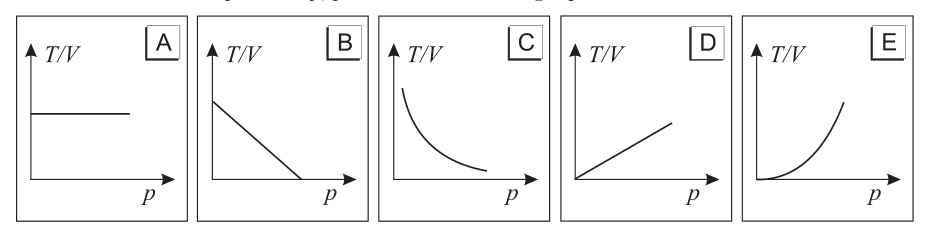
Q8. Quale grafico rappresenta il rapporto (temperatura assoluta su volume) in funzione della pressione , per una data massa di gas perfetto? [Cinque grafici A–E; , retta per l’origine.]
Topic: Thermodynamics Metodi: Ideal Gas Law Competenze: Diagrammatic Reasoning Objects: Gas Fonte: Testo (PDF) — p.4 Risposta: D · Soluzioni (PDF)
Q8. Which graph represents the ratio (absolute temperature over volume) as a function of pressure , for a given mass of ideal gas? [Five graphs A–E; , straight line through the origin.]
Answer: D · Soluzioni (PDF)
Q9. Quale delle linee rappresenta correttamente il raggio di luce uscente da una lente biconvessa (convergente)? [Cinque raggi A–E.]
Topic: Geometric Optics Metodi: Ray Tracing Competenze: Diagrammatic Reasoning Objects: Lens Fonte: Testo (PDF) — p.3 Risposta: D · Soluzioni (PDF)
Q9. Which of the lines correctly represents the light ray emerging from a biconvex (converging) lens? [Five rays A–E.]
Answer: D · Soluzioni (PDF)
Q10. Una ragazza di massa siede sul bordo di una piattaforma circolare di raggio e momento d’inerzia (attrito trascurabile, asse verticale), inizialmente in quiete. La ragazza cammina lungo il bordo con velocità rispetto al suolo. Qual è la velocità angolare della piattaforma rispetto al suolo? A) ; B) ; C) ; D) ; E) .
Topic: Rotational Dynamics Metodi: Torque & Angular Momentum Analysis, Conservation Laws Competenze: Physical Reasoning, Mathematical Modeling Objects: Disk Fonte: Testo (PDF) — p.3 Risposta: B · Soluzioni (PDF)
Q10. A girl of mass sits on the edge of a circular platform of radius and moment of inertia (negligible friction, vertical axis), initially at rest. The girl walks along the edge with speed relative to the ground. What is the angular velocity of the platform relative to the ground? A) ; B) ; C) ; D) ; E) .
Answer: B · Soluzioni (PDF)
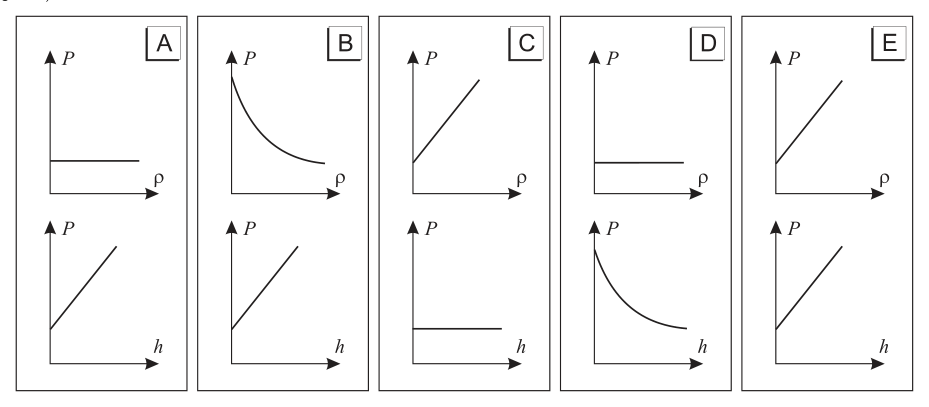
Q11. La pressione in un liquido omogeneo dipende dalla profondità e dalla densità. Quale coppia di grafici descrive in funzione della densità (a parità di profondità) e in funzione della profondità (dato liquido)? [Coppie di grafici A–E; in entrambi i casi dipende linearmente.]
Topic: Fluid Mechanics Metodi: Hydrostatic Equilibrium Competenze: Diagrammatic Reasoning Objects: — Fonte: Testo (PDF) — p.3 Risposta: E · Soluzioni (PDF)
Q11. The pressure in a homogeneous liquid depends on depth and density. Which pair of graphs describes as a function of density (at equal depth) and as a function of depth (for a given liquid)? [Pairs of graphs A–E; in both cases depends linearly.]
Answer: E · Soluzioni (PDF)
Q12. In una lunga vasca un apparecchio genera onde di ampiezza , una ogni ; i fronti d’onda distano . Qual è la velocità delle onde? A) ; B) ; C) ; D) ; E) .
Topic: Oscillations & Waves Metodi: Wave Equation Competenze: Physical Reasoning Objects: — Fonte: Testo (PDF) — p.3 Risposta: C · Soluzioni (PDF)
Q12. In a long tank, a device generates waves of amplitude , one every ; the wavefronts are apart. What is the speed of the waves? A) ; B) ; C) ; D) ; E) .
Answer: C · Soluzioni (PDF)
Q13. Un trasformatore ha 40 spire al primario e 80 al secondario; al primario è immessa una potenza di . Qual è la potenza trasferita al secondario se l’efficienza è del ? A) ; B) ; C) ; D) ; E) .
Topic: Electromagnetic Induction Metodi: — Competenze: Physical Reasoning Objects: Coil Fonte: Testo (PDF) — p.5 Risposta: B · Soluzioni (PDF)
Q13. A transformer has 40 turns in the primary and 80 in the secondary; a power of is fed into the primary. What is the power transferred to the secondary if the efficiency is ? A) ; B) ; C) ; D) ; E) .
Answer: B · Soluzioni (PDF)
Q14. Un gas perfetto subisce un’espansione a pressione costante dal volume (temperatura ) al volume (temperatura ); il calore molare a pressione costante è . Il lavoro compiuto da moli durante l’espansione è: A) ; B) ; C) ; D) ; E) .
Topic: Thermodynamics Metodi: First Law of Thermodynamics, Ideal Gas Law Competenze: Mathematical Modeling Objects: Gas Fonte: Testo (PDF) — p.4 Risposta: E · Soluzioni (PDF)
Q14. An ideal gas undergoes an expansion at constant pressure from volume (temperature ) to volume (temperature ); the molar heat at constant pressure is . The work done by moles during the expansion is: A) ; B) ; C) ; D) ; E) .
Answer: E · Soluzioni (PDF)
Q15. Una pellicola sottile di spessore e indice di rifrazione aderisce a un vetro di indice ; la luce è riflessa da entrambe le superfici. Un fascio di lunghezza d’onda incide quasi perpendicolarmente. Qual è il minimo spessore per cui la luce non viene riflessa in aria? A) ; B) ; C) ; D) ; E) .
Topic: Wave Optics Metodi: Interference & Diffraction Analysis Competenze: Physical Reasoning, Mathematical Modeling Objects: — Fonte: Testo (PDF) — p.3 Risposta: A · Soluzioni (PDF)
Q15. A thin film of thickness and refractive index adheres to a glass of index ; light is reflected from both surfaces. A beam of wavelength is incident almost perpendicularly. What is the minimum thickness for which the light is not reflected into air? A) ; B) ; C) ; D) ; E) .
Answer: A · Soluzioni (PDF)
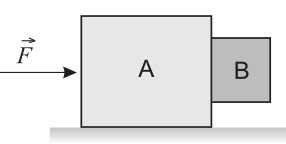
Q16. Una forza agisce sul blocco A determinando un’accelerazione ; il coefficiente d’attrito statico fra i blocchi A e B è . La condizione affinché il blocco B non scivoli in basso è: A) ; B) ; C) ; D) ; E) .
Topic: Newtonian Mechanics Metodi: Free-Body Diagram Competenze: Physical Reasoning Objects: Block Fonte: Testo (PDF) — p.3 Risposta: D · Soluzioni (PDF)
Q16. A force acts on block A producing an acceleration ; the coefficient of static friction between blocks A and B is . The condition for block B not to slide down is: A) ; B) ; C) ; D) ; E) .
Answer: D · Soluzioni (PDF)
Q17. Un frammento di roccia cade da fermo in caduta libera vicino alla superficie di un pianeta senza atmosfera, dove . Qual è la velocità dopo essere caduto per ? A) ; B) ; C) ; D) ; E) .
Topic: Newtonian Mechanics Metodi: Kinematic Equations Competenze: Mathematical Modeling Objects: Planet Fonte: Testo (PDF) — p.3 Risposta: B · Soluzioni (PDF)
Q17. A rock fragment falls from rest in free fall near the surface of a planet without an atmosphere, where . What is the velocity after falling for ? A) ; B) ; C) ; D) ; E) .
Answer: B · Soluzioni (PDF)
Q18. Atomi di idrogeno vengono eccitati allo stato . Quando ritornano allo stato fondamentale emettono fotoni di diverse energie. Secondo il modello di Bohr, quante sono le diverse energie? A) ; B) ; C) ; D) ; E) .
Topic: Modern-Quantum Physics Metodi: Bohr Model & Quantization Competenze: Physical Reasoning Objects: Atom, Photon Fonte: Testo (PDF) — p.6 Risposta: E · Soluzioni (PDF)
Q18. Hydrogen atoms are excited to the state. When they return to the ground state they emit photons of different energies. According to the Bohr model, how many different energies are there? A) ; B) ; C) ; D) ; E) .
Answer: E · Soluzioni (PDF)
Q19. Tre sferette identiche: 1 e 2 hanno carica , la 3 è scarica; sono a grande distanza e la forza repulsiva fra 1 e 2 è . La sferetta 3 viene messa in contatto con 1, poi con 2, infine allontanata. Se la distanza fra 1 e 2 non cambia, la forza di repulsione fra loro ha ora modulo: A) ; B) ; C) ; D) ; E) .
Topic: Electrostatics Metodi: Coulomb’s Law Competenze: Physical Reasoning, Mathematical Modeling Objects: Conducting Sphere Fonte: Testo (PDF) — p.5 Risposta: D · Soluzioni (PDF)
Q19. Three identical small spheres: 1 and 2 have charge , the 3rd is uncharged; they are at a large distance and the repulsive force between 1 and 2 is . Sphere 3 is put in contact with 1, then with 2, and finally moved away. If the distance between 1 and 2 does not change, the repulsive force between them now has magnitude: A) ; B) ; C) ; D) ; E) .
Answer: D · Soluzioni (PDF)
Q20. Un’automobile di massa viaggia a velocità su strada piana. Sia la forza costante necessaria per arrestarla in . L’intensità della forza per arrestarla in è: A) ; B) ; C) ; D) ; E) .
Topic: Newtonian Mechanics Metodi: Impulse-Momentum Theorem Competenze: Physical Reasoning Objects: — Fonte: Testo (PDF) — p.3 Risposta: D · Soluzioni (PDF)
Q20. A mass car travels at speed on a flat road. Sia la forza costante necessaria per arrestarla in . The force to stop it in shall be: A) ; B) ; C) ; D) ; E) .
Topic: Newtonian Mechanics Metodi: Impulse-Momentum Theorem Competenze: Physical Reasoning Objects: — Fonte: Testo (PDF) — p.3 Risposta: D · Soluzioni (PDF)
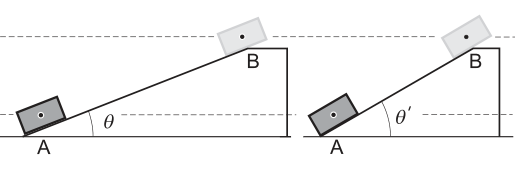
Q21. Una scatola di su un piano inclinato di angolo (senza attrito) è spinta a velocità costante da A a B da una forza parallela al piano. Aumentando (e variando per mantenere la velocità costante), come variano il modulo della forza e il lavoro compiuto da A a B? A) forza diminuisce, lavoro aumenta; B) forza aumenta, lavoro diminuisce; C) aumentano entrambi; D) forza diminuisce, lavoro invariato; E) forza aumenta, lavoro invariato.
Topic: Newtonian Mechanics Metodi: Free-Body Diagram, Conservation of Energy Competenze: Physical Reasoning Objects: Block, Inclined Plane Fonte: Testo (PDF) — p.3 Risposta: E · Soluzioni (PDF)
Q21. A box of on an inclined plane of angle (without friction) is pushed at constant speed from A to B by a force parallel to the plane. By increasing (and varying to maintain constant speed), how do the magnitude of the force and the work done from A to B vary? A) force decreases, work increases; B) force increases, work decreases; C) both increase; D) force decreases, work unchanged; E) force increases, work unchanged.
Answer: E · Soluzioni (PDF)
Q22. Un apparato riscalda un liquido; è un voltmetro ad alta resistenza interna, un amperometro a bassa resistenza interna. Chiudendo l’interruttore, il voltmetro indica una d.d.p. ma l’amperometro segna zero. La causa potrebbe essere: A) l’interruttore si è riaperto; B) la pila è completamente scarica; C) la resistenza della bobina è troppo piccola; D) la bobina di riscaldamento è spezzata; E) c’è troppo liquido nel recipiente.
Topic: Circuits Metodi: Kirchhoff’s Laws Competenze: Physical Reasoning Objects: Galvanometer, Coil, Battery, Switch Fonte: Testo (PDF) — p.5 Risposta: D · Soluzioni (PDF)
Q22. A device heats a liquid; is a voltmeter with high internal resistance, an ammeter with low internal resistance. When the switch is closed, the voltmeter shows a p.d. but the ammeter reads zero. The cause could be: A) the switch has reopened; B) the battery is completely flat; C) the resistance of the coil is too small; D) the heating coil is broken; E) there is too much liquid in the container.
Answer: D · Soluzioni (PDF)
Q23. Una sostanza radioattiva ha tempo di dimezzamento di anni. Quale frazione di un campione sarà rimasta fra anni? A) zero; B) circa ; C) circa ; D) circa ; E) circa .
Topic: Nuclear & Particle Physics Metodi: Radioactive Decay Law Competenze: Mathematical Modeling Objects: — Fonte: Testo (PDF) — p.6 Risposta: D · Soluzioni (PDF)
Q23. A radioactive substance has a half-life of years. What fraction of a sample will remain after years? A) zero; B) about ; C) about ; D) about ; E) about .
Answer: D · Soluzioni (PDF)
Q24. A parità di temperatura la densità del vapore è minore di quella dell’acqua. Questo è dovuto al fatto che, rispetto all’acqua, nel vapore… A) la distanza media tra le molecole è maggiore; B) la velocità media delle molecole è maggiore; C) la massa delle molecole è minore; D) le dimensioni delle molecole sono molto maggiori; E) la velocità media delle molecole è minore.
Topic: Kinetic Theory Metodi: — Competenze: Physical Reasoning Objects: Gas Fonte: Testo (PDF) — p.4 Risposta: A · Soluzioni (PDF)
Q24. At the same temperature, the density of steam is lower than that of water. This is due to the fact that, compared to water, in steam… A) the average distance between molecules is greater; B) the average speed of the molecules is greater; C) the mass of the molecules is smaller; D) the size of the molecules is much larger; E) the average speed of the molecules is lower.
Answer: A · Soluzioni (PDF)
Q25. Per far viaggiare in acqua a un motoscafo di massa occorre una forza orizzontale di . Il motore deve fornire energia almeno al ritmo di: A) ; B) ; C) ; D) ; E) .
Topic: Newtonian Mechanics Metodi: — Competenze: Physical Reasoning, Mathematical Modeling Objects: — Fonte: Testo (PDF) — p.3 Risposta: D · Soluzioni (PDF)
Q25. To make a motorboat of mass travel in water at , a horizontal force of is needed. The engine must supply energy at least at the rate of: A) ; B) ; C) ; D) ; E) .
Answer: D · Soluzioni (PDF)
Q25. (Vedi blocco Meccanica B1, Q25 — potenza del motoscafo.)
Topic: Newtonian Mechanics Metodi: — Competenze: Physical Reasoning Objects: — Fonte: Testo (PDF) — p.5 Soluzione: Soluzioni (PDF)
Q25. (See Mechanics block B1, Q25 — power of the motorboat.)
Topic: Newtonian Mechanics Metodi: — Competenze: Physical Reasoning Objects: — Fonte: Testo (PDF) — p.5 Soluzione: Soluzioni (PDF)
Q26. Un anello conduttore di area è perpendicolare a un campo magnetico uniforme crescente , con e . La f.e.m. indotta all’istante è: A) ; B) ; C) ; D) ; E) .
Topic: Electromagnetic Induction Metodi: Faraday’s Law of Induction Competenze: Mathematical Modeling Objects: Coil Fonte: Testo (PDF) — p.5 Risposta: C · Soluzioni (PDF)
Q26. A conductive ring of area is perpendicular to a uniform magnetic field rising , with and . La f.e.m. indotta all’istante è: A) ; B) ; C) ; D) ; E) .
Topic: Electromagnetic Induction Metodi: Faraday’s Law of Induction Competenze: Mathematical Modeling Objects: Coil Fonte: Testo (PDF) — p.5 Risposta: C · Soluzioni (PDF)
Q27. Un treno parte con accelerazione costante . Quando la velocità è , un passeggero lascia cadere una moneta che impiega a toccare il pavimento. Rispetto ai binari, lo spostamento orizzontale della moneta durante la caduta è… A) nel verso del moto; B) nel verso del moto; C) nel verso del moto; D) nullo; E) in verso opposto.
Topic: Newtonian Mechanics Metodi: Kinematic Equations, Vector Decomposition Competenze: Physical Reasoning, Mathematical Modeling Objects: — Fonte: Testo (PDF) — p.3 Risposta: B · Soluzioni (PDF)
Q27. A train departs with constant acceleration . When the speed is , a passenger drops a coin that takes to touch the floor. With respect to the tracks, the horizontal displacement of the coin during the fall is… A) in the direction of motion; B) in the direction of motion; C) in the direction of motion; D) zero; E) in the opposite direction.
Answer: B · Soluzioni (PDF)
Q28. Quanto vale in kg la massa di una particella di ? A) ; B) ; C) ; D) ; E) .
Topic: Special Relativity Metodi: Mass-Energy Equivalence Competenze: Unit Conversion Objects: Particle Beam Fonte: Testo (PDF) — p.5 Risposta: B · Soluzioni (PDF)
Q28. What is the mass in kg of a particle of ? A) ; B) ; C) ; D) ; E) .
Answer: B · Soluzioni (PDF)
Q28. (Quesito di conversione di unità — vedi blocco Elettromagnetismo B4, Q28; risposta B, .)
Topic: Special Relativity Metodi: Mass-Energy Equivalence Competenze: Unit Conversion Objects: — Fonte: Testo (PDF) — p.6 Soluzione: Soluzioni (PDF)
Q28. (Question on unit conversion see electromagnetism block B4, Q28; answer B, .)
Topic: Special Relativity Metodi: Mass-Energy Equivalence Competenze: Unit Conversion Objects: — Fonte: Testo (PDF) — p.6 Soluzione: Soluzioni (PDF)
Q29. Un gas perfetto compie un ciclo: isoterma a (assorbe ); a volume costante (cede , ); adiabatica. Qual è la variazione di energia interna nella trasformazione ? A) ; B) ; C) ; D) ; E) .
Topic: Thermodynamics Metodi: First Law of Thermodynamics, Thermodynamic Cycle Analysis Competenze: Physical Reasoning Objects: Gas Fonte: Testo (PDF) — p.4 Risposta: E · Soluzioni (PDF)
Q29. An ideal gas undergoes a cycle: isothermal at (absorbs ); at constant volume (releases , ); adiabatic. What is the change in internal energy in the transformation ? A) ; B) ; C) ; D) ; E) .
Answer: E · Soluzioni (PDF)
Q30. Una palla di massa attaccata a una corda ruota in un piano orizzontale su circonferenza di raggio a velocità costante. Quale variazione richiederebbe il massimo aumento della forza centripeta? A) quadruplicare sia che ; B) raddoppiare sia che ; C) raddoppiare e dimezzare ; D) dimezzare e raddoppiare ; E) dimezzare sia che .
Topic: Newtonian Mechanics Metodi: — Competenze: Physical Reasoning, Mathematical Modeling Objects: Ball, String Fonte: Testo (PDF) — p.3 Risposta: C · Soluzioni (PDF)
Q30. A ball of mass attached to a rope rotates in a horizontal plane on a circle of radius at constant speed . Which change would require the greatest increase in centripetal force? A) quadruple both and ; B) double both and ; C) double and halve ; D) halve and double ; E) halve both and .
Answer: C · Soluzioni (PDF)
Q31. Una persona sale su una bilancia in un ascensore fermo: segna . Quando l’ascensore sale con accelerazione , quanto vale la massa della persona? A) ; B) ; C) ; D) ; E) .
Topic: Newtonian Mechanics Metodi: Free-Body Diagram Competenze: Physical Reasoning Objects: — Fonte: Testo (PDF) — p.3 Risposta: C · Soluzioni (PDF)
Q31. A person steps on a scale in a stationary elevator: it reads . When the elevator ascends with acceleration , what is the mass of the person? A) ; B) ; C) ; D) ; E) .
Answer: C · Soluzioni (PDF)
Q32. Tre lampadine identiche dissipano ciascuna quando collegate separatamente a . Sono erroneamente collegate in serie a (comportamento ohmico). Quanto vale la potenza dissipata da ciascuna lampadina? A) ; B) ; C) ; D) ; E) .
Topic: Circuits Metodi: Equivalent Circuit Reduction, Kirchhoff’s Laws Competenze: Mathematical Modeling Objects: Resistor, Battery Fonte: Testo (PDF) — p.5 Risposta: A · Soluzioni (PDF)
Q32. Three identical light bulbs each dissipate when connected separately to . They are mistakenly connected in series to (ohmic behavior). What is the power dissipated by each light bulb? A) ; B) ; C) ; D) ; E) .
Answer: A · Soluzioni (PDF)
Q33. Quanto calore deve essere fornito per trasformare di ghiaccio a in acqua a ? A) ; B) ; C) ; D) ; E) .
 cinque grafici T/V in funzione di p
ciclo termodinamico p-V gas perfetto
Topic: Thermodynamics Metodi: — Competenze: Physical Reasoning Objects: — Fonte: Testo (PDF) — p.4 Risposta: B · Soluzioni (PDF)
Q33. How much heat must be supplied to transform of ice at into water at ? A) ; B) ; C) ; D) ; E) .
five graphs T/V as a function of p
thermodynamic p-V cycle ideal gas
Answer: B · Soluzioni (PDF)
Q34. Due automobili viaggiano alla stessa velocità; quella davanti frena e quella dietro la tampona. Nell’urto, quale delle due subisce la variazione maggiore (in modulo) di quantità di moto? A) la più massiccia; B) quella con massa minore; C) quella dietro; D) quella davanti; E) la variazione è in modulo la stessa per entrambe.
Topic: Conservation of Momentum Metodi: Conservation of Momentum, Impulse-Momentum Theorem Competenze: Physical Reasoning Objects: — Fonte: Testo (PDF) — p.3 Risposta: E · Soluzioni (PDF)
Q34. Two cars travel at the same speed; the one in front brakes and the one behind rear-ends it. In the collision, which of the two undergoes the greater change (in magnitude) of momentum? A) the more massive one; B) the one with smaller mass; C) the one behind; D) the one in front; E) the change is the same in magnitude for both.
Answer: E · Soluzioni (PDF)
Q35. Un blocco di massa si muove verso l’alto lungo un piano inclinato di angolo , spinto da una forza orizzontale ; il coefficiente d’attrito dinamico è . L’intensità della forza d’attrito è: A) ; B) ; C) ; D) ; E) .
Topic: Newtonian Mechanics Metodi: Free-Body Diagram, Vector Decomposition Competenze: Mathematical Modeling Objects: Block, Inclined Plane Fonte: Testo (PDF) — p.3 Risposta: C · Soluzioni (PDF)
Q35. A block of mass moves upward along an inclined plane of angle , pushed by a horizontal force ; the coefficient of kinetic friction is . The magnitude of the friction force is: A) ; B) ; C) ; D) ; E) .
Answer: C · Soluzioni (PDF)
Q36. Un raggio di luce passa dall’aria a un mezzo B, poi attraversa un mezzo C e ritorna in aria. Qual è la velocità della luce in B?A) ; B) ; C) ; D) ; E) .
carrello con sorgente sonora verso parete
 oscilloscopio con segnale sinusoidale
 due impulsi su fune verso M
 cinque grafici evoluzione temporale punto M
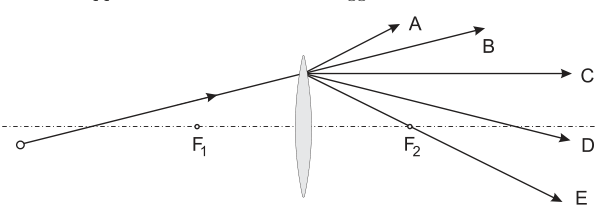 lente biconvessa con raggi A-E
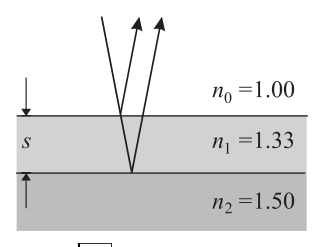 pellicola sottile strati n=1.00,1.33,1.50
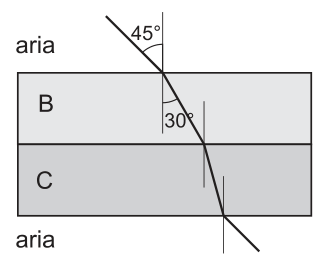 rifrazione luce aria-B-C-aria angoli 45-30
Topic: Geometric Optics Metodi: Snell’s Law Competenze: Mathematical Modeling Objects: — Fonte: Testo (PDF) — p.3 Risposta: B · Soluzioni (PDF)
Q36. A light ray passes from air into a medium B, then travels through a medium C and returns to air. What is the speed of light in B? A) ; B) ; C) ; D) ; E) .
cart with sound source toward wall
oscilloscope with sinusoidal signal
two pulses on a rope toward M
five graphs of temporal evolution of point M
biconvex lens with rays A-E
thin film layers n=1.00, 1.33, 1.50
refraction of light air-B-C-air angles 45-30
Answer: B · Soluzioni (PDF)
Q37. Tre cariche di valore , con , sono poste in tre vertici di un quadrato di lato . Posto a zero il potenziale all’infinito, il potenziale elettrostatico nel quarto vertice è: A) ; B) ; C) ; D) ; E) .
Topic: Electrostatics Metodi: Electric Potential Method, Superposition Principle Competenze: Mathematical Modeling Objects: Point Charge Fonte: Testo (PDF) — p.5 Risposta: C · Soluzioni (PDF)
Q37. Three charges of value , with , are placed at three vertices of a square of side . Setting the potential at infinity to zero, the electrostatic potential at the fourth vertex is: A) ; B) ; C) ; D) ; E) .
Answer: C · Soluzioni (PDF)
Q38. Uno ione di carica e massa entra in un campo magnetico uniforme con velocità perpendicolare e percorre un arco di raggio . Un altro ione di carica , massa e velocità percorre una traiettoria di raggio: A) ; B) ; C) ; D) ; E) .
Topic: Magnetism Metodi: Lorentz Force Analysis Competenze: Physical Reasoning, Mathematical Modeling Objects: Point Charge Fonte: Testo (PDF) — p.5 Risposta: A · Soluzioni (PDF)
Q38. An ion of charge and mass enters a uniform magnetic field with velocity perpendicular and travels along an arc of radius . Another ion of charge , mass and velocity travels along a trajectory of radius: A) ; B) ; C) ; D) ; E) .
Answer: A · Soluzioni (PDF)
Q39. Tre distribuzioni piane, uniformi e infinite di carica, perpendicolari al piano della pagina, con densità superficiali , e . Nel punto X l’intensità e il verso del campo sono: A) verso sinistra; B) verso sinistra; C) ; D) verso destra; E) verso destra.
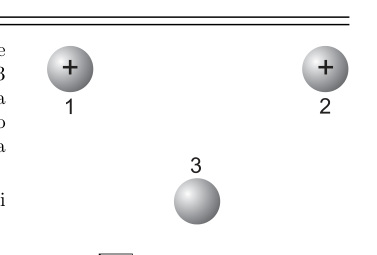 tre sferette cariche 1, 2, 3
circuito con bobina riscaldante voltmetro amperometro
tre cariche pm Q ai vertici quadrato
Topic: Electrostatics Metodi: Gauss’s Law, Superposition Principle Competenze: Physical Reasoning Objects: — Fonte: Testo (PDF) — p.5 Risposta: C · Soluzioni (PDF)
Q39. Three planar, uniform and infinite charge distributions, perpendicular to the plane of the page, with surface densities , and . At point X the magnitude and direction of the field are: A) to the left; B) to the left; C) ; D) to the right; E) to the right.
three charged small spheres 1, 2, 3
circuit with heating coil voltmeter ammeter
three point charges Q at the vertices of a square
Answer: C · Soluzioni (PDF)
Q40. Sulla Luna (, ) una sonda è messa in orbita circolare ad altezza molto minore del raggio lunare. Qual è il periodo del moto? A) ; B) ; C) ; D) ; E) .
 cinque coppie grafici P(rho) e P(h)
 blocchi A e B con forza F
 blocco su piano inclinato angolo theta
blocco su piano inclinato forza orizzontale F
Topic: Gravitation Metodi: Newton’s Law of Gravitation, Kepler’s Laws Competenze: Mathematical Modeling Objects: Satellite, Planet Fonte: Testo (PDF) — p.3 Risposta: B · Soluzioni (PDF)
Q40. On the Moon (, ) a probe is placed in a circular orbit at a height much smaller than the lunar radius. What is the period of the motion? A) ; B) ; C) ; D) ; E) .
five pairs of graphs P(rho) and P(h)
blocks A and B with force F
block on inclined plane angle theta
block on inclined plane horizontal force F
Answer: B · Soluzioni (PDF)