Q1 Tre furgoncini identici – 1, 2 e 3 – sono soggetti ciascuno ad una forza costante, rispettivamente , e ; una o più di queste forze possono essere nulle. La figura mostra la posizione di ciascuno dei tre furgoncini ad ogni secondo, per un intervallo totale di 6 s. • Quale furgone ha la velocità media maggiore in questo intervallo?
- A. Il numero 1
- B. Il numero 2
- C. Il numero 3
- D. I numeri 1 e 3.
- E. Tutti e tre hanno la stessa velocità media.
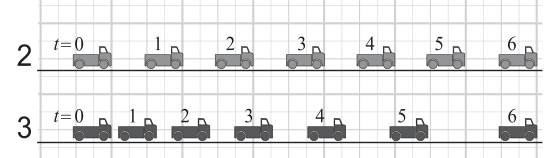 grafico posizione-tempo tre furgoncini
Topic: Newtonian Mechanics Metodi: Kinematic Equations, Free-Body Diagram Competenze: Diagrammatic Reasoning, Physical Reasoning Objects: — Fonte: Testo (PDF) — p.3 Risposta: E · Soluzioni (PDF)
Q1 Three identical vans – 1, 2, and 3 – are each subject to a constant force, respectively , , and ; one or more of these forces may be zero. The figure shows the position of each of the three vans at each second, for a total interval of 6 s. • Which van has the greatest average velocity in this interval?
- A. Number 1
- B. Number 2
- C. Number 3
- D. Numbers 1 and 3.
- E. All three have the same average velocity.
position-time graph three vans
Answer: E · Soluzioni (PDF)
Q2 • Con riferimento alla figura del quesito precedente, come si confrontano le intensità delle tre forze agenti sui furgoncini?
- A.
- B.
- C.
- D.
- E. Topic: Newtonian Mechanics Metodi: Kinematic Equations, Physical Modeling Competenze: Physical Reasoning, Diagrammatic Reasoning Objects: — Fonte: Testo (PDF) — p.3 Risposta: B · Soluzioni (PDF)
Q2 • With reference to the figure in the previous question, how do the magnitudes of the three forces acting on the carts compare?
- A.
- B.
- C.
- D.
- E. Answer: B · Soluzioni (PDF)
Q3 In figura sono mostrati una piccola lampada, che può essere considerata una sorgente puntiforme di luce, e un fotometro per misurare la potenza della radiazione incidente su una superficie posta a quella distanza. La potenza è espressa dal fotometro in unità arbitrarie. • Se il fotometro indica 4 unità quando è a 20 cm dalla lampada, che cosa si può fare affinche ́ si leggano 64 unità?
- A. Spostare il fotometro a 80 cm.
- B. Spostare il fotometro a 40 cm.
- C. Spostare il fotometro a 10 cm.
- D. Spostare il fotometro a 5 cm.
- E. Usare una lampadina quattro volte più potente.
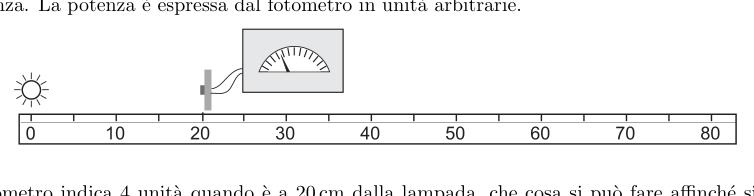 lampada puntiforme e fotometro su asta
Topic: Geometric Optics Metodi: Physical Modeling, Dimensional Analysis Competenze: Physical Reasoning, Estimation & Approximation Objects: — Fonte: Testo (PDF) — p.3 Risposta: D · Soluzioni (PDF)
Q3 The figure shows a small lamp, which can be considered a point source of light, and a photometer for measuring the power of the radiation incident on a surface placed at that distance. The power is expressed by the photometer in arbitrary units. • If the photometer reads 4 units when it is 20 cm from the lamp, what can be done so that it reads 64 units?
- A. Move the photometer to 80 cm.
- B. Move the photometer to 40 cm.
- C. Move the photometer to 10 cm.
- D. Move the photometer to 5 cm.
- E. Use a bulb four times more powerful.
point lamp and photometer on a rod
Answer: D · Soluzioni (PDF)
Q4 In figura è rappresentato il grafico accelerazione-tempo di un corpo che si muove di moto rettilineo. • Calcolando l’area evidenziata nel grafico, quale grandezza si ottiene?
- A. La distanza percorsa tra e
- B. L’accelerazione media tra e
- C. La velocità media tra e
- D. La velocità al tempo
- E. L’impulso per unità di massa dato al corpo tra e
grafico accelerazione-tempo con area evidenziata
Topic: Newtonian Mechanics Metodi: Kinematic Equations, Impulse-Momentum Theorem Competenze: Diagrammatic Reasoning, Physical Reasoning, Mathematical Modeling Objects: — Fonte: Testo (PDF) — p.3 Risposta: E · Soluzioni (PDF)
Q4 The figure shows the acceleration-time graph of a body moving in rectilinear motion. • By calculating the highlighted area in the graph, which quantity is obtained?
- A. The distance traveled between and
- B. The average acceleration between and
- C. The average velocity between and
- D. The velocity at time
- E. The impulse per unit mass given to the body between and
acceleration-time graph with highlighted area
Answer: E · Soluzioni (PDF)
Q5 La luce di un laser incide perpendicolarmente su due fenditure parallele realizzate su una lastra opaca. Su uno schermo, posto dietro la lastra con le fenditure e parallelo a questa, si formano delle frange di interferenza. La separazione delle frange può essere aumentata… 1 – aumentando la lunghezza d’onda della luce. 2 – aumentando la distanza tra fenditure e schermo. 3 – aumentando la distanza tra le fenditure. • Quali delle affermazioni date sopra sono corrette?
- A. Solo 1
- B. Solo 1 e 2
- C. Solo 1 e 3
- D. Solo 2 e 3
- E. 1, 2 e 3
doppia fenditura laser frange interferenza
Topic: Wave Optics Metodi: Interference & Diffraction Analysis, Superposition Principle Competenze: Physical Reasoning, Mathematical Modeling Objects: Slit, Screen Fonte: Testo (PDF) — p.4 Risposta: B · Soluzioni (PDF)
Q5 The light from a laser strikes perpendicularly two parallel slits made in an opaque plate. On a screen placed behind the plate with the slits and parallel to it, interference fringes are formed. The separation of the fringes can be increased… 1 – by increasing the wavelength of the light. 2 – by increasing the distance between the slits and the screen. 3 – by increasing the distance between the slits. • Which of the statements given above are correct?
- A. Only 1
- B. Only 1 and 2
- C. Only 1 and 3
- D. Only 2 and 3
- E. 1, 2 and 3
double slit laser interference fringes
Answer: B · Soluzioni (PDF)
Q6 La figura rappresenta schematicamente una successione di tre decadimenti radioattivi in cui un nucleo P forma un nucleo Q che a sua volta decade formando un nucleo R e infine un nucleo S. • Quale delle alternative fornisce i valori corretti rispettivamente per la variazione del numero di massa e quella del numero atomico tra P e S?
- A. ,
- B. ,
- C. ,
- D. ,
- E. ,
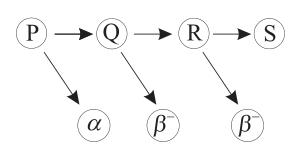 schema reazione nucleare nucleoni
Topic: Nuclear & Particle Physics Metodi: Radioactive Decay Law, Conservation Laws Competenze: Physical Reasoning, Mathematical Modeling Objects: Nucleus Fonte: Testo (PDF) — p.4 Risposta: E · Soluzioni (PDF)
Q6 The figure schematically represents a succession of three radioactive decays in which a nucleus P forms a nucleus Q which in turn decays forming a nucleus R and finally a nucleus S. • Which of the alternatives provides the correct values respectively for the change in the mass number and that in the atomic number between P and S?
- A. ,
- B. ,
- C. ,
- D. ,
- E. ,
nuclear reaction nucleons diagram
Answer: E · Soluzioni (PDF)
Q7 Un condensatore è collegato in serie ad un resistore variabile, ad un amperometro molto sensibile, ad un interruttore e ad una batteria come mostrato in figura. Alla chiusura dell’interruttore, si varia progressivamente la resistenza R in modo tale da garantire che il condensatore C abbia una corrente di carica costante di A per un tempo di 30 s. In questo intervallo di tempo la differenza di potenziale tra le piastre del condensatore sale da 0 V a 12 V. • Qual è la capacità del condensatore?
- A. F
- B. F
- C. F
- D. F
- E. F
circuito RC con amperometro e interruttore
Topic: Circuits, Electrostatics Metodi: Kirchhoff’s Laws, Equivalent Circuit Reduction Competenze: Mathematical Modeling, Physical Reasoning Objects: Capacitor, Resistor, Switch, Battery, Wire Fonte: Testo (PDF) — p.4 Risposta: C · Soluzioni (PDF)
Q7 A capacitor is connected in series to a variable resistor, to a Very sensitive ampere, with a switch and a battery As shown in the figure. When the switch is closed, the resistance R is progressively changed so that the resistance R is not a power output of not more than 0,5% but less than 0,5% of the total power of the capacitor A per un tempo di 30 s. In this timeframe the difference between The potential between the capacitor plates rises from 0 V to 12 V. • What is the capacity of the capacitor?
- A. F
- B. F
- C. F
- D. F
- E. F
RC circuit with ampere and switch
Topic: Circuits, Electrostatics Metodi: Kirchhoff’s Laws, Equivalent Circuit Reduction Competenze: Mathematical Modeling, Physical Reasoning Objects: Capacitor, Resistor, Switch, Battery, Wire Fonte: Testo (PDF) — p.4 Risposta: C · Soluzioni (PDF)
Q8 Cinque studenti vogliono verificare la legge di Snell della rifrazione ( = costante) secondo cui la luce subisce un cambiamento di direzione mentre si propaga da un mezzo ad un altro; e sono gli angoli che danno la direzione della luce prima e dopo la rifrazione; ogni studente utilizza uno degli oggetti di vetro mostrati in figura e misura gli angoli indicati, al variare della direzione del raggio incidente. • Quale studente potrà effettivamente verificare la legge della rifrazione?
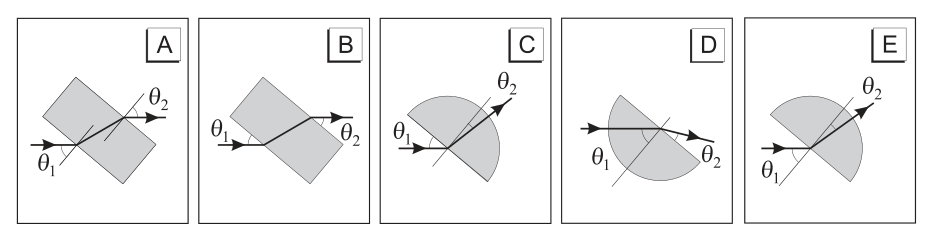 cinque configurazioni rifrazione laser-prisma
Topic: Geometric Optics Metodi: Snell’s Law, Ray Tracing, Experimental Data Analysis Competenze: Diagrammatic Reasoning, Physical Reasoning Objects: Prism Fonte: Testo (PDF) — p.4 Risposta: E · Soluzioni (PDF)
Q8 Five students want to verify Snell’s law of refraction ( = constant) according to which light undergoes a change of direction as it propagates from one medium to another; and are the angles that give the direction of the light before and after refraction; each student uses one of the glass objects shown in the figure and measures the indicated angles, as the direction of the incident ray varies. • Which student will actually be able to verify the law of refraction?
five laser-prism refraction configurations
Answer: E · Soluzioni (PDF)
Q9 • Qual è, approssimativamente, il volume di un normale foglio di carta formato A4?
- A.
- B.
- C.
- D.
- E. Topic: Order-of-Magnitude Estimation Metodi: Order-of-Magnitude Estimation, Physical Modeling Competenze: Estimation & Approximation, Unit Conversion Objects: — Fonte: Testo (PDF) — p.5 Risposta: E · Soluzioni (PDF)
Q9 • What is, approximately, the volume of a normal sheet of A4 paper?
- A.
- B.
- C.
- D.
- E. Answer: E · Soluzioni (PDF)
Q10 • Quale dei seguenti grafici mostra la relazione tra il volume e la temperatura, a pressione costante, per una data quantità di gas perfetto?
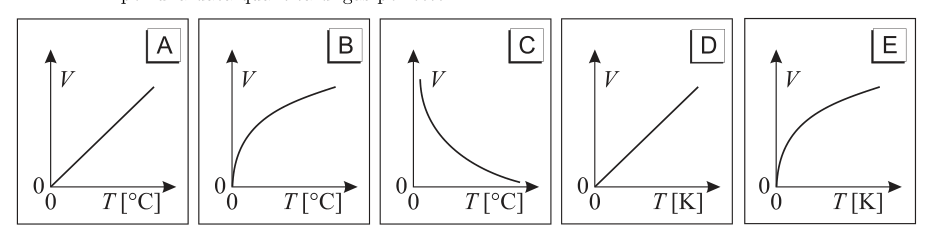 cinque grafici volume-temperatura a pressione costante
Topic: Thermodynamics Metodi: Ideal Gas Law, Physical Modeling Competenze: Mathematical Modeling, Physical Reasoning Objects: Gas Fonte: Testo (PDF) — p.5 Risposta: D · Soluzioni (PDF)
Q10 • Which of the following graphs shows the relationship between volume and temperature, at constant pressure, for a given quantity of an ideal gas?
five volume-temperature graphs at constant pressure
Answer: D · Soluzioni (PDF)
Q11 Un generatore di tensione con una f.e.m. di 20 V è connesso a quattro resistori in serie come mostrato in figura. Un voltmetro ideale può essere connesso a due qualunque tra i punti K, L, M, N e O, in modo da ottenere diversi valori della differenza di potenziale. • Tra quali punti occorre connettere il voltmetro per avere una differenza di potenziale di 8 V?
- A. L e N
- B. M e O
- C. K e L
- D. K e N
- E. L e O
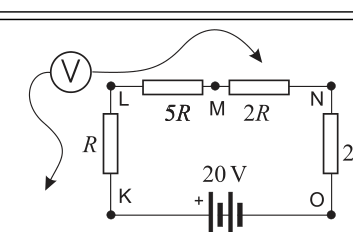 circuito serie quattro resistori generatore
Topic: Circuits Metodi: Kirchhoff’s Laws, Equivalent Circuit Reduction Competenze: Mathematical Modeling, Diagrammatic Reasoning, Physical Reasoning Objects: Resistor, Battery, Galvanometer Fonte: Testo (PDF) — p.5 Risposta: B · Soluzioni (PDF)
Q11 A voltage generator with an electromotive force of 20 V is connected to four resistors in series as shown in the figure. An ideal voltmeter can be connected to any two of the points K, L, M, N and O, so as to obtain different values of the potential difference. • Between which points must the voltmeter be connected to obtain a potential difference of 8 V?
- A. L and N
- B. M and O
- C. K and L
- D. K and N
- E. L and O
series circuit four resistors generator
Answer: B · Soluzioni (PDF)
Q12 Nella figura viene rappresentata una semplice dimostrazione dell’effetto fotoelettrico. Una sorgente monocromatica viene accesa e diretta su una lastra di zinco elettricamente carica, montata su un elettroscopio. • Quali dei seguenti fattori possono essere decisivi per stabilire se la lastra si scaricherà o no? 1 – La luminosità della sorgente. 2 – La lunghezza d’onda della luce utilizzata. 3 – Il tipo di carica (positiva o negativa) sulla lastra.
- A. Solo 2
- B. Solo 3
- C. 1 e 2
- D. 2 e 3
- E. 1, 2 e 3
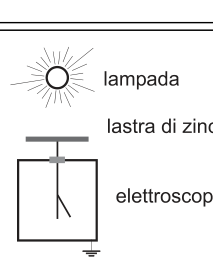 dimostrazione effetto fotoelettrico lampada lastra
Topic: Modern-Quantum Physics, Electrostatics Metodi: Photon Energy Relation, Physical Modeling Competenze: Physical Reasoning, Mathematical Modeling Objects: — Fonte: Testo (PDF) — p.5 Risposta: D · Soluzioni (PDF)
Q12 The figure shows a simple demonstration of the photoelectric effect. A monochromatic source is turned on and directed at an electrically charged zinc plate mounted on an electroscope. • Which of the following factors can be decisive in determining whether the plate will discharge or not? 1 – The brightness of the source. 2 – The wavelength of the light used. 3 – The type of charge (positive or negative) on the plate.
- A. Only 2
- B. Only 3
- C. 1 and 2
- D. 2 and 3
- E. 1, 2 and 3
demonstration photoelectric effect lamp plate
Answer: D · Soluzioni (PDF)
Q13 Una sferetta di plastilina di massa m viene lanciata a velocità v contro l’estremità inferiore di un’asta rigida appesa e libera di ruotare attorno alla sua estremità superiore. L’asta ha una massa trascurabile rispetto alla sferetta, è lunga , come mostrato in figura, alla sua estremità inferiore è fissata una seconda sferetta di massa 2m. Nell’urto le due sferette restano attaccate. • Qual è la velocità tangenziale delle due sferette attaccate, subito dopo la collisione?
- A.
- B.
- C.
- D.
- E.
asta rigida sferetta collisione
Topic: Conservation of Momentum, Rotational Dynamics Metodi: Conservation of Momentum, Torque & Angular Momentum Analysis Competenze: Mathematical Modeling, Physical Reasoning Objects: Rod, Ball Fonte: Testo (PDF) — p.5 Risposta: A · Soluzioni (PDF)
Q13 A small ball of modeling clay with mass m is thrown at speed v against the lower end of a rigid rod that is suspended and free to rotate about its upper end. The rod has a negligible mass compared with the small ball, is of length , as shown in the figure, and at its lower end a second small ball of mass 2m is attached. In the collision the two small balls remain attached. • What is the tangential speed of the two attached small balls, immediately after the collision?
- A.
- B.
- C.
- D.
- E.
rigid rod small ball collision
Answer: A · Soluzioni (PDF)
Q14 In una regione sferica di raggio a vi è una distribuzione uniforme di carica di densità . All’interno della distribuzione è stata creata una cavità sferica schematizzata in figura, avente raggio c e con il centro posto a distanza b dal centro della sfera. • Determinare l’intensità del campo elettrico nel centro della cavità.
- A. 0
- B.
- C.
- D.
- E.
distribuzione sferica uniforme di carica
Topic: Electrostatics Metodi: Gauss’s Law, Superposition Principle, Electric Potential Method Competenze: Mathematical Modeling, Diagrammatic Reasoning Objects: Sphere Fonte: Testo (PDF) — p.6 Risposta: B · Soluzioni (PDF)
Q14 In a spherical region of radius a there is a uniform charge distribution with density . Inside the distribution, a spherical cavity has been created, schematized in the figure, having radius c and with its center placed at distance b from the center of the sphere. • Determine the magnitude of the electric field at the center of the cavity.
- A. 0
- B.
- C.
- D.
- E.
uniform spherical charge distribution
Answer: B · Soluzioni (PDF)
Q15 Una sonda spaziale è in orbita circolare intorno a un pianeta; viene dato il comando di accendere per un breve intervallo di tempo un motore che emette un potente getto in direzione del centro del pianeta, cosicche ́ il modulo della velocità aumenta del 2 %. • Al termine della manovra, quale delle seguenti affermazioni è corretta in riferimento alla traiettoria seguita successivamente dalla sonda?
- A. È un’ellisse
- B. È un’iperbole
- C. È una circonferenza di raggio maggiore
- D. È una spirale di raggio crescente
- E. È caratterizzata da molte oscillazioni radiali durante una rivoluzione intorno al pianeta Topic: Gravitation Metodi: Kepler’s Laws, Newton’s Law of Gravitation, Conservation Laws Competenze: Physical Reasoning, Mathematical Modeling Objects: Satellite, Planet Fonte: Testo (PDF) — p.6 Risposta: A · Soluzioni (PDF)
Q15 A space probe is in a circular orbit around a planet; the command is given to turn on for a short time interval an engine that emits a powerful jet in the direction of the planet’s center, so that the magnitude of the velocity increases by 2%. • At the end of the maneuver, which of the following statements is correct with reference to the trajectory subsequently followed by the probe?
- A. It is an ellipse
- B. It is a hyperbola
- C. It is a circle of greater radius
- D. It is a spiral of increasing radius
- E. It is characterized by many radial oscillations during one revolution around the planet Answer: A · Soluzioni (PDF)
Q16 Un camion del peso di N percorre 1.6 km su una strada in salita, superando un dislivello di 80 m dal livello di partenza. • Se il camion, viaggiando a velocità costante, impiega 3 minuti, qual è il minimo valore della potenza media utilizzata?
- A. 67 W
- B. 1.3 kW
- C. 67 kW
- D. 1.3 MW
- E. 4 MW Topic: Newtonian Mechanics, Conservation of Energy Metodi: Energy Conservation Method, Free-Body Diagram Competenze: Mathematical Modeling, Physical Reasoning Objects: — Fonte: Testo (PDF) — p.6 Risposta: C · Soluzioni (PDF)
Q16 A truck weighing N travels 1.6 km on an uphill road, climbing a height difference of 80 m from the starting level. • If the truck, traveling at constant speed, takes 3 minutes, what is the minimum value of the average power used?
- A. 67 W
- B. 1.3 kW
- C. 67 kW
- D. 1.3 MW
- E. 4 MW Answer: C · Soluzioni (PDF)
Q17 Il conduttore termico ST mostrato in figura è isolato termicamente lungo la sua superficie laterale e gli estremi S e T sono mantenuti a temperature differenti; al suo interno il conduttore è interrotto da uno strato XY di un materiale diverso. In condizioni stazionarie, la differenza di temperatura tra gli estremi dello strato XY dipende … 1 – dalla differenza di temperatura tra gli estremi ST del conduttore. 2 – dallo spessore dello strato XY. 3 – dalla posizione di XY lungo ST. • Quali delle precedenti affermazioni sono corrette?
- A. Nessuna delle tre.
- B. Solo la 1 e la 2.
- C. Solo la 2 e la 3.
- D. Solo la 1.
- E. Solo la 3.
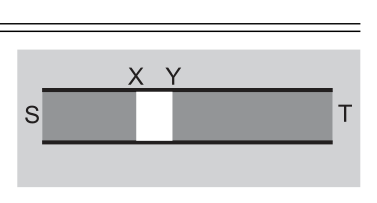 conduttore termico ST isolato lateralmente
Topic: Thermodynamics Metodi: Physical Modeling, Dimensional Analysis Competenze: Physical Reasoning, Mathematical Modeling Objects: Rod Fonte: Testo (PDF) — p.6 Risposta: B · Soluzioni (PDF)
Q17 The thermal conductor ST shown in the figure is thermally insulated along its lateral surface, and its ends S and T are maintained at different temperatures; inside it, the conductor is interrupted by a layer XY of a different material. Under steady-state conditions, the temperature difference between the ends of layer XY depends … 1 – on the temperature difference between the ends ST of the conductor. 2 – on the thickness of layer XY. 3 – on the position of XY along ST. • Which of the above statements are correct?
- A. None of the three.
- B. Only 1 and 2.
- C. Only 2 and 3.
- D. Only 1.
- E. Only 3.
thermal conductor ST insulated laterally
Answer: B · Soluzioni (PDF)
Due cariche puntiformi e , ciascuna di , stanno alla distanza di .
- Quale, tra le combinazioni di cariche, alla distanza indicata, determina una forza elettrostatica uguale in modulo a quella tra e ?
| [µC] | [µC] | [m] | |
|---|---|---|---|
| A | 2 | 2 | 0.4 |
| B | 6 | 4 | 0.8 |
| C | 8 | 2 | 1.6 |
| D | 8 | 4 | 2.4 |
| E | 16 | 4 | 2.0 |
Topic: Electrostatics Metodi: Coulomb’s Law Competenze: Mathematical Modeling, Physical Reasoning Objects: Point Charge Fonte: Testo (PDF) — p.7 Risposta: E · Soluzioni (PDF)
Two point charges and , each of , are at a distance of .
- Which, among the combinations of charges, at the indicated distance, produces an electrostatic force equal in magnitude to that between and ?
| [µC] | [µC] | [m] | |
|---|---|---|---|
| A | 2 | 2 | 0.4 |
| B | 6 | 4 | 0.8 |
| C | 8 | 2 | 1.6 |
| D | 8 | 4 | 2.4 |
| E | 16 | 4 | 2.0 |
Answer: E · Soluzioni (PDF)
L’hertz è un’unità di misura della frequenza.
-
Questa unità, nel caso particolare della propagazione di un’onda periodica, esprime il numero di
-
A. secondi necessari a completare un ciclo dell’onda.
-
B. cicli che l’onda completa in un secondo.
-
C. punti in fase nello spazio di un metro, nella direzione di propagazione dell’onda.
-
D. punti in controfase nello spazio di un metro, nella direzione di propagazione dell’onda.
-
E. metri di distanza fra due creste consecutive dell’onda.
Topic: Oscillations & Waves Metodi: Physical Modeling, Wave Equation Competenze: Physical Reasoning Objects: — Fonte: Testo (PDF) — p.7 Risposta: B · Soluzioni (PDF)
The hertz is a unit of measurement of frequency.
-
This unit, in the particular case of the propagation of a periodic wave, expresses the number of
-
A. seconds needed to complete one cycle of the wave.
-
B. cycles that the wave completes in one second.
-
C. points in phase in one meter of space, in the direction of propagation of the wave.
-
D. points in antiphase in one meter of space, in the direction of propagation of the wave.
-
E. meters of distance between two consecutive crests of the wave.
Answer: B · Soluzioni (PDF)
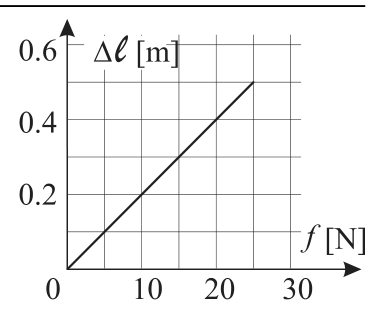
Il grafico in figura mostra la relazione tra l’allungamento di una molla e il modulo della forza ad essa applicata.
-
Quanto vale la costante elastica della molla?
-
A.
-
B.
-
C.
-
D.
-
E.
p.7 — Grafico allungamento vs forza della molla
Topic: Elasticity & Materials Metodi: Hooke’s Law, Physical Modeling Competenze: Graph Linearization, Mathematical Modeling Objects: Spring Fonte: Testo (PDF) — p.7 Risposta: D · Soluzioni (PDF)
The graph in this figure shows the relationship between the lengthening of a spring and the form of force applied to it.
-
How much is the spring’s elastic constant?
-
A.
-
B.
-
C.
-
D.
-
E.
p.7 — Grafico allungamento vs forza della molla
Topic: Elasticity & Materials Metodi: Hooke’s Law, Physical Modeling Competenze: Graph Linearization, Mathematical Modeling Objects: Spring Fonte: Testo (PDF) — p.7 Risposta: D · Soluzioni (PDF)
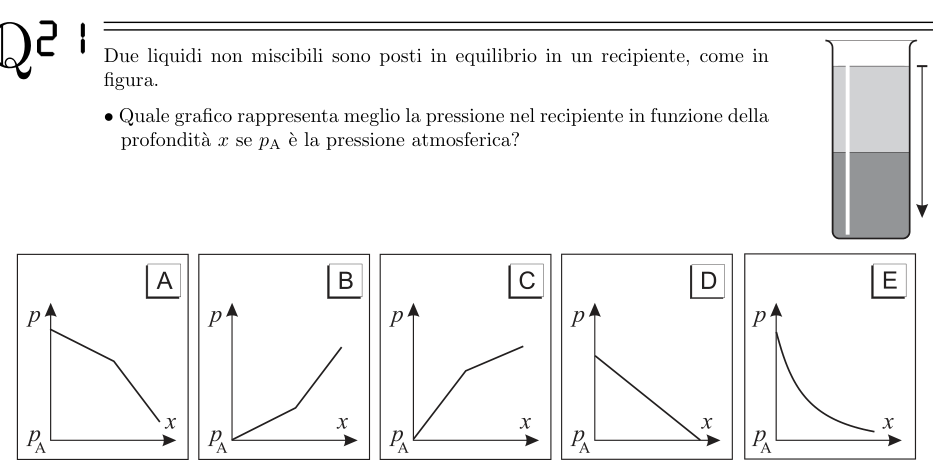
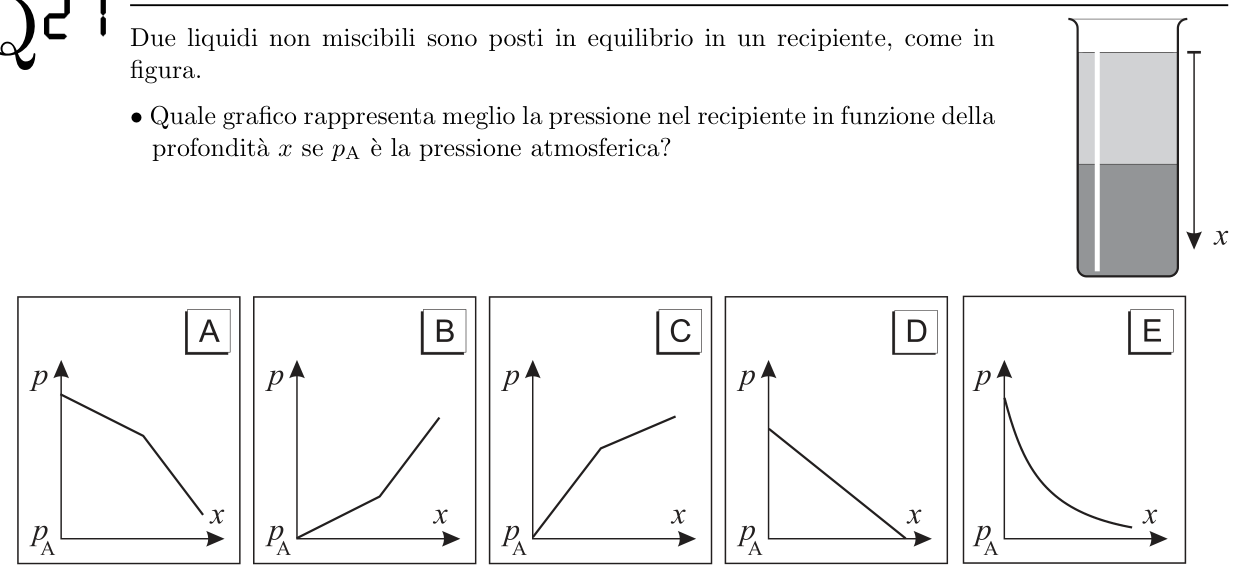
Due liquidi non miscibili sono posti in equilibrio in un recipiente, come in figura.
- Quale grafico rappresenta meglio la pressione nel recipiente in funzione della profondità se è la pressione atmosferica?
Le cinque opzioni A–E sono rappresentate nella figura.
p.7 — Recipiente con due liquidi immiscibili e cinque grafici A–E pressione-profondità
Topic: Fluid Mechanics Metodi: Hydrostatic Equilibrium, Physical Modeling Competenze: Diagrammatic Reasoning, Physical Reasoning Objects: Container Fonte: Testo (PDF) — p.7 Risposta: B · Soluzioni (PDF)
Two immiscible liquids are in equilibrium in a container, as in the figure.
- Which graph best represents the pressure in the container as a function of depth if is the atmospheric pressure?
The five options A–E are shown in the figure.
p.7 — Container with two immiscible liquids and five pressure-depth graphs A–E
Answer: B · Soluzioni (PDF)
Una palla di è lasciata cadere verticalmente da un’altezza di sul pavimento e, dopo il rimbalzo, risale fino a un’altezza di .
-
L’energia meccanica persa è
-
A. 0.020 J
-
B. 0.078 J
-
C. 0.20 J
-
D. 0.78 J
-
E. 0.98 J
Topic: Conservation of Energy Metodi: Energy Conservation Method Competenze: Mathematical Modeling Objects: Ball Fonte: Testo (PDF) — p.8 Risposta: C · Soluzioni (PDF)
A ball of is dropped vertically from a height of onto the floor and, after bouncing, rises back up to a height of .
-
The mechanical energy lost is
-
A. 0.020 J
-
B. 0.078 J
-
C. 0.20 J
-
D. 0.78 J
-
E. 0.98 J
Answer: C · Soluzioni (PDF)
-
Cosa succede quando la luce passa dall’acqua all’aria?
-
A. La sua velocità diminuisce, la sua lunghezza d’onda diminuisce e la sua frequenza rimane la stessa.
-
B. La sua velocità diminuisce, la sua lunghezza d’onda diminuisce e la sua frequenza diminuisce.
-
C. La sua velocità diminuisce, la sua lunghezza d’onda rimane la stessa e la sua frequenza diminuisce.
-
D. La sua velocità aumenta, la sua lunghezza d’onda aumenta e la sua frequenza rimane la stessa.
-
E. La sua velocità aumenta, la sua lunghezza d’onda rimane la stessa e la sua frequenza aumenta.
Topic: Wave Optics Metodi: Snell’s Law, Wave Equation Competenze: Physical Reasoning Objects: — Fonte: Testo (PDF) — p.8 Risposta: D · Soluzioni (PDF)
-
What happens when light passes from water to air?
-
A. Its speed decreases, its wavelength decreases, and its frequency remains the same.
-
B. Its speed decreases, its wavelength decreases, and its frequency decreases.
-
C. Its speed decreases, its wavelength remains the same, and its frequency decreases.
-
D. Its speed increases, its wavelength increases, and its frequency remains the same.
-
E. Its speed increases, its wavelength remains the same, and its frequency increases.
Answer: D · Soluzioni (PDF)
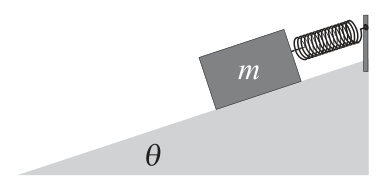
In figura è mostrato un blocco di massa tenuto fermo su un piano liscio (inclinato di rispetto all’orizzontale) e agganciato ad una molla a riposo, di costante elastica . Ad un certo istante il blocco viene lasciato libero di muoversi.
-
Qual è il massimo allungamento della molla?
-
A.
-
B.
-
C.
-
D.
-
E.
p.8 — Blocco su piano inclinato liscio agganciato a una molla
Topic: Newtonian Mechanics Metodi: Energy Conservation Method, Free-Body Diagram, Hooke’s Law Competenze: Mathematical Modeling Objects: Block, Spring, Inclined Plane Fonte: Testo (PDF) — p.8 Risposta: A · Soluzioni (PDF)
The figure shows a mass block held firmly on a smooth plane (inclined by relative to the horizontal) and attached to a resting spring of constant elasticity . At a certain moment the block is left free to move.
-
Qual è il massimo allungamento della molla?
-
A.
-
B.
-
C.
-
D.
-
E.
p.8 Flat-slung block attached to a spring
Topic: Newtonian Mechanics Metodi: Energy Conservation Method, Free-Body Diagram, Hooke’s Law Competenze: Mathematical Modeling Objects: Block, Spring, Inclined Plane Fonte: Testo (PDF) — p.8 Risposta: A · Soluzioni (PDF)
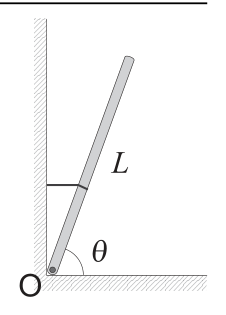
L’asta di una bandiera è omogenea, lunga e ha massa ; il momento d’inerzia dell’asta rispetto a un’estremità è . L’asta è appoggiata in terra ad un angolo col piano orizzontale, mantenuta da un supporto. Se il supporto dell’asta si rompe, questa comincia a cadere ruotando attorno al punto in figura.
-
Qual è l’accelerazione angolare dell’asta nell’istante iniziale della caduta?
-
A. 0
-
B.
-
C.
-
D.
-
E.
p.8 — Asta della bandiera inclinata di , perno in
Topic: Rotational Dynamics Metodi: Torque & Angular Momentum Analysis Competenze: Mathematical Modeling Objects: Rod Fonte: Testo (PDF) — p.8 Risposta: D · Soluzioni (PDF)
The flagpole is uniform, is long and has mass ; the moment of inertia of the pole about one end is . The pole rests on the ground at an angle with the horizontal plane, held by a support. If the support of the pole breaks, it begins to fall rotating about the point in the figure.
-
What is the angular acceleration of the pole at the initial instant of the fall?
-
A. 0
-
B.
-
C.
-
D.
-
E.
p.8 — Flagpole inclined at , pivot at
Answer: D · Soluzioni (PDF)
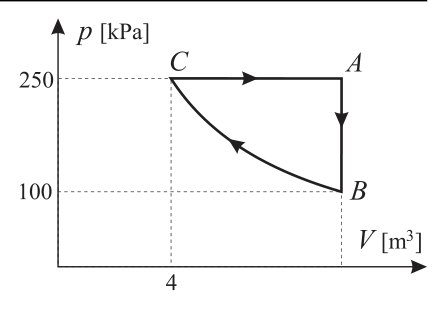
Una certa quantità di gas perfetto è sottoposta ad un ciclo reversibile mostrato in figura, in cui la trasformazione è un’isoterma.
-
Il lavoro sviluppato dal gas in un ciclo ha un valore prossimo a
-
A. 900 kJ
-
B. 600 kJ
-
C. 0
-
D. −600 kJ
-
E. −900 kJ
p.8 — Ciclo termodinamico – con isoterma
Topic: Thermodynamics Metodi: Thermodynamic Cycle Analysis, Ideal Gas Law Competenze: Diagrammatic Reasoning, Mathematical Modeling Objects: Gas Fonte: Testo (PDF) — p.8 Risposta: B · Soluzioni (PDF)
A certain amount of perfect gas is subjected to a reversible cycle shown in Figure 1, where the transformation is an isotherm.
-
The work developed by the gas in a cycle has a value close to
-
A. 900 kJ
-
B. 600 kJ
-
C. 0
-
D. −600 kJ
-
E. −900 kJ
p.8 — Ciclo termodinamico – con isoterma
Topic: Thermodynamics Metodi: Thermodynamic Cycle Analysis, Ideal Gas Law Competenze: Diagrammatic Reasoning, Mathematical Modeling Objects: Gas Fonte: Testo (PDF) — p.8 Risposta: B · Soluzioni (PDF)
Tre blocchi - numerati 1, 2 e 3 - sono appoggiati e in quiete su un piano orizzontale liscio come si vede nella figura. La massa di ciascun blocco è e i blocchi sono collegati da uno spago inestensibile di massa trascurabile. Si tira verso destra il blocco 3 con una forza di modulo .
-
La forza risultante sul blocco 2 è …
-
A. 0
-
B.
-
C.
-
D.
-
E.
p.9 — Tre blocchi collegati su piano orizzontale liscio, forza
Topic: Newtonian Mechanics Metodi: Free-Body Diagram, Kinematic Equations Competenze: Physical Reasoning, Mathematical Modeling Objects: Block, String Fonte: Testo (PDF) — p.9 Risposta: B · Soluzioni (PDF)
Three blocks - numbered 1, 2 and 3 - rest on a smooth horizontal plane as shown in the figure. The mass of each block is and the blocks are connected by an inextensible string of negligible mass. Block 3 is pulled to the right with a force of magnitude .
-
The resultant force on block 2 is …
-
A. 0
-
B.
-
C.
-
D.
-
E.
p.9 — Three connected blocks on a smooth horizontal plane, force
Answer: B · Soluzioni (PDF)
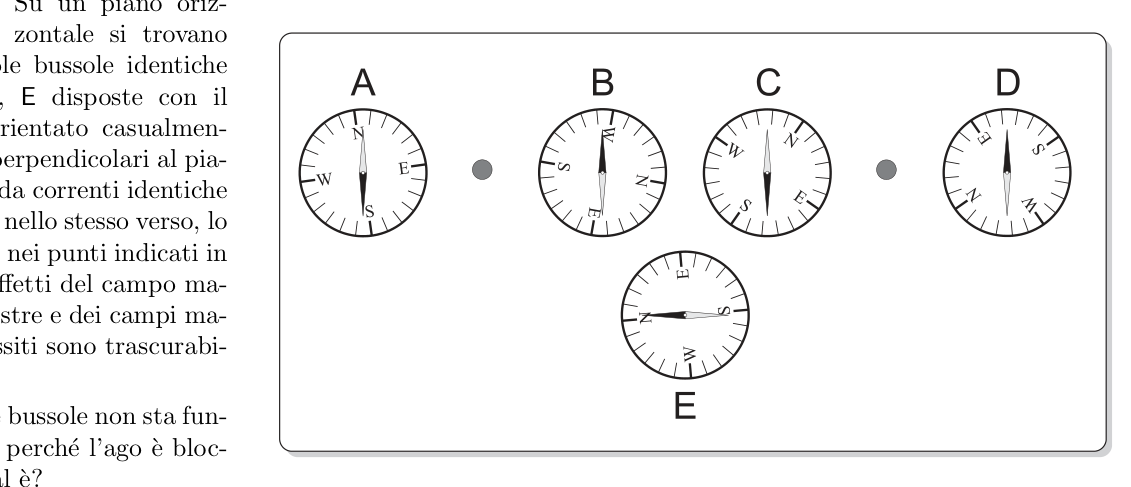
Su un piano orizzontale si trovano cinque piccole bussole identiche disposte con il quadrante orientato casualmente. Due fili perpendicolari al piano, percorsi da correnti identiche che scorrono nello stesso verso, lo attraversano nei punti indicati in figura. Gli effetti del campo magnetico terrestre e dei campi magnetici parassiti sono trascurabili.
- Una delle bussole non sta funzionando perché l’ago è bloccato: qual è?
Le cinque opzioni A–E sono rappresentate nella figura.
p.9 — Cinque bussole A–E e due fili percorsi da corrente (piano)
Topic: Magnetism Metodi: Lorentz Force Analysis, Physical Modeling Competenze: Diagrammatic Reasoning Objects: Wire, Magnet Fonte: Testo (PDF) — p.9 Risposta: E · Soluzioni (PDF)
On a horizontal plane there are five identical small compasses arranged with the dial oriented randomly. Two wires perpendicular to the plane, carrying identical currents flowing in the same direction, pass through it at the points indicated in the figure. The effects of the Earth’s magnetic field and of stray magnetic fields are negligible.
- One of the compasses is not working because its needle is stuck: which one is it?
The five options A–E are shown in the figure.
p.9 — Five compasses A–E and two current-carrying wires (plane)
Answer: E · Soluzioni (PDF)
Una sorgente sonora, che emette un suono di frequenza pari a , si sta muovendo in direzione rettilinea verso un osservatore ad una velocità pari a volte quella del suono.
-
La frequenza misurata dall’osservatore è
-
A. 0.1 kHz
-
B. 0.5 kHz
-
C. 1.1 kHz
-
D. 1.9 kHz
-
E. 10 kHz
Topic: Oscillations & Waves Metodi: Wave Equation, Physical Modeling Competenze: Mathematical Modeling Objects: — Fonte: Testo (PDF) — p.9 Risposta: E · Soluzioni (PDF)
A sound source, which emits a sound of frequency equal to , is moving in a straight line toward an observer at a speed equal to times that of sound.
-
The frequency measured by the observer is
-
A. 0.1 kHz
-
B. 0.5 kHz
-
C. 1.1 kHz
-
D. 1.9 kHz
-
E. 10 kHz
Answer: E · Soluzioni (PDF)
In un cilindro di capacità , riempito di ossigeno, la pressione è . La densità dell’ossigeno a temperatura ambiente, alla pressione atmosferica di , è di .
-
Assumendo che l’ossigeno nel cilindro sia a temperatura ambiente, qual è la sua densità?
-
A.
-
B.
-
C.
-
D.
-
E.
Topic: Thermodynamics Metodi: Ideal Gas Law Competenze: Mathematical Modeling Objects: Gas, Cylinder Fonte: Testo (PDF) — p.9 Risposta: D · Soluzioni (PDF)
In a cylinder of capacity , filled with oxygen, the pressure is . The density of oxygen at room temperature, at atmospheric pressure of , is .
-
Assuming that the oxygen in the cylinder is at room temperature, what is its density?
-
A.
-
B.
-
C.
-
D.
-
E.
Answer: D · Soluzioni (PDF)
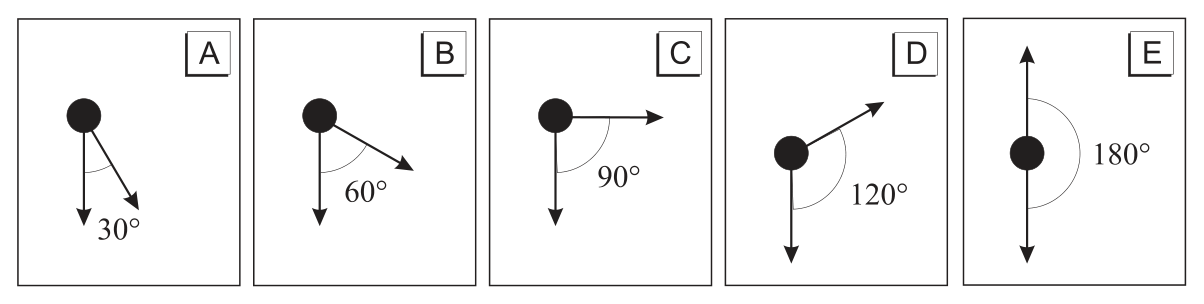
Due forze di agiscono sullo stesso oggetto in direzioni diverse.
- In quale diagramma la forza risultante è di ?
Le cinque opzioni A–E sono rappresentate nella figura.
p.9 — Cinque diagrammi A–E di somma vettoriale di due forze
Topic: Newtonian Mechanics Metodi: Vector Decomposition, Free-Body Diagram Competenze: Diagrammatic Reasoning Objects: — Fonte: Testo (PDF) — p.9 Risposta: D · Soluzioni (PDF)
Two forces of act on the same object in different directions.
- In which diagram is the resultant force ?
The five options A–E are shown in the figure.
p.9 — Five diagrams A–E of vector addition of two forces
Answer: D · Soluzioni (PDF)
In figura è rappresentata una lente convergente sottile, in posizione . I fuochi si trovano nelle posizioni e .
-
Dove deve essere posizionato un oggetto per produrre a destra della lente un’immagine ingrandita, reale e capovolta?
-
A.
-
B.
-
C.
-
D.
-
E.
p.10 — Lente convergente sottile in con fuochi in
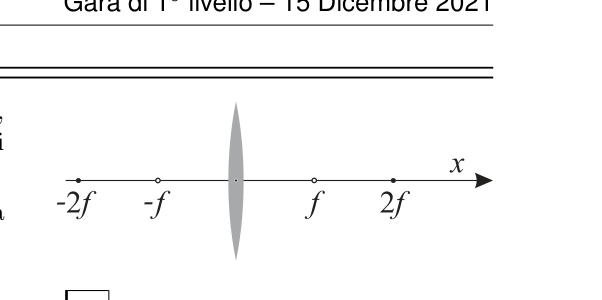
Topic: Geometric Optics Metodi: Thin Lens & Mirror Equation, Ray Tracing Competenze: Diagrammatic Reasoning, Mathematical Modeling Objects: Lens Fonte: Testo (PDF) — p.10 Risposta: B · Soluzioni (PDF)
The figure shows a thin converging lens, in position . The foci are located at positions and .
-
Where must an object be placed to produce to the right of the lens a magnified, real and inverted image?
-
A.
-
B.
-
C.
-
D.
-
E.
p.10 — Thin converging lens at with foci at
Answer: B · Soluzioni (PDF)
Una batteria da è collegata a quattro resistori in modo da formare il circuito in figura.
-
Qual è la corrente nel punto del circuito?
-
A. 2 A
-
B. 4 A
-
C. 5 A
-
D. 7 A
-
E. 9 A
p.10 — Circuito con batteria da 9 V e quattro resistori, punto
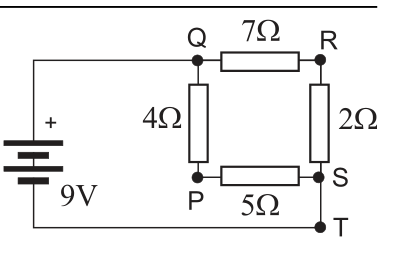
Topic: Circuits Metodi: Kirchhoff’s Laws, Equivalent Circuit Reduction Competenze: Mathematical Modeling Objects: Battery, Resistor Fonte: Testo (PDF) — p.10 Risposta: A · Soluzioni (PDF)
A battery is connected to four resistors so as to form the circuit in the figure.
-
What is the current at point of the circuit?
-
A. 2 A
-
B. 4 A
-
C. 5 A
-
D. 7 A
-
E. 9 A
p.10 — Circuit with a 9 V battery and four resistors, point
Answer: A · Soluzioni (PDF)
Una pietra è lanciata verticalmente verso l’alto con velocità iniziale . Si assuma che la forza di attrito sia proporzionale a , dove è la velocità della pietra, e si trascuri la spinta di Archimede esercitata dall’aria.
-
Quale delle seguenti affermazioni è corretta?
-
A. L’accelerazione della pietra è sempre uguale a .
-
B. L’accelerazione della pietra è uguale a solo nel punto più alto della traiettoria.
-
C. Il modulo dell’accelerazione della pietra è sempre minore di .
-
D. Il modulo della velocità della pietra, quando è tornata nel punto di partenza, è uguale a .
-
E. La pietra può raggiungere una velocità massima il cui modulo è maggiore di , prima di tornare al suo punto di partenza.
Topic: Newtonian Mechanics Metodi: Free-Body Diagram, Differential Equations Competenze: Physical Reasoning Objects: — Fonte: Testo (PDF) — p.10 Risposta: B · Soluzioni (PDF)
A stone is thrown vertically upward with initial velocity . Assume that the friction force is proportional to , where is the velocity of the stone, and neglect the buoyant force exerted by the air.
-
Which of the following statements is correct?
-
A. The acceleration of the stone is always equal to .
-
B. The acceleration of the stone is equal to only at the highest point of the trajectory.
-
C. The magnitude of the acceleration of the stone is always less than .
-
D. The magnitude of the velocity of the stone, when it has returned to the starting point, is equal to .
-
E. The stone can reach a maximum velocity whose magnitude is greater than , before returning to its starting point.
Answer: B · Soluzioni (PDF)
-
Se per spostare una carica di da un punto a un punto la forza del campo elettrostatico compie un lavoro di , la differenza di potenziale è
-
A. 45 V
-
B. 23 V
-
C. 15 V
-
D. 5 V
-
E. 3 V
Topic: Electrostatics Metodi: Electric Potential Method Competenze: Mathematical Modeling Objects: Point Charge Fonte: Testo (PDF) — p.10 Risposta: D · Soluzioni (PDF)
-
If, to move a charge of from a point to a point , the electrostatic field force does work of , the potential difference is
-
A. 45 V
-
B. 23 V
-
C. 15 V
-
D. 5 V
-
E. 3 V
Answer: D · Soluzioni (PDF)
La velocità quadratica media dell’ossigeno molecolare, a temperatura ambiente, è ; la massa molecolare dell’ossigeno è .
-
Qual è la velocità quadratica media dell’elio, avente massa atomica , alla stessa temperatura?
-
A.
-
B.
-
C.
-
D.
-
E.
Topic: Kinetic Theory Metodi: Kinetic Theory of Gases, Statistical Averaging Competenze: Mathematical Modeling Objects: Gas Fonte: Testo (PDF) — p.10 Risposta: B · Soluzioni (PDF)
The root mean square speed of molecular oxygen, at room temperature, is ; the molecular mass of oxygen is .
-
What is the root mean square speed of helium, having atomic mass , at the same temperature?
-
A.
-
B.
-
C.
-
D.
-
E.
Answer: B · Soluzioni (PDF)
Nella figura, il punto si trova sulla ruota di un’auto che sta viaggiando a velocità costante su una strada rettilinea.
- Quale, tra i grafici che seguono, rappresenta, in funzione del tempo, il modulo dell’accelerazione del punto , nel sistema di riferimento della strada?
Le cinque opzioni A–E sono rappresentate nella figura.
p.11 — Ruota con punto e cinque grafici A–E accelerazione-tempo
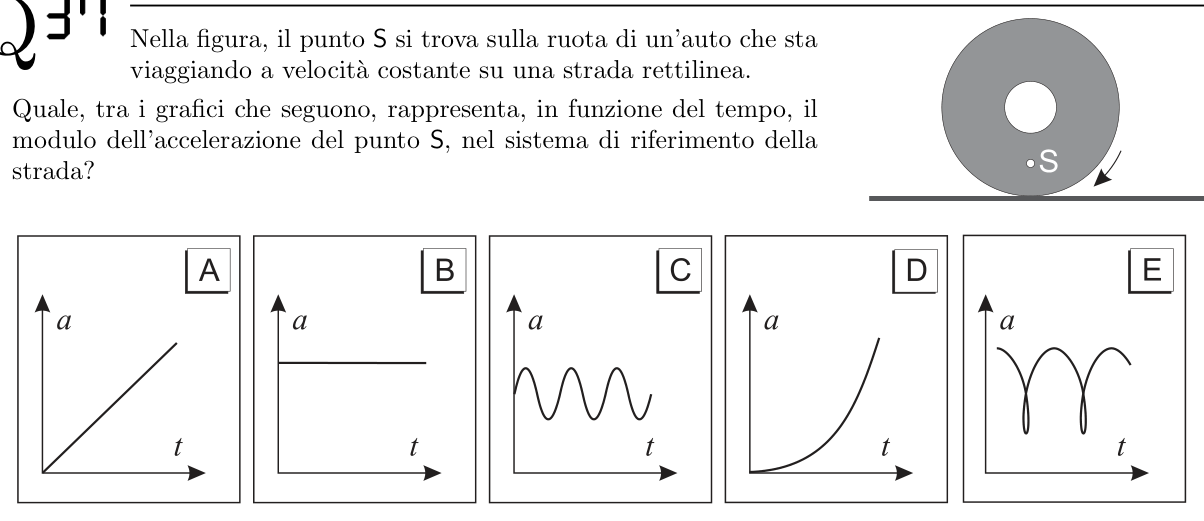
Topic: Newtonian Mechanics Metodi: Physical Modeling, Kinematic Equations Competenze: Diagrammatic Reasoning Objects: Wheel Fonte: Testo (PDF) — p.11 Risposta: B · Soluzioni (PDF)
In the figure, point is located on the wheel of a car that is traveling at constant speed on a straight road.
- Which of the following graphs represents, as a function of time, the magnitude of the acceleration of point , in the road’s frame of reference?
The five options A–E are shown in the figure.
p.11 — Wheel with point and five acceleration-time graphs A–E
Answer: B · Soluzioni (PDF)
Un cubetto di piombo di massa si trova in un becher d’acqua a . In un esperimento il becher con l’acqua e il cubetto di piombo vengono riscaldati finché l’acqua inizia a bollire ().
-
La quantità d’energia accumulata dal cubetto di piombo durante l’esperimento è
-
A. 0.31 kJ
-
B. 10 kJ
-
C. 60 kJ
-
D. 80 kJ
-
E. 790 kJ
Topic: Thermodynamics Metodi: First Law of Thermodynamics, Physical Modeling Competenze: Mathematical Modeling Objects: Block, Container Fonte: Testo (PDF) — p.11 Risposta: A · Soluzioni (PDF)
A lead cube of mass is in a beaker of water at . In an experiment, the beaker with the water and the lead cube are heated until the water begins to boil ().
-
The amount of energy accumulated by the lead cube during the experiment is
-
A. 0.31 kJ
-
B. 10 kJ
-
C. 60 kJ
-
D. 80 kJ
-
E. 790 kJ
Answer: A · Soluzioni (PDF)
Un blocco di , lasciato libero da fermo, scivola giù per una rampa da un’altezza di e raggiunge il suolo con un’energia cinetica di .
-
Il lavoro fatto dalle forze di attrito è approssimativamente di
-
A. −6 J
-
B. −9 J
-
C. −18 J
-
D. −44 J
-
E. −50 J
Topic: Conservation of Energy Metodi: Energy Conservation Method Competenze: Mathematical Modeling Objects: Block, Inclined Plane Fonte: Testo (PDF) — p.11 Risposta: B · Soluzioni (PDF)
A block of , released from rest, slides down a ramp from a height of and reaches the ground with a kinetic energy of .
-
The work done by the friction forces is approximately
-
A. −6 J
-
B. −9 J
-
C. −18 J
-
D. −44 J
-
E. −50 J
Answer: B · Soluzioni (PDF)
Un filo conduttore rigido , lungo , si muove in un campo magnetico uniforme di modulo , perpendicolare al foglio ed entrante in esso, come in figura.
-
Se il filo si muove verso destra con una velocità costante di modulo , la differenza di potenziale indotta tra gli estremi del filo vale
-
A. 0.12 V
-
B. 0.48 V
-
C. 2.4 V
-
D. 4.8 V
-
E. 12 V
p.11 — Filo in campo magnetico entrante nel foglio
Topic: Electromagnetic Induction Metodi: Faraday’s Law of Induction, Lorentz Force Analysis Competenze: Mathematical Modeling Objects: Wire Fonte: Testo (PDF) — p.11 Risposta: B · Soluzioni (PDF)
A rigid conducting wire , of length , moves in a uniform magnetic field of magnitude , perpendicular to the page and directed into it, as in the figure.
-
If the wire moves to the right with a constant speed of magnitude , the induced potential difference between the ends of the wire is
-
A. 0.12 V
-
B. 0.48 V
-
C. 2.4 V
-
D. 4.8 V
-
E. 12 V
p.11 — Wire in a magnetic field directed into the page
Answer: B · Soluzioni (PDF)