Un bambino cammina 5.0 m verso nord, poi 4.0 m verso est e infine 2.0 m verso sud-est.
-
Quanto vale il modulo dello spostamento netto del bambino dall’inizio alla fine del percorso?
-
A. 4.4 m
-
B. 5.0 m
-
C. 6.5 m
-
D. 7.0 m
-
E. 11.0 m Topic: Newtonian Mechanics Metodi: Vector Decomposition Competenze: Mathematical Modeling Objects: — Fonte: Testo (PDF) — p.3 Risposta: C · Soluzioni (PDF)
A child walks 5.0 m north, then 4.0 m east, and finally 2.0 m southeast.
-
What is the magnitude of the child’s net displacement from the beginning to the end of the path?
-
A. 4.4 m
-
B. 5.0 m
-
C. 6.5 m
-
D. 7.0 m
-
E. 11.0 m Answer: C · Soluzioni (PDF)
Il diagramma mostra l’andamento della pressione in funzione del volume di un gas perfetto quando è compresso adiabaticamente dal punto X al punto Y e poi espanso isotermicamente fino al punto Z; entrambe le trasformazioni sono reversibili.
- Quale dei seguenti grafici rappresenta meglio l’andamento della temperatura del gas al variare dell’entropia ?
p-V diagram adiabatic + isothermal
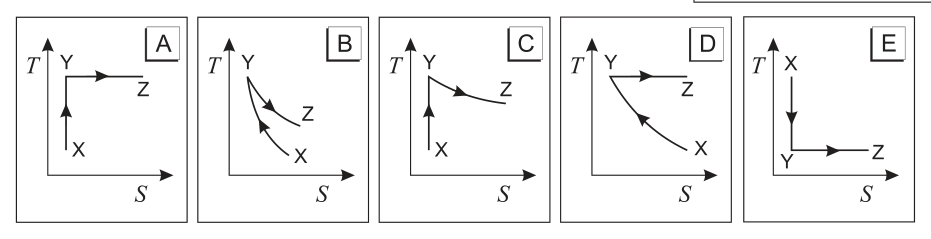 T-S answer choice graphs A-E
Topic: Thermodynamics Metodi: Thermodynamic Cycle Analysis, First Law of Thermodynamics Competenze: Physical Reasoning, Diagrammatic Reasoning Objects: Gas Fonte: Testo (PDF) — p.3 Risposta: A · Soluzioni (PDF)
The diagram shows the trend of pressure as a function of volume for a perfect gas when it is compressed adiabatically from point X to point Y and then expanded isothermally to point Z; both transformations are reversible.
- Which of the following graphs best represents the trend of the temperature of the gas as the entropy varies?
p-V diagram adiabatic + isothermal
T-S answer choice graphs A-E
Answer: A · Soluzioni (PDF)
Due specchi piani, e , sono disposti l’uno di fronte all’altro, parallelamente, a una distanza di 3 m. Uno studente, posto a 2 m di distanza dallo specchio di sinistra, guarda questo specchio e vede una serie di immagini che mostrano il suo volto o la sua nuca.
-
Qual è la distanza tra lo studente e la seconda delle immagini, qui sopra citate, che mostra il suo volto?
-
A. 2 m
-
B. 4 m
-
C. 6 m
-
D. 8 m
-
E. 10 m
Two parallel plane mirrors with student
Topic: Geometric Optics Metodi: Ray Tracing Competenze: Physical Reasoning, Diagrammatic Reasoning Objects: Mirror Fonte: Testo (PDF) — p.3 Risposta: E · Soluzioni (PDF)
Two plane mirrors, and , are placed facing each other, parallel, at a distance of 3 m. A student, placed 2 m from the left-hand mirror, looks at this mirror and sees a series of images showing his face or the back of his head.
-
What is the distance between the student and the second of the images mentioned above that shows his face?
-
A. 2 m
-
B. 4 m
-
C. 6 m
-
D. 8 m
-
E. 10 m
Two parallel plane mirrors with student
Answer: E · Soluzioni (PDF)
Uno studente che utilizza l’apparato di Millikan ha ottenuto i seguenti valori per la carica elettrica su diverse gocce di olio:
-
Usando unicamente questi risultati lo studente potrebbe dedurre che
-
A. il valore più grande per la carica dell’elettrone è C.
-
B. il valore più grande per la carica dell’elettrone è C.
-
C. il valore più grande per la carica dell’elettrone è C.
-
D. la minima carica dell’elettrone è C.
-
E. la goccia con la carica più piccola ha solo un elettrone. Topic: Modern-Quantum Physics, Electrostatics Metodi: Experimental Data Analysis, Physical Modeling Competenze: Physical Reasoning, Significant Figures Objects: Droplet Fonte: Testo (PDF) — p.3 Risposta: B · Soluzioni (PDF)
A student using Millikan’s apparatus obtained the following values for the electric charge on different oil drops:
-
Using only these results, the student could deduce that
-
A. the largest value for the electron’s charge is C.
-
B. the largest value for the electron’s charge is C.
-
C. the largest value for the electron’s charge is C.
-
D. the smallest charge of the electron is C.
-
E. the drop with the smallest charge has only one electron. Answer: B · Soluzioni (PDF)
La massa della Terra è circa 81 volte più grande di quella della Luna.
-
Se la gravità terrestre esercita una forza di modulo sulla Luna, il modulo della forza gravitazionale della Luna sulla Terra è…
-
A.
-
B.
-
C.
-
D.
-
E. Topic: Gravitation, Newtonian Mechanics Metodi: Newton’s Law of Gravitation, Free-Body Diagram Competenze: Physical Reasoning Objects: Planet Fonte: Testo (PDF) — p.3 Risposta: C · Soluzioni (PDF)
The mass of the Earth is about 81 times greater than that of the Moon.
-
If Earth’s gravity exerts a force of magnitude on the Moon, the magnitude of the Moon’s gravitational force on the Earth is…
-
A.
-
B.
-
C.
-
D.
-
E. Answer: C · Soluzioni (PDF)
In figura è rappresentato un blocco di massa kg che si sta muovendo verso destra con un’accelerazione di 10 m s concorde con il moto; al blocco è applicata una forza di modulo N.
-
Quanto vale il coefficiente d’attrito dinamico tra il blocco e il piano?
-
A. 0
-
B. 0.13
-
C. 0.25
-
D. 0.51
-
E. 1.02
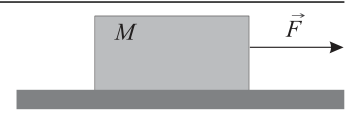 Block M on surface with force F
Topic: Newtonian Mechanics Metodi: Free-Body Diagram, Kinematic Equations Competenze: Physical Reasoning, Mathematical Modeling Objects: Block Fonte: Testo (PDF) — p.4 Risposta: C · Soluzioni (PDF)
The figure shows a block of mass kg that is moving to the right with an acceleration of 10 m s in the same direction as the motion; a force of magnitude N is applied to the block.
-
What is the value of the coefficient of kinetic friction between the block and the plane?
-
A. 0
-
B. 0.13
-
C. 0.25
-
D. 0.51
-
E. 1.02
Block M on surface with force F
Answer: C · Soluzioni (PDF)
Nel circuito rappresentato in figura, dove V, , , ed , qual è l’intensità di corrente segnata dall’amperometro che si può supporre ideale?
- A. 0.33 A
- B. 1.0 A
- C. 2.0 A
- D. 4.0 A
- E. 6.0 A
Resistor circuit with ammeter
Topic: Circuits Metodi: Kirchhoff’s Laws, Equivalent Circuit Reduction Competenze: Mathematical Modeling, Physical Reasoning Objects: Resistor, Battery, Galvanometer Fonte: Testo (PDF) — p.4 Risposta: B · Soluzioni (PDF)
In the circuit shown in the figure, where V, , , and , what is the current intensity indicated by the ammeter, which can be assumed ideal?
- A. 0.33 A
- B. 1.0 A
- C. 2.0 A
- D. 4.0 A
- E. 6.0 A
Resistor circuit with ammeter
Answer: B · Soluzioni (PDF)
Un piccolo LED rosso viene usato come sorgente di luce puntiforme e approssimativamente monocromatica. Un fotorivelatore, in grado di misurare sia la lunghezza d’onda che il flusso luminoso incidente per unità di superficie normale (illuminamento), viene posto perpendicolarmente alla radiazione a 1 m di distanza dalla sorgente e usato come ricevitore. L’esperimento viene fatto in un mezzo trasparente, omogeneo e isotropo.
-
Se il ricevitore viene spostato alla distanza di 2 m dalla sorgente, quali differenze si osservano?
-
A. La lunghezza d’onda non cambia, l’illuminamento non cambia.
-
B. La lunghezza d’onda non cambia, l’illuminamento si dimezza.
-
C. La lunghezza d’onda non cambia, l’illuminamento si riduce a un quarto.
-
D. La lunghezza d’onda si dimezza, l’illuminamento si dimezza.
-
E. La lunghezza d’onda si dimezza, l’illuminamento si riduce a un quarto. Topic: Geometric Optics, Oscillations & Waves Metodi: Physical Modeling Competenze: Physical Reasoning Objects: — Fonte: Testo (PDF) — p.4 Risposta: C · Soluzioni (PDF)
A small red LED is used as a point-like and approximately monochromatic light source. A photodetector, capable of measuring both the wavelength and the incident luminous flux per unit area normal to the surface (illuminance), is placed perpendicular to the radiation at a distance of 1 m from the source and used as a receiver. The experiment is carried out in a transparent, homogeneous and isotropic medium.
-
If the receiver is moved to a distance of 2 m from the source, what differences are observed?
-
A. The wavelength does not change, the illuminance does not change.
-
B. The wavelength does not change, the illuminance is halved.
-
C. The wavelength does not change, the illuminance is reduced to one quarter.
-
D. The wavelength is halved, the illuminance is halved.
-
E. The wavelength is halved, the illuminance is reduced to one quarter. Answer: C · Soluzioni (PDF)
-
Perché in qualche supermercato si adopera uno specchio convesso per tenere sotto controllo la situazione?
-
A. Per ingrandire gli oggetti.
-
B. Per raddrizzare l’immagine degli oggetti.
-
C. Per fornire una immagine reale.
-
D. Perché fornisce un campo visivo ampio.
-
E. Per invertire la destra con la sinistra. Topic: Geometric Optics Metodi: Ray Tracing, Thin Lens & Mirror Equation Competenze: Physical Reasoning Objects: Mirror Fonte: Testo (PDF) — p.4 Risposta: D · Soluzioni (PDF)
-
Why do some supermarkets use a convex mirror to keep the situation under control?
-
A. To magnify objects.
-
B. To make the image of objects upright.
-
C. To provide a real image.
-
D. Because it provides a wide field of view.
-
E. To swap right with left. Answer: D · Soluzioni (PDF)
Due sorgenti a distanza emettono, in fase, onde della stessa lunghezza d’onda .
-
Per quale valore della differenza di percorso si avrà sempre interferenza distruttiva nel punto ?
-
A.
-
B.
-
C.
-
D.
-
E.
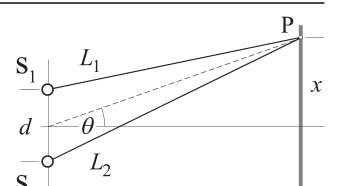 Two-source interference geometry
Topic: Wave Optics, Oscillations & Waves Metodi: Superposition Principle, Interference & Diffraction Analysis Competenze: Physical Reasoning, Diagrammatic Reasoning Objects: — Fonte: Testo (PDF) — p.4 Risposta: D · Soluzioni (PDF)
Two sources at distance emit, in phase, waves of the same wavelength .
-
For which value of the path difference will there always be destructive interference at point ?
-
A.
-
B.
-
C.
-
D.
-
E.
Two-source interference geometry
Answer: D · Soluzioni (PDF)
-
Stimare la massa di una colonna di monete da 1 € alta quanto la torre di Pisa.
-
A. 20 kg
-
B. 200 kg
-
C. 2 000 kg
-
D. 20 000 kg
-
E. 200 000 kg Topic: Order-of-Magnitude Estimation Metodi: Order-of-Magnitude Estimation, Dimensional Analysis Competenze: Estimation & Approximation Objects: — Fonte: Testo (PDF) — p.4 Risposta: B · Soluzioni (PDF)
-
Estimate the mass of a column of 1 € coins as tall as the Tower of Pisa.
-
A. 20 kg
-
B. 200 kg
-
C. 2 000 kg
-
D. 20 000 kg
-
E. 200 000 kg Topic: Order-of-Magnitude Estimation Metodi: Order-of-Magnitude Estimation, Dimensional Analysis Competenze: Estimation & Approximation Objects: — Fonte: Testo (PDF) — p.4 Risposta: B · Soluzioni (PDF)
Si riempie di mercurio un tubo di vetro lungo 1 m e lo si rovescia, tenendolo tappato, in una bacinella di mercurio; liberando l’apertura, un po’ di mercurio scende e, all’equilibrio, il menisco del mercurio si trova 76 cm al di sopra del livello del mercurio nella bacinella.
-
In quale situazione il dislivello tra le superfici libere del mercurio dentro e fuori dal tubo non è più 76 cm?
-
A. Se si inclina il tubo di 15°.
-
B. Se si utilizza un tubo di diametro diverso.
-
C. Se si utilizza un tubo più lungo.
-
D. Se si introduce tutto l’apparato sotto una campana di vetro da cui si estrae un po’ d’aria con una pompa.
-
E. Se si versa dell’altro mercurio nella bacinella. Topic: Fluid Mechanics Metodi: Hydrostatic Equilibrium Competenze: Physical Reasoning Objects: Tube, Manometer Fonte: Testo (PDF) — p.5 Risposta: D · Soluzioni (PDF)
A 1 m long glass tube is filled with mercury and inverted, keeping it stoppered, into a basin of mercury; on releasing the opening, some mercury descends and, at equilibrium, the mercury meniscus is 76 cm above the level of the mercury in the basin.
-
In which situation is the difference in level between the free surfaces of the mercury inside and outside the tube no longer 76 cm?
-
A. If the tube is tilted by 15°.
-
B. If a tube of different diameter is used.
-
C. If a longer tube is used.
-
D. If the whole apparatus is placed under a glass bell jar from which some air is extracted with a pump.
-
E. If more mercury is poured into the basin. Answer: D · Soluzioni (PDF)
La figura mostra un disco che ruota, senza attrito, attorno a un asse verticale mantenuto fisso. Un grosso pezzo di plastilina viene appoggiato sul disco e vi rimane attaccato.
- Considerando la situazione subito prima e subito dopo l’urto, quali delle seguenti affermazioni sono corrette?
1 – Il momento angolare del sistema rimane lo stesso. 2 – La velocità angolare del disco diminuisce. 3 – L’energia cinetica del sistema non cambia.
- A. Solo la 1 e la 2.
- B. Solo la 2 e la 3.
- C. Solo la 1.
- D. Solo la 3.
- E. Tutte e tre.
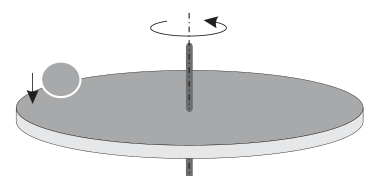 Rotating disk before clay impact
Topic: Rotational Dynamics Metodi: Conservation of Momentum, Torque & Angular Momentum Analysis Competenze: Physical Reasoning, Diagrammatic Reasoning Objects: Disk Fonte: Testo (PDF) — p.5 Risposta: A · Soluzioni (PDF)
The figure shows a disk rotating, without friction, around a fixed vertical axis. A large piece of modeling clay is placed on the disk and remains attached to it.
- Considering the situation immediately before and immediately after the collision, which of the following statements are correct?
1 – The angular momentum of the system remains the same. 2 – The angular velocity of the disk decreases. 3 – The kinetic energy of the system does not change.
- A. Only 1 and 2.
- B. Only 2 and 3.
- C. Only 1.
- D. Only 3.
- E. All three.
Rotating disk before clay impact
Answer: A · Soluzioni (PDF)
Una molla appesa verticalmente sostiene una scatola avente massa di 2 kg; se a questa si sostituisce una scatola con massa di 7 kg la molla si allunga ulteriormente di 7.5 cm. La figura mostra il sistema molla-scatola in equilibrio, prima e dopo l’operazione.
-
La costante elastica della molla vale
-
A. 0.67 N/m
-
B. 6.54 N/m
-
C. 66.7 N/m
-
D. 654 N/m
-
E. 1177 N/m
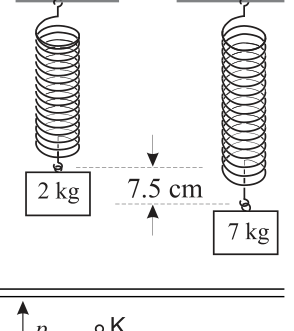 Spring-box system before and after
Topic: Oscillations & Waves, Newtonian Mechanics Metodi: Hooke’s Law, Free-Body Diagram Competenze: Mathematical Modeling, Physical Reasoning Objects: Spring, Block Fonte: Testo (PDF) — p.5 Risposta: D · Soluzioni (PDF)
A spring hanging vertically supports a box having a mass of 2 kg; if this is replaced by a box with a mass of 7 kg, the spring stretches further by 7.5 cm. The figure shows the spring-box system in equilibrium, before and after the operation.
-
The spring constant of the spring is
-
A. 0.67 N/m
-
B. 6.54 N/m
-
C. 66.7 N/m
-
D. 654 N/m
-
E. 1177 N/m
Spring-box system before and after
Answer: D · Soluzioni (PDF)
Un gas perfetto segue il ciclo termodinamico reversibile mostrato in figura. La trasformazione KL è isoterma e la trasformazione MK è adiabatica.
- Quali delle seguenti affermazioni sono corrette?
1 – Durante la trasformazione LM il gas compie lavoro. 2 – La temperatura in K è maggiore della temperatura in L. 3 – La temperatura in K è maggiore della temperatura in M.
- A. La 1 e la 2.
- B. La 2 e la 3.
- C. Solo la 1.
- D. Solo la 3.
- E. Sono tutte corrette.
Thermodynamic cycle K-L-M diagram
Topic: Thermodynamics Metodi: Thermodynamic Cycle Analysis, First Law of Thermodynamics Competenze: Physical Reasoning, Diagrammatic Reasoning Objects: Gas Fonte: Testo (PDF) — p.5 Risposta: D · Soluzioni (PDF)
A perfect gas undergoes the reversible thermodynamic cycle shown in the figure. The transformation KL is isothermal and the transformation MK is adiabatic.
- Which of the following statements are correct?
1 – During the transformation LM the gas does work. 2 – The temperature at K is greater than the temperature at L. 3 – The temperature at K is greater than the temperature at M.
- A. 1 and 2.
- B. 2 and 3.
- C. Only 1.
- D. Only 3.
- E. They are all correct.
Thermodynamic cycle K-L-M diagram
Answer: D · Soluzioni (PDF)
La figura mostra due sfere conduttrici identiche tra loro, S e T, inizialmente cariche, con carica C e C.
-
Se le sfere vengono messe in contatto per un breve intervallo di tempo mediante un filo di elevata resistenza, quale delle due sfere avrà un guadagno netto di elettroni?
-
A. Solamente S.
-
B. Solamente T.
-
C. Sia S che T.
-
D. Nessuna delle due.
-
E. Dipende dalla durata del contatto.
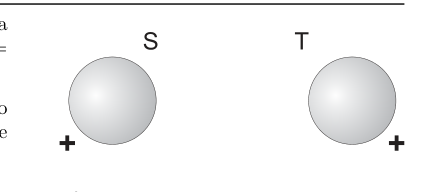 Two conducting spheres S and T
Topic: Electrostatics Metodi: Coulomb’s Law, Physical Modeling Competenze: Physical Reasoning Objects: Conducting Sphere, Wire Fonte: Testo (PDF) — p.6 Risposta: A · Soluzioni (PDF)
The figure shows two identical conducting spheres, S and T, initially charged, with charge C and C.
-
If the spheres are put in contact for a brief interval of time by means of a high-resistance wire, which of the two spheres will have a net gain of electrons?
-
A. Only S.
-
B. Only T.
-
C. Both S and T.
-
D. Neither of the two.
-
E. It depends on the duration of the contact.
Two conducting spheres S and T
Answer: A · Soluzioni (PDF)
La spira rettangolare in figura ruota a velocità costante intorno al suo asse. Nella regione dove è presente la spira il campo magnetico può considerarsi uniforme.
- Quale dei seguenti grafici rappresenta meglio come varia col tempo la f.e.m. indotta ai capi della spira, durante un periodo della rotazione?
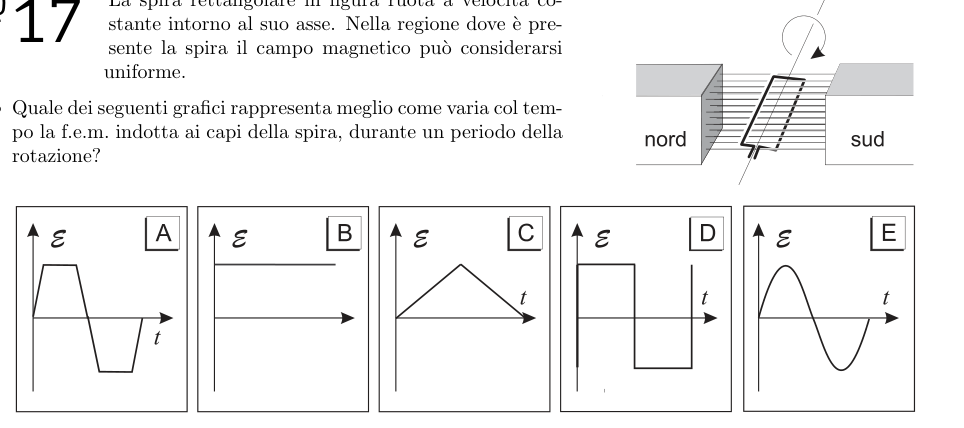 Rotating coil in B field + EMF graphs A-E
Topic: Electromagnetic Induction Metodi: Faraday’s Law of Induction, Simple Harmonic Motion Analysis Competenze: Physical Reasoning, Diagrammatic Reasoning Objects: Coil Fonte: Testo (PDF) — p.6 Risposta: E · Soluzioni (PDF)
The rectangular coil in the figure rotates at constant speed around its axis. In the region where the coil is present, the magnetic field can be considered uniform.
- Which of the following graphs best represents how the induced electromotive force across the coil varies with time, during one period of rotation?
Rotating coil in B field + EMF graphs A-E
Answer: E · Soluzioni (PDF)
Un gas perfetto subisce un’espansione isobara.
- Quale riga della tabella descrive correttamente la trasformazione?
| Il gas fa lavoro | Cambia l’energia interna del gas | Cambia la temperatura del gas | Cambia l’entropia del gas | |
|---|---|---|---|---|
| A | NO | SÌ | SÌ | SÌ |
| B | SÌ | NO | NO | SÌ |
| C | SÌ | SÌ | SÌ | SÌ |
| D | NO | NO | NO | NO |
| E | SÌ | SÌ | SÌ | NO |
Topic: Thermodynamics Metodi: First Law of Thermodynamics, Ideal Gas Law Competenze: Physical Reasoning Objects: Gas Fonte: Testo (PDF) — p.6 Risposta: C · Soluzioni (PDF)
A perfect gas undergoes an isobaric expansion.
- Which row of the table correctly describes the transformation?
| The gas does work | The internal energy of the gas changes | The temperature of the gas changes | The entropy of the gas changes | |
|---|---|---|---|---|
| A | NO | YES | YES | YES |
| B | YES | NO | NO | YES |
| C | YES | YES | YES | YES |
| D | NO | NO | NO | NO |
| E | YES | YES | YES | NO |
Answer: C · Soluzioni (PDF)
Un oggetto è lanciato con un angolo rispetto al piano orizzontale; in figura sono mostrate le componenti orizzontale e verticale della velocità nell’istante del lancio.
-
Trascurando la resistenza dell’aria, quale di queste coppie di valori dà, approssimativamente, le componenti orizzontale e verticale della velocità dopo 0.5 s dal lancio, espresse in m s?
-
A. (3; 3)
-
B. (3; 4)
-
C. (8; 3)
-
D. (8; 4)
-
E. (8; 9)
Velocity components at launch
Topic: Newtonian Mechanics Metodi: Kinematic Equations, Vector Decomposition Competenze: Mathematical Modeling, Physical Reasoning Objects: Projectile Fonte: Testo (PDF) — p.6 Risposta: D · Soluzioni (PDF)
An object is launched at an angle with respect to the horizontal plane; the figure shows the horizontal and vertical components of the velocity at the instant of launch.
-
Neglecting air resistance, which of these pairs of values gives, approximately, the horizontal and vertical components of the velocity 0.5 s after launch, expressed in m s?
-
A. (3; 3)
-
B. (3; 4)
-
C. (8; 3)
-
D. (8; 4)
-
E. (8; 9)
Velocity components at launch
Answer: D · Soluzioni (PDF)
Un pendolo semplice viene spostato di un piccolo angolo rispetto alla verticale e poi viene lasciato libero al tempo .
- Quale dei seguenti grafici descrive meglio l’andamento dell’energia cinetica in funzione del tempo durante un’intera oscillazione?
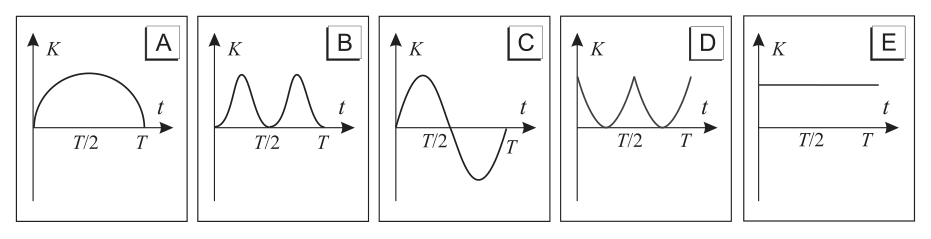 Kinetic energy K vs time answer graphs A-E
Topic: Oscillations & Waves Metodi: Simple Harmonic Motion Analysis, Conservation of Energy Competenze: Physical Reasoning, Diagrammatic Reasoning Objects: Pendulum Fonte: Testo (PDF) — p.7 Risposta: B · Soluzioni (PDF)
A simple pendulum is displaced by a small angle from the vertical and then released at time .
- Which of the following graphs best describes the trend of the kinetic energy as a function of time during one complete oscillation?
Kinetic energy K vs time answer graphs A-E
Answer: B · Soluzioni (PDF)
Una persona sta salendo di corsa le scale. Il grafico seguente mostra il lavoro compiuto in funzione del tempo trascorso, misurati entrambi dalla partenza.
-
Quale grandezza è rappresentata dalla pendenza della retta?
-
A. Impulso
-
B. Quantità di moto
-
C. Velocità
-
D. Potenza
-
E. Accelerazione
Work vs time graph for stair climbing
Topic: Newtonian Mechanics, Conservation of Energy Metodi: Physical Modeling, Graph Linearization Competenze: Physical Reasoning, Diagrammatic Reasoning Objects: — Fonte: Testo (PDF) — p.7 Risposta: D · Soluzioni (PDF)
A person is running up the stairs. The following graph shows the work done as a function of the elapsed time, both measured from the start.
-
What quantity is represented by the slope of the line?
-
A. Impulse
-
B. Momentum
-
C. Velocity
-
D. Power
-
E. Acceleration
Work vs time graph for stair climbing
Answer: D · Soluzioni (PDF)
Un oggetto si raffredda mentre l’ambiente circostante si trova alla temperatura .
-
Quali dei seguenti grafici descrivono correttamente questa situazione?
-
A. Solo il numero 1.
-
B. Solo il numero 3.
-
C. Il numero 1 e il 2.
-
D. Il numero 2 e il 3.
-
E. Sono tutti corretti.
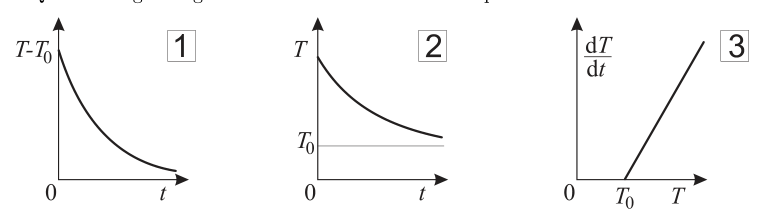 Cooling object temperature graphs 1-3
Topic: Thermodynamics Metodi: Physical Modeling, Differential Equations Competenze: Physical Reasoning, Diagrammatic Reasoning Objects: — Fonte: Testo (PDF) — p.7 Risposta: C · Soluzioni (PDF)
An object cools while the surrounding environment is at temperature .
-
Which of the following graphs correctly describe this situation?
-
A. Only number 1.
-
B. Only number 3.
-
C. Number 1 and 2.
-
D. Number 2 and 3.
-
E. They are all correct.
Cooling object temperature graphs 1-3
Answer: C · Soluzioni (PDF)
Il polonio 214 (Po) può decadere in polonio 210 (Po) attraverso un decadimento seguito da
- A. un decadimento e un decadimento
- B. due decadimenti
- C. un decadimento e un decadimento
- D. due decadimenti
- E. un decadimento Topic: Nuclear & Particle Physics Metodi: Radioactive Decay Law, Physical Modeling Competenze: Physical Reasoning Objects: Nucleus Fonte: Testo (PDF) — p.7 Risposta: B · Soluzioni (PDF)
Polonium 214 (Po) can decay into polonium 210 (Po) through a decay followed by
- A. a decay and a decay
- B. two decays
- C. a decay and a decay
- D. two decays
- E. a decay Answer: B · Soluzioni (PDF)
Un filo di rame di lunghezza e sezione ha una resistenza . Un secondo filo di rame ha una lunghezza e una sezione ed è alla stessa temperatura del primo.
-
Qual è la resistenza del secondo filo?
-
A.
-
B.
-
C.
-
D.
-
E. Topic: Circuits Metodi: Physical Modeling, Dimensional Analysis Competenze: Mathematical Modeling, Physical Reasoning Objects: Wire Fonte: Testo (PDF) — p.7 Risposta: E · Soluzioni (PDF)
A copper wire of length and cross-section has a resistance . A second copper wire has a length and a cross-section and is at the same temperature as the first.
-
What is the resistance of the second wire?
-
A.
-
B.
-
C.
-
D.
-
E. Answer: E · Soluzioni (PDF)
-
L’unità di misura della capacità di un condensatore può essere scritta come
-
A. V C
-
B. C V
-
C. J s
-
D. C J
-
E. J C Topic: Electrostatics, Circuits Metodi: Dimensional Analysis Competenze: Unit Conversion, Physical Reasoning Objects: Capacitor Fonte: Testo (PDF) — p.8 Risposta: B · Soluzioni (PDF)
-
The unit of measurement of the capacitance of a capacitor can be written as
-
A. V C
-
B. C V
-
C. J s
-
D. C J
-
E. J C Answer: B · Soluzioni (PDF)
-
Quanto vale la potenza minima sviluppata da un argano a motore per sollevare in 8 s un corpo di 400 kg a velocità costante per 10 m?
-
A. 320 W
-
B. 500 W
-
C. 3 100 W
-
D. 4 900 W
-
E. 32 000 W Topic: Newtonian Mechanics, Conservation of Energy Metodi: Energy Conservation Method, Kinematic Equations Competenze: Mathematical Modeling Objects: Block Fonte: Testo (PDF) — p.8 Risposta: D · Soluzioni (PDF)
-
What is the minimum power developed by a motorized winch to lift a 400 kg body in 8 s at constant speed over 10 m?
-
A. 320 W
-
B. 500 W
-
C. 3 100 W
-
D. 4 900 W
-
E. 32 000 W Answer: D · Soluzioni (PDF)
Un grafico mostra come una grandezza dipende dalla grandezza . L’area sottesa al grafico ha le dimensioni di un lavoro quando
1 – è la velocità di un corpo e il modulo della forza che agisce su di esso. 2 – è la corrente che scorre in un resistore e la d.d.p. applicata a esso. 3 – è il volume occupato da un gas perfetto e la sua pressione.
-
Quali delle tre affermazioni sono vere?
-
A. Solo la 1
-
B. Solo la 3
-
C. Sia la 1 che la 2
-
D. Sia la 2 che la 3
-
E. Tutte e tre Topic: Newtonian Mechanics, Thermodynamics Metodi: Dimensional Analysis, Physical Modeling Competenze: Physical Reasoning, Mathematical Modeling Objects: Resistor, Gas Fonte: Testo (PDF) — p.8 Risposta: B · Soluzioni (PDF)
A graph shows how a quantity depends on the quantity . The area under the graph has the dimensions of work when
1 – is the velocity of a body and the magnitude of the force acting on it. 2 – is the current flowing through a resistor and the potential difference applied to it. 3 – is the volume occupied by a perfect gas and its pressure.
-
Which of the three statements are true?
-
A. Only 1
-
B. Only 3
-
C. Both 1 and 2
-
D. Both 2 and 3
-
E. All three Answer: B · Soluzioni (PDF)
Quando un razzo che trasporta una navicella spaziale viene lanciato dalla superficie della Terra verso lo spazio con un’accelerazione verso l’alto diversa da zero, un uomo dentro la navicella che si sta pesando su una bilancia vede che il valore segnato dalla bilancia va a zero.
-
Questa affermazione è…
-
A. corretta, perché il peso di un oggetto decresce rapidamente se aumenta la distanza dal centro della Terra.
-
B. corretta, poiché l’attrazione gravitazionale si annulla con la reazione del pavimento della navicella sull’uomo.
-
C. corretta, poiché sia l’uomo, sia la navicella sono all’interno dello stesso campo gravitazionale.
-
D. sbagliata, poiché la navicella sta accelerando verso l’alto.
-
E. sbagliata, poiché l’uomo si muove con la stessa velocità della navicella. Topic: Gravitation, Newtonian Mechanics Metodi: Free-Body Diagram, Physical Modeling Competenze: Physical Reasoning Objects: Satellite, Planet Fonte: Testo (PDF) — p.8 Risposta: D · Soluzioni (PDF)
When a rocket carrying a spacecraft is launched from the surface of the Earth into space with a nonzero upward acceleration, a man inside the spacecraft who is weighing himself on a scale sees that the value indicated by the scale goes to zero.
-
This statement is…
-
A. correct, because the weight of an object decreases rapidly if the distance from the center of the Earth increases.
-
B. correct, since the gravitational attraction is canceled by the reaction of the spacecraft floor on the man.
-
C. correct, since both the man and the spacecraft are inside the same gravitational field.
-
D. wrong, since the spacecraft is accelerating upward.
-
E. wrong, since the man moves with the same velocity as the spacecraft. Answer: D · Soluzioni (PDF)
Un condensatore viene inizialmente caricato a una differenza di potenziale di 120 V e successivamente scaricato su un resistore. Dopo s la sua d.d.p. si è ridotta a 60 V.
-
Dopo ulteriori s la sua d.d.p. sarà
-
A. 30 V
-
B. 20 V
-
C. 15 V
-
D. 0 V
-
E. −60 V Topic: Circuits Metodi: Differential Equations, Physical Modeling Competenze: Mathematical Modeling, Physical Reasoning Objects: Capacitor, Resistor Fonte: Testo (PDF) — p.8 Risposta: C · Soluzioni (PDF)
A capacitor is initially charged to a potential difference of 120 V and then discharged through a resistor. After s its p.d. has dropped to 60 V.
-
After a further s its p.d. will be
-
A. 30 V
-
B. 20 V
-
C. 15 V
-
D. 0 V
-
E. −60 V Answer: C · Soluzioni (PDF)
Un’onda trasversale che si propaga lungo una corda è descritta dall’equazione
con cm, rad m e rad s. L’asse è diretto verso destra.
-
Qual è la velocità dell’onda?
-
A. 0.80 m s verso sinistra
-
B. 1.25 m s verso sinistra
-
C. m s verso sinistra
-
D. 1.25 m s verso destra
-
E. 0.80 m s verso destra Topic: Oscillations & Waves Metodi: Wave Equation Competenze: Mathematical Modeling, Physical Reasoning Objects: String Fonte: Testo (PDF) — p.8 Risposta: A · Soluzioni (PDF)
A transverse wave propagating along a rope is described by the equation
with cm, rad m and rad s. The axis is directed to the right.
-
What is the velocity of the wave?
-
A. 0.80 m s to the left
-
B. 1.25 m s to the left
-
C. m s to the left
-
D. 1.25 m s to the right
-
E. 0.80 m s to the right Answer: A · Soluzioni (PDF)
La corrente di un fiume largo 30 m si muove verso nord a 1.5 m s. Una barca a motore si muove con una velocità di 3 m s rispetto all’acqua del fiume.
-
Che angolo di rotta deve tenere la barca rispetto alla direzione della corrente per attraversare il fiume in direzione perpendicolare alle sponde?
-
A. 0°
-
B. 60°
-
C. 90°
-
D. 120°
-
E. 150° Topic: Newtonian Mechanics Metodi: Vector Decomposition, Kinematic Equations Competenze: Mathematical Modeling, Physical Reasoning Objects: — Fonte: Testo (PDF) — p.9 Risposta: D · Soluzioni (PDF)
The current of a river 30 m wide moves north at 1.5 m s. A motorboat moves with a speed of 3 m s relative to the river water.
-
What heading angle must the boat keep relative to the direction of the current in order to cross the river in a direction perpendicular to the banks?
-
A. 0°
-
B. 60°
-
C. 90°
-
D. 120°
-
E. 150° Answer: D · Soluzioni (PDF)
Nelle stesse condizioni del quesito precedente, quanto tempo impiega la barca per attraversare il fiume da una sponda all’altra?
- A. 5 s
- B. 8.6 s
- C. 11.5 s
- D. 15 s
- E. 60 s Topic: Newtonian Mechanics Metodi: Vector Decomposition, Kinematic Equations Competenze: Mathematical Modeling Objects: — Fonte: Testo (PDF) — p.9 Risposta: C · Soluzioni (PDF)
Under the same conditions as the previous question, how long does the boat take to cross the river from one bank to the other?
- A. 5 s
- B. 8.6 s
- C. 11.5 s
- D. 15 s
- E. 60 s Answer: C · Soluzioni (PDF)
Uno studente pone un oggetto a diverse distanze da una lente convergente e misura le distanze a cui si formano le immagini. I valori di e misurati sono riportati in tabella, ma lo studente ha dimenticato di trascrivere l’ultima misura effettuata.
| 14.9 cm | 20.0 cm | 25.9 cm | |
|---|---|---|---|
| 29.7 cm | 20.4 cm | ? |
-
Qual è il valore che, ragionevolmente, ha dimenticato di scrivere?
-
A. 10.1 cm
-
B. 16.5 cm
-
C. 19.9 cm
-
D. 25.3 cm
-
E. 30.4 cm Topic: Geometric Optics Metodi: Thin Lens & Mirror Equation, Experimental Data Analysis Competenze: Physical Reasoning, Mathematical Modeling Objects: Lens Fonte: Testo (PDF) — p.9 Risposta: B · Soluzioni (PDF)
A student places an object at various distances from a converging lens and measures the distances at which the images form. The measured values of and are shown in the table, but the student forgot to write down the last measurement taken.
| 14.9 cm | 20.0 cm | 25.9 cm | |
|---|---|---|---|
| 29.7 cm | 20.4 cm | ? |
-
What is the value that, reasonably, they forgot to write?
-
A. 10.1 cm
-
B. 16.5 cm
-
C. 19.9 cm
-
D. 25.3 cm
-
E. 30.4 cm Answer: B · Soluzioni (PDF)
La figura rappresenta un circuito composto da un resistore di resistenza variabile, un generatore ideale, un amperometro e un voltmetro ideali.
- Qual è l’effetto registrato dagli strumenti se si aumenta la resistenza da 1 000 Ω a 10 000 Ω? (Si assuma che la temperatura del sistema non vari).
| Voltmetro | Amperometro | |
|---|---|---|
| A | Invariato | Invariato |
| B | Invariato | Diminuisce |
| C | Invariato | Aumenta |
| D | Diminuisce | Invariato |
| E | Diminuisce | Diminuisce |
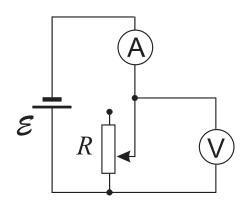 Circuit with variable resistor and meters
Topic: Circuits Metodi: Kirchhoff’s Laws, Equivalent Circuit Reduction Competenze: Physical Reasoning, Diagrammatic Reasoning Objects: Resistor, Battery, Galvanometer Fonte: Testo (PDF) — p.9 Risposta: B · Soluzioni (PDF)
The figure represents a circuit composed of a variable-resistance resistor, an ideal generator, an ammeter and an ideal voltmeter.
- What is the effect recorded by the instruments if the resistance is increased from 1 000 Ω to 10 000 Ω? (Assume that the temperature of the system does not vary).
| Voltmeter | Ammeter | |
|---|---|---|
| A | Unchanged | Unchanged |
| B | Unchanged | Decreases |
| C | Unchanged | Increases |
| D | Decreases | Unchanged |
| E | Decreases | Decreases |
Circuit with variable resistor and meters
Answer: B · Soluzioni (PDF)
Un elettrone si sta muovendo a m s in direzione perpendicolare a quella di un campo magnetico uniforme di intensità 2.0 T.
-
Qual è il modulo della forza magnetica agente sull’elettrone?
-
A. 0
-
B. N
-
C. N
-
D. N
-
E. N Topic: Magnetism, Electromagnetism Metodi: Lorentz Force Analysis Competenze: Mathematical Modeling, Physical Reasoning Objects: Electron Fonte: Testo (PDF) — p.9 Risposta: C · Soluzioni (PDF)
An electron is moving at m s in a direction perpendicular to that of a uniform magnetic field of magnitude 2.0 T.
-
What is the magnitude of the magnetic force acting on the electron?
-
A. 0
-
B. N
-
C. N
-
D. N
-
E. N Answer: C · Soluzioni (PDF)
Un osservatore ha registrato i dati di velocità in tre diversi istanti, relativi al moto di un’auto soggetta a un’accelerazione costante, riportati nella tabella a destra.
| / s | / m s |
|---|---|
| 3.0 | 4.0 |
| 5.0 | 7.0 |
| 6.0 | 8.5 |
-
Quanto vale il modulo dell’accelerazione dell’auto?
-
A. 1.3 m s
-
B. 1.4 m s
-
C. 1.5 m s
-
D. 2.0 m s
-
E. 2.8 m s Topic: Newtonian Mechanics Metodi: Kinematic Equations, Experimental Data Analysis, Graph Linearization Competenze: Physical Reasoning, Mathematical Modeling Objects: — Fonte: Testo (PDF) — p.9 Risposta: C · Soluzioni (PDF)
An observer recorded velocity data at three different instants, relating to the motion of a car subject to constant acceleration, shown in the table on the right.
| / s | / m s |
|---|---|
| 3.0 | 4.0 |
| 5.0 | 7.0 |
| 6.0 | 8.5 |
-
What is the magnitude of the car’s acceleration?
-
A. 1.3 m s
-
B. 1.4 m s
-
C. 1.5 m s
-
D. 2.0 m s
-
E. 2.8 m s Answer: C · Soluzioni (PDF)
Un blocco di 3.0 kg è a riposo su una superficie orizzontale. Un pezzo di argilla di 1.0 kg viene lanciato orizzontalmente alla velocità di 6.0 m s come mostrato in figura. Nell’urto, l’argilla e il blocco rimangono attaccati e si muovono insieme verso destra.
-
Trascurando gli attriti, la loro velocità subito dopo l’urto sarà di
-
A. 1.5 m s
-
B. 2.0 m s
-
C. 3.0 m s
-
D. 6.0 m s
-
E. 8.0 m s
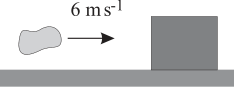 Clay block collision diagram
Topic: Newtonian Mechanics, Conservation of Momentum Metodi: Conservation of Momentum, Impulse-Momentum Theorem Competenze: Mathematical Modeling, Physical Reasoning Objects: Block Fonte: Testo (PDF) — p.10 Risposta: A · Soluzioni (PDF)
A 3.0 kg block is at rest on a horizontal surface. A 1.0 kg piece of clay is thrown horizontally at a speed of 6.0 m s as shown in the figure. In the collision, the clay and the block stick together and move together to the right.
-
Neglecting friction, their speed immediately after the collision will be
-
A. 1.5 m s
-
B. 2.0 m s
-
C. 3.0 m s
-
D. 6.0 m s
-
E. 8.0 m s
Clay block collision diagram
Answer: A · Soluzioni (PDF)
Un’automobile si sta muovendo a velocità di modulo costante su una pista circolare di raggio , come mostrato in figura.
-
Quando la macchina è nella posizione indicata la sua accelerazione è
-
A. diretta verso nord
-
B. diretta verso est
-
C. diretta verso sud
-
D. diretta verso ovest
-
E. nulla
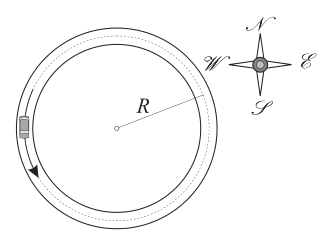 Car on circular track with compass directions
Topic: Newtonian Mechanics Metodi: Kinematic Equations, Free-Body Diagram Competenze: Physical Reasoning, Diagrammatic Reasoning Objects: — Fonte: Testo (PDF) — p.10 Risposta: B · Soluzioni (PDF)
A car is moving at constant speed on a circular track of radius , as shown in the figure.
-
When the car is in the indicated position, its acceleration is
-
A. directed north
-
B. directed east
-
C. directed south
-
D. directed west
-
E. zero
Car on circular track with compass directions
Answer: B · Soluzioni (PDF)
Quando una radiazione elettromagnetica di frequenza colpisce il catodo di una cella fotoemissiva, si ha un’emissione di elettroni.
-
Se la frequenza di soglia della cella è , la massima energia cinetica degli elettroni emessi è direttamente proporzionale
-
A. al lavoro di estrazione dal catodo.
-
B. alla lunghezza d’onda della radiazione incidente.
-
C. alla frequenza della radiazione incidente.
-
D. alla frequenza di soglia .
-
E. alla differenza tra le frequenze. Topic: Modern-Quantum Physics Metodi: Photon Energy Relation Competenze: Physical Reasoning, Mathematical Modeling Objects: Photon, Electron Fonte: Testo (PDF) — p.10 Risposta: E · Soluzioni (PDF)
When electromagnetic radiation of frequency hits the cathode of a photoemissive cell, electrons are emitted.
-
If the cell threshold frequency is , the maximum kinetic energy of the electrons emitted is directly proportional
-
A to the extraction work from the cathode.
-
B at the wavelength of the incident radiation.
-
C. alla frequenza della radiazione incidente.
-
D. at the threshold frequency .
-
E. to the difference between frequencies. Topic: Modern-Quantum Physics Metodi: Photon Energy Relation Competenze: Physical Reasoning, Mathematical Modeling Objects: Photon, Electron Fonte: Testo (PDF) — p.10 Risposta: E · Soluzioni (PDF)
-
In quale dei seguenti casi si avrà la maggior variazione del modulo della quantità di moto di un carrello di massa kg che si sta muovendo di moto rettilineo?
-
A. Quando accelera da fermo fino a 3 m s.
-
B. Quando accelera da 2 m s fino a 4 m s.
-
C. Quando subisce per 2 s l’effetto di una forza di 3 N parallela al moto.
-
D. Quando subisce per 0.5 s l’effetto di una forza di 10 N parallela al moto.
-
E. Quando la sua velocità aumenta di 4 m s in 0.1 s. Topic: Newtonian Mechanics, Conservation of Momentum Metodi: Impulse-Momentum Theorem, Kinematic Equations Competenze: Mathematical Modeling, Physical Reasoning Objects: Cart Fonte: Testo (PDF) — p.10 Risposta: C · Soluzioni (PDF)
-
In which of the following cases will there be the greatest change in the magnitude of the momentum of a cart of mass kg moving in straight-line motion?
-
A. When it accelerates from rest to 3 m s.
-
B. When it accelerates from 2 m s to 4 m s.
-
C. When it undergoes for 2 s the effect of a force of 3 N parallel to the motion.
-
D. When it undergoes for 0.5 s the effect of a force of 10 N parallel to the motion.
-
E. When its speed increases by 4 m s in 0.1 s. Answer: C · Soluzioni (PDF)