Qui sotto sono indicate la lunghezza e l’area della sezione di cinque pezzi di filo di rame, tutti alla stessa temperatura. Quale filo ha la resistenza maggiore?
| Filo | Lunghezza (m) | Area della sez. (m²) |
|---|---|---|
| A | 10 | |
| B | 10 | |
| C | 5 | |
| D | 1 | |
| E | 1 |
Topic: Circuits Metodi: Physical Modeling Competenze: Physical Reasoning Objects: Wire Fonte: Testo (PDF) — p.3 Risposta: A · Soluzioni (PDF)
Below are the length and cross-sectional area of five pieces of copper wire, all at the same temperature. Which wire has the greatest resistance?
| Wire | Length (m) | Cross-sectional area (m²) |
|---|---|---|
| A | 10 | |
| B | 10 | |
| C | 5 | |
| D | 1 | |
| E | 1 |
Answer: A · Soluzioni (PDF)
Un pianeta si muove intorno al Sole lungo un’orbita ellittica, come mostrato in figura. Quando il pianeta si sposta dal punto al punto , come cambiano la sua energia cinetica e la sua energia potenziale?
- A. L’energia cinetica diminuisce, l’energia potenziale diminuisce.
- B. L’energia cinetica diminuisce, l’energia potenziale aumenta.
- C. L’energia cinetica aumenta, l’energia potenziale diminuisce.
- D. L’energia cinetica aumenta, l’energia potenziale aumenta.
- E. L’energia cinetica e l’energia potenziale non variano.
p.3 — Orbita ellittica del pianeta attorno al Sole
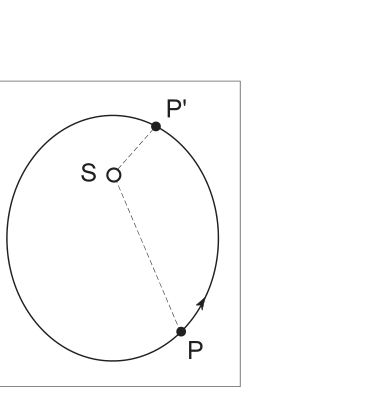
Topic: Gravitation, Conservation of Energy Metodi: Physical Modeling Competenze: Physical Reasoning Objects: Planet, Star Fonte: Testo (PDF) — p.3 Risposta: C · Soluzioni (PDF)
A planet moves around the Sun along an elliptical orbit, as shown in the figure. Quando il pianeta si sposta dal punto al punto , come cambiano la sua energia cinetica e la sua energia potenziale?
- A. Kinetic energy decreases, potential energy decreases.
- B. Kinetic energy decreases, potential energy increases.
- C. Kinetic energy increases, potential energy decreases.
- D. Kinetic energy increases, potential energy increases.
- E. The kinetic energy and the potential energy do not vary.
p.3 — Orbita ellittica del pianeta attorno al Sole
Topic: Gravitation, Conservation of Energy Metodi: Physical Modeling Competenze: Physical Reasoning Objects: Planet, Star Fonte: Testo (PDF) — p.3 Risposta: C · Soluzioni (PDF)
Durante il processo di fusione del piombo, c’è un cambiamento apprezzabile:
- A. della temperatura.
- B. del calore di fusione.
- C. del valore medio dell’energia cinetica delle molecole.
- D. del valore medio dell’energia potenziale delle molecole.
- E. della massa. Topic: Thermodynamics Metodi: Physical Modeling Competenze: Physical Reasoning Objects: — Fonte: Testo (PDF) — p.3 Risposta: D · Soluzioni (PDF)
During the melting process of lead, there is an appreciable change in:
- A. the temperature.
- B. the heat of fusion.
- C. the average value of the kinetic energy of the molecules.
- D. the average value of the potential energy of the molecules.
- E. the mass. Answer: D · Soluzioni (PDF)
La figura mostra quattro cannoni che stanno sparando proiettili di massa diversa e con diversi angoli di alzata (angolo tra l’orizzontale e la direzione di sparo), raggiungendo diverse gittate (distanza sul piano orizzontale tra il punto di sparo e quello di caduta del proiettile). Nei quattro casi la componente orizzontale della velocità dei proiettili è uguale. Si supponga trascurabile la resistenza dell’aria.
In quale caso la gittata del cannone è massima?
- A. Caso 1
- B. Caso 2
- C. Caso 3
- D. Caso 4
- E. Casi 2 e 3, dato che i due cannoni hanno la stessa gittata.
p.4 — Quattro cannoni con diversi angoli di alzata
Topic: Newtonian Mechanics Metodi: Physical Modeling Competenze: Physical Reasoning Objects: Projectile Fonte: Testo (PDF) — p.3 Risposta: D · Soluzioni (PDF)
The figure shows four cannons that are firing projectiles of different mass and with different elevation angles (angle between the horizontal and the firing direction), reaching different ranges (distance on the horizontal plane between the firing point and the point where the projectile falls). In the four cases the horizontal component of the projectiles’ velocity is the same. Assume that air resistance is negligible.
In which case is the cannon’s range maximum?
- A. Case 1
- B. Case 2
- C. Case 3
- D. Case 4
- E. Cases 2 and 3, since the two cannons have the same range.
p.4 — Four cannons with different elevation angles
Answer: D · Soluzioni (PDF)
Una pila da è collegata a quattro resistori che formano il semplice circuito indicato nella seguente figura. Quant’è la differenza di potenziale fra il punto e il punto ?
- A.
- B.
- C.
- D.
- E.
p.4 — Circuito con pila e quattro resistori
Topic: Circuits Metodi: Physical Modeling Competenze: Physical Reasoning Objects: Battery, Resistor Fonte: Testo (PDF) — p.4 Risposta: A · Soluzioni (PDF)
A battery of is connected to four resistors that form the simple circuit shown in the following figure. What is the potential difference between point and point ?
- A.
- B.
- C.
- D.
- E.
p.4 — Circuit with battery and four resistors
Answer: A · Soluzioni (PDF)
Un pallone viene riempito con gas elio ed utilizzato per sollevare in aria un corpo di volume trascurabile e massa di , molto maggiore di quella del pallone. Quale dei seguenti valori approssima meglio il minimo volume di elio richiesto?
(NOTA: in condizioni standard la densità dell’aria vale e quella dell’elio ; si può assumere che l’elio nel pallone sia a pressione atmosferica.)
- A.
- B.
- C.
- D.
- E. Topic: Fluid Mechanics Metodi: Physical Modeling Competenze: Physical Reasoning Objects: Gas Fonte: Testo (PDF) — p.4 Risposta: D · Soluzioni (PDF)
A balloon is filled with helium gas and used to lift into the air a body of negligible volume and mass , much greater than that of the balloon. Which of the following values best approximates the minimum volume of helium required?
(NOTE: under standard conditions the density of air is and that of helium ; it can be assumed that the helium in the balloon is at atmospheric pressure.)
- A.
- B.
- C.
- D.
- E. Answer: D · Soluzioni (PDF)
Una particella di massa , che inizialmente si sta muovendo lungo l’asse con una velocità , urta una particella di massa inizialmente ferma. In seguito all’urto la prima particella si ferma, mentre la seconda particella si divide in due parti di uguale massa che si muovono in direzioni che formano uno stesso angolo con l’asse , come mostrato in figura.
Quale delle seguenti affermazioni descrive correttamente la velocità delle due parti?
- A. Entrambe le parti si muovono con velocità .
- B. Una delle due parti si muove con velocità , l’altra con velocità minore di .
- C. Entrambe le parti si muovono con velocità .
- D. Una delle due parti si muove con velocità , l’altra con velocità maggiore di .
- E. Entrambe le parti si muovono con velocità maggiore di .
p.5 — Urto e divisione in due frammenti
Topic: Newtonian Mechanics, Conservation of Momentum Metodi: Physical Modeling Competenze: Physical Reasoning Objects: — Fonte: Testo (PDF) — p.4 Risposta: E · Soluzioni (PDF)
A particle of mass , which is initially moving along the axis with a velocity , collides with a particle of mass initially at rest. As a result of the collision, the first particle stops, while the second particle splits into two parts of equal mass that move in directions forming the same angle with the axis, as shown in the figure.
Which of the following statements correctly describes the velocity of the two parts?
- A. Both parts move with velocity .
- B. One of the two parts moves with velocity , the other with a velocity less than .
- C. Both parts move with velocity .
- D. One of the two parts moves with velocity , the other with a velocity greater than .
- E. Both parts move with a velocity greater than .
p.5 — Collision and splitting into two fragments
Answer: E · Soluzioni (PDF)
La figura rappresenta due sorgenti, e , di un ondoscopio. Che fenomeno si osserva nel punto ?
- A. Interferenza distruttiva
- B. Interferenza costruttiva
- C. Riflessione
- D. Rifrazione
- E. Diffrazione
p.5 — Sorgenti A e B di un ondoscopio
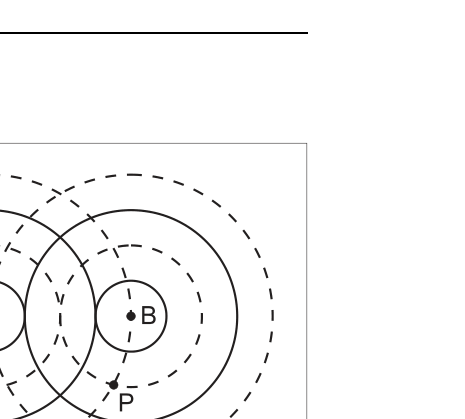
Topic: Newtonian Mechanics, Circuits, Fluid Mechanics Metodi: Kinematic Equations, Kirchhoff’s Laws, Conservation of Momentum, Impulse-Momentum Theorem, Ideal Gas Law, Hooke’s Law, Coulomb’s Law, Free-Body Diagram Competenze: Physical Reasoning, Mathematical Modeling, Diagrammatic Reasoning Objects: — Fonte: Testo (PDF) — p.5 Risposta: B · Soluzioni (PDF)
The figure represents two sources, and , of a ripple tank. What phenomenon is observed at point ?
- A. Destructive interference
- B. Constructive interference
- C. Reflection
- D. Refraction
- E. Diffraction
p.5 — Sources A and B of a ripple tank
Answer: B · Soluzioni (PDF)
Nella figura, le superfici e del blocco di legno hanno lo stesso grado di levigatura. L’area della superficie è doppia dell’area della superficie .
Se è la forza orizzontale necessaria per far scivolare a velocità costante il blocco con la superficie a contatto con il tavolo, quanto vale approssimativamente la forza necessaria per far scivolare a velocità costante il blocco con la superficie a contatto con il tavolo?
- A.
- B.
- C.
- D.
- E.
p.5 — Blocco di legno con superfici A e B
Topic: Newtonian Mechanics, Electrostatics, Nuclear & Particle Physics Metodi: Kinematic Equations, Conservation of Momentum, Conservation of Energy, Coulomb’s Law, Mass-Energy Equivalence, Wave Equation Competenze: Physical Reasoning, Mathematical Modeling, Estimation & Approximation Objects: Block Fonte: Testo (PDF) — p.5 Risposta: A · Soluzioni (PDF)
In the figure, surfaces and of the wooden block have the same degree of smoothness. The area of surface is twice the area of surface .
If is the horizontal force needed to make the block slide at constant speed with surface in contact with the table, approximately what is the force needed to make the block slide at constant speed with surface in contact with the table?
- A.
- B.
- C.
- D.
- E.
p.5 — Wooden block with surfaces A and B
Answer: A · Soluzioni (PDF)
Uno studente che si trova su una piccola collinetta lancia una palla orizzontalmente, da un’altezza di sul livello del suolo, verso una ciminiera che si trova a una distanza orizzontale di . La palla colpisce la ciminiera dopo dal lancio (si trascuri l’attrito dell’aria).
Nell’istante in cui la palla lascia la mano del ragazzo, la componente orizzontale della sua velocità è, approssimativamente,
- A.
- B.
- C.
- D.
- E.
p.6 — Collinetta, lancio orizzontale verso ciminiera
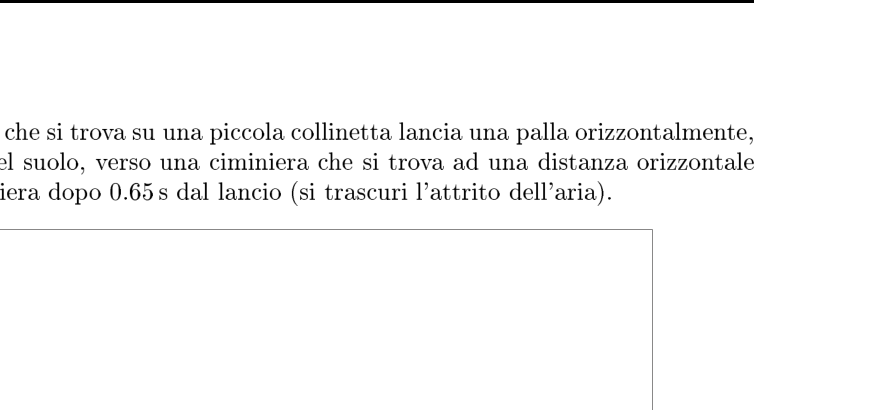
Topic: Newtonian Mechanics Metodi: Kinematic Equations, Vector Decomposition Competenze: Physical Reasoning, Mathematical Modeling Objects: Ball Fonte: Testo (PDF) — p.5 Risposta: E · Soluzioni (PDF)
A student standing on a small hill throws a ball horizontally, from a height of above ground level, toward a chimney that is at a horizontal distance of . The ball hits the chimney after from the throw (air friction is to be neglected).
At the instant the ball leaves the boy’s hand, the horizontal component of its velocity is, approximately,
- A.
- B.
- C.
- D.
- E.
p.6 — Hill, horizontal throw toward chimney
Answer: E · Soluzioni (PDF)
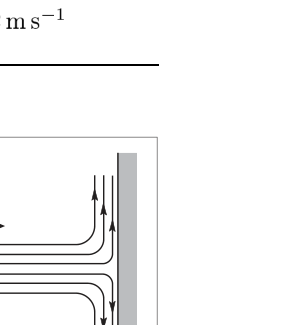
Un getto d’acqua di densità , area della sezione trasversale e velocità colpisce una parete verticale perpendicolare alla direzione del getto, come mostrato in figura. L’acqua poi fluisce parallelamente alla parete, in modo simmetrico rispetto alla direzione del getto.
La forza esercitata dal getto sulla parete è
- A.
- B.
- C.
- D.
- E.
p.6 — Getto d’acqua contro parete verticale
Topic: Fluid Mechanics, Newtonian Mechanics Metodi: Impulse-Momentum Theorem, Continuity Equation Competenze: Physical Reasoning, Mathematical Modeling Objects: — Fonte: Testo (PDF) — p.5 Risposta: A · Soluzioni (PDF)
A water jet with density , cross-sectional area and velocity hits a vertical wall perpendicular to the direction of the jet, as shown in the figure. The water then flows parallel to the wall, symmetrically with respect to the direction of the jet.
The force exerted by the jet on the wall is
- A.
- B.
- C.
- D.
- E.
p.6 — Water jet against a vertical wall
Answer: A · Soluzioni (PDF)
Una quantità pari a di gas perfetto, contenuta in un recipiente ermeticamente chiuso e a pareti rigide, viene scaldata fino a che la velocità quadratica media delle sue molecole risulta raddoppiata.
Di quale fattore risulta variata la pressione?
- A.
- B.
- C.
- D.
- E. Topic: Kinetic Theory, Thermodynamics Metodi: Ideal Gas Law, Kinetic Theory of Gases Competenze: Physical Reasoning, Mathematical Modeling Objects: Gas, Container Fonte: Testo (PDF) — p.6 Risposta: D · Soluzioni (PDF)
A quantity equal to of perfect gas, contained in a hermetically closed container with rigid walls, is heated until the root mean square speed of its molecules is doubled.
By what factor has the pressure changed?
- A.
- B.
- C.
- D.
- E. Answer: D · Soluzioni (PDF)
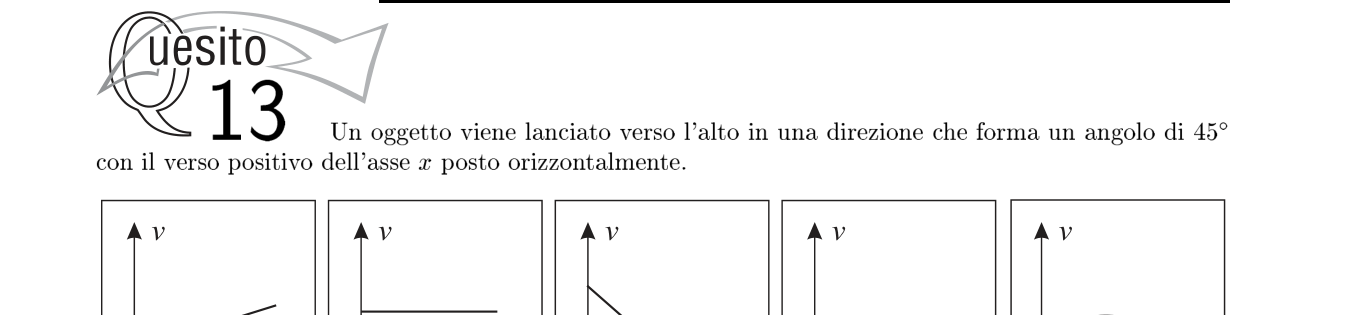
Un oggetto viene lanciato verso l’alto in una direzione che forma un angolo di con il verso positivo dell’asse posto orizzontalmente. Trascurando la resistenza dell’aria, quali dei precedenti grafici della velocità in funzione del tempo meglio rappresentano, rispettivamente, in funzione di e in funzione di ?
| A | I | IV |
| B | I | III |
| C | II | III |
| D | II | V |
| E | IV | V |
p.7 — Cinque grafici velocita in funzione del tempo
Topic: Newtonian Mechanics Metodi: Kinematic Equations, Vector Decomposition Competenze: Physical Reasoning, Diagrammatic Reasoning Objects: Projectile Fonte: Testo (PDF) — p.6 Risposta: C · Soluzioni (PDF)
An object is launched upward in a direction that forms an angle of with the positive direction of the horizontally placed axis. Neglecting air resistance, which of the previous graphs of velocity as a function of time best represent, respectively, as a function of and as a function of ?
| A | I | IV |
| B | I | III |
| C | II | III |
| D | II | V |
| E | IV | V |
p.7 — Five graphs of velocity as a function of time
Answer: C · Soluzioni (PDF)
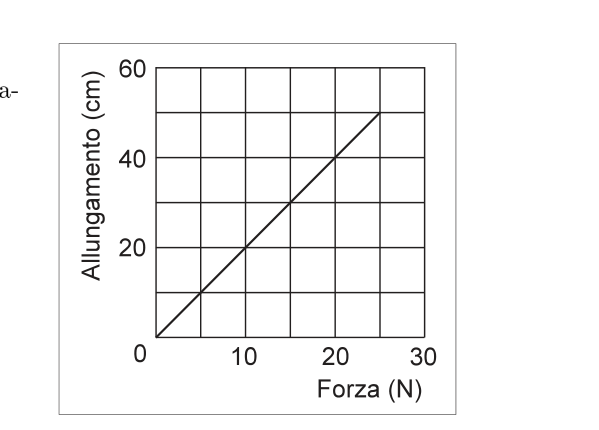
Il grafico mostra la relazione tra l’allungamento di una molla e la forza applicata che lo provoca. Quanto vale la costante elastica della molla?
- A.
- B.
- C.
- D.
- E.
p.7 — Grafico allungamento molla in funzione forza
Topic: Newtonian Mechanics Metodi: Hooke’s Law, Graph Linearization Competenze: Physical Reasoning, Experimental Data Analysis Objects: Spring Fonte: Testo (PDF) — p.6 Risposta: D · Soluzioni (PDF)
The graph shows the relationship between the extension of a spring and the applied force that causes it. What is the spring constant of the spring?
- A.
- B.
- C.
- D.
- E.
p.7 — Graph of spring extension as a function of force
Answer: D · Soluzioni (PDF)
Cinque cariche positive di valore sono disposte in modo simmetrico lungo una circonferenza di raggio . Qual è la forza elettrica risultante su ognuna di esse?
- A.
- B.
- C.
- D.
- E. Non è zero, ma dipende dalla posizione della carica sulla circonferenza. Topic: Electrostatics Metodi: Coulomb’s Law, Symmetry Argument, Vector Decomposition Competenze: Physical Reasoning, Mathematical Modeling Objects: Point Charge Fonte: Testo (PDF) — p.7 Risposta: A · Soluzioni (PDF)
Five positive charges of value are arranged symmetrically along a circumference of radius . What is the resulting electric force on each of them?
- A.
- B.
- C.
- D.
- E. It is not zero, but depends on the position of the charge on the circumference. Answer: A · Soluzioni (PDF)
In una gara di salto in lungo, un atleta raggiunge una gittata orizzontale di saltando con un angolo di rispetto all’orizzontale. Quanto è approssimativamente la velocità iniziale del salto?
- A.
- B.
- C.
- D.
- E.
p.8 — Salto con angolo di alzata
Topic: Newtonian Mechanics Metodi: Kinematic Equations, Vector Decomposition Competenze: Physical Reasoning, Mathematical Modeling Objects: Projectile Fonte: Testo (PDF) — p.7 Risposta: B · Soluzioni (PDF)
In a long jump competition, an athlete achieves a horizontal range of by jumping at an angle of with respect to the horizontal. What is approximately the initial velocity of the jump?
- A.
- B.
- C.
- D.
- E.
p.8 — Jump with take-off angle
Answer: B · Soluzioni (PDF)
Tre resistori, di resistenza , e , sono collegati come mostrato in figura a un generatore di f.e.m. con resistenza interna trascurabile. Qual è la corrente che fluisce attraverso ?
- A.
- B.
- C.
- D.
- E. Topic: Circuits Metodi: Kirchhoff’s Laws, Equivalent Circuit Reduction Competenze: Physical Reasoning, Mathematical Modeling Objects: Resistor, Battery Fonte: Testo (PDF) — p.7 Risposta: C · Soluzioni (PDF)
Three resistors, , and , are connected as shown in Figure 1 to an f.e.m. generator. with negligible internal resistance. Qual è la corrente che fluisce attraverso ?
- A.
- B.
- C.
- D.
- E. Topic: Circuits Metodi: Kirchhoff’s Laws, Equivalent Circuit Reduction Competenze: Physical Reasoning, Mathematical Modeling Objects: Resistor, Battery Fonte: Testo (PDF) — p.7 Risposta: C · Soluzioni (PDF)
Una forza costante agisce su un corpo di massa inizialmente fermo. Dopo un tempo il corpo ha percorso una distanza . Se la stessa forza agisce su un corpo di massa inizialmente fermo per lo stesso tempo , quale distanza percorre?
- A.
- B.
- C.
- D.
- E. Topic: Newtonian Mechanics Metodi: Kinematic Equations, Free-Body Diagram Competenze: Physical Reasoning, Mathematical Modeling Objects: Block Fonte: Testo (PDF) — p.7 Risposta: B · Soluzioni (PDF)
A constant force acts on a body of mass initially at rest. After a time the body has traveled a distance . If the same force acts on a body of mass initially at rest for the same time , what distance does it travel?
- A.
- B.
- C.
- D.
- E. Answer: B · Soluzioni (PDF)
La figura mostra un raggio di luce che incide su una superficie piana che separa due mezzi trasparenti. L’angolo di incidenza è e l’angolo di rifrazione è . Qual è il rapporto degli indici di rifrazione ?
- A.
- B.
- C.
- D.
- E.
p.9 — Raggio di luce su superficie di separazione
Topic: Geometric Optics Metodi: Snell’s Law Competenze: Physical Reasoning, Mathematical Modeling Objects: — Fonte: Testo (PDF) — p.8 Risposta: B · Soluzioni (PDF)
The figure shows a ray of light that strikes a flat surface separating two transparent media. The angle of incidence is and the angle of refraction is . What is the ratio of the refractive indices ?
- A.
- B.
- C.
- D.
- E.
p.9 — Ray of light on a separating surface
Answer: B · Soluzioni (PDF)
Una quantità di gas biatomico ideale subisce una trasformazione isobara (a pressione costante). Se la temperatura assoluta raddoppia, di quale fattore varia il volume?
- A.
- B.
- C.
- D.
- E.
p.9 — Cinque diagrammi di trasformazione del gas
Topic: Thermodynamics Metodi: Ideal Gas Law Competenze: Physical Reasoning Objects: Gas Fonte: Testo (PDF) — p.8 Risposta: A · Soluzioni (PDF)
A quantity of ideal diatomic gas undergoes an isobaric transformation (at constant pressure). If the absolute temperature doubles, by what factor does the volume change?
- A.
- B.
- C.
- D.
- E.
p.9 — Five gas transformation diagrams
Answer: A · Soluzioni (PDF)
Un oggetto è posto davanti a uno specchio concavo di raggio di curvatura , a una distanza di dallo specchio. Dove si forma l’immagine?
- A. dallo specchio, dallo stesso lato dell’oggetto
- B. dallo specchio, dallo stesso lato dell’oggetto
- C. dallo specchio, dallo stesso lato dell’oggetto
- D. dallo specchio, dal lato opposto all’oggetto
- E. All’infinito
p.11 — Grafico coordinata immagine in funzione tempo
Topic: Geometric Optics Metodi: Thin Lens & Mirror Equation Competenze: Physical Reasoning, Mathematical Modeling Objects: Mirror Fonte: Testo (PDF) — p.8 Risposta: C · Soluzioni (PDF)
An object is placed in front of a concave mirror with radius of curvature , at a distance of from the mirror. Where is the image formed?
- A. from the mirror, on the same side as the object
- B. from the mirror, on the same side as the object
- C. from the mirror, on the same side as the object
- D. from the mirror, on the opposite side from the object
- E. At infinity
p.11 — Graph of image coordinate as a function of time
Answer: C · Soluzioni (PDF)
Un filo rettilineo percorso da corrente è immerso in un campo magnetico uniforme perpendicolare al filo. La forza per unità di lunghezza sul filo è . Se la corrente è raddoppiata e il campo è dimezzato, come cambia ?
- A. rimane invariata
- B. raddoppia
- C. si dimezza
- D. quadruplica
- E. si riduce a un quarto Topic: Magnetism, Electromagnetism Metodi: Lorentz Force Analysis Competenze: Physical Reasoning Objects: Wire Fonte: Testo (PDF) — p.8 Risposta: D · Soluzioni (PDF)
A straight wire carrying current is immersed in a uniform magnetic field perpendicular to the wire. The force per unit length on the wire is . If the current is doubled and the field is halved, how does change?
- A. it remains unchanged
- B. it doubles
- C. it is halved
- D. it quadruples
- E. it is reduced to a quarter Answer: D · Soluzioni (PDF)
Un satellite di massa orbita attorno alla Terra di massa a una quota al di sopra della superficie terrestre di raggio . Qual è la velocità orbitale del satellite?
- A.
- B.
- C.
- D.
- E. Topic: Gravitation, Newtonian Mechanics Metodi: Newton’s Law of Gravitation, Kinematic Equations Competenze: Physical Reasoning, Mathematical Modeling Objects: Satellite, Planet Fonte: Testo (PDF) — p.9 Risposta: E · Soluzioni (PDF)
A satellite of mass orbits around the Earth of mass at an altitude above the Earth’s surface of radius . What is the orbital speed of the satellite?
- A.
- B.
- C.
- D.
- E. Answer: E · Soluzioni (PDF)
Un condensatore piano di capacità è collegato a un generatore di tensione . Le armature sono separate da una distanza . Se si raddoppia la distanza tra le armature mantenendo il condensatore collegato al generatore, come varia la carica sulle armature?
- A. raddoppia
- B. si dimezza
- C. rimane invariata
- D. quadruplica
- E. si riduce a un quarto
p.10 — Cinque schemi di armature con tensione
Topic: Electrostatics, Circuits Metodi: Electric Potential Method, Physical Modeling Competenze: Physical Reasoning Objects: Capacitor, Battery Fonte: Testo (PDF) — p.9 Risposta: D · Soluzioni (PDF)
A parallel-plate capacitor with capacitance is connected to a voltage generator . The plates are separated by a distance . If the distance between the plates is doubled while keeping the capacitor connected to the generator, how does the charge on the plates change?
- A. doubles
- B. is halved
- C. remains unchanged
- D. quadruples
- E. is reduced to a quarter
p.10 — Five diagrams of plates with voltage
Answer: D · Soluzioni (PDF)
Una sonda spaziale viene lanciata dalla Terra con una velocità diretta verso il Sole. Trascurando tutti i corpi del Sistema Solare tranne il Sole e la Terra, quale delle seguenti affermazioni è corretta mentre la sonda si avvicina al Sole?
- A. La velocità della sonda aumenta e la sua energia meccanica totale aumenta.
- B. La velocità della sonda aumenta e la sua energia meccanica totale diminuisce.
- C. La velocità della sonda aumenta e la sua energia meccanica totale rimane costante.
- D. La velocità della sonda diminuisce e la sua energia meccanica totale rimane costante.
- E. La velocità della sonda rimane costante e la sua energia meccanica totale rimane costante. Topic: Gravitation, Conservation of Energy Metodi: Conservation Laws, Newton’s Law of Gravitation Competenze: Physical Reasoning Objects: Satellite, Star Fonte: Testo (PDF) — p.9 Risposta: D · Soluzioni (PDF)
A space probe is launched from Earth with a speed directed toward the Sun. Neglecting all bodies of the Solar System except the Sun and the Earth, which of the following statements is correct while the probe approaches the Sun?
- A. The speed of the probe increases and its total mechanical energy increases.
- B. The speed of the probe increases and its total mechanical energy decreases.
- C. The speed of the probe increases and its total mechanical energy remains constant.
- D. The speed of the probe decreases and its total mechanical energy remains constant.
- E. The speed of the probe remains constant and its total mechanical energy remains constant. Answer: D · Soluzioni (PDF)
Un’onda sonora si propaga nell’aria a con frequenza . Qual è la lunghezza d’onda?
- A.
- B.
- C.
- D.
- E. Topic: Oscillations & Waves Metodi: Wave Equation Competenze: Physical Reasoning, Mathematical Modeling Objects: — Fonte: Testo (PDF) — p.9 Risposta: B · Soluzioni (PDF)
A sound wave propagates in air at with frequency . What is the wavelength?
- A.
- B.
- C.
- D.
- E. Answer: B · Soluzioni (PDF)
Un elettrone e un protone sono accelerati dalla stessa differenza di potenziale . Qual è il rapporto tra la velocità finale dell’elettrone e quella del protone ?
- A.
- B.
- C.
- D.
- E. Topic: Electrostatics, Modern-Quantum Physics Metodi: Energy Conservation Method, Electric Potential Method Competenze: Physical Reasoning, Mathematical Modeling Objects: Electron, Nucleus Fonte: Testo (PDF) — p.9 Risposta: D · Soluzioni (PDF)
An electron and a proton are accelerated by the same potential difference . What is the ratio between the final velocity of the electron and that of the proton ?
- A.
- B.
- C.
- D.
- E. Answer: D · Soluzioni (PDF)
Un corpo di massa appeso a una molla verticale di costante elastica oscilla con periodo . Se la massa è quadruplicata e la costante della molla è raddoppiata, qual è il nuovo periodo?
- A.
- B.
- C.
- D.
- E. Topic: Oscillations & Waves Metodi: Simple Harmonic Motion Analysis Competenze: Physical Reasoning, Mathematical Modeling Objects: Spring Fonte: Testo (PDF) — p.10 Risposta: D · Soluzioni (PDF)
A body of mass hanging from a vertical spring with spring constant oscillates with period . If the mass is quadrupled and the spring constant is doubled, what is the new period?
- A.
- B.
- C.
- D.
- E. Answer: D · Soluzioni (PDF)
Un carrello di massa è fermo su una rotaia orizzontale priva di attrito. Un proiettile di massa e velocità viene sparato orizzontalmente e si conficca nel carrello. Qual è la velocità del sistema carrello+proiettile dopo l’urto?
- A.
- B.
- C.
- D.
- E. Topic: Newtonian Mechanics, Conservation of Momentum Metodi: Conservation of Momentum, Impulse-Momentum Theorem Competenze: Physical Reasoning, Mathematical Modeling Objects: Cart, Projectile Fonte: Testo (PDF) — p.10 Risposta: C · Soluzioni (PDF)
A cart of mass is at rest on a frictionless horizontal track. A projectile of mass and velocity is fired horizontally and embeds itself in the cart. What is the velocity of the cart+projectile system after the collision?
- A.
- B.
- C.
- D.
- E. Answer: C · Soluzioni (PDF)
Due sfere identiche, conduttrici e isolate, vengono caricate con cariche e rispettivamente. Le sfere si trovano a distanza grande rispetto al loro diametro. Quale è la forza tra le sfere prima che vengano messe a contatto?
- A. repulsiva
- B. attrattiva
- C. attrattiva
- D. repulsiva
- E. Zero Topic: Electrostatics Metodi: Coulomb’s Law Competenze: Physical Reasoning Objects: Conducting Sphere Fonte: Testo (PDF) — p.10 Risposta: B · Soluzioni (PDF)
Two identical conducting and isolated spheres are charged with charges and respectively. The spheres are located at a distance large compared to their diameter. What is the force between the spheres before they are brought into contact?
- A. repulsive
- B. attractive
- C. attractive
- D. repulsive
- E. Zero Answer: B · Soluzioni (PDF)
Un carrello parte da ferma in un punto e scende lungo un piano inclinato liscio fino al punto , posto a più in basso. Se l’attrito può essere trascurato, quale sarà la velocità del carrello nel punto ?
- A.
- B.
- C.
- D.
- E.
p.13 — Profilo del percorso con punti A e B
Topic: Newtonian Mechanics, Conservation of Energy Metodi: Energy Conservation Method, Kinematic Equations Competenze: Physical Reasoning, Mathematical Modeling Objects: Cart, Inclined Plane Fonte: Testo (PDF) — p.10 Risposta: B · Soluzioni (PDF)
A cart starts from rest at a point and descends along a smooth inclined plane to point , located lower. If friction can be neglected, what will be the speed of the cart at point ?
- A.
- B.
- C.
- D.
- E.
p.13 — Profile of the path with points A and B
Answer: B · Soluzioni (PDF)
Qual è la potenza sviluppata da una forza che agisce su un oggetto in moto con velocità nella stessa direzione della forza?
- A.
- B.
- C.
- D.
- E. Topic: Newtonian Mechanics Metodi: Kinematic Equations, Energy Conservation Method Competenze: Physical Reasoning, Mathematical Modeling Objects: — Fonte: Testo (PDF) — p.11 Risposta: B · Soluzioni (PDF)
What is the power developed by a force that acts on an object moving with velocity in the same direction as the force?
- A.
- B.
- C.
- D.
- E. Answer: B · Soluzioni (PDF)
Un trasformatore ideale ha un avvolgimento primario di spire e uno secondario di spire. La tensione efficace al primario è . Qual è la tensione efficace al secondario?
- A.
- B.
- C.
- D.
- E. Topic: Electromagnetic Induction, Electromagnetism Metodi: Faraday’s Law of Induction Competenze: Physical Reasoning, Mathematical Modeling Objects: Coil Fonte: Testo (PDF) — p.11 Risposta: C · Soluzioni (PDF)
An ideal transformer has a primary winding of turns and a secondary winding of turns. The rms voltage at the primary is . What is the rms voltage at the secondary?
- A.
- B.
- C.
- D.
- E. Answer: C · Soluzioni (PDF)
Su due sfere identiche, conduttrici e isolate, vengono depositate due cariche elettriche uguali. Le sfere si trovano a distanza grande rispetto al loro diametro e si respingono con forza . Una terza sfera conduttrice identica alle due precedenti, ma scarica, viene posta in contatto elettrico con la prima sfera e poi con la seconda, quindi viene allontanata definitivamente.
Qual è, ora, l’intensità della forza tra le due sfere?
- A.
- B.
- C.
- D.
- E. Topic: Electrostatics Metodi: Coulomb’s Law, Physical Modeling Competenze: Physical Reasoning, Mathematical Modeling Objects: Conducting Sphere Fonte: Testo (PDF) — p.11 Risposta: D · Soluzioni (PDF)
Two identical conducting and isolated spheres are given two equal electric charges. The spheres are located at a distance large compared to their diameter and repel each other with a force . A third conducting sphere identical to the previous two, but uncharged, is placed in electrical contact with the first sphere and then with the second, then it is definitively removed.
What is now the magnitude of the force between the two spheres?
- A.
- B.
- C.
- D.
- E. Answer: D · Soluzioni (PDF)
Un’automobile, la cui massa è di , sta viaggiando alla velocità di quando inizia a frenare con un’accelerazione costante di , fino a fermarsi.
Quanta strada percorre la macchina durante la frenata?
- A.
- B.
- C.
- D.
- E. Topic: Newtonian Mechanics Metodi: Kinematic Equations Competenze: Physical Reasoning, Mathematical Modeling Objects: — Fonte: Testo (PDF) — p.12 Risposta: C · Soluzioni (PDF)
A car, whose mass is , is traveling at a speed of when it begins to brake with a constant acceleration of , until it stops.
How much distance does the car cover during braking?
- A.
- B.
- C.
- D.
- E. Answer: C · Soluzioni (PDF)
In un urto unidimensionale non relativistico, una particella di massa colpisce una particella di massa inizialmente ferma. Se le particelle rimangono unite dopo l’urto, quale frazione dell’energia cinetica iniziale viene persa nell’urto?
- A.
- B.
- C.
- D.
- E. Topic: Newtonian Mechanics, Conservation of Momentum Metodi: Conservation of Momentum, Conservation of Energy Competenze: Physical Reasoning, Mathematical Modeling Objects: — Fonte: Testo (PDF) — p.13 Risposta: C · Soluzioni (PDF)
In a non-relativistic one-dimensional collision, a particle of mass hits a particle of mass initially at rest. If the particles remain joined after the collision, what fraction of the initial kinetic energy is lost in the collision?
- A.
- B.
- C.
- D.
- E. Answer: C · Soluzioni (PDF)
Il disegno schematizza un’onda d’acqua che si propaga alla velocità di e mette in moto un tappo che compie oscillazioni in .
Qual è la lunghezza d’onda?
- A.
- B.
- C.
- D.
- E.
p.14 — Onda d’acqua che muove un tappo
Topic: Oscillations & Waves Metodi: Wave Equation Competenze: Physical Reasoning, Mathematical Modeling Objects: — Fonte: Testo (PDF) — p.13 Risposta: B · Soluzioni (PDF)
The drawing schematizes a water wave that propagates at the speed of and sets in motion a cork that completes oscillations in .
What is the wavelength?
- A.
- B.
- C.
- D.
- E.
p.14 — Water wave that moves a cork
Answer: B · Soluzioni (PDF)
Quando una studentessa beve dell’acqua fredda, il suo corpo scalda l’acqua fino al raggiungimento dell’equilibrio termico. Se la studentessa, nell’arco di una giornata, beve circa un litro e mezzo d’acqua a , quanta energia — sotto forma di calore — deve fornire approssimativamente il suo corpo all’acqua?
(NOTA: si consideri la temperatura interna della studentessa pari a .)
- A.
- B.
- C.
- D.
- E. Topic: Thermodynamics Metodi: First Law of Thermodynamics, Physical Modeling Competenze: Physical Reasoning, Estimation & Approximation Objects: — Fonte: Testo (PDF) — p.13 Risposta: B · Soluzioni (PDF)
When a student drinks cold water, her body warms the water until thermal equilibrium is reached. If the student, over the course of a day, drinks about a liter and a half of water at , approximately how much energy — in the form of heat — must her body supply to the water?
(NOTE: consider the student’s internal temperature to be .)
- A.
- B.
- C.
- D.
- E. Answer: B · Soluzioni (PDF)
A fianco sono indicate le masse di due particelle e un nucleo, espresse in unità di massa atomica (u), di cui è dato il valore. Qual è l’energia di legame del nucleo di ?
| Particella | Massa (u) |
|---|---|
| protone | |
| neutrone | |
- A.
- B.
- C.
- D.
- E. Topic: Nuclear & Particle Physics Metodi: Mass-Energy Equivalence Competenze: Physical Reasoning, Mathematical Modeling Objects: Nucleus Fonte: Testo (PDF) — p.13 Risposta: B · Soluzioni (PDF)
The masses of two particles and a nucleus, expressed in atomic mass unit (u), are indicated next to each other, and the value is given. What is the bonding energy of the nucleus?
♪ The part # The mass # |-----------|-----------| | protone | | | neutrone | | | | |
- A.
- B.
- C.
- D.
- E. Topic: Nuclear & Particle Physics Metodi: Mass-Energy Equivalence Competenze: Physical Reasoning, Mathematical Modeling Objects: Nucleus Fonte: Testo (PDF) — p.13 Risposta: B · Soluzioni (PDF)
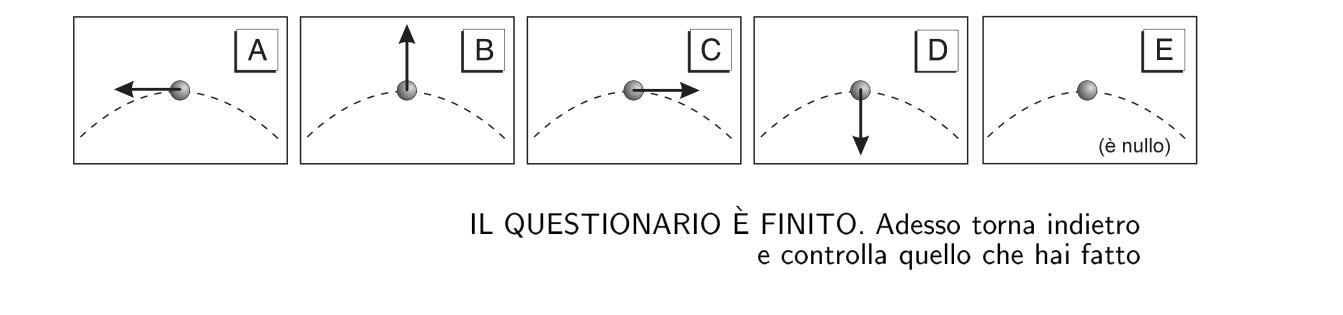
Un proiettile si sta muovendo a velocità nel punto più alto della sua traiettoria. Si faccia l’ipotesi che l’aria non influenzi apprezzabilmente il moto.
Come è rivolto il vettore accelerazione del proiettile in tale punto, indicato in figura?
- A. Nella direzione del moto (orizzontale)
- B. Verticalmente verso l’alto
- C. Verticalmente verso il basso
- D. In direzione obliqua verso il basso
- E. Il vettore accelerazione è nullo in quel punto
p.14 — Cinque traiettorie del proiettile con vertice
Topic: Newtonian Mechanics Metodi: Kinematic Equations, Free-Body Diagram Competenze: Physical Reasoning Objects: Projectile Fonte: Testo (PDF) — p.14 Risposta: D · Soluzioni (PDF)
A projectile is moving at speed at the highest point of its trajectory. Assume that the air does not appreciably influence the motion.
How is the acceleration vector of the projectile directed at that point, indicated in the figure?
- A. In the direction of motion (horizontal)
- B. Vertically upward
- C. Vertically downward
- D. In an oblique direction downward
- E. The acceleration vector is zero at that point
p.14 — Five projectile trajectories with vertex
Answer: D · Soluzioni (PDF)