Auguri a tutti i partecipanti alle Olimpiadi di Fisica e in particolare a quanti oggi festeggiano il compleanno!!!
Qual è, tra i seguenti, l’ordine di grandezza che esprime più correttamente il numero di volte che il loro cuore ha battuto dal momento della nascita?
- A.
- B.
- C.
- D.
- E. Topic: Order-of-Magnitude Estimation, Newtonian Mechanics Metodi: Order-of-Magnitude Estimation Competenze: Estimation & Approximation, Physical Reasoning Objects: — Fonte: Testo (PDF) — p.3 Risposta: C · Soluzioni (PDF)
Best wishes to all participants in the Physics Olympiad and in particular to those who are celebrating their birthday today!!!
Which of the following is the order of magnitude that most correctly expresses the number of times their heart has beaten since the moment of birth?
- A.
- B.
- C.
- D.
- E. Answer: C · Soluzioni (PDF)
In un esperimento sono state registrate queste misure con le rispettive incertezze:
| Grandezza | Valore | Incertezza |
|---|---|---|
| Aumento di temperatura | ||
| Corrente nel bollitore | ||
| Tensione applicata al bollitore | ||
| Tempo | ||
| Massa del liquido |
La misura con la maggiore incertezza percentuale è quella relativa a:
- A. l’aumento di temperatura.
- B. la corrente nel bollitore.
- C. la tensione applicata al bollitore.
- D. il tempo.
- E. la massa del liquido. Topic: Thermodynamics Metodi: Error Propagation Competenze: Error Propagation, Physical Reasoning Objects: — Fonte: Testo (PDF) — p.3 Risposta: A · Soluzioni (PDF)
In one experiment these measures were recorded with their respective uncertainties:
♪ Greatness ♪ Value ♪ Uncertainty ♪ |---|---|---| | Aumento di temperatura | | | | Corrente nel bollitore | | | | Tensione applicata al bollitore | | | | Tempo | | | | Massa del liquido | | |
The measure with the greatest percentage uncertainty is that relating to:
- A the increase in temperature.
- B. current in the boiler.
- C. the voltage applied to the boiler.
- D the time.
- E. the mass of the liquid. Topic: Thermodynamics Metodi: Error Propagation Competenze: Error Propagation, Physical Reasoning Objects: — Fonte: Testo (PDF) — p.3 Risposta: A · Soluzioni (PDF)
Un pendolo è appeso al soffitto di un ascensore. Quando l’ascensore è fermo il periodo del pendolo è .
Qual è il periodo quando l’ascensore si muove con un’accelerazione di diretta verso l’alto?
- A.
- B.
- C.
- D.
- E. Topic: Oscillations & Waves, Newtonian Mechanics Metodi: Simple Harmonic Motion Analysis, Free-Body Diagram Competenze: Physical Reasoning, Mathematical Modeling Objects: Pendulum Fonte: Testo (PDF) — p.3 Risposta: B · Soluzioni (PDF)
A pendulum is suspended from the ceiling of an elevator. When the elevator is stationary the period of the pendulum is .
What is the period when the elevator moves with an acceleration of directed upward?
- A.
- B.
- C.
- D.
- E. Answer: B · Soluzioni (PDF)
Un fascio di elettroni di energia cinetica viene frenato con un campo elettrostatico opportunamente orientato.
Quanto deve essere intenso il campo elettrostatico per poter arrestare questi elettroni in ?
- A.
- B.
- C.
- D.
- E. Topic: Electrostatics, Newtonian Mechanics Metodi: Electric Potential Method, Kinematic Equations Competenze: Mathematical Modeling, Physical Reasoning Objects: Particle Beam Fonte: Testo (PDF) — p.3 Risposta: D · Soluzioni (PDF)
A beam of kinetic energy electrons is brake with an appropriately oriented electrostatic field.
Quanto deve essere intenso il campo elettrostatico per poter arrestare questi elettroni in ?
- A.
- B.
- C.
- D.
- E. Topic: Electrostatics, Newtonian Mechanics Metodi: Electric Potential Method, Kinematic Equations Competenze: Mathematical Modeling, Physical Reasoning Objects: Particle Beam Fonte: Testo (PDF) — p.3 Risposta: D · Soluzioni (PDF)
Un contenitore rigido di metallo contiene inizialmente del gas compresso. Il gas viene lentamente fatto uscire dal contenitore. La temperatura del gas rimane costante.
Quale dei seguenti gruppi di tre grafici indica come possono cambiare nel tempo la pressione, il volume e la massa del gas nel contenitore?
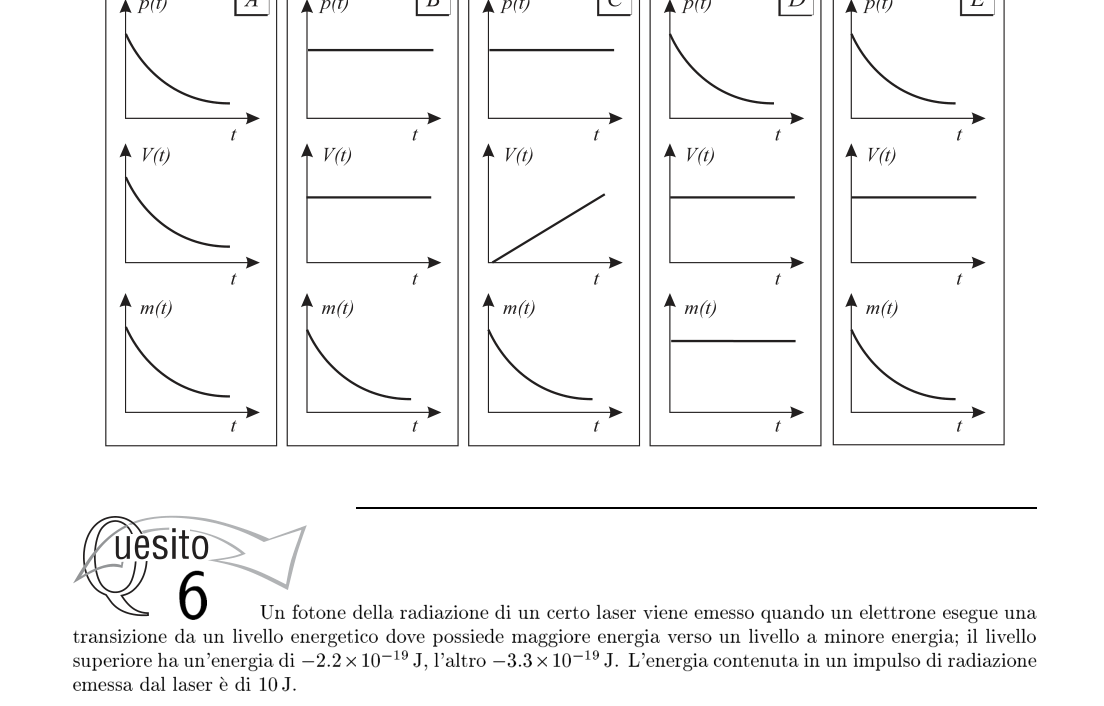 Grafici di p, V, m del gas nel tempo
Topic: Thermodynamics, Kinetic Theory Metodi: Ideal Gas Law Competenze: Physical Reasoning, Diagrammatic Reasoning Objects: Gas, Container Fonte: Testo (PDF) — p.4 Risposta: E · Soluzioni (PDF)
A rigid metal container initially contains compressed gas. The gas is slowly allowed to escape from the container. The temperature of the gas remains constant.
Which of the following groups of three graphs indicates how the pressure, volume, and mass of the gas in the container may change over time?
Graphs of p, V, m of the gas over time
Answer: E · Soluzioni (PDF)
Un fotone della radiazione di un certo laser viene emesso quando un elettrone esegue una transizione da un livello energetico dove possiede maggiore energia verso un livello a minore energia; il livello superiore ha un’energia di , l’altro . L’energia contenuta in un impulso di radiazione emessa dal laser è di .
Quanti fotoni ci sono in un impulso di radiazione di quel laser?
- A.
- B.
- C.
- D.
- E. Topic: Modern-Quantum Physics Metodi: Photon Energy Relation, Bohr Model & Quantization Competenze: Mathematical Modeling, Physical Reasoning Objects: Photon, Electron Fonte: Testo (PDF) — p.4 Risposta: E · Soluzioni (PDF)
A photon of the radiation from a certain laser is emitted when an electron undergoes a transition from an energy level where it has greater energy to a level with lower energy; the upper level has an energy of , the other . The energy contained in a pulse of radiation emitted by the laser is .
How many photons are there in a pulse of radiation from that laser?
- A.
- B.
- C.
- D.
- E. Answer: E · Soluzioni (PDF)
Due carrelli si trovano su una rotaia a cuscino d’aria, disposta orizzontalmente, su cui possono muoversi con attrito trascurabile. Il carrello A, di massa , si muove con una velocità e urta contro un carrello B, di massa , inizialmente fermo. Nell’urto, i due carrelli restano agganciati.
Quale frazione dell’energia cinetica iniziale del sistema viene trasformata in altre forme (energia sonora, termica…) nella collisione?
- A.
- B.
- C.
- D.
- E. Topic: Conservation of Momentum, Conservation of Energy, Newtonian Mechanics Metodi: Conservation of Momentum, Conservation Laws Competenze: Mathematical Modeling, Physical Reasoning Objects: Cart Fonte: Testo (PDF) — p.4 Risposta: D · Soluzioni (PDF)
Two carts are on an air cushion track, placed horizontally, on which they can move with negligible friction. Cart A, of mass , moves with a velocity and collides with a cart B, of mass , initially at rest. In the collision, the two carts remain coupled.
What fraction of the initial kinetic energy of the system is transformed into other forms (sound energy, thermal energy…) in the collision?
- A.
- B.
- C.
- D.
- E. Answer: D · Soluzioni (PDF)
Un ragazzo e una ragazza stanno pattinando sul ghiaccio. Ad un certo istante, quando sono vicini e fermi, si danno una spinta, allontanandosi e poco tempo dopo sono distanti . La massa del ragazzo è , quella della ragazza . L’attrito è trascurabile.
Qual è lo spazio percorso dalla ragazza in questo intervallo di tempo?
- A.
- B.
- C.
- D.
- E. Topic: Conservation of Momentum, Newtonian Mechanics Metodi: Conservation of Momentum, Kinematic Equations Competenze: Mathematical Modeling, Physical Reasoning Objects: — Fonte: Testo (PDF) — p.5 Risposta: C · Soluzioni (PDF)
A boy and a girl are skating on the ice. At a certain instant, when they are close together and stationary, they push each other, moving apart, and a short time later they are a distance apart. The mass of the boy is , that of the girl is . Friction is negligible.
What is the distance traveled by the girl in this time interval?
- A.
- B.
- C.
- D.
- E. Answer: C · Soluzioni (PDF)
Uno studente esegue un esperimento di carica di un condensatore, collegandolo a un generatore di tensione costante attraverso una resistenza ; traccia poi i tre grafici mostrati in figura dimenticando di indicare sugli assi le grandezze cui si riferiscono.
Quale riga della seguente tabella riporta le indicazioni corrette, rispettivamente per le ordinate e le ascisse?
| Grafico 1 | Grafico 2 | Grafico 3 | |
|---|---|---|---|
| A | carica e tensione | corrente e tempo | tensione e tempo |
| B | corrente e tempo | tensione e tempo | carica e tensione |
| C | corrente e tempo | carica e tensione | tensione e tempo |
| D | tensione e tempo | corrente e tempo | carica e tensione |
| E | tensione e tempo | carica e tensione | corrente e tempo |
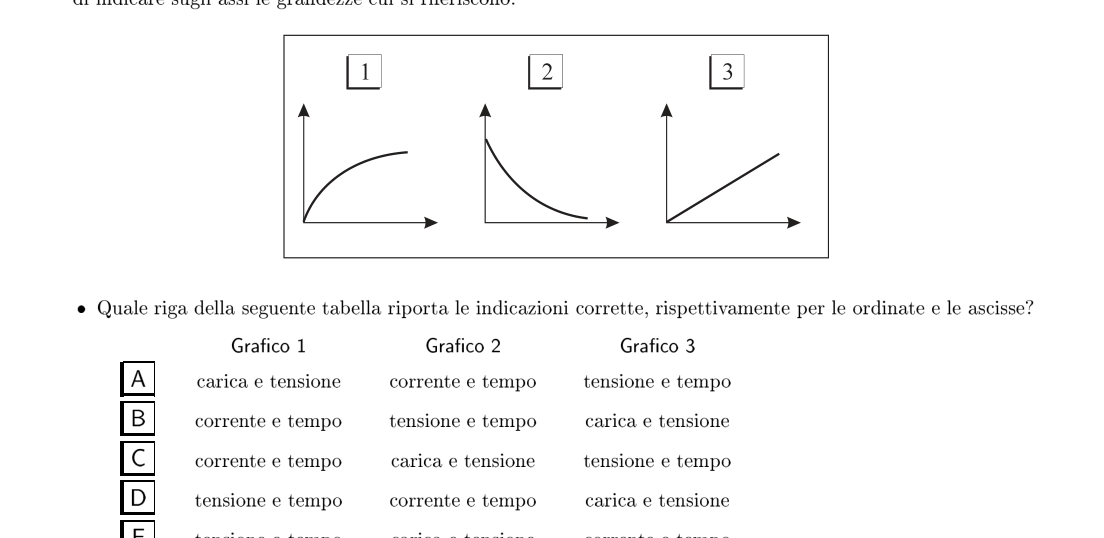 Tre grafici carica condensatore
Topic: Circuits Metodi: Equivalent Circuit Reduction, Kirchhoff’s Laws Competenze: Diagrammatic Reasoning, Physical Reasoning Objects: Capacitor, Resistor, Battery Fonte: Testo (PDF) — p.5 Risposta: D · Soluzioni (PDF)
A student performs an experiment charging a capacitor, connecting it to a constant voltage generator through a resistance ; he then plots the three graphs shown in the figure, forgetting to indicate on the axes the quantities to which they refer.
Which row of the following table gives the correct indications, respectively for the ordinates and the abscissas?
| Graph 1 | Graph 2 | Graph 3 | |
|---|---|---|---|
| A | charge and voltage | current and time | voltage and time |
| B | current and time | voltage and time | charge and voltage |
| C | current and time | charge and voltage | voltage and time |
| D | voltage and time | current and time | charge and voltage |
| E | voltage and time | charge and voltage | current and time |
Three capacitor charging graphs
Answer: D · Soluzioni (PDF)
Due oggetti, rispettivamente di massa e , sono collegati mediante un dinamometro di massa trascurabile e sono trascinati senza attrito sopra un piano orizzontale da una forza di applicata all’oggetto con maggiore massa, come mostrato in figura.
Qual è il valore della forza letto sul dinamometro?
- A.
- B.
- C.
- D.
- E.
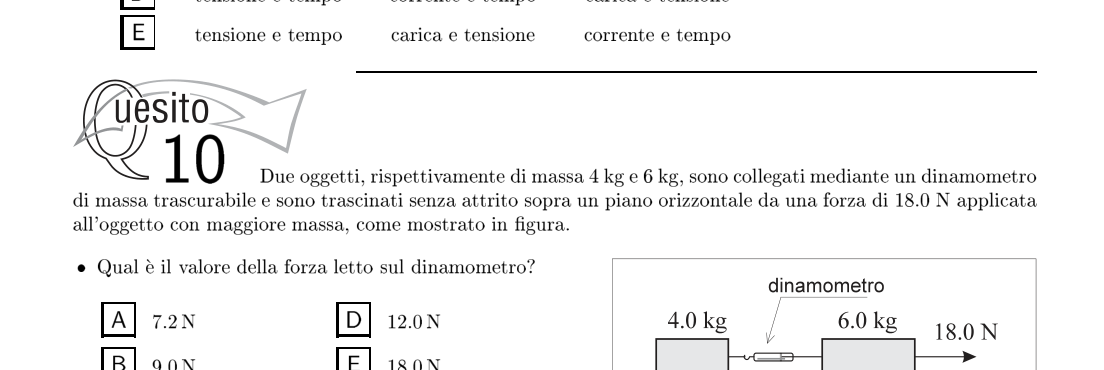 Due masse collegate da dinamometro
Topic: Newtonian Mechanics Metodi: Free-Body Diagram, Kinematic Equations Competenze: Physical Reasoning, Diagrammatic Reasoning Objects: Block Fonte: Testo (PDF) — p.5 Risposta: A · Soluzioni (PDF)
Two objects, respectively of mass and , are connected by means of a dynamometer of negligible mass and are dragged without friction over a horizontal plane by a force of applied to the object with the greater mass, as shown in the figure.
What is the value of the force read on the dynamometer?
- A.
- B.
- C.
- D.
- E.
Two masses connected by a dynamometer
Answer: A · Soluzioni (PDF)
Un corpo parte da fermo e accelera lungo una linea retta. Il grafico mostra come varia nel tempo l’accelerazione del corpo.
La velocità del corpo all’istante è:
- A.
- B.
- C.
- D.
- E.
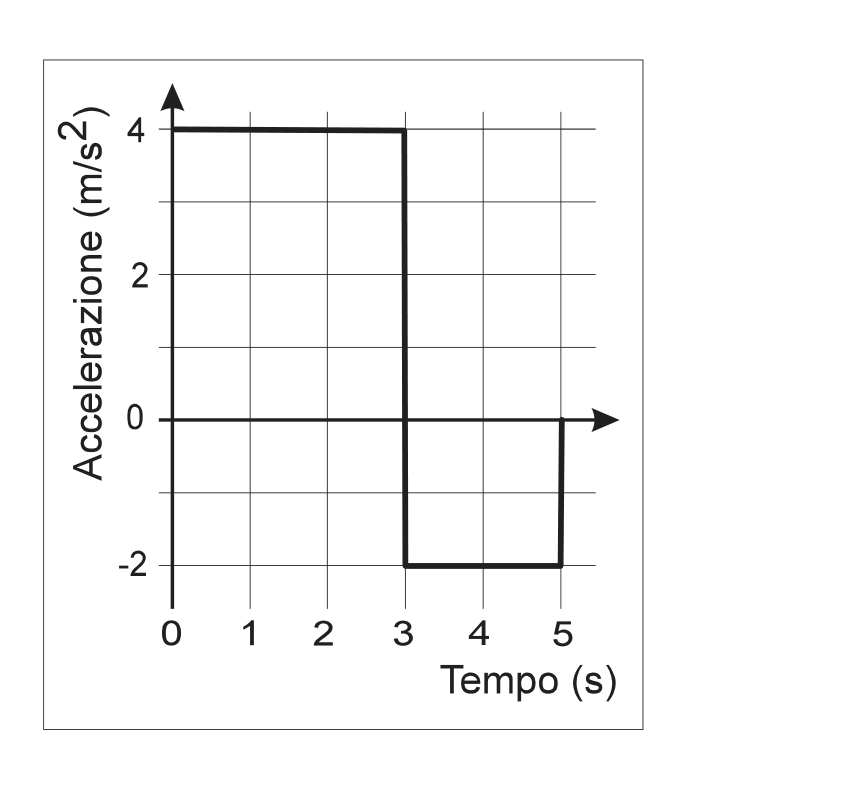 Grafico accelerazione vs tempo
Topic: Newtonian Mechanics Metodi: Kinematic Equations, Calculus-Integration Competenze: Diagrammatic Reasoning, Physical Reasoning Objects: — Fonte: Testo (PDF) — p.6 Risposta: B · Soluzioni (PDF)
A body starts from rest and accelerates along a straight line. The graph shows how the acceleration of the body varies over time.
The velocity of the body at the instant is:
- A.
- B.
- C.
- D.
- E.
Graph acceleration vs time
Answer: B · Soluzioni (PDF)
Una provetta dal fondo piatto contenente alcuni pallini di piombo sta galleggiando in un liquido A, come mostrato a sinistra nella figura. Il fondo della provetta si trova ad una profondità di dalla superficie del liquido. La stessa provetta, riempita con gli stessi pallini di piombo, viene successivamente fatta galleggiare in un liquido B. In questo caso il fondo della provetta si trova ad una profondità di dalla superficie del liquido (a destra).
Quali delle seguenti affermazioni sono corrette? 1 — In ciascun liquido la pressione esercitata sul fondo della provetta è la stessa. 2 — La densità del liquido A è più grande della densità del liquido B. 3 — In ciascun liquido la spinta verso l’alto esercitata sul fondo della provetta è la stessa.
- A. Solo la 1.
- B. Solo la 2.
- C. Solo la 1. e la 2.
- D. Solo la 2. e la 3.
- E. Tutte e tre.
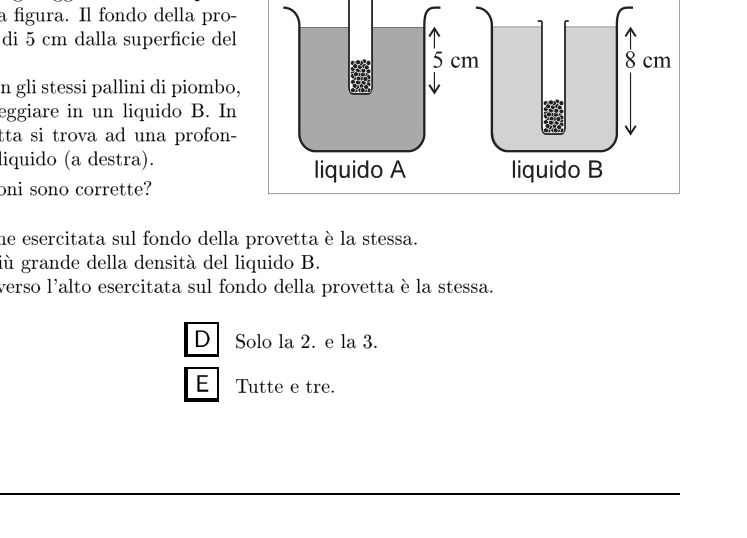 Provetta galleggiante nei due liquidi
Topic: Fluid Mechanics Metodi: Hydrostatic Equilibrium, Bernoulli’s Equation Competenze: Physical Reasoning, Diagrammatic Reasoning Objects: Container Fonte: Testo (PDF) — p.6 Risposta: E · Soluzioni (PDF)
A flat-bottomed test tube containing some lead shot is floating in a liquid A, as shown on the left in the figure. The bottom of the test tube is at a depth of from the surface of the liquid. The same test tube, filled with the same lead shot, is then made to float in a liquid B. In this case the bottom of the test tube is at a depth of from the surface of the liquid (on the right).
Which of the following statements are correct? 1 — In each liquid the pressure exerted on the bottom of the test tube is the same. 2 — The density of liquid A is greater than the density of liquid B. 3 — In each liquid the upward buoyant force exerted on the bottom of the test tube is the same.
- A. Only 1.
- B. Only 2.
- C. Only 1. and 2.
- D. Only 2. and 3.
- E. All three.
Test tube floating in the two liquids
Answer: E · Soluzioni (PDF)
Una giocatrice di pallacanestro salta in alto in verticale per afferrare un rimbalzo e rimane in aria per .
Considerando il moto verticale del centro di massa della giocatrice durante il salto, nell’ipotesi che la sua posizione sia la stessa nell’attimo dello stacco e al momento della ricaduta a terra, di quanto si è sollevata in alto?
- A.
- B.
- C.
- D.
- E. Topic: Newtonian Mechanics Metodi: Kinematic Equations Competenze: Mathematical Modeling, Physical Reasoning Objects: — Fonte: Testo (PDF) — p.6 Risposta: B · Soluzioni (PDF)
A basketball player jumps vertically upward to grab a rebound and remains in the air for .
Considering the vertical motion of the player’s center of mass during the jump, assuming that her position is the same at the instant of takeoff and at the moment of landing back on the ground, how high did she rise?
- A.
- B.
- C.
- D.
- E. Answer: B · Soluzioni (PDF)
Nei diagrammi mostrati qui sotto, la curva tratteggiata rappresenta una trasformazione isoterma di un gas perfetto.
Quale, tra le linee a tratto pieno, rappresenta una trasformazione adiabatica reversibile?
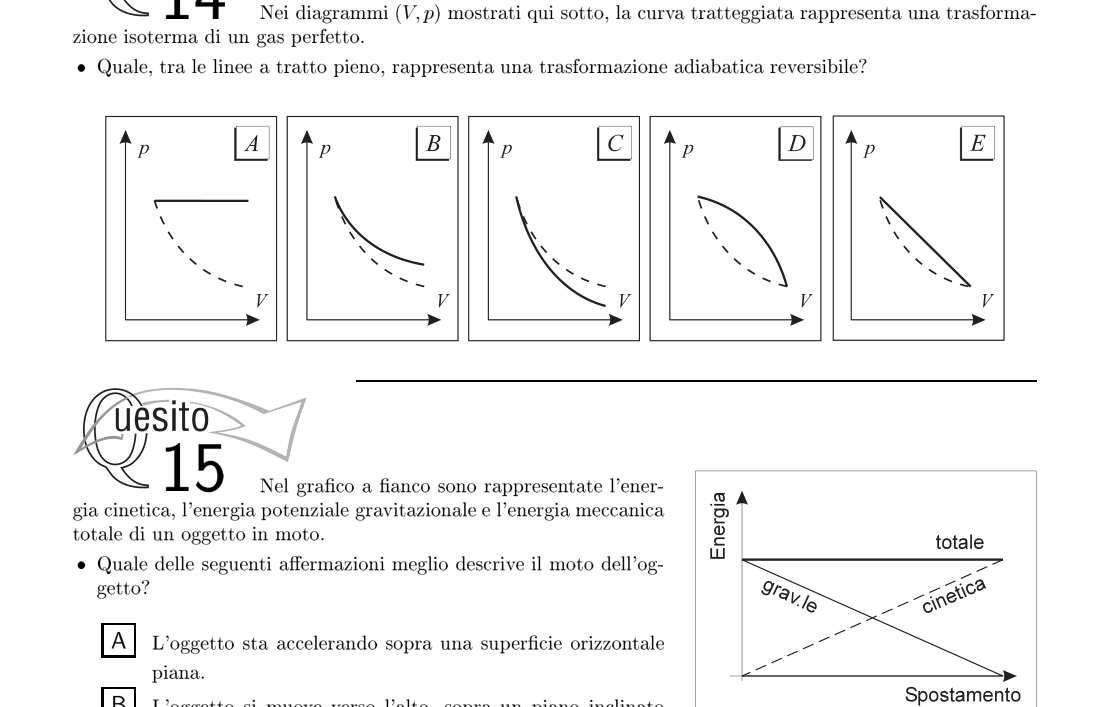 Diagrammi pV con isoterma e adiabatica
Topic: Thermodynamics Metodi: Thermodynamic Cycle Analysis, Ideal Gas Law Competenze: Diagrammatic Reasoning, Physical Reasoning Objects: Gas Fonte: Testo (PDF) — p.7 Risposta: C · Soluzioni (PDF)
In the diagrams shown below, the dashed curve represents an isothermal transformation of a perfect gas.
Which, among the solid lines, represents a reversible adiabatic transformation?
pV diagrams with isotherm and adiabat
Answer: C · Soluzioni (PDF)
Nel grafico a fianco sono rappresentate l’energia cinetica, l’energia potenziale gravitazionale e l’energia meccanica totale di un oggetto in moto.
Quale delle seguenti affermazioni meglio descrive il moto dell’oggetto?
- A. L’oggetto sta accelerando sopra una superficie orizzontale piana.
- B. L’oggetto si muove verso l’alto, sopra un piano inclinato senza attrito.
- C. L’oggetto è in caduta libera.
- D. L’oggetto viene sollevato a velocità costante.
- E. L’oggetto si muove in basso, sopra un piano inclinato con attrito.
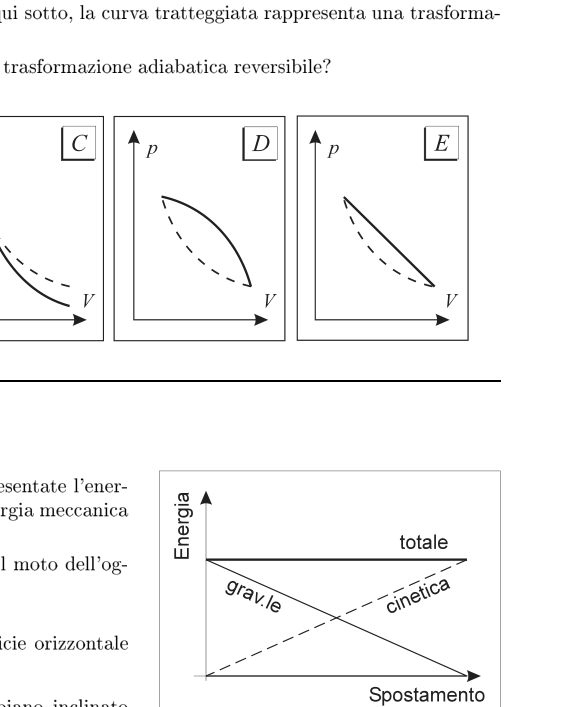 Grafico energie cinetica, potenziale, totale
Topic: Conservation of Energy, Newtonian Mechanics Metodi: Energy Conservation Method, Free-Body Diagram Competenze: Diagrammatic Reasoning, Physical Reasoning Objects: Inclined Plane Fonte: Testo (PDF) — p.7 Risposta: C · Soluzioni (PDF)
The graph alongside shows the kinetic energy, the gravitational potential energy and the total mechanical energy of a moving object.
Which of the following statements best describes the motion of the object?
- A. The object is accelerating on a flat horizontal surface.
- B. The object moves upward, on a frictionless inclined plane.
- C. The object is in free fall.
- D. The object is being raised at constant speed.
- E. The object moves downward, on an inclined plane with friction.
Graph of kinetic, potential, total energy
Answer: C · Soluzioni (PDF)
Un oggetto di massa si trova sopra un piano inclinato. Il modulo della componente della forza peso lungo la direzione del piano inclinato vale . Una forza di , parallela al piano inclinato, è applicata all’oggetto, come mostrato in figura. L’oggetto accelera verso l’alto lungo il piano inclinato a .
Quanto vale l’intensità della forza di attrito che si oppone al moto dell’oggetto?
- A.
- B.
- C.
- D.
- E.
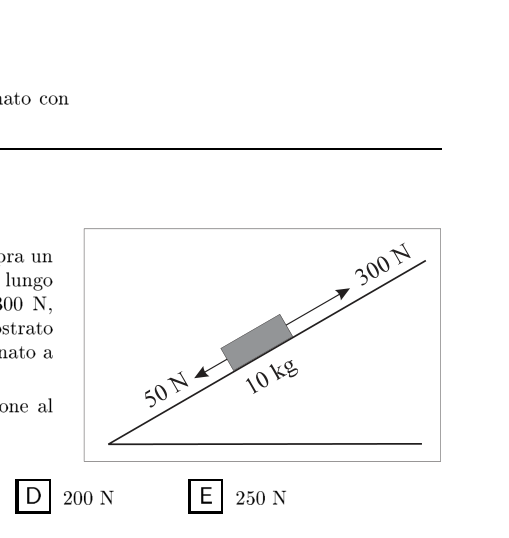 Oggetto su piano inclinato con forza applicata
Topic: Newtonian Mechanics Metodi: Free-Body Diagram, Vector Decomposition Competenze: Physical Reasoning, Mathematical Modeling Objects: Block, Inclined Plane Fonte: Testo (PDF) — p.7 Risposta: C · Soluzioni (PDF)
An object of mass is on an inclined plane. The magnitude of the component of the weight force along the direction of the inclined plane is . A force of , parallel to the inclined plane, is applied to the object, as shown in the figure. The object accelerates upward along the inclined plane at .
What is the magnitude of the friction force that opposes the motion of the object?
- A.
- B.
- C.
- D.
- E.
Object on an inclined plane with applied force
Answer: C · Soluzioni (PDF)
Cinque gruppi di studenti effettuano un esperimento in cui un fascio di luce monocromatica incide su una superficie metallica dalla quale vengono emessi elettroni. Partendo tutti dalla stessa situazione, ogni gruppo prova a cambiare l’intensità del fascio () e la lunghezza d’onda della luce (), osservando che in tutti i casi si continua ad osservare l’emissione di elettroni. Quale gruppo registra un aumento del numero di elettroni emesso per unità di tempo e contemporaneamente una diminuzione della loro energia cinetica media?
| Variazione di | Variazione di | |
|---|---|---|
| A | diminuzione del | aumento del |
| B | diminuzione del | invariata |
| C | invariata | diminuzione del |
| D | aumento del | diminuzione del |
| E | aumento del | diminuzione del |
Topic: Modern-Quantum Physics Metodi: Photon Energy Relation Competenze: Physical Reasoning, Experimental Data Analysis Objects: Photon, Electron Fonte: Testo (PDF) — p.8 Risposta: B · Soluzioni (PDF)
Five groups of students perform an experiment in which a beam of monochromatic light strikes a metal surface from which electrons are emitted. Starting from the same situation, each group tries to change the intensity of the beam () and the wavelength of the light (), observing that in all cases the emission of electrons continues to be observed. Which group records an increase in the number of electrons emitted per unit time and at the same time a decrease in their average kinetic energy?
| Change in | Change in | |
|---|---|---|
| A | decrease in | increase in |
| B | decrease in | unchanged |
| C | unchanged | decrease in |
| D | increase in | decrease in |
| E | increase in | decrease in |
Answer: B · Soluzioni (PDF)
Una carica puntiforme si trova all’interno di un conduttore sferico di raggio interno e raggio esterno . La carica totale del conduttore è .
Qual è la carica sulla superficie interna del conduttore e quella sulla sua superficie esterna?
| A | ||
| B | ||
| C | ||
| D | ||
| E |
Topic: Electrostatics Metodi: Gauss’s Law, Symmetry Argument Competenze: Physical Reasoning, Mathematical Modeling Objects: Point Charge, Conducting Sphere Fonte: Testo (PDF) — p.8 Risposta: A · Soluzioni (PDF)
A point charge is located inside a spherical conductor with inner radius and outer radius . The total charge of the conductor is .
What is the charge on the inner surface of the conductor and the charge on its outer surface?
| A | ||
| B | ||
| C | ||
| D | ||
| E |
Answer: A · Soluzioni (PDF)
Due fili di uguale lunghezza, uno di alluminio () e l’altro di rame (), hanno la stessa resistenza elettrica.
Qual è il rapporto dei loro raggi ?
(A) (B) (C) (D) (E)
Topic: Circuits, Electromagnetism Metodi: Physical Modeling, Dimensional Analysis Competenze: Mathematical Modeling, Physical Reasoning Objects: Wire Fonte: Testo (PDF) — p.8 Soluzione: Soluzioni (PDF)
Two wires of equal length, one of aluminium () and the other of copper (), have the same electrical resistance.
What is the ratio of their radii ?
(A) (B) (C) (D) (E)
Topic: Circuits, Electromagnetism Metodi: Physical Modeling, Dimensional Analysis Competenze: Mathematical Modeling, Physical Reasoning Objects: Wire Fonte: Testo (PDF) — p.8 Soluzione: Soluzioni (PDF)
Le ruote motrici di una locomotiva a vapore hanno il raggio di . La locomotiva parte da ferma con accelerazione costante per , spazio nel quale le ruote motrici raggiungono — senza mai strisciare — una velocità angolare di .
Con che accelerazione angolare si sono mosse le ruote?
- A.
- B.
- C.
- D.
- E. Topic: Rotational Dynamics, Newtonian Mechanics Metodi: Kinematic Equations, Torque & Angular Momentum Analysis Competenze: Mathematical Modeling, Physical Reasoning Objects: Wheel Fonte: Testo (PDF) — p.8 Risposta: B · Soluzioni (PDF)
The driving wheels of a steam locomotive have a radius of . The locomotive starts from rest with constant acceleration for , a distance over which the driving wheels reach — without ever slipping — an angular velocity of .
With what angular acceleration did the wheels move?
- A.
- B.
- C.
- D.
- E. Answer: B · Soluzioni (PDF)
Una sbarra rigida, di massa trascurabile, di lunghezza , è imperniata nel punto W. Alle estremità della sbarra sono applicate due forze verticali, ciascuna di modulo , orientate verso l’alto, come mostrato nella figura. Una terza forza verticale, anch’essa di modulo , orientata verso l’alto o verso il basso, può essere applicata in uno dei seguenti punti: V, W, X e Y.
Scegliendo opportunamente il verso, la sbarra può trovarsi in equilibrio se la terza forza viene applicata:
- A. nel punto W.
- B. nel punto Y.
- C. nel punto V o nel punto X.
- D. nel punto V o nel punto Y.
- E. in uno dei punti V, W o X.
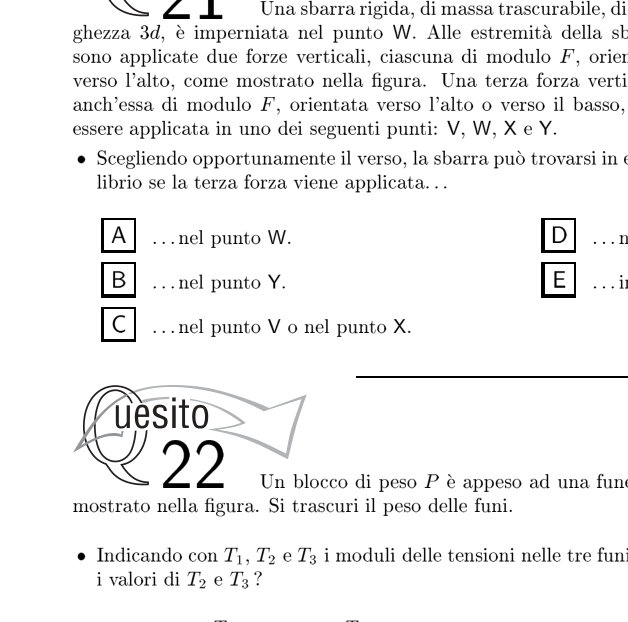 Sbarra con tre forze e punto di perno
Topic: Rigid Body Statics, Newtonian Mechanics Metodi: Torque & Angular Momentum Analysis, Free-Body Diagram Competenze: Physical Reasoning, Diagrammatic Reasoning Objects: Rod Fonte: Testo (PDF) — p.9 Risposta: C · Soluzioni (PDF)
A rigid bar, of negligible mass, of length , is pivoted at point W. At the ends of the bar two vertical forces are applied, each of magnitude , directed upward, as shown in the figure. A third vertical force, also of magnitude , directed upward or downward, can be applied at one of the following points: V, W, X and Y.
By choosing the direction appropriately, the bar can be in equilibrium if the third force is applied:
- A. at point W.
- B. at point Y.
- C. at point V or at point X.
- D. at point V or at point Y.
- E. at one of the points V, W or X.
Bar with three forces and pivot point
Answer: C · Soluzioni (PDF)
Un blocco di peso è appeso ad una fune a sua volta attaccata ad altre due funi, come mostrato nella figura. Si trascuri il peso delle funi.
Indicando con , e i moduli delle tensioni nelle tre funi, quali sono i valori di e ?
| A | ||
| B | ||
| C | ||
| D | ||
| E |
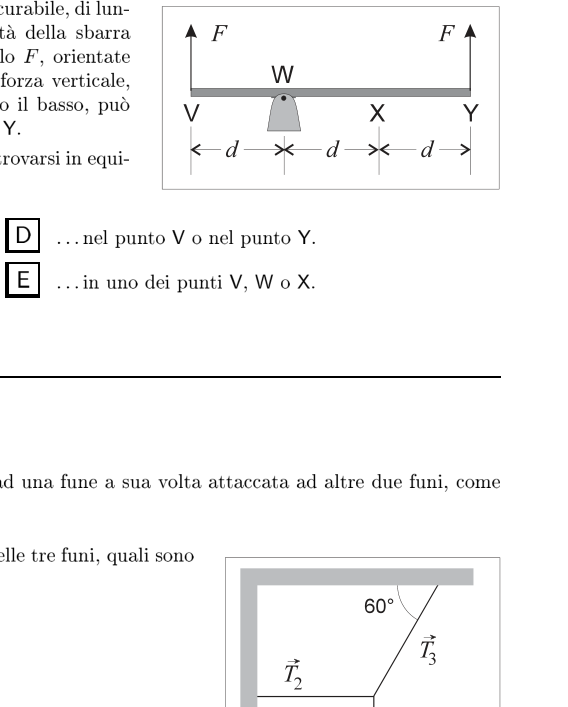 Blocco appeso a sistema di tre funi
Topic: Rigid Body Statics, Newtonian Mechanics Metodi: Free-Body Diagram, Vector Decomposition Competenze: Physical Reasoning, Mathematical Modeling Objects: Block, String Fonte: Testo (PDF) — p.9 Risposta: E · Soluzioni (PDF)
A block of weight is suspended from a rope which is in turn attached to two other ropes, as shown in the figure. Neglect the weight of the ropes.
Denoting by , and the magnitudes of the tensions in the three ropes, what are the values of and ?
| A | ||
| B | ||
| C | ||
| D | ||
| E |
Block suspended from a system of three ropes
Answer: E · Soluzioni (PDF)
In figura sono schematizzati due impulsi, A e B, che viaggiano lungo una fune omogenea da sinistra verso destra.
Rispetto all’impulso A l’impulso B ha:
- A. velocità minore ed energia più alta.
- B. velocità maggiore ed energia più bassa.
- C. velocità maggiore e la stessa energia.
- D. la stessa velocità ed energia più bassa.
- E. la stessa velocità ed energia più alta.
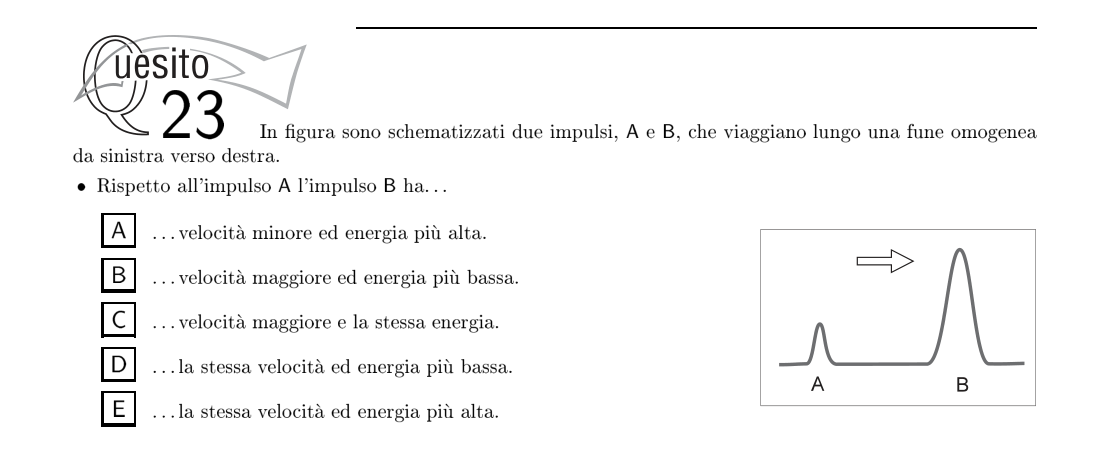 Due impulsi A e B su una fune
Topic: Oscillations & Waves Metodi: Wave Equation, Superposition Principle Competenze: Physical Reasoning, Diagrammatic Reasoning Objects: String Fonte: Testo (PDF) — p.9 Risposta: E · Soluzioni (PDF)
The figure schematically shows two pulses, A and B, traveling along a uniform string from left to right.
Compared with pulse A, pulse B has:
- A. lower speed and higher energy.
- B. higher speed and lower energy.
- C. higher speed and the same energy.
- D. the same speed and lower energy.
- E. the same speed and higher energy.
Two pulses A and B on a string
Answer: E · Soluzioni (PDF)
Due lunghi fili rettilinei, paralleli, posti a distanza , sono disposti sul piano di questo foglio, e sono percorsi da corrente elettrica di intensità uguale nei due fili e rivolta nello stesso verso.
Il campo magnetico generato dalla corrente che scorre nei due fili, in un punto del foglio, equidistante da essi, è:
- A. Nullo.
- B. Perpendicolare al piano del foglio, con verso entrante.
- C. Perpendicolare al piano del foglio, con verso uscente.
- D. Nel piano del foglio, parallelo ai fili e diretto nel verso della corrente.
- E. Nel piano del foglio, parallelo ai fili e diretto in verso opposto alla corrente. Topic: Magnetism, Electromagnetism Metodi: Biot-Savart Law, Superposition Principle Competenze: Physical Reasoning, Diagrammatic Reasoning Objects: Wire Fonte: Testo (PDF) — p.10 Risposta: A · Soluzioni (PDF)
Two long straight parallel wires, placed at a distance , are arranged on the plane of this sheet, and are traversed by an electric current of intensity equal in the two wires and directed in the same direction.
The magnetic field generated by the current flowing in the two wires, at a point on the sheet equidistant from them, is:
- A. Zero.
- B. Perpendicular to the plane of the sheet, directed inward.
- C. Perpendicular to the plane of the sheet, directed outward.
- D. In the plane of the sheet, parallel to the wires and directed in the direction of the current.
- E. In the plane of the sheet, parallel to the wires and directed opposite to the current. Answer: A · Soluzioni (PDF)
Nella figura è schematizzato uno specchio sferico concavo ed un oggetto sottile, perpendicolare all’asse ottico e posto con un’estremità nel centro di curvatura dello specchio, C.
Se l’oggetto viene spostato lungo l’asse, mentre si avvicina al fuoco, l’immagine:
- A. rimpicciolisce e si avvicina allo specchio.
- B. rimpicciolisce e si allontana dallo specchio.
- C. mantiene le medesime dimensioni e si avvicina allo specchio.
- D. ingrandisce e si avvicina allo specchio.
- E. ingrandisce e si allontana dallo specchio.
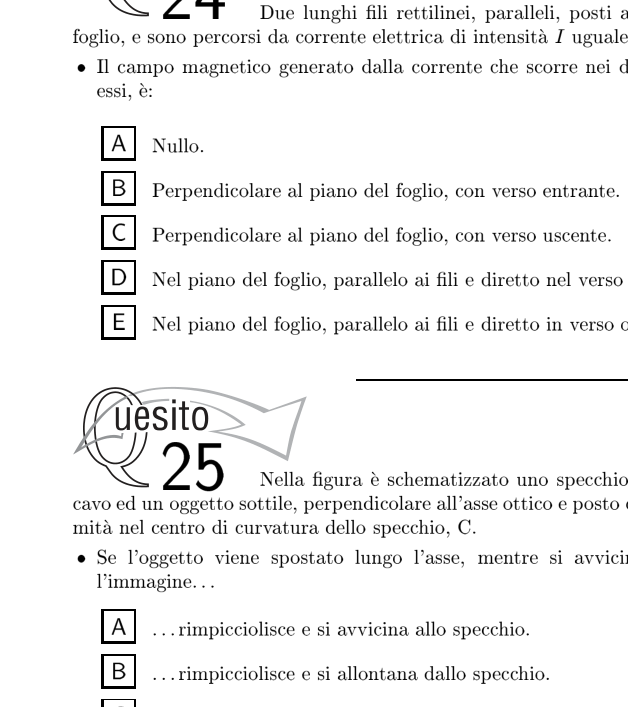 Specchio sferico concavo con oggetto al centro
Topic: Geometric Optics Metodi: Thin Lens & Mirror Equation, Ray Tracing Competenze: Physical Reasoning, Diagrammatic Reasoning Objects: Mirror Fonte: Testo (PDF) — p.10 Risposta: E · Soluzioni (PDF)
The figure schematically shows a concave spherical mirror and a thin object, perpendicular to the optical axis and placed with one end at the center of curvature of the mirror, C.
If the object is moved along the axis while approaching the focus, the image:
- A. shrinks and approaches the mirror.
- B. shrinks and moves away from the mirror.
- C. keeps the same size and approaches the mirror.
- D. enlarges and approaches the mirror.
- E. enlarges and moves away from the mirror.
Concave spherical mirror with object at the center
Answer: E · Soluzioni (PDF)
Una batteria avente una forza elettromotrice di e una resistenza interna di viene collegata al circuito mostrato in figura.
Quando l’interruttore S viene chiuso il valore indicato dall’amperometro passa:
- A. da a
- B. da a
- C. da a
- D. da a
- E. da a
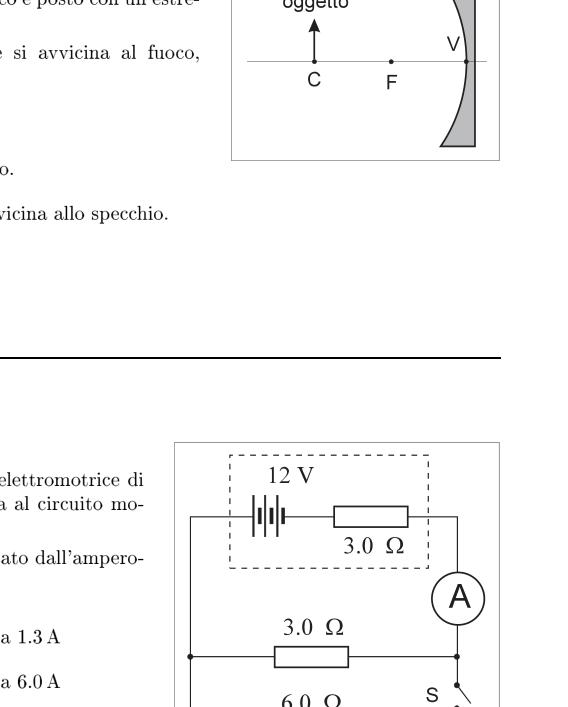 Circuito con batteria e interruttore S
Topic: Circuits Metodi: Kirchhoff’s Laws, Equivalent Circuit Reduction Competenze: Physical Reasoning, Mathematical Modeling Objects: Battery, Resistor, Switch Fonte: Testo (PDF) — p.10 Risposta: B · Soluzioni (PDF)
A battery having an electromotive force of and an internal resistance of is connected to the circuit shown in the figure.
When switch S is closed, the value indicated by the ammeter changes:
- A. from to
- B. from to
- C. from to
- D. from to
- E. from to
Circuit with battery and switch S
Answer: B · Soluzioni (PDF)
Un raggio di luce incide su una coppia di specchi piani posti ad angolo retto, rigidamente collegati tra loro. L’angolo di incidenza sul primo specchio è di , come mostrato nella figura a sinistra.
Se l’insieme dei due specchi viene rigidamente ruotato in modo che l’angolo di incidenza sul primo specchio sia (figura a destra), che cosa succede alla direzione del raggio riflesso dal secondo specchio?
- A. Ruoterà di .
- B. Ruoterà di .
- C. Ruoterà di .
- D. Ruoterà di .
- E. Non ruoterà affatto.
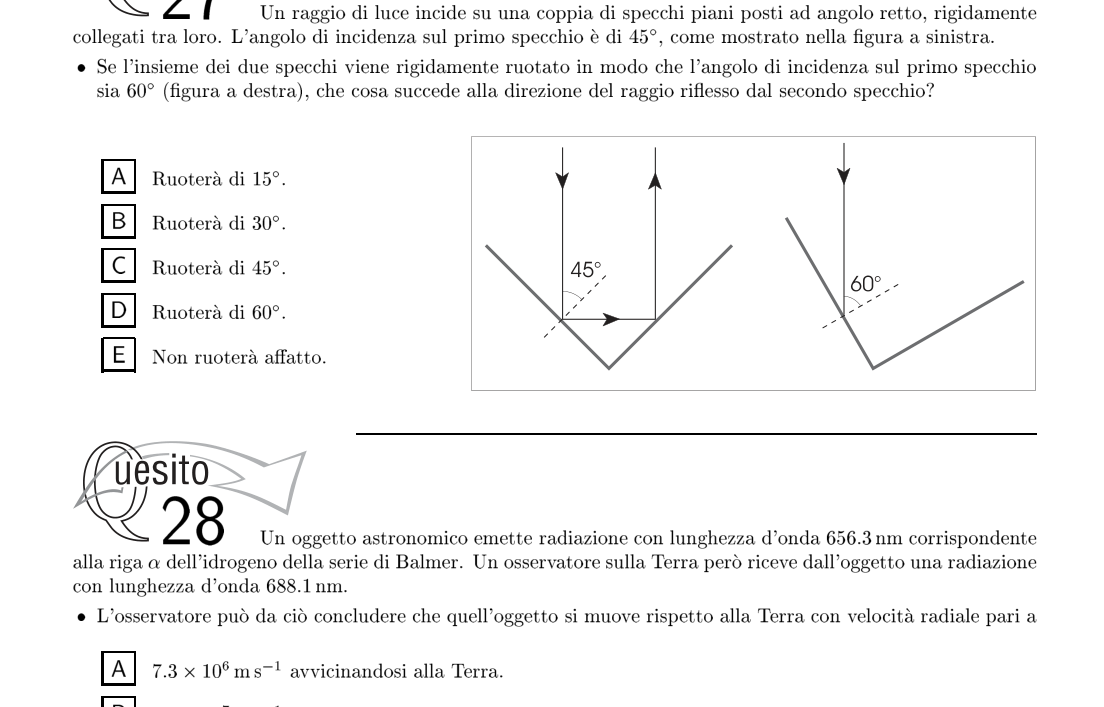 Coppia di specchi piani ad angolo retto
Topic: Geometric Optics Metodi: Ray Tracing, Symmetry Argument Competenze: Physical Reasoning, Diagrammatic Reasoning Objects: Mirror Fonte: Testo (PDF) — p.11 Risposta: E · Soluzioni (PDF)
A ray of light strikes a pair of plane mirrors placed at a right angle, rigidly connected to each other. The angle of incidence on the first mirror is , as shown in the figure on the left.
If the assembly of the two mirrors is rigidly rotated so that the angle of incidence on the first mirror is (figure on the right), what happens to the direction of the ray reflected by the second mirror?
- A. It will rotate by .
- B. It will rotate by .
- C. It will rotate by .
- D. It will rotate by .
- E. It will not rotate at all.
Pair of plane mirrors at a right angle
Answer: E · Soluzioni (PDF)
Un oggetto astronomico emette radiazione con lunghezza d’onda corrispondente alla riga dell’idrogeno della serie di Balmer. Un osservatore sulla Terra però riceve dall’oggetto una radiazione con lunghezza d’onda .
L’osservatore può da ciò concludere che quell’oggetto si muove rispetto alla Terra con velocità radiale pari a:
- A. avvicinandosi alla Terra.
- B. avvicinandosi alla Terra.
- C. allontanandosi dalla Terra.
- D. allontanandosi dalla Terra.
- E. allontanandosi dalla Terra. Topic: Astrophysics, Oscillations & Waves, Special Relativity Metodi: Wave Equation, Approximation & Series Expansion Competenze: Mathematical Modeling, Physical Reasoning Objects: Star, Photon Fonte: Testo (PDF) — p.11 Risposta: D · Soluzioni (PDF)
An astronomical object emits radiation with wavelength corresponding to the line of hydrogen in the Balmer series. An observer on Earth, however, receives from the object radiation with wavelength .
From this the observer can conclude that this object moves relative to the Earth with radial velocity equal to:
- A. approaching the Earth.
- B. approaching the Earth.
- C. moving away from the Earth.
- D. moving away from the Earth.
- E. moving away from the Earth. Answer: D · Soluzioni (PDF)
Un grosso rocchetto, su cui è avvolto del filo, è appoggiato sul pavimento. L’estremità X del filo viene tirata (v. figura) per un tratto . Il rocchetto rotola senza strisciare.
Di quanto si sposta il centro del rocchetto?
- A.
- B.
- C.
- D.
- E.
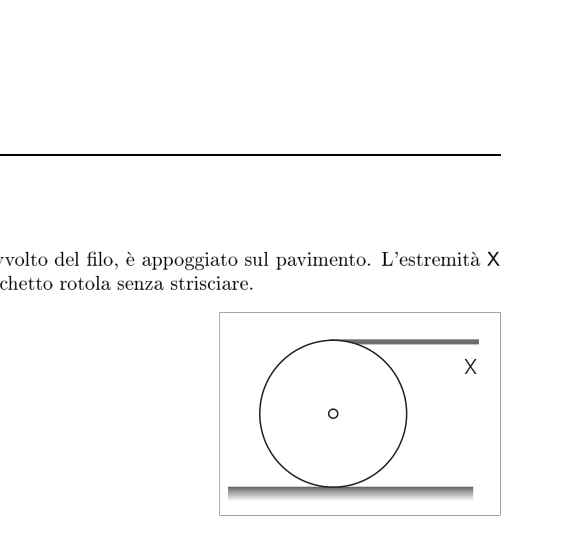 Rocchetto con filo tirato che rotola
Topic: Rotational Dynamics, Newtonian Mechanics Metodi: Torque & Angular Momentum Analysis, Kinematic Equations Competenze: Physical Reasoning, Diagrammatic Reasoning Objects: Cylinder, String Fonte: Testo (PDF) — p.11 Risposta: C · Soluzioni (PDF)
A large spool, on which thread is wound, rests on the floor. The end X of the thread is pulled (see figure) by a length . The spool rolls without slipping.
By how much does the center of the spool move?
- A.
- B.
- C.
- D.
- E.
Spool with thread pulled that rolls
Answer: C · Soluzioni (PDF)
La figura si riferisce ad una forza costante , di componenti e , che agisce su un corpo puntiforme mentre si sposta dal punto al punto , dove le coordinate sono espresse in metri.
Quanto lavoro viene esercitato dalla forza durante lo spostamento del corpo?
- A.
- B.
- C.
- D.
- E.
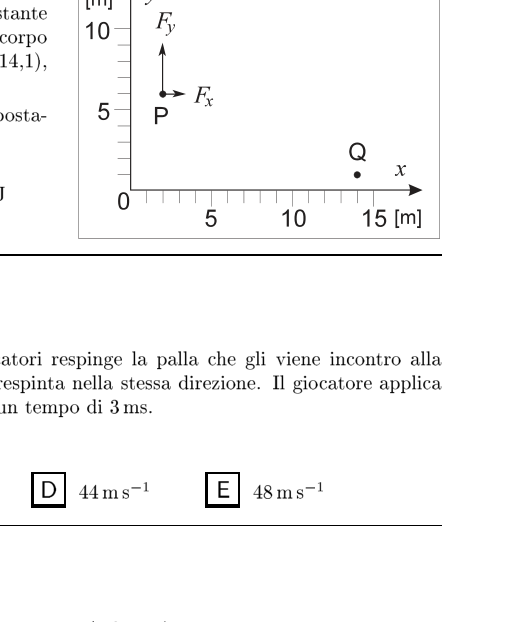 Forza costante con spostamento P→Q
Topic: Newtonian Mechanics, Conservation of Energy Metodi: Energy Conservation Method, Vector Decomposition Competenze: Mathematical Modeling, Physical Reasoning Objects: — Fonte: Testo (PDF) — p.12 Risposta: A · Soluzioni (PDF)
The figure refers to a constant force , with components and , acting on a point mass as it moves from point to point , where the coordinates are expressed in meters.
How much work is done by the force during the displacement of the body?
- A.
- B.
- C.
- D.
- E.
Constant force with displacement P→Q
Answer: A · Soluzioni (PDF)
In una partita di tennis uno dei giocatori respinge la palla che gli viene incontro alla velocità di ; la palla, la cui massa è di , viene respinta nella stessa direzione. Il giocatore applica alla palla, con la racchetta, una forza media di per un tempo di .
Che velocità ha la palla appena è stata respinta?
- A.
- B.
- C.
- D.
- E. Topic: Newtonian Mechanics, Conservation of Momentum Metodi: Impulse-Momentum Theorem Competenze: Mathematical Modeling, Physical Reasoning Objects: Ball Fonte: Testo (PDF) — p.12 Risposta: D · Soluzioni (PDF)
In a tennis match one of the players hits back the ball coming toward him at a speed of ; the ball, whose mass is , is hit back in the same direction. The player applies to the ball, with the racket, an average force of for a time of .
What speed does the ball have as soon as it has been hit back?
- A.
- B.
- C.
- D.
- E. Answer: D · Soluzioni (PDF)
Un’automobile che viaggia alla velocità di frena (con accelerazione che si suppone costante) e si arresta in .
Quanto tempo impiega la macchina a fermarsi?
- A.
- B.
- C.
- D.
- E. Topic: Newtonian Mechanics Metodi: Kinematic Equations Competenze: Mathematical Modeling, Physical Reasoning Objects: — Fonte: Testo (PDF) — p.12 Risposta: E · Soluzioni (PDF)
A car traveling at a speed of brakes (with acceleration assumed constant) and comes to a stop in .
How much time does the car take to stop?
- A.
- B.
- C.
- D.
- E. Answer: E · Soluzioni (PDF)
In un episodio di Star Trek un oggetto di peso (sulla Terra) viene teletrasportato dal capitano Kirk su di un pianeta X il cui raggio e la cui massa sono esattamente metà di quelli terrestri.
Se il capitano pesasse di nuovo l’oggetto troverebbe un valore pari a:
- A.
- B.
- C.
- D.
- E. Topic: Gravitation, Newtonian Mechanics Metodi: Newton’s Law of Gravitation Competenze: Mathematical Modeling, Physical Reasoning Objects: Planet Fonte: Testo (PDF) — p.12 Risposta: B · Soluzioni (PDF)
In an episode of Star Trek an object of weight (on Earth) is teleported by Captain Kirk onto a planet X whose radius and mass are exactly half those of Earth.
If the captain weighed the object again he would find a value equal to:
- A.
- B.
- C.
- D.
- E. Answer: B · Soluzioni (PDF)
Un pallone di di volume contiene una certa massa di gas alla temperatura di e alla pressione di . Il gas, che può essere trattato come gas perfetto, viene riscaldato fino a mentre la pressione viene ridotta alla metà.
Il volume finale del pallone è:
- A.
- B.
- C.
- D.
- E. Topic: Thermodynamics, Kinetic Theory Metodi: Ideal Gas Law Competenze: Mathematical Modeling, Physical Reasoning Objects: Gas, Container Fonte: Testo (PDF) — p.12 Risposta: E · Soluzioni (PDF)
A balloon of volume contains a certain mass of gas at a temperature of and at a pressure of . The gas, which can be treated as an ideal gas, is heated to while the pressure is reduced by half.
The final volume of the balloon is:
- A.
- B.
- C.
- D.
- E. Answer: E · Soluzioni (PDF)
Una radiazione a microonde passa attraverso due fenditure P e Q di una piastra metallica. Un sensore di microonde che viene spostato dal punto R al punto S dello schermo rileva una serie di massimi e minimi di intensità della radiazione, come indicato in figura. La lunghezza d’onda della radiazione è .
Quanto vale la differenza di percorso tra PT e QT?
- A.
- B.
- C.
- D.
- E.
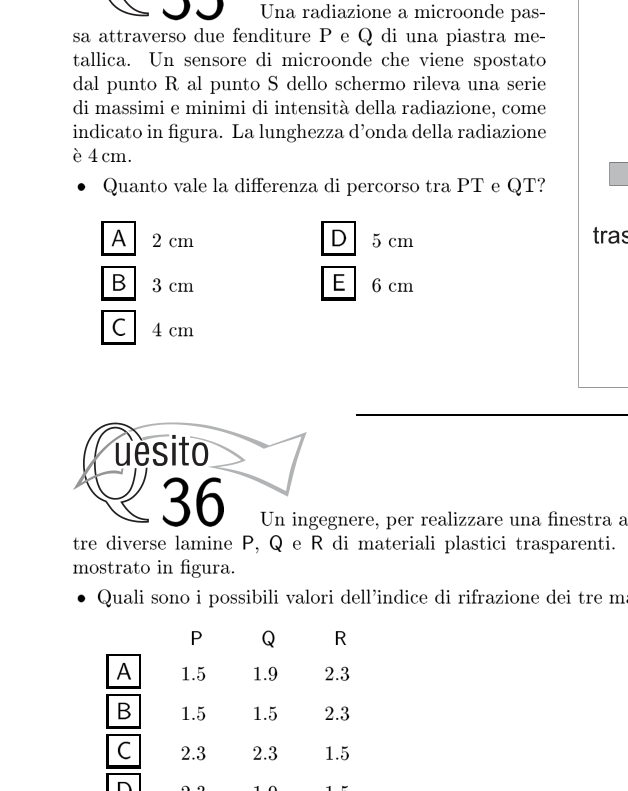 Doppia fenditura con pattern di interferenza
Topic: Wave Optics, Oscillations & Waves Metodi: Interference & Diffraction Analysis, Superposition Principle Competenze: Mathematical Modeling, Physical Reasoning Objects: Slit, Screen Fonte: Testo (PDF) — p.13 Risposta: E · Soluzioni (PDF)
A microwave radiation passes through two slits P and Q in a metal plate. A microwave sensor that is moved from point R to point S on the screen detects a series of maxima and minima of radiation intensity, as shown in the figure. The wavelength of the radiation is .
What is the path difference between PT and QT?
- A.
- B.
- C.
- D.
- E.
Double slit with interference pattern
Answer: E · Soluzioni (PDF)
Un ingegnere, per realizzare una finestra attraverso cui osservare un esperimento, utilizza tre diverse lamine P, Q e R di materiali plastici trasparenti. Un raggio di luce attraversa la finestra come mostrato in figura.
Quali sono i possibili valori dell’indice di rifrazione dei tre materiali plastici?
| P | Q | R | |
|---|---|---|---|
| A | |||
| B | |||
| C | |||
| D | |||
| E |
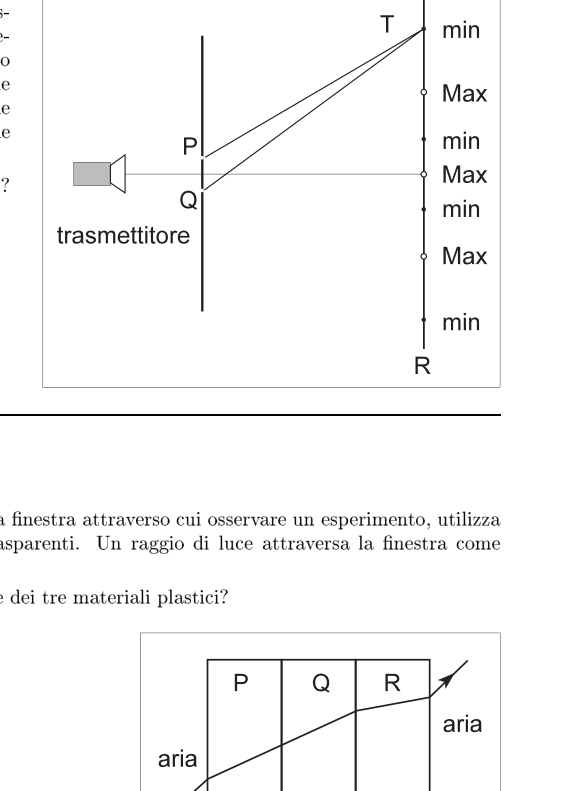 Raggio di luce attraverso tre lamine P, Q, R
Topic: Geometric Optics Metodi: Snell’s Law, Ray Tracing Competenze: Physical Reasoning, Diagrammatic Reasoning Objects: — Fonte: Testo (PDF) — p.13 Soluzione: Soluzioni (PDF)
An engineer, to create a window through which to observe an experiment, uses three different layers P, Q and R of transparent plastic materials. A ray of light passes through the window as shown in the figure.
What are the possible values of the refractive index of the three plastic materials?
| P | Q | R | |
|---|---|---|---|
| A | |||
| B | |||
| C | |||
| D | |||
| E |
Light ray through three sheets P, Q, R*
Topic: Geometric Optics Metodi: Snell’s Law, Ray Tracing Competenze: Physical Reasoning, Diagrammatic Reasoning Objects: — Fonte: Testo (PDF) — p.13 Soluzione: Soluzioni (PDF)
Di due oggetti si conoscono solo le rispettive temperature, che sono diverse.
Con queste sole informazioni si può dedurre:
- A. l’energia interna di ciascun oggetto.
- B. quanto calore può essere trasmesso da un oggetto all’altro.
- C. se ci sarà uno scambio di calore quando gli oggetti sono messi in contatto termico.
- D. l’energia termica di ciascun oggetto.
- E. la temperatura di equilibrio a cui pervengono i due oggetti messi in contatto termico. Topic: Thermodynamics Metodi: First Law of Thermodynamics, Physical Modeling Competenze: Physical Reasoning Objects: — Fonte: Testo (PDF) — p.13 Risposta: C · Soluzioni (PDF)
Only the respective temperatures of two objects are known, and they are different.
With only this information, one can deduce:
- A. the internal energy of each object.
- B. how much heat can be transferred from one object to the other.
- C. whether there will be an exchange of heat when the objects are put in thermal contact.
- D. the thermal energy of each object.
- E. the equilibrium temperature reached by the two objects when put in thermal contact. Answer: C · Soluzioni (PDF)
Cinque oggetti sono fatti, rispettivamente, di piombo, argento, tungsteno, rame e cromo; hanno tutti massa di e sono alla temperatura di .
Se ad ogni oggetto vengono forniti di calore, quale di essi alla fine avrà la temperatura più bassa?
- A. Il piombo, dato che presenta il calore di fusione più basso.
- B. L’argento, dato che ha la conducibilità termica più alta.
- C. Il tungsteno, dato che ha il calore di vaporizzazione più alto.
- D. Il rame, dato che ha il calore specifico più alto.
- E. Il cromo, dato che ha il calore specifico più basso.
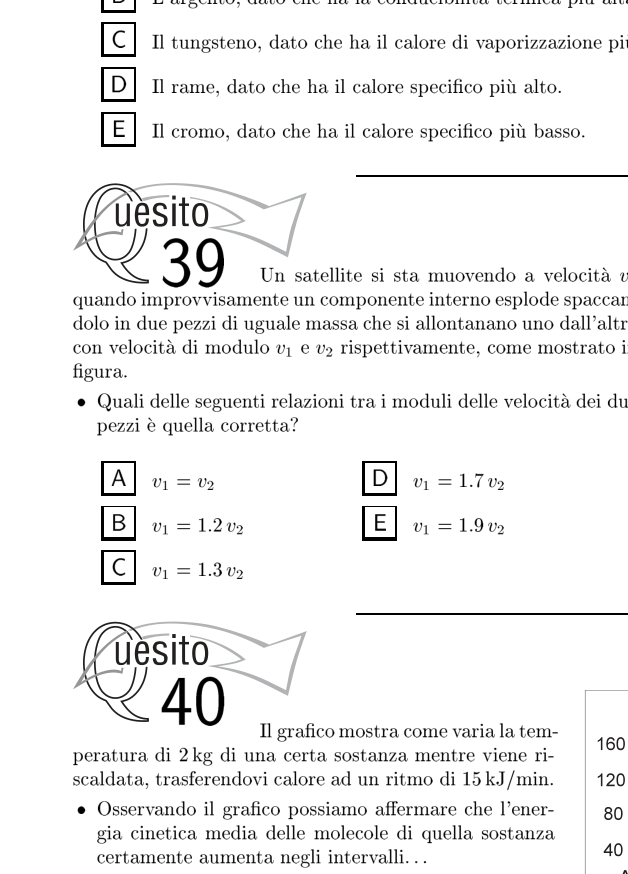 Grafico temperatura vs calore fornito
Topic: Thermodynamics Metodi: First Law of Thermodynamics, Physical Modeling Competenze: Physical Reasoning, Estimation & Approximation Objects: — Fonte: Testo (PDF) — p.14 Risposta: D · Soluzioni (PDF)
Five objects are made, respectively, of lead, silver, tungsten, copper, and chromium; they all have a mass of and are at a temperature of .
If each object is supplied with of heat, which of them will ultimately have the lowest temperature?
- A. Lead, since it has the lowest heat of fusion.
- B. Silver, since it has the highest thermal conductivity.
- C. Tungsten, since it has the highest heat of vaporization.
- D. Copper, since it has the highest specific heat.
- E. Chromium, since it has the lowest specific heat.
Graph of temperature vs heat supplied
Answer: D · Soluzioni (PDF)
Un satellite si sta muovendo a velocità quando improvvisamente un componente interno esplode spaccandolo in due pezzi di uguale massa che si allontanano uno dall’altro con velocità di modulo e rispettivamente, come mostrato in figura.
Quali delle seguenti relazioni tra i moduli delle velocità dei due pezzi è quella corretta?
- A.
- B.
- C.
- D.
- E.
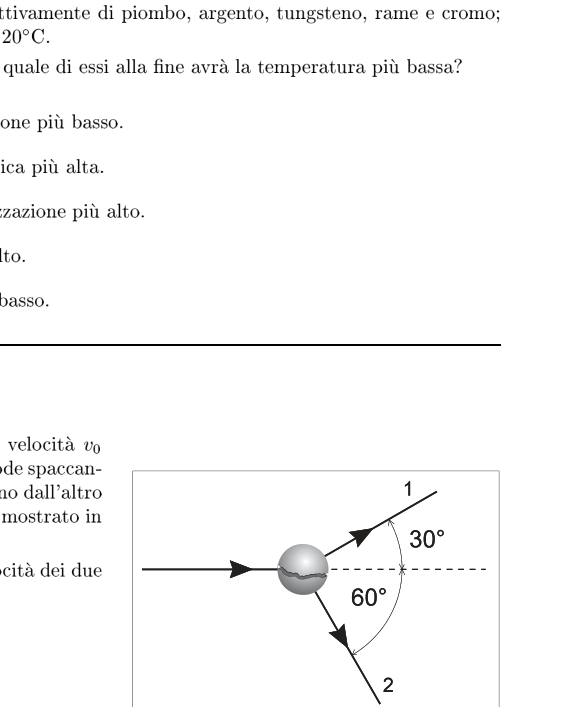 Satellite che esplode in due pezzi
Topic: Conservation of Momentum, Newtonian Mechanics Metodi: Conservation of Momentum Competenze: Mathematical Modeling, Physical Reasoning Objects: Satellite Fonte: Testo (PDF) — p.14 Risposta: D · Soluzioni (PDF)
A satellite is moving at speed when suddenly an internal component explodes, breaking it into two pieces of equal mass that move away from each other with speeds of magnitude and respectively, as shown in the figure.
Which of the following relations between the magnitudes of the velocities of the two pieces is the correct one?
- A.
- B.
- C.
- D.
- E.
Satellite exploding into two pieces
Answer: D · Soluzioni (PDF)
Il grafico mostra come varia la temperatura di di una certa sostanza mentre viene riscaldata, trasferendovi calore ad un ritmo di .
Osservando il grafico possiamo affermare che l’energia cinetica media delle molecole di quella sostanza certamente aumenta negli intervalli:
- A. AB e CD.
- B. BC e DE.
- C. BC ed EF.
- D. DE ed EF.
- E. AB e BC. Topic: Thermodynamics, Kinetic Theory Metodi: First Law of Thermodynamics, Kinetic Theory of Gases Competenze: Diagrammatic Reasoning, Physical Reasoning Objects: — Fonte: Testo (PDF) — p.14 Risposta: A · Soluzioni (PDF)
The graph shows how the temperature of of a certain substance varies while it is being heated, transferring heat to it at a rate of .
By observing the graph we can state that the average kinetic energy of the molecules of that substance certainly increases in the intervals:
- A. AB and CD.
- B. BC and DE.
- C. BC and EF.
- D. DE and EF.
- E. AB and BC. Answer: A · Soluzioni (PDF)