Two high performance bicycle wheels have the same mass but one is a solid disk and the other is a hoop with very light (as compared to the mass of the rim) spokes. Which wheel takes the most energy to accelerate to a speed ? Ignore any air and rolling resistances.
- A. The disk wheel requires more energy.
- B. The spoked wheel requires more energy.
- C. Both take the same amount of energy.
- D. It depends on the radius of each wheel.
Topic: Rotational Dynamics, Conservation of Energy Metodi: Conservation of Energy, Physical Modeling Competenze: Physical Reasoning Objects: Wheel, Disk Fonte: Testo (PDF) — p.1
Due ruote di bicicletta ad alte prestazioni hanno la stessa massa, ma una è un disco solido e l’altra è un cerchio con spugni molto leggeri (rispetto alla massa del bordo). Quale ruota ha bisogno di più energia per accelerare a una velocità ? Ignora qualsiasi resistenza a aria e a rotoli.
- A. La ruota del disco richiede più energia.
- B. La ruota a spina richiede più energia.
- C. Entrambi assumono la stessa quantità di energia.
- D. Dipende dal raggio di ciascuna ruota.
Topic: Rotational Dynamics, Conservation of Energy Metodi: Conservation of Energy, Physical Modeling Competenze: Physical Reasoning Objects: Wheel, Disk Fonte: Testo (PDF) — p.1
An astronaut on a strange planet finds that the acceleration due to gravity is two times greater than that on earth. Which of the following could explain this?
- A. The mass of the planet is half that of the earth’s but its radius is the same.
- B. The radius of the planet is half that of the earth’s but its mass is the same.
- C. Both the mass and the radius are twice the earth’s values.
- D. Both the mass and the radius are half the earth’s values.
Topic: Gravitation, Newtonian Mechanics Metodi: Newton’s Law of Gravitation, Dimensional Analysis Competenze: Physical Reasoning Objects: Planet Fonte: Testo (PDF) — p.1
Un astronauta su un estraneo pianeta scopre che l’accelerazione dovuta alla gravità è due volte maggiore di quella sulla Terra. Quale delle seguenti spiegazioni potrebbe spiegare questo?
La massa del pianeta è metà della massa terrestre, ma il suo raggio è lo stesso. Il raggio del pianeta è la metà di quello della Terra ma la sua massa è la stessa.
- C. Sia la massa che il raggio sono due volte i valori della terra.
- D. Sia la massa che il raggio sono la metà dei valori della terra.
Topic: Gravitation, Newtonian Mechanics Metodi: Newton’s Law of Gravitation, Dimensional Analysis Competenze: Physical Reasoning Objects: Planet Fonte: Testo (PDF) — p.1
A ball of mass of 10 g is hung from the end of a light vertical spring and set oscillating with an amplitude of 10 cm. The period of the oscillation is 1 s. If the ball is now replaced by another with a mass of 40 g and again set oscillating with the same amplitude, its new period of oscillation will be,
- A. 1 s.
- B. 2 s.
- C. 4 s.
- D. 8 s.
Topic: Oscillations & Waves Metodi: Simple Harmonic Motion Analysis, Hooke’s Law Competenze: Physical Reasoning Objects: Ball, Spring Fonte: Testo (PDF) — p.1
Una palla di massa di 10 g viene appesa all’estremità di una leggera molla verticale e impostata oscillante con un’ampiezza di 10 cm. Il periodo di oscillazione è di 1 s. Se la palla viene sostituita da un’altra con una massa di 40 g e riposta oscillante con la stessa amplitudine, il suo nuovo periodo di oscillazione sarà:
- A. 1 s.
- B. 2 s.
- C. 4 s.
- D. 8 s.
Topic: Oscillations & Waves Metodi: Simple Harmonic Motion Analysis, Hooke’s Law Competenze: Physical Reasoning Objects: Ball, Spring Fonte: Testo (PDF) — p.1
The human ear canal, which is open to the atmosphere and ends at the ear drum, is about 3 cm long. Which of the following is the best approximation to the fundamental resonant frequency of the ear canal?
- A. 1,500 Hz
- B. 3,000 Hz
- C. 6,000 Hz
- D. 11,000 Hz
Topic: Oscillations & Waves Metodi: Wave Equation, Physical Modeling Competenze: Estimation & Approximation, Physical Reasoning Objects: Tube Fonte: Testo (PDF) — p.1
Il canale uditivo umano, che è aperto all’atmosfera e termina al tamburo dell’orecchio, ha circa 3 cm di lunghezza. Qual è la migliore approssimazione della frequenza di risonanza fondamentale del canale uditivo?
- A. 1,500 Hz
- B. 3,000 Hz
- C. 6,000 Hz
- D. 11,000 Hz
Topic: Oscillations & Waves Metodi: Wave Equation, Physical Modeling Competenze: Estimation & Approximation, Physical Reasoning Objects: Tube Fonte: Testo (PDF) — p.1
A metal ball is connected to the ground with a wire via a switch. The switch is initially closed (i.e. the ball is connected to ground) while a charge is brought close to the ball (but not touching). While the charge is near the ball, the switch is opened and then the charge is taken away. The charge on the ball is now,
- A. zero.
- B. positive.
- C. negative.
- D. unchanged from its initial charge.
Topic: Electrostatics Metodi: Physical Modeling, Superposition Principle Competenze: Physical Reasoning, Diagrammatic Reasoning Objects: Conducting Sphere, Wire, Switch, Point Charge Fonte: Testo (PDF) — p.2
Una palla di metallo è collegata al suolo con un filo tramite uno switch. Il switch è inizialmente chiuso (cioè: la palla è collegata al suolo) mentre una carica viene portata vicino alla palla (ma non si tocca). Mentre la carica è vicino alla palla, si apre il interruttore e poi la carica viene tolta. La carica sulla palla e’ ora,
- A. zero.
- B. positivo.
- C. negativo.
- D. invariato dal suo carico iniziale.
Topic: Electrostatics Metodi: Physical Modeling, Superposition Principle Competenze: Physical Reasoning, Diagrammatic Reasoning Objects: Conducting Sphere, Wire, Switch, Point Charge Fonte: Testo (PDF) — p.2
In the light from a distant star, a particular spectral line is observed. The wavelength of this line varies between being about 2% shorter than the same line as observed in an earth based laboratory, and about 2% longer. Which of the following best describes the star.
- A. The star is moving away from the earth.
- B. The star is moving towards the earth.
- C. The star is very, very massive as compared to the sun.
- D. The star is orbiting about some massive hidden object.
Topic: Astrophysics, Oscillations & Waves Metodi: Physical Modeling, Wave Equation Competenze: Physical Reasoning Objects: Star Fonte: Testo (PDF) — p.2
Nella luce di una stella lontana si osserva una particolare linea spettrale. La lunghezza d’onda di questa linea varia tra essere circa il 2% più breve della stessa linea osservata in un laboratorio terrestre e circa il 2% più lunga. Quale delle seguenti descrive meglio la stella.
La stella si sta allontanando dalla Terra.
- MSK1/> La stella si sta muovendo verso la Terra. La stella è molto, molto massiccia rispetto al sole. La stella sta orbitando attorno ad un oggetto massiccio nascosto.
Topic: Astrophysics, Oscillations & Waves Metodi: Physical Modeling, Wave Equation Competenze: Physical Reasoning Objects: Star Fonte: Testo (PDF) — p.2
A metal bar rotates about a vertical axis which passes through the center of the bar. The axis of rotation is perpendicular to the length of the bar. There is a uniform magnetic field in the vertical direction. The emf (or potential difference) induced between the two ends of the bar is,
- A. zero.
- B. a sinusoidally oscillating value.
- C. a non-zero positive value.
- D. a non-zero negative value.
Topic: Electromagnetic Induction Metodi: Faraday’s Law of Induction, Lorentz Force Analysis Competenze: Physical Reasoning, Diagrammatic Reasoning Objects: Rod Fonte: Testo (PDF) — p.2
Una barra di metallo ruota intorno ad un asse verticale che passa attraverso il centro della barra. L’asse di rotazione è perpendicolare alla lunghezza della barra. C’è un campo magnetico uniforme nella direzione verticale. L’emf (o differenza potenziale) indotta tra le due estremità della barra è:
- A. zero.
- B. un valore oscillante sinusoidale.
- C. un valore positivo non zero.
- D. un valore negativo non zero.
Topic: Electromagnetic Induction Metodi: Faraday’s Law of Induction, Lorentz Force Analysis Competenze: Physical Reasoning, Diagrammatic Reasoning Objects: Rod Fonte: Testo (PDF) — p.2
A projector shows an image which is in focus but too large for the screen on which it is shown. Since the projector and the screen are fixed in place, the projectionist must,
- A. adjust the projector’s lens by moving it closer to the screen.
- B. adjust the projector’s lens by moving it farther from the screen.
- C. replace the projector’s lens with one having a shorter focal length.
- D. replace the projector’s lens with one having a longer focal length.
Topic: Geometric Optics Metodi: Thin Lens & Mirror Equation, Ray Tracing Competenze: Physical Reasoning Objects: Lens, Screen Fonte: Testo (PDF) — p.2
Un proiettore mostra un’immagine che è focalizzata ma troppo grande per lo schermo su cui viene visualizzata. Poiché il proiettore e lo schermo sono fissati, il proiettore deve:
- A. regolare l’obiettivo del proiettore spostandolo più vicino allo schermo.
- B. regolare l’obiettivo del proiettore spostandolo più lontano dallo schermo.
- C. sostituire l’obiettivo del proiettore con uno con una lunghezza focale più breve.
- D. sostituire l’obiettivo del proiettore con uno con lunghezza focale più lunga.
Topic: Geometric Optics Metodi: Thin Lens & Mirror Equation, Ray Tracing Competenze: Physical Reasoning Objects: Lens, Screen Fonte: Testo (PDF) — p.2
In photographic darkrooms, the only source of light is usually a red light bulb. After spending time in a darkroom, a person’s eye becomes adjusted to the light but everything appears to be in black and white. Since a red surface reflects all red light, it will appear “white”. Which of the following colours will appear to be the brightest?
- A. Green
- B. Blue
- C. Purple
- D. Black
Topic: Geometric Optics, Wave Optics Metodi: Physical Modeling Competenze: Physical Reasoning Objects: — Fonte: Testo (PDF) — p.2
Nelle camera oscure fotografiche, l’unica fonte di luce è solitamente una lampadina rossa. Dopo aver passato del tempo in una stanza buia, l’occhio di una persona si adatta alla luce ma tutto sembra essere in bianco e nero. Poiché una superficie rossa riflette tutta la luce rossa, apparirà “bianca”. Quale dei seguenti colori sembrerà il più luminoso?
- A. Verde
- B. Azzurro
- C. Purpuro
- D. Nero
Topic: Geometric Optics, Wave Optics Metodi: Physical Modeling Competenze: Physical Reasoning Objects: — Fonte: Testo (PDF) — p.2
Millikan’s oil drop experiment attempts to measure the charge on a single electron, , by measuring the charge on tiny oil drops suspended in an electrostatic field. It is assumed that the charge on the oil drops is due to just a small number of excess electrons. The charges C, C, and C are measured on three drops of oil. The charge of an electron is deduced to be,
- A. C.
- B. C.
- C. C.
- D. C.
Topic: Electrostatics, Modern-Quantum Physics Metodi: Experimental Data Analysis, Physical Modeling Competenze: Experimental Data Analysis, Mathematical Modeling Objects: Droplet, Electron Fonte: Testo (PDF) — p.2
L’esperimento di goccia di olio di Millikan tenta di misurare la carica su un singolo elettrone, , misurando la carica su piccole gocce di olio sospese in un campo elettrostatico. Si presume che la carica sulle gocce di olio sia dovuta a un piccolo numero di elettroni in eccesso. Le cariche C, C e C sono misurate su tre gocce di olio. La carica di un elettrone è dedotta come,
- A. C.
- B. C.
- C. C.
- D. C.
Topic: Electrostatics, Modern-Quantum Physics Metodi: Experimental Data Analysis, Physical Modeling Competenze: Experimental Data Analysis, Mathematical Modeling Objects: Droplet, Electron Fonte: Testo (PDF) — p.2
Two mirrors are joined together so that they make an angle of as shown. A person stands at a point P which is on the line which bisects the angle. How many images of herself does the person see?
- A. 1
- B. 3
- C. 6
- D. infinite number
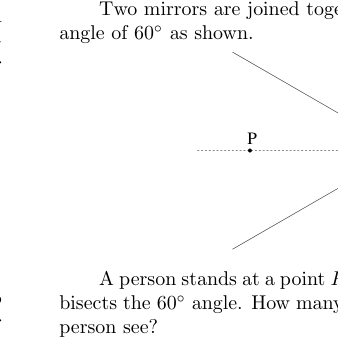 Two mirrors at 60° with point P
Topic: Geometric Optics Metodi: Ray Tracing, Superposition Principle Competenze: Physical Reasoning, Diagrammatic Reasoning Objects: Mirror Fonte: Testo (PDF) — p.2
Due specchi sono uniti in modo da formare un angolo di come mostrato. Una persona si trova in un punto P che è sulla linea che divide l’angolo . Quante immagini di se stessa vede la persona?
- A. 1
- B. 3
- C. 6
- D. numero infinito
Due specchi a 60° con punto P
Topic: Geometric Optics Metodi: Ray Tracing, Superposition Principle Competenze: Physical Reasoning, Diagrammatic Reasoning Objects: Mirror Fonte: Testo (PDF) — p.2
Consider a roller coaster with a loop-the-loop. The loop is not circular (that would be too dangerous) but has a radius of curvature which decreases with height. A roller coaster car starts from rest from the top of a hill which is 5 m higher than the top of the loop. It rolls down the hill and through the loop. What must the radius of curvature at the top of the loop be so that the passengers of the car will feel, at that point, as if they have their normal weight?
- A. 5 m
- B. 10 m
- C. 15 m
- D. 20 m
Topic: Newtonian Mechanics, Conservation of Energy Metodi: Conservation of Energy, Free-Body Diagram, Kinematic Equations Competenze: Physical Reasoning, Mathematical Modeling Objects: Cart Fonte: Testo (PDF) — p.3
Considerate una montagna russa con un circuito a rotonda. Il circuito non è circolare (che sarebbe troppo pericoloso), ma ha un raggio di curvatura che diminuisce con l’altezza. Una montagna russa parte dal riposo dalla cima di una collina che è 5 metri più alta della cima del circuito. Rolla giù per la collina e attraverso il circuito. Qual deve essere il raggio di curvatura della parte superiore del circuito, affinché i passeggeri della macchina si sentano, a quel punto, come se avessero il loro peso normale?
- A. 5 m
- B. 10 m
- C. 15 m
- D. 20 m
Topic: Newtonian Mechanics, Conservation of Energy Metodi: Conservation of Energy, Free-Body Diagram, Kinematic Equations Competenze: Physical Reasoning, Mathematical Modeling Objects: Cart Fonte: Testo (PDF) — p.3
Two identical conducting balls have positive charges respectively. The balls are brought together so that they touch and then put back in their original positions. The force between the balls is,
- A. The same as it was before the balls touched.
- B. Greater than before the balls touched.
- C. Less than before the balls touched.
- D. Zero.
Topic: Electrostatics Metodi: Coulomb’s Law, Physical Modeling Competenze: Physical Reasoning Objects: Conducting Sphere Fonte: Testo (PDF) — p.3
Due palle conduttrici identiche hanno rispettivamente cariche positive . Le palle vengono riunite in modo che si toccino e poi rimettono nelle loro posizioni originali. La forza tra le palle è:
- A. Lo stesso che era prima che le palle si toccassero.
- B. Più grande di prima che le palle si toccassero.
- C. Menso rispetto al momento in cui le palle si sono toccate.
- D. Zero.
Topic: Electrostatics Metodi: Coulomb’s Law, Physical Modeling Competenze: Physical Reasoning Objects: Conducting Sphere Fonte: Testo (PDF) — p.3
Helium becomes a superfluid at temperatures K. A superfluid flows with no viscosity. This behaviour can only be explained using quantum physics and it can only happen if the de Broglie wavelength of a helium atom, of mass , is comparable to the inter-atomic spacing of the fluid. Which of the following could be an expression for , the de Broglie wavelength?
- A.
- B.
- C.
- D.
Topic: Modern-Quantum Physics, Kinetic Theory Metodi: de Broglie Relation, Dimensional Analysis, Kinetic Theory of Gases Competenze: Physical Reasoning Objects: Atom Fonte: Testo (PDF) — p.3
L’elio diventa un superfluido a temperature K. Un superfluido scorre senza viscosità. Questo comportamento può essere spiegato solo usando la fisica quantistica e può accadere solo se la lunghezza d’onda de Broglie di un atomo di elio, di massa , è paragonabile all’inter-atomo spaziamento del fluido. Qual è l’espressione di , la lunghezza d’onda de Broglie?
- A.
- B.
- C.
- D.
Topic: Modern-Quantum Physics, Kinetic Theory Metodi: de Broglie Relation, Dimensional Analysis, Kinetic Theory of Gases Competenze: Physical Reasoning Objects: Atom Fonte: Testo (PDF) — p.3
In a game of egg-toss, two players toss an egg back and forth between them while moving farther and farther apart. The loser is the person who breaks the egg when catching it. The force required to break an egg’s shell is about 5 N and a typical egg has a mass of about 50 g. If the players are 10 m apart, and the eggs are thrown with initial velocities directed at above the horizontal, what is the shortest time that a player can take to arrest the motion of the egg so as not to break it?
- A. 0.01 s
- B. 0.10 s
- C. 0.50 s
- D. 1.00 s
Topic: Newtonian Mechanics Metodi: Impulse-Momentum Theorem, Kinematic Equations, Physical Modeling Competenze: Estimation & Approximation, Physical Reasoning Objects: Projectile Fonte: Testo (PDF) — p.3
In un gioco di lancio di uova, due giocatori lanciano un uovo avanti e indietro tra loro mentre si allontanano sempre di più. Il perdente è la persona che rompe l’uovo quando lo cattura. La forza necessaria per rompere la conchiglia di un uovo è di circa 5 N e un uovo tipico ha una massa di circa 50 g. Se i giocatori sono a 10 m di distanza e gli uova vengono lanciati con velocità iniziali dirette a sopra l’orizzontale, qual è il tempo più breve che un giocatore può impiegare per arrestare il movimento dell’uovo in modo da non romperlo?
- A. 0.01 s
- B. 0.10 s
- C. 0.50 s
- D. 1.00 s
Topic: Newtonian Mechanics Metodi: Impulse-Momentum Theorem, Kinematic Equations, Physical Modeling Competenze: Estimation & Approximation, Physical Reasoning Objects: Projectile Fonte: Testo (PDF) — p.3
A circuit is comprised of 8 identical batteries connected in series as shown. Each battery has an emf of 1.5 V and an internal resistance of . What is the reading on a voltmeter connected across any one of the batteries?
- A. 0.0
- B. 1.3 V
- C. 1.5 V
- D. 12 V
 8 batteries in series with voltmeter
Topic: Circuits Metodi: Kirchhoff’s Laws, Equivalent Circuit Reduction Competenze: Physical Reasoning, Mathematical Modeling Objects: Battery Fonte: Testo (PDF) — p.3
Un circuito è composto da 8 batterie identiche collegate in serie come mostrato. Ogni batteria ha un’emf di 1,5 V e una resistenza interna di . Qual è la lettura di un voltmeter collegato a una delle batterie?
- A. 0.0
- B. 1.3 V
- C. 1.5 V
- D. 12 V
8 batterie in serie con voltmeter
Topic: Circuits Metodi: Kirchhoff’s Laws, Equivalent Circuit Reduction Competenze: Physical Reasoning, Mathematical Modeling Objects: Battery Fonte: Testo (PDF) — p.3
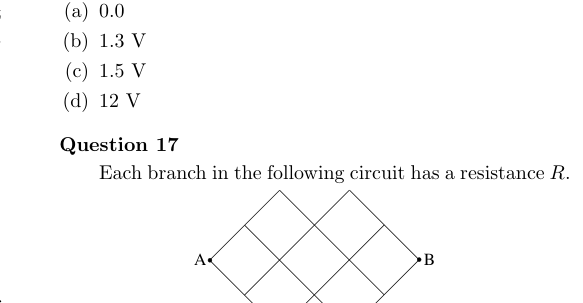
Each branch in the following circuit has a resistance . The equivalent resistance of the circuit between the points A and B is,
- A.
- B.
- C.
- D.
 Resistor network between points A and B
Topic: Circuits Metodi: Equivalent Circuit Reduction, Kirchhoff’s Laws Competenze: Physical Reasoning, Mathematical Modeling Objects: Resistor Fonte: Testo (PDF) — p.3
Ogni ramo del circuito seguente ha una resistenza . La resistenza equivalente del circuito tra i punti A e B è:
- A.
- B.
- C.
- D.
Rete di resistore tra i punti A e B
Topic: Circuits Metodi: Equivalent Circuit Reduction, Kirchhoff’s Laws Competenze: Physical Reasoning, Mathematical Modeling Objects: Resistor Fonte: Testo (PDF) — p.3
Which of the following statements is true concerning the elastic collision of two objects?
- A. No work is done on any of the two objects, since there is no external force.
- B. The work done by the first object on the second is equal to the work done on the second by the first.
- C. The work done by the first object on the second is exactly the opposite of the work done on the second by the first.
- D. The work done on the system depends on the angle of collision.
Topic: Newtonian Mechanics, Conservation of Momentum Metodi: Conservation of Momentum, Conservation of Energy Competenze: Physical Reasoning Objects: — Fonte: Testo (PDF) — p.3
Quale delle seguenti affermazioni è vera riguardo alla collisione elastica di due oggetti?
- A. Non si fa alcun lavoro su nessuno dei due oggetti, poiché non esiste una forza esterna.
- B. Il lavoro svolto dal primo oggetto sul secondo è uguale al lavoro svolto sul secondo dal primo.
- C. Il lavoro svolto dal primo oggetto sul secondo è esattamente l’opposto del lavoro svolto sul secondo dal primo.
- D. Il lavoro svolto sul sistema dipende dall’angolo di collisione.
Topic: Newtonian Mechanics, Conservation of Momentum Metodi: Conservation of Momentum, Conservation of Energy Competenze: Physical Reasoning Objects: — Fonte: Testo (PDF) — p.3
Which of the following statements is false?
- A. The momentum of a heavy object is greater than that of a light object moving at the same speed.
- B. In a perfectly inelastic collision, all the initial kinetic energy of the colliding bodies is dissipated.
- C. The momentum of a system of colliding bodies may be conserved even though the total mechanical energy may not.
- D. The velocity of the center of mass of a system is the system’s total momentum divided by its total mass.
Topic: Conservation of Momentum, Newtonian Mechanics Metodi: Conservation of Momentum, Conservation Laws Competenze: Physical Reasoning Objects: — Fonte: Testo (PDF) — p.4
Quale delle seguenti affermazioni è falsa?
- A. La dinamica di un oggetto pesante è maggiore di quella di un oggetto leggero che si muove alla stessa velocità.
- B. In una collisione perfettamente inelastica, tutta l’energia cinetica iniziale dei corpi in collisione viene dissipata.
- C. L’impulso di un sistema di corpi in collisione può essere conservato anche se l’energia meccanica totale non può essere conservata.
- D. La velocità del centro di massa di un sistema è il momento totale del sistema diviso per la sua massa totale.
Topic: Conservation of Momentum, Newtonian Mechanics Metodi: Conservation of Momentum, Conservation Laws Competenze: Physical Reasoning Objects: — Fonte: Testo (PDF) — p.4
Which of the following statements is true?
- A. The observed doppler shift for sound waves depends only on the relative motion of the source and the receiver.
- B. Only transverse waves can diffract.
- C. Two wave sources that are out of phase by are incoherent.
- D. Interference patterns are only observed for coherent sources.
Topic: Oscillations & Waves, Wave Optics Metodi: Wave Equation, Superposition Principle Competenze: Physical Reasoning Objects: — Fonte: Testo (PDF) — p.4
Quale delle seguenti affermazioni è vera?
- A. Il doppler spostamento osservato per le onde sonore dipende solo dal movimento relativo della fonte e del ricevitore.
- B. Solo le onde trasversali possono diffraggere.
- C. Due fonti d’onda che sono fuori fase da sono incoerenti.
- D. I modelli di interferenza sono osservati solo per fonti coerenti.
Topic: Oscillations & Waves, Wave Optics Metodi: Wave Equation, Superposition Principle Competenze: Physical Reasoning Objects: — Fonte: Testo (PDF) — p.4
An airplane circumnavigates the globe by flying above the equator and at a constant altitude above sea level. If the plane repeats the journey but flies at an altitude which is 1000 m higher than before, how much larger a distance through the atmosphere does the plane travel as compared to the first time?
- A. 6.283 km
- B. 62.83 km
- C. 628.3 km
- D. 6283 km
Topic: Newtonian Mechanics, Order-of-Magnitude Estimation Metodi: Physical Modeling, Approximation & Series Expansion Competenze: Mathematical Modeling, Estimation & Approximation Objects: Planet Fonte: Testo (PDF) — p.4
Un aereo circonnaviga il globo volando sopra l’equatore e ad una costante altitudine sopra il livello del mare. Se l’aereo ripete il viaggio ma vola ad un’altitudine di 1000 m superiore a quella precedente, quanto più grande sarà la distanza attraverso l’atmosfera che attraversa l’aereo rispetto alla prima volta?
- A. 6.283 km
- B. 62.83 km
- C. 628.3 km
- D. 6283 km
Topic: Newtonian Mechanics, Order-of-Magnitude Estimation Metodi: Physical Modeling, Approximation & Series Expansion Competenze: Mathematical Modeling, Estimation & Approximation Objects: Planet Fonte: Testo (PDF) — p.4
A block of mass is at rest on an inclined plane. The coefficients of static and kinetic friction between the block and the plane are and . The angle that the plane makes with the horizontal satisfies . A string is attached to the block. Is it possible to pull on the string in such a way that the block will slide with constant velocity along a horizontal line? That is to say, can the block slide along a line of constant elevation?
- A. Yes
- B. Yes, but only if
- C. Yes, but only if
- D. No
Topic: Newtonian Mechanics Metodi: Free-Body Diagram, Vector Decomposition, Physical Modeling Competenze: Physical Reasoning, Diagrammatic Reasoning Objects: Block, Inclined Plane, String Fonte: Testo (PDF) — p.4
Un blocco di massa è in riposo su un piano inclinato. I coefficienti di attrito statico e cinetico tra il blocco e il piano sono e . L’angolo che il piano fa con l’orizzontale soddisfa . Una corda è attaccata al blocco. È possibile tirare la corda in modo tale che il blocco scivoli con una velocità costante lungo una linea orizzontale? Cioè, il blocco può scivolare lungo una linea di elevazione costante?
- A. Sì
- B. Sì, ma solo se
- C. Sì, ma solo se
- D. No
Topic: Newtonian Mechanics Metodi: Free-Body Diagram, Vector Decomposition, Physical Modeling Competenze: Physical Reasoning, Diagrammatic Reasoning Objects: Block, Inclined Plane, String Fonte: Testo (PDF) — p.4
A proton is moving with a speed of directly towards an alpha-particle (Helium nucleus) which, when the two particles were very far apart from one another, was initially at rest. What is the separation of the particles at their point of closest approach? You may assume that .
- A.
- B.
- C.
- D.
Topic: Electrostatics, Conservation of Momentum, Conservation of Energy Metodi: Conservation of Energy, Conservation of Momentum, Coulomb’s Law Competenze: Physical Reasoning, Mathematical Modeling Objects: Nucleus Fonte: Testo (PDF) — p.4
Un protone si muove con una velocità di direttamente verso una particella alfa (nucleo di elio) che, quando le due particelle erano molto distanti l’una dall’altra, inizialmente era in riposo. Qual è la separazione delle particelle al punto di avvicinamento più vicino? Si può supporre che .
- A.
- B.
- C.
- D.
Topic: Electrostatics, Conservation of Momentum, Conservation of Energy Metodi: Conservation of Energy, Conservation of Momentum, Coulomb’s Law Competenze: Physical Reasoning, Mathematical Modeling Objects: Nucleus Fonte: Testo (PDF) — p.4
Red light from a HeNe laser has a wavelength of 630 nm. If it is normally incident upon an optical diffraction grating with 2000 lines per centimeter, how many maxima (including the central maximum) may be observed on a screen which is far from the grating?
- A. 14
- B. 15
- C. 16
- D. 17
Topic: Wave Optics Metodi: Interference & Diffraction Analysis, Physical Modeling Competenze: Mathematical Modeling, Physical Reasoning Objects: Diffraction Grating, Screen Fonte: Testo (PDF) — p.4
La luce rossa di un laser HeNe ha una lunghezza d’onda di 630 nm. Se si verifica normalmente su una griglia di diffrazione ottica con 2000 linee per centimetro, quante massime (compreso il massimo centrale) possono essere osservate su uno schermo lontano dalla griglia?
- A. 14
- B. 15
- C. 16
- D. 17
Topic: Wave Optics Metodi: Interference & Diffraction Analysis, Physical Modeling Competenze: Mathematical Modeling, Physical Reasoning Objects: Diffraction Grating, Screen Fonte: Testo (PDF) — p.4
Which of the following statements is true?
- A. The capacitance of a capacitor is the total amount of charge it can store.
- B. The equivalent capacitance of two capacitors in series is the sum of the two capacitances.
- C. A dielectric material inserted between the conductors of a capacitor increases its capacitance.
- D. The electrostatic energy stored by a capacitor is equal to the ratio of the charge on either conductor to the potential difference between the conductors.
Topic: Electrostatics, Circuits Metodi: Electric Potential Method, Physical Modeling Competenze: Physical Reasoning Objects: Capacitor Fonte: Testo (PDF) — p.4
Quale delle seguenti affermazioni è vera?
- A. La capacità di un condensatore è la quantità totale di carica che può immagazzinare.
- B. La capacità equivalente di due condensatori in serie è la somma delle due capacità.
- C. Un materiale dielettrico inserito tra i conduttori di un condensatore aumenta la sua capacità.
- D. L’energia elettrostatica immagazzinata da un condensatore è pari al rapporto tra la carica su entrambi i conduttori e la differenza di potenziale tra i conduttori.
Topic: Electrostatics, Circuits Metodi: Electric Potential Method, Physical Modeling Competenze: Physical Reasoning Objects: Capacitor Fonte: Testo (PDF) — p.4
Problem 1 — Mass Spectrometer
A mass spectrometer measures the mass of ions. An ion is accelerated to a high speed and injected into a region with a uniform magnetic field which is perpendicular to the ion’s velocity. The ion will follow a curved trajectory and impact a photographic plate some distance away from the injection point. By measuring this distance, the ion’s mass can be deduced.
Suppose singly charged () ions of and are accelerated to an energy of 500 eV and injected into a magnetic field T. The velocity of the ions upon entering the magnetic field is perpendicular to the line OP.
(a) What speed does each of the ions have when they impact the photographic plate at a point P?
(b) What is the shape of the trajectory for the ions? Find the distance OP for each of the two ions.
(c) In reality, things are not quite so simple. Variations in the ions’ velocities can cause problems with the resolution of the machine. If the initial energy of the ions cannot be held precisely at 500 eV, there will be a small variation in the distances OP. Suppose that the energy of the ions is eV. Can the two ions be distinguished from one another when they hit the screen?
(d) Suppose that the velocity of the ions when they enter the magnetic field cannot be held perpendicular to the line OP. If there is a small variation of about a perpendicular injection angle, find the variation in the length of OP. Can the two ions be distinguished from one another if ?
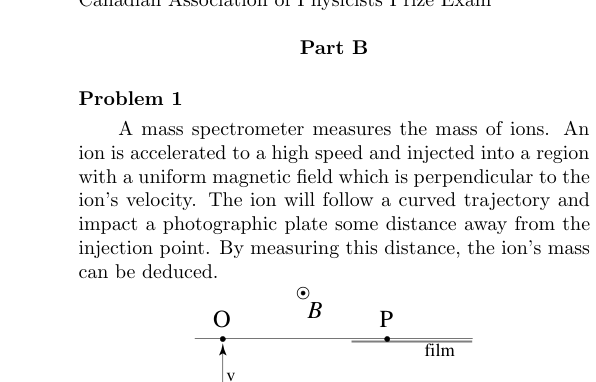 Mass spectrometer schematic with film and trajectory
Topic: Magnetism, Modern-Quantum Physics Metodi: Lorentz Force Analysis, Conservation of Energy, Approximation & Series Expansion Competenze: Mathematical Modeling, Physical Reasoning Objects: Particle Beam, Screen Fonte: Testo (PDF) — p.5
Problema 1 Spettometro di massa
Uno spettrometro di massa misura la massa degli ioni. Un ione viene accelerato ad alta velocità e iniettato in una regione con un campo magnetico uniforme perpendicolare alla velocità dell’io. L’ion seguirà una traiettoria curva e colpirà una piastra fotografica a qualche distanza dal punto di iniezione. Misurando questa distanza, si può dedurre la massa dell’ion.
Supponiamo che gli ioni singolari () di e siano accelerati ad un’energia di 500 eV e iniettati in un campo magnetico T. La velocità degli ioni quando entrano nel campo magnetico è perpendicolare alla linea OP.
(a) Che velocità ha ciascuno degli ioni quando colpisce la piastra fotografica a un punto P?
b) Qual è la forma della traiettoria degli ioni? Trova la distanza OP per ciascuno dei due ioni.
(c) In realtà le cose non sono così semplici. Le variazioni delle velocità degli ioni possono causare problemi alla risoluzione della macchina. Se l’energia iniziale degli ioni non può essere mantenuta esattamente a 500 eV, ci sarà una piccola variazione nelle distanze OP. Supponiamo che l’energia degli ioni sia eV. I due ioni possono essere distinguiti l’uno dall’altro quando colpiscono lo schermo?
(d) Supponiamo che la velocità degli ioni quando entrano nel campo magnetico non possa essere mantenuta perpendicolare alla linea OP. Se vi è una piccola variazione di circa un angolo di iniezione perpendicolare, trovare la variazione nella lunghezza di OP. I due ioni possono essere distinguiti tra loro se ?
Settometro di massa schema con film e traiettoria
Topic: Magnetism, Modern-Quantum Physics Metodi: Lorentz Force Analysis, Conservation of Energy, Approximation & Series Expansion Competenze: Mathematical Modeling, Physical Reasoning Objects: Particle Beam, Screen Fonte: Testo (PDF) — p.5
Problem 2 — Airplane and Wind
A town B is directly east of a town A. The two towns are a distance apart. In the absence of any wind, a plane can fly from town A to B in a time . The speed of the airplane, is called the plane’s air-speed. Assume in all that follows that the plane always has the same air-speed.
If the plane flies with a tail wind of speed , then it will have a speed with respect to the ground, given by . This is called the plane’s ground-speed.
(a) Explain how the plane could have a ground-speed of zero.
(b) If a wind blows from the west (i.e. to the east), find the time that the plane would take for a round trip from town A to B and back again. Show that it is greater than .
(c) If a wind blows from the south (i.e. to the north), sketch a diagram showing the heading that the plane must fly so as to fly in a straight line from town A to town B. Again, find the round trip time for flying in such a cross wind.
(d) Show that regardless of the wind direction, the round trip time for a flight from town A to B and back again is longer than if there was no wind whatsoever. Find an expression for the round trip time if a wind blows in an arbitrary direction.
Topic: Newtonian Mechanics Metodi: Vector Decomposition, Kinematic Equations, Physical Modeling Competenze: Mathematical Modeling, Physical Reasoning Objects: — Fonte: Testo (PDF) — p.5
Problema 2 Aereo e vento
Una città B è direttamente ad est di una città A. Le due città sono distanti . In assenza di vento, un aereo può volare dalla città A a B in un tempo . La velocità dell’aereo, , è chiamata velocità aerea dell’aereo. Supponiamo in tutto ciò che segue che l’aereo abbia sempre la stessa velocità d’aria.
Se l’aereo vola con un vento di coda di velocità , avrà una velocità rispetto al suolo, data da . Questa è chiamata velocità di terra dell’aereo.
(a) Spiegate come l’aereo possa avere una velocità di terra pari a zero.
b) Se un vento soffia da ovest (cioè a est), trovare il tempo necessario per un viaggio di andata e ritorno dalla città A a B e di nuovo. Indicare che è superiore a .
c) Se un vento soffia da sud (cioè verso nord), disegnare un diagramma che mostri la direzione che l’aereo deve volare per volare in linea retta dalla città A alla città B. Ancora una volta, trova il tempo di andata e ritorno per volare in un vento così incrociato.
d) Indicare che, indipendentemente dalla direzione del vento, il tempo di andata e ritorno per un volo da città A a B e di ritorno è più lungo di se non ci fosse alcun vento. Trova un’espressione per il tempo di andata e ritorno se un vento soffia in una direzione arbitraria.
Topic: Newtonian Mechanics Metodi: Vector Decomposition, Kinematic Equations, Physical Modeling Competenze: Mathematical Modeling, Physical Reasoning Objects: — Fonte: Testo (PDF) — p.5
Problem 3 — Concrete Pedestal and Structural Design
Leonardo da Vinci was commissioned by the Duke of Milan to construct a Bronze statue as a tribute to his late father. The proposed size was to be twenty three feet tall and weigh 80 tons (73,000 kg). Heavy statues need to be placed upon very strong concrete pedestals. The compressive strength of high strength concrete ranges from 10–70 N/mm². Let’s take a typical high-strength concrete with a compressive strength of N/mm² and a density of kg/m³. This concrete will crumble if a pressure of greater than this is applied.
(a) Suppose Leonardo’s statue (a horse with four feet touching the ground) is to be placed on such a concrete pedestal. What must be the minimum area of each of the horse’s feet so as not to damage the pedestal?
(b) Now, more generally, what is the maximum height of a conical mountain made of high strength concrete?
(c) Finally, outline the design constraints that go into making a free standing concrete structure with the maximum possible height.
Topic: Rigid Body Statics, Elasticity & Materials, Newtonian Mechanics Metodi: Hydrostatic Equilibrium, Physical Modeling, Stress-Strain Analysis Competenze: Mathematical Modeling, Estimation & Approximation Objects: — Fonte: Testo (PDF) — p.5
Problema 3 Piedestal e struttura di cemento
Leonardo da Vinci fu incaricato dal Duca di Milano di costruire una statua di bronzo come omaggio al suo defunto padre. La dimensione proposta era di essere alta ventitré metri e pesare 80 tonnellate (73.000 kg). Le statue pesanti devono essere posizionate su pedestali di cemento molto forti. La resistenza compressiva del calcestruzzo ad alta resistenza varia da 1070 N/mm2. Prendiamo un tipico calcestruzzo ad alta resistenza con una resistenza a compressione di N/mm2 e una densità di kg/m3. Questo cemento si crollera’ se si applique una pressione superiore a questa.
(a) Supponiamo che la statua di Leonardo (un cavallo con quattro piedi che tocca il terreno) sia posta su un piedistallo di cemento. Qual è la superficie minima di ciascuna delle zampe del cavallo per non danneggiare il piedistallo?
(b) Ora, più in generale, qual è l’altezza massima di una montagna conica fatta di calcestruzzo di alta resistenza?
c) Infine, descrivere i vincoli di progettazione che si applicano alla realizzazione di una struttura di cemento in piedi libero con la massima altezza possibile.
Topic: Rigid Body Statics, Elasticity & Materials, Newtonian Mechanics Metodi: Hydrostatic Equilibrium, Physical Modeling, Stress-Strain Analysis Competenze: Mathematical Modeling, Estimation & Approximation Objects: — Fonte: Testo (PDF) — p.5