Three identical resistors are connected across a voltage source so that one of them is in parallel with two others which are connected in series. The power dissipated through the first one, compared to the power dissipated by each of the other two, is approximately
- A. the same.
- B. half as much.
- C. twice as much.
- D. four times as much.
Topic: Circuits Metodi: Equivalent Circuit Reduction, Kirchhoff’s Laws Competenze: Physical Reasoning Objects: Resistor Fonte: Testo (PDF) — p.1
Tre resistori identici sono collegati attraverso una fonte di tensione in modo che uno di essi sia parallelo ad altri due collegati in serie. La potenza dissipata attraverso la prima, rispetto alla potenza dissipata da ciascuna delle altre due, è di circa
- A. lo stesso.
- ** B.** metà di più.
- C. il doppio.
- ** D.** quattro volte più.
Topic: Circuits Metodi: Equivalent Circuit Reduction, Kirchhoff’s Laws Competenze: Physical Reasoning Objects: Resistor Fonte: Testo (PDF) — p.1
The diagram below shows various positions of a child in motion on a swing. Somewhere in front of the child a stationary whistle is blowing. At which position will the child hear the highest frequency for the sound of the whistle?
- A. At B when moving toward A.
- B. At B when moving toward C.
- C. At C when moving toward B.
- D. At C when moving toward D.
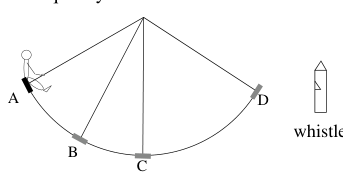 Child on swing, positions A B C D
Topic: Oscillations & Waves Metodi: Physical Modeling, Wave Equation Competenze: Physical Reasoning Objects: — Fonte: Testo (PDF) — p.1
Il diagramma di seguito mostra varie posizioni di un bambino in movimento su uno swing. Da qualche parte davanti al bambino suona un fischio fermo. In quale posizione il bambino udirà la frequenza più alta per il suono del fischio?
- A. A B quando si muove verso A.
- B. A B quando si muove verso C.
- C. A C quando si muove verso B.
- D. A C quando si muove verso D.
Bambino in swing, posizioni A B C D
Topic: Oscillations & Waves Metodi: Physical Modeling, Wave Equation Competenze: Physical Reasoning Objects: — Fonte: Testo (PDF) — p.1
In a Young double slit experiment, green light is incident on the two slits. The interference pattern is observed on a screen. Which one of the following changes would cause the observed fringes to be more closely spaced?
- A. Reducing the separation between the slits.
- B. Using blue light instead of green light.
- C. Using red light instead of green light.
- D. Moving the light source further away from the slits.
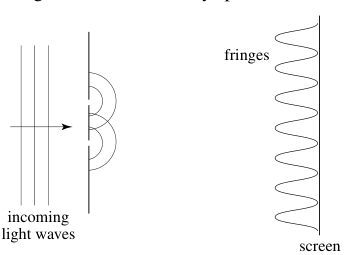 Double slit and fringe pattern on screen
Topic: Wave Optics Metodi: Interference & Diffraction Analysis, Superposition Principle Competenze: Physical Reasoning Objects: Slit, Screen Fonte: Testo (PDF) — p.1
In un esperimento Young a doppia fessura, la luce verde è incidente sulle due fessure. Il modello di interferenza è osservato su uno schermo. Quale delle seguenti modifiche avrebbe portato i margini osservati ad essere più strettamente spaziati?
- A. Riduzione della separazione tra le fessure.
- B. Utilizzare luce blu invece di luce verde.
- C. Utilizzare luce rossa invece di luce verde.
- D. Trasferire la fonte luminosa più lontano dalle fessure.
Doppia fessura e modello marginale sullo schermo
Topic: Wave Optics Metodi: Interference & Diffraction Analysis, Superposition Principle Competenze: Physical Reasoning Objects: Slit, Screen Fonte: Testo (PDF) — p.1
A thin lens with focal length is to be used as a magnifying glass. Which of the following statements regarding this situation is true?
- A. A converging lens must be used, and the object be placed at a distance greater than from the lens.
- B. A diverging lens must be used, and the object be placed between and from the lens.
- C. A converging lens must be used, and the object be placed at a distance less than from the lens.
- D. A diverging lens must be used, and the object be placed at any point other than the focal point.
Topic: Geometric Optics Metodi: Thin Lens & Mirror Equation, Ray Tracing Competenze: Physical Reasoning Objects: Lens Fonte: Testo (PDF) — p.1
Come lente di ingrandimento si deve utilizzare una lente sottile con distanza focale . Quale delle seguenti affermazioni in merito a questa situazione è vera?
- A. Deve essere utilizzata una lente convergente e l’oggetto deve essere posizionato a una distanza superiore a dalla lente.
- B. Deve essere utilizzata una lente divergente e l’oggetto deve essere posto tra e dalla lente.
- C. Deve essere utilizzata una lente convergente e l’oggetto deve essere posizionato a una distanza inferiore a dalla lente.
- D. Deve essere utilizzata una lente divergente e l’oggetto deve essere posizionato in qualsiasi punto diverso dal punto focale.
Topic: Geometric Optics Metodi: Thin Lens & Mirror Equation, Ray Tracing Competenze: Physical Reasoning Objects: Lens Fonte: Testo (PDF) — p.1
The figure shows the path of a ray of light as it passes through three different materials with refractive indices , and . The figure is drawn to scale. What can we conclude concerning the indices of these three materials?
- A. .
- B. .
- C. .
- D. .
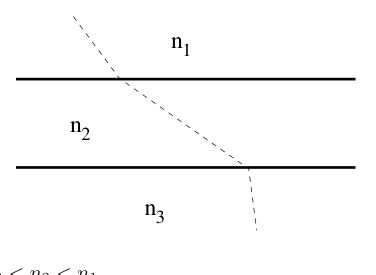 Ray path through three media n1 n2 n3
Topic: Geometric Optics Metodi: Snell’s Law, Ray Tracing Competenze: Diagrammatic Reasoning Objects: — Fonte: Testo (PDF) — p.2
La figura mostra il percorso di un raggio di luce che attraversa tre materiali diversi con indici di rifrazione , e . La figura è disegnata in scala. Che conclusione possiamo trarre riguardo agli indici di questi tre materiali?
- A. .
- B. .
- C. .
- D. .
Costruzione di raggi attraverso tre media n1 n2 n3
Topic: Geometric Optics Metodi: Snell’s Law, Ray Tracing Competenze: Diagrammatic Reasoning Objects: — Fonte: Testo (PDF) — p.2
The diagram shows the trajectory of three artillery shells. Each was fired with the same initial speed. Which shell was in the air for the longest time? (Ignore air friction.)
- A. Shell A.
- B. Shell B.
- C. Shell C.
- D. Shells A and C were in the air for equal time, which was longer than for shell B.
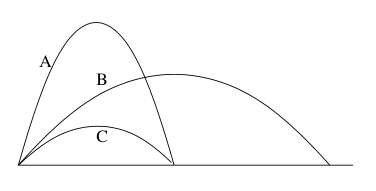 Trajectories of three artillery shells A B C
Topic: Newtonian Mechanics Metodi: Kinematic Equations, Physical Modeling Competenze: Diagrammatic Reasoning, Physical Reasoning Objects: Projectile Fonte: Testo (PDF) — p.2
Il diagramma mostra la traiettoria di tre proiettili di artiglieria. Ognuno è stato sparato con la stessa velocità iniziale. Quale granchio è stato in aria per il più lungo tempo? (Ignorare l’attrito dell’aria.)
- A. Shell A.
- B. Shell B.
- C. Shell C.
- D. Le conchiglie A e C sono state in aria per un tempo pari, che è stato più lungo rispetto alla conchiglia B.
*Traspetto di tre proiettili d’artiglieria A B C *
Topic: Newtonian Mechanics Metodi: Kinematic Equations, Physical Modeling Competenze: Diagrammatic Reasoning, Physical Reasoning Objects: Projectile Fonte: Testo (PDF) — p.2
Let be electric potential and the magnitude of the electric field. At a given position, which of the following statements is true?
- A. is always zero where is zero.
- B. is always zero where is zero.
- C. can be zero where is nonzero.
- D. is always nonzero where is nonzero.
Topic: Electrostatics Metodi: Electric Potential Method, Symmetry Argument Competenze: Physical Reasoning Objects: — Fonte: Testo (PDF) — p.2
sia il potenziale elettrico e la magnitudine del campo elettrico. In una determinata situazione, quale delle seguenti affermazioni è vera?
- A. è sempre zero, mentre è zero.
- B. è sempre zero, mentre è zero.
- C. può essere zero, mentre non è zero.
- D. è sempre non zero, mentre non è zero.
Topic: Electrostatics Metodi: Electric Potential Method, Symmetry Argument Competenze: Physical Reasoning Objects: — Fonte: Testo (PDF) — p.2
Two test charges are brought successively to a position some distance away from a negative charge . First, test-charge is placed at a distance from . Then it is removed and a test-charge is placed at a distance from . The sign of is unknown. Compared with the electric potential at the position of the test-charge in the first case, the electric potential at the position of the second test-charge is
- A. the same.
- B. twice as large.
- C. half as large.
- D. impossible to determine unless the sign of is known.
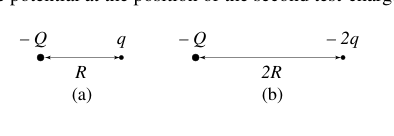 Two scenarios with charges , and ,
Topic: Electrostatics Metodi: Coulomb’s Law, Electric Potential Method Competenze: Physical Reasoning Objects: Point Charge Fonte: Testo (PDF) — p.2
Due cariche di prova sono successivamente riportate in una posizione a qualche distanza da una carica negativa . In primo luogo, la carica di prova è posta a una distanza da . Il dispositivo di prova è quindi rimosso e la carica è posta a una distanza da . Il segno di è sconosciuto. Rispetto al potenziale elettrico nella posizione della carica di prova nel primo caso, il potenziale elettrico nella posizione della seconda carica di prova è
- A. lo stesso.
- B. doppio di dimensioni.
- C. metà di grandezza.
- D. impossibile da determinare a meno che non sia noto il segno di .
Due scenari con spese , e ,
Topic: Electrostatics Metodi: Coulomb’s Law, Electric Potential Method Competenze: Physical Reasoning Objects: Point Charge Fonte: Testo (PDF) — p.2
A simple pendulum, consisting of a mass at the end of an unstretchable string of length , swings upward, making an angle with the vertical. The work done by the tension in the string is
- A. Zero.
- B.
- C.
- D.
Topic: Newtonian Mechanics Metodi: Free-Body Diagram, Conservation of Energy Competenze: Physical Reasoning Objects: Pendulum Fonte: Testo (PDF) — p.2
Un semplice pendolo, costituito da una massa alla fine di una stringa non allungata di lunghezza , oscilla verso l’alto, formando un angolo con la verticale. Il lavoro svolto dalla tensione nella corda è
- A. Zero.
- B.
- C.
- D.
Topic: Newtonian Mechanics Metodi: Free-Body Diagram, Conservation of Energy Competenze: Physical Reasoning Objects: Pendulum Fonte: Testo (PDF) — p.2
In problems involving electromagnetism it is often convenient and informative to express answers in terms of a constant , which is a combination of the Coulomb constant , the charge of the electron , and , being Planck’s constant. For instance, the lowest energy that a hydrogen atom can have is given by , where is the mass of the electron and is the speed of light. Which of the following is the correct expression for ? (HINT: non-relativistic kinetic energy is , where is speed.)
- A. .
- B. .
- C. .
- D.
Topic: Modern-Quantum Physics Metodi: Bohr Model & Quantization, Dimensional Analysis Competenze: Physical Reasoning, Unit Conversion Objects: Atom, Electron Fonte: Testo (PDF) — p.2
In problems involving electromagnetism it is often convenient and informative to express answers in terms of a constant , which is a combination of the Coulomb constant , the charge of the electron , and , being Planck’s constant. Ad esempio, l’energia più bassa che un atomo di idrogeno può avere è data da , dove è la massa dell’elettrone e è la velocità della luce. Qual è l’espressione corretta per ? (INSIGNAZIONE: l’energia cinetica non relativistica è , dove è velocità.)
- A. .
- B. .
- C. .
- D.
Topic: Modern-Quantum Physics Metodi: Bohr Model & Quantization, Dimensional Analysis Competenze: Physical Reasoning, Unit Conversion Objects: Atom, Electron Fonte: Testo (PDF) — p.2
A mass suspended from a spring is oscillating up and down. Consider the following two statements:
(1) At some point during the oscillation, the mass has zero velocity but it is accelerating. (2) At some point during the oscillation, the mass has zero velocity and zero acceleration.
- A. Both occur at some time during the oscillation.
- B. Neither occurs during the oscillation.
- C. Only (1) occurs.
- D. Only (2) occurs.
Topic: Oscillations & Waves Metodi: Simple Harmonic Motion Analysis, Free-Body Diagram Competenze: Physical Reasoning Objects: Spring, Block Fonte: Testo (PDF) — p.3
Una massa sospesa da una sorgente oscilla su e giù. Considerate le seguenti due affermazioni:
(1) A un certo punto durante l’oscillazione, la massa ha velocità zero ma sta accelerando. (2) A un certo punto durante l’oscillazione, la massa ha velocità zero e accelerazione zero.
- A. Entrambi si verificano in un certo momento durante l’ oscillazione.
- B. Nessuna delle due si verifica durante l’ oscillazione.
- C. Si verifica solo (1).
- D. Si verifica solo (2).
Topic: Oscillations & Waves Metodi: Simple Harmonic Motion Analysis, Free-Body Diagram Competenze: Physical Reasoning Objects: Spring, Block Fonte: Testo (PDF) — p.3
A very long solenoid perpendicular to the page generates a downward magnetic field whose magnitude increases with time. This induces an emf in a conducting wire loop around the solenoid which lights two identical bulbs connected in series along the wire. Now two points diametrically opposed on the wire loop are shorted with another wire lying to the right of bulb B in the plane of the page. After the shorting wire is inserted,
- A. bulb A goes out, and bulb B dims.
- B. bulb A goes out, and bulb B gets brighter.
- C. bulb B goes out, and bulb A dims.
- D. bulb B goes out, and bulb A gets brighter.
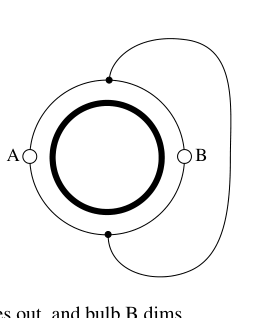 Solenoid with wire loop and bulbs A B
Topic: Electromagnetic Induction, Circuits Metodi: Faraday’s Law of Induction, Kirchhoff’s Laws Competenze: Diagrammatic Reasoning, Physical Reasoning Objects: Solenoid, Wire Fonte: Testo (PDF) — p.3
Un solenoide molto lungo perpendicolare alla pagina genera un campo magnetico a discesa la cui magnitudine aumenta con il tempo. Questo induce un emf in un circuito di filo conduttore attorno al solenoide che accende due lampadine identiche collegate in serie lungo il filo. Ora due punti diametralmente opposti sul circuito di filo sono abbreviati con un altro filo a destra del bulbo B nel piano della pagina. Dopo l’inserimento del filo di scorciatoia,
- A. lampadina A si spegne e lampadina B si attenua.
- B. lampadina A si spegne, e lampadina B diventa più luminosa.
- C. la lampadina B si spegne e la lampadina A si attenua.
- D. lampadina B si spegne, e lampadina A diventa più luminosa.
*Solenoide con circuito di filo e lampadine A B *
Topic: Electromagnetic Induction, Circuits Metodi: Faraday’s Law of Induction, Kirchhoff’s Laws Competenze: Diagrammatic Reasoning, Physical Reasoning Objects: Solenoid, Wire Fonte: Testo (PDF) — p.3
A quantity of charge is distributed uniformly through a sphere of radius . A smaller sphere, of radius and concentric with the large sphere, is now removed from it, leaving a spherical cavity with no charge in it. The charge density of the remaining shell has not changed. The electrostatic potential at a distance , outside the shell, is
(A)
(B)
(C)
(D)
Topic: Electrostatics Metodi: Gauss’s Law, Electric Potential Method, Superposition Principle Competenze: Mathematical Modeling Objects: Sphere Fonte: Testo (PDF) — p.3
Una quantità di carica è distribuita uniformemente attraverso una sfera di raggio . Una sfera più piccola, di raggio e concentrica con la sfera più grande, viene ora rimossa da essa, lasciando una cavità sferica senza carica. La densità di carica del resto del guscio non è cambiata. Il potenziale elettrostatico a distanza , al di fuori della conchiglia, è
(A)
(B)
(C)
(D)
Topic: Electrostatics Metodi: Gauss’s Law, Electric Potential Method, Superposition Principle Competenze: Mathematical Modeling Objects: Sphere Fonte: Testo (PDF) — p.3
A vertical spring with constant and negligible mass is attached to a horizontal plate. A block of mass is dropped onto the spring which compresses by before coming momentarily to rest. The following two numbers are the work done by the force of gravity, , and the work done by the spring, , (both over the total distance that the spring is compressed).
- A. , .
- B. , .
- C. , .
- D. , .
Topic: Conservation of Energy Metodi: Energy Conservation Method, Hooke’s Law Competenze: Physical Reasoning Objects: Spring, Block Fonte: Testo (PDF) — p.3
Un molle verticale con massa costante e trascurabile è fissato a una piastra orizzontale. Un blocco di massa viene gettato sulla molla che si comprime di prima di riposare momentaneamente. I seguenti due numeri sono il lavoro svolto dalla forza di gravità, , e il lavoro svolto dalla molla, , (entrambi sulla distanza totale che la molla è compressa).
- A. , .
- B. , .
- C. , .
- D. , .
Topic: Conservation of Energy Metodi: Energy Conservation Method, Hooke’s Law Competenze: Physical Reasoning Objects: Spring, Block Fonte: Testo (PDF) — p.3
A stone of mass is attached to a light strong string and whirled in a vertical circle of radius . At the exact bottom of the path, the tension in the string is three times the weight of the stone. The stone’s speed at that point is given by
- A.
- B.
- C.
- D.
Topic: Newtonian Mechanics Metodi: Free-Body Diagram, Kinematic Equations Competenze: Physical Reasoning Objects: String, Ball Fonte: Testo (PDF) — p.3
Una pietra di massa è attaccata a una corda leggera e rotollata in un cerchio verticale di raggio . Alla fine del percorso, la tensione della corda è tre volte maggiore del peso della pietra. La velocità della pietra in quel punto è data da
- A.
- B.
- C.
- D.
Topic: Newtonian Mechanics Metodi: Free-Body Diagram, Kinematic Equations Competenze: Physical Reasoning Objects: String, Ball Fonte: Testo (PDF) — p.3
You are rapidly pumping air into a tire with a bicycle pump. At the same time, helium gas is rapidly escaping out of a balloon. Which of the following statements is true?
- A. The pump cools down while the helium gas warms up as it is expelled.
- B. The pump warms up while the helium gas cools down as it is expelled.
- C. The pump cools down while the helium gas also cools down as it is expelled.
- D. The pump warms up while the helium gas also warms up as it is expelled.
Topic: Thermodynamics Metodi: First Law of Thermodynamics, Physical Modeling Competenze: Physical Reasoning Objects: Gas Fonte: Testo (PDF) — p.3
Si sta pompando rapidamente l’aria in un pneumatico con una pompa da bicicletta. Allo stesso tempo, il gas elio sta rapidamente sfuggendo da un pallone. Quale delle seguenti affermazioni è vera?
- A. La pompa si raffredda mentre il gas elio si riscaldano mentre viene espulso.
- B. La pompa si riscalda mentre il gas elio si raffredda mentre viene espulso.
- C. La pompa si raffredda mentre il gas elio si raffredda anche quando viene espulso.
- D. La pompa si riscalda mentre il gas elio si riscalda anche quando viene espulso.
Topic: Thermodynamics Metodi: First Law of Thermodynamics, Physical Modeling Competenze: Physical Reasoning Objects: Gas Fonte: Testo (PDF) — p.3
A particle, moving through a certain region of space, experiences a non-zero magnetic force. Which of the following is possible?
- A. A magnetic field exists in that region and changes the speed of the particle.
- B. A magnetic field exists in this region and the particle’s velocity vector is parallel to the magnetic field vector.
- C. A magnetic field exists in this region and the particle is moving at right angle to the magnetic field.
- D. A magnetic field exists in this region and the particle is moving in the direction opposite to the magnetic field vector.
Topic: Magnetism Metodi: Lorentz Force Analysis, Physical Modeling Competenze: Physical Reasoning Objects: Point Charge Fonte: Testo (PDF) — p.3
Una particella, che si muove attraverso una certa regione dello spazio, sperimenta una forza magnetica non zero. Quale di queste è possibile?
- A. In quella regione esiste un campo magnetico che modifica la velocità della particella.
- B. In questa regione esiste un campo magnetico e il vettore di velocità della particella è parallelo al vettore del campo magnetico.
- C. In questa regione esiste un campo magnetico e la particella si muove in angolo retto verso il campo magnetico.
- D. In questa regione esiste un campo magnetico e la particella si muove nella direzione opposta al vettore del campo magnetico.
Topic: Magnetism Metodi: Lorentz Force Analysis, Physical Modeling Competenze: Physical Reasoning Objects: Point Charge Fonte: Testo (PDF) — p.3
The astronauts aboard a Space Shuttle in circular orbit around the Earth wish to transfer the shuttle to a new circular orbit at higher altitude. In this new orbit, the shuttle will have
- A. a smaller orbital speed and a larger total energy.
- B. a smaller orbital speed and a smaller total energy.
- C. a larger orbital speed and a larger total energy.
- D. a larger orbital speed and a smaller total energy.
Topic: Gravitation Metodi: Kepler’s Laws, Newton’s Law of Gravitation, Conservation of Energy Competenze: Physical Reasoning Objects: Satellite, Planet Fonte: Testo (PDF) — p.4
Gli astronauti a bordo di una navetta spaziale in orbita circolare intorno alla Terra desiderano trasferire la navetta in una nuova orbita circolare ad altitudine più alta. In questa nuova orbita, lo shuttle avrà
- A. una velocità orbitale minore e un’energia totale maggiore.
- B. una velocità orbitale minore e un’energia totale minore.
- C. una velocità orbitale maggiore e un’energia totale maggiore.
- ** D.** una velocità orbitale maggiore e un’energia totale minore.
Topic: Gravitation Metodi: Kepler’s Laws, Newton’s Law of Gravitation, Conservation of Energy Competenze: Physical Reasoning Objects: Satellite, Planet Fonte: Testo (PDF) — p.4
A car pushes a stalled truck up a hill. The car exerts a force of magnitude on the truck. The truck exerts a force of magnitude on the car. Then
- A. since these forces form an action-reaction pair.
- B. only if the car and truck do not accelerate.
- C. , or else the car and the truck would not move.
- D. because the truck is heavier.
Topic: Newtonian Mechanics Metodi: Free-Body Diagram, Physical Modeling Competenze: Physical Reasoning Objects: — Fonte: Testo (PDF) — p.4
Una macchina spinge un camion bloccato su una collina. L’auto esercita una forza di magnitudo sul camion. Il camion esercita una forza di magnitudo sulla vettura. Allora…
- A. poiché queste forze formano una coppia di azione-reazione.
- B. solo se la macchina e il camion non accelerano.
- C. , altrimenti la macchina e il camion non si muoveranno.
- D. perché il camion è più pesante.
Topic: Newtonian Mechanics Metodi: Free-Body Diagram, Physical Modeling Competenze: Physical Reasoning Objects: — Fonte: Testo (PDF) — p.4
A convex mirror has its centre of curvature located behind the mirror. The image formed by such a mirror is
- A. upside down, enlarged and virtual.
- B. upside down, reduced and virtual.
- C. right side up, reduced and real.
- D. right side up, reduced and virtual.
Topic: Geometric Optics Metodi: Ray Tracing, Thin Lens & Mirror Equation Competenze: Physical Reasoning Objects: Mirror Fonte: Testo (PDF) — p.4
Uno specchio convexo ha il suo centro di curvatura situato dietro lo specchio. L’immagine che si forma da uno specchio di questo tipo è
- A. a testa in giù, ingrandito e virtuale.
- B. a testa in giù, ridotta e virtuale.
- C. lato destro in alto, ridotto e reale.
- D. lato destro in su, ridotto e virtuale.
Topic: Geometric Optics Metodi: Ray Tracing, Thin Lens & Mirror Equation Competenze: Physical Reasoning Objects: Mirror Fonte: Testo (PDF) — p.4
A toy airplane is travelling in a horizontal circle at a constant speed at the end of a tether wire. The magnitude of the tension in the wire is . Then the wire is played out to twice its original length and the plane is made to fly at twice its original speed. The tension in the wire is now
- A.
- B.
- C.
- D.
Topic: Newtonian Mechanics Metodi: Kinematic Equations, Physical Modeling Competenze: Physical Reasoning Objects: String Fonte: Testo (PDF) — p.4
Un aereo giocattolo viaggia in un cerchio orizzontale a velocità costante alla fine di un filo di legame. La grandezza della tensione nel filo è . Poi il filo viene esteso al doppio della sua lunghezza originale e l’aereo viene fatto volare al doppio della sua velocità originale. La tensione del filo è ora
- A.
- B.
- C.
- D.
Topic: Newtonian Mechanics Metodi: Kinematic Equations, Physical Modeling Competenze: Physical Reasoning Objects: String Fonte: Testo (PDF) — p.4
The plates of a parallel-plate capacitor are separated by a solid dielectric. This capacitor and a resistor are connected in series across the terminals of a battery. Now the plates of the capacitor are pulled slightly farther apart. When equilibrium is restored in the circuit,
- A. the potential difference across the plates has increased.
- B. the energy stored on the capacitor has increased.
- C. the capacitance of the capacitor has increased.
- D. the charge on the plates of the capacitor has decreased.
Topic: Circuits, Electrostatics Metodi: Kirchhoff’s Laws, Equivalent Circuit Reduction Competenze: Physical Reasoning Objects: Capacitor, Resistor, Battery Fonte: Testo (PDF) — p.4
Le piastre di un condensatore a piastra parallela sono separate da un dielettrico solido. Questo condensatore e una resistenza sono collegati in serie attraverso i terminali di una batteria. Ora le piastre del condensatore sono tirate leggermente più a distanza. Quando l’equilibrio è ripristinato nel circuito,
- A. la differenza potenziale tra le piastre è aumentata.
- ** B.** l’energia immagazzinata sul condensatore è aumentata.
- C. la capacità del condensatore è aumentata.
- D. la carica sulle lastre del condensatore è diminuita.
Topic: Circuits, Electrostatics Metodi: Kirchhoff’s Laws, Equivalent Circuit Reduction Competenze: Physical Reasoning Objects: Capacitor, Resistor, Battery Fonte: Testo (PDF) — p.4
A uniform pole is attached to a vertical wall by a frictionless pivot. The pole is held horizontal by a vertical cable attached to the ceiling as shown. Considering torques on the pole about the axis of the pivot, which one of the statements below the figure is correct?
- A. The magnitude of the torque due to the tension in the cable is equal to the magnitude of the torque due to the weight of the pole.
- B. The magnitude of the torque due to the tension in the cable is greater than the magnitude of the torque due to the weight of the pole.
- C. The magnitude of the torque due to the tension in the cable is less than the magnitude of the torque due to the weight of the pole.
- D. The tension in the cable is equal to the weight of the pole.
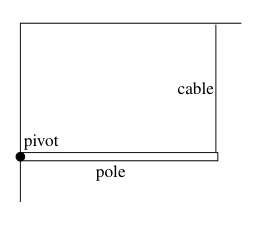 Horizontal pole on wall with cable to ceiling
Topic: Rigid Body Statics Metodi: Torque & Angular Momentum Analysis, Free-Body Diagram Competenze: Diagrammatic Reasoning Objects: Rod, String Fonte: Testo (PDF) — p.4
Un polo uniforme è attaccato a un muro verticale da un pivot senza attrito. Il polo è tenuto orizzontale da un cavo verticale collegato al soffitto come mostrato. Considerando i coppi sul polo intorno all’asse del pivot, quale delle affermazioni di seguito è corretta?
- A. La grandezza della coppia dovuta alla tensione del cavo è pari alla grandezza della coppia dovuta al peso del polo.
- B. La grandezza della coppia dovuta alla tensione del cavo è superiore alla grandezza della coppia dovuta al peso del polo.
- C. La grandezza della coppia dovuta alla tensione del cavo è inferiore alla grandezza della coppia dovuta al peso del polo.
- D. La tensione del cavo è uguale al peso del polo.
Polo orizzontale su parete con cavo al soffitto
Topic: Rigid Body Statics Metodi: Torque & Angular Momentum Analysis, Free-Body Diagram Competenze: Diagrammatic Reasoning Objects: Rod, String Fonte: Testo (PDF) — p.4
The minimum speed with respect to air that a particular jet aircraft must have in order to keep aloft is . Suppose that as its pilot prepares to take off, the wind blows eastward at a ground speed that can vary between and . Ignoring any other fact, a safe procedure to follow, consistent with using up as little fuel as possible, is to
- A. take off eastward at a ground speed of .
- B. take off westward at a ground speed of .
- C. take off westward at a ground speed of .
- D. take off westward at a ground speed of .
Topic: Newtonian Mechanics Metodi: Vector Decomposition, Physical Modeling Competenze: Physical Reasoning, Estimation & Approximation Objects: — Fonte: Testo (PDF) — p.4
La velocità minima rispetto all’aria che un determinato aereo a reazione deve avere per mantenere in alto è . Supponiamo che il pilota si stia preparando a decollare e il vento soffia verso est a una velocità di terra che può variare tra e . In particolare, il Consiglio ha adottato una decisione che prevede che il
- A. decolla verso est a una velocità di terra di .
- B. decolla verso ovest a una velocità di terra di .
- C. decolla verso ovest a una velocità di terra di .
- D. decolla verso ovest a una velocità di terra di .
Topic: Newtonian Mechanics Metodi: Vector Decomposition, Physical Modeling Competenze: Physical Reasoning, Estimation & Approximation Objects: — Fonte: Testo (PDF) — p.4
A mass is moving at speed perpendicular to a rod of length and mass which pivots around a frictionless axle running through its centre. It strikes and sticks to the end of the rod. The moment of inertia of the rod about its centre is . Then the angular speed of the system right after the collision is
- A.
- B.
- C.
- D.
Topic: Rotational Dynamics Metodi: Conservation of Momentum, Torque & Angular Momentum Analysis Competenze: Mathematical Modeling Objects: Rod Fonte: Testo (PDF) — p.4
Una massa si muove a velocità perpendicolare a una barra di lunghezza e massa che ruota attorno a un asse senza attrito che attraversa il suo centro. Colpisce e si attacca alla fine della canna. Il momento di inerzia della canna intorno al suo centro è . Quindi la velocità angolare del sistema subito dopo la collisione è
- A.
- B.
- C.
- D.
Topic: Rotational Dynamics Metodi: Conservation of Momentum, Torque & Angular Momentum Analysis Competenze: Mathematical Modeling Objects: Rod Fonte: Testo (PDF) — p.4
Suppose that initially the system of masses shown below is held motionless. All surfaces are frictionless, and the pulley is fixed to mass . The string is completely inextensible: its length is constant. We are interested in the acceleration of each mass at the instant right after they are released. Note that at this instant the string holding is still vertical.
(a) Draw free-body diagrams showing and labelling all forces that act on the three masses at the instant right after they are released.
(b) Write Newton’s second law as it applies to each mass. Explain briefly why accelerates.
(c) Let be the acceleration of mass , that of , and that of . Find a relation between the accelerations of the three masses.
(d) Determine the tension in the string and the three accelerations in terms of the masses and of the gravitational acceleration .
- E. Take the limits of your results in part
- D. as . What do they become if instead you take , or if you take (not both at the same time)? Do your results make sense in all those limits?
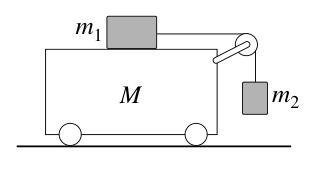 Pulley fixed to with masses and
Topic: Newtonian Mechanics Metodi: Free-Body Diagram, Kinematic Equations, Conservation of Momentum Competenze: Diagrammatic Reasoning, Mathematical Modeling Objects: Pulley, String, Block Fonte: Testo (PDF) — p.5
Supponiamo che inizialmente il sistema di masse mostrato qui sotto sia tenuto immobile. Tutte le superfici sono senza attrito e la pollice è fissata a massa . La corda è completamente inestensibile: la sua lunghezza è costante. Ci interessa l’accelerazione di ogni massa immediatamente dopo il rilascio. Si noti che in questo momento la tenuta della corda è ancora verticale.
a) Disegnare diagrammi di corpi liberi che mostrino e etichettino tutte le forze che agiscono sulle tre masse nel momento stesso dopo che sono rilasciate.
(b) Scrivi la seconda legge di Newton come si applica a ogni massa. Spiegate brevemente perché accelera.
c) L’accelerazione di massa è , è e è . Trova una relazione tra le accelerazioni delle tre masse.
d) Determinare la tensione nella corda e le tre accelerazioni in termini di massa e di accelerazione gravitazionale .
- E. Prendete in parte i limiti dei risultati
- D. as . Cosa si verifica se invece si prende , o se si prende (non entrambi allo stesso tempo)? I risultati hanno senso in tutti questi limiti?
Pulley fissato a con masse e
Topic: Newtonian Mechanics Metodi: Free-Body Diagram, Kinematic Equations, Conservation of Momentum Competenze: Diagrammatic Reasoning, Mathematical Modeling Objects: Pulley, String, Block Fonte: Testo (PDF) — p.5
A (when empty) cylindrical bottle of gas, containing of air at a pressure of atmospheres, falls over on the lab floor, breaking the valve. This leaves a circular hole of radius at the end of the bottle, through which the air escapes in a direction parallel to the long axis of the bottle.
(a) Let be the exhaust speed of the air relative to the lab, assumed to be constant, and , the initial and final mass of the bottle, respectively. The bottle slides across a floor with a kinetic coefficient of friction . Calculate , the maximum rate at which the mass of the bottle changes if is limited by the speed of sound, approximately equal to . HINT: under our assumptions, is constant, and the escaping air (as opposed to the air still in the bottle) has a density of . Write down the fundamental conservation law which governs the motion of the bottle. Calculate its acceleration as the air starts escaping.
- B. Suppose that the acceleration imparted to the bottle by the escaping gas and that you calculated in part
- A. remains the same until the air has finished escaping at the constant rate . What would be the total distance covered by the bottle when it finally comes to a stop?
(c) NOTE: BONUS marks will be awarded if you can derive the following expression for the maximum speed the bottle can ever attain once all the air has escaped, and which does not assume that the acceleration of the bottle is constant while the air is escaping: where is the mass of the escaped air, neglecting the air left in the bottle at the end.
Topic: Newtonian Mechanics, Fluid Mechanics Metodi: Conservation of Momentum, Kinematic Equations, Differential Equations Competenze: Mathematical Modeling, Physical Reasoning Objects: Cylinder, Gas Fonte: Testo (PDF) — p.5
Una bottiglia cilindrica di gas (quando vuota), contenente di aria a pressione di atmosfere, cade sul pavimento del laboratorio, rompendo la valvola. Ciò lascia un buco circolare di raggio alla fine della bottiglia, attraverso il quale l’aria scorre in direzione parallela all’asse lungo della bottiglia.
a) La velocità di scarico dell’aria relativa al laboratorio deve essere , presumendo che sia costante, e , , rispettivamente, la massa iniziale e la massa finale della bottiglia. La bottiglia scivola attraverso un pavimento con un coefficiente di attrito cinetico . Calcolare , la velocità massima con cui la massa della bottiglia cambia se è limitata dalla velocità del suono, approssimativamente uguale a . SINCisione: secondo le nostre ipotesi, è costante e l’aria che scappa (a differenza dell’aria ancora in bottiglia) ha una densità di . Scrivi la legge fondamentale sulla conservazione che regola il movimento della bottiglia. Calcola la sua accelerazione quando l’aria inizia a fuggire.
- B. Supponiamo che l’accelerazione impartita alla bottiglia dal gas di fuga e che tu abbia calcolato in parte
- A. rimane lo stesso fino a quando l’aria non è finita a fuggire al ritmo costante . Qual è la distanza totale percorsa dalla bottiglia quando si ferma?
(c) NOTA: I segni BONUS saranno assegnati se si può derivare la seguente espressione per la velocità massima che la bottiglia può raggiungere una volta che tutta l’aria è sfuggita, e che non presuppone che l’accelerazione della bottiglia sia costante mentre l’aria si sfugge: dove è la massa dell’aria sfuggita, trascurando l’aria lasciata nella bottiglia alla fine.
Topic: Newtonian Mechanics, Fluid Mechanics Metodi: Conservation of Momentum, Kinematic Equations, Differential Equations Competenze: Mathematical Modeling, Physical Reasoning Objects: Cylinder, Gas Fonte: Testo (PDF) — p.5
Consider a long horizontal cylindrical shell, of length , radius which can rotate freely about its longitudinal axis with a moment of inertia . The material that composes it is electrically insulating and non-magnetic. A massless string attached to a vertically hanging mass is then wound around the cylinder drum. The mass is released from rest at time .
(a) Determine the angular acceleration and kinetic energy of the system after the hanging mass has fallen a distance .
- B. A net amount of positive charge , of negligible mass, is deposited uniformly on the outside drum of the shell before the mass is released. Redo part
- A. under these conditions. Calculate the difference in kinetic energy between the two cases and . Do you have any idea as to where the “missing” kinetic energy went?
HINT: The magnetic field due to a very long solenoid of length and turns carrying a current produces no net magnetic field outside the solenoid, but a net uniform magnetic field of strength inside the solenoid. The field is directed along the solenoid axis.
Topic: Rotational Dynamics, Electromagnetic Induction Metodi: Torque & Angular Momentum Analysis, Energy Conservation Method, Faraday’s Law of Induction Competenze: Mathematical Modeling, Physical Reasoning Objects: Cylinder, String Fonte: Testo (PDF) — p.5
Considera un lungo guscio cilindrico orizzontale, di lunghezza , raggio , che può ruotare liberamente intorno al suo asse longitudinale con un momento di inerzia . Il materiale che lo compone è isolante elettricamente e non magnetico. Una corda senza massa attaccata a una massa appesa verticalmente viene quindi arroccata intorno al tamburo cilindrico. La massa viene rilasciata dal riposo al tempo .
a) Determinare l’accelerazione angolare e l’energia cinetica del sistema dopo che la massa pendente è scesa a una distanza .
- B. Una quantità netta di carica positiva , di massa trascurabile, viene depositata uniformemente sul tamburo esterno della conchiglia prima del rilascio della massa. Particolari di ripiegamento
- A. in queste condizioni. Calcolare la differenza di energia cinetica tra i due casi e . Hai idea di dove sia andata l’energia cinetica “mancata”?
SINCLUSIONE: il campo magnetico dovuto a un solenoide molto lungo di lunghezza e rotazioni che trasportano una corrente non produce un campo magnetico netto al di fuori del solenoide, ma un campo magnetico netto uniforme di forza all’interno del solenoide. Il campo è diretto lungo l’asse solenoide.
Topic: Rotational Dynamics, Electromagnetic Induction Metodi: Torque & Angular Momentum Analysis, Energy Conservation Method, Faraday’s Law of Induction Competenze: Mathematical Modeling, Physical Reasoning Objects: Cylinder, String Fonte: Testo (PDF) — p.5