A little girl is holding a helium-filled balloon on a string while riding in a closed elevator going down a very tall building at constant speed. The elevator shaft is maintained under vacuum. Suddenly the elevator cable snaps, sending the elevator into free fall. In her surprise the girl lets go of the string. She is even more surprised to see
- A. the balloon rising.
- B. the balloon floating downward.
- C. the balloon remaining stationary.
- D. the balloon bouncing slowly between the floor and the ceiling.
Topic: Fluid Mechanics, Newtonian Mechanics Metodi: Free-Body Diagram, Physical Modeling Competenze: Physical Reasoning, Diagrammatic Reasoning Objects: Bubble Fonte: Testo (PDF) — p.1
Una bambina sta tenendo un pallone pieno di elio su una corda mentre guida in un ascensore chiuso scendendo in un edificio molto alto a velocità costante. L’albero dell’ascensore è mantenuto sotto vuoto. All’improvviso il cavo dell’ascensore si stacca, spingendo l’ascensore in caduta libera. Nella sua sorpresa la ragazza lascia andare la corda. E ’ ancora più sorpreso di vedere
- A. il pallone in rialzo.
- B. il palloncino galleggiante verso il basso.
- C. il palloncino che rimane fermo.
- D. il palloncino che rimbalza lentamente tra il pavimento e il soffitto.
Topic: Fluid Mechanics, Newtonian Mechanics Metodi: Free-Body Diagram, Physical Modeling Competenze: Physical Reasoning, Diagrammatic Reasoning Objects: Bubble Fonte: Testo (PDF) — p.1
A demonstration apparatus sits on a table in the lab. It consists of a metal track (shown as a thick solid line in the figure below) along which a perfectly spherical marble can roll without slipping. In one run, the marble is released from rest at a height above the table on the left section, rolls down one side and then up the other side without slipping, briefly stopping when it has reached . Assuming the table to be horizontal and neglecting air drag as well as any energy loss due to rolling,
- A. always, because the friction that keeps the ball rolling must dissipate energy.
- B. , since total mechanical energy is conserved.
- C. only if tilt angles and are equal.
- D. only if tilt angle is larger than .
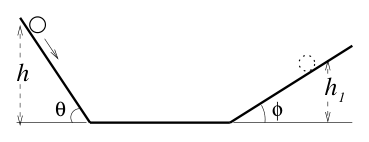 Rolling marble on V-shaped track
Topic: Conservation of Energy, Rotational Dynamics Metodi: Conservation of Energy, Energy Conservation Method Competenze: Physical Reasoning, Diagrammatic Reasoning Objects: Ball Fonte: Testo (PDF) — p.1
Un apparecchio di dimostrazione si trova su un tavolo del laboratorio. Esso consiste in una pista di metallo (visto come una spessa linea solida nella figura seguente) lungo la quale un marmo perfettamente sferico può rotolare senza scivolare. In una corsa, il marmo viene rilasciato dal riposo ad un’altezza sopra il tavolo nella sezione sinistra, si rulla da un lato e poi dall’altro lato senza scivolare, fermandosi brevemente quando raggiunge . Supponendo che il tavolo sia orizzontale e che non si debba tenere conto della resistenza all’aria e delle perdite di energia dovute al rotolamento,
- A. sempre, perché l’attrito che mantiene la palla in rotolamento deve dissipare l’energia.
- B. , poiché l’energia meccanica totale è conservata.
- C. solo se gli angoli di inclinazione e sono uguali.
- D. solo se l’angolo di inclinazione è maggiore di .
Marmo a rotoli su una pista a forma di V
Topic: Conservation of Energy, Rotational Dynamics Metodi: Conservation of Energy, Energy Conservation Method Competenze: Physical Reasoning, Diagrammatic Reasoning Objects: Ball Fonte: Testo (PDF) — p.1
In the movie Jurassic Park, as a jeep is being pursued by a dinosaur, one can see the animal in the jeep’s side rear-view mirror on which is printed: “Objects in mirror are closer than they appear.” Then,
- A. the mirror is flat.
- B. the mirror is concave.
- C. the mirror is convex.
- D. the mirror could be either convex or concave.
Topic: Geometric Optics Metodi: Ray Tracing, Thin Lens & Mirror Equation Competenze: Physical Reasoning, Diagrammatic Reasoning Objects: Mirror Fonte: Testo (PDF) — p.1
Nel film Jurassic Park, mentre un jeep è inseguito da un dinosauro, si può vedere l’animale nel specchio retrovisore laterale del jeep su cui è stampato: “Gli oggetti nello specchio sono più vicini di quanto sembrino”.
- A. lo specchio è piatto.
- B. lo specchio è concavo.
- C. lo specchio è convexo.
- D. lo specchio può essere convexo o concavo.
Topic: Geometric Optics Metodi: Ray Tracing, Thin Lens & Mirror Equation Competenze: Physical Reasoning, Diagrammatic Reasoning Objects: Mirror Fonte: Testo (PDF) — p.1
A lump of sticky chewing-gum with mass moves at speed toward another lump of mass at rest. They collide and stick together, both moving at speed . Nothing else is known about the conditions under which the collision takes place. Which of the following statements is the most correct?
- A. Neither total kinetic energy nor total linear momentum can be conserved.
- B. This is an elastic collision in which both total kinetic energy and total linear momentum are conserved; the final speed is .
- C. This is an inelastic collision, and in such collisions, total linear momentum is always conserved; the final speed is .
- D. This is an inelastic collision in which total linear momentum is conserved, provided no external force can deliver an impulse to the system during the collision.
Topic: Conservation of Momentum, Newtonian Mechanics Metodi: Conservation of Momentum, Impulse-Momentum Theorem Competenze: Physical Reasoning, Mathematical Modeling Objects: — Fonte: Testo (PDF) — p.1
Un fascio di gomma da masticare adesiva di massa si muove a velocità verso un altro fascio di massa in riposo. Collidono e si fissano, entrambi in movimento a velocità . Non si conoscono altre condizioni di collisione. Quale delle seguenti affermazioni è più corretta?
- A. Non si può conservare né l’energia cinetica totale né il momento lineare totale.
- B. Si tratta di una collisione elastica in cui si conservano sia l’energia cinetica totale che l’impulso lineare totale; la velocità finale è .
- C. Si tratta di una collisione inelastica e in tali collisioni il momento lineare totale è sempre conservato; la velocità finale è .
- D. Si tratta di una collisione inelastica in cui viene conservato il momento lineare totale, a condizione che nessuna forza esterna possa fornire un impulso al sistema durante la collisione.
Topic: Conservation of Momentum, Newtonian Mechanics Metodi: Conservation of Momentum, Impulse-Momentum Theorem Competenze: Physical Reasoning, Mathematical Modeling Objects: — Fonte: Testo (PDF) — p.1
According to the Archimedes principle,
- A. a body immersed in a fluid experiences an upward force equal to the weight of the fluid it displaces.
- B. a body immersed in a fluid experiences an upward force equal to the weight of the object.
- C. a body immersed in a fluid displaces an amount of fluid equal to the volume of the body.
- D. a body immersed in a liquid floats only if its density is smaller than that of the liquid.
Topic: Fluid Mechanics Metodi: Hydrostatic Equilibrium, Physical Modeling Competenze: Physical Reasoning, Unit Conversion Objects: — Fonte: Testo (PDF) — p.2
Secondo il principio di Archimede,
- A. un corpo immerso in un fluido sperimenta una forza ascendente pari al peso del fluido che lo sposta.
- B. un corpo immerso in un fluido sperimenta una forza ascendente pari al peso dell’oggetto.
- C. un corpo immerso in un fluido sposta una quantità di fluido pari al volume del corpo.
- D. un corpo immerso in un liquido galleggia solo se la sua densità è inferiore a quella del liquido.
Topic: Fluid Mechanics Metodi: Hydrostatic Equilibrium, Physical Modeling Competenze: Physical Reasoning, Unit Conversion Objects: — Fonte: Testo (PDF) — p.2
A guitar string of length , with both of its ends fixed, is vibrating, producing a sound composed of a fundamental frequency and its integer multiples (harmonics). To emphasize all the even-numbered harmonics at the expense of the odd-numbered ones, the furthest distance away from either end where one should hold down the string is
- A. .
- B. .
- C. .
- D. .
Topic: Oscillations & Waves Metodi: Superposition Principle, Wave Equation Competenze: Physical Reasoning, Mathematical Modeling Objects: String Fonte: Testo (PDF) — p.2
Una stringa di chitarra di lunghezza , con entrambe le estremità fissate, vibra, producendo un suono composto da una frequenza fondamentale e dei suoi multipli interi (armonica). Per enfatizzare tutte le armoniche pari a scapito di quelle parie, la distanza più lontana da entrambe le estremità dove si dovrebbe tenere giù la corda è
- A. .
- B. .
- C. .
- D. .
Topic: Oscillations & Waves Metodi: Superposition Principle, Wave Equation Competenze: Physical Reasoning, Mathematical Modeling Objects: String Fonte: Testo (PDF) — p.2
A sinusoidal wave is moving along a string of uniform density. If you double the frequency of the wave,
- A. the wavelength of the wave doubles.
- B. the speed of the wave doubles.
- C. the speed of the wave remains about the same.
- D. the period of the wave doubles.
Topic: Oscillations & Waves Metodi: Wave Equation, Physical Modeling Competenze: Physical Reasoning, Mathematical Modeling Objects: String Fonte: Testo (PDF) — p.2
Un’onda sinusoidale si muove lungo una stringa di densità uniforme. Se raddoppiate la frequenza dell’onda,
- A. la lunghezza d’onda dei due moltiplicati.
- ** B.** la velocità delle onde raddoppia.
- C. la velocità dell’onda rimane quasi uguale.
- D. il periodo di doppiamento delle onde.
Topic: Oscillations & Waves Metodi: Wave Equation, Physical Modeling Competenze: Physical Reasoning, Mathematical Modeling Objects: String Fonte: Testo (PDF) — p.2
Two point-charges, each with a charge of , lie some finite distance apart. On which of the segments of an infinite line going through the charges is there a point, a finite distance away from the charges, where the electric potential is zero, assuming that it vanishes at infinity?
- A. Between the charges only.
- B. On either side outside the system.
- C. Impossible to tell without knowing the distance between the charges.
- D. Nowhere.
Topic: Electrostatics Metodi: Electric Potential Method, Superposition Principle Competenze: Physical Reasoning, Mathematical Modeling Objects: Point Charge Fonte: Testo (PDF) — p.2
Due cariche puntate, ciascuna con una carica di , si trovano a una distanza limitata. Su quale segmento di una linea infinita che attraversa le cariche c’è un punto, una distanza finita dalle cariche, dove il potenziale elettrico è zero, supponendo che scompaia all’infinito?
- A. Solo tra le spese.
- B. Su entrambi i lati al di fuori del sistema.
- C. Impossibile di dire senza conoscere la distanza tra le cariche.
- ** D.** Niente.
Topic: Electrostatics Metodi: Electric Potential Method, Superposition Principle Competenze: Physical Reasoning, Mathematical Modeling Objects: Point Charge Fonte: Testo (PDF) — p.2
Standing on the ground, you are holding with your hand a string from which is suspended a stone. The reaction force, associated—in the sense of Newton’s 3rd law—with the force of Earth’s gravity on the stone, is the force exerted by
- A. the string on your hand.
- B. the stone on the string.
- C. your body on the Earth.
- D. the stone on the Earth.
Topic: Newtonian Mechanics, Gravitation Metodi: Free-Body Diagram, Physical Modeling Competenze: Physical Reasoning, Diagrammatic Reasoning Objects: String Fonte: Testo (PDF) — p.2
Stando a terra, tieni con la mano una corda dalla quale è sospesa una pietra. La forza di reazione, associata, nel senso della terza legge di Newton, alla forza della gravità terrestre sulla pietra, è la forza esercitata da
- A. la corda sulla mano.
- B. la pietra sulla corda.
- Il tuo corpo sulla Terra.
- La pietra sulla Terra.
Topic: Newtonian Mechanics, Gravitation Metodi: Free-Body Diagram, Physical Modeling Competenze: Physical Reasoning, Diagrammatic Reasoning Objects: String Fonte: Testo (PDF) — p.2
At the shallow end of a swimming pool, the water is deep. The diameter of the cone of light emerging from the water into the air above, emitted by a light source in diameter at the bottom of the pool and measured by an observer on the edge of the pool away, is
- A. .
- B. .
- C. .
- D. .
Topic: Geometric Optics, Wave Optics Metodi: Snell’s Law, Ray Tracing Competenze: Mathematical Modeling, Physical Reasoning Objects: — Fonte: Testo (PDF) — p.2
Al termine poco profondo di una piscina, l’acqua è profonda . Il diametro del cono di luce che emerge dall’acqua nell’aria sopra, emesso da una fonte luminosa di diametro in fondo alla piscina e misurato da un osservatore sul bordo della piscina , è
- A. .
- B. .
- C. .
- D. .
Topic: Geometric Optics, Wave Optics Metodi: Snell’s Law, Ray Tracing Competenze: Mathematical Modeling, Physical Reasoning Objects: — Fonte: Testo (PDF) — p.2
Of two quantities of water and steam, both at and having the same mass, in immediate contact with the same area of your skin, which is likeliest to cause a more severe burn?
- A. The steam.
- B. There is no difference.
- C. The water.
- D. It depends on the steam’s pressure.
Topic: Thermodynamics Metodi: First Law of Thermodynamics, Physical Modeling Competenze: Physical Reasoning, Estimation & Approximation Objects: — Fonte: Testo (PDF) — p.2
Due quantità di acqua e vapore, entrambi e della stessa massa, in contatto immediato con la stessa area della pelle, che è più probabile che causino un bruciore più grave?
- A. Il vapore.
- B. Non vi è alcuna differenza.
- C. L’acqua.
- D. Dipende dalla pressione del vapore.
Topic: Thermodynamics Metodi: First Law of Thermodynamics, Physical Modeling Competenze: Physical Reasoning, Estimation & Approximation Objects: — Fonte: Testo (PDF) — p.2
A varying electric current running through a coiled wire induces an emf across the coil. The voltage measured by a voltmeter across the terminals of the coil
- A. is smaller or larger than the emf, depending on how fast the current changes.
- B. is larger than the emf.
- C. is equal to the emf.
- D. is smaller than the emf.
Topic: Electromagnetic Induction, Circuits Metodi: Faraday’s Law of Induction, Kirchhoff’s Laws Competenze: Physical Reasoning, Diagrammatic Reasoning Objects: Coil, Wire Fonte: Testo (PDF) — p.2
Una corrente elettrica variabile che attraversa un filo incrociato induce un emf attraverso la bobina. La tensione misurata con un voltmeter attraverso i terminali della bobina
- A. è più piccolo o più grande dell’emf, a seconda della velocità di cambiamento della corrente.
- B. è maggiore dell’ emf.
- C. è uguale all’emf.
- D. è inferiore all’ emf.
Topic: Electromagnetic Induction, Circuits Metodi: Faraday’s Law of Induction, Kirchhoff’s Laws Competenze: Physical Reasoning, Diagrammatic Reasoning Objects: Coil, Wire Fonte: Testo (PDF) — p.2
Three blocks of identical mass are connected by strings as shown below. The whole system is accelerated to the right along a frictionless, horizontal surface by a force . The net force acting on the middle block is
- A. zero.
- B. .
- C. .
- D. .
 Three equal masses on strings with force F
Topic: Newtonian Mechanics Metodi: Free-Body Diagram, Kinematic Equations Competenze: Physical Reasoning, Diagrammatic Reasoning Objects: Block, String Fonte: Testo (PDF) — p.2
Tre blocchi di massa identica sono collegati con stringhe come mostrato di seguito. L’intero sistema è accelerato a destra lungo una superficie orizzontale senza attrito con una forza . La forza di rete che agisce sul blocco medio è
- A. zero.
- B. .
- C. .
- D. .
Tre masse uguali su stringhe con forza F
Topic: Newtonian Mechanics Metodi: Free-Body Diagram, Kinematic Equations Competenze: Physical Reasoning, Diagrammatic Reasoning Objects: Block, String Fonte: Testo (PDF) — p.2
A spaceship is moving straight toward Earth with its engine turned off. Let and be the masses of the Earth and of the spaceship, respectively, with the distance from the spaceship to the centre of the Earth. As a result of the gravitational force of the Earth, in moving from position 1 to position 2, the kinetic energy of the spaceship increases by
(A) .
(B) .
(C) .
(D) .
Topic: Gravitation, Conservation of Energy Metodi: Newton’s Law of Gravitation, Energy Conservation Method Competenze: Mathematical Modeling, Physical Reasoning Objects: Satellite, Planet Fonte: Testo (PDF) — p.2
Una nave spaziale si sta muovendo dritta verso la Terra con il motore spento. e siano rispettivamente le masse della Terra e della nave spaziale, con la distanza dalla nave spaziale al centro della Terra. Come risultato della forza gravitazionale della Terra, nel passare dalla posizione 1 alla posizione 2, l’energia cinetica della nave spaziale aumenta di
(A) .
(B) .
(C) .
(D) .
Topic: Gravitation, Conservation of Energy Metodi: Newton’s Law of Gravitation, Energy Conservation Method Competenze: Mathematical Modeling, Physical Reasoning Objects: Satellite, Planet Fonte: Testo (PDF) — p.2
Two masses, and , attached to the end of springs and , respectively, undergo simple harmonic motion on a horizontal, frictionless surface. If the periods of motion are identical, and if , the amplitudes of oscillation of the two masses are related by
- A. .
- B. .
- C. .
- D. none of the above.
Topic: Oscillations & Waves Metodi: Simple Harmonic Motion Analysis, Hooke’s Law Competenze: Mathematical Modeling, Physical Reasoning Objects: Spring, Block Fonte: Testo (PDF) — p.3
Due masse, e , fissate rispettivamente alla fine delle sorgenti e , subiscono un semplice movimento armonico su una superficie orizzontale senza attrito. Se i periodi di movimento sono identici e se , le amplitudini di oscillazione delle due masse sono correlate da
- A. .
- B. .
- C. .
- D. nessuna delle seguenti.
Topic: Oscillations & Waves Metodi: Simple Harmonic Motion Analysis, Hooke’s Law Competenze: Mathematical Modeling, Physical Reasoning Objects: Spring, Block Fonte: Testo (PDF) — p.3
Consider a circuit which contains a battery and a single resistance . If a second resistance is added in parallel with ,
- A. the voltage across will decrease.
- B. the current through will increase.
- C. the total current drawn from the battery will increase.
- D. the power dissipated in will decrease.
Topic: Circuits Metodi: Kirchhoff’s Laws, Equivalent Circuit Reduction Competenze: Physical Reasoning, Mathematical Modeling Objects: Battery, Resistor Fonte: Testo (PDF) — p.3
Considerate un circuito che contiene una batteria e una singola resistenza . Se viene aggiunta una seconda resistenza in parallelo con ,
- A. la tensione attraverso diminuirà.
- B. la corrente attraverso aumenterà.
- C. la corrente totale trattenuta dalla batteria aumenterà.
- D. la potenza dissipata in diminuirà.
Topic: Circuits Metodi: Kirchhoff’s Laws, Equivalent Circuit Reduction Competenze: Physical Reasoning, Mathematical Modeling Objects: Battery, Resistor Fonte: Testo (PDF) — p.3
Starship Enterprise is in a circular orbit of period 300 minutes around planet Thera at an altitude of 1000 km. A Klingon spaceship then enters another circular orbit around Thera at an altitude of 19000 km. Thera has a radius of 5000 km. The Klingon spaceship circles Thera in
- A. 600 minutes.
- B. 1200 minutes.
- C. 1800 minutes.
- D. 2400 minutes.
Topic: Gravitation Metodi: Kepler’s Laws, Newton’s Law of Gravitation Competenze: Mathematical Modeling, Physical Reasoning Objects: Satellite, Planet Fonte: Testo (PDF) — p.3
La nave stellare Enterprise è in orbita circolare di 300 minuti attorno al pianeta Thera ad un’altitudine di 1000 km. Una nave spaziale klingon entra quindi in un’altra orbita circolare intorno a Thera ad un’altitudine di 19000 km. Thera ha un raggio di 5000 km. La nave spaziale Klingon circonda Thera in
- **A ** 600 minuti.
- B. 1200 minuti.
- **C ** 1800 minuti.
- D. 2400 minuti.
Topic: Gravitation Metodi: Kepler’s Laws, Newton’s Law of Gravitation Competenze: Mathematical Modeling, Physical Reasoning Objects: Satellite, Planet Fonte: Testo (PDF) — p.3
A simplified bola consists of two (instead of the usual three) small but heavy balls connected to a common point by identical lengths of string. To launch it, you hold one of the balls overhead and swing the other ball in a horizontal circle about your wrist. You then let go of the bola which very soon starts rotating around its centre of mass, as shown below. Which one of the following statements holds true when the rotation axis changes from (1) to (2)?
- A. Angular momentum is the same, but angular speed increases.
- B. Angular momentum and angular speed remain the same.
- C. Angular momentum is the same, but angular speed decreases.
- D. Angular momentum and angular speed both increase.
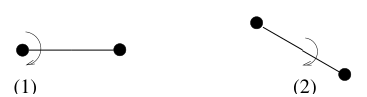 Bola rotating about axes (1) and (2)
Topic: Rotational Dynamics Metodi: Torque & Angular Momentum Analysis, Conservation Laws Competenze: Physical Reasoning, Diagrammatic Reasoning Objects: Ball, String Fonte: Testo (PDF) — p.3
Una bola semplificata è costituita da due (invece delle solite tre) palle piccole ma pesanti collegate a un punto comune con lunghezze identiche di corda. Per lanciarla, si tiene una delle palle sopra la testa e si svinga l’altra palla in un cerchio orizzontale intorno al polso. Quindi si lascia andare la palla che molto presto inizia a girare intorno al suo centro di massa, come mostrato di seguito. Quale delle seguenti affermazioni è vera quando l’asse di rotazione passa da (1) a (2)?
- A. Il momento angolare è lo stesso, ma la velocità angolare aumenta.
- B. Momentum angolare e velocità angolare rimangono uguali.
- C. Il momento angolare è lo stesso, ma la velocità angolare diminuisce.
- D. Ambi aumentano il momento angolare e la velocità angolare.
*Bola che ruota intorno agli assi (1) e (2) *
Topic: Rotational Dynamics Metodi: Torque & Angular Momentum Analysis, Conservation Laws Competenze: Physical Reasoning, Diagrammatic Reasoning Objects: Ball, String Fonte: Testo (PDF) — p.3
In an ink-jet printer, an ink droplet of mass is given a negative charge by a computer-controlled charging unit, and then enters at speed the region between two deflecting parallel plates of length separated by distance (see figure below). All over this region exists a downward electric field which you can assume to be uniform. Neglecting the gravitational force on the droplet, the maximum charge that it can be given so that it will not hit a plate is most closely approximated by
(A) .
(B) .
(C) .
(D) .
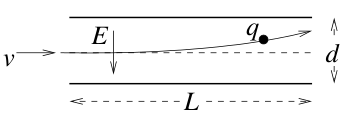 Charged droplet between deflecting plates
Topic: Electrostatics, Newtonian Mechanics Metodi: Lorentz Force Analysis, Kinematic Equations Competenze: Mathematical Modeling, Physical Reasoning Objects: Droplet, Capacitor Fonte: Testo (PDF) — p.3
In una stampante a getto di inchiostro, un’unità di ricarica a controllo informatico dà una carica negativa a un gocciolo di inchiostro di massa e quindi entra a velocità nella regione tra due lastre parallele di lunghezza che si deviano e separate da una distanza (vedere figura seguente). In tutta questa regione esiste un campo elettrico a discesa che si può presumere uniforme. Nonostante la forza gravitazionale della goccia, la carica massima che può essere data per non colpire una piastra è più strettamente approssimata da
(A) .
(B) .
(C) .
(D) .
Gottolina carica tra le piastre di deviazione
Topic: Electrostatics, Newtonian Mechanics Metodi: Lorentz Force Analysis, Kinematic Equations Competenze: Mathematical Modeling, Physical Reasoning Objects: Droplet, Capacitor Fonte: Testo (PDF) — p.3
Four very long straight wires carry equal electric currents in the direction. They intersect the – plane at , , , and . The magnetic force exerted on the wire at position is along
- A. .
- B. .
- C. .
- D. .
Topic: Magnetism, Electromagnetism Metodi: Biot-Savart Law, Symmetry Argument Competenze: Physical Reasoning, Diagrammatic Reasoning Objects: Wire Fonte: Testo (PDF) — p.3
Quattro fili retti molto lunghi portano correnti elettriche uguali nella direzione . Si incrociano il piano x$$y a , , e . La forza magnetica esercitata sul filo in posizione è lungo
- A. .
- B. .
- C. .
- D. .
Topic: Magnetism, Electromagnetism Metodi: Biot-Savart Law, Symmetry Argument Competenze: Physical Reasoning, Diagrammatic Reasoning Objects: Wire Fonte: Testo (PDF) — p.3
Two masses, both equal to , are suspended at the ends of identical light strings of length , attached to the same point on the ceiling (see figure). At time , they are simultaneously released from rest, one at angle , the other at angle from the vertical. The masses will collide
- A. at , later.
- B. at to the right of the vertical, later.
- C. at , later.
- D. at to the right of the vertical, later.
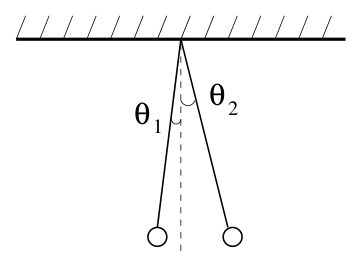 Two pendulums at angles θ₁ and θ₂
Topic: Oscillations & Waves, Newtonian Mechanics Metodi: Simple Harmonic Motion Analysis, Small-Angle Approximation Competenze: Mathematical Modeling, Physical Reasoning Objects: Pendulum Fonte: Testo (PDF) — p.3
Due masse, entrambe uguali a , sono sospese alle estremità di una stessa catena luminosa di lunghezza , attaccate allo stesso punto del soffitto (vedi figura). Al tempo , vengono simultaneamente rilasciati dal riposo, uno all’angolo , l’altro all’angolo dalla verticale. Le masse si scontreranno .
- A. a , successivamente.
- B. a a destra della verticale, dopo.
- C. a , successivamente.
- D. a a destra della verticale, dopo.
Due penduli ad angoli θ1 e θ2
Topic: Oscillations & Waves, Newtonian Mechanics Metodi: Simple Harmonic Motion Analysis, Small-Angle Approximation Competenze: Mathematical Modeling, Physical Reasoning Objects: Pendulum Fonte: Testo (PDF) — p.3
Two trains are moving toward each other on two parallel tracks at the same speed with respect to the ground. When the whistle of one train blows, the frequency of the sound heard by a passenger on the other train will be
- A. greatest if the air is still.
- B. greatest if a wind blows in the same direction and at the same speed as the other train.
- C. greatest if a wind blows in the opposite direction and at the same speed as the other train.
- D. will not depend on whether there is a wind blowing.
Topic: Oscillations & Waves Metodi: Wave Equation, Physical Modeling Competenze: Physical Reasoning, Mathematical Modeling Objects: — Fonte: Testo (PDF) — p.4
Due treni si muovono l’uno verso l’altro su due binari paralleli alla stessa velocità rispetto al suolo. Quando suona il fischio di un treno, la frequenza del suono che un passeggero su un altro treno sente sarà
- A. maggiore se l’aria è ferma.
- B. maggiore se un vento soffia nella stessa direzione e alla stessa velocità dell’altro treno.
- C. maggiore se un vento soffia nella direzione opposta e alla stessa velocità dell’altro treno.
- D. non dipenderà dal fatto che soffia un vento.
Topic: Oscillations & Waves Metodi: Wave Equation, Physical Modeling Competenze: Physical Reasoning, Mathematical Modeling Objects: — Fonte: Testo (PDF) — p.4
In an African wildlife reserve your jeep is travelling at a constant speed of alongside a cheetah running at full speed. The animal, frightened by the jeep’s noise, keeps at a constant distance of from the vehicle. Not having paid much attention to the surrounding landscape, you suddenly realize that your jeep is passing the very same spot where it was 60 seconds before. The speed of the cheetah is
- A. .
- B. .
- C. .
- D. .
Topic: Newtonian Mechanics Metodi: Kinematic Equations, Physical Modeling Competenze: Mathematical Modeling, Physical Reasoning Objects: — Fonte: Testo (PDF) — p.4
In una riserva di fauna selvatica africana la tua jeep sta viaggiando a velocità costante di insieme a un gepardo che corre a piena velocità. L’animale, spaventato dal rumore della jeep, si trova a una distanza costante di dal veicolo. Non avendo prestato molta attenzione al paesaggio circostante, ti rendi conto improvvisamente che la tua jeep sta passando nello stesso punto dove era 60 secondi prima. La velocità del gepardo è
- A. .
- B. .
- C. .
- D. .
Topic: Newtonian Mechanics Metodi: Kinematic Equations, Physical Modeling Competenze: Mathematical Modeling, Physical Reasoning Objects: — Fonte: Testo (PDF) — p.4
A jet-fighter pilot, wishing to experience weightlessness conditions, enters a parabolic trajectory closely approximating that of a projectile in free-fall. His aircraft must fly at a minimum speed of to keep control, and he should not exceed so as not to suffer a black-out when he pulls out of the trajectory at the end. There is no wind and air resistance can be compensated by the engine. In order to be weightless as long as possible, he should enter the parabola at an upward angle (with respect to the horizontal ground) of
- A. .
- B. .
- C. .
- D. .
Topic: Newtonian Mechanics Metodi: Kinematic Equations, Calculus-Integration Competenze: Mathematical Modeling, Physical Reasoning Objects: Projectile Fonte: Testo (PDF) — p.4
Un pilota di caccia a reazione, desideroso di sperimentare condizioni di assenza di peso, entra in una traiettoria parabolica che si avvicina a quella di un proiettile in caduta libera. Il suo aereo deve volare a una velocità minima di per mantenere il controllo e non deve superare per non subire un black-out quando si allontana dalla traiettoria alla fine. Non c’è vento e la resistenza all’aria può essere compensata dal motore. Per rimanere il più a lungo possibile senza peso, deve inserire la parabola in angolo ascendente (rispetto al terreno orizzontale) di
- A. .
- B. .
- C. .
- D. .
Topic: Newtonian Mechanics Metodi: Kinematic Equations, Calculus-Integration Competenze: Mathematical Modeling, Physical Reasoning Objects: Projectile Fonte: Testo (PDF) — p.4
Which one of the following statements is not true? The phase difference between two light waves can change
- A. by reflection.
- B. by the waves travelling along paths of different lengths.
- C. by the waves travelling through media that have a different refraction index.
- D. by being transmitted through a boundary between two media with different refraction indices.
Topic: Wave Optics, Geometric Optics Metodi: Interference & Diffraction Analysis, Snell’s Law Competenze: Physical Reasoning, Mathematical Modeling Objects: — Fonte: Testo (PDF) — p.4
Quale delle seguenti affermazioni non è vera? La differenza di fase tra due onde di luce può cambiare
- A. per riflessione.
- B. dalle onde che viaggiano lungo percorsi di lunghezza diversa.
- C. dalle onde che attraversano i mezzi di rifrazione con un indice di rifrazione diverso.
- D. tramite trasmissione attraverso un confine tra due media con indici di rifrazione diversi.
Topic: Wave Optics, Geometric Optics Metodi: Interference & Diffraction Analysis, Snell’s Law Competenze: Physical Reasoning, Mathematical Modeling Objects: — Fonte: Testo (PDF) — p.4
Part B — Problem 1
Passing a car on a two-lane road requires more caution as speeds increase. Apart from maintaining a safe distance between vehicles in the same lane, there should also be enough space between oncoming vehicles while the passing manoeuvre takes place.
Take all cars initially, travelling at the same constant speed, to have a length . Suppose further that a passing manoeuvre starts with the passing car at least car lengths behind the back of the slower car, and that it ends when the driver has pulled in with the back of her car at least car lengths ahead of the slower car (no fish-tailing!). The passing car takes at constant acceleration to reach its final passing speed, which it keeps thereafter. This final speed is greater than the steady speed of the slower car.
(a) Calculate the total time it takes for such a passing manoeuvre.
- B. Now suppose that at the instant the passing driver has reached her overtaking speed, she notices ahead (from the front of her car) a very large truck coming toward her. The speed limit for trucks on that road, which we shall assume the truck driver respects, is . The slower car is driving at . Otherwise, the same conditions as in part
- A. apply. We assume that for minimal safety she should have completed her manoeuvre at least before the truck and her pass each other, but she cannot abort the manoeuvre without braking unless the front of her car is at least behind the back of the slow car, and she cannot brake safely because another car right behind her is also trying to pass the slow car. Given that it takes her to react after she first sees the truck, discuss whether it is safe for her to continue, or whether she should pull back behind the slower car (if she can!). If it turns out that she is in trouble, could she continue accelerating at the same rate up to a higher speed not exceeding and pass safely while still pulling in three car lengths in front of the slow car?
Topic: Newtonian Mechanics Metodi: Kinematic Equations, Free-Body Diagram Competenze: Mathematical Modeling, Physical Reasoning Objects: — Fonte: Testo (PDF) — p.4
Parte B Problema 1
Passare un’auto su una strada a due corsie richiede maggiore cautela man mano che le velocità aumentano. Oltre a mantenere una distanza di sicurezza tra i veicoli nella stessa corsia, dovrebbe esserci anche sufficiente spazio tra i veicoli in arrivo mentre si svolge la manovra di passaggio.
Prendete tutte le auto in partenza, che viaggiano alla stessa velocità costante, per avere una lunghezza . Supponiamo inoltre che una manovra di passaggio inizia con le lunghezze della macchina in passaggio almeno dietro la parte posteriore della macchina più lenta, e che finisca quando il conducente si è fermato con la parte posteriore della sua auto almeno lunghezze della macchina in precedenza della macchina più lenta (nessun pesce-tailing!). La macchina che passa deve passare ad accelerazione costante per raggiungere la sua velocità di passaggio finale, che essa mantiene successivamente. Questa velocità finale è superiore alla velocità costante della macchina più lenta.
-
Calcolare il tempo totale necessario per una tale manovra di passaggio.
-
B. Now suppose that at the instant the passing driver has reached her overtaking speed, she notices ahead (from the front of her car) a very large truck coming toward her. Il limite di velocità per i camion su tale strada, che presumibilmente il camionista rispetta, è . L’auto più lenta è in . Altrimenti, le stesse condizioni che in parte
-
si applica il A.. Supponiamo che per una sicurezza minima avrebbe dovuto completare la sua manovra almeno prima che il camion e lei si passassero l’uno l’altro, ma non può interrompere la manovra senza frenare a meno che la parte anteriore della sua auto non sia almeno dietro la parte posteriore della macchina lenta, e non può frenare in modo sicuro perché un’altra auto proprio dietro di lei sta cercando di passare anche la macchina lenta. Dato che le serve per reagire dopo aver visto il camion per la prima volta, discutere se è sicuro per lei continuare, o se dovrebbe ritirarsi dietro la macchina più lenta (se può!). Se si scopre che è in difficoltà, potrebbe continuare ad accelerare allo stesso ritmo fino a una velocità superiore non superiore a e passare in sicurezza mentre continua a tirare in tre lunghezze di macchina davanti alla macchina lenta?
Topic: Newtonian Mechanics Metodi: Kinematic Equations, Free-Body Diagram Competenze: Mathematical Modeling, Physical Reasoning Objects: — Fonte: Testo (PDF) — p.4
Part B — Problem 2
In Poe’s famous horror tale, The Pit and the Pendulum, the hero, who finds himself strapped flat to a horizontal surface, notices an almost motionless pendulum hanging from the ceiling above him. After some time, he also realizes that the pendulum is descending very slowly toward him with, according to the story, the amplitude of the swings and the speed at the lowest point in each swing both increasing inexorably. What is swinging is in fact a small razor-edged crescent of steel which will eventually sweep across the man’s heart.
Let’s analyze this terrifying situation more closely to see if Poe’s spell-binding description actually makes physical sense. The blade of mass is suspended on the end of a massless cable of length and is executing simple harmonic motion. Assume that the blade is also slowly lowered in very small increments of which occur only when it goes through its lowest position in each swing, at , where is the angular position with respect to the vertical.
(a) Explain in one short sentence why the angular momentum of the razor at remains constant all through the descent.
(b) Let the initial length of the cord be and the initial maximum speed of the razor be . Obtain an algebraic expression for as a function of .
(c) Derive an algebraic expression for the kinetic energy of the pendulum at as a function of .
(d) Make a reasonable simplifying assumption about the total mechanical energy. Find (always as a function of ) the maximum gravitational potential energy acquired by the pendulum in a given swing.
(e) Find the maximum angular displacement of the razor as a function of .
(f) Discuss the accuracy of Poe’s description of the descent of the pendulum.
Topic: Oscillations & Waves, Conservation of Energy Metodi: Torque & Angular Momentum Analysis, Simple Harmonic Motion Analysis, Conservation Laws Competenze: Mathematical Modeling, Physical Reasoning Objects: Pendulum Fonte: Testo (PDF) — p.5
Parte B Problema 2
Nel famoso racconto d’orrore di Poe, Il pozzo e il pendolo, l’eroe, che si ritrova attaccato a una superficie orizzontale, nota un pendolo quasi immobile appeso dal soffitto sopra di lui. Dopo un po’ di tempo, si rende conto che il pendolo sta discendendo verso di lui molto lentamente con, secondo la storia, l’ampiezza degli oscillati e la velocità al punto più basso di ogni oscillazione che aumentano inessorabilmente. Quello che sta oscillato è in realtà una piccola mezzaluna di acciaio con la punta di una rasoio che alla fine spazzerà attraverso il cuore dell’uomo.
Analizziamo questa terribile situazione più da vicino per vedere se la descrizione incantesima di Poe ha davvero senso fisico. La lama di massa è sospesa all’estremità di un cavo senza massa di lunghezza ed esegue un semplice movimento armonico. Supponiamo che la lama sia anche abbassata lentamente in piccoli incrementi di che si verificano solo quando attraversa la sua posizione più bassa in ogni swing, a , dove è la posizione angolare rispetto alla verticale.
a) Spiegare in una breve frase perché il momento angolare della rasoio a rimane costante durante tutta la discesa.
b) La lunghezza iniziale del cavo deve essere e la velocità massima iniziale della rasoio deve essere . Ottenere un’espressione algebrica per come funzione di .
(c) Derivare un’espressione algebrica per l’energia cinetica del pendolo a come funzione di .
d) Fare un’ipotesi ragionevole di semplificazione dell’energia meccanica totale. Trova (sempre in funzione di ) l’energia gravitazionale potenziale massima acquisita dal pendolo in un determinato swing.
e) Trova il spostamento angolare massimo della rasatura come funzione di .
(f) Discutere l’accuratezza della descrizione di Poe della discesa del pendolo.
Topic: Oscillations & Waves, Conservation of Energy Metodi: Torque & Angular Momentum Analysis, Simple Harmonic Motion Analysis, Conservation Laws Competenze: Mathematical Modeling, Physical Reasoning Objects: Pendulum Fonte: Testo (PDF) — p.5
Part B — Problem 3
One fine afternoon, as his family watches from some distance, a man walking barefoot on moist ground near a tower supporting electric transmission lines suddenly stops and collapses. His relatives call in emergency services, but these arrive too late to prevent the man’s death.
The autopsy reveals that the man’s heart went into ventricular fibrillation, a fatal condition if not stopped very quickly. His relatives believe that he was electrocuted by some stray electric current from the tower and sue the power company. The court orders a forensic investigation to determine if the company is responsible for the victim’s death.
The investigation finds that there was indeed an electrical fault at the time the incident occurred: for about , an electric current of leaked into the ground from a vertical conducting rod whose rounded tip was just below ground, located away from where the man was standing. The resistivity of the moist ground was about .
(a) Assuming that the current spread uniformly into the ground from the rounded tip, find the magnitudes of the current density, (in ), and of the electric field, , as a function of the distance from the tip of the rod. If you don’t know the relationship between and , you can derive it from Ohm’s law and a bit of dimensional analysis.
(b) Calculate and at the victim’s location.
(c) Under any suitable approximation, obtain a reasonable estimate of the potential difference between the man’s feet.
(d) It is reasonable to suppose that the current went up one leg of the man, across the torso (and the heart), and down through the other leg. The commonly accepted values for the resistance of a leg is and that of a torso in these conditions. From these data, estimate the current across the victim’s torso.
(e) Using your expression for , obtain the potential difference, , between the tip of the rod and a point situated at distance . Take the tip of the rod to have radius . If the integral is a problem, you can still get the answer by noticing the similarity between and the field of a well-known charge configuration.
(f) Currents ranging from to across a torso can trigger fibrillation in the heart. Could the accident have been caused by the current that leaked from the rod?
Topic: Electrostatics, Circuits Metodi: Gauss’s Law, Coulomb’s Law, Kirchhoff’s Laws Competenze: Mathematical Modeling, Physical Reasoning Objects: Rod, Wire Fonte: Testo (PDF) — p.5
Parte B Problema 3
Un bel pomeriggio, mentre la sua famiglia guardava da qualche distanza, un uomo che camminava a piedi nudi su un terreno umido vicino a una torre che sosteneva le linee di trasmissione elettrica si ferma improvvisamente e crolla. I suoi parenti chiamano i servizi di emergenza, ma arrivano troppo tardi per evitare la morte dell’uomo.
L’autopsia rivela che il cuore dell’uomo è entrato in fibrillazione ventricolare, una condizione fatale se non fermata molto rapidamente. I suoi parenti credono che sia stato elettricato da una corrente elettrica di strada dalla torre e hanno citato la compagnia elettrica. Il tribunale ordina un’indagine forense per determinare se la società è responsabile della morte della vittima.
L’inchiesta rileva che al momento dell’incidente vi era effettivamente un guasto elettrico: per circa , una corrente elettrica di è uscita a terra da una canna di conduttore verticale la cui punta arrotondata era appena sotto terra, situata lontano da dove l’uomo era in piedi. La resistività del terreno umido era di circa .
a) Supponendo che la corrente si diffonda uniformemente in terra dalla punta arrotondata, si trovano le magnitudini della densità di corrente, (in ), e del campo elettrico, , in funzione della distanza dalla punta della canna. Se non conosci la relazione tra e , puoi derivarla dalla legge di Ohm e da un po’ di analisi dimensionale.
b) Calcolare e al luogo della vittima.
(c) In base a qualsiasi approssimazione appropriata, ottenere una ragionevole stima della potenziale differenza tra i piedi dell’uomo.
(d) È ragionevole supporre che la corrente sia salita su una gamba dell’uomo, attraverso il torso (e il cuore), e scesa attraverso l’altra gamba. I valori comunemente accettati per la resistenza di una gamba sono e di un torso in queste condizioni. Da questi dati, si stima la corrente nel torso della vittima.
e) Usando l’espressione per , si ottiene la differenza potenziale, , tra la punta della canna e un punto situato a distanza . Prendi la punta della canna per avere un raggio . Se l’integrale è un problema, si può ancora ottenere la risposta notando la somiglianza tra e il campo di una configurazione di carica ben nota.
f) Correnti che vanno da a attraverso un tronco possono innescare fibrillazione nel cuore. L’incidente potrebbe essere stato causato dalla corrente che ha trapelato dalla canna?
Topic: Electrostatics, Circuits Metodi: Gauss’s Law, Coulomb’s Law, Kirchhoff’s Laws Competenze: Mathematical Modeling, Physical Reasoning Objects: Rod, Wire Fonte: Testo (PDF) — p.5