Volleyball (8 points)
Consider a simplified model of a volleyball: a thin spherical envelope filled with air. The envelope material is non-stretchable, easily foldable. The excess pressure inside the ball , the ball radius and mass (the air mass inside the ball is negligible). You can neglect the dependence of the excess pressure on the deformation of the ball.
-
The ball is pressed between two parallel rigid plates, the distance between of which is (so that the height of the deformed segments is ). Find the force between the ball and a plate .
-
Ball moves with velocity and hits a rigid wall. Find the maximal height of the deformed segment …
-
…and the collision time .
-
For small excess pressures, the ball can lose its spherical shape even in those points, which are not in touch with the wall. Which condition between the quantities , , and has to be satisfied in order to ensure that such a loss of sphericity is negligible?
Topic: Fluid Mechanics, Newtonian Mechanics, Oscillations & Waves Metodi: Free-Body Diagram, Conservation of Energy, Physical Modeling Competenze: Physical Reasoning, Mathematical Modeling Objects: Ball Fonte: Testo (PDF) — p.1
Volleyball (8 punti)
Prendiamo un modello semplificato di una palla da volley: una tenuta busta sferica piena di aria. Il materiale della busta non è estensibile, facilmente pieghevole. La pressione in eccesso all’interno della palla , il raggio della palla e la massa (la massa dell’aria all’interno della palla è trascurabile). Si può trascurare la dipendenza della pressione in eccesso dalla deformazione della palla.
-
La palla è premuta tra due piastre rigide parallele, la cui distanza è (in modo che l’altezza dei segmenti deformati sia ). Trova la forza tra la palla e la piastra .
-
La palla si muove con velocità e colpisce un muro rigido. Trova l’altezza massima del segmento deformato …
-
… e il tempo di collisione .
-
Per piccole pressioni eccessive, la palla può perdere la sua forma sferica anche in quei punti che non sono in contatto con il muro. Quale condizione deve essere soddisfatta tra i quantitativi , , e per garantire che tale perdita di sfericità sia trascurabile?
Topic: Fluid Mechanics, Newtonian Mechanics, Oscillations & Waves Metodi: Free-Body Diagram, Conservation of Energy, Physical Modeling Competenze: Physical Reasoning, Mathematical Modeling Objects: Ball Fonte: Testo (PDF) — p.1
Heat flux (4 points)
Heat resistivity is equal to the ratio of the temperature difference between the end-points of a wire of unit cross-section and unit length, and the heat flux (unit: W) through this wire.
-
Microprocessor of power has a water-cooling system. The chip and flowing water are separated by a copper plate of thickness and cross-section area . What is the temperature difference between the processor and water? The copper heat resistivity is .
-
A wire is made of different alloys; its heat resistivity as a function of the coordinate along the wire is given in the attached graph. The cross-section area of the wire is , its length . Find the heat flux through the wire, if one end of the wire is kept at the temperature , and the other end — at .
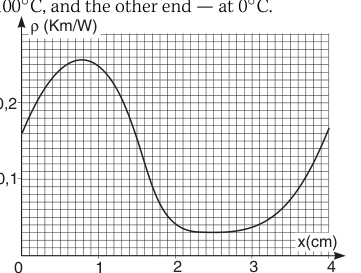 Heat resistivity vs position along wire
Topic: Thermodynamics, Electrostatics Metodi: Physical Modeling, Calculus-Integration, Dimensional Analysis Competenze: Physical Reasoning, Mathematical Modeling Objects: Wire Fonte: Testo (PDF) — p.1
Flusso di calore (4 punti)
La resistenza al calore è pari al rapporto tra la differenza di temperatura tra i punti di fine di un filo di sezione trasversale e di lunghezza unitaria e il flusso di calore (unità: W) attraverso questo filo.
-
Il microprocessore di potenza dispone di un sistema di raffreddamento idrico. Il chip e l’acqua che scorre sono separati da una piastra di rame di spessore e da una superficie di sezione trasversale . Qual è la differenza di temperatura tra il processore e l’acqua? La resistenza al calore del rame è .
-
Un filo è costituito da diverse leghe; la sua resistenza termico in funzione delle coordinate lungo il filo è indicata nel grafico allegato. L’area di sezione trasversale del filo è , la sua lunghezza . Trova il flusso di calore attraverso il filo, se una estremità del filo è tenuta alla temperatura e l’altra estremità a .
Resistenza al calore rispetto alla posizione lungo il filo
Topic: Thermodynamics, Electrostatics Metodi: Physical Modeling, Calculus-Integration, Dimensional Analysis Competenze: Physical Reasoning, Mathematical Modeling Objects: Wire Fonte: Testo (PDF) — p.1
Gravitation (6 points)
-
Find the free falling acceleration at the surface of a spherical planet, which has mass and material density (in what follows, and are assumed to be constant).
-
Is it possible that at the surface of a non-spherical planet, there is a point with free falling acceleration ? Motivate your answer.
-
For which planet shape is the maximum of the free falling acceleration achieved? The answer can be given in polar coordinates; the expression can contain one unspecified constant.
Topic: Gravitation, Newtonian Mechanics Metodi: Newton’s Law of Gravitation, Symmetry Argument, Physical Modeling Competenze: Physical Reasoning, Mathematical Modeling Objects: Planet Fonte: Testo (PDF) — p.1
**Gravitazione ** (6 punti)
-
Trovare l’accelerazione di caduta libera sulla superficie di un pianeta sferico, che ha massa e densità di materiale (in quanto segue, e sono presunti come costanti).
-
È possibile che sulla superficie di un pianeta non sferico, ci sia un punto con accelerazione di caduta libera ? Motiva la tua risposta.
-
Per quale forma di pianeta si ottiene il massimo dell’accelerazione di caduta libera? La risposta può essere data in coordinate polari; l’espressione può contenere una costante non specificata.
Topic: Gravitation, Newtonian Mechanics Metodi: Newton’s Law of Gravitation, Symmetry Argument, Physical Modeling Competenze: Physical Reasoning, Mathematical Modeling Objects: Planet Fonte: Testo (PDF) — p.1
Tunnel diode (8 points)
Tunnel diode is a semi-conductor device, similar to the ordinary diode; the volt-ampere characteristic of which is given in the attached graph. The circuit below describes a simple amplifier. The resistance , battery voltage .
-
Find the current in the circuit, if .
-
Find the output voltage if .
-
Find the output signal if .
-
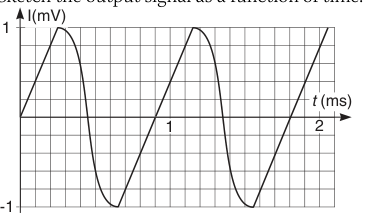
The input signal is given in the graph below. Sketch the output signal as a function of time.
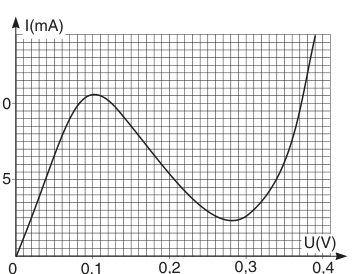 Tunnel diode I-V characteristic
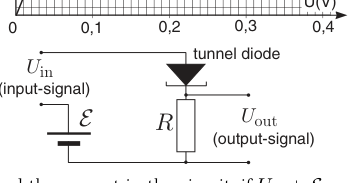 Amplifier circuit with tunnel diode
 Input signal vs time
Topic: Circuits, Electrostatics Metodi: Kirchhoff’s Laws, Equivalent Circuit Reduction, Physical Modeling Competenze: Physical Reasoning, Diagrammatic Reasoning Objects: Resistor, Battery Fonte: Testo (PDF) — p.1
diodo del tunnel (8 punti)
Il diodo di tunnel è un dispositivo semiconduttore, simile al diodo ordinario, la cui caratteristica di volt-ampere è indicata nel grafico allegato. Il circuito di seguito descrive un semplice amplificatore. La resistenza , la tensione della batteria .
-
Trova la corrente nel circuito, se .
-
Trova la tensione di uscita se .
-
Trova il segnale di uscita se .
-
Il segnale di ingresso è riportato nel grafico seguente. Segna il segnale di uscita in funzione del tempo.
Caricatura di diodo tunnel I-V
Circuito di amplificatore con diodo tunnel
Signal di ingresso vs tempo
Topic: Circuits, Electrostatics Metodi: Kirchhoff’s Laws, Equivalent Circuit Reduction, Physical Modeling Competenze: Physical Reasoning, Diagrammatic Reasoning Objects: Resistor, Battery Fonte: Testo (PDF) — p.1
Vibration (10 points)
Consider a smooth horizontal surface, which is moved periodically back and forth along the horizontal -axis: during the first semi-period , the surface velocity is ; during the second semi-period — . A brick of mass is put on that surface; the friction coefficient between the surface and brick is , free falling acceleration is .
-
The brick has initial -directional velocity . Which condition between the quantities , , , and has to be satisfied in order to ensure that the brick velocity changes during a semi-period is negligible? Further we assume that this condition is satisfied.
-
The brick is kept in motion along -axis by a force in such a way that the mean brick velocity is . Sketch graphically the dependence .
-
The brick is kept in motion along (horizontal) -axis by a force in such a way that the mean brick velocity is . Find the dependence .
-
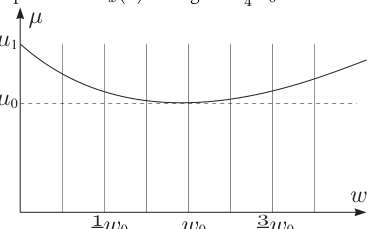
Until now we have ignored the dependence of the friction coefficient on the sliding velocity. Further let us assume this dependence is given by the graph below. The brick is kept in motion along -axis by a force in such a way that the mean brick velocity is . Sketch graphically the dependence taking .
-
The brick is put on the surface; there are no external forces. What is the brick’s terminal velocity ? Provide the answer as a function of .
 Friction coefficient vs sliding velocity
Topic: Newtonian Mechanics, Oscillations & Waves Metodi: Free-Body Diagram, Impulse-Momentum Theorem, Physical Modeling Competenze: Physical Reasoning, Mathematical Modeling Objects: Block Fonte: Testo (PDF) — p.1
**Vibrazione ** (10 punti)
Si consideri una superficie orizzontale liscia, che si muove periodicamente avanti e indietro lungo l’asse orizzontale : durante il primo semiperiodo , la velocità superficiale è ; durante il secondo semiperiodo . Si pone su tale superficie un mattone di massa ; il coefficiente di attrito tra superficie e mattone è , l’accelerazione di caduta libera è .
-
Il mattone ha una velocità iniziale -direzionale . Quale condizione deve essere soddisfatta tra le quantità , , e per garantire che la velocità di rotaia durante un semiperiodo sia trascurabile? Inoltre, presumiamo che questa condizione sia soddisfatta.
-
Il mattone è tenuto in movimento lungo l’asse da una forza in modo tale che la velocità media del mattone sia . Segna graficamente la dipendenza .
-
Il mattone è tenuto in movimento lungo (orizzontale) -asse da una forza in modo tale che la velocità media del mattone sia . Trova la dipendenza .
-
Finora abbiamo ignorato la dipendenza del coefficiente di attrito dalla velocità di scorrere. Supponiamo inoltre che questa dipendenza sia data dal grafico di seguito. Il mattone è tenuto in movimento lungo l’asse da una forza in modo tale che la velocità media del mattone sia . Sfoglio grafico della dipendenza assumendo .
-
Il mattone viene posto sulla superficie; non ci sono forze esterne. Qual è la velocità terminale del mattone ? Fornire la risposta come funzione di .
Coefficiente di frattura vs velocità di scorrimento
Topic: Newtonian Mechanics, Oscillations & Waves Metodi: Free-Body Diagram, Impulse-Momentum Theorem, Physical Modeling Competenze: Physical Reasoning, Mathematical Modeling Objects: Block Fonte: Testo (PDF) — p.1
Charged particle (12 points)
A particle of mass and charge is in a homogeneous magnetic field with induction (the vector is parallel to the -axis). The characteristic time of the system is the cyclotron period of the particle . The system is situated in between two parallel electrodes, which can be used to create a homogeneous, parallel to the -axis electric field .
-
The particle is at rest. At the moment of time , the electric field is switched on; after a short time interval (), it is switched off, again. What will be the trajectory of the particle?
-
Let and denote the - and -components of the momentum of the particle. Sketch the trajectory of the particle in the -plane and depict the vectors of the momentum for the moments of time ( and ).
-
Consider the situation when the on-off switching of the electric field is done periodically, starting with , after equal time intervals . Sketch the particle trajectories in the - and -planes.
-
Let the period be short, (but still much longer than the duration of pulse, ). Show that after the -th pulse (at the time moment ), the momentum of the particle can be represented as the sum of vectors , where all the component-vectors are equal in modulus (the modulus being independent of ), and the neighbouring vectors ( and , ) have equal angles between them.
-
Consider the limit case , so that ( denotes the time-average of the electric field). Sketch the particle trajectory in the -plane and express the particle’s mean velocity (vectorially; averaged over the cyclotron period) via the quantities and .
-
Let us return to the non-zero (but still small, ) time-intervals. Let us consider the case when the pulses are of variable polarity: for the -th pulse, the electric field is , and for the -st pulse . Find the particle’s average velocity (vectorially) averaged over the cyclotron period.
Topic: Electromagnetism, Magnetism, Newtonian Mechanics Metodi: Lorentz Force Analysis, Impulse-Momentum Theorem, Physical Modeling Competenze: Physical Reasoning, Mathematical Modeling Objects: Point Charge Fonte: Testo (PDF) — p.2
Particella carica (12 punti)
Una particella di massa e carica è in un campo magnetico omogeneo con induzione (il vettore è parallelo all’asse ). Il tempo caratteristico del sistema è il ciclotronico della particella . Il sistema è situato tra due elettrodi paralleli, che possono essere utilizzati per creare un campo elettrico omogeneo, parallelo all’asse .
-
La particella è in riposo. Nel momento di , il campo elettrico viene acceso; dopo un breve intervallo di tempo (), viene nuovamente spento. Qual sarà la traiettoria della particella?
-
Indicare i componenti e - e del momento della particella. Segnare la traiettoria della particella nel piano e illustrare i vettori di impulso per i momenti di tempo ( e ).
-
Considerare la situazione in cui l’intervento di spegnimento del campo elettrico viene effettuato periodicamente, a partire da , dopo intervalli di tempo uguali . Sine di traiettorie delle particelle nei piani - e .
-
Il periodo deve essere breve, (ma comunque molto più lungo della durata del polso, ). Mostra che dopo l’impulso -th (al momento ), la dinamica della particella può essere rappresentata come la somma dei vettori , dove tutti i vettori componenti sono uguali di modulo (il modulo è indipendente da ), e i vettori vicini ( e , ) hanno angoli uguali tra di loro.
-
Considerare il caso limite , in modo che ( indica la media temporale del campo elettrico). Segnare la traiettoria delle particelle nel piano ed esprimere la velocità media della particella (vectorialmente; media nel periodo del ciclotrone) attraverso le quantità e .
-
Torniamo agli intervalli temporali non zero (ma ancora piccoli, ). Consideriamo il caso in cui gli impulsi sono di polarità variabile: per l’impulso -th, il campo elettrico è , e per l’impulso -st . Trova la velocità media (vectorialmente) della particella media nel periodo del ciclotrone.
Topic: Electromagnetism, Magnetism, Newtonian Mechanics Metodi: Lorentz Force Analysis, Impulse-Momentum Theorem, Physical Modeling Competenze: Physical Reasoning, Mathematical Modeling Objects: Point Charge Fonte: Testo (PDF) — p.2
Telescope (12 points)
As it is well known, a telescope makes it possible to see the stars in daylight. Let us study the problem in more details. Consider a simplified model of the eye: a single lens with focal length and diameter creating an image on screen (retina). The model of a telescope is similar: a lens of focal length and diameter creating an image in focal plane (where e.g. a film can be put). In your calculations, the following quantities can be used: the density of the light energy radiated from a unit Solar surface in unit time (the light power surface density); the ratio of the star and Sun distances (we assume that the star is identical to the Sun); Solar angular diameter . Remark: If the answer contains then numerical answer is not required.
-
Consider a sheet of paper, the normal of which is directed towards the Sun. What is the surface density of the light power arriving to the sheet from the Sun?
-
Find the net power of the light, which is focused by the telescope into the image of the star.
-
Assume that blue sky is as bright as a sheet of gray paper illuminated by Sun. You may assume that in the direction, perpendicular to the sheet, the ratio of the light power scattered by the paper into a space angle, to the net light power arriving to the sheet, is (this corresponds to the dissipation of ca 70% light energy in the gray paper). What is the surface density of the light power in the focal plane of the telescope , due to the blue sky?
-
While studying the star image, let us ignore for all the effects other than diffraction. Estimate a the surface density of the light power in the centre of the star image (in the focal plane of the telescope), due to the light arriving from the star.
-
Provide an expression for the ratio of the surface densities of the light power in the middle of the star image, and in a point farther away from it.
-
Is it possible to see a star in daylight using a telescope? Plain eye? Motivate yourself.
Topic: Geometric Optics, Wave Optics, Astrophysics Metodi: Ray Tracing, Thin Lens & Mirror Equation, Physical Modeling Competenze: Physical Reasoning, Estimation & Approximation Objects: Lens, Star, Screen Fonte: Testo (PDF) — p.2
Telescopio (12 punti)
Come è noto, un telescopio permette di vedere le stelle alla luce del giorno. Esaminiamo il problema in modo più dettagliato. Considera un modello semplificato dell’occhio: una singola lente con lunghezza focale e diametro che crea un’immagine sullo schermo (retina). Il modello di un telescopio è simile: una lente di lunghezza focale e di diametro che crea un’immagine in piano focale (dove, ad esempio, un film può essere messo). Nei vostri calcoli possono essere utilizzate le seguenti quantità: la densità dell’energia luminosa irradiata da un’unità di superficie solare in unità di tempo (la densità di superficie di potenza luminosa); il rapporto tra le distanze stellare e solare (supponiamo che l’estella sia identica al Sole); il diametro angolare solare . Ricordo: se la risposta contiene , la risposta numerica non è richiesta.
-
Considerate un foglio di carta, il cui normale è rivolto verso il sole. Qual è la densità superficiale della potenza luminosa che arriva al foglio dal Sole?
-
Trova la potenza netta della luce, che viene focalizzata dal telescopio nell’immagine della stella.
-
Supponiamo che il cielo blu sia luminoso come un foglio di carta grigia illuminato dal Sole. Si può presumere che, perpendicolare al foglio, il rapporto tra la potenza luminosa dispersa dalla carta in un angolo spaziale e la potenza luminosa netta che arriva al foglio sia (corrisponde alla dissipazione di circa il 70% di energia luminosa nella carta grigia). Qual è la densità superficiale della potenza luminosa nel piano focale del telescopio , a causa del cielo blu?
-
Mentre studiamo l’immagine stellare, ignoriamo tutti gli effetti diversi dalla diffrazione. Estimare a la densità superficiale della potenza luminosa nel centro dell’immagine stellare (nel piano focale del telescopio), a causa della luce che arriva dalla stella.
-
Fornire un’espressione del rapporto delle densità superficiali della potenza luminosa nel centro dell’immagine stellare e in un punto più lontano da essa.
-
È possibile vedere una stella al sole con un telescopio? Con un occhio chiaro? Motivati.
Topic: Geometric Optics, Wave Optics, Astrophysics Metodi: Ray Tracing, Thin Lens & Mirror Equation, Physical Modeling Competenze: Physical Reasoning, Estimation & Approximation Objects: Lens, Star, Screen Fonte: Testo (PDF) — p.2
Experiment (12 points)
Determination of attraction force between iron plate and a permanent magnet as a function of distance. Tools: iron plate, wooden brick, ruler, dynamometer, paper stripes.
Attention! The permanent magnets are very strong; keep them far from credit cards etc. Avoid also hitting them against each other and against the iron plate, because they are fragile and can be broken.
-
Determine the static and dynamic coefficients of friction between the iron plate and a paper stripe. Draw the scheme of your set-up.
-
(4 points) Determine the attraction force between the iron plate and a magnet for those distances which allow direct usage of dynamometer. Draw the scheme of your set-up.
-
(4 points) Determine the attraction force between the iron plate and a magnet for smaller distances. For that purpose, you can use the wooden brick sliding down an inclined plate and hitting the magnet. You do not need to study the zero-distance (direct contact of magnet and iron plate) case. Draw the scheme of your set-up. Depict all the measurement results graphically.
-
Join two permanent magnets by a bridge made of a piece of iron (a) as shown in figure. Put a stripe of paper (b) on the iron plate (c) and put the system of magnets upon it. Determine the attraction force between the system of magnets and iron plate.
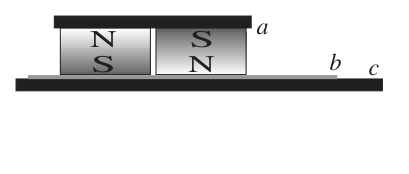 Two magnets bridged by iron piece (a), paper stripe (b), iron plate (c)
Topic: Magnetism, Newtonian Mechanics Metodi: Free-Body Diagram, Experimental Data Analysis, Physical Modeling Competenze: Experimental Data Analysis, Measurement & Instrumentation Objects: Magnet, Inclined Plane, Block Fonte: Testo (PDF) — p.2
Esperimento (12 punti)
Determinazione della forza di attrazione tra la piastra di ferro e un magnete permanente in funzione della distanza. Strumenti: piastra di ferro, mattoni di legno, regola, dinamometro, strisce di carta.
Attenzione! I magneti permanenti sono molto forti; teneteli lontani dalle carte di credito, ecc. Evitate di colpirle tra loro e contro la piastra di ferro, perché sono fragili e possono essere rotte.
-
Determinare i coefficienti statici e dinamici di attrito tra la piastra di ferro e una striscia di carta. Disegna il piano della tua impostazione.
-
(4 punti) Determinare la forza di attrazione tra la piastra di ferro e un magnete per quelle distanze che consentono l’uso diretto del dinamometro. Disegna il piano della tua impostazione.
-
(4 punti) Determina la forza di attrazione tra la piastra di ferro e un magnete per distanze più piccole. Per questo, si può usare il mattone di legno per scivolare giù una piastra inclinata e colpire il magnete. Non è necessario studiare il caso di distanza a zero (contatto diretto tra magnete e piastre di ferro). Disegna il piano della tua impostazione. Descrivere graficamente tutti i risultati delle misure.
-
Unire due magneti permanenti con un ponte di ferro (a) come mostrato nella figura. Metti una striscia di carta (b) sulla piastra di ferro (c) e mettiti su di essa il sistema di magneti. Determinare la forza di attrazione tra il sistema di magneti e la piastra di ferro.
*Due magneti collegati da un pezzo di ferro (a), una striscia di carta (b), una piastra di ferro (c) *
Topic: Magnetism, Newtonian Mechanics Metodi: Free-Body Diagram, Experimental Data Analysis, Physical Modeling Competenze: Experimental Data Analysis, Measurement & Instrumentation Objects: Magnet, Inclined Plane, Block Fonte: Testo (PDF) — p.2