A parallel-plate capacitor holds charge and is not connected to anything. The distance between the plates is now increased. The electrical energy stored on the capacitor
- A. decreases;
- B. remains the same;
- C. increases;
- D. can do any of the above, depending on how the capacitance changes.
Topic: Electrostatics Metodi: Electric Potential Method Competenze: Physical Reasoning Objects: Capacitor Fonte: Testo (PDF) — p.2
Un condensatore a piastra parallela tiene carica e non è collegato a nulla. La distanza tra le piastre è ora aumentata. L’energia elettrica immagazzinata sul condensatore
- A. diminuisce;
- B. rimane lo stesso;
- C. aumenta;
- D. può fare qualsiasi delle seguenti cose, a seconda delle variazioni della capacità.
Topic: Electrostatics Metodi: Electric Potential Method Competenze: Physical Reasoning Objects: Capacitor Fonte: Testo (PDF) — p.2
When a mechanical or electromagnetic wave goes from one medium to another, it undergoes a change in
- A. amplitude only;
- B. both speed and wavelength;
- C. speed only;
- D. wavelength only.
Topic: Oscillations & Waves Metodi: Wave Equation Competenze: Physical Reasoning Objects: — Fonte: Testo (PDF) — p.2
Quando un’onda meccanica o elettromagnetica passa da un mezzo ad un altro, subisce un cambiamento di
- solo A. di amplitudine;
- B. sia velocità che lunghezza d’onda;
- solo C. velocità;
- D. solo lunghezza d’onda.
Topic: Oscillations & Waves Metodi: Wave Equation Competenze: Physical Reasoning Objects: — Fonte: Testo (PDF) — p.2
Two identical rooms in a perfectly insulated house are connected by an open doorway. The temperature in the two rooms are maintained at different values. The room which contains more air molecules is
- A. the one with the higher temperature;
- B. the one with the lower temperature;
- C. the one with the higher pressure;
- D. neither, since both have the same volume.
Topic: Kinetic Theory, Thermodynamics Metodi: Ideal Gas Law Competenze: Physical Reasoning Objects: Gas Fonte: Testo (PDF) — p.2
Due camere identiche in una casa perfettamente isolata sono collegate da una porta aperta. La temperatura nelle due stanze è mantenuta a valori diversi. La stanza che contiene più molecole di aria è
- A. quella con la temperatura più alta;
- B. quella con temperatura inferiore;
- C. quella con pressione superiore;
- D. né, poiché entrambi hanno lo stesso volume.
Topic: Kinetic Theory, Thermodynamics Metodi: Ideal Gas Law Competenze: Physical Reasoning Objects: Gas Fonte: Testo (PDF) — p.2
Three airplanes, A, B and C, each release an object from the same altitude and with the same initial speed with respect to the ground. At the moment their object is released, A is flying horizontally, B is flying upward at an angle with respect to the horizontal, and C is flying at the same angle as B but downward with respect to the horizontal. Assuming the ground to be horizontal and neglecting any aerodynamical effect, the speeds at which the three objects will hit the ground satisfy
- A. ;
- B. ;
- C. ;
- D. .
Topic: Newtonian Mechanics Metodi: Conservation of Energy, Kinematic Equations Competenze: Physical Reasoning Objects: Projectile Fonte: Testo (PDF) — p.2
Tre aerei, A, B e C, rilasciano ciascuno un oggetto dalla stessa quota e con la stessa velocità iniziale rispetto al suolo. Nel momento in cui il loro oggetto viene rilasciato, A vola orizzontalmente, B vola in alto ad un angolo rispetto all’orizzontale e C vola nell’angolo stesso di B ma in discesa rispetto all’orizzontale. Supponendo che il terreno sia orizzontale e ignorando qualsiasi effetto aerodinamico, le velocità alle quali i tre oggetti colpiranno il terreno soddisfano
- A. ;
- B. ;
- C. ;
- D. .
Topic: Newtonian Mechanics Metodi: Conservation of Energy, Kinematic Equations Competenze: Physical Reasoning Objects: Projectile Fonte: Testo (PDF) — p.2
Two identical conducting spheres, A and B, carry equal electric charge. They are separated by a distance much larger than their diameter and exert an electrostatic force on each other. A third identical conducting sphere C is initially uncharged and far away from A and B. Sphere C is then brought briefly into contact with sphere A, then with sphere B, and finally removed far away. The electrostatic force between A and B is now
- A. ;
- B. ;
- C. ;
- D. .
Topic: Electrostatics Metodi: Coulomb’s Law Competenze: Physical Reasoning, Mathematical Modeling Objects: Conducting Sphere Fonte: Testo (PDF) — p.2
Due sfere di conduttore identiche, A e B, portano uguale carica elettrica. Sono separati da una distanza molto maggiore del loro diametro e esercitano una forza elettrostatica l’uno sull’altro. Una terza sfera di conduttore identica C è inizialmente scaricabile e lontana da A e B. La sfera C viene poi portata brevemente a contatto con la sfera A, poi con la sfera B, e infine rimossa lontano. La forza elettrostatica tra A e B è ora
- A. ;
- B. ;
- C. ;
- D. .
Topic: Electrostatics Metodi: Coulomb’s Law Competenze: Physical Reasoning, Mathematical Modeling Objects: Conducting Sphere Fonte: Testo (PDF) — p.2
On the ground, the Earth exerts a force on an astronaut. The force that the Earth exerts on this astronaut inside the Space Shuttle in low Earth orbit, 300 km above the ground, is
- A. a little less than ;
- B. a little more than ;
- C. exactly ;
- D. zero, since the astronaut is weightless when in orbit.
Topic: Gravitation, Newtonian Mechanics Metodi: Newton’s Law of Gravitation Competenze: Physical Reasoning Objects: Satellite, Planet Fonte: Testo (PDF) — p.2
In terra, la Terra esercita una forza su un astronauta. La forza che la Terra esercita su questo astronauta all’interno della navetta spaziale in bassa orbita terrestre, 300 km sopra la terra, è
- A. un po’ inferiore a ;
- B. un po’ più di ;
- C. esattamente ;
- D. zero, poiché l’astronauta è senza peso in orbita.
Topic: Gravitation, Newtonian Mechanics Metodi: Newton’s Law of Gravitation Competenze: Physical Reasoning Objects: Satellite, Planet Fonte: Testo (PDF) — p.2
A person is swinging a ball at the end of a string of length with constant speed . The work done by the tension in the string over one revolution is
- A. ;
- B. ;
- C. ;
- D. undetermined by the information given.
Topic: Newtonian Mechanics Metodi: Free-Body Diagram, Conservation of Energy Competenze: Physical Reasoning Objects: Ball, String Fonte: Testo (PDF) — p.2
Una persona sta svingendo una palla alla fine di una stringa di lunghezza con velocità costante . Il lavoro svolto dalla tensione nella corda su una rivoluzione è
- A. ;
- B. ;
- C. ;
- D. non determinato dalle informazioni fornite.
Topic: Newtonian Mechanics Metodi: Free-Body Diagram, Conservation of Energy Competenze: Physical Reasoning Objects: Ball, String Fonte: Testo (PDF) — p.2
The pressure exerted by a gas on the walls of the vessel that contains it is due to the
- A. change in kinetic energy of the gas molecules as they strike the walls;
- B. collisions between the gas molecules;
- C. repulsive force between the gas molecules;
- D. change in momentum of the gas molecules as they strike the walls.
Topic: Kinetic Theory Metodi: Kinetic Theory of Gases, Impulse-Momentum Theorem Competenze: Physical Reasoning Objects: Gas, Container Fonte: Testo (PDF) — p.3
La pressione esercitata da un gas sulle pareti del recipiente che lo contiene è dovuta alla
- A. cambiamento dell’energia cinetica delle molecole di gas quando colpiscono le pareti;
- B. collisioni tra le molecole di gas;
- C. forza repulsiva tra le molecole di gas;
- D. cambiamento di impulso delle molecole di gas quando colpiscono le pareti.
Topic: Kinetic Theory Metodi: Kinetic Theory of Gases, Impulse-Momentum Theorem Competenze: Physical Reasoning Objects: Gas, Container Fonte: Testo (PDF) — p.3
A Martian creature similar to an Earth frog jumps with an initial speed and attains the range over horizontal ground. The maximum possible height reached by the creature, neglecting friction in the tenuous Martian air, is ( being the launch angle):
- A. ;
- B. ;
- C. ;
- D. undetermined because of missing data.
Topic: Newtonian Mechanics Metodi: Kinematic Equations Competenze: Physical Reasoning, Mathematical Modeling Objects: Projectile Fonte: Testo (PDF) — p.3
Una creatura marziana simile a una rana terrestre salta con una velocità iniziale e raggiunge l’intervallo su un terreno orizzontale. L’altezza massima possibile raggiunta dalla creatura, trascurando l’attrito nell’aria marziana tenua, è ( essendo l’angolo di lancio):
- A. ;
- B. ;
- C. ;
- D. indeterminato a causa di mancati dati.
Topic: Newtonian Mechanics Metodi: Kinematic Equations Competenze: Physical Reasoning, Mathematical Modeling Objects: Projectile Fonte: Testo (PDF) — p.3
The work done to accelerate a truck on a horizontal road from rest to speed
- A. is less than that required to accelerate it from to ;
- B. is equal to that required to accelerate it from to ;
- C. is more than that required to accelerate it from to ;
- D. may be any one of the above since it depends on the force acting on the truck and the distance over which it acts.
Topic: Newtonian Mechanics, Conservation of Energy Metodi: Energy Conservation Method Competenze: Physical Reasoning Objects: — Fonte: Testo (PDF) — p.3
Il lavoro svolto per accelerare un camion su una strada orizzontale dal riposo alla velocità
- A. è inferiore a quello necessario per accelerarlo da a ;
- B. è uguale a quello necessario per accelerarlo da a ;
- C. è superiore a quello necessario per accelerarla da a ;
- D. può essere uno dei suddetti, in quanto dipende dalla forza che agisce sul camion e dalla distanza su cui agisce.
Topic: Newtonian Mechanics, Conservation of Energy Metodi: Energy Conservation Method Competenze: Physical Reasoning Objects: — Fonte: Testo (PDF) — p.3
If the Earth did not rotate on its axis, the magnitude of the gravitational acceleration at the Equator would be about
- A. 0.003% larger;
- B. 0.3% larger;
- C. 0.3% smaller;
- D. 0.003% smaller.
Topic: Newtonian Mechanics, Gravitation Metodi: Newton’s Law of Gravitation, Order-of-Magnitude Estimation Competenze: Estimation & Approximation Objects: Planet Fonte: Testo (PDF) — p.3
Se la Terra non ruotava sul suo asse, la magnitudine dell’accelerazione gravitazionale all’equatore sarebbe di circa
- A. 0,003% più grande;
- B. 0,3% più grande;
- C. 0,3% più piccolo;
- D. 0,003% più piccolo.
Topic: Newtonian Mechanics, Gravitation Metodi: Newton’s Law of Gravitation, Order-of-Magnitude Estimation Competenze: Estimation & Approximation Objects: Planet Fonte: Testo (PDF) — p.3
You want to apply a force on a box so that it moves with constant speed across a horizontal floor. The coefficient of kinetic friction between the box and the floor is . Of the four following cases, the force you apply on the box will be smallest when you
- A. push on it with a force applied at an angle downward from the horizontal;
- B. pull on it with a force applied at the same angle as in (A), upward from the horizontal;
- C. do either (A) or (B) since the applied force is the same;
- D. push or pull with a force applied horizontally.
Topic: Newtonian Mechanics Metodi: Free-Body Diagram, Vector Decomposition Competenze: Physical Reasoning, Mathematical Modeling Objects: Block Fonte: Testo (PDF) — p.3
Si vuole applicare una forza su una scatola in modo che si muova con velocità costante attraverso un pavimento orizzontale. Il coefficiente di attrito cinetico tra la scatola e il pavimento è . Dei quattro casi seguenti, la forza che si applica sulla scatola sarà la più piccola quando si
- A. spingere su di esso con una forza applicata ad un angolo verso il basso dall’orizzontale;
- B. tirare su di esso con una forza applicata all’angolo come in (A), verso l’alto dall’orizzontale;
- C. fa (A) o (B) poiché la forza applicata è la stessa;
- D. spingere o tirare con una forza applicata orizzontalmente.
Topic: Newtonian Mechanics Metodi: Free-Body Diagram, Vector Decomposition Competenze: Physical Reasoning, Mathematical Modeling Objects: Block Fonte: Testo (PDF) — p.3
An electric current runs counterclockwise in a rectangular loop around the outside edge of this page, which lies flat on your table. A uniform magnetic field is then turned on, directed parallel to the page from top to bottom. The magnetic force on the page will cause
- A. the left edge to lift up;
- B. the right edge to lift up;
- C. the top edge to lift up;
- D. the bottom edge to lift up.
Topic: Magnetism, Electromagnetism Metodi: Lorentz Force Analysis Competenze: Diagrammatic Reasoning, Physical Reasoning Objects: Wire Fonte: Testo (PDF) — p.3
Una corrente elettrica corre in senso contrario al senso dell’orologio in un ciclo rettangolare intorno al bordo esterno di questa pagina, che si trova piatto sulla tua tavola. Si accende un campo magnetico uniforme, diretto parallelo alla pagina dall’alto in basso. La forza magnetica sulla pagina causerà
- A. il bordo sinistro per sollevare;
- B. il bordo destro per sollevare;
- C. il bordo superiore da sollevare;
- D. il bordo inferiore per sollevare.
Topic: Magnetism, Electromagnetism Metodi: Lorentz Force Analysis Competenze: Diagrammatic Reasoning, Physical Reasoning Objects: Wire Fonte: Testo (PDF) — p.3
A car has a maximum acceleration of . Its maximum acceleration while towing another car twice its mass, assuming no skidding, would be
- A. ;
- B. ;
- C. ;
- D. .
Topic: Newtonian Mechanics Metodi: Free-Body Diagram Competenze: Physical Reasoning, Mathematical Modeling Objects: — Fonte: Testo (PDF) — p.3
Un’auto ha una massima accelerazione di . La sua massima accelerazione mentre trascina un’altra auto due volte la sua massa, presumendo che non scivoli, sarebbe
- A. ;
- B. ;
- C. ;
- D. .
Topic: Newtonian Mechanics Metodi: Free-Body Diagram Competenze: Physical Reasoning, Mathematical Modeling Objects: — Fonte: Testo (PDF) — p.3
Two satellites of equal mass, A and B, are in concentric orbits around the Earth. The distance of B from Earth’s centre is twice that of A. The ratio of the centripetal force acting on B to that acting on A is
- A. ;
- B. ;
- C. ;
- D. .
Topic: Gravitation, Newtonian Mechanics Metodi: Newton’s Law of Gravitation, Kepler’s Laws Competenze: Physical Reasoning, Mathematical Modeling Objects: Satellite, Planet Fonte: Testo (PDF) — p.3
Due satelliti di massa uguale, A e B, sono in orbite concentriche intorno alla Terra. La distanza di B dal centro della Terra è il doppio di quella di A. Il rapporto tra la forza centripetale che agisce su B e quella che agisce su A è
- A. ;
- B. ;
- C. ;
- D. .
Topic: Gravitation, Newtonian Mechanics Metodi: Newton’s Law of Gravitation, Kepler’s Laws Competenze: Physical Reasoning, Mathematical Modeling Objects: Satellite, Planet Fonte: Testo (PDF) — p.3
A proton sits at coordinates , and an electron at , where . At time , a uniform electric field of unknown magnitude but pointing in the positive direction is turned on. Assuming that is large enough that the proton–electron interaction is negligible, the coordinates of the two particles will be equal (at equal time)
- A. at about ;
- B. at an undetermined value since is unknown;
- C. at about ;
- D. nowhere: they move in opposite directions.
Topic: Electrostatics, Newtonian Mechanics Metodi: Kinematic Equations, Coulomb’s Law Competenze: Physical Reasoning, Estimation & Approximation Objects: Point Charge, Electron Fonte: Testo (PDF) — p.3
Un protone si trova alle coordinate , e un elettrone a , dove . Al tempo , viene attivato un campo elettrico uniforme di magnitudo sconosciuta ma che punta nella direzione positiva . Supponendo che sia abbastanza grande da rendersi trascurabile l’interazione dei protoni, le coordinate delle due particelle saranno uguali (in pari tempo)
- A. a circa ;
- B. a un valore indeterminato poiché è sconosciuto;
- C. a circa ;
- D. in nessun luogo: si muovono in direzioni opposte.
Topic: Electrostatics, Newtonian Mechanics Metodi: Kinematic Equations, Coulomb’s Law Competenze: Physical Reasoning, Estimation & Approximation Objects: Point Charge, Electron Fonte: Testo (PDF) — p.3
In the circuit below we increase the resistance . If is the current through resistor (), then
- A. and both increase;
- B. decreases and increases;
- C. and both decrease;
- D. increases and decreases.
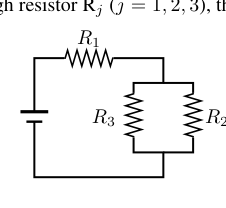 Series-parallel resistor circuit R1 R2 R3
Topic: Circuits Metodi: Kirchhoff’s Laws, Equivalent Circuit Reduction Competenze: Diagrammatic Reasoning, Physical Reasoning Objects: Resistor Fonte: Testo (PDF) — p.3
Nel circuito di sotto aumentamo la resistenza . Se è la corrente attraverso la resistenza (), allora
- A. e entrambi aumentano;
- B. diminuisce e aumenta;
- C. e entrambi diminuiscono;
- D. aumenta e diminuisce.
Circuito di resistenza parallela serie R1 R2 R3
Topic: Circuits Metodi: Kirchhoff’s Laws, Equivalent Circuit Reduction Competenze: Diagrammatic Reasoning, Physical Reasoning Objects: Resistor Fonte: Testo (PDF) — p.3
Two carts, A and B, are placed on an air track. They are made of the same material and look identical. B is given a constant speed and collides elastically with A at rest. After the collision, both carts move in the same direction. One concludes that
- A. A is hollow;
- B. B is hollow;
- C. A and B are identical;
- D. any of the first three answers is possible.
Topic: Conservation of Momentum, Newtonian Mechanics Metodi: Conservation of Momentum, Conservation of Energy Competenze: Physical Reasoning Objects: Cart Fonte: Testo (PDF) — p.4
Due carri, A e B, sono posti su una pista aerea. Sono fatti dello stesso materiale e sembrano identici. B è dato una velocità costante e colpisce elasticamente con A in riposo. Dopo la collisione, entrambe le carrozzine si muovono nella stessa direzione. Si conclude che
- A. A è vuoto;
- B. B è vuoto;
- C. A e B sono identiche;
- D. è possibile rispondere a qualsiasi delle prime tre risposte.
Topic: Conservation of Momentum, Newtonian Mechanics Metodi: Conservation of Momentum, Conservation of Energy Competenze: Physical Reasoning Objects: Cart Fonte: Testo (PDF) — p.4
The smallest length scale known in physics is the Planck length. It is an important ingredient in some current cosmological theories. Which of the following expressions could represent this Planck length? (See Data table.)
- A. ;
- B. ;
- C. ;
- D. .
Topic: Modern-Quantum Physics Metodi: Dimensional Analysis Competenze: Physical Reasoning, Mathematical Modeling Objects: — Fonte: Testo (PDF) — p.4
La scala di lunghezza più piccola conosciuta in fisica è la lunghezza di Planck. È un ingrediente importante in alcune teorie cosmologiche attuali. Quale delle seguenti espressioni potrebbe rappresentare questa lunghezza di Planck? (Vedi tabella dati)
- A. ;
- B. ;
- C. ;
- D. .
Topic: Modern-Quantum Physics Metodi: Dimensional Analysis Competenze: Physical Reasoning, Mathematical Modeling Objects: — Fonte: Testo (PDF) — p.4
The Webb space telescope, scheduled to be launched in 2010, will have a mirror 6 m in diameter. Compared with the Hubble space telescope, whose mirror has a 2.4 m diameter, it will be able to resolve objects whose angular separation is about
- A. 2.5 times smaller;
- B. 5 times smaller;
- C. an order of magnitude smaller;
- D. the same: the larger mirror only increases the amount of light gathered.
Topic: Wave Optics, Astrophysics Metodi: Interference & Diffraction Analysis, Order-of-Magnitude Estimation Competenze: Physical Reasoning, Estimation & Approximation Objects: Mirror Fonte: Testo (PDF) — p.4
Il telescopio spaziale Webb, che dovrebbe essere lanciato nel 2010, avrà uno specchio di 6 metri di diametro. Rispetto al telescopio spaziale Hubble, il cui specchio ha un diametro di 2,4 m, sarà in grado di risolvere oggetti la cui separazione angolare è di circa
- A. 2,5 volte più piccolo;
- B. 5 volte più piccolo;
- C. di ordine di magnitudo inferiore;
- D. lo stesso: lo specchio più grande aumenta solo la quantità di luce raccolta.
Topic: Wave Optics, Astrophysics Metodi: Interference & Diffraction Analysis, Order-of-Magnitude Estimation Competenze: Physical Reasoning, Estimation & Approximation Objects: Mirror Fonte: Testo (PDF) — p.4
A simple pendulum of length is suspended from the top of a flat beam of thickness . The bob is pulled away from the beam so that it makes an angle with the vertical, as shown in the figure. It is then released from rest. If is the maximum angular deflection to the right, then
- A. ;
- B. ;
- C. ;
- D. .
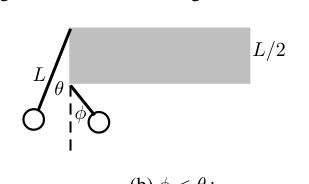 Pendulum bob swinging around flat beam
Topic: Oscillations & Waves, Newtonian Mechanics Metodi: Conservation of Energy, Simple Harmonic Motion Analysis Competenze: Physical Reasoning, Diagrammatic Reasoning Objects: Pendulum, Beam Fonte: Testo (PDF) — p.4
Un semplice pendolo di lunghezza è sospeso dalla parte superiore di un fascio piatto di spessore . Il bob è allontanato dal fascio in modo che esso faccia un angolo con la verticale, come mostrato nella figura. È poi rilasciato dal riposo. Se è la deviazione angolare massima a destra,
- A. ;
- B. ;
- C. ;
- D. .
*Pendulum bob oscillante intorno a fascio piatto *
Topic: Oscillations & Waves, Newtonian Mechanics Metodi: Conservation of Energy, Simple Harmonic Motion Analysis Competenze: Physical Reasoning, Diagrammatic Reasoning Objects: Pendulum, Beam Fonte: Testo (PDF) — p.4
In the diagram below, light is incident on the interface between media 1 and 2 at exactly the critical angle, and is totally reflected. The light is then also totally reflected at the interface between media 1 and 3, after which it travels in a direction opposite to its initial direction. The two interfaces are perpendicular. The media must have a refraction index such that
- A. ;
- B. ;
- C. ;
- D. .
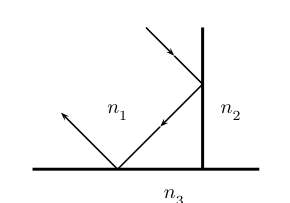 Total internal reflection at perpendicular interfaces n1 n2 n3
Topic: Geometric Optics, Wave Optics Metodi: Snell’s Law, Ray Tracing Competenze: Physical Reasoning, Mathematical Modeling Objects: — Fonte: Testo (PDF) — p.4
Nel diagramma di seguito, la luce si incide sull’interfaccia tra i media 1 e 2 esattamente all’angolo critico, e si riflette totalmente. La luce si riflette poi anche totalmente all’interfaccia tra i media 1 e 3, dopo di che viaggia in direzione opposta alla sua direzione iniziale. Le due interfacce sono perpendicolari. I supporti devono avere un indice di rifrazione tale da
- A. ;
- B. ;
- C. ;
- D. .
Riflessione interna totale alle interfacce perpendicolari n1 n2 n3
Topic: Geometric Optics, Wave Optics Metodi: Snell’s Law, Ray Tracing Competenze: Physical Reasoning, Mathematical Modeling Objects: — Fonte: Testo (PDF) — p.4
For the sake of science a physicist jumps attached to the end of a bungee cord, carrying sound measuring equipment. As he swings up and down vertically with a period of 6.0 s, he monitors the frequency of a sound source on the ground directly below him, and observes a difference of 84 Hz between the maximum and minimum frequency of the source. If the source emits at a constant 1370 Hz, and assuming no significant attenuation of his oscillations over the duration of the measurements, the amplitude of his oscillations is closest to
- A. 10 m;
- B. 20 m;
- C. 32 m;
- D. 15 m.
Topic: Oscillations & Waves, Newtonian Mechanics Metodi: Wave Equation, Simple Harmonic Motion Analysis Competenze: Mathematical Modeling, Physical Reasoning Objects: String Fonte: Testo (PDF) — p.4
Per il bene della scienza un fisico salta attaccato alla fine di un cordone da bungee, portando con sé un’attrezzatura per la misura del suono. Mentre svinge in verticale su e giù con un periodo di 6,0 secondi, monitora la frequenza di una fonte sonora sul terreno direttamente sotto di sé, e osserva una differenza di 84 Hz tra la frequenza massima e la minima della fonte. Se la fonte emette a una costante 1370 Hz e non presumendo alcuna attenuazione significativa delle sue oscillazioni durante la durata delle misurazioni, l’ampiezza delle sue oscillazioni è più vicina a
- A. 10 m;
- B. 20 m;
- C. 32 m;
- D. 15 m.
Topic: Oscillations & Waves, Newtonian Mechanics Metodi: Wave Equation, Simple Harmonic Motion Analysis Competenze: Mathematical Modeling, Physical Reasoning Objects: String Fonte: Testo (PDF) — p.4
A person pulls a box along the ground at constant speed. Considering the Earth and the box together as a system, which of the following is true about the net force exerted by the person on this system and the work she does on it?
- A. and ;
- B. and ;
- C. and ;
- D. and .
Topic: Newtonian Mechanics, Conservation of Energy Metodi: Free-Body Diagram, Conservation of Energy Competenze: Physical Reasoning Objects: Block Fonte: Testo (PDF) — p.4
Una persona tira una scatola lungo il terreno a velocità costante. Considerando la Terra e la scatola insieme come un sistema, quale delle seguenti cose è vero circa la forza netta esercitata dalla persona su questo sistema e il lavoro che fa su di esso?
- A. e ;
- B. e ;
- C. e ;
- D. e .
Topic: Newtonian Mechanics, Conservation of Energy Metodi: Free-Body Diagram, Conservation of Energy Competenze: Physical Reasoning Objects: Block Fonte: Testo (PDF) — p.4
A magnet moves inside a coil. Which of the following factors can affect the emf induced in the coil?
I. the speed at which the magnet moves II. the strength of the magnet III. the number of turns in the coil
- A. I only;
- B. I and II only;
- C. II and III only;
- D. I, II and III.
Topic: Electromagnetic Induction Metodi: Faraday’s Law of Induction, Lenz’s Law Competenze: Physical Reasoning Objects: Magnet, Coil Fonte: Testo (PDF) — p.4
Un magnete si muove all’interno di una bobina. Quali dei seguenti fattori possono influenzare l’emf indotto nella bobina?
I. la velocità con cui il magnete si muove II. la forza del magnete III. Il numero di giri nella bobina
- solo A. I;
- solo B. I e II;
- solo C. II e III;
- D. I, II e III.
Topic: Electromagnetic Induction Metodi: Faraday’s Law of Induction, Lenz’s Law Competenze: Physical Reasoning Objects: Magnet, Coil Fonte: Testo (PDF) — p.4
Problem 1 — Velocity and Mass Selector (TRIUMF)
At TRIUMF, a large experimental particle and nuclear physics research facility on the campus of the University of British Columbia, one major programme involves the production of intense beams of unstable isotopes of alkali atoms (potassium K, rubidium Rb, francium Fr). Many isotopes are produced when bombarding a calcium oxide target with 0.5 GeV protons from the TRIUMF accelerator. You are asked to design a simplified version of TISOL. You want to select ions whose energy is 20 keV. has a mass of kg. Separation should proceed in two steps, as illustrated below.
(a) In the first step, out of all ions ( or not) entering the velocity selector from the left, only those that have a speed corresponding to a 20 keV ion should be undeflected. Suggest a field configuration that can do this, draw a sketch showing the direction of the field(s), and derive as much information as you can about the magnitude of the field(s).
(b) In the second step, only ions should be deflected so that the radius of their trajectory is 2.1 m. Again, suggest a suitable field configuration for this, draw a sketch showing the direction of the field(s), and derive as much information as you can about the magnitude of the field(s).
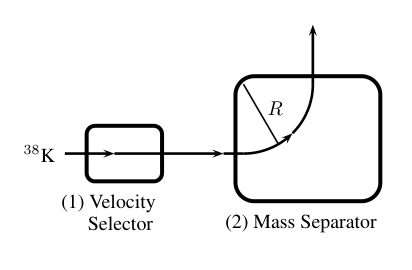 Ion beam path through velocity selector and mass separator
Topic: Electromagnetism, Electrostatics, Magnetism Metodi: Lorentz Force Analysis, Energy Conservation Method, Kinematic Equations Competenze: Physical Reasoning, Mathematical Modeling Objects: Particle Beam Fonte: Testo (PDF) — p.5
**Problema 1 Velocità e selettore di massa (TRIUMF) **
Al TRIUMF, un grande centro di ricerca di particelle sperimentali e fisica nucleare nel campus dell’Università della Columbia Britannica, un programma importante prevede la produzione di fasci intensi di isotopi instabili di atomi alcalini (potassio K, rubidio Rb, francio Fr). Molti isotopi vengono prodotti quando si bombardano un bersaglio di ossido di calcio con protoni di 0,5 GeV dall’acceleratore TRIUMF. Vi viene chiesto di progettare una versione semplificata di TISOL. Si vuole selezionare ioni la cui energia è di 20 keV. ha una massa di kg. La separazione deve avvenire in due fasi, come illustrato di seguito.
a) Nel primo passo, di tutti gli ioni ( o meno) che entrano dal lato sinistro nel selettore di velocità, solo quelli con una velocità corrispondente a un ione di 20 keV devono essere indefletti. Suggerire una configurazione di campo che possa fare questo, disegnare uno schizzo che mostra la direzione del campo(s), e derivare il maggior numero possibile di informazioni sulla grandezza del campo(s).
b) Nella seconda fase, solo gli ioni devono essere deflettiti in modo che il raggio della loro traiettoria sia di 2,1 m. Propone ancora una configurazione del campo adatta, disegna uno schizzo che mostra la direzione del campo (s) e derivi il maggior numero possibile di informazioni sull’entità del campo (s).
Costruzione del fascio di ioni attraverso il selettore di velocità e il separatore di massa
Topic: Electromagnetism, Electrostatics, Magnetism Metodi: Lorentz Force Analysis, Energy Conservation Method, Kinematic Equations Competenze: Physical Reasoning, Mathematical Modeling Objects: Particle Beam Fonte: Testo (PDF) — p.5
Problem 2 — Bay of Fundy Tidal Resonance
Tides are mainly caused by the gradient (or variation) of the gravitational force of the Moon and of the Sun across the Earth’s diameter. Large water masses, such as Earth’s oceans, bulge along the direction of the gradient and are pinched in the perpendicular direction. As the Earth rotates, the bulges (high tide regions) move across the surface of the Earth.
Now the Bay of Fundy, between New Brunswick and Nova Scotia, is reputed to have the highest tides in the world. Their amplitude is only about a metre at the mouth, or entrance, of the bay, whereas at the other end, 260 km away, the amplitude reaches up to 16 m. You may assume that the relevant speed of water waves in the bay (for very long wavelengths and shallow enough depth) is about 25 m/s. The bay is narrow compared to its length.
Using the above data, investigate whether the unusually high tides could be the result of a resonance excited by the Moon in the bay. Assume that the depth of the bay is uniform, and neglect the influence of the Sun. Hint: calculate the period of the water oscillations in the bay.
Topic: Oscillations & Waves, Fluid Mechanics, Gravitation Metodi: Wave Equation, Physical Modeling, Simple Harmonic Motion Analysis Competenze: Physical Reasoning, Estimation & Approximation Objects: — Fonte: Testo (PDF) — p.5
Problema 2 Resonanza delle maree di Bay of Fundy
Le maree sono causate principalmente dal gradiente (o variazione) della forza gravitazionale della Luna e del Sole attraverso il diametro della Terra. Grandi masse d’acqua, come gli oceani della Terra, si gonfiano lungo la direzione del gradiente e sono pizzicate nella direzione perpendicolare. Mentre la Terra ruota, le protuberanze (regioni di marea alta) si muovono sulla superficie della Terra.
Ora la baia di Fundy, tra il Nuovo Brunswick e la Nuova Scozia, è reputata per avere le maree più alte del mondo. La loro amplitudine è di circa un metro all’ingresso della baia, mentre all’altra estremità, a 260 km di distanza, la loro amplitudine raggiunge i 16 m. Si può presumere che la velocità di onde d’acqua della baia (per lunghe lunghezze d’onda molto lunghe e profondità sufficientemente bassa) sia di circa 25 m/s. La baia è stretta rispetto alla sua lunghezza.
Usando i dati di cui sopra, si può verificare se le maree insolitamente alte possano essere il risultato di una risonanza suscitata dalla Luna nella baia. Supponiamo che la profondità della baia sia uniforme, e trascuriamo l’influenza del Sole. Suggetta: calcolare il periodo delle oscillazioni dell’acqua nella baia.
Topic: Oscillations & Waves, Fluid Mechanics, Gravitation Metodi: Wave Equation, Physical Modeling, Simple Harmonic Motion Analysis Competenze: Physical Reasoning, Estimation & Approximation Objects: — Fonte: Testo (PDF) — p.5
Problem 3 — Lagrange Points
The next-generation large space telescope is scheduled for launch in 2010. It will be put in orbit around the Sun, in a special zone where its distance relative to the Earth and to the Sun can remain constant. The location of such zones was first calculated in the XVIIIth century by the French-Italian mathematician Joseph-Louis Lagrange.
Consider two point masses, and , referring respectively to the Sun and the Earth. Both orbit around their common centre of mass at angular velocity and with a period of one year. These orbits are circular to a good approximation, and the distance between and is constant. Since , the motion of is not detectable at the scale of the figure and can be neglected.
(a) Write down the equation that must be satisfied by the forces acting on the orbiting in terms of , , , and , where is the distance between and .
(b) Show that in the limit , this condition can be written where , and .
(c) Do not attempt to solve this algebraic equation. Instead, use physical arguments to find how many solutions there are for and where roughly the Lagrange zones are positioned on the axis. Provide a qualitative sketch based on the above figure, and explain your reasoning.
(d) The Webb space telescope will operate at a temperature of about 35 K and, therefore, it should be shielded from heat sources at all times, while having as unobstructed a view of the sky as possible. Discuss which (if any) of your solutions is most suitable for the Webb telescope.
(e) If there are other Lagrange zones off the axis, they cannot be found from the equation in (b), but what would be their minimum number? Justify your answer.
Hint: To a good approximation Kepler’s Third Law for the system is .
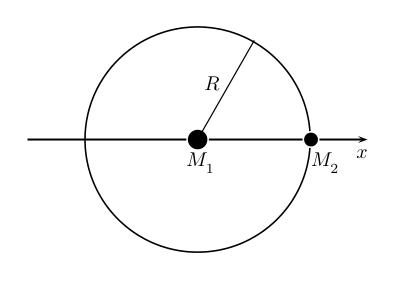 Sun M1 Earth M2 orbital diagram with distance R and x
Topic: Gravitation, Newtonian Mechanics, Astrophysics Metodi: Newton’s Law of Gravitation, Kepler’s Laws, Approximation & Series Expansion Competenze: Physical Reasoning, Mathematical Modeling Objects: Planet, Star, Satellite Fonte: Testo (PDF) — p.5
Problema 3 Punti di lagranza
Il prossimo grande telescopio spaziale di generazione è previsto per il lancio nel 2010. Sarà messa in orbita attorno al Sole, in una zona speciale dove la sua distanza rispetto alla Terra e al Sole può rimanere costante. La posizione di tali zone fu calcolata per la prima volta nel XVIII secolo dal matematico francese-italiano Joseph-Louis Lagrange.
Consideriamo due masse puntine, e , che si riferiscono rispettivamente al Sole e alla Terra. Entrambe orbitano attorno al loro centro di massa comune a velocità angolare e con un periodo di un anno. Queste orbite sono circolari a una buona approssimazione e la distanza tra e è costante. Poiché , il movimento di non è rilevabile sulla scala della figura e può essere trascurato.
a) Scrivere l’equazione che deve essere soddisfatta dalle forze che agiscono sull’orbita in termini di , , , e , dove è la distanza tra e .
b) Indicare che nel limite , questa condizione può essere scritta in cui e .
(c) Non cercare di risolvere questa equazione algebrica. Invece, utilizzare argomenti fisici per trovare quante soluzioni ci sono per e dove approssimativamente le zone di Lagrange sono posizionate sull’asse . Fornisci un bozzetto qualitativo basato sulla figura di cui sopra e spiega il tuo ragionamento.
d) Il telescopio spaziale Webb opererà a una temperatura di circa 35 K e, pertanto, dovrebbe essere protetto da fonti di calore in ogni momento, avendo una vista del cielo il più possibile libera. Discutete quale (se esistono) delle vostre soluzioni sia più adatta al telescopio Webb.
(e) Se ci sono altre zone di Lagrange al di fuori dell’asse , non possono essere trovate dall’equazione di cui alla lettera b), ma quale sarebbe il loro numero minimo? giustifica la tua risposta.
Signore: per una buona approssimazione la terza legge di Kepler per il sistema è .
Sol M1 Diagramma orbitale della Terra M2 con distanze R e x
Topic: Gravitation, Newtonian Mechanics, Astrophysics Metodi: Newton’s Law of Gravitation, Kepler’s Laws, Approximation & Series Expansion Competenze: Physical Reasoning, Mathematical Modeling Objects: Planet, Star, Satellite Fonte: Testo (PDF) — p.5