You are standing upright in a room in front of a vertical mirror. In this mirror, you can see from your position only the upper two-thirds of your body. You wish to see the entire length of your body reflected in the mirror. Which combination of the following three courses of action will achieve this?
(I) Move away from the mirror; (II) move toward the mirror; (III) use a mirror whose height will allow you to see your whole image when you are at your initial position.
- A. (I) only;
- B. (II) only;
- C. (III) only;
- D. either (I) or (III).
Topic: Geometric Optics Metodi: Ray Tracing Competenze: Physical Reasoning Objects: Mirror Fonte: Testo (PDF) — p.2
Stai in piedi in una stanza davanti a uno specchio verticale. In questo specchio, dalla tua posizione puoi vedere solo i due terzi superiori del tuo corpo. Volete vedere tutta la lunghezza del vostro corpo riflessa nello specchio. Quale combinazione dei tre seguenti orientamenti di azione permetterà di raggiungere questo obiettivo?
(I) allontanati dallo specchio; (II) si muove verso lo specchio; (III) utilizzare uno specchio la cui altezza vi permetterà di vedere l’intera immagine quando siete nella vostra posizione iniziale.
- solo A. (I);
- solo B. (II);
- solo C. (III);
- D. (I) o (III).
Topic: Geometric Optics Metodi: Ray Tracing Competenze: Physical Reasoning Objects: Mirror Fonte: Testo (PDF) — p.2
A 5 kg cart collides on a horizontal surface with a 20 kg cart. Which cart experiences the smaller force because of the collision?
- A. The 5 kg cart;
- B. the forces are equal;
- C. the 20 kg cart;
- D. it depends if the collision is elastic.
Topic: Newtonian Mechanics Metodi: Free-Body Diagram Competenze: Physical Reasoning Objects: Cart Fonte: Testo (PDF) — p.2
Un carrello da 5 kg si schianta su una superficie orizzontale con un carrello da 20 kg. Quale carro ha la forza più piccola a causa della collisione?
- A. Il carrello da 5 kg;
- B. le forze sono uguali;
- C. il carrello di 20 kg;
- D. dipende dal fatto che la collisione sia elastica.
Topic: Newtonian Mechanics Metodi: Free-Body Diagram Competenze: Physical Reasoning Objects: Cart Fonte: Testo (PDF) — p.2
Two monkeys with the same mass stand on a branch at height above the horizontal jungle floor. Monkey A steps off the branch holding the end of an inextensible rope of length whose other end is tied to another branch at height , lets go at the bottom of the swing, and falls freely to the floor, as shown below. Monkey B steps off and falls straight downward. Then, neglecting air resistance but not the tension in the rope, the total work done on each monkey and the speed with which each hits the floor are as follows:
- A. , ;
- B. , ;
- C. , ;
- D. , .
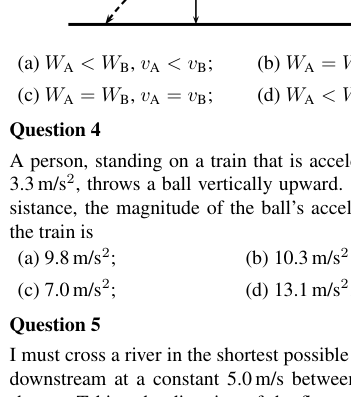 Monkey A on rope, Monkey B falling, heights H and h
Topic: Conservation of Energy, Newtonian Mechanics Metodi: Energy Conservation Method, Free-Body Diagram Competenze: Physical Reasoning, Diagrammatic Reasoning Objects: String Fonte: Testo (PDF) — p.2
Due scimmie della stessa massa si trovano su un ramo ad un’altezza sopra il pavimento della giungla orizzontale. Monkey A scende dal ramo tenendo la punta di una corda inestensibile di lunghezza la cui altra estremità è legata ad un altro ramo ad altezza , lascia andare in fondo allo swing e cade liberamente sul pavimento, come mostrato di seguito. Scacciato dalla scimmia B, cade dritto in basso. Poi, trascurando la resistenza all’aria ma non la tensione della corda, il lavoro totale effettuato su ciascuna scimmia e la velocità con cui ogni scimmia colpisce il pavimento sono i seguenti:
- A. , ;
- B. , ;
- C. , ;
- D. , .
Sapi A su corda, Sapi B che cade, altezza H e h
Topic: Conservation of Energy, Newtonian Mechanics Metodi: Energy Conservation Method, Free-Body Diagram Competenze: Physical Reasoning, Diagrammatic Reasoning Objects: String Fonte: Testo (PDF) — p.2
A person, standing on a train that is accelerating forward at , throws a ball vertically upward. Neglecting air resistance, the magnitude of the ball’s acceleration relative to the train is
- A. ;
- B. ;
- C. ;
- D. .
Topic: Newtonian Mechanics Metodi: Vector Decomposition, Kinematic Equations Competenze: Physical Reasoning, Mathematical Modeling Objects: Ball Fonte: Testo (PDF) — p.2
Una persona, in piedi su un treno che si accelera in avanti a , lancia una palla verticalmente verso l’alto. Negli esseri umani, la resistenza dell’aria è
- A. ;
- B. ;
- C. ;
- D. .
Topic: Newtonian Mechanics Metodi: Vector Decomposition, Kinematic Equations Competenze: Physical Reasoning, Mathematical Modeling Objects: Ball Fonte: Testo (PDF) — p.2
I must cross a river in the shortest possible time. Water flows downstream at a constant between the two parallel shores. Taking the direction of the flow as reference, if my boat has a maximum speed of , it should head at
- A. ;
- B. ;
- C. ;
- D. .
Topic: Newtonian Mechanics Metodi: Vector Decomposition, Kinematic Equations Competenze: Physical Reasoning, Mathematical Modeling Objects: — Fonte: Testo (PDF) — p.2
Devo attraversare un fiume nel più breve tempo possibile. L’acqua scorre a valle a una costante tra le due rive parallele. Considerando la direzione del flusso come riferimento, se la mia barca ha una velocità massima di , dovrebbe dirigersi verso
- A. ;
- B. ;
- C. ;
- D. .
Topic: Newtonian Mechanics Metodi: Vector Decomposition, Kinematic Equations Competenze: Physical Reasoning, Mathematical Modeling Objects: — Fonte: Testo (PDF) — p.2
A hoop and a solid cylinder have the same mass and radius. They both roll, without slipping, on a horizontal surface. If their kinetic energies are equal,
- A. the hoop has a greater translational speed than the cylinder;
- B. the cylinder has a greater translational speed than the hoop;
- C. the hoop and the cylinder have the same translational speed;
- D. the hoop has a greater rotational speed than the cylinder.
Topic: Rotational Dynamics Metodi: Conservation of Energy, Torque & Angular Momentum Analysis Competenze: Physical Reasoning, Mathematical Modeling Objects: Cylinder Fonte: Testo (PDF) — p.2
Un cerchio e un cilindro solido hanno la stessa massa e il medesimo raggio. Entrambi ruotano, senza scivolare, su una superficie orizzontale. Se le loro energie cinetiche sono uguali,
- A. il cerchio ha una velocità di trasformazione superiore a quella del cilindro;
- B. il cilindro ha una velocità di trasformazione superiore a quella del cerchio;
- C. il cerchio e il cilindro hanno la stessa velocità di trasmissione;
- D. il cerchio ha una velocità di rotazione superiore a quella del cilindro.
Topic: Rotational Dynamics Metodi: Conservation of Energy, Torque & Angular Momentum Analysis Competenze: Physical Reasoning, Mathematical Modeling Objects: Cylinder Fonte: Testo (PDF) — p.2
A string clamped at both ends is vibrating. At the moment the string looks flat, the instantaneous transverse velocity of points along the string, excluding its end-points, must be
- A. zero everywhere.
- B. dependent on the location along the string.
- C. not zero anywhere.
- D. non-zero and in the same direction everywhere.
Topic: Oscillations & Waves Metodi: Wave Equation, Superposition Principle Competenze: Physical Reasoning Objects: String Fonte: Testo (PDF) — p.3
Una corda fissata alle estremità sta vibrando. Nel momento in cui la corda sembra piatta, la velocità trasversale istantanea dei punti lungo la corda, escludendo i suoi punti finali, deve essere
- **A ** zero ovunque.
- B. dipende dalla posizione lungo la stringa.
- C. non nulla da nessuna parte.
- D. non zero e nella stessa direzione ovunque.
Topic: Oscillations & Waves Metodi: Wave Equation, Superposition Principle Competenze: Physical Reasoning Objects: String Fonte: Testo (PDF) — p.3
In vacuum, a potential difference is maintained between points a distance apart. The corresponding electric field accelerates an electron from rest to a speed over that distance. Which one of the following statements is true?
- A. does not depend on ;
- B. depends on , not on ;
- C. depends only on ;
- D. depends on , not on .
Topic: Electrostatics Metodi: Electric Potential Method, Conservation of Energy Competenze: Physical Reasoning, Mathematical Modeling Objects: Electron Fonte: Testo (PDF) — p.3
Nel vuoto, una differenza di potenziale viene mantenuta tra i punti a distanza . Il corrispondente campo elettrico accelera un elettrone dal riposo a una velocità su tale distanza. Quale delle seguenti affermazioni è vera?
- A. non dipende da ;
- B. dipende da , non da ;
- C. dipende solo da ;
- D. dipende da , non da .
Topic: Electrostatics Metodi: Electric Potential Method, Conservation of Energy Competenze: Physical Reasoning, Mathematical Modeling Objects: Electron Fonte: Testo (PDF) — p.3
Light waves propagate along the length of a pipe containing a perfect vacuum and whose end caps are perfect reflectors. A standing-wave pattern is formed with frequency and wavelength . When a gas, with index of refraction , is introduced into the pipe, which of the following changes occurs?
- A. increases;
- B. increases;
- C. decreases;
- D. decreases.
Topic: Oscillations & Waves, Geometric Optics Metodi: Wave Equation, Snell’s Law Competenze: Physical Reasoning Objects: Tube Fonte: Testo (PDF) — p.3
Le onde luminose si diffondono lungo la lunghezza di un tubo che contiene un vuoto perfetto e le cui tappe finali sono perfetti riflettori. Si forma un modello di onde in piedi con frequenza e lunghezza d’onda . Quando un gas, con indice di rifrazione , viene introdotto nel tubo, quale delle seguenti variazioni si verifica?
- Aumento di A. ;
- B. aumenta;
- C. diminuisce;
- D. diminuisce.
Topic: Oscillations & Waves, Geometric Optics Metodi: Wave Equation, Snell’s Law Competenze: Physical Reasoning Objects: Tube Fonte: Testo (PDF) — p.3
Students claim that in a lab experiment they witnessed a head-on elastic collision between two balls on a horizontal surface which resulted in the balls being both at rest. No external horizontal force was acting at any time on the masses. Which of these comments is the most appropriate about this process?
- A. Initial speeds and masses must have been different;
- B. initial speeds and masses must have been identical;
- C. initial speeds, but not necessarily masses, were identical;
- D. the process cannot have occurred as claimed.
Topic: Conservation of Momentum, Newtonian Mechanics Metodi: Conservation of Momentum, Conservation Laws Competenze: Physical Reasoning Objects: Ball Fonte: Testo (PDF) — p.3
Gli studenti sostengono che in un esperimento di laboratorio hanno assistito a una collisione elastica frontale tra due palle su una superficie orizzontale che ha portato alle palle a stare entrambe a riposo. Nessuna forza orizzontale esterna agisce in nessun momento sulle masse. Quali di questi commenti sono più appropriati a proposito di questo processo?
- A. Le velocità iniziali e le masse devono essere state diverse;
- B. le velocità iniziali e le masse devono essere identiche;
- C. le velocità iniziali, ma non necessariamente le masse, erano identiche;
- D. il processo non può aver avuto luogo come dichiarato.
Topic: Conservation of Momentum, Newtonian Mechanics Metodi: Conservation of Momentum, Conservation Laws Competenze: Physical Reasoning Objects: Ball Fonte: Testo (PDF) — p.3
The potential across a capacitor is when it is not connected to anything. It is then connected in parallel with an uncharged capacitor. At equilibrium, the charge on the capacitor and the potential difference across it are
- A. , ;
- B. , ;
- C. , ;
- D. , .
Topic: Circuits, Electrostatics Metodi: Equivalent Circuit Reduction, Conservation Laws Competenze: Mathematical Modeling, Physical Reasoning Objects: Capacitor Fonte: Testo (PDF) — p.3
Il potenziale di un condensatore è quando non è collegato a nulla. È quindi collegato in parallelo con un condensatore non carico . Al momento dell’equilibrio, la carica sul condensatore e la differenza potenziale su di esso sono
- A. , ;
- B. , ;
- C. , ;
- D. , .
Topic: Circuits, Electrostatics Metodi: Equivalent Circuit Reduction, Conservation Laws Competenze: Mathematical Modeling, Physical Reasoning Objects: Capacitor Fonte: Testo (PDF) — p.3
In subatomic physics, one often associates a characteristic wavelength with a particle of mass . If ( being Planck’s constant) and the speed of light, which of the following expressions is most likely to be the correct one?
- A. ;
- B. ;
- C. ;
- D. .
Topic: Modern-Quantum Physics Metodi: Dimensional Analysis, de Broglie Relation Competenze: Physical Reasoning, Estimation & Approximation Objects: — Fonte: Testo (PDF) — p.3
Nella fisica subatomica, spesso si associa una lunghezza d’onda caratteristica a una particella di massa . Se ( è costante di Planck) e è la velocità della luce, quale delle seguenti espressioni è più probabile essere la corretta?
- A. ;
- B. ;
- C. ;
- D. .
Topic: Modern-Quantum Physics Metodi: Dimensional Analysis, de Broglie Relation Competenze: Physical Reasoning, Estimation & Approximation Objects: — Fonte: Testo (PDF) — p.3
At equilibrium, the electric field at a point on a closed conducting surface, whether the surface is charged or neutral, can never be
- A. tangent to the surface;
- B. perpendicular to the surface;
- C. zero;
- D. directed inward since it must vanish inside.
Topic: Electrostatics Metodi: Gauss’s Law, Symmetry Argument Competenze: Physical Reasoning Objects: — Fonte: Testo (PDF) — p.3
In equilibrio, il campo elettrico in un punto su una superficie conduttrice chiusa, sia che la superficie sia carica o neutrale, non può mai essere
- A. tangente alla superficie;
- B. perpendicolare alla superficie;
- C. zero;
- D. rivolto verso l’interno poiché deve scomparire all’interno.
Topic: Electrostatics Metodi: Gauss’s Law, Symmetry Argument Competenze: Physical Reasoning Objects: — Fonte: Testo (PDF) — p.3
A uniform cubical box of mass rests on a horizontal floor with one edge against a small obstruction fixed to the floor. Can a horizontal force of magnitude applied on the box at the centre of the side opposite the obstruction tip the box?
- A. No, never;
- B. yes, only if ;
- C. yes, is sufficient;
- D. yes, only if .
Topic: Rigid Body Statics Metodi: Torque & Angular Momentum Analysis, Free-Body Diagram Competenze: Physical Reasoning, Mathematical Modeling Objects: Block Fonte: Testo (PDF) — p.3
Una scatola cubica uniforme di massa si posa su un pavimento orizzontale con un bordo contro un piccolo ostacolo fissato al pavimento. Può applicare una forza orizzontale di magnitudo sulla scatola al centro del lato opposto alla punta di ostruzione?
- A. No, mai;
- B. sì, solo se ;
- C. sì, è sufficiente;
- D. sì, solo se .
Topic: Rigid Body Statics Metodi: Torque & Angular Momentum Analysis, Free-Body Diagram Competenze: Physical Reasoning, Mathematical Modeling Objects: Block Fonte: Testo (PDF) — p.3
A circuit consists of a battery, a resistor , and two light bulbs and as shown below:
If the filament in lightbulb A burns out, then the following is true for light bulb B:
- A. It is turned off;
- B. its brightness does not change;
- C. it gets dimmer;
- D. it gets brighter.
 Circuit with battery, R, and bulbs A and B
Topic: Circuits Metodi: Kirchhoff’s Laws, Equivalent Circuit Reduction Competenze: Physical Reasoning, Diagrammatic Reasoning Objects: Battery, Resistor Fonte: Testo (PDF) — p.3
Un circuito è costituito da una batteria, da una resistenza e da due lampadine e come mostrato di seguito:
Se il filamento della lampadina A si spende, per la lampadina B vale quanto segue:
- A. È spento;
- B. la sua luminosità non cambia;
- C. si fa più scura;
- D. diventa più luminoso.
*Circuito con batterie, R e lampadine A e B *
Topic: Circuits Metodi: Kirchhoff’s Laws, Equivalent Circuit Reduction Competenze: Physical Reasoning, Diagrammatic Reasoning Objects: Battery, Resistor Fonte: Testo (PDF) — p.3
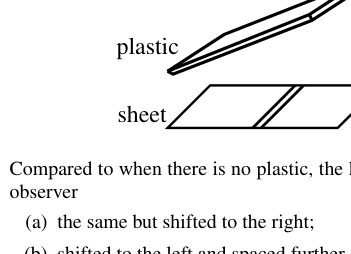
An observer at O views two closely spaced lines on the bottom sheet through an angled slab of plastic with parallel faces, exactly as shown in the figure below. Compared to when there is no plastic, the lines appear to the observer
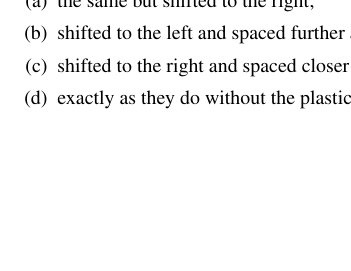
- A. the same but shifted to the right;
- B. shifted to the left and spaced further apart;
- C. shifted to the right and spaced closer together;
- D. exactly as they do without the plastic slab.
 Observer O viewing lines through angled plastic slab
Topic: Geometric Optics Metodi: Snell’s Law, Ray Tracing Competenze: Physical Reasoning, Diagrammatic Reasoning Objects: — Fonte: Testo (PDF) — p.3
Un osservatore a O vede due linee strettamente spaziate sul foglio inferiore attraverso una lastra angolata di plastica con facce parallele, esattamente come mostrato nella figura seguente. Rispetto a quando non c’è plastica, le linee appaiono all’osservatore
- A. lo stesso, ma spostato a destra;
- B. spostato a sinistra e spaziato più a distanza;
- C. spostato a destra e spaziato più vicini;
- D. esattamente come senza la lastra di plastica.
Observer O linee di visualizzazione attraverso lastre di plastica angolate
Topic: Geometric Optics Metodi: Snell’s Law, Ray Tracing Competenze: Physical Reasoning, Diagrammatic Reasoning Objects: — Fonte: Testo (PDF) — p.3
If all of Earth’s polar ice were suddenly to melt into the oceans, in the short term the length of the day would
- A. increase;
- B. remain the same;
- C. decrease;
- D. first decrease, then increase.
Topic: Rotational Dynamics, Astrophysics Metodi: Torque & Angular Momentum Analysis, Conservation Laws Competenze: Physical Reasoning Objects: Planet Fonte: Testo (PDF) — p.4
Se tutto il ghiaccio polare della Terra si scioglie improvvisamente negli oceani, nel breve termine la lunghezza del giorno sarebbe
- aumento di MSK0/>A.**;
- B. rimane lo stesso;
- diminuzione di C.;
- D. prima diminuzione, poi aumento.
Topic: Rotational Dynamics, Astrophysics Metodi: Torque & Angular Momentum Analysis, Conservation Laws Competenze: Physical Reasoning Objects: Planet Fonte: Testo (PDF) — p.4
Two identical balls, A and B, of uniform composition and initially at the same temperature, each absorb exactly the same amount of heat. A is hanging down from the ceiling while B rests on the horizontal floor in the same room. Assuming no subsequent heat loss by the balls, which of the following statements is correct about their final temperatures, and , once the balls have reached their final dimension?
- A. ;
- B. ;
- C. ;
- D. .
 Ball A hanging and ball B on floor
Topic: Thermodynamics Metodi: First Law of Thermodynamics, Conservation of Energy Competenze: Physical Reasoning Objects: Ball Fonte: Testo (PDF) — p.4
Due palle identiche, A e B, di composizione uniforme e inizialmente alla stessa temperatura, assorbono ciascuna esattamente la stessa quantità di calore. A è appeso al soffitto mentre B riposa sul pavimento orizzontale nella stessa stanza. Se non si assunse alcuna perdita di calore successiva da parte delle palle, quale delle seguenti affermazioni è corretta riguardo alle loro temperature finali, e , una volta che le palle hanno raggiunto la loro dimensione finale?
- A. ;
- B. ;
- C. ;
- D. .
Polla A appesa e palla B sul pavimento
Topic: Thermodynamics Metodi: First Law of Thermodynamics, Conservation of Energy Competenze: Physical Reasoning Objects: Ball Fonte: Testo (PDF) — p.4
Two uncharged balls A and B, each very light and coated with a conducting material, hang vertically side by side just touching each other. A positively-charged glass rod is brought near ball A without touching it. Now A and B are separated and then the glass rod is removed. If and represent the electric charges on A and B, respectively, you conclude that
- A. and ;
- B. and ;
- C. and ;
- D. and .
Topic: Electrostatics Metodi: Symmetry Argument, Physical Modeling Competenze: Physical Reasoning, Diagrammatic Reasoning Objects: Ball, Rod Fonte: Testo (PDF) — p.4
Due palle non caricate A e B, ciascuna molto leggera e rivestita di materiale conduttore, appese verticalmente fianco a fianco, solo toccando l’una l’altra. Una barra di vetro carica positivamente viene avvicinata alla palla A senza toccarla. Ora A e B sono separati e poi la canna di vetro viene rimossa. Se e rappresentano rispettivamente le cariche elettriche di A e B, si conclude che
- A. e ;
- B. e ;
- C. e ;
- D. e .
Topic: Electrostatics Metodi: Symmetry Argument, Physical Modeling Competenze: Physical Reasoning, Diagrammatic Reasoning Objects: Ball, Rod Fonte: Testo (PDF) — p.4
You are travelling at constant speed in an airtight car with a balloon floating motionless next to you. Suddenly, you slam on the brakes so as to stop the car quickly. During deceleration, with respect to the car the balloon
- A. moves forward;
- B. remains motionless;
- C. moves backward;
- D. can move forward or backward.
Topic: Fluid Mechanics, Newtonian Mechanics Metodi: Free-Body Diagram, Physical Modeling Competenze: Physical Reasoning Objects: — Fonte: Testo (PDF) — p.4
Si viaggia a velocità costante in un’auto a prova d’aria con un palloncino che galleggia immobile accanto a se. All’improvviso, si accende i freni per fermare rapidamente l’auto. Durante la decelerazione, rispetto all’auto il palloncino
- A. si muove in avanti;
- B. rimane immobile;
- C. si muove indietro;
- D. può muoversi in avanti o in indietro.
Topic: Fluid Mechanics, Newtonian Mechanics Metodi: Free-Body Diagram, Physical Modeling Competenze: Physical Reasoning Objects: — Fonte: Testo (PDF) — p.4
Due to tidal friction on Earth, the radius of the Moon’s orbit is increasing at the rate of a few centimetres per year. During this process, the Moon’s angular momentum
- A. remains constant since its speed decreases;
- B. remains constant but its total energy increases;
- C. increases as while its total energy increases;
- D. decreases as while its kinetic energy decreases.
Topic: Gravitation, Astrophysics Metodi: Torque & Angular Momentum Analysis, Kepler’s Laws Competenze: Physical Reasoning, Mathematical Modeling Objects: Planet, Satellite Fonte: Testo (PDF) — p.4
A causa dell’attrito delle maree sulla Terra, il raggio dell’orbita lunare aumenta a un ritmo di pochi centimetri all’anno. Durante questo processo, la dinamica angolare della Luna
- A. rimane costante poiché la sua velocità diminuisce;
- B. rimane costante ma la sua energia totale aumenta;
- C. aumenta con mentre aumenta la sua energia totale;
- D. diminuisce come mentre la sua energia cinetica diminuisce.
Topic: Gravitation, Astrophysics Metodi: Torque & Angular Momentum Analysis, Kepler’s Laws Competenze: Physical Reasoning, Mathematical Modeling Objects: Planet, Satellite Fonte: Testo (PDF) — p.4
In order to measure the speed of blood flowing through an artery, a uniform magnetic field is applied in a direction perpendicular to the flow and a voltmeter measures the voltage across the diameter of the artery, at right angles to . If positive and negative ions in the blood are longitudinally at rest with respect to the flow, the speed of the flow is closest to
- A. ;
- B. ;
- C. ;
- D. .
Topic: Magnetism, Electromagnetism Metodi: Lorentz Force Analysis, Dimensional Analysis Competenze: Physical Reasoning, Mathematical Modeling Objects: Tube, Galvanometer Fonte: Testo (PDF) — p.4
Per misurare la velocità del sangue che scorre attraverso un’arteria, viene applicato un campo magnetico uniforme in direzione perpendicolare al flusso e un voltmeter misura la tensione attraverso il diametro dell’arteria, ad angoli retti fino a . Se gli ioni positivi e negativi nel sangue sono a riposo longitudinale rispetto al flusso, la velocità del flusso è più vicina a
- A. ;
- B. ;
- C. ;
- D. .
Topic: Magnetism, Electromagnetism Metodi: Lorentz Force Analysis, Dimensional Analysis Competenze: Physical Reasoning, Mathematical Modeling Objects: Tube, Galvanometer Fonte: Testo (PDF) — p.4
A bar magnet with its north (N) and south (S) poles as shown below is initially moving to the left, along the axis of, and away from a circular conducting loop. A current is induced in the loop, with the acceleration of the magnet due to this current. As seen from the magnet looking in the direction of the loop,
- A. runs clockwise and points to the left;
- B. runs counterclockwise and points to the right;
- C. runs clockwise and points to the right;
- D. runs counterclockwise and points to the left.
 Bar magnet SN moving left away from conducting loop
Topic: Electromagnetic Induction Metodi: Faraday’s Law of Induction, Lenz’s Law Competenze: Physical Reasoning, Diagrammatic Reasoning Objects: Magnet, Coil Fonte: Testo (PDF) — p.4
Un magnete a barre con i suoi poli nord (N) e sud (S) come mostrato di seguito si muove inizialmente a sinistra, lungo l’asse di e lontano da un ciclo di conduttore circolare. Una corrente viene indotta nel ciclo, con l’accelerazione del magnete dovuta a questa corrente. Come visto dal magnete che guarda nella direzione del ciclo,
- A. corre nel senso orario e punta a sinistra;
- B. corre in senso contrario all’orologio e punta a destra;
- C. corre nel senso orario e punta a destra;
- D. corre in senso contrario all’orologio e punta a sinistra.
SN magneto a barre che si allontana a sinistra dal circuito di condotta
Topic: Electromagnetic Induction Metodi: Faraday’s Law of Induction, Lenz’s Law Competenze: Physical Reasoning, Diagrammatic Reasoning Objects: Magnet, Coil Fonte: Testo (PDF) — p.4
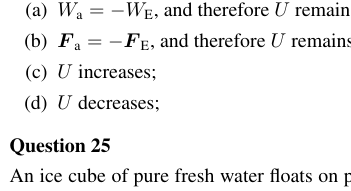
You are moving a negative charge at a small constant speed away from a conducting spherical shell on which resides a negative charge . The electrostatic field of is . Let be the total energy of , the work done by the force you exert on , and the work done by the electrostatic force on . Then, as is being moved,
- A. , and therefore remains constant;
- B. , and therefore remains constant;
- C. increases;
- D. decreases.
Topic: Electrostatics Metodi: Electric Potential Method, Conservation of Energy Competenze: Physical Reasoning, Mathematical Modeling Objects: Conducting Sphere, Point Charge Fonte: Testo (PDF) — p.4
Si sta spostando una carica negativa a una piccola velocità costante lontano da una conchiglia sferica conduttrice sulla quale risiede una carica negativa . Il campo elettrostatico di è . Si deve essere l’energia totale di , il lavoro svolto dalla forza che si esercita su , e il lavoro svolto dalla forza elettrostatica su . Poi, mentre viene spostato,
- A. , e pertanto rimane costante;
- B. , e pertanto rimane costante;
- C. aumenta;
- D. diminuisce.
Topic: Electrostatics Metodi: Electric Potential Method, Conservation of Energy Competenze: Physical Reasoning, Mathematical Modeling Objects: Conducting Sphere, Point Charge Fonte: Testo (PDF) — p.4
An ice cube of pure fresh water floats on pure fresh water in a glass. A huge ice shelf, also of pure fresh water, floats on the ocean away from Antarctica. Neglecting the contribution due to the density of air, as the ice cube and the iceberg melt,
- A. the water level rises both in the glass and in the ocean;
- B. the water level does not change in either case;
- C. the water level stays the same in the glass but rises in the ocean;
- D. the water level decreases in the glass but stays the same in the ocean.
Topic: Fluid Mechanics Metodi: Hydrostatic Equilibrium, Physical Modeling Competenze: Physical Reasoning, Estimation & Approximation Objects: Container Fonte: Testo (PDF) — p.4
Un cubo di ghiaccio di acqua dolce pura galleggia su acqua dolce pura in un bicchiere. Un enorme scaffale di ghiaccio, anche di pura acqua dolce, galleggia sull’oceano lontano dall’Antartide. Negliandosi il contributo dovuto alla densità dell’aria, come il cubo di ghiaccio e il iceberg si sciolgono,
- A. il livello dell’acqua aumenta sia nel vetro che nell’oceano;
- B. il livello dell’acqua non cambia in entrambi i casi;
- C. il livello dell’acqua nel vetro rimane lo stesso, ma aumenta nell’oceano;
- D. il livello dell’acqua diminuisce nel vetro ma rimane lo stesso nell’oceano.
Topic: Fluid Mechanics Metodi: Hydrostatic Equilibrium, Physical Modeling Competenze: Physical Reasoning, Estimation & Approximation Objects: Container Fonte: Testo (PDF) — p.4
Problem B1. A uniform ball of mass is released from rest at the surface of a pond and sinks vertically into the water. An observer, wishing to determine the density of this ball, measures the time-dependence of the angle between the vertical at his position, a distance above the surface, and the direction of the ball’s apparent instantaneous position (see figure). The horizontal distance between the observer and the initial position of the ball is .
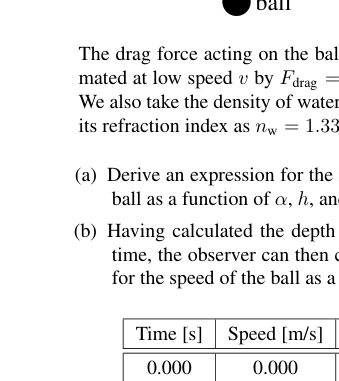
The drag force acting on the ball as it sinks is well approximated at low speed by , where is a constant. We also take the density of water to be and its refraction index as .
(a) Derive an expression for the instantaneous depth of the ball as a function of , , and .
(b) Having calculated the depth of the ball as a function of time, the observer can then construct the following table for the speed of the ball as a function of time:
| Time [s] | Speed [m/s] | Time [s] | Speed [m/s] |
|---|---|---|---|
| 0.000 | 0.000 | 0.225 | 0.8425 |
| 0.010 | 0.0910 | 0.275 | 0.8767 |
| 0.025 | 0.2086 | 0.325 | 0.8966 |
| 0.075 | 0.5081 | 0.375 | 0.9082 |
| 0.125 | 0.6823 | 0.425 | 0.9145 |
| 0.175 | 0.7836 | 0.475 | 0.9155 |
From these data, find the initial acceleration of the ball and estimate at which value its speed will stabilise. Then calculate the density of the ball and obtain a value for the drag coefficient .
 Observer above pond, angle theta to sinking ball
Topic: Fluid Mechanics, Newtonian Mechanics, Geometric Optics Metodi: Free-Body Diagram, Differential Equations, Experimental Data Analysis, Graph Linearization Competenze: Mathematical Modeling, Experimental Data Analysis, Physical Reasoning Objects: Ball Fonte: Testo (PDF) — p.5
Problema B1. Una sfera uniforme di massa viene rilasciata dal riposo alla superficie di un stagno e si affonda verticalmente nell’acqua. Un osservatore, che desidera determinare la densità di questa palla, misura la dipendenza temporale dell’angolo tra la verticale nella sua posizione, una distanza sopra la superficie e la direzione della posizione istantanea apparente della palla (vedere figura). La distanza orizzontale tra l’osservatore e la posizione iniziale della palla è .
La forza di trazione che agisce sulla palla mentre affonda è ben approssimata a bassa velocità da , dove è una costante. Prendiamo anche la densità dell’acqua come e il suo indice di rifrazione come .
(a) Derivare un’espressione per la profondità istantanea della palla come funzione di , e .
b) Dopo aver calcolato la profondità della palla in funzione del tempo, l’osservatore può quindi costruire la seguente tabella per la velocità della palla in funzione del tempo:
Il tempo # # velocità # # tempo # # velocità
|----------|-------------|----------|-------------| | 0.000 | 0.000 | 0.225 | 0.8425 | | 0.010 | 0.0910 | 0.275 | 0.8767 | | 0.025 | 0.2086 | 0.325 | 0.8966 | | 0.075 | 0.5081 | 0.375 | 0.9082 | | 0.125 | 0.6823 | 0.425 | 0.9145 | | 0.175 | 0.7836 | 0.475 | 0.9155 |
Da questi dati, si trova l’accelerazione iniziale della palla e si stima a quale valore la sua velocità si stabilizzerà. Calcolare quindi la densità della palla e ottenere un valore per il coefficiente di resistenza .
Osservatore sopra lo stagno, angolo theta alla palla che affonda
Topic: Fluid Mechanics, Newtonian Mechanics, Geometric Optics Metodi: Free-Body Diagram, Differential Equations, Experimental Data Analysis, Graph Linearization Competenze: Mathematical Modeling, Experimental Data Analysis, Physical Reasoning Objects: Ball Fonte: Testo (PDF) — p.5
Problem B2. Bicycle headlights are often powered by a generator, with the rim of the generator’s shaft rolling against the tire’s rim due to the rotation of the wheel. The shaft is rigidly connected to a coil within the generator which rotates in a magnetic field .
In one such generator, the coil has 125 turns of wire and a cross-sectional area of , immersed in a field of magnitude . At the area of contact with the tire, the rim of the generator’s shaft has a radius of . The tire’s diameter is .
(a) If the lightbulb in the headlight needs of average electrical power, corresponding to a voltage amplitude of , to produce a decent amount of light, calculate the linear speed of the bicycle needed, assuming no slipping anywhere in the problem.
(b) Calculate the torque that must be supplied by the bicycle wheel to produce the required average electrical power for the bulb. State briefly two other simplifying assumptions that must be made.
(c) What is the amplitude of the current induced in the coil under these conditions?
(d) To the extent that the lightbulb obeys Ohm’s Law, and that its resistance is constant, by what factor would the power delivered to the bulb increase if the cyclist tripled the bicycle’s speed (presumably downhill or at the Tour de France)?
Topic: Electromagnetic Induction, Circuits Metodi: Faraday’s Law of Induction, Torque & Angular Momentum Analysis, Kirchhoff’s Laws Competenze: Mathematical Modeling, Physical Reasoning Objects: Coil, Wheel, Magnet Fonte: Testo (PDF) — p.5
Problema B2. I fari delle biciclette sono spesso alimentati da un generatore, con il bordo dell’albero del generatore che ruota contro il bordo del pneumatico a causa della rotazione della ruota. L’albero è rigidamente collegato a una bobina all’interno del generatore che ruota in un campo magnetico .
In uno di tali generatori, la bobina ha 125 giri di filo e un’area di sezione trasversale di , immersa in un campo di magnitudine . L’area di contatto con il pneumatico è la periferia del filo del generatore con un raggio di . Il diametro del pneumatico è .
(a) If the lightbulb in the headlight needs of average electrical power, corresponding to a voltage amplitude of , to produce a decent amount of light, calculate the linear speed of the bicycle needed, assuming no slipping anywhere in the problem.
b) Calcolare la coppia che deve essere fornita dalla ruota della bicicletta per produrre la potenza elettrica media richiesta per l’ampolla. Indicare brevemente altre due ipotesi semplificanti che devono essere fatte.
c) Qual è l’ampiezza della corrente indotta nella bobina in queste condizioni?
d) Nella misura in cui la lampadina obbedisce alla Legge di Ohm e la sua resistenza è costante, per quale fattore aumenterebbe la potenza fornita alla lampadina se il ciclista triplicasse la velocità della bicicletta (presumibilmente in discesa o al Tour de France)?
Topic: Electromagnetic Induction, Circuits Metodi: Faraday’s Law of Induction, Torque & Angular Momentum Analysis, Kirchhoff’s Laws Competenze: Mathematical Modeling, Physical Reasoning Objects: Coil, Wheel, Magnet Fonte: Testo (PDF) — p.5
Problem B3. The long jump as an Olympic sport dates back at least as far as 700 BC. Unlike in the modern Olympics, it was practised not only from a running start, but also from a standing start. The length of a jump was measured (as it still is) from the point where the back of the feet touched the ground on landing. Paintings on ancient Greek vases depict athletes jumping from a standing start while holding compact weights in both hands. Examples of these have been dug up by archaeologists, and typical ones, made of stone or lead, each have a mass of around .
(a) Write a short paragraph explaining qualitatively how athletes could boost their performance, i.e. jump further from a standing start, by carrying such weights. More precisely, describe what they would have done with the weights during the jump. You can accept that, as biomechanics research has shown, a loaded body could take off at the same speed and angle as an unloaded one.
(b) Estimate by how much the length of a 3 m jump could be increased for a 65 kg athlete jumping at an angle of . Remember that this takes place from a standing start, not a running start like today’s long jump. You can take the centre of mass of the body to be at a height of 1 m above ground and the length of the arms to be 65 cm. Also, at the moment of take-off, the athlete is leaning forward so that his shoulders are about 15 cm in front of the centre of mass of his body.
Topic: Newtonian Mechanics, Conservation of Momentum Metodi: Kinematic Equations, Conservation of Momentum, Free-Body Diagram Competenze: Physical Reasoning, Estimation & Approximation, Mathematical Modeling Objects: — Fonte: Testo (PDF) — p.5
Il salto a lungo come sport olimpico risale almeno al 700 a.C. A differenza delle moderne Olimpiadi, si praticava non solo dal primo passo, ma anche dal primo passo. La lunghezza del salto è stata misurata (come è ancora) dal punto in cui la parte posteriore dei piedi ha toccato il terreno al momento dell’atterraggio. Le dipintiche su vasi greci antichi raffigurano atleti che saltano da un punto di partenza in piedi tenendo in entrambe le mani pesi compatti. Esempi di questi sono stati scavati dagli archeologi, e quelli tipici, fatti di pietra o piombo, hanno ognuno una massa di circa .
(a) Scrivi un breve paragrafo che spieghi qualitativamente come gli atleti possano migliorare le loro prestazioni, cioè salta più lontano da un inizio in piedi, portando tali pesi. Più precisamente, descrivi cosa avrebbero fatto con i pesi durante il salto. Puoi accettare che, come ha dimostrato la ricerca biomeganica, un corpo carico possa decollare alla stessa velocità e angolo di uno scaricato.
b) Estimare in che misura la lunghezza di un salto di 3 m potrebbe essere aumentata per un atleta da 65 kg che salta ad un angolo di . Ricordate che questo avviene da un inizio fermo, non da un inizio di corsa come il salto a lungo di oggi. Si può prendere il centro di massa del corpo ad un’altezza di 1 m sopra il suolo e la lunghezza delle braccia a 65 cm. Inoltre, al momento del decollo, l’atleta si penza in avanti in modo che le spalle siano circa 15 cm davanti al centro di massa del suo corpo.
Topic: Newtonian Mechanics, Conservation of Momentum Metodi: Kinematic Equations, Conservation of Momentum, Free-Body Diagram Competenze: Physical Reasoning, Estimation & Approximation, Mathematical Modeling Objects: — Fonte: Testo (PDF) — p.5