Rock Climber (6 points)
A rock climber of mass ascends along a vertical rock. For self-protection, the climber uses the following method. One end of an elastic rope is anchored to the ground. The rope goes through smooth protection loops (carabiners), which are anchored to the rock. The height of the last carabiner is . The other end of the rope goes through a special braking clip which is tied to the harness of the climber. During the climb, this clip keeps the rope tight, but enables the climber to lengthen the protective part of the rope. (Assume that the rope between the clip and carabiners is always tight.) When falling, the maximum acceleration must not exceed (to protect from injuries). You may assume that the rope is always vertical, the distance between the clip and the centre of mass of the climber is very small, and friction between the rope and carabiners is negligible. The relationship between the strain and stress of the rope is sketched on the graph below.
-
Assume that the distance between the climber and the last carabiner is (see Figure). If the climber happens to fall, the distance between the highest carabiner and the climber will reach a maximal value (afterwards, the elasticity of the rope starts lifting the climber). Which inequality should be satisfied for ? (1.5 pts)
-
Find the maximal safe length between the climber and the last carabiner (upon reaching of which he has to anchor a next carabiner). (4.5 pts)
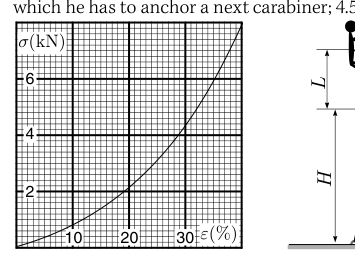 Stress-strain graph and rope/carabiner diagram
Topic: Newtonian Mechanics, Elasticity & Materials, Conservation of Energy Metodi: Free-Body Diagram, Energy Conservation Method, Hooke’s Law Competenze: Physical Reasoning, Mathematical Modeling Objects: String Fonte: Testo (PDF) — p.1
Rocco di arrampicata (6 punti)
Un alpinista di massa sale lungo una roccia verticale. Per proteggersi, l’alpinista usa il seguente metodo. Una estremità di una corda elastica è ancorata al suolo. La corda attraversa dei cicli di protezione lisci (carabineri), che sono ancorati alla roccia. L’altezza dell’ultimo carabinero è . L’altra estremità della corda passa attraverso una speciale clip di frenata che è legata al cordone dell’alpinista. Durante l’arrampicata, questo clip mantiene la corda stretta, ma consente al scalatore di allungare la parte protettiva della corda. (Supponiamo che la corda tra il clip e i carabineri sia sempre stretta.) Quando cade, l’accelerazione massima non deve superare (per proteggere dai infortuni). Si può presumere che la corda sia sempre verticale, che la distanza tra il clip e il centro di massa dell’alpinista sia molto piccola e che l’attrito tra la corda e le carabinere sia trascurabile. La relazione tra la tensione e la tensione della corda è disegnata nel grafico di seguito.
-
Supponiamo che la distanza tra l’alpinista e l’ultimo carabinero sia (vedere figura). Se il scalatore cade, la distanza tra il carabinero più alto e il scalatore raggiungerà un valore massimo (dopo, l’elasticità della corda inizia a sollevare il scalatore). Quali disuguaglianze devono essere soddisfatte per ? 1, 5 punti)
-
Trovare la lunghezza massima di sicurezza tra l’alpinista e l’ultimo carabinero (al suo arrivo deve ancorare un altro carabinero). 4,5 pts)
Grafica di tensione e diagramma di corda/carabinero
Topic: Newtonian Mechanics, Elasticity & Materials, Conservation of Energy Metodi: Free-Body Diagram, Energy Conservation Method, Hooke’s Law Competenze: Physical Reasoning, Mathematical Modeling Objects: String Fonte: Testo (PDF) — p.1
Magnetic brake (12 points)
Foucault currents can be used to decelerate moving metal objects, e.g. a rotating disc. Consider the following simple model. For the sake of simplicity, the disc is substituted by a “circular railway” (see Figure). A plastic “can” of radius , mass , and height consists of a homogeneous disc (the bottom of the “can”), and of a much thinner cylindrical wall. Along the edges of the cylinder, there are two wire rings (“rails”), which are connected with a set of parallel wire bars (“sleepers”). Both the “sleepers” and “rails” are made of a copper wire of diameter ; the distance between the “sleepers” , where . Frictionless rotation of the system is decelerated with a homogeneous magnetic field () in the slit between the poles of a permanent magnet (see Figure). Assume that the homogeneous field fills a region of rectangular cross-section, equal to the area between three subsequent “sleepers” (i.e. of size ). Outside of that region, the field is negligible. The specific resistance of the copper .
Suppose the system is motionless.
-
Find the resistance of a single “sleeper”. (1 pt)
-
Suppose the “rails” are cut near the end-points of a certain “sleeper” A and B. Prove that the resistance between A and B is approximately given by . (2 pts)
Now suppose the system is rotating with an angular speed , and the “rails” are uncut.
-
Sketch an equivalent DC circuit, so that the currents through the resistors are equal to the currents in the respective “railway” elements: “sleepers” and “rail” segments (between subsequent “sleepers”). (2 pts)
-
Using the above obtained results, prove that the (Joule) dissipation power is given by formula , and express the constant . (3 pts)
-
Find the decelerating torque . (2 pts)
-
Prove that the angular speed will vanish as , and determine the time constant . (2 pts)
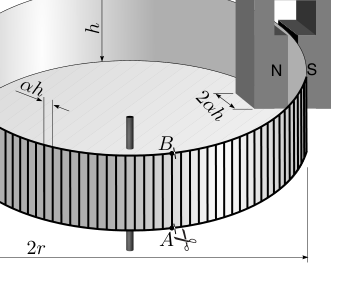 Circular railway in magnetic field, N-S poles
Topic: Electromagnetic Induction, Circuits, Rotational Dynamics Metodi: Faraday’s Law of Induction, Kirchhoff’s Laws, Equivalent Circuit Reduction Competenze: Physical Reasoning, Mathematical Modeling Objects: Disk, Cylinder, Wire, Magnet Fonte: Testo (PDF) — p.1
Fremma magnetica (12 punti)
Le correnti di Foucault possono essere utilizzate per rallentare gli oggetti metallici in movimento, ad esempio. un disco rotante. Considerate il seguente modello semplice. Per semplificazione, il disco viene sostituito da una “ferrovia circolare” (vedi figura). Una “lattina” di plastica di raggio , massa e altezza è costituita da un disco omogeneo (il fondo della “lattina”), e da una parete cilindrica molto più sottile. Lungo i bordi del cilindro, ci sono due anelli di filo (“rails”), che sono collegati con un insieme di barre di filo parallele (“sleepers”). Le “sleepers” e le “rails” sono realizzate in un filo di rame di diametro ; la distanza tra le “sleepers” , dove . La rotazione senza frizione del sistema è rallentata con un campo magnetico omogeneo () nella fessura tra i poli di un magnete permanente (vedi figura). Supponiamo che il campo omogeneo riempia una regione di sezione trasversale rettangolare, pari all’area tra tre “dormitori” successivi (cioè di dimensioni ). Al di fuori di quella regione, il campo è trascurabile. La resistenza specifica del rame .
Supponiamo che il sistema sia immobile.
-
Trova la resistenza di un singolo “dormitore”. (1 pt)
-
Supponiamo che le “ferrovie” siano tagliate vicino ai punti finali di un certo “dormitore” A e B. Prove che la resistenza tra A e B è di . (cfr.
Supponiamo che il sistema ruota a una velocità angolare , e che i “scinelli” siano incolti.
-
Segnare un circuito di corrente continua equivalente, in modo che le correnti attraverso le resistenze siano uguali alle correnti nei rispettivi elementi “ferroviari”: segmenti “dormitori” e “ferroviari” (tra i successivi “dormitori”). (cfr.
-
Sfruttando i risultati ottenuti in precedenza, dimostrare che la potenza di dissipazione (Joule) è data con la formula ed esprimere la costante . (3 punti)
-
Trova la coppia di rallentamento . (cfr.
-
Prove che la velocità angolare scompare come e determina la costante temporale . (cfr.
Schiene circolari in campo magnetico, poli N-S
Topic: Electromagnetic Induction, Circuits, Rotational Dynamics Metodi: Faraday’s Law of Induction, Kirchhoff’s Laws, Equivalent Circuit Reduction Competenze: Physical Reasoning, Mathematical Modeling Objects: Disk, Cylinder, Wire, Magnet Fonte: Testo (PDF) — p.1
Ballistic rocket (8 points)
A rocket is launched from a pole of the Earth with the first cosmic velocity (near-Earth orbital velocity) in such a way that it lands at the Equator. The radius of the Earth .
-
Find the longer semi-axis of the rocket’s orbit. (1.5 pts)
-
What is the maximal height of the rocket’s orbit (from the Earth’s surface)? (3.5 pts)
-
What is the rocket’s flight time ? (3 pts)
Remark: The mechanical energy of a planet rotating around a star , where is the gravitation constant, — the star mass, — the planet mass, and — the orbit’s longer semi-axis (zero potential energy corresponds to an infinite departure). The surface area of an ellipse , where is the shorter semi-axis.
Topic: Gravitation, Newtonian Mechanics Metodi: Kepler’s Laws, Conservation of Energy, Newton’s Law of Gravitation Competenze: Physical Reasoning, Mathematical Modeling Objects: Satellite, Planet Fonte: Testo (PDF) — p.1
Raccia balistica (8 punti)
Un razzo viene lanciato da un polo della Terra con la prima velocità cosmica (velocità orbitale vicino alla Terra) in modo tale che atterri all’Equatore. Il raggio della Terra .
-
Trova il semiaasse più lungo dell’orbita del razzo. 1, 5 punti)
-
Qual è l’altezza massima dell’orbita del razzo (da terra)? 3,5 punti)
-
Qual è il tempo di volo del razzo ? (3 punti)
*Rimarca: * L’energia meccanica di un pianeta che ruota attorno a una stella , dove è la costante di gravitazione, la massa stellare, la massa planetaria e la semiaccia più lunga dell’orbita (energia potenziale zero corrisponde a una partenza infinita). L’area superficiale di un’ellisse , dove è il semiaasse più breve.
Topic: Gravitation, Newtonian Mechanics Metodi: Kepler’s Laws, Conservation of Energy, Newton’s Law of Gravitation Competenze: Physical Reasoning, Mathematical Modeling Objects: Satellite, Planet Fonte: Testo (PDF) — p.1
Water pump (10 points)
Consider the following construction of a water pump. A vertical tube of cross-sectional area leads from an open water reservoir to a cylindric rotating tank of radius . All the vessels are filled with water; there are holes of net cross-sectional area along the perimeter of the tank, which are open for the operating regime of the pump. The height of the tank from the free water surface of the reservoir is (the height of the tank itself is small). An electric engine keeps the vessel rotating at the angular velocity . The water density is , the air pressure — , and the saturated vapour pressure — . Assume the water flow to be laminar (neglect the energy of vortices) and neglect the friction. Inside the tank, there are metal blades, which make the water rotating together with the tank.
-
Calculate the pressure at the perimeter of the tank, when all the holes are closed. (2 pts)
-
From now on, all the holes are open. Find the velocity of the water jets with respect to the ground. (2 pts)
-
If the tank rotates too fast, the pump efficiency drops due to cavitation: the water starts “boiling” in some parts of the pump. Find the highest cavitation-free angular speed . (3 pts)
-
If the power of the electric engine is , what is the theoretical upper limit of the volume productivity of the pump (volume of the pumped water per unit time)?
Topic: Fluid Mechanics, Rotational Dynamics Metodi: Bernoulli’s Equation, Conservation of Energy, Continuity Equation Competenze: Physical Reasoning, Mathematical Modeling Objects: Tube, Container Fonte: Testo (PDF) — p.1
Pompetta d’acqua (10 punti)
Considerate la seguente costruzione di una pompa d’acqua. Un tubo verticale di superficie trasversale conduce da un serbatoio di acqua aperta a un serbatoio cilindrico a rotazione di raggio . Tutti i recipienti sono riempiti di acqua; nel perimetro del serbatoio sono presenti buchi di superficie netta , aperti per il regime di funzionamento della pompa. L’altezza del serbatoio rispetto alla superficie dell’acqua libera del serbatoio è (l’altezza del serbatoio stesso è piccola). Un motore elettrico mantiene il recipiente in rotazione alla velocità angolare . La densità dell’acqua è , la pressione dell’aria e la pressione del vapore saturo . Supponiamo che il flusso d’acqua sia laminare (negliamo l’energia dei vortici) e trascurare l’attrito. All’interno del serbatoio ci sono lame di metallo, che fanno girare l’acqua insieme al serbatoio.
-
Calcolare la pressione sul perimetro del serbatoio, quando tutti i fori sono chiusi. (cfr.
-
Da ora in poi, tutti i buchi sono aperti. Trova la velocità dei getti d’acqua rispetto al suolo. (cfr.
-
Se il serbatoio ruota troppo velocemente, l’efficienza della pompa diminuisce a causa della cavitazione: l’acqua inizia a “boicare” in alcune parti della pompa. Trova la velocità angolare senza cavitazione più alta . (3 punti)
-
Se la potenza del motore elettrico è , qual è il limite teorico superiore della produttività del volume della pompa (volume dell’acqua pompata per unità di tempo)?
Topic: Fluid Mechanics, Rotational Dynamics Metodi: Bernoulli’s Equation, Conservation of Energy, Continuity Equation Competenze: Physical Reasoning, Mathematical Modeling Objects: Tube, Container Fonte: Testo (PDF) — p.1
Anemometer (6 points)
An anemometer is a device measuring the flow rate of a gas or a fluid. Let us look at the construction of a simple laser-anemometer. In a rectangular pipe with thin glass walls flows a fluid (refractive index ), which contains light-dissipating particles. Two coherent plane waves with wavelength and angle between their wave vectors are incident on a plate so that (a) the angle bisector of the angle between wave vectors is normal to one wall of the pipe and (b) the pipe is parallel to the plane defined by the wave vectors. Behind the pipe is a photodetector that measures the frequency of changes in dissipated light intensity.
-
How long is the (spatial) period of the interference pattern created along the -axis (see Figure)? (2 pts)
-
Let the oscillation frequency of the photometer signal be . How large is the fluid’s speed ? What can be said about the direction of the fluid flow? (2 pts)
-
Let us consider a situation when the wavelengths of the plane waves differ by (). What is the frequency of signal oscillations now (fluid’s speed is the same as in the previous section)? Is it possible to determine the flow direction with such a device? (2 pts)
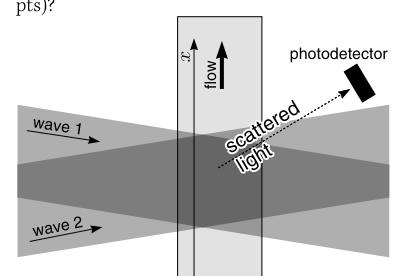 Laser anemometer setup with two beams and photodetector
Topic: Wave Optics, Geometric Optics Metodi: Interference & Diffraction Analysis, Superposition Principle, Snell’s Law Competenze: Physical Reasoning, Mathematical Modeling Objects: Tube, Screen Fonte: Testo (PDF) — p.2
Anemometro (6 punti)
Un anemometro è un dispositivo che misura il flusso di un gas o di un fluido. Vediamo la costruzione di un semplice anemometro laser. In un tubo rettangolare con pareti di vetro sottili scorre un fluido (indice di rifrazione ), che contiene particelle che disperdono la luce. Due onde piano coerenti con lunghezza d’onda e angolo tra i loro vettori d’onda si incidono su una piastra in modo che (a) il bisettore angolare dell’angolo tra i vettori d’onda sia normale ad una parete del tubo e (b) il tubo sia parallelo al piano definito dai vettori d’onda. Dietro il tubo c’è un fotodettore che misura la frequenza dei cambiamenti nell’intensità della luce dissipata.
-
Quanto è lungo il periodo (spaziale) del modello di interferenza creato lungo l’asse (vedi figura)? (cfr.
-
La frequenza di oscillazione del segnale del fotometro deve essere . Quanto è grande la velocità del fluido ? Cosa si può dire della direzione del flusso di fluido? (cfr.
-
Consideriamo una situazione in cui le lunghezze d’onda delle onde a piatto differiscono di (). Qual è la frequenza delle oscillazioni del segnale ora (la velocità del fluido è la stessa della sezione precedente)? È possibile determinare la direzione del flusso con un tale dispositivo? (cfr.
Configurazione di anemometro laser con due raggi e fotodettor
Topic: Wave Optics, Geometric Optics Metodi: Interference & Diffraction Analysis, Superposition Principle, Snell’s Law Competenze: Physical Reasoning, Mathematical Modeling Objects: Tube, Screen Fonte: Testo (PDF) — p.2
Mechano-electrical oscillator (7 points)
Mechanical and electrical processes are sometimes strongly coupled. Very important examples are systems containing piezoelectric materials, e.g. quartz resonator. Here we investigate a somewhat simpler situation.
There are two metal plates with area and mass . One plate is situated atop of the other one. Plates are connected to each other with springs, whose total spring constant is and which are made of insulator. The lower plate is mounted on a steady base. Equilibrium distance between the plates is .
-
Let us assume that there is a small vertical shift of the upper plate from its equilibrium position. Derive the acceleration of in terms of system parameters. What is the angular frequency of the small vertical oscillations of the upper plate? (1 pt)
-
Plates are now connected to a constant high voltage source, so that they form a capacitor. Electrostatic force between the plates causes an additional shift of the upper plate. The equilibrium distance between the plates is now . Derive expressions of the electrical attractive force and voltage applied to the plates in terms of , , , and . (2 pts)
-
System is set to oscillate again, keeping voltage constant. Let stand for the shift from the equilibrium position. Derive an expression for the acceleration of in terms of , , , , and shift . What is the angular frequency of the upper plate’s small vertical oscillations? (2 pts)
-
Let us modify the situation of the previous question and connect an inductor with inductance in series to the capacitor and voltage source. We describe the situation in terms of plate shift and capacitor’s charge . Derive expressions for the accelerations and in terms of , , , , , and . Which angular frequencies of harmonic oscillation are possible in the system? (2 pts)
Topic: Oscillations & Waves, Electrostatics, Circuits Metodi: Simple Harmonic Motion Analysis, Electric Potential Method, Differential Equations Competenze: Physical Reasoning, Mathematical Modeling Objects: Capacitor, Spring, Inductor Fonte: Testo (PDF) — p.2
Oscillatore meccanico-elettrico (7 punti)
A volte i processi meccanici e elettrici sono fortemente congiunti. Esempi molto importanti sono i sistemi contenenti materiali piezoelettrici, ad esempio: risonatore di quarzo. Qui si tratta di una situazione un po’ più semplice.
Sono presenti due lastre di metallo con superficie e massa . Una piastra è situata sopra l’altra. Le piastre sono collegate tra loro con molle, la cui costante totale di molle è e sono realizzate in isolante. La piastra inferiore è montata su una base stabile. La distanza di equilibrio tra le piastre è .
-
Supponiamo che ci sia un piccolo spostamento verticale della piastra superiore dalla sua posizione di equilibrio. Derivare l’accelerazione di in termini di parametri del sistema. Qual è la frequenza angolare delle piccole oscillazioni verticali della superficie superiore? (1 pt)
-
Le piastre sono ora collegate a una fonte di alta tensione costante, in modo da formare un condensatore. La forza elettrostatica tra le lastre provoca un ulteriore spostamento della lastra superiore. La distanza di equilibrio tra le piastre è ora . Espressioni derivate della forza di attrazione elettrica e della tensione applicata alle lastre in termini di , , , e . (cfr.
-
Il sistema è impostato a oscillare di nuovo, mantenendo costante la tensione . Lasciate indicare il spostamento dalla posizione di equilibrio. Derivare un’espressione per l’accelerazione di in termini di , , , , e spostamento . Qual è la frequenza angolare delle piccole oscillazioni verticali della superficie? (cfr.
-
Modifichiamo la situazione della domanda precedente e colleghiamo un induttore con induttanza in serie al condensatore e alla fonte di tensione. Descriviamo la situazione in termini di spostamento della piastra e carica del condensatore . Espressioni derivate per le accelerazioni e in termini di , , , , , e . Quali frequenze angolari di oscillazione armonica sono possibili nel sistema? (cfr.
Topic: Oscillations & Waves, Electrostatics, Circuits Metodi: Simple Harmonic Motion Analysis, Electric Potential Method, Differential Equations Competenze: Physical Reasoning, Mathematical Modeling Objects: Capacitor, Spring, Inductor Fonte: Testo (PDF) — p.2
Heat exchange (8 points)
-
Consider a simplified model of the air ventilation system of a house using a passive heat exchanger. The exchanger consists of a metal plate of length and width and thickness dividing the air channel into two halves, one for incoming cold air, and another for outgoing warm air. Both channels have constant thickness , air flow velocity is (see Figure). Thermal conductance of the metal is (the heat flux through a unit area of the plate per unit time, assuming that the temperature drops by one degree per unit thickness of the plate). Specific heat capacity of the air at constant pressure is , air density is (neglect its temperature dependence). You may assume that the air is turbulently mixed in the channel, so that the incoming and outgoing air temperatures and depend only on the coordinate (the -axis is taken parallel to the flow velocity), i.e. and . Assuming that the inside and outside temperatures are and , respectively, what is the temperature of the incoming air at the entrance to the room? (4 pts)
-
Attached is a plot of the heat exchange rate of the wire of an electric heater as a function of temperature (assuming the room temperature is ). The operating temperature of the wire is . The heater is switched off; find the time after which the temperature of the wire will drop down to . The heat capacitance of the wire is . (4 pts)
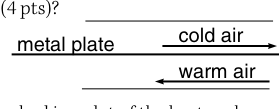 Heat exchanger plate, cold and warm air channels
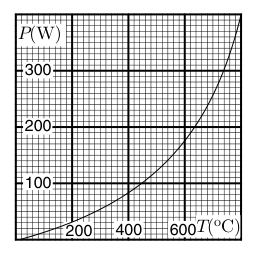 P(W) vs T(C) graph for electric heater wire
Topic: Thermodynamics Metodi: First Law of Thermodynamics, Differential Equations, Experimental Data Analysis Competenze: Physical Reasoning, Mathematical Modeling Objects: Tube, Wire Fonte: Testo (PDF) — p.2
scambio di calore (8 punti)
-
Considerate un modello semplificato del sistema di ventilazione dell’aria di una casa che utilizza uno scambio di calore passivo. Lo scambiatore è costituito da una piastra di metallo di lunghezza , larghezza e spessore che divide il canale d’aria in due metà, una per l’aria fredda che entra e l’altra per l’aria calda che esce. Entrambi i canali hanno spessore costante , la velocità di flusso d’aria è (vedi figura). La conduttività termica del metallo è (il flusso di calore attraverso un’area unitaria della piastra per unità di tempo, supponendo che la temperatura scenda di un grado per unità di spessore della piastra). La capacità termica specifica dell’aria a pressione costante è , la densità dell’aria è (non si deve considerare la sua dipendenza dalla temperatura). Si può presumere che l’aria sia turbolentemente mescolata nel canale, in modo che le temperature dell’aria entrante e uscente e dipendano solo dalla coordinata (l’asse è preso parallelo alla velocità di flusso), ovvero e . Se si presuppone che le temperature interne ed esterne siano rispettivamente e , qual è la temperatura dell’aria che entra all’ingresso della stanza? (4 punti)
-
Aggiunto è un diagramma del tasso di scambio di calore del filo di un riscaldatore elettrico in funzione della temperatura (presumendo che la temperatura ambiente sia ). La temperatura di funzionamento del filo è . Il riscaldatore è spento; trova il tempo dopo il quale la temperatura del filo scenderà a . La capacità termico del filo è . (4 punti)
Platte di scambiatore di calore, canali di aria fredda e calda
P(W) vs T(C) grafico per filo di riscaldatore elettrico
Topic: Thermodynamics Metodi: First Law of Thermodynamics, Differential Equations, Experimental Data Analysis Competenze: Physical Reasoning, Mathematical Modeling Objects: Tube, Wire Fonte: Testo (PDF) — p.2
Balloon (8 points)
Find the mass of the balloon (including the gas inside it). Equipment: balloon (floats in air), digital scales, rope, measuring tape, rope fasteners, dynamometer, paper sheets for folding and rough angle measurements, 100-g weight, thread.
Remark: You may find it useful to know that if a rope is tied around a balloon so that the tension of the rope is , the excess pressure inside the balloon is , the angle between the tangents of the balloon envelope near the rope is (average over the perimeter; see Figure), and the radius of the circular loop formed by the rope is , then . The universal gas constant , the molar mass of air .
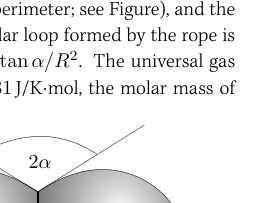 Balloon with rope tied around showing angle 2alpha
Topic: Fluid Mechanics, Newtonian Mechanics Metodi: Hydrostatic Equilibrium, Physical Modeling, Ideal Gas Law Competenze: Estimation & Approximation, Experimental Data Analysis Objects: Gas, String Fonte: Testo (PDF) — p.2
Balloon (8 punti)
Trova la massa del palloncino (compreso il gas all’interno). Attrezzature: pallone (flotta nell’aria), scale digitali, corda, nastro di misura, fissaggi per la corda, dinamometro, fogli di carta per le misure di piegatura e angolo grosso, peso di 100 g, filo.
Ricordo: Potrebbe essere utile sapere che se una corda è legata attorno a un palloncino in modo tale che la tensione della corda sia , la pressione in eccesso all’interno del palloncino è , l’angolo tra le tangenti della busta del palloncino vicino alla corda è (media sul perimetro; vedere figura), e il raggio del ciclo circolare formato dalla corda è , allora . La costante universale del gas , la massa molare dell’aria .
Balone con corda legata intorno a cui è indicato l’angolo 2alpha
Topic: Fluid Mechanics, Newtonian Mechanics Metodi: Hydrostatic Equilibrium, Physical Modeling, Ideal Gas Law Competenze: Estimation & Approximation, Experimental Data Analysis Objects: Gas, String Fonte: Testo (PDF) — p.2
Mechanical black box (7 points)
There is something small inside the cylindrical “black box”. Find the mass of it, as well as the friction coefficient between it and the inner surface of the box. Equipment: black box, ruler, a wooden plank, timer, scales.
Topic: Newtonian Mechanics, Rigid Body Statics Metodi: Free-Body Diagram, Kinematic Equations, Physical Modeling Competenze: Experimental Data Analysis, Measurement & Instrumentation Objects: Cylinder, Block Fonte: Testo (PDF) — p.2
Scatola nera meccanica (7 punti)
C’è qualcosa di piccolo all’interno della “scatola nera” cilindrica. Trova la massa della scatola, così come il coefficiente di attrito tra la scatola e la superficie interna. Attrezzature: scatola nera, regolare, tavola in legno, timer, scale.
Topic: Newtonian Mechanics, Rigid Body Statics Metodi: Free-Body Diagram, Kinematic Equations, Physical Modeling Competenze: Experimental Data Analysis, Measurement & Instrumentation Objects: Cylinder, Block Fonte: Testo (PDF) — p.2