A child throws a ball toward the front end of an approaching train. The collision between the ball and the train is perfectly elastic. Let be the speed of the ball with respect to the train and its speed with respect to the ground. If the labels “i” and “f” refer to those speeds just before and just after, respectively, the ball hits the train, then
- A. and ;
- B. and ;
- C. and ;
- D. and .
Topic: Newtonian Mechanics, Conservation of Energy Metodi: Conservation of Momentum, Conservation of Energy Competenze: Physical Reasoning Objects: Ball Fonte: Testo (PDF) — p.2
Un bambino lancia una palla verso l’anteriore di un treno che si avvicina. La collisione tra palla e treno è perfettamente elastica. La velocità della palla rispetto al treno è e la velocità della palla rispetto al suolo è . Se le etichette “i” e “f” si riferiscono a tali velocità poco prima e poco dopo, rispettivamente, che la palla colpisca il treno, allora
- A. e ;
- B. e ;
- C. e ;
- D. e .
Topic: Newtonian Mechanics, Conservation of Energy Metodi: Conservation of Momentum, Conservation of Energy Competenze: Physical Reasoning Objects: Ball Fonte: Testo (PDF) — p.2
A physics textbook of mass rests flat on a horizontal table of mass placed on the ground. Let be the contact force exerted by body “a” on body “b”. According to Newton’s 3rd Law, which of the following is an action-reaction pair of forces?
- A. and ;
- B. and ;
- C. and ;
- D. and .
Topic: Newtonian Mechanics Metodi: Free-Body Diagram Competenze: Physical Reasoning Objects: Block Fonte: Testo (PDF) — p.2
Un libro di fisica di massa si posa piatto su una tavola orizzontale di massa posta a terra. Il deve essere la forza di contatto esercitata dal corpo “a” sul corpo “b”. Secondo la terza legge di Newton, quale delle seguenti è una coppia di forze azione-reazione?
- A. e ;
- B. e ;
- C. e ;
- D. e .
Topic: Newtonian Mechanics Metodi: Free-Body Diagram Competenze: Physical Reasoning Objects: Block Fonte: Testo (PDF) — p.2
At some time , two identical balls, A and B, are set rolling without slipping at the same speed from one end of two tracks which are identical with the same horizontal length, except that track B has a dip in the path of ball B, as shown in the figure. The straight portions of the tracks are horizontal. Gravity is uniform throughout. Which ball reaches the other end first?
- A. Ball A;
- B. neither, since both arrive at the same time;
- C. ball B;
- D. ball A, but only if the dip is deep enough.
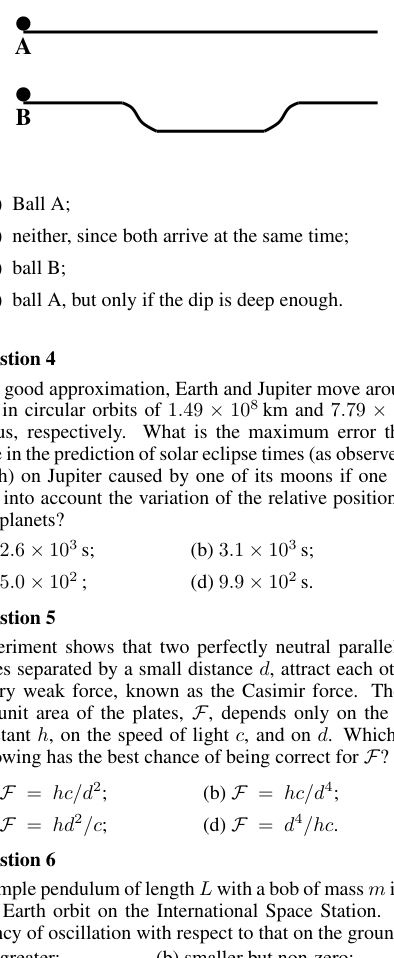 Two parallel tracks A and B, B has dip
Topic: Newtonian Mechanics, Conservation of Energy Metodi: Conservation of Energy, Kinematic Equations Competenze: Physical Reasoning, Diagrammatic Reasoning Objects: Ball Fonte: Testo (PDF) — p.2
In alcuni momenti , due palle identiche, A e B, sono impostate a rotolare senza scivolare alla stessa velocità da una estremità di due binari identici con la stessa lunghezza orizzontale, tranne che la pista B ha un dip nel percorso della palla B, come mostrato nella figura. Le parti rette delle binarie sono orizzontali. La gravità è uniforme in tutto. Quale palla arriva prima all’altra estremità?
- A. palla A;
- B. né, poiché entrambe arrivano contemporaneamente;
- C. palla B;
- M.S.K.1, ma solo se la scarica è abbastanza profonda.
Due binari paralleli A e B, B ha dip
Topic: Newtonian Mechanics, Conservation of Energy Metodi: Conservation of Energy, Kinematic Equations Competenze: Physical Reasoning, Diagrammatic Reasoning Objects: Ball Fonte: Testo (PDF) — p.2
To a good approximation, Earth and Jupiter move around the Sun in circular orbits of and radius, respectively. What is the maximum error that can arise in the prediction of solar eclipse times (as observed from Earth) on Jupiter caused by one of its moons if one fails to take into account the variation of the relative position of the two planets?
- A. ;
- B. ;
- C. ;
- D. .
Topic: Astrophysics, Special Relativity Metodi: Kepler’s Laws, Order-of-Magnitude Estimation Competenze: Estimation & Approximation, Physical Reasoning Objects: Planet, Star Fonte: Testo (PDF) — p.2
Per una buona approssimazione, la Terra e Giove si muovono intorno al Sole in orbite circolari di raggio e , rispettivamente. Qual è l’errore massimo che può sorgere nella previsione dei tempi di eclissi solari (come osservato dalla Terra) su Giove causato da una delle sue lune se non si tiene conto della variazione della posizione relativa dei due pianeti?
- A. ;
- B. ;
- C. ;
- D. .
Topic: Astrophysics, Special Relativity Metodi: Kepler’s Laws, Order-of-Magnitude Estimation Competenze: Estimation & Approximation, Physical Reasoning Objects: Planet, Star Fonte: Testo (PDF) — p.2
Experiment shows that two perfectly neutral parallel metal plates separated by a small distance attract each other via a very weak force, known as the Casimir force. The force per unit area of the plates, , depends only on the Planck constant , on the speed of light , and on . Which of the following has the best chance of being correct for ?
- A. ;
- B. ;
- C. ;
- D. .
Topic: Modern-Quantum Physics Metodi: Dimensional Analysis Competenze: Physical Reasoning, Estimation & Approximation Objects: Capacitor Fonte: Testo (PDF) — p.2
L’esperimento mostra che due piastre metalliche parallele perfettamente neutre, separate da una piccola distanza , si attraggono a vicenda tramite una forza molto debole, nota come forza di Casimir. La forza per unità di superficie delle piastre, , dipende solo dalla costante di Planck , dalla velocità della luce e da . Qual è la probabilità migliore di correttezza per ?
- A. ;
- B. ;
- C. ;
- D. .
Topic: Modern-Quantum Physics Metodi: Dimensional Analysis Competenze: Physical Reasoning, Estimation & Approximation Objects: Capacitor Fonte: Testo (PDF) — p.2
A simple pendulum of length with a bob of mass is taken into Earth orbit on the International Space Station. Its frequency of oscillation with respect to that on the ground is
- A. greater;
- B. smaller but non-zero;
- C. the same;
- D. zero.
Topic: Oscillations & Waves, Gravitation Metodi: Simple Harmonic Motion Analysis, Newton’s Law of Gravitation Competenze: Physical Reasoning Objects: Pendulum Fonte: Testo (PDF) — p.2
Un semplice pendolo di lunghezza con una bobina di massa viene portato in orbita sulla Terra sulla Stazione Spaziale Internazionale. La sua frequenza di oscillazione rispetto a quella sul terreno è
- A. superiore;
- B. più piccolo ma non zero;
- C. lo stesso;
- D. zero.
Topic: Oscillations & Waves, Gravitation Metodi: Simple Harmonic Motion Analysis, Newton’s Law of Gravitation Competenze: Physical Reasoning Objects: Pendulum Fonte: Testo (PDF) — p.2
When you turn on a battery-operated portable music-playing device, how long must you leave it on for electrons leaving the negative terminal of the battery to reach the positive terminal if their path lies within good conductors?
- A. A few milliseconds;
- B. a few tenths of a second;
- C. a few microseconds;
- D. a few minutes.
Topic: Circuits, Electromagnetism Metodi: Order-of-Magnitude Estimation Competenze: Estimation & Approximation, Physical Reasoning Objects: Battery, Electron, Wire Fonte: Testo (PDF) — p.2
Quando si accende un dispositivo portatile che riproduce musica a batteria, per quanto tempo deve essere acceso per permettere agli elettroni di lasciare il terminale negativo della batteria per raggiungere il terminale positivo se il loro percorso è all’interno di buoni conduttori?
- A. Pochi millisecondi;
- B. qualche decimo di secondo;
- C. qualche microseconda;
- ** D.** pochi minuti.
Topic: Circuits, Electromagnetism Metodi: Order-of-Magnitude Estimation Competenze: Estimation & Approximation, Physical Reasoning Objects: Battery, Electron, Wire Fonte: Testo (PDF) — p.2
Circuit A is made of resistors connected in series to a battery; circuit B is made of resistors connected in parallel to a battery. Let be the power drawn from the batteries. As the number of resistors in each circuit is increased,
- A. increases and decreases;
- B. both and increase;
- C. decreases and increases;
- D. and remain the same.
Topic: Circuits Metodi: Equivalent Circuit Reduction, Kirchhoff’s Laws Competenze: Physical Reasoning Objects: Resistor, Battery Fonte: Testo (PDF) — p.3
Il circuito A è costituito da resistori collegati in serie a una batteria; il circuito B è costituito da resistori collegati in parallelo a una batteria. Lasciate che sia la potenza ricavata dalle batterie. Con l’aumento del numero di resistenti in ogni circuito,
- Aumento di A. e diminuzione di ;
- B. both and increase;
- C. diminuisce e aumenta;
- D. e restano uguali.
Topic: Circuits Metodi: Equivalent Circuit Reduction, Kirchhoff’s Laws Competenze: Physical Reasoning Objects: Resistor, Battery Fonte: Testo (PDF) — p.3
According to a simplified but still useful model, the drag force due to air resistance on a moving car goes like the square of the car’s speed . Suppose that the maximum speed of a car is limited only by this drag force. If the power of the car’s engine were increased by 50%, the top speed of the car would increase by about
- A. 50%;
- B. 15%;
- C. 22%;
- D. 30%.
Topic: Newtonian Mechanics, Fluid Mechanics Metodi: Dimensional Analysis, Approximation & Series Expansion Competenze: Estimation & Approximation, Physical Reasoning Objects: — Fonte: Testo (PDF) — p.3
Secondo un modello semplificato ma ancora utile, la forza di trazione dovuta alla resistenza all’aria su un’auto in movimento è pari al quadrato della velocità dell’auto . Supponiamo che la velocità massima di un’auto sia limitata solo da questa forza di trazione. Se la potenza del motore dell’auto fosse aumentata del 50%, la velocità massima dell’auto aumenterebbe di circa
- A. 50%;
- B. 15%;
- C. 22%;
- D. 30%.
Topic: Newtonian Mechanics, Fluid Mechanics Metodi: Dimensional Analysis, Approximation & Series Expansion Competenze: Estimation & Approximation, Physical Reasoning Objects: — Fonte: Testo (PDF) — p.3
A projectile is launched with an initial velocity , with and the horizontal and vertical velocity components, respectively. When is there a point on its trajectory after launch where its velocity is perpendicular to its acceleration?
- A. Always;
- B. only if and points upward;
- C. only if ;
- D. always, except if .
Topic: Newtonian Mechanics Metodi: Kinematic Equations, Vector Decomposition Competenze: Physical Reasoning, Diagrammatic Reasoning Objects: Projectile Fonte: Testo (PDF) — p.3
Un proiettile viene lanciato con una velocità iniziale , con e rispettivamente le componenti di velocità orizzontale e verticale. Quando c’è un punto sulla sua traiettoria dopo il lancio dove la sua velocità è perpendicolare alla sua accelerazione?
- A. Sempre;
- B. solo se e puntano verso l’alto;
- C. solo se ;
- D. sempre, tranne se .
Topic: Newtonian Mechanics Metodi: Kinematic Equations, Vector Decomposition Competenze: Physical Reasoning, Diagrammatic Reasoning Objects: Projectile Fonte: Testo (PDF) — p.3
Three charged conducting metal spheres, of radius , , and , are connected together by wires. Let . At equilibrium, which of the following sets of relations involving the electric field strength generated by a sphere, its potential , and its charge , must hold between the spheres?
- A. , , ;
- B. , , ;
- C. , , ;
- D. , , .
Topic: Electrostatics Metodi: Gauss’s Law, Electric Potential Method Competenze: Physical Reasoning Objects: Conducting Sphere, Wire Fonte: Testo (PDF) — p.3
Tre sfere metalliche conduttrici cariche, di raggio , e , sono collegate tra loro mediante fili. Lasciate . In equilibrio, quale dei seguenti set di relazioni che coinvolgono la forza del campo elettrico generata da una sfera, il suo potenziale e la sua carica deve mantenere tra le sfere?
- A. , , ;
- B. , , ;
- C. , , ;
- D. , , .
Topic: Electrostatics Metodi: Gauss’s Law, Electric Potential Method Competenze: Physical Reasoning Objects: Conducting Sphere, Wire Fonte: Testo (PDF) — p.3
A ball of mass attached to an inextensible string of length is swung around a vertical circle just fast enough so that the string is always fully stretched. Let denote the difference between the tension in the string at the bottom and at the top of the circle, and the speed of the ball at the bottom and at the top, respectively. Then, taking “dependence” to be with respect to a set of independent variables,
- A. is independent of , and ;
- B. is independent of , but depends on ;
- C. depends on , but on neither nor ;
- D. depends on and .
Topic: Newtonian Mechanics, Conservation of Energy Metodi: Free-Body Diagram, Conservation of Energy Competenze: Physical Reasoning, Mathematical Modeling Objects: Ball, String Fonte: Testo (PDF) — p.3
Una palla di massa attaccata a una stringa inestensibile di lunghezza si agita intorno a un cerchio verticale abbastanza velocemente da rendere la stringa sempre completamente estesa. indichi la differenza tra la tensione della corda nella parte inferiore e superiore del cerchio, e la velocità della palla nella parte inferiore e superiore, rispettivamente. Quindi, assumendo “dipendenza” per essere rispetto ad un insieme di variabili indipendenti,
- A. è indipendente da , e ;
- B. è indipendente da , ma dipende da ;
- C. dipende da , ma né da né da ;
- D. dipende da e .
Topic: Newtonian Mechanics, Conservation of Energy Metodi: Free-Body Diagram, Conservation of Energy Competenze: Physical Reasoning, Mathematical Modeling Objects: Ball, String Fonte: Testo (PDF) — p.3
An object of mass hangs motionless from a vertical spring. When the object is pulled down to a new rest position, the total mechanical energy of the system
- A. increases;
- B. remains the same;
- C. decreases;
- D. may increase or decrease depending on the new position.
Topic: Oscillations & Waves, Conservation of Energy Metodi: Conservation of Energy, Simple Harmonic Motion Analysis Competenze: Physical Reasoning Objects: Spring Fonte: Testo (PDF) — p.3
Un oggetto di massa è sospeso immobile da una molla verticale. Quando l’oggetto viene trascinato in una nuova posizione di riposo, l’energia meccanica totale del sistema
- A aumenta;
- B. rimane lo stesso;
- C. diminuisce;
- D. può aumentare o diminuire a seconda della nuova posizione.
Topic: Oscillations & Waves, Conservation of Energy Metodi: Conservation of Energy, Simple Harmonic Motion Analysis Competenze: Physical Reasoning Objects: Spring Fonte: Testo (PDF) — p.3
As more and more negative electric charge is being brought to a conducting sphere, inside the sphere
- A. the electric field and potential increase;
- B. the electric field stays constant and the potential increases;
- C. the electric field stays constant and the potential decreases;
- D. the electric field increases and the potential decreases.
Topic: Electrostatics Metodi: Gauss’s Law, Electric Potential Method Competenze: Physical Reasoning Objects: Conducting Sphere Fonte: Testo (PDF) — p.3
Poiché una carica elettrica negativa viene portata sempre più a una sfera conduttrice, all’interno della sfera
- A. il campo elettrico e l’aumento potenziale;
- B. il campo elettrico rimane costante e il potenziale aumenta;
- C. il campo elettrico rimane costante e il potenziale diminuisce;
- D. il campo elettrico aumenta e il potenziale diminuisce.
Topic: Electrostatics Metodi: Gauss’s Law, Electric Potential Method Competenze: Physical Reasoning Objects: Conducting Sphere Fonte: Testo (PDF) — p.3
A static magnetic field of about in strength can erase data on the magnetic strip of a credit card. What would be roughly the minimum diameter of a long straight wire carrying a current for which your card would be safe no matter how close you take it to the wire?
- A. ;
- B. ;
- C. ;
- D. .
Topic: Magnetism Metodi: Ampère’s Law, Order-of-Magnitude Estimation Competenze: Estimation & Approximation, Physical Reasoning Objects: Wire Fonte: Testo (PDF) — p.3
Un campo magnetico statico di circa in forza può cancellare i dati sulla striscia magnetica di una carta di credito. Qual sarebbe il diametro minimo di un lungo filo retto con una corrente per la quale la carta sarebbe sicura non importa quanto vi si avvicina al filo?
- A. ;
- B. ;
- C. ;
- D. .
Topic: Magnetism Metodi: Ampère’s Law, Order-of-Magnitude Estimation Competenze: Estimation & Approximation, Physical Reasoning Objects: Wire Fonte: Testo (PDF) — p.3
A string of length is composed of two segments of equal length. One segment has linear mass density and the other . One segment is tied to a wall, and the string is stretched by a force, applied to the other segment, which is much greater than the total weight of the string. If is the tension in the -th segment, and the speed of a transverse wave propagating along that segment,
- A. and ;
- B. and ;
- C. and ;
- D. and .
Topic: Oscillations & Waves Metodi: Wave Equation, Free-Body Diagram Competenze: Physical Reasoning Objects: String Fonte: Testo (PDF) — p.3
Una stringa di lunghezza è composta da due segmenti di uguale lunghezza. Un segmento ha una densità di massa lineare e l’altro . Un segmento è legato a un muro e la corda è estesa da una forza, applicata all’altro segmento, che è molto maggiore del peso totale della corda. Se è la tensione nel segmento -th e la velocità di un’onda trasversale che si propaga lungo tale segmento,
- A. e ;
- B. e ;
- C. e ;
- D. e .
Topic: Oscillations & Waves Metodi: Wave Equation, Free-Body Diagram Competenze: Physical Reasoning Objects: String Fonte: Testo (PDF) — p.3
A perfectly straight portion of a uniform rope has mass and length . At end A of the segment, the tension in the rope is ; at end B it is . The tension in the rope at a distance from end A is
- A. ;
- B. ;
- C. ;
- D. .
Topic: Newtonian Mechanics Metodi: Free-Body Diagram, Kinematic Equations Competenze: Physical Reasoning, Mathematical Modeling Objects: String Fonte: Testo (PDF) — p.3
Una parte perfettamente retta di una corda uniforme ha massa e lunghezza . Alla fine A del segmento, la tensione della corda è ; alla fine B è . La tensione della corda a una distanza dalla fine A è
- A. ;
- B. ;
- C. ;
- D. .
Topic: Newtonian Mechanics Metodi: Free-Body Diagram, Kinematic Equations Competenze: Physical Reasoning, Mathematical Modeling Objects: String Fonte: Testo (PDF) — p.3
Two spheres are identical except that sphere A is white whereas sphere B is black. After they have been in thermal contact long enough with each other and their surroundings, in the visible range,
- A. A radiates less than B;
- B. both emit the same amount of radiation;
- C. A radiates more than B;
- D. A radiates more than B only if its temperature is high enough.
Topic: Thermodynamics Metodi: Physical Modeling Competenze: Physical Reasoning Objects: Sphere Fonte: Testo (PDF) — p.3
Due sfere sono identiche, tranne che la sfera A è bianca mentre la sfera B è nera. Dopo aver avuto un contatto termico abbastanza lungo tra loro e con il loro ambiente, nell’intervallo visibile,
- A. A irradia meno di B;
- B. entrambi emettono la stessa quantità di radiazioni;
- C. A irradia più di B;
- D. A irradia più di B solo se la sua temperatura è sufficientemente elevata.
Topic: Thermodynamics Metodi: Physical Modeling Competenze: Physical Reasoning Objects: Sphere Fonte: Testo (PDF) — p.3
An aircraft bound for Vancouver and coming from Montréal is flying due west. Its body and wings are covered in aluminium. At some point on its flight path, the Earth’s magnetic field points north and downward. The point on the plane’s exterior which is then at the highest potential is
- A. the nose (front);
- B. the tail (back);
- C. the tip of the right wing;
- D. the tip of the left wing.
Topic: Electromagnetism, Magnetism Metodi: Lorentz Force Analysis, Vector Decomposition Competenze: Physical Reasoning, Diagrammatic Reasoning Objects: — Fonte: Testo (PDF) — p.4
Un aereo diretto a Vancouver e proveniente da Montréal vola verso ovest. Il corpo e le ali sono ricoperti di alluminio. A un certo punto della sua rotta di volo, il campo magnetico terrestre punta verso nord e verso il basso. Il punto sullo spazio esterno dell’aereo che è quindi al massimo potenziale è
- A. il naso (frontal);
- B. la coda (sul retro);
- C. la punta dell’ala destra;
- D. la punta dell’ala sinistra.
Topic: Electromagnetism, Magnetism Metodi: Lorentz Force Analysis, Vector Decomposition Competenze: Physical Reasoning, Diagrammatic Reasoning Objects: — Fonte: Testo (PDF) — p.4
You are on the shore of a canal of uniform width and want to reach a point a distance away along the other shore as quickly as possible. To achieve this, you first run along the shore at constant speed , then jump in the canal and swim directly toward your target at constant speed , both being your maximum speeds. The water in the canal is motionless. The angle of your trajectory in the water with respect to the shore must obey:
- A. ;
- B. ;
- C. ;
- D. .
Topic: Newtonian Mechanics, Geometric Optics Metodi: Kinematic Equations, Snell’s Law Competenze: Physical Reasoning, Mathematical Modeling Objects: — Fonte: Testo (PDF) — p.4
Si trova sulla riva di un canale di larghezza uniforme e si vuole raggiungere un punto a distanza lungo l’altra riva il più rapidamente possibile. Per raggiungere questo obiettivo, prima si corre lungo la riva a velocità costante , poi si salta nel canale e si nuota direttamente verso il bersaglio a velocità costante , entrambi le velocità massime. L’acqua nel canale è immobile. L’angolo della vostra traiettoria in acqua rispetto alla riva deve obbedire:
- A. ;
- B. ;
- C. ;
- D. .
Topic: Newtonian Mechanics, Geometric Optics Metodi: Kinematic Equations, Snell’s Law Competenze: Physical Reasoning, Mathematical Modeling Objects: — Fonte: Testo (PDF) — p.4
Exactly half of a rectangular conducting loop lies in a uniform magnetic field perpendicular to the plane of the loop. At some point in time, the magnitude of the magnetic field starts rapidly decreasing. While this is happening, which of the following statements most accurately describes the effect on the loop?
- A. The loop is pulled into the magnetic field;
- B. the loop is pushed out of the magnetic field;
- C. the loop starts rotating;
- D. the behaviour of the loop cannot be determined unless the direction of the magnetic field is completely specified.
Topic: Electromagnetic Induction Metodi: Faraday’s Law of Induction, Lenz’s Law Competenze: Physical Reasoning, Diagrammatic Reasoning Objects: Coil Fonte: Testo (PDF) — p.4
Esattamente la metà di un ciclo di conduttori rettangolare si trova in un campo magnetico uniforme perpendicolare al piano del ciclo. A un certo punto, la magnitudine del campo magnetico inizia a diminuire rapidamente. Mentre questo accade, quale delle seguenti affermazioni descrive con maggior precisione l’effetto sul ciclo?
- A. Il ciclo viene trascinato nel campo magnetico;
- B. il ciclo viene spinto fuori dal campo magnetico;
- C. il ciclo inizia a ruotare;
- D. il comportamento del circuito non può essere determinato se non è stata completamente specificata la direzione del campo magnetico.
Topic: Electromagnetic Induction Metodi: Faraday’s Law of Induction, Lenz’s Law Competenze: Physical Reasoning, Diagrammatic Reasoning Objects: Coil Fonte: Testo (PDF) — p.4
Two otherwise identical spaceships have different solar sails: sail A is a perfect reflector, sail B is a perfect absorber. Each starts at the same distance from the Sun and travels radially outward. Let and be the momentum gained by the ships after travelling equal distances. Then
- A. ;
- B. ;
- C. ;
- D. .
Topic: Modern-Quantum Physics, Conservation of Momentum Metodi: Photon Energy Relation, Conservation of Momentum Competenze: Physical Reasoning Objects: Photon, Star Fonte: Testo (PDF) — p.4
Due navi spaziali altrimenti identiche hanno vele solari diverse: vela A è un riflettore perfetto, vela B è un assorbente perfetto. Ognuno inizia alla stessa distanza dal Sole e viaggia radialmente verso l’esterno. La velocità di movimento delle navi dopo aver percorso distanze uguali è e . Allora…
- A. ;
- B. ;
- C. ;
- D. .
Topic: Modern-Quantum Physics, Conservation of Momentum Metodi: Photon Energy Relation, Conservation of Momentum Competenze: Physical Reasoning Objects: Photon, Star Fonte: Testo (PDF) — p.4
If there were only one transmitter, and you were separated from this transmitter by the many tall buildings to be found in downtown Toronto, spaced about apart on average, with which of the following would you be most likely to experience dead spots (places with very poor or no reception)?
- A. AM radio stations (frequency );
- B. FM radio stations (frequency );
- C. cell phones (frequency );
- D. all of the previous equally.
Topic: Oscillations & Waves, Wave Optics Metodi: Interference & Diffraction Analysis, Order-of-Magnitude Estimation Competenze: Estimation & Approximation, Physical Reasoning Objects: — Fonte: Testo (PDF) — p.4
Se ci fosse solo un trasmettitore, e tu fossi separato da questo trasmettitore dai numerosi edifici alti che si trovano nel centro di Toronto, spaziati in media circa , con quale delle seguenti cose sarebbe più probabile che tu provassi punti morti (luoghi con una ricezione molto scarsa o senza ricezione)?
- A. stazioni radio AM (frequenza );
- B. stazioni radio FM (frequenza );
- C. telefoni cellulari (frequenza );
- D. tutti gli elementi precedenti in modo uguale.
Topic: Oscillations & Waves, Wave Optics Metodi: Interference & Diffraction Analysis, Order-of-Magnitude Estimation Competenze: Estimation & Approximation, Physical Reasoning Objects: — Fonte: Testo (PDF) — p.4
A horizontal cathode ray tube (CRT) is set so that its electron beam produces a spot of light at the centre of the screen when no external electromagnetic field is present. When you look straight at the screen, however, you discover that the spot, instead of being at the centre as it should, is shifted a bit to the right. Suspecting what the cause of this deflection may be, you rotate the CRT by around its vertical axis. Facing the screen, you find that the spot of light is still shifted to right of centre by the same distance as before. You conclude that the CRT is immersed in
- A. an electric field directed horizontally to the left with respect to the screen’s initial position;
- B. an electric field directed horizontally to the right with respect to the screen’s initial position;
- C. a magnetic field directed vertically upward with respect to the screen’s initial position;
- D. a magnetic field directed vertically downward with respect to the screen’s initial position.
Topic: Electromagnetism, Electrostatics Metodi: Lorentz Force Analysis, Vector Decomposition Competenze: Physical Reasoning, Diagrammatic Reasoning Objects: Electron, Screen Fonte: Testo (PDF) — p.4
Un tubo di catodo orizzontale (CRT) è impostato in modo che il suo fascio di elettroni produca una macchia di luce al centro dello schermo quando non vi è alcun campo elettromagnetico esterno. Quando si guarda direttamente allo schermo, tuttavia, si scopre che il punto, invece di essere al centro come dovrebbe essere, è spostato un po’ a destra. Sospettando qual è la causa di questa deviazione, si ruota il CRT di attorno all’asse verticale. Di fronte allo schermo, si vede che il punto di luce è ancora spostato a destra del centro per la stessa distanza che prima. Si conclude che il CRT è immerso in
- A. un campo elettrico diretto orizzontalmente a sinistra rispetto alla posizione iniziale dello schermo;
- B. un campo elettrico diretto orizzontalmente a destra rispetto alla posizione iniziale dello schermo;
- C. un campo magnetico diretto verticalmente verso l’alto rispetto alla posizione iniziale dello schermo;
- D. un campo magnetico diretto verticalmente verso il basso rispetto alla posizione iniziale dello schermo.
Topic: Electromagnetism, Electrostatics Metodi: Lorentz Force Analysis, Vector Decomposition Competenze: Physical Reasoning, Diagrammatic Reasoning Objects: Electron, Screen Fonte: Testo (PDF) — p.4
Light rays from a very distant source travel along the direction. Two identical thin lenses with focal length and their optical axis along , sit, one at , and the other at . Where do the rays focus?
- A. ;
- B. ;
- C. ;
- D. .
Topic: Geometric Optics Metodi: Thin Lens & Mirror Equation, Ray Tracing Competenze: Mathematical Modeling, Physical Reasoning Objects: Lens Fonte: Testo (PDF) — p.4
I raggi luminosi provenienti da una fonte molto lontana viaggiano lungo la direzione . Due lenti sottili identiche con lunghezza focale e il loro asse ottico lungo , sedute, una a e l’altra a . Dove si concentrano i raggi?
- A. ;
- B. ;
- C. ;
- D. .
Topic: Geometric Optics Metodi: Thin Lens & Mirror Equation, Ray Tracing Competenze: Mathematical Modeling, Physical Reasoning Objects: Lens Fonte: Testo (PDF) — p.4
Problem 1 — Magnetohydrodynamic Generator
A magnetohydrodynamic (MHD) generator is a device that converts part of the kinetic energy of a streaming hot gas into electrical energy. At its operating temperature of between 2000 and 3000 K, the gas is readily ionised. As schematically shown in the figure, the ions and electrons enter a region between two electrodes (here, parallel conducting plates of area separated by a gap ) in which a uniform and constant magnetic field has been set up, pointing straight out of the page. Their initial velocity is parallel to the plates. A resistor is connected to the plates. The magnetic field is strong enough that many charged particles will hit the electrodes and charge them before they can exit. This creates a time-varying potential difference between the plates.
(a) On a diagram, display all the forces acting on a positive ion at some generic position between the plates. Use your diagram to show that the ion experiences a braking force as soon as its velocity has a component transverse to the plates.
(b) Then, as a crude approximation, assume that any electric field arising from the process is uniform everywhere between the plates. Assume also that the transverse component of the velocity of the charges remains everywhere much smaller than its longitudinal component, and that the latter therefore is pretty uniform. The gas obeys a generalised Ohm’s law, according to which , where is the transverse current density between the plates and is the conductivity of the gas.
Obtain an expression for the current flowing through the resistor in terms of , , and .
(c) Derive an expression for the output voltage that does not explicitly contain .
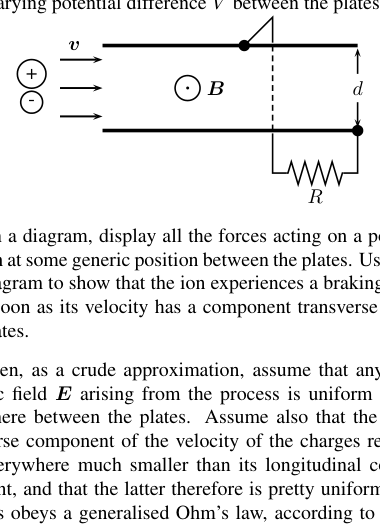 MHD generator schematic with plates, field B, resistor R
Topic: Electromagnetism, Circuits Metodi: Lorentz Force Analysis, Kirchhoff’s Laws, Ampère’s Law Competenze: Physical Reasoning, Mathematical Modeling Objects: Gas, Resistor Fonte: Testo (PDF) — p.5
Problema 1 Generatore magnetoidrodinamico
Un generatore magnetohidrodinamico (MHD) è un dispositivo che converte parte dell’energia cinetica di un gas caldo in corrente in energia elettrica. A una temperatura di funzionamento compresa tra i 2000 e i 3000 K, il gas si ionizza facilmente. Come illustrato schematicamente nella figura, gli ioni e gli elettroni entrano in una regione tra due elettrodi (qui, piastre conduttrici parallele di superficie separate da un gap ) in cui è stato creato un campo magnetico uniforme e costante , che punta direttamente fuori dalla pagina. La loro velocità iniziale è parallela alle lastre. Una resistenza è collegata alle piastre. Il campo magnetico è abbastanza forte da far colpire gli elettrodi e caricarli prima che possano uscire. Ciò crea una differenza di potenziale variabile nel tempo tra le piastre.
(a) Su un diagramma, mostrare tutte le forze che agiscono su un ione positivo in una posizione generica tra le placche. Utilizzare il diagramma per mostrare che l’ion prova una forza di frenata non appena la sua velocità ha un componente trasversale alle placche.
b) Quindi, come approssimazione grezza, supponiamo che qualsiasi campo elettrico derivante dal processo sia uniforme ovunque tra le piastre. Supponiamo anche che la componente trasversale della velocità delle cariche rimanga ovunque molto più piccola della sua componente longitudinale, e che quest’ultima sia quindi abbastanza uniforme. Il gas obbedisce alla legge di Ohm, secondo la quale , dove è la densità di corrente trasversale tra le piastre e è la conducibilità del gas.
Ottenere un’espressione della corrente che scorre attraverso la resistenza in termini di , e .
c) Derivare un’espressione per la tensione di uscita che non contiene esplicitamente .
Schematic generator MHD con piastre, campo B, resistenza R
Topic: Electromagnetism, Circuits Metodi: Lorentz Force Analysis, Kirchhoff’s Laws, Ampère’s Law Competenze: Physical Reasoning, Mathematical Modeling Objects: Gas, Resistor Fonte: Testo (PDF) — p.5
Problem 2 — Satellite Atmospheric Drag
A satellite is orbiting the Earth at an altitude of . It receives electrical power from a solar panel of area . At this altitude, Earth’s atmosphere is very tenuous, with a density . Nevertheless, over time, the friction force generated by collisions of the molecules and the panel might cause the satellite to lose altitude.
(a) Assume that in such collisions, the molecules become embedded in the solar panel. If the satellite is moving at speed , find an expression for the maximum retarding force on the solar panel in terms of and of the radius of the satellite’s orbit. Make any other reasonable assumption.
(b) Estimate how much altitude the satellite might lose over one week because of this friction. If you make assumptions, do not forget to justify them briefly.
(c) Somebody claims that as the satellite loses altitude it also loses speed because of the friction. Comment briefly.
Topic: Newtonian Mechanics, Gravitation Metodi: Newton’s Law of Gravitation, Conservation of Energy, Dimensional Analysis Competenze: Physical Reasoning, Estimation & Approximation Objects: Satellite, Planet Fonte: Testo (PDF) — p.5
**Problema 2 Trascinamento atmosferico satellitare **
Un satellite orbita la Terra ad un’altitudine di . Esso riceve energia elettrica da un pannello solare di superficie . A questa altitudine, l’atmosfera terrestre è molto tenua, con una densità . Tuttavia, nel tempo, la forza di attrito generata dalle collisioni delle molecole e del pannello potrebbe causare la perdita di altitudine del satellite.
(a) Supponiamo che in tali collisioni le molecole si inseriscano nel pannello solare. Se il satellite si muove a velocità , trovare un’espressione della forza massima di ritardo sul pannello solare in termini di e del raggio di orbita del satellite. Fai qualsiasi altra ipotesi ragionevole.
b) Estimare quanta altitudine il satellite potrebbe perdere in una settimana a causa di questo attrito. Se fate ipotesi, non dimenticate di giustificarle brevemente.
c) Qualcuno sostiene che, man mano che il satellite perde altitudine, perde anche velocità a causa del attrito. Commento brevemente.
Topic: Newtonian Mechanics, Gravitation Metodi: Newton’s Law of Gravitation, Conservation of Energy, Dimensional Analysis Competenze: Physical Reasoning, Estimation & Approximation Objects: Satellite, Planet Fonte: Testo (PDF) — p.5
Problem 3 — Sailboat Stability
In a mood for some physics as you look at a sailboat on a lake, you wonder about its stability when a strong wind blows from the side. The sailboat leans over in the wind and the question is whether its keel can prevent it from being blown over completely.
Analyze the stability of the sailboat using the following over-simplified model. Consider the hull of the sailboat as an airtight hollow cylinder. On top of this cylinder and perpendicular to it sits a mast carrying a square sail, assumed to be always parallel to the length of the hull. Attached to the bottom of the hull is a keel in the shape of a square always parallel to the sail. A heavy lead weight forms the bottom of the keel underwater. Other than the lead weight, consider mast, sail, hull, and keel to be weightless. Somewhat unrealistically (it would make tacking difficult), you can also assume that the sail extends all the way from the bottom to the top of the mast.
(a) Establish a relationship between wind speed and the angle the mast will tilt away from its initial upright position when a wind with speed blows perpendicular (initially) to the sail. Other assumptions may be made so long as they are explicitly stated and, as much as possible, justified.
In this simplified model, is this boat stable in all wind speeds? Since you may not be able to find a general solution for the angle as a function of , you are welcome to obtain solutions valid only for small or for large . The expansion for may be useful.
(b) The following data, loosely based on the Catalina Capri-16, are given for a small sailboat. Area of sail is , mass of lead weight , depth of keel below water level (technically known as draft) , height of mast , specific gravity of lead, supposed to be the part at the bottom of the keel that acts as a stabiliser, . Also, air density is .
With these data, at what wind speed will be ? ?
Topic: Fluid Mechanics, Rigid Body Statics, Rotational Dynamics Metodi: Torque & Angular Momentum Analysis, Bernoulli’s Equation, Hydrostatic Equilibrium Competenze: Physical Reasoning, Mathematical Modeling Objects: Cylinder Fonte: Testo (PDF) — p.5
Problema 3 Stabilità delle vele
Con un’atmosfera fisica, mentre guardi una barca a vela su un lago, ti chiedi se la sua stabilità è stabilizzata quando un forte vento soffia da un lato. La barca a vela si penza nel vento e la questione è se la sua quila possa impedire che venga completamente sopraffatta.
Analizzare la stabilità della vela utilizzando il seguente modello eccessivamente semplificato. Considera il casco della vela come un cilindro vuoto e aereo. Sopra questo cilindro e perpendicolare a esso si trova un mastro che porta una vela quadrata, che si presume sia sempre parallela alla lunghezza dello scafo. Al fondo del casco è attaccato una quila a forma di quadrato sempre parallela alla vela. Un pesante peso di piombo forma il fondo della quila sott’acqua. Oltre al peso del piombo, considerate che il masto, la vela, lo scafo e la quila siano senza peso. In modo un po’ irrealistico (farebbe difficile il taglio), si può anche presumere che la vela si estenda fino al fondo fino alla cima del masto.
a) stabilire un rapporto tra la velocità del vento e l’angolo in cui il masto si allontana dalla sua posizione verticale iniziale quando un vento con velocità soffia perpendicolare (in primo luogo) alla vela. Altri presupposti possono essere formulati purché siano esplicitamente indicati e, per quanto possibile, giustificati.
In questo modello semplificato, questa barca è stabile in tutte le velocità del vento? Poiché non è possibile trovare una soluzione generale per l’angolo come funzione di , è possibile ottenere soluzioni valide solo per piccoli o per grandi. L’espansione per può essere utile.
b) I seguenti dati, basati vagamente sulla Catalina Capri-16, sono forniti per una piccola vela. La superficie della vela è , la massa di peso di piombo , la profondità della quila sotto il livello dell’acqua (technicamente nota come tracciato) , l’altezza del masto , la gravità specifica del piombo, che dovrebbe essere la parte al fondo della quila che agisce come stabilizzatore, . Inoltre, la densità dell’aria è .
Con questi dati, a che velocità del vento sarà ? ?
Topic: Fluid Mechanics, Rigid Body Statics, Rotational Dynamics Metodi: Torque & Angular Momentum Analysis, Bernoulli’s Equation, Hydrostatic Equilibrium Competenze: Physical Reasoning, Mathematical Modeling Objects: Cylinder Fonte: Testo (PDF) — p.5