1. Drying (12 p)
According to the wide-spread belief, it is useful to keep window open when drying laundry even if the relative humidity outside is 100%, because the temperature of the incoming air rises and thereby the relative humidity drops. Let us analyse, do these arguments hold, when heating is switched off.
Suppose that inside a room, the volume of air from inside at the temperature is mixed with the volume of air from outside at the temperature . The specific heat of the air (by fixed pressure) can be assumed to be constant for the given temperature range; the heat exchange with the medium can be neglected. For the time being, you may neglect the possibility of (partial) condensation of the vapour.
-
Prove that the total volume of the air will not change i.e. that the volume of the mixed air .
-
What is the temperature of the mixed air ?
-
The graph below shows the dependence of the saturated vapour density for water as a function of temperature. Before mixing, both the interior and exterior air had relative humidity of . What is the relative humidity of the mixed air (if it happens to increase then assume that an oversaturated vapour with is formed)?
-
If you happened to obtain then the oversaturated vapour breaks down into a fog which contains tiny water droplets. In that case, what is the mass of the condensed water (i.e. the total mass of the water droplets)? Air density ; latent heat of vaporization for water .
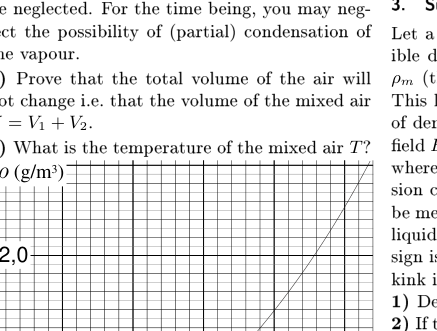 Saturated vapour density vs temperature
Topic: Thermodynamics, Fluid Mechanics Metodi: Ideal Gas Law, First Law of Thermodynamics, Physical Modeling Competenze: Physical Reasoning, Mathematical Modeling Objects: Gas, Droplet Fonte: Testo (PDF) — p.1
**1. Asciugatura (12 p) **
Secondo la diffusa convinzione, è utile tenere le finestre aperte quando si asciuga il bucato anche se l’umidità relativa esterna è del 100%, perché la temperatura dell’aria che entra aumenta e quindi l’umidità relativa scende. Analisiamo, se questi argomenti si riescono a mantenere, quando il riscaldamento è spento.
Supponiamo che all’interno di una stanza il volume di aria dall’interno alla temperatura sia mescolato al volume di aria dall’esterno alla temperatura . Il calore specifico dell’aria (a pressione fissa) può essere presunto costante per la data gamma di temperature; l’interscambio di calore con il mezzo può essere trascurato. Per il momento, si può trascurare la possibilità di (parziale) condensazione del vapore.
-
dimostrare che il volume totale dell’aria non cambia, cioè che il volume dell’aria miscelata .
-
Qual è la temperatura dell’aria miscelata ?
-
Il grafico seguente mostra la dipendenza della densità di vapori saturi per l’acqua in funzione della temperatura. Prima della miscelazione, sia l’aria interna che l’aria esterna avevano un’umidità relativa di . Qual è l’umidità relativa dell’aria miscelata (se si verifica un aumento, si presume che si formi un vapore sovrainsaturizzato con )?
-
Se si è verificato di ottenere , il vapore sovrasaturi si decompone in una nebbia contenente piccole goccioline d’ acqua. In tal caso, qual è la massa dell’acqua condensata (cioè la massa totale delle gocce d’acqua)? densità dell’aria ; calore latente di vaporizzazione per l’acqua .
Densità di vapori saturi rispetto alla temperatura
Topic: Thermodynamics, Fluid Mechanics Metodi: Ideal Gas Law, First Law of Thermodynamics, Physical Modeling Competenze: Physical Reasoning, Mathematical Modeling Objects: Gas, Droplet Fonte: Testo (PDF) — p.1
2. Photography (7 p)
By taking measurements from the photo at the end of the page, determine the diameter of the camera lens used for this photo. You can assume that images created by this camera lens are identical to ones created by ideal thin lens of matching focal length and diameter.
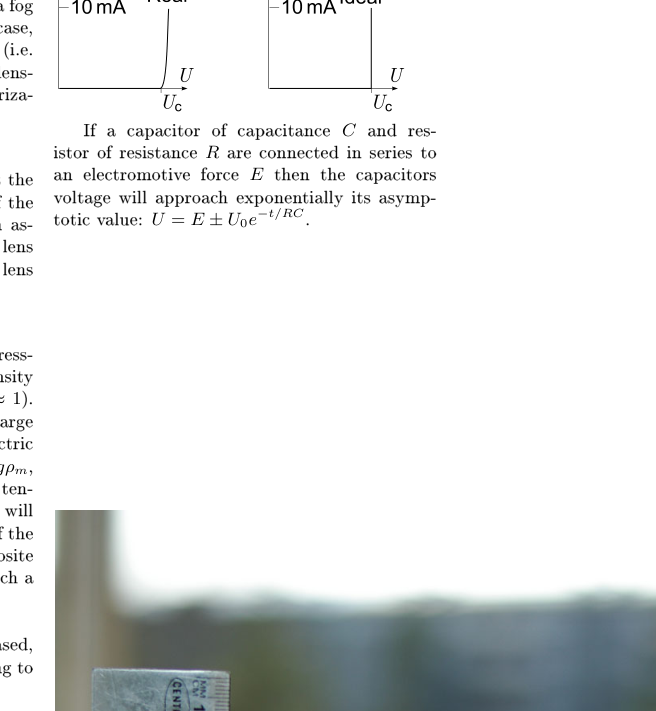 Photo of fence post used for measurement
Topic: Geometric Optics Metodi: Thin Lens & Mirror Equation, Physical Modeling, Experimental Data Analysis Competenze: Diagrammatic Reasoning, Estimation & Approximation Objects: Lens Fonte: Testo (PDF) — p.1
**2. Foto (7 pag.) **
Prendendo le misure dalla foto alla fine della pagina, determinare il diametro della lente della fotocamera utilizzata per questa foto. Si può supporre che le immagini create da questa lente della fotocamera siano identiche a quelle create da un ideale lente sottile di lunghezza focale e diametro corrispondenti.
Foto del palo di recinzione utilizzato per la misura
Topic: Geometric Optics Metodi: Thin Lens & Mirror Equation, Physical Modeling, Experimental Data Analysis Competenze: Diagrammatic Reasoning, Estimation & Approximation Objects: Lens Fonte: Testo (PDF) — p.1
3. Sucking (7 p)
Let a large vessel be filled with an incompressible dielectric liquid of density of mass density (the relative dielectric permeability ). This liquid carries homogeneous volume charge of density which is so small that the electric field created by it is negligible: , where is the free fall acceleration. Surface tension can also be neglected. All the heights will be measured from the unperturbed height of the liquid surface. A point charge of opposite sign is brought to the height , due to which a kink is formed on the liquid surface.
-
Determine the height of the kink .
-
If the height of the charge is slowly decreased, at which height will the liquid start flowing to the point charge?
Topic: Electrostatics, Fluid Mechanics Metodi: Coulomb’s Law, Hydrostatic Equilibrium, Physical Modeling Competenze: Physical Reasoning, Mathematical Modeling Objects: Point Charge Fonte: Testo (PDF) — p.1
**3. Assorbimento (7 p) **
Si riempie un vascello di grandi dimensioni di un liquido dielettrico incompressibile di densità di massa (permeabilità di massa di massa di massa di massa ). Questo liquido porta una carica voluminosa omogenea di densità che è così piccola che il campo elettrico creato da esso è trascurabile: , dove è l’accelerazione della caduta libera. Si può anche trascurare la tensione superficiale. Tutte le altezze saranno misurate dall’altezza non disturbata della superficie liquida. Una carica puntologica di segno opposto viene portata all’altezza , a causa della quale si forma un criccio sulla superficie liquida.
-
Determina l’altezza del colpo .
-
Se l’altezza della carica diminuisce lentamente, a quale altezza il liquido inizierà a scorrere verso la carica di punto?
Topic: Electrostatics, Fluid Mechanics Metodi: Coulomb’s Law, Hydrostatic Equilibrium, Physical Modeling Competenze: Physical Reasoning, Mathematical Modeling Objects: Point Charge Fonte: Testo (PDF) — p.1
4. Electric experiment (12 p)
Find the capacitance of an unknown capacitor and estimate the experimental uncertainty.
Equipment: red light emitting diode (LED), three resistors one of resistance , one of resistance , and one of unknown resistance; a battery of unknown electromotive force (internal resistance is smaller than ), wires, timer, unknown capacitor.
Remarks: below is provided a typical – curve of a LED; during this experiment, the – curve of the LED can be approximated with that of an ideal diode, cf. graph. The value of the opening voltage of the LED is not known. When there is a non-zero current through the LED, it emits light.
If a capacitor of capacitance and resistor of resistance are connected in series to an electromotive force , then the capacitor’s voltage will approach exponentially its asymptotic value:
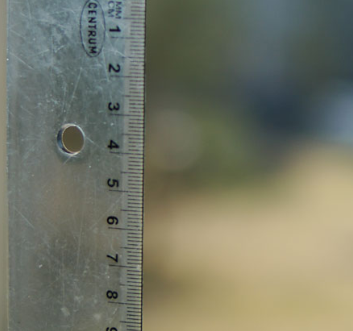 V-I curve of LED with opening voltage
Topic: Circuits Metodi: Kirchhoff’s Laws, Equivalent Circuit Reduction, Experimental Data Analysis Competenze: Experimental Data Analysis, Mathematical Modeling Objects: Capacitor, Resistor, Battery Fonte: Testo (PDF) — p.1
**4. Esperienza elettrica (12 p) **
Trova la capacità di un condensatore sconosciuto e stima l’incertezza sperimentale.
Attrezzature: diodo di emissione di luce rossa (LED), tre resistori, uno di resistenza , uno di resistenza e uno di resistenza sconosciuta; una batteria di forza elettromotrice sconosciuta (resistenza interna è inferiore a ), fili, timer, condensatore sconosciuto.
Nota: qui sotto è fornita una curva tipica V$$I di un LED; durante questo esperimento, la curva V$$I del LED può essere approssimata a quella di un diodo ideale, cf. - Il grafico. Il valore della tensione di apertura del LED non è noto. Quando c’è una corrente non zero attraverso il LED, emette luce.
Se un condensatore di capacità e resistente di resistenza sono collegati in serie a una forza elettromotrice , la tensione del condensatore si avvicinerà esponenzialmente al suo valore asimptotico:
Curva V-I di LED con tensione di apertura
Topic: Circuits Metodi: Kirchhoff’s Laws, Equivalent Circuit Reduction, Experimental Data Analysis Competenze: Experimental Data Analysis, Mathematical Modeling Objects: Capacitor, Resistor, Battery Fonte: Testo (PDF) — p.1
5. Empty bag (12 p)
A cylindrical bag is made from a freely deformable fabric, impermeable for air, which has surface mass density ; its perimeter is much less than its length . If this bag is filled with air, it resembles a sausage. The bag is laid on a horizontal smooth floor (coefficient of friction ). The excess pressure inside the bag is , the free fall acceleration . The density of air is negligible.
-
Find the width of the contact surface between the bag and the floor .
-
Prove that the tension in the bag’s fabric , where is the height of the given point above the floor, and find the coefficient . Remark: fabric’s tension is (loosely speaking) the force per unit length. Actually, fabric’s tension is not as simple concept as a rope’s tension, because different force directions are possible; here, however, we neglect the force component along the sausage’s axis. Thus, we can describe the fabric’s tension here with a single number, the force per unit length acting across a horizontal cut of the sausage.
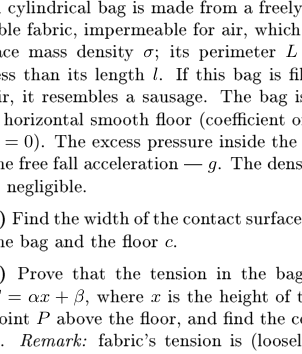
Hint: consider the force balance for a small piece of fabric (using the vertical cut shown in figure).
- Let the highest point of the bag be at height from the floor. What is the tension at this highest point? Express your answer in terms of , and (or , if you were unable to answer the previous question).
Hint: consider the force balance between two halves of the bag.
- Assuming that , determine the quantity , where is the width of the bag.
 Cross-section of cylindrical bag on floor
Topic: Elasticity & Materials, Fluid Mechanics, Newtonian Mechanics Metodi: Free-Body Diagram, Hydrostatic Equilibrium, Physical Modeling Competenze: Physical Reasoning, Diagrammatic Reasoning Objects: Gas Fonte: Testo (PDF) — p.2
**5. Borsa vuota (12 p) **
Un sacchetto cilindrico è realizzato in tessuto liberamente deformabile, impermeabile all’aria, con una densità di massa superficiale ; il suo perimetro è molto inferiore alla sua lunghezza . Se questa borsa è piena di aria, assomiglia a una salsiccia. Il sacchetto è posto su un pavimento liscio orizzontale (coefficiente di attrito ). La pressione in eccesso all’interno della borsa è , l’accelerazione della caduta libera . La densità dell’aria è trascurabile.
-
Trova la larghezza della superficie di contatto tra la borsa e il pavimento .
-
Prove che la tensione nel tessuto del sacchetto , dove è l’altezza del punto sopra il pavimento, e trova il coefficiente . Nota: la tensione del tessuto è (in parole libere) la forza per unità di lunghezza. In realtà, la tensione del tessuto non è un concetto semplice come la tensione di una corda, perché sono possibili diverse direzioni di forza; qui, tuttavia, trascuriamo la componente di forza lungo l’asse della salsiccia. Pertanto, possiamo descrivere la tensione del tessuto con un singolo numero, la forza per unità di lunghezza che agisce su un taglio orizzontale della salsiccia.
Suggerimento: considera il bilanciamento della forza per un piccolo pezzo di tessuto (con il taglio verticale mostrato nella figura).
- Il punto più alto del sacchetto deve essere all’altezza dal pavimento. Qual è la tensione a questo punto più alto? Esprimi la tua risposta in termini di , e (o , se non sei stato in grado di rispondere alla domanda precedente).
Suggerimento: considera l’equilibrio di forza tra le due metà del sacchetto.
- Supponendo che , determinare la quantità , dove è la larghezza del sacchetto.
Sezione trasversale di sacchetto cilindrico sul pavimento
Topic: Elasticity & Materials, Fluid Mechanics, Newtonian Mechanics Metodi: Free-Body Diagram, Hydrostatic Equilibrium, Physical Modeling Competenze: Physical Reasoning, Diagrammatic Reasoning Objects: Gas Fonte: Testo (PDF) — p.2
6. Car (7 p)
A car attempts driving over a road barrier, starting from rest, as shown in figure. The diameter of its wheel , coefficient of friction between the wheels and ground . The sketch is drawn using correct proportions, point marks the position of the car’s centre of mass.
Determine the maximal height of those road barriers which can be driven over with such a car, assuming that there is no drag in the non-driving axis (i.e. wheels rotate without friction), and the driving wheels are
-
front wheels;
-
rear axis.
-
Suppose that the car has four-wheel-drive, and the road barrier is substituted with a wall. Would it be possible to rise the front of the car by driving slowly against the wall?
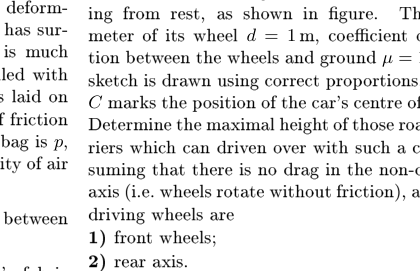 Car approaching road barrier, centre of mass C
Topic: Newtonian Mechanics, Rigid Body Statics Metodi: Free-Body Diagram, Torque & Angular Momentum Analysis, Physical Modeling Competenze: Physical Reasoning, Diagrammatic Reasoning Objects: Wheel Fonte: Testo (PDF) — p.2
**6. Auto (7 p) **
Una macchina tenta di superare una barriera stradale, partendo dal riposo, come mostrato nella figura. Il diametro della ruota , il coefficiente di attrito tra le ruote e il terreno . Lo schema è disegnato con corrette proporzioni, il punto segna la posizione del centro di massa dell’auto.
Determinare l’altezza massima delle barriere stradali che possono essere superate con una vettura del genere, purché non vi sia resistenza nell’asse non guidato (cioè le ruote ruotano senza attrito), e le ruote di guida sono
-
ruote anteriori;
-
asse posteriore.
-
Supponiamo che l’auto abbia quattro ruote motrici e che la barriera stradale sia sostituita da un muro. È possibile sollevare la parte anteriore della macchina guidando lentamente contro il muro?
Barriera stradale di auto che si avvicina, centro di massa C
Topic: Newtonian Mechanics, Rigid Body Statics Metodi: Free-Body Diagram, Torque & Angular Momentum Analysis, Physical Modeling Competenze: Physical Reasoning, Diagrammatic Reasoning Objects: Wheel Fonte: Testo (PDF) — p.2
7. Mass-spectrometer (9 p)
In the figure below, a simplified scheme of a mass-spectrometer is given. It is a device for measuring the masses of molecules. The substance under investigation is ionised by heating up to a temperature on a hot filament (molecules undergo a single-electron ionisation). The ions are accelerated using voltage . At first, let us neglect the thermal energy of the ions (, where is elementary charge and the Boltzmann’s constant). A narrow beam of accelerated ions enters a region with magnetic field. For the sake of simplicity, let us assume that the region has a rectangular shape, and the magnetic field is homogeneous inside it. The magnetic field deflects the ions and depending on their mass, they may hit the detector. Let us assume that those ions which hit the centre of the detector enter and exit the region with magnetic field perpendicularly with its boundary, and the distance between the entry and exit points is (see figure).
-
Express the mass of those ions which hit the centre of the detector via the quantities , , and .
-
The entrance to the detector is a circle with radius (). Because of the finite size of the detector entrance, ions within a mass range from to will enter the detector; find the range width .
-
Under the assumptions of the previous question, what is the width of the range of the exit angles of those ions which can still hit the detector?
-
Now let us assume that is negligibly small, but we cannot neglect the thermal effects (still ). Due to difference in energies, the detector can be hit by ions of different masses, within the range from to . What is the resolving power of the mass-spectrometer?
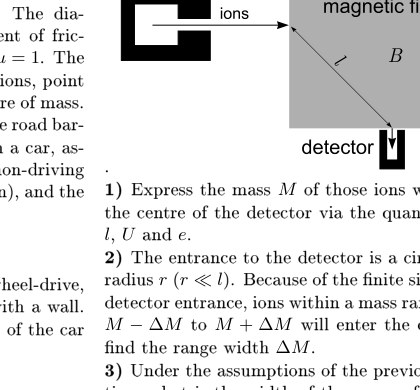 Mass-spectrometer schematic with magnetic field region
Topic: Magnetism, Modern-Quantum Physics Metodi: Lorentz Force Analysis, Kinematic Equations, Physical Modeling Competenze: Mathematical Modeling, Physical Reasoning Objects: Particle Beam Fonte: Testo (PDF) — p.2
**7. Spettometro di massa (9 p) **
Nella figura seguente è riportato un schema semplificato di uno spettrometro di massa. È un dispositivo per misurare le masse delle molecole. La sostanza oggetto dell’inchiesta è ionizzata riscaldando fino a una temperatura su un filamento caldo (le molecole subiscono un’ionizzazione a singolo elettrone). Gli ioni sono accelerati utilizzando una tensione . In primo luogo, trascureremo l’energia termica degli ioni (, dove è la carica elementare e la costante di Boltzmann). Un raggio stretto di ioni accelerati entra in una regione con campo magnetico. Per semplificazione, supponiamo che la regione abbia una forma rettangolare e che il campo magnetico sia omogeneo all’interno. Il campo magnetico devia gli ioni e a seconda della loro massa, possono colpire il rilevatore. Supponiamo che gli ioni che colpiscono il centro del rilevatore entrino e uscino dalla regione con campo magnetico perpendicolare al suo confine, e che la distanza tra i punti di ingresso e di uscita sia (vedi figura).
-
Esprimere la massa di quegli ioni che hanno colpito il centro del rilevatore attraverso i quantitativi , , e .
-
L’ingresso al rilevatore è un cerchio con raggio (). A causa della dimensione finita dell’entrata del rilevatore, gli ioni all’interno di un intervallo di massa da a entreranno nel rilevatore; trovare la larghezza del intervallo .
-
Sulla base delle ipotesi della domanda precedente, qual è la larghezza del raggio degli angoli di uscita di quegli ioni che possono ancora colpire il rilevatore?
-
Supponiamo che sia insignificante, ma non possiamo trascurare gli effetti termici (anche ). A causa delle differenze di energia, il rilevatore può essere colpito da ioni di diverse masse, nell’intervallo da a . Qual è la potenza di risoluzione dello spettrometro di massa?
Schemi di spettrometro di massa con regione di campo magnetico
Topic: Magnetism, Modern-Quantum Physics Metodi: Lorentz Force Analysis, Kinematic Equations, Physical Modeling Competenze: Mathematical Modeling, Physical Reasoning Objects: Particle Beam Fonte: Testo (PDF) — p.2
8. Optics experiment (10 p)
Equipment: a cylindrical bottle filled with water and having a millimetre scale across half of its perimeter (seen when looking through the bottle); measuring tape.
-
Determine how long arc of the bottle’s measuring scale could be seen simultaneously if looking at it through the bottle from a very distant point (much larger than the bottle’s diameter), assuming that the observation point lies at the height of the millimetre scale.
-
Using the results of the previous experiment determine the angular radius of a rainbow (the angle between a ray coming to the observer’s eye from a rainbow, and the axis of the cone formed by other such rays).
Remark: Rainbow is formed due to those rays which enter a spherical water droplet, reflect once from its surface internally, and exit the droplet after second refraction. Note that the internal reflection is only partial, and not total, see figure. The exit angle has a maximum as a function of the impact parameter ; the angular radius of the rainbow equals to the maximal exit angle. Indeed, if light of intensity falls onto the droplet with all possible impact parameters , the light energy per impact parameter range is ; hence, the energy per exit angle interval is , which diverges near the maximum of the function .
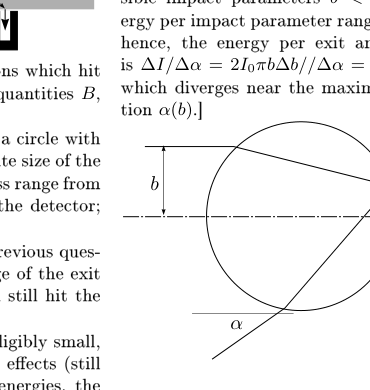 Water droplet with impact parameter b and exit angle α
Topic: Geometric Optics, Wave Optics Metodi: Snell’s Law, Ray Tracing, Physical Modeling Competenze: Experimental Data Analysis, Physical Reasoning Objects: Droplet Fonte: Testo (PDF) — p.2
**8. Esperienza con l’ottica (10 p) **
Attrezzatura: una bottiglia cilindrica riempita di acqua e con una scala di millimetri su metà del suo perimetro (visto quando si guarda attraverso la bottiglia); nastro di misura.
-
Determinare quanto arco lungo della scala di misura della bottiglia possa essere visto contemporaneamente se la si guarda attraverso la bottiglia da un punto molto lontano (molto più grande del diametro della bottiglia), supponendo che il punto di osservazione sia all’altezza della scala millimetrica.
-
Con i risultati dell’esperimento precedente si determina il raggio angolare di un arcobaleno (l’angolo tra un raggio che arriva all’occhio dell’osservatore da un arcobaleno e l’asse del cono formato da altri tali raggi).
Nota: l’arcobaleno si forma a causa di quei raggi che entrano in una goccia d’acqua sferica, si riflettono una volta dalla sua superficie interna e usciranno dalla goccia dopo la seconda rifrazione. Si noti che il riflesso interno è solo parziale, non totale, vedi figura. L’angolo di uscita ha un massimo in funzione del parametro di impatto ; il raggio angolare dell’arcobaleno è uguale all’angolo di uscita massimo. Infatti, se la luce di intensità cade sulla goccia con tutti i possibili parametri di impatto , l’energia luminosa per intervallo di parametri di impatto è ; quindi, l’energia per intervallo di angolo di uscita è , che diverge vicino al massimo della funzione .
Gattola d’acqua con parametro di impatto b e angolo di uscita α
Topic: Geometric Optics, Wave Optics Metodi: Snell’s Law, Ray Tracing, Physical Modeling Competenze: Experimental Data Analysis, Physical Reasoning Objects: Droplet Fonte: Testo (PDF) — p.2