A uniform meter stick is supported on a fulcrum at the 25-cm mark. A 0.50-kg object is hung from the 0-cm end of the meter stick, and the stick is balanced horizontally. The mass of the meter stick is:
- A. 0.25 kg;
- B. 0.50 kg;
- C. 0.75 kg;
- D. 1.00 kg.
Topic: Rigid Body Statics Metodi: Torque & Angular Momentum Analysis, Free-Body Diagram Competenze: Physical Reasoning, Mathematical Modeling Objects: Lever, Block Fonte: Testo (PDF) — p.2
Un palo di misura uniforme è sostenuto su un fulcro al marchio di 25 cm. Un oggetto di 0,50 kg è appeso all’estremità di 0 cm del bastone di misura e il bastone è equilibrato orizzontalmente. La massa del bastone è:
- A. 0.25 kg;
- B. 0.50 kg;
- C. 0.75 kg;
- D. 1.00 kg.
Topic: Rigid Body Statics Metodi: Torque & Angular Momentum Analysis, Free-Body Diagram Competenze: Physical Reasoning, Mathematical Modeling Objects: Lever, Block Fonte: Testo (PDF) — p.2
The radius of the Earth is m. Approximately how fast is a person on the Equator moving due to the Earth’s rotation?
- A. 5 m/s
- B. 50 m/s
- C. 500 m/s
- D. 5000 m/s
Topic: Newtonian Mechanics Metodi: Kinematic Equations, Order-of-Magnitude Estimation Competenze: Estimation & Approximation, Unit Conversion Objects: Planet Fonte: Testo (PDF) — p.2
Il raggio di radius della Terra è m. Quante velocità ha una persona sull’equatore a causa della rotazione terrestre?
- A. 5 m/s
- B. 50 m/s
- C. 500 m/s
- D. 5000 m/s
Topic: Newtonian Mechanics Metodi: Kinematic Equations, Order-of-Magnitude Estimation Competenze: Estimation & Approximation, Unit Conversion Objects: Planet Fonte: Testo (PDF) — p.2
In a certain region of space, the electric field is zero. From this we can conclude that the electric potential in this region is:
- A. constant;
- B. zero;
- C. positive;
- D. negative.
Topic: Electrostatics Metodi: Electric Potential Method, Symmetry Argument Competenze: Physical Reasoning, Mathematical Modeling Objects: — Fonte: Testo (PDF) — p.2
In una certa regione dello spazio, il campo elettrico è zero. Da questo possiamo concludere che il potenziale elettrico in questa regione è:
- costante A.;
- B. zero;
- C. positivo;
- D. negativo.
Topic: Electrostatics Metodi: Electric Potential Method, Symmetry Argument Competenze: Physical Reasoning, Mathematical Modeling Objects: — Fonte: Testo (PDF) — p.2
A bullet of mass and speed hits a pendulum bob of mass at time , and passes completely through the bob. The bullet emerges at time with a speed of . The pendulum bob is suspended by a stiff rod of length and negligible mass. After the collision, the bob can barely swing through a complete vertical circle. At time , the bob reaches the highest position.
What quantities are conserved in this process?
- A. Total kinetic energy of the bob and the bullet during the time interval .
- B. Total momentum of the bob and the bullet during the time interval .
- C. Total mechanical energy of the bob and the bullet during the time interval .
- D. Momentum of the bob after .
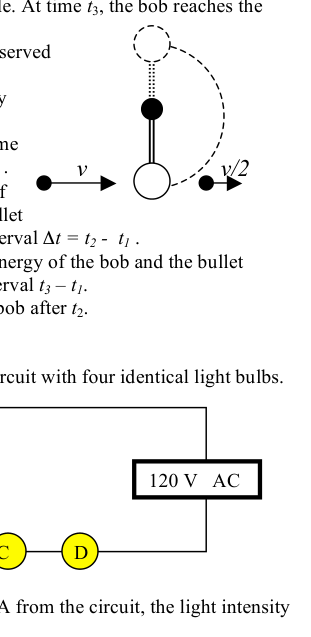 Bullet passing through pendulum bob
Topic: Conservation of Momentum, Conservation of Energy, Newtonian Mechanics Metodi: Conservation of Momentum, Conservation of Energy, Free-Body Diagram Competenze: Physical Reasoning, Diagrammatic Reasoning Objects: Pendulum, Projectile, Rod Fonte: Testo (PDF) — p.2
Un proiettile di massa e velocità colpisce un bobino pendolo di massa al tempo , e passa completamente attraverso il bobino. Il proiettile emerge al tempo con una velocità . Il bobino del pendolo è sospeso da una barra rigida di lunghezza e di massa trascurabile. Dopo la collisione, la bobina può a malapena svingere attraverso un cerchio verticale completo. Al tempo , il bob raggiunge la posizione più alta.
Quali quantità vengono conservate in questo processo?
- A. Energia cinetica totale della bobina e del proiettile durante l’intervallo temporale .
- B. Momentum totale della bobina e del proiettile durante l’intervallo temporale .
- C. Energia meccanica totale della bobina e del proiettile durante l’intervallo temporale .
- D. Momentum del bob dopo .
*Gli oggetti di proiettile che passano attraverso il pendolo *
Topic: Conservation of Momentum, Conservation of Energy, Newtonian Mechanics Metodi: Conservation of Momentum, Conservation of Energy, Free-Body Diagram Competenze: Physical Reasoning, Diagrammatic Reasoning Objects: Pendulum, Projectile, Rod Fonte: Testo (PDF) — p.2
The diagram shows a circuit with four identical light bulbs arranged as shown, connected to 120 V AC. When we remove bulb A from the circuit, the light intensity of bulb C:
- A. remains the same;
- B. increases;
- C. decreases;
- D. becomes zero.
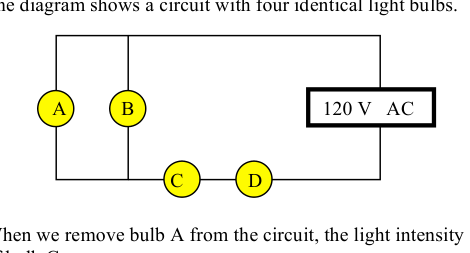 Four identical bulbs A B C D circuit
Topic: Circuits Metodi: Kirchhoff’s Laws, Equivalent Circuit Reduction Competenze: Physical Reasoning, Diagrammatic Reasoning Objects: Resistor Fonte: Testo (PDF) — p.2
Il diagramma mostra un circuito con quattro lampadine identiche disposte come mostrato, collegate a 120 V AC. Quando rimuoviamo l’ampolla A dal circuito, l’intensità luminosa dell’ampolla C:
- A. rimane lo stesso;
- B. aumenta;
- C. diminuisce;
- D. diventa zero.
Quattro lampadine identiche A B C D circuito
Topic: Circuits Metodi: Kirchhoff’s Laws, Equivalent Circuit Reduction Competenze: Physical Reasoning, Diagrammatic Reasoning Objects: Resistor Fonte: Testo (PDF) — p.2
The amplitude of an electromagnetic wave in vacuum is doubled with no other changes made to the wave. As a result of this doubling of the amplitude, which of the following statements is correct?
- A. The speed of propagation of the wave changes.
- B. The frequency of the wave changes.
- C. All of the above are true.
- D. None of the above is true.
Topic: Electromagnetism, Oscillations & Waves Metodi: Wave Equation, Physical Modeling Competenze: Physical Reasoning, Mathematical Modeling Objects: — Fonte: Testo (PDF) — p.2
L’ampiezza di un’onda elettromagnetica nel vuoto è raddoppiata senza che siano apportate altre modifiche all’onda. Come risultato di questo raddoppio dell’ampiezza, quale delle seguenti affermazioni è corretta?
- A. La velocità di propagazione dell’onda cambia.
- B. La frequenza delle onde cambia.
- C. Tutti i dati sopra indicati sono veri.
- D. Nessuna delle indicazioni sopra esposte è vera.
Topic: Electromagnetism, Oscillations & Waves Metodi: Wave Equation, Physical Modeling Competenze: Physical Reasoning, Mathematical Modeling Objects: — Fonte: Testo (PDF) — p.2
Two objects are initially at rest on a frictionless surface. Object 1 has a greater mass than object 2. The same constant force starts to act on each object. The force is removed from each object after it accelerates over a distance . After the force is removed from both objects, which statement is correct (: momentum; : kinetic energy)?
- A. ;
- B. ;
- C. ;
- D. .
Topic: Newtonian Mechanics, Conservation of Momentum Metodi: Kinematic Equations, Conservation of Energy, Impulse-Momentum Theorem Competenze: Physical Reasoning, Mathematical Modeling Objects: Block Fonte: Testo (PDF) — p.2
Due oggetti sono inizialmente a riposo su una superficie senza attrito. L’oggetto 1 ha una massa maggiore dell’oggetto 2. La stessa forza costante inizia ad agire su ogni oggetto. La forza viene rimossa da ogni oggetto dopo aver accelerato per una distanza . Dopo che la forza è rimossa da entrambi gli oggetti, quale dichiarazione è corretta (: momentum; : energia cinetica)?
- A. ;
- B. ;
- C. ;
- D. .
Topic: Newtonian Mechanics, Conservation of Momentum Metodi: Kinematic Equations, Conservation of Energy, Impulse-Momentum Theorem Competenze: Physical Reasoning, Mathematical Modeling Objects: Block Fonte: Testo (PDF) — p.2
A dart is loaded into a spring-loaded toy dart gun by pushing the spring in by a distance . For the next loading, the spring is compressed a distance . How much faster does the second dart leave the gun compared to the first?
- A. four times as fast;
- B. two times as fast;
- C. the same;
- D. half as fast;
- E. one-fourth as fast.
Topic: Conservation of Energy, Oscillations & Waves Metodi: Hooke’s Law, Energy Conservation Method Competenze: Physical Reasoning, Mathematical Modeling Objects: Spring, Projectile Fonte: Testo (PDF) — p.3
Un’artiglietta viene caricata in un fucile da gioco caricato con spring spingendo l’artiglietta a una distanza . Per il prossimo carico, la molla viene compressa a una distanza . Quanto più velocemente la seconda freccia lascia la pistola rispetto alla prima?
- A. quattro volte più veloce;
- B. due volte più veloce;
- C. lo stesso;
- D. metà più veloce;
- E. un quarto più veloce.
Topic: Conservation of Energy, Oscillations & Waves Metodi: Hooke’s Law, Energy Conservation Method Competenze: Physical Reasoning, Mathematical Modeling Objects: Spring, Projectile Fonte: Testo (PDF) — p.3
One of two parallel metallic plates is uniformly charged with charge , and the other one is charged with charge . In this case, the electric field between them is . When the negatively charged plate is discharged then recharged with a positive charge , the electric field between the plates becomes:
- A. 0;
- B. ;
- C. ;
- D. ;
- E. .
Topic: Electrostatics Metodi: Gauss’s Law, Superposition Principle Competenze: Physical Reasoning, Mathematical Modeling Objects: Capacitor Fonte: Testo (PDF) — p.3
Una delle due piastre metalliche parallele è uniformemente carica con carica e l’altra è carica con carica . In questo caso, il campo elettrico tra loro è . Quando la piastra carica negativamente viene scaricata e ricaricata con una carica positiva , il campo elettrico tra le piastre diventa:
- A. 0;
- B. ;
- C. ;
- D. ;
- E. .
Topic: Electrostatics Metodi: Gauss’s Law, Superposition Principle Competenze: Physical Reasoning, Mathematical Modeling Objects: Capacitor Fonte: Testo (PDF) — p.3
A uniform magnetic field is directed out of the page. A metallic wire has the shape of a square frame and is placed in the field as shown. While the shape of the wire is steadily transformed into a circle in the same plane, the current in the frame:
- A. is directed clockwise;
- B. does not appear;
- C. is directed counterclockwise.
Topic: Electromagnetic Induction Metodi: Faraday’s Law of Induction, Lenz’s Law Competenze: Physical Reasoning, Diagrammatic Reasoning Objects: Wire Fonte: Testo (PDF) — p.3
Un campo magnetico uniforme viene diretto fuori dalla pagina. Un filo metallico ha la forma di un quadrato e viene posizionato nel campo come mostrato. Mentre la forma del filo si trasforma costantemente in un cerchio nello stesso piano, la corrente nel telaio:
- A. è orientato in senso orario;
- B. non appare;
- C. è orientato in senso contrario all’orologio.
Topic: Electromagnetic Induction Metodi: Faraday’s Law of Induction, Lenz’s Law Competenze: Physical Reasoning, Diagrammatic Reasoning Objects: Wire Fonte: Testo (PDF) — p.3
The drawing shows velocity () versus time () graphs for two cyclists moving along the same straight segment of a highway from the same point. The second cyclist starts moving at min.
At what time do the two cyclists meet?
- A. 4.0 min;
- B. 6.0 min;
- C. 12 min.
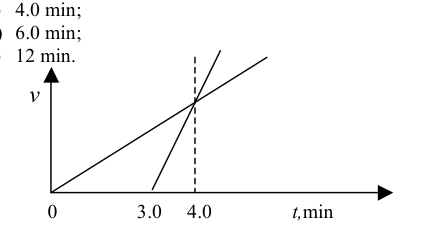 Velocity vs time graph two cyclists
Topic: Newtonian Mechanics Metodi: Kinematic Equations, Graph Linearization Competenze: Diagrammatic Reasoning, Physical Reasoning Objects: — Fonte: Testo (PDF) — p.3
Il disegno mostra i grafici della velocità () contro il tempo () per due ciclisti che si muovono lungo lo stesso segmento retto di una strada da uno stesso punto. Il secondo ciclista inizia a muoversi a min.
A che ora si incontrano i due ciclisti?
- A. 4,0 min;
- B. 6,0 min;
- C. 12 min.
Velocità vs grafico temporale due ciclisti
Topic: Newtonian Mechanics Metodi: Kinematic Equations, Graph Linearization Competenze: Diagrammatic Reasoning, Physical Reasoning Objects: — Fonte: Testo (PDF) — p.3
Two solid spheres manufactured of the same material freely fall down in the air. One sphere has a diameter twice as large as the other. The force due to air resistance is proportional to the cross-sectional area of a moving object and is a quadratic function of the speed of an object. Some time after the beginning of motion in the presence of air resistance, the velocity of each sphere becomes constant. It is called the terminal velocity. The ratio of terminal velocities of the spheres is:
- A. 2;
- B. ;
- C. ;
- D. .
Topic: Fluid Mechanics, Newtonian Mechanics Metodi: Free-Body Diagram, Dimensional Analysis Competenze: Physical Reasoning, Mathematical Modeling Objects: Sphere Fonte: Testo (PDF) — p.3
Due sfere solide realizzate dallo stesso materiale cadono liberamente nell’aria. Una sfera ha il doppio di diametro dell’altra. La forza dovuta alla resistenza all’aria è proporzionale all’area trasversale di un oggetto in movimento ed è una funzione quadrata della velocità di un oggetto. Qualche tempo dopo l’inizio del movimento in presenza di resistenza dell’aria, la velocità di ogni sfera diventa costante. Si chiama velocità terminale. Il rapporto delle velocità terminali delle sfere è:
- A. 2;
- B. ;
- C. ;
- D. .
Topic: Fluid Mechanics, Newtonian Mechanics Metodi: Free-Body Diagram, Dimensional Analysis Competenze: Physical Reasoning, Mathematical Modeling Objects: Sphere Fonte: Testo (PDF) — p.3
Astronauts are weightless in orbit because:
- A. they are beyond the pull of gravity;
- B. they travel in the accelerated frame of reference where fictitious centrifugal force is equal to centripetal force, and the net force on an astronaut is zero;
- C. they are in free fall together with their spacecraft;
- D. of another cause.
Topic: Gravitation, Newtonian Mechanics Metodi: Newton’s Law of Gravitation, Physical Modeling Competenze: Physical Reasoning, Estimation & Approximation Objects: Satellite Fonte: Testo (PDF) — p.3
Gli astronauti sono senza peso in orbita perché:
- A. sono al di là della forza di forza di gravità;
- B. viaggiano nel quadro di riferimento accelerato in cui la forza centrifugata fittizia è uguale alla forza centripetale e la forza netta su un astronauta è zero;
- C. sono in caduta libera insieme alle loro navi spaziali;
- D. di un’altra causa.
Topic: Gravitation, Newtonian Mechanics Metodi: Newton’s Law of Gravitation, Physical Modeling Competenze: Physical Reasoning, Estimation & Approximation Objects: Satellite Fonte: Testo (PDF) — p.3
Two solid objects of the same mass are supplied with heat at the same rate . The temperature of the first object with latent heat and specific heat capacity changes according to graph 1 on the diagram. The temperature of the second object with latent heat and specific heat capacity changes according to graph 2 on the diagram.
Based on what is shown on the graph, the latent heats and , and the specific heat capacities and in solid state obey which of the following relationships:
- A. ; ;
- B. ; ;
- C. There is not enough information to determine these relations;
- D. ; ;
- E. ; .
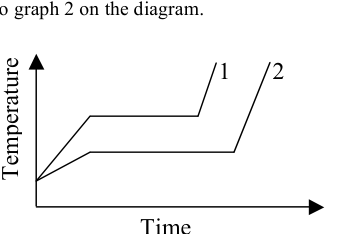 Temperature vs time graphs two objects
Topic: Thermodynamics Metodi: First Law of Thermodynamics, Graph Linearization Competenze: Diagrammatic Reasoning, Physical Reasoning Objects: — Fonte: Testo (PDF) — p.3
Due oggetti solidi della stessa massa sono alimentati dal calore allo stesso ritmo . La temperatura del primo oggetto con calore latente e capacità termico specifica cambia secondo il grafico 1 del diagramma. La temperatura del secondo oggetto con calore latente e capacità termico specifica cambia secondo il grafico 2 del diagramma.
In base a quanto riportato sul grafico, i calori latenti e e le capacità termiche specifiche e in stato solido seguono quale delle seguenti relazioni:
- A. ; ;
- B. ; ;
- C. Non ci sono informazioni sufficienti per determinare tali relazioni;
- D. ; ;
- E. ; .
Temperatura vs grafici temporali di due oggetti
Topic: Thermodynamics Metodi: First Law of Thermodynamics, Graph Linearization Competenze: Diagrammatic Reasoning, Physical Reasoning Objects: — Fonte: Testo (PDF) — p.3
A light ray strikes a prism as shown in the drawing. The angles of the prism are , , and . The critical angle of the prism material is . What rays are the possible continuations of the incident ray?
- A. The ray 1 only.
- B. The ray 2 only.
- C. The ray 3 only.
- D. Both rays 1 and 3.
- E. Both rays 2 and 3.
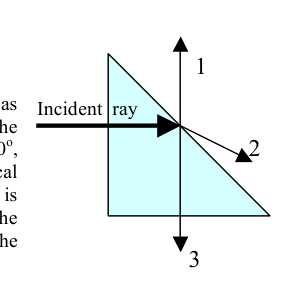 45-45-90 prism with incident ray
Topic: Geometric Optics Metodi: Snell’s Law, Ray Tracing Competenze: Diagrammatic Reasoning, Physical Reasoning Objects: Prism Fonte: Testo (PDF) — p.3
Un raggio di luce colpisce un prisma come mostrato nel disegno. Gli angoli del prisma sono , e . L’angolo critico del materiale del prisma è . Quali sono i possibili continuamenti del raggio incidente?
- A. Solo il raggio 1.
- B. Solo il raggio 2.
- C. Solo il raggio 3.
- D. Entrambi i raggi 1 e 3.
- E. Entrambi i raggi 2 e 3.
45-45-90 prisma con raggi incidenti
Topic: Geometric Optics Metodi: Snell’s Law, Ray Tracing Competenze: Diagrammatic Reasoning, Physical Reasoning Objects: Prism Fonte: Testo (PDF) — p.3
You stand on a platform at a train station and listen to a train horn as the train approaches the station at a constant velocity. While the train approaches, but before it arrives, you hear:
- A. the intensity and the frequency of the sound both increasing;
- B. the intensity and the frequency of the sound both decreasing;
- C. the intensity increasing and the frequency decreasing;
- D. the intensity decreasing and the frequency increasing;
- E. the intensity increasing and the frequency remaining the same.
Topic: Oscillations & Waves Metodi: Wave Equation, Physical Modeling Competenze: Physical Reasoning, Estimation & Approximation Objects: — Fonte: Testo (PDF) — p.4
Ti trovi su una piattaforma di una stazione ferroviaria e ascolti un corno di treno mentre il treno si avvicina alla stazione a velocità costante. Mentre il treno si avvicina, ma prima di arrivare, si sente:
- A. l’intensità e la frequenza del suono aumentano entrambe;
- B. l’intensità e la frequenza del suono diminuiscono entrambe;
- C. l’aumento dell’intensità e la diminuzione della frequenza;
- D. l’intensità diminuente e la frequenza in aumento;
- E. l’intensità aumenta e la frequenza rimane la stessa.
Topic: Oscillations & Waves Metodi: Wave Equation, Physical Modeling Competenze: Physical Reasoning, Estimation & Approximation Objects: — Fonte: Testo (PDF) — p.4
A linear conductor with current is placed along the axis of a circular conductor, which carries current . The magnetic force acting on each of the conductors is:
- A. zero;
- B. directly proportional to the product of currents and , and inversely proportional to the radius of the circular conductor;
- C. directly proportional to the product of currents and , inversely proportional to the square of the radius of the circular conductor;
- D. directly proportional to the product of current , current , and the area of a circular conductor.
 Linear conductor along axis of circular loop
Topic: Magnetism, Electromagnetism Metodi: Ampère’s Law, Biot-Savart Law, Symmetry Argument Competenze: Physical Reasoning, Diagrammatic Reasoning Objects: Wire, Coil Fonte: Testo (PDF) — p.4
Un conduttore lineare con corrente è posizionato lungo l’asse di un conduttore circolare che trasporta corrente . La forza magnetica che agisce su ciascuno dei conduttori è:
- A. zero;
- B. direttamente proporzionale al prodotto delle correnti e , e inversamente proporzionale al raggio del conduttore circolare;
- C. direttamente proporzionale al prodotto delle correnti e , inversamente proporzionale al quadrato del raggio del conduttore circolare;
- D. direttamente proporzionale al prodotto della corrente , della corrente e dell’area di un conduttore circolare.
Conduttore lineare lungo l’asse di un ciclo circolare
Topic: Magnetism, Electromagnetism Metodi: Ampère’s Law, Biot-Savart Law, Symmetry Argument Competenze: Physical Reasoning, Diagrammatic Reasoning Objects: Wire, Coil Fonte: Testo (PDF) — p.4
An aquarium is filled with water. The lateral wall of the aquarium is 40 cm long and 30 cm high. Using for the acceleration due to gravity, and for the density of water, the force on the lateral wall of the aquarium is:
- A. 36 N;
- B. 90 N;
- C. 180 N;
- D. 1500 N.
Topic: Fluid Mechanics Metodi: Hydrostatic Equilibrium, Calculus-Integration Competenze: Mathematical Modeling, Physical Reasoning Objects: Container Fonte: Testo (PDF) — p.4
Un acquario è pieno di acqua. La parete laterale dell’acquario è lunga 40 cm e alta 30 cm. Se si utilizza per l’accelerazione dovuta alla gravità e per la densità dell’acqua, la forza sulla parete laterale dell’acquario è:
- A. 36 N;
- B. 90 N;
- C. 180 N;
- D. 1500 N.
Topic: Fluid Mechanics Metodi: Hydrostatic Equilibrium, Calculus-Integration Competenze: Mathematical Modeling, Physical Reasoning Objects: Container Fonte: Testo (PDF) — p.4
A satellite is moved from one circular orbit around the earth, to another of lesser radius. Which of the following is true?
- A. The kinetic energy increases and the potential energy increases;
- B. The kinetic energy increases, and the potential energy decreases;
- C. The kinetic energy decreases and the potential energy decreases;
- D. The kinetic energy decreases and the potential energy increases.
Topic: Gravitation, Conservation of Energy Metodi: Newton’s Law of Gravitation, Energy Conservation Method Competenze: Physical Reasoning, Mathematical Modeling Objects: Satellite, Planet Fonte: Testo (PDF) — p.4
Un satellite si sposta da un’orbita circolare intorno alla Terra ad un’altra di raggio inferiore. Quale di queste parole è vero?
- A. L’energia cinetica aumenta e l’energia potenziale aumenta;
- B. L’energia cinetica aumenta e l’energia potenziale diminuisce;
- C. L’energia cinetica diminuisce e l’energia potenziale diminuisce;
- D. L’energia cinetica diminuisce e l’energia potenziale aumenta.
Topic: Gravitation, Conservation of Energy Metodi: Newton’s Law of Gravitation, Energy Conservation Method Competenze: Physical Reasoning, Mathematical Modeling Objects: Satellite, Planet Fonte: Testo (PDF) — p.4
A point particle carries a positive charge and is maintained at a distance above a large conductive uncharged plate. The electric force of interaction between the charge and the plate is best described as:
- A. zero force;
- B. an attractive force proportional to ;
- C. an attractive force proportional to ;
- D. an attractive force proportional to ;
- E. a repulsive force proportional to .
Topic: Electrostatics Metodi: Coulomb’s Law, Symmetry Argument, Electric Potential Method Competenze: Physical Reasoning, Mathematical Modeling Objects: Point Charge Fonte: Testo (PDF) — p.4
Una particella puntante ha una carica positiva e viene mantenuta a una distanza sopra una grande piastra conduttiva non carica. La forza elettrica di interazione tra carica e piastra è meglio descritta come:
- A. forza zero;
- B. una forza di attrazione proporzionale a ;
- C. una forza di attrazione proporzionale a ;
- D. una forza di attrazione proporzionale a ;
- E. una forza repulsiva proporzionale a .
Topic: Electrostatics Metodi: Coulomb’s Law, Symmetry Argument, Electric Potential Method Competenze: Physical Reasoning, Mathematical Modeling Objects: Point Charge Fonte: Testo (PDF) — p.4
A heavy pendulum bob is swinging back and forth when the string, supporting it, suddenly breaks. Ignoring the mass of the string and air resistance, draw the path of the subsequent motion of the bob if the string breaks when the bob is at its highest point.
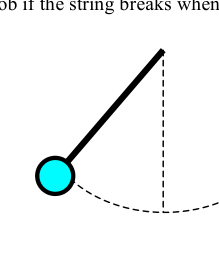 Pendulum at highest point, string breaks
Topic: Newtonian Mechanics Metodi: Kinematic Equations, Free-Body Diagram Competenze: Diagrammatic Reasoning, Physical Reasoning Objects: Pendulum Fonte: Testo (PDF) — p.4
Un pesante bobino pendolo si muove avanti e indietro quando la corda, che lo sostiene, si rompe improvvisamente. Ignorando la massa della corda e la resistenza dell’aria, disegna il percorso del successivo movimento del bobino se la corda si rompe quando il bobino è al suo punto più alto.
Pendolo al punto più alto, interruzioni delle corde
Topic: Newtonian Mechanics Metodi: Kinematic Equations, Free-Body Diagram Competenze: Diagrammatic Reasoning, Physical Reasoning Objects: Pendulum Fonte: Testo (PDF) — p.4
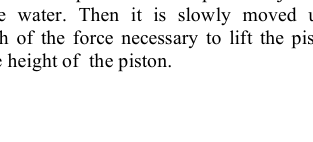
A long vertical tube with a weightless movable piston inside has its lower end under water. The tube is motionless throughout the experiment. The cross-sectional area of the piston is . The initial position of the piston is just over the surface of the water. Then it is slowly moved upwards. Sketch a graph of the force necessary to lift the piston as a function of the height of the piston.
Topic: Fluid Mechanics, Thermodynamics Metodi: Hydrostatic Equilibrium, Ideal Gas Law, Free-Body Diagram Competenze: Diagrammatic Reasoning, Mathematical Modeling Objects: Tube, Piston Fonte: Testo (PDF) — p.4
Un lungo tubo verticale con un pistone mobile senza peso all’interno ha la sua estremità inferiore sotto l’acqua. Il tubo è immobile durante l’esperimento. L’area di sezione trasversale del pistone è . La posizione iniziale del pistone è appena sopra la superficie dell’acqua. Poi si sposta lentamente verso l’alto. Segnare un grafico della forza necessaria per sollevare il pistone in funzione dell’altezza del pistone.
Topic: Fluid Mechanics, Thermodynamics Metodi: Hydrostatic Equilibrium, Ideal Gas Law, Free-Body Diagram Competenze: Diagrammatic Reasoning, Mathematical Modeling Objects: Tube, Piston Fonte: Testo (PDF) — p.4
On the same graph, draw the following two functions: 1) kinetic energy versus speed of a particle according to classical mechanics and 2) the same function for Einstein’s relativistic theory.
 KE vs speed classical and relativistic axes
Topic: Special Relativity, Newtonian Mechanics Metodi: Relativistic Energy-Momentum, Approximation & Series Expansion Competenze: Diagrammatic Reasoning, Mathematical Modeling Objects: — Fonte: Testo (PDF) — p.5
Sullo stesso grafico, disegnare le seguenti due funzioni: 1) energia cinetica contro velocità di una particella secondo la meccanica classica e 2) la stessa funzione per la teoria relativistica di Einstein.
KE vs velocità assi classici e relativistici
Topic: Special Relativity, Newtonian Mechanics Metodi: Relativistic Energy-Momentum, Approximation & Series Expansion Competenze: Diagrammatic Reasoning, Mathematical Modeling Objects: — Fonte: Testo (PDF) — p.5
An electron is moving at a constant velocity in a region of space with a uniform electric field of N/C and a uniform magnetic field of T. The electric field has only an -component while the magnetic field has only a -component.
Sketch a vector diagram for the velocity of the electron, the magnetic field, and the electric field in the Cartesian system of coordinates.
Topic: Electromagnetism, Magnetism Metodi: Lorentz Force Analysis, Vector Decomposition Competenze: Diagrammatic Reasoning, Physical Reasoning Objects: Electron Fonte: Testo (PDF) — p.5
Un elettrone si muove a velocità costante in una regione dello spazio con un campo elettrico uniforme di N/C e un campo magnetico uniforme di T. Il campo elettrico ha solo un componente mentre il campo magnetico ha solo un componente .
Segna un diagramma vettoriale per la velocità dell’elettrone, del campo magnetico e del campo elettrico nel sistema cartesiano di coordinate.
Topic: Electromagnetism, Magnetism Metodi: Lorentz Force Analysis, Vector Decomposition Competenze: Diagrammatic Reasoning, Physical Reasoning Objects: Electron Fonte: Testo (PDF) — p.5
A brick is on an incline whose angle of inclination can be changed from to degrees. Sketch a graph of the force of friction acting on the brick versus the angle of inclination in the given range.
 Friction force vs inclination angle axes
Topic: Newtonian Mechanics Metodi: Free-Body Diagram, Vector Decomposition Competenze: Diagrammatic Reasoning, Mathematical Modeling Objects: Block, Inclined Plane Fonte: Testo (PDF) — p.5
Un mattone è inclinato e l’angolo di inclinazione può essere cambiato da a gradi. Segnare un grafico della forza di attrito che agisce sul mattone rispetto all’angolo di inclinazione nella data gamma.
Frattazione forza vs assi angolo di inclinazione
Topic: Newtonian Mechanics Metodi: Free-Body Diagram, Vector Decomposition Competenze: Diagrammatic Reasoning, Mathematical Modeling Objects: Block, Inclined Plane Fonte: Testo (PDF) — p.5
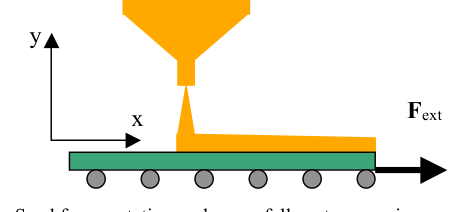
Sand from a stationary hopper falls onto a moving conveyor belt at a rate of 5.00 kg/s as shown. The conveyor belt is supported by frictionless rollers and moves at a constant speed of 0.75 m/s under the action of a constant horizontal external force supplied by the motor that drives the belt.
Find:
- the force of friction exerted by the belt on the sand;
- the external force ;
- the work done by in 1 s;
- the kinetic energy acquired by the falling sand each second due to the change in its horizontal motion;
- compare and analyse the answers to (3) and (4).
 Sand falling onto moving conveyor belt
Topic: Newtonian Mechanics, Conservation of Momentum Metodi: Impulse-Momentum Theorem, Conservation of Momentum, Free-Body Diagram Competenze: Physical Reasoning, Mathematical Modeling Objects: — Fonte: Testo (PDF) — p.5
La sabbia di un hopper stazionario cade su una cintura trasportatrice in movimento a una velocità di 5,00 kg/s come mostrato. La cintura trasportatrice è sostenuta da rulli senza attrito e si muove a una velocità costante di 0,75 m/s sotto l’azione di una forza esterna orizzontale costante fornita dal motore che guida la cintura.
Trova:
- la forza di attrito esercitata dalla cintura sulla sabbia;
- la forza esterna ;
- il lavoro svolto da in 1 s;
- l’energia cinetica acquisita dalla sabbia cadente ogni secondo a causa del cambiamento del suo movimento orizzontale;
- confrontare e analizzare le risposte a (3) e (4).
Sand che cade su cintura trasportatrice in movimento
Topic: Newtonian Mechanics, Conservation of Momentum Metodi: Impulse-Momentum Theorem, Conservation of Momentum, Free-Body Diagram Competenze: Physical Reasoning, Mathematical Modeling Objects: — Fonte: Testo (PDF) — p.5
A source of electric power with electromotive force and internal resistance , is connected to a resistor.
- Find the power delivered to the resistor as a function of the resistance of the resistor.
- Find the power produced by the source as a function of the resistance of the resistor.
- Sketch graphs of these two functions.
- Treating the efficiency of the source as the ratio of power consumed to power produced by the source, find the efficiency of the source of electric power as a function of the resistance of the resistor and sketch the graph of this function.
- Find the resistance of the resistor that corresponds to the maximum power delivered to the resistor, and calculate the efficiency for this resistance.
Topic: Circuits Metodi: Kirchhoff’s Laws, Equivalent Circuit Reduction, Graph Linearization Competenze: Mathematical Modeling, Diagrammatic Reasoning Objects: Battery, Resistor Fonte: Testo (PDF) — p.5
Una fonte di energia elettrica con forza elettromotrice e resistenza interna è collegata a una resistenza.
- Trova la potenza trasmessa alla resistenza in funzione della resistenza della resistenza.
- Trova la potenza prodotta dalla fonte in funzione della resistenza della resistenza.
- Sketch grafici di queste due funzioni.
- Trattando l’efficienza della fonte come rapporto tra potenza consumata e potenza prodotta dalla fonte, trovare l’efficienza della fonte di potenza elettrica come funzione della resistenza della resistenza e disegnare il grafico di questa funzione.
- Trova la resistenza della resistenza corrispondente alla potenza massima fornita alla resistenza e calcola l’efficienza di questa resistenza.
Topic: Circuits Metodi: Kirchhoff’s Laws, Equivalent Circuit Reduction, Graph Linearization Competenze: Mathematical Modeling, Diagrammatic Reasoning Objects: Battery, Resistor Fonte: Testo (PDF) — p.5
A point source of light is moving uniformly along a straight line, which intersects the optical axis of a converging lens under a small angle at a distance from the lens with a focal distance . The speed of the source of light is .
(i) Draw the lens, the trajectory of the source of light, and the trajectory of its image produced by the lens. (ii) Draw the vector diagram for the velocity of the source of light, the velocity of the image, and the relative velocity of the image with respect to the source. (iii) Determine the minimum relative speed of the image of the source of light with respect to the source.
Topic: Geometric Optics, Newtonian Mechanics Metodi: Thin Lens & Mirror Equation, Ray Tracing, Small-Angle Approximation Competenze: Diagrammatic Reasoning, Mathematical Modeling Objects: Lens Fonte: Testo (PDF) — p.5
Una fonte di luce puntaria si muove uniformemente lungo una linea retta, che incrocia l’asse ottico di una lente convergente sotto un angolo piccolo a una distanza dalla lente con una distanza focale . La velocità della fonte luminosa è .
(i) Disegnare l’obiettivo, la traiettoria della fonte di luce e la traiettoria dell’immagine prodotta dall’obiettivo. (ii) Disegnare il diagramma vettoriale per la velocità della fonte di luce, la velocità dell’immagine e la velocità relativa dell’immagine rispetto alla fonte.
- Determinare la velocità relativa minima dell’immagine della fonte luminosa rispetto alla fonte.
Topic: Geometric Optics, Newtonian Mechanics Metodi: Thin Lens & Mirror Equation, Ray Tracing, Small-Angle Approximation Competenze: Diagrammatic Reasoning, Mathematical Modeling Objects: Lens Fonte: Testo (PDF) — p.5