Una persona de 1,88 m de estatura se tumba en una tabla de peso despreciable que, a su vez, está apoyada sobre dos balanzas como se observa en la figura. Las indicaciones de las balanzas se muestran en la figura.
¿A qué distancia de los pies tiene esta persona su centro de gravedad?
(Las balanzas indican 44,5 kg y 40,0 kg; la longitud de la tabla es 1,88 m.)
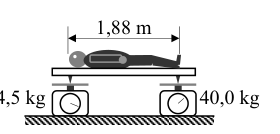 Person on plank between two scales
Topic: Rigid Body Statics, Newtonian Mechanics Metodi: Free-Body Diagram, Torque & Angular Momentum Analysis Competenze: Physical Reasoning, Mathematical Modeling Objects: Beam Fonte: Testo (PDF) — p.2
Una persona di 1,88 metri di altezza si trova sepolta su una tavola di peso disprezioso che, a sua volta, è appoggiata su due scale come si vede nella figura. Le indicazioni delle balance sono riportate nella figura.
A che distanza di piedi ha questa persona il suo centro di gravità?
*(Le balance indicano 44,5 kg e 40,0 kg; la lunghezza della tabella è di 1,88 m.) *
Person on plank between two scales
Topic: Rigid Body Statics, Newtonian Mechanics Metodi: Free-Body Diagram, Torque & Angular Momentum Analysis Competenze: Physical Reasoning, Mathematical Modeling Objects: Beam Fonte: Testo (PDF) — p.2
A 1.88-foot-tall person is buried on a table of despicable weight that, in turn, is rested on two scales as seen in the figure. The indications of the scales are shown in the figure.
How far from the feet is this person’s center of gravity?
(The scales indicate 44.5 kg and 40.0 kg; the length of the table is 1.88 m.)
Person on plank between two scales
Topic: Rigid Body Statics, Newtonian Mechanics Metodi: Free-Body Diagram, Torque & Angular Momentum Analysis Competenze: Physical Reasoning, Mathematical Modeling Objects: Beam Fonte: Testo (PDF) — p.2
Una atracción de feria consiste en un cilindro hueco de radio m que gira en torno a su eje de simetría con velocidad angular . Los pasajeros están apoyados en la pared cilíndrica y llevan un chaleco especial, cuyo coeficiente de rozamiento con la pared es . Cuando la velocidad angular de rotación es suficientemente alta se retira la plataforma inferior, pero los pasajeros no se caen.
Calcula la mínima velocidad angular con que debe girar el cilindro antes de retirar la plataforma. Considera m/s².
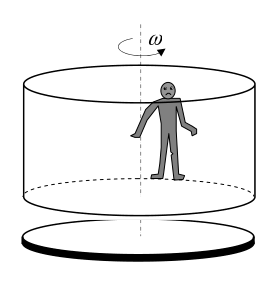 Rotating hollow cylinder fairground ride
Topic: Newtonian Mechanics Metodi: Free-Body Diagram, Kinematic Equations Competenze: Physical Reasoning, Mathematical Modeling Objects: Cylinder Fonte: Testo (PDF) — p.2
Un attrazione di fiera consiste in un cilindro vuoto di radio m che ruota attorno al suo asse di simmetria con velocità angolare . I passeggeri sono appoggiati al muro cilindrico e indossano un vestito speciale, il cui coefficiente di rottura con il muro è . Quando la velocità angolare di rotazione è sufficientemente alta, la piattaforma inferiore viene rimossa, ma i passeggeri non cadono.
Calcola la velocità angolare minima con cui deve girare il cilindro prima di ritirare la piattaforma. Considera m/s2.
Rotating hollow cylinder fairground ride
Topic: Newtonian Mechanics Metodi: Free-Body Diagram, Kinematic Equations Competenze: Physical Reasoning, Mathematical Modeling Objects: Cylinder Fonte: Testo (PDF) — p.2
A fair attraction consists of a hollow cylinder of radius m which rotates around its axis of symmetry with angular velocity . Passengers are supported on the cylindrical wall and carry a special vest, the coefficient of friction with the wall being . When the angular rotation speed is high enough, the bottom platform is removed, but the passengers do not fall.
Calculate the minimum angular speed at which the cylinder must rotate before the platform is removed. Consider m/s2.
The following is the list of the categories of vehicles used in the production of the product:
Topic: Newtonian Mechanics Metodi: Free-Body Diagram, Kinematic Equations Competenze: Physical Reasoning, Mathematical Modeling Objects: Cylinder Fonte: Testo (PDF) — p.2
El sistema global de navegación por satélite Galileo, desarrollado por la Unión Europea y la Agencia Espacial Europea, estará operativo en el año 2011. Constará de 30 satélites moviéndose en órbitas circulares a una altura m sobre la superficie terrestre. El primero de ellos, el «Giove A», fue puesto en órbita en diciembre de 2005.
Calcula el periodo orbital de este satélite.
Datos: radio de la Tierra, m. Intensidad del campo gravitatorio en la superficie de la Tierra, N/kg.
Topic: Gravitation, Newtonian Mechanics Metodi: Newton’s Law of Gravitation, Kinematic Equations, Kepler’s Laws Competenze: Physical Reasoning, Mathematical Modeling Objects: Satellite, Planet Fonte: Testo (PDF) — p.2
Il sistema globale di navigazione satellitare Galileo, sviluppato dall’Unione europea e dall’Agenzia spaziale europea, sarà operativo nel 2011. Esso sarà costituito da 30 satelliti in orbita circolare ad un’altezza m sulla superficie terrestre. Il primo di questi, il Giove A, è stato messo in orbita nel dicembre 2005.
Calcola il periodo orbitale di questo satellite.
Data: radius della Terra, m. Intensità del campo gravitazionale sulla superficie terrestre, N/kg.
Topic: Gravitation, Newtonian Mechanics Metodi: Newton’s Law of Gravitation, Kinematic Equations, Kepler’s Laws Competenze: Physical Reasoning, Mathematical Modeling Objects: Satellite, Planet Fonte: Testo (PDF) — p.2
The global Galileo satellite navigation system, developed by the European Union and the European Space Agency, will be operational by 2011. It shall consist of 30 satellites moving in circular orbits at a height m above the Earth’s surface. The first of these, the Giove A, was launched into orbit in December 2005.
Calculate the orbital period of this satellite.
Data: radius of the Earth, m. The gravitational field intensity on the Earth’s surface, N/kg.
Topic: Gravitation, Newtonian Mechanics Metodi: Newton’s Law of Gravitation, Kinematic Equations, Kepler’s Laws Competenze: Physical Reasoning, Mathematical Modeling Objects: Satellite, Planet Fonte: Testo (PDF) — p.2
En la figura 1 se muestra un tubo de pequeño diámetro y cerrado por su extremo inferior en el que se ha introducido mercurio, de densidad kg/m³. En la parte inferior del tubo ha quedado atrapada una columna de aire, de altura cm. Al invertir el tubo (figura 2), la columna de aire pasa a tener en equilibrio una altura cm. En ambos casos, la altura de la columna de mercurio es cm.
Suponiendo que el aire se comporta como un gas ideal y que su temperatura se mantiene constante, calcula la presión atmosférica.
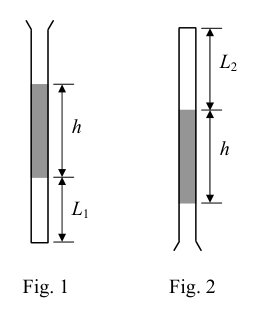 Closed tube with mercury, two orientations
Topic: Thermodynamics, Fluid Mechanics Metodi: Ideal Gas Law, Hydrostatic Equilibrium Competenze: Physical Reasoning, Mathematical Modeling Objects: Tube, Gas Fonte: Testo (PDF) — p.2
La figura 1 mostra un tubo di piccolo diametro chiuso dalla sua estremità inferiore in cui è stato introdotto il mercurio, di densità kg/m3. Nella parte inferiore del tubo è rimasta intrappolata una colonna d’aria, alta cm. Invertendo il tubo (figura 2), la colonna d’aria diventa in equilibrio ad una altezza cm. In entrambi i casi, l’altezza della colonna di mercurio è cm.
Supponendo che l’aria si comporti come un gas ideale e che la sua temperatura sia costante, calcola la pressione atmosferica.
Closed tube with mercury, two orientations
Topic: Thermodynamics, Fluid Mechanics Metodi: Ideal Gas Law, Hydrostatic Equilibrium Competenze: Physical Reasoning, Mathematical Modeling Objects: Tube, Gas Fonte: Testo (PDF) — p.2
Figure 1 shows a small diameter tube closed by its lower end into which mercury has been introduced, density kg/m3. A column of air, cm in height, has been trapped at the bottom of the tube. When the tube is reversed (Figure 2), the air column is balanced to a height of cm. In both cases, the height of the mercury column is cm.
Assuming that air behaves like an ideal gas and its temperature remains constant, he calculates atmospheric pressure.
Closed tube with mercury, two orientations
Topic: Thermodynamics, Fluid Mechanics Metodi: Ideal Gas Law, Hydrostatic Equilibrium Competenze: Physical Reasoning, Mathematical Modeling Objects: Tube, Gas Fonte: Testo (PDF) — p.2
El recipiente esférico de la figura, de radio cm, tiene un orificio cerrado con un tapón A a la altura del centro de la esfera, y otro tapón B en la parte inferior, cada uno de superficie cm². El recipiente está lleno de agua. Mediante un émbolo que puede deslizar por el tubo superior se aplica una fuerza N. La superficie del émbolo es cm².
Calcula la fuerza neta que actúa sobre cada tapón.
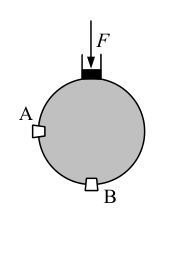 Spherical vessel with piston and two plugs
Topic: Fluid Mechanics Metodi: Hydrostatic Equilibrium, Bernoulli’s Equation Competenze: Physical Reasoning, Mathematical Modeling Objects: Container, Piston Fonte: Testo (PDF) — p.3
Il recipiente sferico della figura, di radio cm, ha un orizzonte chiuso con una tappa A a quotazione del centro della sfera e un’altra tappa B in basso, ciascuna di superficie cm2. Il contenitore è pieno di acqua. Per un embolsante che può scivolare attraverso il tubo superiore si applica una forza N. La superficie dell’imbolo è cm2.
Calcola la forza netta che agisce su ogni tappo.
Spherical vessel with piston and two plugs
Topic: Fluid Mechanics Metodi: Hydrostatic Equilibrium, Bernoulli’s Equation Competenze: Physical Reasoning, Mathematical Modeling Objects: Container, Piston Fonte: Testo (PDF) — p.3
The spherical vessel in the figure, radius cm, has a closed hole with a stopper A at the centre of the sphere and another stopper B at the bottom, each of a surface cm2. The container is full of water. A force N is applied to a plunger that can slide through the upper tube. The surface of the embolus is cm2.
Calculate the net force acting on each cap.
Spherical vessel with piston and two plugs
Topic: Fluid Mechanics Metodi: Hydrostatic Equilibrium, Bernoulli’s Equation Competenze: Physical Reasoning, Mathematical Modeling Objects: Container, Piston Fonte: Testo (PDF) — p.3
En la gráfica de la figura 1 se representa el perfil de una onda armónica, que se propaga a lo largo del eje OX, en el instante de tiempo . En la figura 2 se representa la elongación del punto situado en en función del tiempo.
a) Determina la amplitud, la longitud de onda y el periodo de la onda.
b) Escribe la función de la onda, .
c) Representa gráficamente la velocidad del punto situado en m en función del tiempo.
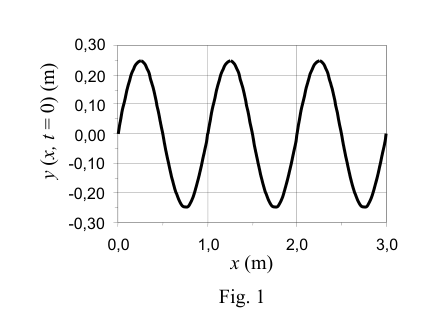 Wave profile y(x) at t=0
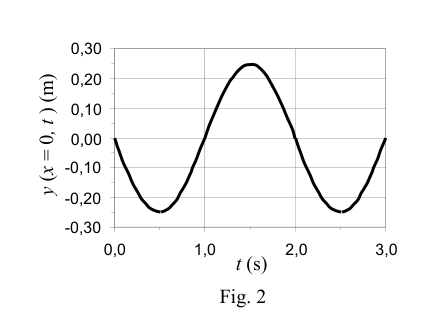 Displacement y(t) at x=0
Topic: Oscillations & Waves Metodi: Wave Equation, Simple Harmonic Motion Analysis Competenze: Diagrammatic Reasoning, Mathematical Modeling Objects: — Fonte: Testo (PDF) — p.3
Il grafico di cui alla figura 1 mostra il profilo di un’onda armonica che si diffonde lungo l’asse OX, nell’istante di tempo . La figura 2 mostra l’allungamento del punto situato in in funzione del tempo.
a) Determina l’ampiezza, la lunghezza e il periodo dell’onda.
b) Scrive la funzione dell’onda, .
c) Rappresenta graficamente la velocità del punto situato in m in funzione del tempo.
Wave profile y(x) at t=0
Dislocazione e(t) a x=0
Topic: Oscillations & Waves Metodi: Wave Equation, Simple Harmonic Motion Analysis Competenze: Diagrammatic Reasoning, Mathematical Modeling Objects: — Fonte: Testo (PDF) — p.3
The graph in Figure 1 shows the profile of a harmonic wave, which propagates along the OX axis, in the time instant . Figure 2 shows the elongation of the point at with respect to time.
(a) Determines the amplitude, wavelength and period of the wave.
(b) Write the wave function, .
(c) Graphically represents the speed of the point at m with respect to time.
The following information is provided for in Part A of Annex I to Regulation (EC) No 1907/2006:
The following table shows the following information:
Topic: Oscillations & Waves Metodi: Wave Equation, Simple Harmonic Motion Analysis Competenze: Diagrammatic Reasoning, Mathematical Modeling Objects: — Fonte: Testo (PDF) — p.3
En el dispositivo de la figura, el generador de señales produce una tensión eléctrica alterna de una determinada frecuencia, que el altavoz convierte en una onda sonora de esa misma frecuencia. Esta onda se propaga por los dos tubos curvados de la figura hasta llegar al micrófono. La longitud del tubo de la derecha puede modificarse, desplazándolo a derecha o izquierda. El sonido detectado por el micrófono se analiza en un osciloscopio.
En el osciloscopio se detecta un máximo de interferencia cuando la frecuencia del sonido es Hz. ¿Qué distancia habrá que desplazar el tubo móvil para que se vuelva a producir otro máximo de interferencia? La velocidad del sonido es m/s.
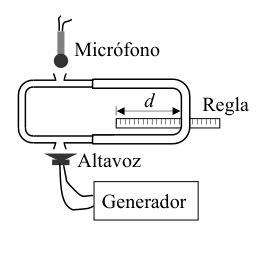 Two-path sound interference tube device
Topic: Oscillations & Waves, Wave Optics Metodi: Superposition Principle, Interference & Diffraction Analysis Competenze: Physical Reasoning, Mathematical Modeling Objects: Tube Fonte: Testo (PDF) — p.3
Nel dispositivo della figura, il generatore di segnali produce una tensione elettrica alternativa di una determinata frequenza, che lo altoparlante converte in un’onda sonora di quella stessa frequenza. Questa onda si diffonde attraverso i due tubi curvi della figura fino al microfono. La lunghezza del tubo a destra può essere modificata spostandolo a destra o a sinistra. Il suono rilevato dal microfono viene analizzato con un osciloscopio.
L’oscilloscopio rileva un massimo di interferenza quando la frequenza del suono è Hz. ¿Qué distancia habrá que desplazar el tubo móvil para que se vuelva a producir otro máximo de interferencia? La velocità del suono è m/s.
Two-path sound interference tube device
Topic: Oscillations & Waves, Wave Optics Metodi: Superposition Principle, Interference & Diffraction Analysis Competenze: Physical Reasoning, Mathematical Modeling Objects: Tube Fonte: Testo (PDF) — p.3
In the device in the figure, the signal generator produces an alternating electrical voltage of a certain frequency, which the speaker converts into a sound wave of that same frequency. This wave propagates through the two curved tubes of the figure to the microphone. The length of the right tube can be modified by shifting it to the right or left. The sound detected by the microphone is analyzed in an oscilloscope.
The oscilloscope detects maximum interference when the sound frequency is Hz. How far will the moving tube have to be moved to produce another maximum interference? The speed of sound is m/s.
The following information shall be provided:
Topic: Oscillations & Waves, Wave Optics Metodi: Superposition Principle, Interference & Diffraction Analysis Competenze: Physical Reasoning, Mathematical Modeling Objects: Tube Fonte: Testo (PDF) — p.3
La luz que viaja por una fibra óptica se atenúa lentamente, debido a fenómenos de absorción y difusión, en forma exponencial. En concreto, si la potencia luminosa a la entrada de la fibra es , tras recorrer una distancia por la fibra la potencia se ha reducido a
donde es el llamado coeficiente de atenuación, que en una buena fibra óptica tiene un valor m⁻¹.
a) Calcula, en tanto por ciento, la proporción de potencia perdida en 1 km de esta fibra.
b) En el mundo técnico, estas pérdidas suelen medirse en dB/km, definiendo una escala decibélica análoga a la que conoces de intensidad acústica, pero con referencia en la potencia inicial . Calcula la atenuación de esta fibra óptica en dB/km.
Topic: Geometric Optics, Order-of-Magnitude Estimation Metodi: Approximation & Series Expansion, Experimental Data Analysis Competenze: Mathematical Modeling, Unit Conversion Objects: — Fonte: Testo (PDF) — p.3
La luce che viaggia attraverso una fibra ottica si attenua lentamente, a causa di fenomeni di assorbimento e diffusione, in modo esponenziale. In particolare, se la potenza luminosa all’ingresso della fibra è , dopo aver percorso una distanza attraverso la fibra la potenza è stata ridotta a
dove è il cosiddetto coefficiente di attenuazione, che in una buona fibra ottica ha un valore m−1.
a) Calcola, in percentuale, il rapporto di potenza persa per 1 km di questa fibra.
b) Nel mondo tecnico, queste perdite sono di solito misurate in dB/km, definendo una scala decibelica analogo a quella conosciuta di intensità acustica, ma con riferimento alla potenza iniziale . Calcola l’attenuazione di questa fibra ottica in dB/km.
Topic: Geometric Optics, Order-of-Magnitude Estimation Metodi: Approximation & Series Expansion, Experimental Data Analysis Competenze: Mathematical Modeling, Unit Conversion Objects: — Fonte: Testo (PDF) — p.3
Light traveling through an optical fiber is slowly dimming due to phenomena of absorption and diffusion, exponentially. In particular, if the light output at the input of the fibre is , after travelling a distance through the fibre the power output has been reduced to
where is the so-called attenuation coefficient, which in a good optical fiber has a value of m−1.
(a) Calculate, as a percentage, the ratio of power lost per 1 km of this fibre.
(b) In the technical world, these losses are usually measured in dB/km, defining a decibel scale similar to that known to you in sound intensity, but with reference to the initial power . Calculate the attenuation of this optical fiber in dB/km.
Topic: Geometric Optics, Order-of-Magnitude Estimation Metodi: Approximation & Series Expansion, Experimental Data Analysis Competenze: Mathematical Modeling, Unit Conversion Objects: — Fonte: Testo (PDF) — p.3
En la fotografía de la figura 1 se ve un recipiente que contiene aceite de girasol con granos de sémola, y dos aros conductores concéntricos que pueden conectarse a una batería. Tanto el aceite como la sémola son sustancias dieléctricas (no conductoras). Cuando se conectan los aros a la batería, los granos de sémola tienden a alinearse en dirección radial (figura 2).
Explica este fenómeno.
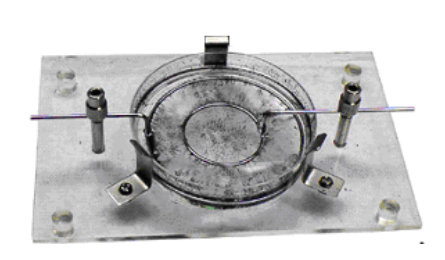 Sunflower oil with semolina, no field
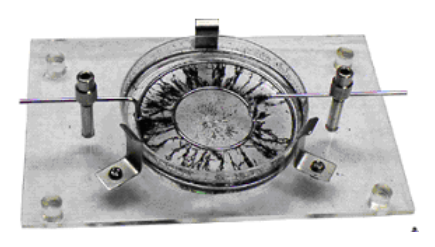 Semolina grains aligned radially in field
Topic: Electrostatics Metodi: Coulomb’s Law, Electric Potential Method Competenze: Physical Reasoning, Diagrammatic Reasoning Objects: Battery Fonte: Testo (PDF) — p.4
Nella fotografia di figura 1 si vede un recipiente contenente olio di girasole con granelli di semola e due anelli conduttori concentrati che possono essere collegati a una batteria. Sia l’olio che la semola sono sostanze dielettriche (non conduttrici). Quando gli anelli sono collegati alla batteria, i granelli di semola tendono ad allinearsi in direzione radial (Figura 2).
Spiega questo fenomeno.
Sunflower oil with semolina, no field
Semolina grains aligned radially in field
Topic: Electrostatics Metodi: Coulomb’s Law, Electric Potential Method Competenze: Physical Reasoning, Diagrammatic Reasoning Objects: Battery Fonte: Testo (PDF) — p.4
In the picture in Figure 1 you can see a container containing sunflower oil with semolina grains, and two concentric conductive rings that can be connected to a battery. Both oil and semolina are dielectric (non-conductive) substances. When the rings are connected to the battery, the semolina grains tend to align in a radial direction (Figure 2).
Explain this phenomenon.
Sunflower oil with semolina, no field
Semolina grains aligned radially in field
Topic: Electrostatics Metodi: Coulomb’s Law, Electric Potential Method Competenze: Physical Reasoning, Diagrammatic Reasoning Objects: Battery Fonte: Testo (PDF) — p.4
Una «caja negra» contiene generadores de tensión continua y resistencias desconocidas. La caja tiene dos terminales eléctricos A y B. El voltaje en circuito abierto entre ambos es V. Si se conecta entre A y B una resistencia de 200 Ω, este voltaje se reduce a V.
Determina el circuito equivalente a la caja negra.
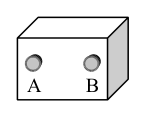 Black box with terminals A and B
Topic: Circuits Metodi: Kirchhoff’s Laws, Equivalent Circuit Reduction Competenze: Physical Reasoning, Mathematical Modeling Objects: Resistor, Battery Fonte: Testo (PDF) — p.4
Una “caixa nera” contiene generatori di tensione continua e resistenze sconosciute. La scatola ha due terminali elettrici A e B. La volta in circuito aperto tra i due è V. Se si collega tra A e B una resistenza di 200 Ω, tale tensione viene ridotta a V.
Determina il circuito equivalente alla cassa nera.
Black box with terminals A and B
Topic: Circuits Metodi: Kirchhoff’s Laws, Equivalent Circuit Reduction Competenze: Physical Reasoning, Mathematical Modeling Objects: Resistor, Battery Fonte: Testo (PDF) — p.4
A black box contains continuous voltage generators and unknown resistance. The box has two electrical terminals A and B. The open-circuit voltage between the two is V. If a resistance of 200 Ω is connected between A and B, this voltage is reduced to V.
Determine the black box equivalent circuit.
Black box with terminals A and B
Topic: Circuits Metodi: Kirchhoff’s Laws, Equivalent Circuit Reduction Competenze: Physical Reasoning, Mathematical Modeling Objects: Resistor, Battery Fonte: Testo (PDF) — p.4
Se coloca una espira conductora sobre un solenoide, como indica la figura. Se observa que, al conectar un generador de corriente al solenoide, la espira sale «disparada» hacia arriba.
Explica por qué ocurre este fenómeno.
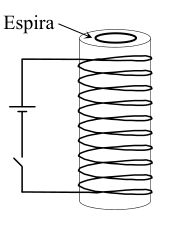 Conducting coil on solenoid, ejected upward
Topic: Electromagnetic Induction, Magnetism Metodi: Faraday’s Law of Induction, Lenz’s Law Competenze: Physical Reasoning, Diagrammatic Reasoning Objects: Solenoid, Coil Fonte: Testo (PDF) — p.4
Si colloca una spira conduttrice su un solenoide, come indica la figura. Si osserva che, collegando un generatore di corrente al solenoide, la spira sale sparazzata verso l’alto.
Spiega perché questo fenomeno si verifica.
Conducting coil on solenoid, ejected upward
Topic: Electromagnetic Induction, Magnetism Metodi: Faraday’s Law of Induction, Lenz’s Law Competenze: Physical Reasoning, Diagrammatic Reasoning Objects: Solenoid, Coil Fonte: Testo (PDF) — p.4
A conductive spiral is placed on a solenoid, as shown in the figure. It is observed that when a power generator is connected to the solenoid, the spire goes upwards.
Explain why this phenomenon occurs.
Conducting coil on solenoid, ejected upward
Topic: Electromagnetic Induction, Magnetism Metodi: Faraday’s Law of Induction, Lenz’s Law Competenze: Physical Reasoning, Diagrammatic Reasoning Objects: Solenoid, Coil Fonte: Testo (PDF) — p.4
La máxima potencia por unidad de superficie radiada por un cuerpo es proporcional a la -ésima potencia de la temperatura absoluta del cuerpo. El coeficiente de proporcionalidad es una constante muy famosa en Física, la constante de Stefan-Boltzmann, J s⁻¹ m⁻² K⁻⁴.
a) ¿Qué valor tiene ?
b) La temperatura del cuerpo humano puede estimarse en 36 °C y la superficie de la piel de una persona media es de 1,7 m². Calcula la máxima potencia con la que el cuerpo humano emite radiación electromagnética.
Topic: Thermodynamics, Modern-Quantum Physics Metodi: Dimensional Analysis, Physical Modeling Competenze: Physical Reasoning, Unit Conversion Objects: — Fonte: Testo (PDF) — p.4
La potenza massima per unità di superficie irradiata da un corpo è proporzionale alla potenza -esima della temperatura assoluta del corpo. Il coefficiente di proporzionalità è una costante molto famosa in fisica, la costante di Stefan-Boltzmann, J s−1 m−2 K−4.
a) Qual è il valore di ?
b) La temperatura del corpo umano può essere stimata in 36 °C e la superficie della pelle della persona media è di 1,7 m2. Calcola la massima potenza con cui il corpo umano emette radiazioni elettromagnetiche.
Topic: Thermodynamics, Modern-Quantum Physics Metodi: Dimensional Analysis, Physical Modeling Competenze: Physical Reasoning, Unit Conversion Objects: — Fonte: Testo (PDF) — p.4
The maximum power per unit area radiated by a body is proportional to the -th power of absolute body temperature. The coefficient of proportionality is a very famous constant in physics, the Stefan-Boltzmann constant, J s−1 m−2 K−4.
(a) What is the value of ?
(b) The human body temperature can be estimated at 36 °C and the average person’s skin area is 1.7 m2. Calculates the maximum power with which the human body emits electromagnetic radiation.
Topic: Thermodynamics, Modern-Quantum Physics Metodi: Dimensional Analysis, Physical Modeling Competenze: Physical Reasoning, Unit Conversion Objects: — Fonte: Testo (PDF) — p.4