A conducting wire is formed of a cylindrical copper core with a diameter of mm. The core is wrapped in a concentric, cylindrical aluminium coating, the total diameter of the wire being mm. A current of A flows through the wire. The specific resistivity of copper is and of aluminium, .
-
What are the current densities in different parts of the wire (current density is defined as the current per cross-section area)?
-
What is the magnetic inductance at the distance cm from the axis of the wire?
-
What is the magnetic inductance at the surface between the copper and aluminium?
Remark. It may be useful to know the circulation theorem: , where the integral is taken along a closed trajectory (loop) and is the net current flowing through that loop; . This formula is completely analogous to the formula for the work done by a force along a trajectory: .
Topic: Magnetism, Electromagnetism Metodi: Ampere’s Law, Symmetry Argument Competenze: Mathematical Modeling, Physical Reasoning Objects: Wire Fonte: Testo (PDF)
Un filo conduttore è formato da un nucleo di rame cilindrico di diametro mm. Il nucleo è avvolto in un rivestimento di alluminio concentrico e cilindrico, il diametro totale del filo è mm. Un flusso di A scorre attraverso il filo. La resistenza specifica del rame è e dell’alluminio, .
-
Quali sono le densità di corrente in diverse parti del filo (la densità di corrente è definita come la corrente per area di sezione trasversale)?
-
Qual è l’induttanza magnetica a distanza cm dall’asse del filo?
-
Qual è l’induttanza magnetica sulla superficie tra rame e alluminio?
Remarca. Può essere utile conoscere il teorema della circolazione: , dove l’integrale è preso lungo una traiettoria chiusa (loop) e è la corrente netta che scorre attraverso quel loop; . Questa formula è completamente analoga alla formula per il lavoro effettuato da una forza lungo una traiettoria: .
Topic: Magnetism, Electromagnetism Metodi: Ampere’s Law, Symmetry Argument Competenze: Mathematical Modeling, Physical Reasoning Objects: Wire Fonte: Testo (PDF)
Consider an elastic rod, the mass and the compressibility of which (i.e. the length change) can be neglected in this problem. It can be assumed that if one end of the rod is firmly fixed, and a force is applied to the other end of the rod, perpendicularly to the rod at the point of application, then the rod takes a form of a circle segment. The radius of that circle is inversely proportional to the force, , where the factor is a characteristic of the rod.
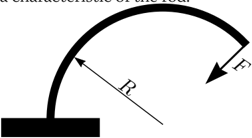
-
Let the rod be fixed vertically, at its bottom end, and a ball of mass be attached to its upper end. Knowing the factor , the length of the rod , and the free fall acceleration , find the period of small oscillations of the ball. In this question, you may assume that .
-
What is the maximal mass of the ball, which can be stably held on such a vertical rod?
Remark. You may use approximate expressions and (for ).
Topic: Oscillations & Waves Metodi: Simple Harmonic Motion Analysis, Small-Angle Approximation, Torque & Angular Momentum Analysis Competenze: Mathematical Modeling, Physical Reasoning Objects: Rod, Ball Fonte: Testo (PDF)
Considerare una canna elastica, la cui massa e compressibilità (cioè In questo caso, la variazione della lunghezza) può essere trascurata. Si può supporre che se una estremità della canna è saldamente fissata e si applichi una forza all’altra estremità della canna, perpendicolare alla canna al punto di applicazione, allora la canna assume la forma di un segmento circolare. Il raggio di radius di tale cerchio è inversamente proporzionale alla forza, , dove il fattore è una caratteristica della canna.
-
La canna deve essere fissata verticalmente, alla sua estremità inferiore, e alla sua estremità superiore deve essere fissata una palla di massa . Con la conoscenza del fattore , della lunghezza della canna e dell’accelerazione di caduta libera , si trova il periodo di piccole oscillazioni della palla. In questa domanda, si può presumere che .
-
Qual è la massa massima della palla, che può essere tenuta stabile su una tale canna verticale?
Rimarca. È possibile utilizzare espressioni approssimative e (per ).
Topic: Oscillations & Waves Metodi: Simple Harmonic Motion Analysis, Small-Angle Approximation, Torque & Angular Momentum Analysis Competenze: Mathematical Modeling, Physical Reasoning Objects: Rod, Ball Fonte: Testo (PDF)
Suppose that at the point , there is a source of thermal electrons (of negligible thermal energy), which are accelerated initially by the voltage V in horizontal direction (see figure). At the path of the electrons, there are two voltage gaps and of negligible size, at the distance from each other. These gaps receive a voltage signal from a waveform generator. We can assume that . The electrons starting at different moments of time are to be gathered together (focused) at the probe , which is at distance from the gap . In order to analyze this setup, answer the following questions.
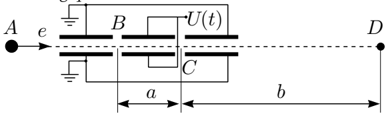
-
Assuming that , what is the time needed for the electrons to travel from the gap to the probe ?
-
Find the same travel time assuming that the voltage is constant (your approximating expression should be a linear function of ).
-
What functional equation should be satisfied for the waveform in order to ensure the focusing of all the electrons at the probe . Solve this equation by assuming and .
-
The waveform generator yields a periodic signal of period in such a way that the profile is followed up to achieving some maximal value ; after that, the voltage drops immediately to and the process starts repeating. What is the fraction of electrons missing the time focus at the probe ?
Topic: Electrostatics, Newtonian Mechanics Metodi: Electric Potential Method, Kinematic Equations, Approximation & Series Expansion Competenze: Mathematical Modeling, Physical Reasoning Objects: Electron, Particle Beam Fonte: Testo (PDF)
Supponiamo che al punto vi sia una fonte di elettroni termici (di energia termica trascurabile), che vengono accelerati inizialmente dalla tensione V in direzione orizzontale (vedi figura). Al percorso degli elettroni, ci sono due intervalli di tensione e di dimensioni trascurabili, a distanza l’uno dall’altro. Questi spazi ricevono un segnale di tensione da un generatore di forma d’onda. Possiamo supporre che . Gli elettroni che partono in momenti diversi di tempo devono essere raccolti (focalizzati) alla sonda , che è a distanza dal gap . Per analizzare questa impostazione, rispondi alle seguenti domande.
-
Supponendo che , qual è il tempo necessario per i elettroni per viaggiare dal gap alla sonda ?
-
Trovare lo stesso tempo di viaggio supponendo che la tensione sia costante (la tua espressione approssimativa dovrebbe essere una funzione lineare di ).
-
Quale equazione funzionale deve essere soddisfatta per la forma d’onda al fine di garantire la messa a fuoco di tutti gli elettroni alla sonda . Risolvi questa equazione assumendo e .
-
Il generatore di forma d’onda produce un segnale periodico di periodo in modo tale che il profilo venga seguito fino a raggiungere un certo valore massimo ; dopo di che, la tensione scende immediatamente a e il processo inizia a ripetersi. Qual è la frazione di elettroni che manca il focus temporale alla sonda ?
Topic: Electrostatics, Newtonian Mechanics Metodi: Electric Potential Method, Kinematic Equations, Approximation & Series Expansion Competenze: Mathematical Modeling, Physical Reasoning Objects: Electron, Particle Beam Fonte: Testo (PDF)
Equipment: a wooden brick, a spherical ball, board and ruler (the mass ratio of the brick and ball is provided).
-
Determine the static coefficient of friction between the board and the brick.
-
Determine the static coefficient of friction between the ball and the brick.
Topic: Newtonian Mechanics Metodi: Free-Body Diagram, Experimental Data Analysis Competenze: Experimental Data Analysis, Measurement & Instrumentation Objects: Block, Ball Fonte: Testo (PDF)
**Equipaggiamento: ** un mattone di legno, una palla sferica, una lavagna e una regina (si fornisce il rapporto di massa del mattone e della palla).
-
Determinare il coefficiente di attrito statico tra la lavagna e il mattone.
-
Determinare il coefficiente statico di attrito tra la palla e il mattone.
Topic: Newtonian Mechanics Metodi: Free-Body Diagram, Experimental Data Analysis Competenze: Experimental Data Analysis, Measurement & Instrumentation Objects: Block, Ball Fonte: Testo (PDF)
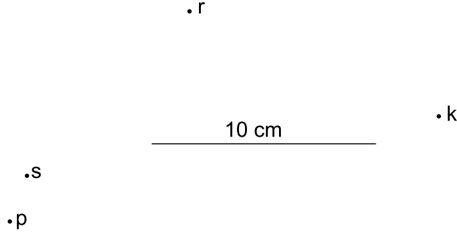
A lamp is attached to the edge of a disk, which moves (slides) rotating on ice. The lamp emits light pulses: the duration of each pulse is negligible, the interval between two pulses is ms. The first pulse is of orange light, the next one is blue, followed by red, green, yellow, and again orange (the process starts repeating periodically). The motion of the disk is photographed using so long exposure time that exactly four pulses are recorded on the photo (see figure). Due to the shortness of the pulses and small size of the lamp, each pulse corresponds to a colored dot on the photo. The colors of the dots are provided with lettering: O - orange, S - blue, P - red, R - green, and K - yellow. The friction forces acting on the disk can be neglected.
-
Mark on the figure by numbers (1-4) the order of the pulses (dots). Motivate your answer. What can be said about the value of the exposure time?
-
Using the provided figure, find the radius of the disk , the velocity of the center of the disk and the angular velocity (it is known that rad/s). The scale of the figure is provided by the image of a line of length cm.
Topic: Rotational Dynamics Metodi: Kinematic Equations, Vector Decomposition Competenze: Diagrammatic Reasoning, Mathematical Modeling Objects: Disk Fonte: Testo (PDF)
Una lampada è attaccata al bordo di un disco, che si muove (slide) girando su ghiaccio. La lampada emette impulsi luminosi: la durata di ciascun impulso è trascurabile, l’intervallo tra due impulsi è ms. Il primo impulso è di luce arancione, il successivo blu, seguito da rosso, verde, giallo e di nuovo arancione (il processo inizia a ripetersi periodicamente). Il movimento del disco viene fotografato utilizzando un tempo di esposizione così lungo che vengono registrati esattamente quattro impulsi sulla foto (vedi figura). A causa della brevità degli impulsi e della piccola dimensione della lampada, ogni impulso corrisponde a un punto colorato sulla foto. I colori dei punti sono scritti con le lettere: O - arancione, S - azzurro, P - rosso, R - verde e K - giallo. Le forze di attrito che agiscono sul disco possono essere trascurate.
-
Segnalare sulla figura per numero (1-4) l’ordine dei pulsi (punti). Motiva la tua risposta. Che cosa si può dire del valore del tempo di esposizione?
-
Con la figura fornita, si trova il raggio del disco , la velocità del centro del disco e la velocità angolare (è noto che rad/s). La scala della figura è fornita dall’immagine di una linea di lunghezza cm.
Topic: Rotational Dynamics Metodi: Kinematic Equations, Vector Decomposition Competenze: Diagrammatic Reasoning, Mathematical Modeling Objects: Disk Fonte: Testo (PDF)
-
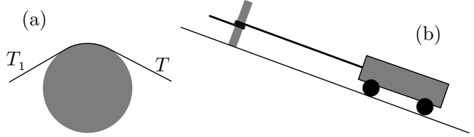
A rope is put over a pole so that the plane of the rope is perpendicular to the axis of the pole, and the length of that segment of the rope which touches the pole is , much shorter than the radius of the pole , see figure (a). To the one end of the rope, a force is applied; the sliding of the rope can be prevented by applying a force to the other end of the rope. Express the ratio via , , and , where is the coefficient of friction between the rope and the pole.
-
Answer the first question, if is not small (i.e. without the assumption ).
Remark. You may use the equality .
-
The rope makes exactly winds around the pole. One end of the rope is attached to a truck standing on a slope (slanting angle ); the mass of the truck t, see figure (b). Find the force , needed to apply to the other end of the rope, in order to keep the truck at rest. Use the numerical value . All the other friction forces acting upon the truck can be neglected.
-
How does the answer change, if the cross-section of the pole is not circular, but instead, egg-shaped? Motivate your answer.
Topic: Newtonian Mechanics Metodi: Free-Body Diagram, Calculus-Integration, Differential Equations Competenze: Mathematical Modeling, Physical Reasoning Objects: String Fonte: Testo (PDF)
-
Una corda viene posta sopra un polo in modo che il piano della corda sia perpendicolare all’asse del polo e la lunghezza di quel segmento della corda che tocca il polo è , molto più breve del raggio del polo , vedi figura (a). All’unico capo della corda viene applicata una forza ; la scorciatura della corda può essere impedita applicando una forza all’altra estremità della corda. Esprimere il rapporto tramite , e , dove è il coefficiente di attrito tra la corda e il polo.
-
Rispondere alla prima domanda, se il non è piccolo (cioè senza la presunzione ).
Ricordare. È possibile utilizzare l’uguaglianza .
-
La corda fa esattamente venti intorno al polo. Un’estremità della corda è collegata a un camion in pendenza (angolo di pendenza ); la massa del camion t, vedi figura (b). Trova la forza necessaria per applicare all’altra estremità della corda, per mantenere il camion in riposo. Utilizzare il valore numerico . Tutte le altre forze di attrito che agiscono sul camion possono essere trascurate.
-
Come cambia la risposta, se la sezione trasversale del polo non è circolare, ma invece, a forma di uovo? Motiva la tua risposta.
Topic: Newtonian Mechanics Metodi: Free-Body Diagram, Calculus-Integration, Differential Equations Competenze: Mathematical Modeling, Physical Reasoning Objects: String Fonte: Testo (PDF)
In this problem, we study a project for flying to Mars. At the first stage, the space ship switches on the rocket engines and obtains an initial velocity . You may assume that during the first stage, the height of the space ship (from the surface of the Earth) remains much smaller than the radius of the Earth km. At the second stage, the space ship performs a ballistic motion in the gravity field of the Earth: upon achieving a height, which is much larger than the radius of the Earth , but much smaller than the orbital radius of the Earth, km.
- Find the relationship between the residual velocity (with respect to the Earth) at the end of the second stage, and the quantities , , and the free fall acceleration at the surface of the Earth (for the subsequent questions you may use the numeric value ).
At the third stage, the space ship performs a ballistic motion in the gravity field of the Sun, up to reaching an immediate neighborhood of Mars. The trajectory is chosen by minimizing the residual launch velocity (required for achieving Mars).
-
Sketch the trajectory.
-
Find the flight time . You may use the following numeric data: the orbital velocity of the Earth km/s, orbital radius of Mars km.
-
Find the previously considered launch velocity and the terminal (i.e. at the end of the third stage) velocity of the space ship with respect to Mars.
-
The required mass of the fuel can be found from the formula , where is the speed of the gas at the outlet of the engine (with respect to the space ship), and is the useful mass of the ship (when all the fuel is exhausted). You may assume and use the numerical value km/s. Find how much more fuel is needed for the Mars flight, as compared to simply escaping the Earth gravity field, if the useful space ship mass is equal in both cases.
Topic: Gravitation Metodi: Kepler’s Laws, Conservation of Energy, Newton’s Law of Gravitation Competenze: Mathematical Modeling, Estimation & Approximation Objects: Planet, Satellite Fonte: Testo (PDF)
In questo problema, studiamo un progetto per volare su Marte. Nella prima fase, la nave spaziale accende i motori del razzo e ottiene una velocità iniziale . Si può supporre che durante la prima fase, l’altezza della nave spaziale (da superficie della Terra) rimanga molto inferiore al raggio della Terra km. Nella seconda fase, la nave spaziale esegue un movimento balistico nel campo di gravità della Terra: raggiungendo un’altezza, che è molto più grande del raggio della Terra , ma molto più piccola del raggio orbitale della Terra, km.
- Trova la relazione tra la velocità residuale (rispetto alla Terra) alla fine della seconda fase, e le quantità , , e l’accelerazione della caduta libera alla superficie della Terra (per le domande successive puoi usare il valore numerica ).
Nella terza fase, la nave spaziale esegue un movimento balistico nel campo gravitazionale del Sole, fino a raggiungere un vicino di Marte. La traiettoria viene scelto riducendo al minimo la velocità di lancio residuo (requisita per raggiungere Marte).
-
Segnare la traiettoria.
-
Trova il tempo di volo . È possibile utilizzare i seguenti dati numerici: la velocità orbitale della Terra km/s, il raggio orbitale di Marte km.
-
Trova la velocità di lancio e il terminale (cioè alla fine della terza fase) velocità della nave spaziale rispetto a Marte.
-
La massa richiesta del combustibile può essere trovata dalla formula , dove è la velocità del gas all’uscita del motore (per quanto riguarda la nave spaziale) e è la massa utile della nave (quando tutto il combustibile è esaurito). Si può assumere e utilizzare il valore numerico km/s. Scopri quanto più carburante è necessario per il volo su Marte, rispetto al semplice scappamento dal campo gravitazionale terrestre, se la massa della nave spaziale utile è uguale in entrambi i casi.
Topic: Gravitation Metodi: Kepler’s Laws, Conservation of Energy, Newton’s Law of Gravitation Competenze: Mathematical Modeling, Estimation & Approximation Objects: Planet, Satellite Fonte: Testo (PDF)
Apparatus: Laser (wavelength nm), ruler, stand, a strip of reflecting material, a sheet of paper with a circular hole (in your pack of paper sheets), pencil. Note that the reflecting material provided to you is coated with a layer of densely packed tiny glass spheres of equal diameter.
-
Describe the position and geometry of the diffraction pattern, which can be observed, when the laser beam falls onto the strip; use different incidence angles.
-
Provide a qualitative (approximate) explanation for the observed phenomenon.
-
Estimate the diameter of these glass spheres.
Topic: Wave Optics Metodi: Interference & Diffraction Analysis, Experimental Data Analysis Competenze: Experimental Data Analysis, Measurement & Instrumentation Objects: - Fonte: Testo (PDF)
**Apparecchio: ** Laser (lunghezza d’onda nm), regola, supporto, striscia di materiale riflettente, foglio di carta con buco circolare (nel pacchetto di fogli di carta), matita. Si noti che il materiale riflettente che vi viene fornito è rivestito da uno strato di piccole sfere di vetro di uguale diametro.
-
Descrivere la posizione e la geometria del modello di diffrazione, che possono essere osservati quando il fascio laser cade sulla striscia; utilizzare angoli di incidenza diversi.
-
Fornire una spiegazione qualitativa (approssimativa) del fenomeno osservato.
-
Estimare il diametro di queste sfere di vetro.
Topic: Wave Optics Metodi: Interference & Diffraction Analysis, Experimental Data Analysis Competenze: Experimental Data Analysis, Measurement & Instrumentation Objects: - Fonte: Testo (PDF)