An object moves in two dimensions according to
where is in meters and in seconds. When does the object cross the x-axis?
- A. 0.0 s
- B. 0.4 s
- C. 0.6 s
- D. 1.5 s
- E. 2.5 s
Topic: Newtonian Mechanics Metodi: Kinematic Equations Competenze: Mathematical Modeling Objects: — Fonte: Testo (PDF) — p.1
Un oggetto si muove in due dimensioni secondo
in cui è in metri e in secondi. Quando l’oggetto attraversa l’asse x?
- A. 0.0 s
- B. 0.4 s
- C. 0.6 s
- D. 1.5 s
- E. 2.5 s
Topic: Newtonian Mechanics Metodi: Kinematic Equations Competenze: Mathematical Modeling Objects: — Fonte: Testo (PDF) — p.1
The graph shows velocity as a function of time for a car. What was the acceleration at time = 90 seconds?
- A. 0.22 m/s²
- B. 0.33 m/s²
- C. 1.0 m/s²
- D. 9.8 m/s²
- E. 30 m/s²
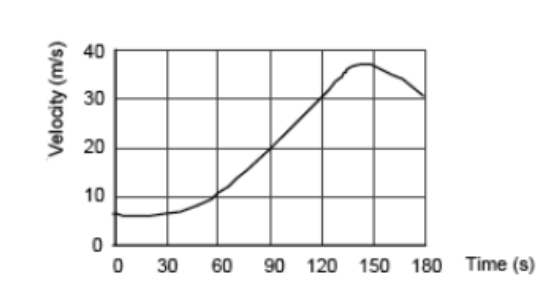 Velocity vs. time graph for a car
Topic: Newtonian Mechanics Metodi: Kinematic Equations, Graph Linearization Competenze: Graph Linearization Objects: Cart Fonte: Testo (PDF) — p.1
Il grafico mostra la velocità come funzione del tempo per un’auto. Qual era l’accelerazione in tempo = 90 secondi?
- A. 0.22 m/s²
- B. 0.33 m/s²
- C. 1.0 m/s²
- D. 9.8 m/s²
- E. 30 m/s²
Velocità vs. grafico temporale per un’auto
Topic: Newtonian Mechanics Metodi: Kinematic Equations, Graph Linearization Competenze: Graph Linearization Objects: Cart Fonte: Testo (PDF) — p.1
The coordinate of an object is given as a function of time by , where is in meters and is in seconds. Its average velocity over the interval from to s is
- A. −2 m/s
- B. −1 m/s
- C. −0.5 m/s
- D. 0.5 m/s
- E. 1 m/s
Topic: Newtonian Mechanics Metodi: Kinematic Equations Competenze: Mathematical Modeling Objects: — Fonte: Testo (PDF) — p.1
La coordinata di un oggetto è data come funzione del tempo da , dove è in metri e è in secondi. La sua velocità media nell’intervallo da a s è
- A. −2 m/s
- B. −1 m/s
- C. −0.5 m/s
- D. 0.5 m/s
- E. 1 m/s
Topic: Newtonian Mechanics Metodi: Kinematic Equations Competenze: Mathematical Modeling Objects: — Fonte: Testo (PDF) — p.1
An object is released from rest and falls a distance during the first second of time. How far will it fall during the next second of time?
- A.
- B.
- C.
- D.
- E.
Topic: Newtonian Mechanics Metodi: Kinematic Equations Competenze: Physical Reasoning Objects: — Fonte: Testo (PDF) — p.1
Un oggetto viene rilasciato dal riposo e cade a una distanza durante il primo secondo di tempo. Quanto cadrà nel prossimo secondo di tempo?
- A.
- B.
- C.
- D.
- E.
Topic: Newtonian Mechanics Metodi: Kinematic Equations Competenze: Physical Reasoning Objects: — Fonte: Testo (PDF) — p.1
A crate of toys remains at rest on a sleigh as the sleigh is pulled up a hill with an increasing speed. The crate is not fastened down to the sleigh. What force is responsible for the crate’s increase in speed up the hill?
- A. the force of static friction of the sleigh on the crate
- B. the contact force (normal force) of the ground on the sleigh
- C. the contact force (normal force) of the sleigh on the crate
- D. the gravitational force acting on the sleigh
- E. no force is needed
Topic: Newtonian Mechanics Metodi: Free-Body Diagram Competenze: Physical Reasoning Objects: Block, Cart, Inclined Plane Fonte: Testo (PDF) — p.2
Una scatola di giocattoli rimane a riposo su uno sciodo mentre lo sciodo viene tirato su una collina con una velocità crescente. La scatola non è attaccata al bagnino. Che forza è responsabile dell’aumento della velocità della cassa?
- A. la forza di attrito statico della slitta sulla cassa
- B. la forza di contatto (forza normale) del terreno sul trenino
- C. la forza di contatto (forza normale) della trinea sulla cassa
- D. la forza gravitazionale che agisce sul baglione
- E. non è necessaria alcuna forza
Topic: Newtonian Mechanics Metodi: Free-Body Diagram Competenze: Physical Reasoning Objects: Block, Cart, Inclined Plane Fonte: Testo (PDF) — p.2
At time a drag racer starts from rest at the origin and moves along a straight line with velocity given by , where is in m/s and in s. The expression for the displacement of the car from to time is
- A.
- B.
- C.
- D.
- E.
Topic: Newtonian Mechanics Metodi: Kinematic Equations, Calculus-Integration Competenze: Mathematical Modeling Objects: Cart Fonte: Testo (PDF) — p.2
Al tempo un drag racer parte dal riposo all’origine e si muove lungo una linea retta con velocità data da , dove è in m/s e in s. L’espressione per il spostamento della vettura da al tempo è
- A.
- B.
- C.
- D.
- E.
Topic: Newtonian Mechanics Metodi: Kinematic Equations, Calculus-Integration Competenze: Mathematical Modeling Objects: Cart Fonte: Testo (PDF) — p.2
The chemical potential energy stored in a battery is converted into kinetic energy in a toy car that increases its speed first from 0 mph to 2 mph and then from 2 mph up to 4 mph. Ignore the energy transferred to thermal energy due to friction and air resistance. Compared to the energy required to go from 0 to 2 mph, the energy required to go from 2 to 4 mph is
- A. half the amount.
- B. the same amount.
- C. twice the amount.
- D. three times the amount.
- E. four times the amount.
Topic: Conservation of Energy Metodi: Energy Conservation Method Competenze: Physical Reasoning Objects: Battery, Cart Fonte: Testo (PDF) — p.2
L’energia chimica potenziale immagazzinata in una batteria viene convertita in energia cinetica in un’auto da giocattoli che aumenta la sua velocità prima da 0 mph a 2 mph e poi da 2 mph a 4 mph. Ignorare l’energia trasferita all’energia termica a causa della friczione e della resistenza all’aria. Rispetto all’energia necessaria per andare da 0 a 2 mph, l’energia necessaria per andare da 2 a 4 mph è
- A. metà dell’importo.
- B. la stessa quantità.
- C. il doppio dell’importo.
- D. tre volte l’importo.
- E. quattro volte l’importo.
Topic: Conservation of Energy Metodi: Energy Conservation Method Competenze: Physical Reasoning Objects: Battery, Cart Fonte: Testo (PDF) — p.2
When two stars are very far apart their gravitational potential energy is zero; when they are separated by a distance the gravitational potential energy of the system is . If the stars are separated by a distance the gravitational potential energy of the system is
- A.
- B.
- C.
- D.
- E.
Topic: Gravitation Metodi: Newton’s Law of Gravitation Competenze: Physical Reasoning Objects: Star Fonte: Testo (PDF) — p.2
Quando due stelle sono molto distanti, la loro energia potenziale gravitazionale è zero; quando sono separate da una distanza , l’energia potenziale gravitazionale del sistema è . Se le stelle sono separate da una distanza , l’energia potenziale gravitazionale del sistema è
- A.
- B.
- C.
- D.
- E.
Topic: Gravitation Metodi: Newton’s Law of Gravitation Competenze: Physical Reasoning Objects: Star Fonte: Testo (PDF) — p.2
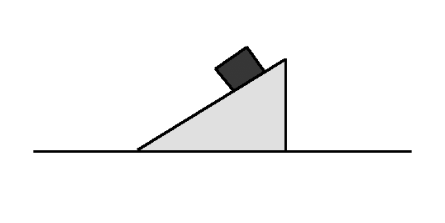
A large wedge rests on a horizontal frictionless surface, as shown. A block starts from rest and slides down the inclined surface of the wedge, which is rough. During the motion of the block, the center of mass of the block and wedge
- A. does not move
- B. moves horizontally with constant speed
- C. moves horizontally with increasing speed
- D. moves vertically with increasing speed
- E. moves both horizontally and vertically
 Block sliding down wedge on frictionless surface
Topic: Newtonian Mechanics, Conservation of Momentum Metodi: Conservation of Momentum, Free-Body Diagram Competenze: Physical Reasoning Objects: Block, Wedge, Inclined Plane Fonte: Testo (PDF) — p.3
Una grande cucina si posa su una superficie orizzontale senza attrito, come mostrato. Un blocco inizia dal riposo e scivola giù sulla superficie inclinata della cuccia, che è rugosa. Durante il movimento del blocco, il centro di massa del blocco e della cucina
- A. non si muove
- B. si muove orizzontalmente a velocità costante
- C. si muove orizzontalmente con velocità crescente
- D. si muove verticalmente con velocità crescente
- E. si muove sia orizzontale che verticale
Block scivolare giù la ciglia su superficie senza attrito
Topic: Newtonian Mechanics, Conservation of Momentum Metodi: Conservation of Momentum, Free-Body Diagram Competenze: Physical Reasoning Objects: Block, Wedge, Inclined Plane Fonte: Testo (PDF) — p.3
Two wheels with fixed hubs, each having a mass of 1 kg, start from rest, and forces are applied as shown. Assume the hubs and spokes are massless, so that the rotational inertia is . In order to impart identical angular accelerations about their respective hubs, how large must be?
- A. 0.25 N
- B. 0.5 N
- C. 1 N
- D. 2 N
- E. 4 N
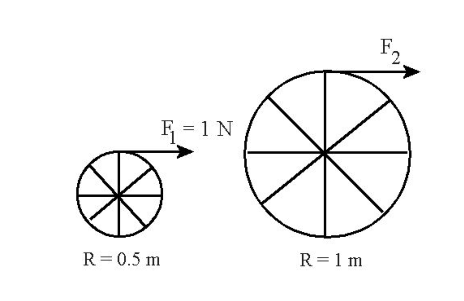 Two wheels with applied forces
Topic: Rotational Dynamics Metodi: Torque & Angular Momentum Analysis Competenze: Physical Reasoning, Diagrammatic Reasoning Objects: Wheel Fonte: Testo (PDF) — p.3
Due ruote con nodi fissi, ciascuna di una massa di 1 kg, partono da riposo e vengono applicate forze come illustrato. Supponiamo che gli hub e le spine siano senza massa, in modo che l’inerzia di rotazione sia . Per impartire le stesse accelerazioni angolari sui rispettivi nodi, quanto deve essere grande ?
- A. 0.25 N
- B. 0.5 N
- C. 1 N
- D. 2 N
- E. 4 N
Due ruote con forze applicate
Topic: Rotational Dynamics Metodi: Torque & Angular Momentum Analysis Competenze: Physical Reasoning, Diagrammatic Reasoning Objects: Wheel Fonte: Testo (PDF) — p.3
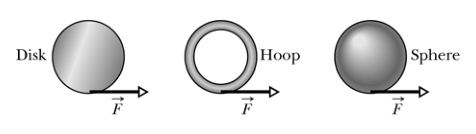
A uniform disk, a thin hoop, and a uniform sphere, all with the same mass and same outer radius, are each free to rotate about a fixed axis through its center. Assume the hoop is connected to the rotation axis by light spokes. With the objects starting from rest, identical forces are simultaneously applied to the rims, as shown. Rank the objects according to their kinetic energies after a given time , from least to greatest.
- A. disk, hoop, sphere
- B. sphere, disk, hoop
- C. hoop, sphere, disk
- D. disk, sphere, hoop
- E. hoop, disk, sphere
 Disk, hoop, sphere with rim forces applied
Topic: Rotational Dynamics Metodi: Torque & Angular Momentum Analysis, Conservation of Energy Competenze: Physical Reasoning, Diagrammatic Reasoning Objects: Disk, Sphere Fonte: Testo (PDF) — p.3
Un disco uniforme, un piccolo cerchio e una sfera uniforme, tutti con la stessa massa e lo stesso raggio esterno, sono liberi di ruotare intorno a un asse fisso attraverso il suo centro. Supponiamo che il cerchio sia collegato all’asse di rotazione da spugni di luce. Con gli oggetti che partono dal riposo, vengono applicate simultaneamente le stesse forze ai marciapiedi, come mostrato. Rendificare gli oggetti secondo le loro energie cinetiche dopo un determinato tempo , dal minimo al massimo.
- A. disco, cerchio, sfera
- B. sfera, disco, cerchio
- C. cerchio, sfera, disco
- D. disco, sfera, cerchio
- E. cerchio, disco, sfera
disco, cerchio, sfera con forze di bordo applicate
Topic: Rotational Dynamics Metodi: Torque & Angular Momentum Analysis, Conservation of Energy Competenze: Physical Reasoning, Diagrammatic Reasoning Objects: Disk, Sphere Fonte: Testo (PDF) — p.3
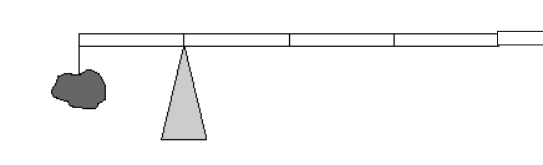
A 2-kg rock is suspended by a massless string from one end of a uniform 1-meter measuring stick. What is the mass of the measuring stick if it is balanced by a support force at the 0.20-meter mark?
- A. 0.20 kg
- B. 1.00 kg
- C. 1.33 kg
- D. 2.00 kg
- E. 3.00 kg
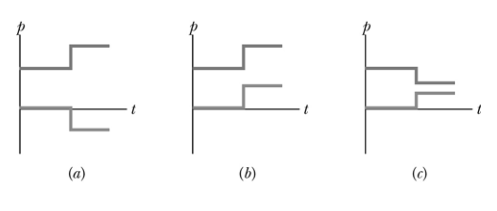 Measuring stick balanced at 0.20 m mark
Topic: Rigid Body Statics Metodi: Torque & Angular Momentum Analysis, Free-Body Diagram Competenze: Physical Reasoning Objects: Rod, String Fonte: Testo (PDF) — p.4
Una roccia di 2 kg è sospesa da una corda senza massa da una estremità di un bastone di misura uniforme di 1 metro. Qual è la massa del bastone di misura se è bilanciato da una forza di supporto al punto di 0,20 metri?
- A. 0.20 kg
- B. 1.00 kg
- C. 1.33 kg
- D. 2.00 kg
- E. 3.00 kg
*Stocco di misura bilanciato a 0,20 m *
Topic: Rigid Body Statics Metodi: Torque & Angular Momentum Analysis, Free-Body Diagram Competenze: Physical Reasoning Objects: Rod, String Fonte: Testo (PDF) — p.4
A particle moves along the x-axis. It collides elastically head-on with an identical particle initially at rest. Which of the following graphs could illustrate the momentum of each particle as a function of time?
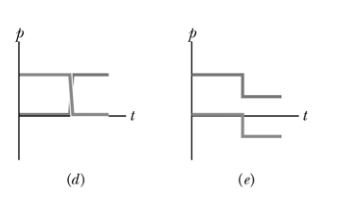 Momentum vs. time graphs for elastic collision
Topic: Conservation of Momentum Metodi: Conservation of Momentum, Conservation of Energy Competenze: Diagrammatic Reasoning, Physical Reasoning Objects: — Fonte: Testo (PDF) — p.4
Una particella si muove lungo l’asse x. Colpisce elasticamente di fronte ad una particella identica inizialmente a riposo. Quale dei grafici seguenti potrebbe illustrare l’impulso di ciascuna particella come funzione del tempo?
- Momento vs. grafici temporali per la collisione elastica*
Topic: Conservation of Momentum Metodi: Conservation of Momentum, Conservation of Energy Competenze: Diagrammatic Reasoning, Physical Reasoning Objects: — Fonte: Testo (PDF) — p.4
When the speed of a rear-drive car is increasing on a horizontal road, the direction of the frictional force on the tires is
- A. backward on the front tires and forward on the rear tires.
- B. forward on the front tires and backward on the rear tires.
- C. forward on all tires.
- D. backward on all tires.
- E. zero.
 Rear-drive car on horizontal road, friction diagram
Topic: Newtonian Mechanics Metodi: Free-Body Diagram Competenze: Physical Reasoning Objects: Cart, Wheel Fonte: Testo (PDF) — p.4
Quando la velocità di un’auto a motore posteriore aumenta su una strada orizzontale, la direzione della forza di attrito sulle gomme è
- A. verso l’indietro sulle gomme anteriori e in avanti sulle gomme posteriori.
- B. avanti sulle gomme anteriori e indietro sulle gomme posteriori.
- C. avanti su tutti i pneumatici.
- D. all’indietro su tutti i pneumatici.
- E. zero.
auto a motore posteriore su strada orizzontale, diagramma di attrito
Topic: Newtonian Mechanics Metodi: Free-Body Diagram Competenze: Physical Reasoning Objects: Cart, Wheel Fonte: Testo (PDF) — p.4
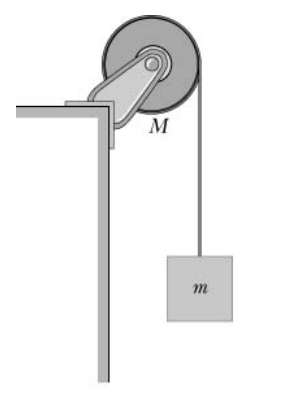
A uniform disk () of mass 8.0 kg can rotate without friction on a fixed axis. A string is wrapped around its circumference and is attached to a 6.0 kg mass. The string does not slip. What is the tension in the cord while the mass is falling?
- A. 20.0 N
- B. 24.0 N
- C. 34.3 N
- D. 60.0 N
- E. 80.0 N
 Disk on fixed axis with hanging mass
Topic: Rotational Dynamics Metodi: Torque & Angular Momentum Analysis, Free-Body Diagram, Newton’s Law of Gravitation Competenze: Physical Reasoning, Mathematical Modeling Objects: Disk, String, Block Fonte: Testo (PDF) — p.5
Un disco uniforme () di massa 8,0 kg può ruotare senza attrito su un asse fisso. Una corda è avvolta intorno alla sua circonferenza e è attaccata a una massa di 6,0 kg. La corda non scivola. Qual è la tensione del cordone mentre la massa sta scendendo?
- A. 20.0 N
- B. 24.0 N
- C. 34.3 N
- D. 60.0 N
- E. 80.0 N
Disco su asse fisso con massa appesa
Topic: Rotational Dynamics Metodi: Torque & Angular Momentum Analysis, Free-Body Diagram, Newton’s Law of Gravitation Competenze: Physical Reasoning, Mathematical Modeling Objects: Disk, String, Block Fonte: Testo (PDF) — p.5
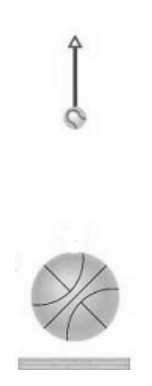
A baseball is dropped on top of a basketball. The basketball hits the ground, rebounds with a speed of 4.0 m/s, and collides with the baseball as it is moving downward at 4.0 m/s. After the collision, the baseball moves upward as shown in the figure and the basketball is instantaneously at rest right after the collision. The mass of the baseball is 0.2 kg and the mass of the basketball is 0.5 kg. Ignore air resistance and ignore any changes in velocities due to gravity during the very short collision times. The speed of the baseball right after colliding with the upward moving basketball is
- A. 4.0 m/s
- B. 6.0 m/s
- C. 8.0 m/s
- D. 12.0 m/s
- E. 16.0 m/s
 Baseball and basketball collision diagram
Topic: Conservation of Momentum Metodi: Conservation of Momentum, Impulse-Momentum Theorem Competenze: Physical Reasoning, Mathematical Modeling Objects: Ball Fonte: Testo (PDF) — p.5
Una palla da baseball viene gettata sulla palla da basket. Il basket colpisce il terreno, rimbalza a una velocità di 4,0 m/s e si schianta con il baseball mentre si muove verso il basso a 4,0 m/s. Dopo la collisione, il baseball si muove verso l’alto come mostrato nella figura e il basket è istantaneamente in riposo subito dopo la collisione. La massa della palla da baseball è di 0,2 kg e la massa della palla da basket è di 0,5 kg. Ignorare la resistenza dell’aria e ignorare eventuali cambiamenti di velocità dovuti alla gravità durante i tempi di collisione molto brevi. La velocità della palla da baseball dopo l’impatto con la palla da basket in movimento verso l’alto è
- A. 4.0 m/s
- B. 6.0 m/s
- C. 8.0 m/s
- D. 12.0 m/s
- E. 16.0 m/s
Diagramma di collisione di baseball e basket
Topic: Conservation of Momentum Metodi: Conservation of Momentum, Impulse-Momentum Theorem Competenze: Physical Reasoning, Mathematical Modeling Objects: Ball Fonte: Testo (PDF) — p.5
A small point-like object is thrown horizontally off of a 50.0-m high building with an initial speed of 10.0 m/s. At any point along the trajectory there is an acceleration component tangential to the trajectory and an acceleration component perpendicular to the trajectory. How many seconds after the object is thrown is the tangential component of the acceleration of the object equal to twice the perpendicular component of the acceleration of the object? Ignore air resistance.
- A. 2.00 s
- B. 1.50 s
- C. 1.00 s
- D. 0.50 s
- E. The building is not high enough for this to occur.
Topic: Newtonian Mechanics Metodi: Kinematic Equations, Vector Decomposition Competenze: Mathematical Modeling, Physical Reasoning Objects: Projectile Fonte: Testo (PDF) — p.5
Un piccolo oggetto di tipo punto viene gettato orizzontalmente da un edificio alto 50,0 m con una velocità iniziale di 10,0 m/s. In qualsiasi punto della traiettoria vi è una componente di accelerazione tangenziale alla traiettoria e una componente di accelerazione perpendicolare alla traiettoria. Quanti secondi dopo che l’oggetto è stato lanciato, la componente tangenziale dell’accelerazione dell’oggetto è uguale al doppio della componente perpendicolare dell’accelerazione dell’oggetto? Ignora la resistenza dell’aria.
- A. 2.00 s
- B. 1.50 s
- C. 1.00 s
- D. 0.50 s
- E. L’edificio non è abbastanza alto per permetterlo.
Topic: Newtonian Mechanics Metodi: Kinematic Equations, Vector Decomposition Competenze: Mathematical Modeling, Physical Reasoning Objects: Projectile Fonte: Testo (PDF) — p.5
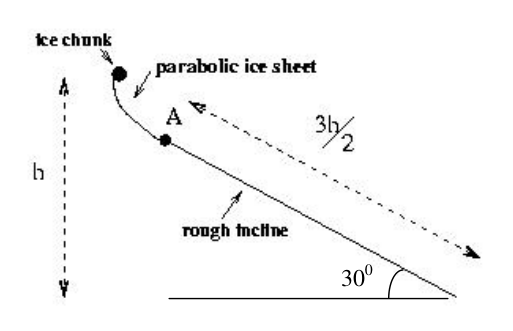
A small chunk of ice falls from rest down a frictionless parabolic ice sheet shown in the figure. At the point labeled A in the diagram, the ice sheet becomes a steady, rough incline of angle with respect to the horizontal and friction coefficient . This incline is of length and ends at a cliff. The chunk of ice comes to rest precisely at the end of the incline. What is the coefficient of friction ?
- A. 0.866
- B. 0.770
- C. 0.667
- D. 0.385
- E. 0.333
 Parabolic ice sheet with rough 30° incline
Topic: Newtonian Mechanics, Conservation of Energy Metodi: Energy Conservation Method, Free-Body Diagram Competenze: Physical Reasoning, Mathematical Modeling Objects: Inclined Plane, Block Fonte: Testo (PDF) — p.6
Un piccolo pezzo di ghiaccio cade dal riposo in un ghiaccio parabolico senza attrito mostrato nella figura. Al punto indicato A del diagramma, la calotta di ghiaccio diventa un’inclinazione costante e grosso dell’angolo rispetto al coefficiente orizzontale e di attrito . Questa inclinazione è di lunghezza e termina su una scogliera. Il pezzo di ghiaccio si riposa proprio alla fine dell’inclinazione. Qual è il coefficiente di attrito ?
- A. 0.866
- B. 0.770
- C. 0.667
- D. 0.385
- E. 0.333
Ghiaccio parabolico con inclinazione cruda 30°
Topic: Newtonian Mechanics, Conservation of Energy Metodi: Energy Conservation Method, Free-Body Diagram Competenze: Physical Reasoning, Mathematical Modeling Objects: Inclined Plane, Block Fonte: Testo (PDF) — p.6
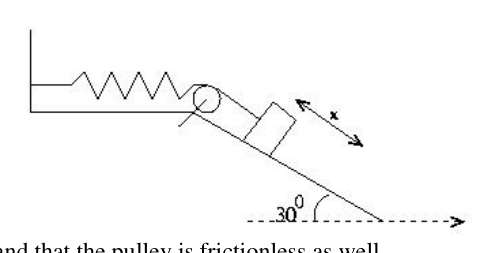
A non-Hookean spring has force , where is the spring constant and is the displacement from its unstretched position. For the system shown of a mass connected to an unstretched spring initially at rest, how far does the spring extend before the system momentarily comes to rest? Assume that all surfaces are frictionless and that the pulley is frictionless as well.
- A.
- B.
- C.
- D.
- E.
 Mass connected to non-Hookean spring over pulley
Topic: Conservation of Energy, Oscillations & Waves Metodi: Energy Conservation Method, Calculus-Integration Competenze: Mathematical Modeling, Physical Reasoning Objects: Spring, Pulley, Block Fonte: Testo (PDF) — p.6
Una molla non Hookean ha forza , dove è la costante della molla e è il spostamento dalla sua posizione non allungata. Per il sistema mostrato di una massa collegata a una molla non allungata inizialmente a riposo, fino a che punto la molla si estende prima che il sistema si riposasse momentaneamente? Supponiamo che tutte le superfici siano senza attrito e che la pollice sia senza attrito.
- A.
- B.
- C.
- D.
- E.
Massa collegata a sorgente non Hookean su pollice
Topic: Conservation of Energy, Oscillations & Waves Metodi: Energy Conservation Method, Calculus-Integration Competenze: Mathematical Modeling, Physical Reasoning Objects: Spring, Pulley, Block Fonte: Testo (PDF) — p.6
A point-like mass moves horizontally between two walls on a frictionless surface with initial kinetic energy . With every collision with the walls, the mass loses its kinetic energy to thermal energy. How many collisions with the walls are necessary before the speed of the mass is reduced by a factor of 8?
- A. 3
- B. 4
- C. 6
- D. 8
- E. 16
Topic: Conservation of Energy, Newtonian Mechanics Metodi: Energy Conservation Method Competenze: Mathematical Modeling, Physical Reasoning Objects: Block Fonte: Testo (PDF) — p.7
Una massa a punto si muove orizzontalmente tra due pareti su una superficie senza attrito con energia cinetica iniziale . Con ogni collisione con le pareti, la massa perde la sua energia cinetica a energia termica. Quante collisioni con le pareti sono necessarie prima che la velocità della massa venga ridotta di un fattore 8?
- A. 3
- B. 4
- C. 6
- D. 8
- E. 16
Topic: Conservation of Energy, Newtonian Mechanics Metodi: Energy Conservation Method Competenze: Mathematical Modeling, Physical Reasoning Objects: Block Fonte: Testo (PDF) — p.7
If the rotational inertia of a sphere about an axis through the center of the sphere is , what is the rotational inertia of another sphere that has the same density, but has twice the radius?
- A.
- B.
- C.
- D.
- E.
Topic: Rotational Dynamics Metodi: Dimensional Analysis, Physical Modeling Competenze: Physical Reasoning, Mathematical Modeling Objects: Sphere Fonte: Testo (PDF) — p.7
Se l’inerzia rotazionale di una sfera attorno ad un asse attraverso il centro della sfera è , qual è l’inerzia rotazionale di un’altra sfera che ha la stessa densità, ma ha il doppio del raggio?
- A.
- B.
- C.
- D.
- E.
Topic: Rotational Dynamics Metodi: Dimensional Analysis, Physical Modeling Competenze: Physical Reasoning, Mathematical Modeling Objects: Sphere Fonte: Testo (PDF) — p.7
Two rockets are in space in a negligible gravitational field. All observations are made by an observer in a reference frame in which both rockets are initially at rest. The masses of the rockets are and . A constant force acts on the rocket of mass for a distance . As a result, the rocket acquires a momentum . If the same constant force acts on the rocket of mass for the same distance , how much momentum does the rocket of mass acquire?
- A.
- B.
- C.
- D.
- E.
Topic: Newtonian Mechanics, Conservation of Momentum Metodi: Kinematic Equations, Impulse-Momentum Theorem Competenze: Physical Reasoning, Mathematical Modeling Objects: — Fonte: Testo (PDF) — p.7
Due razzi sono nello spazio in un campo gravitazionale trascurabile. Tutte le osservazioni sono effettuate da un osservatore in un quadro di riferimento in cui entrambi i razzi sono inizialmente a riposo. Le masse dei razzi sono e . Una forza costante agisce sul razzo di massa per una distanza . Di conseguenza, il razzo acquista un impulso . Se la stessa forza costante agisce sul razzo di massa per la stessa distanza , quanta forza acquista il razzo di massa ?
- A.
- B.
- C.
- D.
- E.
Topic: Newtonian Mechanics, Conservation of Momentum Metodi: Kinematic Equations, Impulse-Momentum Theorem Competenze: Physical Reasoning, Mathematical Modeling Objects: — Fonte: Testo (PDF) — p.7
If a planet of radius spins with an angular velocity about an axis through the North Pole, what is the ratio of the normal force experienced by a person at the equator to that experienced by a person at the North Pole? Assume a constant gravitational field and that both people are stationary relative to the planet and are at sea level.
- A.
- B.
- C.
- D.
- E.
Topic: Newtonian Mechanics, Gravitation Metodi: Free-Body Diagram, Kinematic Equations Competenze: Physical Reasoning, Mathematical Modeling Objects: Planet Fonte: Testo (PDF) — p.8
Se un pianeta di raggio ruota con una velocità angolare intorno ad un asse attraverso il Polo Nord, qual è il rapporto tra la forza normale vissuta da una persona all’equatore e quella vissuta da una persona al Polo Nord? Assume a constant gravitational field and that both people are stationary relative to the planet and are at sea level.
- A.
- B.
- C.
- D.
- E.
Topic: Newtonian Mechanics, Gravitation Metodi: Free-Body Diagram, Kinematic Equations Competenze: Physical Reasoning, Mathematical Modeling Objects: Planet Fonte: Testo (PDF) — p.8
A ball of mass is launched into the air. Ignore air resistance, but assume that there is a wind that exerts a constant force in the direction. In terms of and the acceleration due to gravity , at what angle above the positive -axis must the ball be launched in order to come back to the point from which it was launched?
- A.
- B.
- C.
- D. the angle depends on the launch speed
- E. no such angle is possible
Topic: Newtonian Mechanics Metodi: Kinematic Equations, Vector Decomposition Competenze: Physical Reasoning, Mathematical Modeling Objects: Ball, Projectile Fonte: Testo (PDF) — p.8
Si lancia in aria una palla di massa . Ignorare la resistenza dell’aria, ma supporre che ci sia un vento che esercita una forza costante nella direzione . In termini di e di accelerazione dovuta alla gravità , a quale angolo sopra l’asse positivo deve essere lanciata la palla per tornare al punto da cui è stata lanciata?
- A.
- B.
- C.
- D. l’angolo dipende dalla velocità di lancio
- E. non è possibile tale angolo
Topic: Newtonian Mechanics Metodi: Kinematic Equations, Vector Decomposition Competenze: Physical Reasoning, Mathematical Modeling Objects: Ball, Projectile Fonte: Testo (PDF) — p.8
Find the period of small oscillations of a water pogo, which is a stick of mass in the shape of a box (a rectangular parallelepiped). The stick has a length , a width and a height and is bobbing up and down in water of density . Assume that the water pogo is oriented such that the length and width are horizontal at all times. The buoyant force on an object is given by , where is the volume of the medium displaced by the object and is the density of the medium. Assume that at equilibrium, the pogo is floating.
- A.
- B.
- C.
- D.
- E.
Topic: Oscillations & Waves, Fluid Mechanics Metodi: Simple Harmonic Motion Analysis, Hydrostatic Equilibrium Competenze: Physical Reasoning, Mathematical Modeling Objects: Block Fonte: Testo (PDF) — p.8
Trova il periodo di piccole oscillazioni di un pogo di acqua, che è un bastone di massa a forma di scatola (parallepiped rectangulare). Il bastone ha una lunghezza , una larghezza e un’altezza e si gonfia su e giù in acqua di densità . Supponiamo che il pogo dell’acqua sia orientato in modo tale che la lunghezza e la larghezza siano sempre orizzontali. La forza di galleggiamento su un oggetto è data da , dove è il volume del mezzo spostato dall’oggetto e è la densità del mezzo. Supponiamo che all’equilibrio, il pogo stia galleggiando.
- A.
- B.
- C.
- D.
- E.
Topic: Oscillations & Waves, Fluid Mechanics Metodi: Simple Harmonic Motion Analysis, Hydrostatic Equilibrium Competenze: Physical Reasoning, Mathematical Modeling Objects: Block Fonte: Testo (PDF) — p.8
A sled loaded with children starts from rest and slides down a snowy (with respect to the horizontal) incline traveling 85 meters in 17 seconds. Ignore air resistance. What is the coefficient of kinetic friction between the sled and the slope? (5 pts.)
- A. 0.36
- B. 0.40
- C. 0.43
- D. 1.00
- E. 2.01
Topic: Newtonian Mechanics Metodi: Kinematic Equations, Free-Body Diagram Competenze: Mathematical Modeling, Physical Reasoning Objects: Inclined Plane Fonte: Testo (PDF) — p.9
Un bagliotto carico di bambini parte dal riposo e scivola su una pendenza innevata (rispetto all’orizzontale) che percorre 85 metri in 17 secondi. Ignora la resistenza dell’aria. Qual è il coefficiente di attrito cinetico tra la slitta e la pendenza? (5 pag.)
- A. 0.36
- B. 0.40
- C. 0.43
- D. 1.00
- E. 2.01
Topic: Newtonian Mechanics Metodi: Kinematic Equations, Free-Body Diagram Competenze: Mathematical Modeling, Physical Reasoning Objects: Inclined Plane Fonte: Testo (PDF) — p.9
A space station consists of two living modules attached to a central hub on opposite sides of the hub by long corridors of equal length. Each living module contains astronauts of equal mass. The mass of the space station is negligible compared to the mass of the astronauts, and the size of the central hub and living modules is negligible compared to the length of the corridors. At the beginning of the day, the space station is rotating so that the astronauts feel as if they are in a gravitational field of strength . Two astronauts, one from each module, climb into the central hub, and the remaining astronauts now feel a gravitational field of strength . What is the ratio in terms of ? (5 pts)
- A.
- B.
- C.
- D.
- E. none of the above
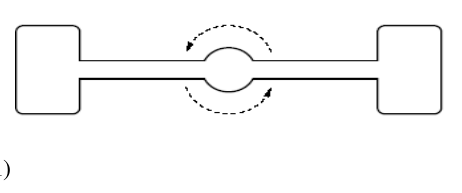 Space station with two modules on rotating corridors
Topic: Rotational Dynamics, Newtonian Mechanics Metodi: Torque & Angular Momentum Analysis Competenze: Mathematical Modeling, Physical Reasoning Objects: Satellite Fonte: Testo (PDF) — p.9
Una stazione spaziale è costituita da due moduli vivi collegati a un hub centrale su lati opposti del hub da lunghi corridoi di uguale lunghezza. Ogni modulo vivente contiene astronauti di massa uguale. La massa della stazione spaziale è trascurabile rispetto alla massa degli astronauti, e le dimensioni del centro e dei moduli vivi sono trascurabili rispetto alla lunghezza dei corridoi. All’inizio della giornata, la stazione spaziale ruota in modo che gli astronauti si sentano come se fossero in un campo gravitazionale di forza . Due astronauti, uno da ogni modulo, salire nel centro, e gli astronauti rimanenti ora sentono un campo gravitazionale di forza . Qual è il rapporto in termini di ? 5 punti)
- A.
- B.
- C.
- D.
- E. nessuna delle seguenti:
Stazione spaziale con due moduli su corridoi rotanti
Topic: Rotational Dynamics, Newtonian Mechanics Metodi: Torque & Angular Momentum Analysis Competenze: Mathematical Modeling, Physical Reasoning Objects: Satellite Fonte: Testo (PDF) — p.9
Questions 28–30: A simplified model of a bicycle of mass has two tires that each comes into contact with the ground at a point. The wheelbase of this bicycle (the distance between the points of contact with the ground) is , and the center of mass of the bicycle is located midway between the tires and a height above the ground. The bicycle is moving to the right, but slowing down at a constant rate. The acceleration has a magnitude . Air resistance may be ignored.
Case 1 (Questions 28–29): Assume that the coefficient of sliding friction between each tire and the ground is , and that both tires are skidding: sliding without rotating. Express your answers in terms of , , , and .
What is the maximum value of so that both tires remain in contact with the ground? (5 pts)
- A.
- B.
- C.
- D.
- E. none of the above
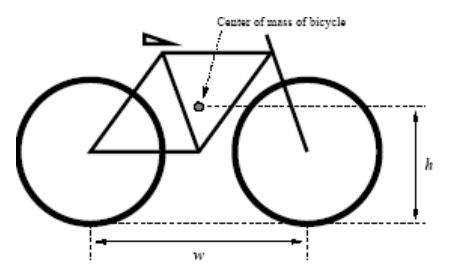 Bicycle model with wheelbase w, height h, decelerating
Topic: Rigid Body Statics, Newtonian Mechanics Metodi: Free-Body Diagram, Torque & Angular Momentum Analysis Competenze: Physical Reasoning, Mathematical Modeling Objects: Wheel Fonte: Testo (PDF) — p.10
**Questioni 2830: ** Un modello semplificato di bicicletta di massa ha due pneumatici che entrano ciascun punto in contatto con il terreno. L’intervallo di rotazione di questa bicicletta (la distanza tra i punti di contatto con il terreno) è , e il centro di massa della bicicletta si trova a metà strada tra le gomme e un’altezza sopra il terreno. La bicicletta si muove a destra, ma rallenta a un ritmo costante. L’accelerazione ha una magnitudine . La resistenza all’aria può essere ignorata.
**Caso 1 (domande 2829): ** Supponiamo che il coefficiente di attrito scorrevole tra ciascun pneumatico e il terreno sia , e che entrambi i pneumatici scivolassero: scorrevano senza ruotare. Esprimere le risposte in termini di , , e .
Qual è il valore massimo di in modo che entrambi i pneumatici rimangano in contatto con il terreno? 5 punti)
- A.
- B.
- C.
- D.
- E. nessuna delle seguenti:
Modello di bicicletta con base di ruote w, altezza h, rallentamento
Topic: Rigid Body Statics, Newtonian Mechanics Metodi: Free-Body Diagram, Torque & Angular Momentum Analysis Competenze: Physical Reasoning, Mathematical Modeling Objects: Wheel Fonte: Testo (PDF) — p.10
Case 1 (continued): What is the maximum value of so that both tires remain in contact with the ground? (5 pts)
- A.
- B.
- C.
- D.
- E. none of the above
Topic: Rigid Body Statics, Newtonian Mechanics Metodi: Free-Body Diagram, Torque & Angular Momentum Analysis Competenze: Physical Reasoning, Mathematical Modeling Objects: Wheel Fonte: Testo (PDF) — p.11
Caso 1 (continuato): Qual è il valore massimo di in modo che entrambe le gomme rimangano in contatto con il terreno? 5 punti)
- A.
- B.
- C.
- D.
- E. nessuna delle seguenti:
Topic: Rigid Body Statics, Newtonian Mechanics Metodi: Free-Body Diagram, Torque & Angular Momentum Analysis Competenze: Physical Reasoning, Mathematical Modeling Objects: Wheel Fonte: Testo (PDF) — p.11
Case 2: Assume, instead, that the coefficient of sliding friction between each tire and the ground is different: for the front tire and for the rear tire. Let .
Assume that both tires are skidding: sliding without rotating. What is the maximum value of so that both tires remain in contact with the ground? (5 pts)
- A.
- B.
- C.
- D.
- E. none of the above
Topic: Rigid Body Statics, Newtonian Mechanics Metodi: Free-Body Diagram, Torque & Angular Momentum Analysis Competenze: Physical Reasoning, Mathematical Modeling Objects: Wheel Fonte: Testo (PDF) — p.11
**Caso 2: ** Supponiamo invece che il coefficiente di attrito scorrevole tra ciascun pneumatico e il terreno sia diverso: per il pneumatico anteriore e per il pneumatico posteriore. Lasciate .
Supponiamo che entrambe le gomme scivolassero: scivolavano senza ruotare. Qual è il valore massimo di in modo che entrambi i pneumatici rimangano in contatto con il terreno? 5 punti)
- A.
- B.
- C.
- D.
- E. nessuna delle seguenti:
Topic: Rigid Body Statics, Newtonian Mechanics Metodi: Free-Body Diagram, Torque & Angular Momentum Analysis Competenze: Physical Reasoning, Mathematical Modeling Objects: Wheel Fonte: Testo (PDF) — p.11
Questions 31–33: A thin, uniform rod has mass and length . Let the acceleration due to gravity be . Let the rotational inertia of the rod about its center be .
Find the ratio . (3 pts)
- A.
- B.
- C.
- D.
- E. none of the above
Topic: Rotational Dynamics, Rigid Body Statics Metodi: Torque & Angular Momentum Analysis Competenze: Mathematical Modeling, Physical Reasoning Objects: Rod Fonte: Testo (PDF) — p.12
**Domanda 3133: ** Una canna sottile e uniforme ha massa e lunghezza . L’accelerazione dovuta alla gravità deve essere . L’inerzia di rotazione della canna intorno al suo centro sia .
Trova il rapporto . (3 punti)
- A.
- B.
- C.
- D.
- E. nessuna delle seguenti:
Topic: Rotational Dynamics, Rigid Body Statics Metodi: Torque & Angular Momentum Analysis Competenze: Mathematical Modeling, Physical Reasoning Objects: Rod Fonte: Testo (PDF) — p.12
The rod is suspended from a point a distance from the center, and undergoes small oscillations with an angular frequency .
Find an expression for in terms of . (7 pts)
- A.
- B.
- C.
- D.
- E. none of the above
Topic: Oscillations & Waves, Rotational Dynamics Metodi: Simple Harmonic Motion Analysis, Torque & Angular Momentum Analysis Competenze: Mathematical Modeling Objects: Rod, Pendulum Fonte: Testo (PDF) — p.12
La canna è sospesa da un punto a una distanza dal centro e subisce piccole oscillazioni con una frequenza angolare .
Trova un’espressione per in termini di . (7 punti)
- A.
- B.
- C.
- D.
- E. nessuna delle seguenti:
Topic: Oscillations & Waves, Rotational Dynamics Metodi: Simple Harmonic Motion Analysis, Torque & Angular Momentum Analysis Competenze: Mathematical Modeling Objects: Rod, Pendulum Fonte: Testo (PDF) — p.12
Find the maximum value of . (5 pts)
- A. 1
- B.
- C.
- D. does not attain a maximum value
- E. none of the above
Topic: Oscillations & Waves, Rotational Dynamics Metodi: Simple Harmonic Motion Analysis, Calculus-Integration Competenze: Mathematical Modeling Objects: Rod, Pendulum Fonte: Testo (PDF) — p.12
Trova il valore massimo di . 5 punti)
- A. 1
- B.
- C.
- D. non raggiunge un valore massimo
- E. nessuna delle seguenti:
Topic: Oscillations & Waves, Rotational Dynamics Metodi: Simple Harmonic Motion Analysis, Calculus-Integration Competenze: Mathematical Modeling Objects: Rod, Pendulum Fonte: Testo (PDF) — p.12
Questions 34–36: A point object of mass is connected to a cylinder of radius via a massless rope. At time the object is moving with an initial velocity perpendicular to the rope, the rope has a length , and the rope has a non-zero tension. All motion occurs on a horizontal frictionless surface. The cylinder remains stationary on the surface and does not rotate. The object moves in such a way that the rope slowly winds up around the cylinder. The rope will break when the tension exceeds . Express your answers in terms of , , , , and .
What is the angular momentum of the object with respect to the axis of the cylinder at the instant that the rope breaks? (6 pts)
- A.
- B.
- C.
- D.
- E. none of the above
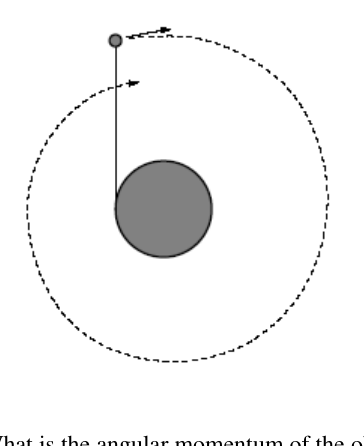 Mass winding rope around stationary cylinder
Topic: Rotational Dynamics, Conservation of Momentum Metodi: Torque & Angular Momentum Analysis, Conservation Laws Competenze: Mathematical Modeling, Physical Reasoning Objects: Cylinder, String Fonte: Testo (PDF) — p.13
**Questioni 3436: ** Un oggetto puntino di massa è collegato a un cilindro di raggio tramite una corda senza massa. Al tempo l’oggetto si muove con una velocità iniziale perpendicolare alla corda, la corda ha una lunghezza , e la corda ha una tensione non zero. Tutto il movimento avviene su una superficie orizzontale senza attrito. Il cilindro rimane fermo sulla superficie e non ruota. L’oggetto si muove in modo tale che la corda si gira lentamente intorno al cilindro. La corda si rompe quando la tensione supera . Esprimere le risposte in termini di , , , e .
Qual è il momento angolare dell’oggetto rispetto all’asse del cilindro nel momento in cui la corda si rompe? 6 punti)
- A.
- B.
- C.
- D.
- E. nessuna delle seguenti:
Riccio di avvolgimento di massa intorno al cilindro fisso
Topic: Rotational Dynamics, Conservation of Momentum Metodi: Torque & Angular Momentum Analysis, Conservation Laws Competenze: Mathematical Modeling, Physical Reasoning Objects: Cylinder, String Fonte: Testo (PDF) — p.13
What is the kinetic energy of the object at the instant that the rope breaks? (4 pts)
- A.
- B.
- C.
- D.
- E. none of the above
Topic: Rotational Dynamics, Conservation of Energy Metodi: Energy Conservation Method, Torque & Angular Momentum Analysis Competenze: Mathematical Modeling Objects: Cylinder, String Fonte: Testo (PDF) — p.14
Qual è l’energia cinetica dell’oggetto nel momento in cui la corda si rompe? (4 punti)
- A.
- B.
- C.
- D.
- E. nessuna delle seguenti:
Topic: Rotational Dynamics, Conservation of Energy Metodi: Energy Conservation Method, Torque & Angular Momentum Analysis Competenze: Mathematical Modeling Objects: Cylinder, String Fonte: Testo (PDF) — p.14
What is the length (not yet wound) of the rope at the instant it breaks? (6 pts)
- A.
- B.
- C.
- D.
- E. none of the above
Topic: Rotational Dynamics, Conservation of Momentum Metodi: Torque & Angular Momentum Analysis, Conservation Laws Competenze: Mathematical Modeling, Physical Reasoning Objects: Cylinder, String Fonte: Testo (PDF) — p.14
Qual è la lunghezza della corda quando si rompe? 6 punti)
- A.
- B.
- C.
- D.
- E. nessuna delle seguenti:
Topic: Rotational Dynamics, Conservation of Momentum Metodi: Torque & Angular Momentum Analysis, Conservation Laws Competenze: Mathematical Modeling, Physical Reasoning Objects: Cylinder, String Fonte: Testo (PDF) — p.14
Questions 37–38: A massless elastic cord (that obeys Hooke’s Law) will break if the tension in the cord exceeds . One end of the cord is attached to a fixed point, the other is attached to an object of mass . If a second, smaller object of mass moving at an initial speed strikes the larger mass and the two stick together, the cord will stretch and break, but the final kinetic energy of the two masses will be zero. If instead the two collide with a perfectly elastic one-dimensional collision, the cord will still break, and the larger mass will move off with a final speed of . All motion occurs on a horizontal, frictionless surface.
Find . (7 pts)
- A.
- B.
- C.
- D.
- E. none of the above
Topic: Conservation of Momentum, Conservation of Energy Metodi: Conservation of Momentum, Conservation of Energy Competenze: Mathematical Modeling, Physical Reasoning Objects: Spring, Block Fonte: Testo (PDF) — p.15
**Domanda 3738: ** Un cavo elastico senza massa (che obbedisce alla legge di Hooke) si rompe se la tensione del cavo supera . Un’estremità del cavo è fissata a un punto fisso, l’altra è fissata ad un oggetto di massa . Se un secondo oggetto di massa in movimento a una velocità iniziale colpisce la massa più grande e i due si attaccano insieme, il cavo si allungerà e si romperà, ma l’energia cinetica finale delle due masse sarà zero. Se invece le due collidono con una collisione unidimensional perfettamente elastica, il cavo si rompe ancora, e la massa più grande si sposta con una velocità finale di . Tutto il movimento avviene su una superficie orizzontale e senza attrito.
Trova . (7 punti)
- A.
- B.
- C.
- D.
- E. nessuna delle seguenti:
Topic: Conservation of Momentum, Conservation of Energy Metodi: Conservation of Momentum, Conservation of Energy Competenze: Mathematical Modeling, Physical Reasoning Objects: Spring, Block Fonte: Testo (PDF) — p.15
Find the ratio of the total kinetic energy of the system of two masses after the perfectly elastic collision and the cord has broken to the initial kinetic energy of the smaller mass prior to the collision. (7 pts)
- A.
- B.
- C.
- D.
- E. none of the above
Topic: Conservation of Energy, Conservation of Momentum Metodi: Conservation of Energy, Conservation of Momentum Competenze: Mathematical Modeling, Physical Reasoning Objects: Spring, Block Fonte: Testo (PDF) — p.15
Trova il rapporto tra l’energia cinetica totale del sistema di due masse dopo la collisione perfettamente elastica e il cavo rotto e l’energia cinetica iniziale della massa più piccola prima della collisione. (7 punti)
- A.
- B.
- C.
- D.
- E. nessuna delle seguenti:
Topic: Conservation of Energy, Conservation of Momentum Metodi: Conservation of Energy, Conservation of Momentum Competenze: Mathematical Modeling, Physical Reasoning Objects: Spring, Block Fonte: Testo (PDF) — p.15