A1. A group of 12 resistors is arranged along the edges of a cube. The vertices of the cube are labeled a–h.
(a) (13 pts) The resistance between each pair of vertices is as follows:
What is the equivalent resistance between points and ?
(b) (12 pts) The three resistors are replaced by identical capacitors: . A battery is attached across points and and the circuit is allowed to operate for a long period of time. What is the charge (, , ) on each capacitor after this long period of time?
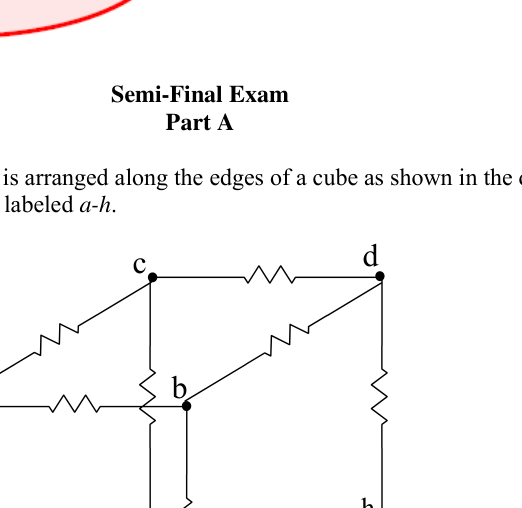 Cube of 12 resistors, vertices a–h
Topic: Circuits, Electrostatics Metodi: Equivalent Circuit Reduction, Kirchhoff’s Laws, Symmetry Argument Competenze: Diagrammatic Reasoning, Physical Reasoning Objects: Resistor, Capacitor, Battery Fonte: Testo (PDF) — p.2
A1. Un gruppo di 12 resistori è disposto lungo i bordi di un cubo. I vertici del cubo sono etichettati ah.
**(a) ** (13 punti) La resistenza tra ciascuna coppia di vertici è la seguente:
Qual è la resistenza equivalente tra i punti e ?
**(b) ** (12 punti) Le tre resistenze sono sostituite da condensatori identici: . Una batteria è collegata tra i punti e e il circuito può funzionare per un lungo periodo di tempo. Qual è la carica (, , ) su ciascun condensatore dopo questo lungo periodo di tempo?
cubo di 12 resistori, vertici ah
Topic: Circuits, Electrostatics Metodi: Equivalent Circuit Reduction, Kirchhoff’s Laws, Symmetry Argument Competenze: Diagrammatic Reasoning, Physical Reasoning Objects: Resistor, Capacitor, Battery Fonte: Testo (PDF) — p.2
A2. A simple gun can be made from a uniform cylinder of length and inside radius . One end of the cylinder is sealed with a moveable plunger and the other end is plugged with a cylindrical cork bullet. The bullet is held in place by friction with the walls of the cylinder. The pressure outside the cylinder is atmospheric pressure . The bullet will just start to slide out of the cylinder if the pressure inside the cylinder exceeds .
(a) There are two ways to launch the bullet: either by heating the gas inside the cylinder and keeping the plunger fixed, or by suddenly pushing the plunger into the cylinder. In either case, assume that an ideal monatomic gas is inside the cylinder, and that originally the gas is at temperature , the pressure inside the cylinder is , and the length of the cylinder is .
(i) (8 pts) Assume that we launch the bullet by heating the gas without moving the plunger. Find the minimum temperature of the gas necessary to launch the bullet. Express your answer in terms of any or all of the variables: , , , , .
(ii) (8 pts) Assume, instead, that we launch the bullet by pushing in the plunger, and that we do so quickly enough so that no heat is transferred into or out of the gas. Find the length of the gas column inside the cylinder when the bullet just starts to move. Express your answer in terms of any or all of the variables: , , , , .
(b) (9 pts) It is necessary to squeeze the bullet to get it into the cylinder in the first place. The bullet normally has a radius that is slightly larger than the inside radius of the cylinder; , which is small compared to . The bullet has a length . The walls of the cylinder apply a pressure to the cork bullet. When a pressure is applied to the bullet along a given direction, the bullet’s dimensions in that direction change by
for a constant known as Young’s modulus. You may assume that compression along one direction does not cause expansion in any other direction (Poisson ratio close to zero, true for cork).
If the coefficient of static friction between the cork and the cylinder is , find an expression for . Express your answer in terms of any or all of the variables: , , , , , .
Topic: Thermodynamics, Elasticity & Materials Metodi: Ideal Gas Law, First Law of Thermodynamics, Stress-Strain Analysis Competenze: Mathematical Modeling, Physical Reasoning Objects: Gas, Cylinder, Piston Fonte: Testo (PDF) — p.3
A2. Una pistola semplice può essere realizzata da un cilindro uniforme di lunghezza e di raggio interno . Un’estremità del cilindro è sigillata con un punte mobile e l’altra è collegata con un proiettile cilindrico di corteccia. Il proiettile si tiene in posizione mediante attrito con le pareti del cilindro. La pressione esterna al cilindro è la pressione atmosferica . Il proiettile inizierà a scivolare fuori dal cilindro se la pressione all’interno del cilindro supera .
**(a) ** Ci sono due modi per lanciare il proiettile: riscaldando il gas all’interno del cilindro e mantenendo il puntecchio fisso, o spingendo improvvisamente il puntecchio nel cilindro. In entrambi i casi, supponiamo che un gas monatomo ideale sia all’interno del cilindro, e che originariamente il gas sia a temperatura , la pressione all’interno del cilindro sia e la lunghezza del cilindro sia .
Supponiamo di lanciare il proiettile riscaldando il gas senza spostare il punte. Trova la temperatura minima del gas necessaria per lanciare il proiettile. Esprimere la risposta in termini di una o tutte le variabili: , , , , .
**(ii) ** (8 pts) Supponiamo invece che lanciamo il proiettile spingendo nel plunger, e che lo facciamo abbastanza rapidamente in modo che non venga trasferito calore nel gas o fuori. Trova la lunghezza della colonna di gas all’interno del cilindro quando il proiettile comincia a muoversi. Esprimere la risposta in termini di una o tutte le variabili: , , , , .
**(b) ** (9 pts) È necessario premere il proiettile per inserirlo in primo luogo nel cilindro. Il proiettile ha normalmente un raggio leggermente superiore al raggio interno del cilindro; , che è piccolo rispetto a . Il proiettile ha una lunghezza . Le pareti del cilindro applicano una pressione al proiettile di corteccia. Quando una pressione viene applicata al proiettile lungo una determinata direzione, le dimensioni del proiettile in tale direzione cambiano di:
per una costante nota come modulo di Young. Si può presumere che la compressione lungo una direzione non provochi espansione in un’altra direzione (quota di Poisson vicina a zero, vera per il sughero).
Se il coefficiente di attrito statico tra il galleggiante e il cilindro è , trovare un’espressione per . Esprimere la risposta in termini di una o tutte le variabili: , , , , , .
Topic: Thermodynamics, Elasticity & Materials Metodi: Ideal Gas Law, First Law of Thermodynamics, Stress-Strain Analysis Competenze: Mathematical Modeling, Physical Reasoning Objects: Gas, Cylinder, Piston Fonte: Testo (PDF) — p.3
A3. A volume of fluid with uniform charge density is sprayed into a room, forming spherical drops. As they float around the room, the drops may break apart into smaller drops or coalesce into larger ones. Suppose that all of the drops have radius . Ignore inter-drop forces and assume that .
(a) (10 pts) Calculate the electrostatic potential energy of a single drop. (Hint: suppose the sphere has radius . How much work is required to increase the radius by ?)
(b) (4 pts) What is the total electrostatic energy of the drops?
Your answer to (b) should indicate that the total energy increases with . In the absence of surface tension, then, the fluid would break apart into infinitesimally small drops. Suppose, however, that the fluid has a surface tension (potential energy per unit surface area, positive).
(c) (4 pts) What is the total energy of the drops due to surface tension?
(d) (7 pts) What is the equilibrium radius of the drops?
Topic: Electrostatics, Fluid Mechanics Metodi: Calculus-Integration, Electric Potential Method, Energy Conservation Method Competenze: Mathematical Modeling, Physical Reasoning Objects: Droplet Fonte: Testo (PDF) — p.4
A3. Un volume di fluido con densità di carica uniforme viene spruzzato in una stanza, formando gocce sferiche. Mentre galleggiano intorno alla stanza, le gocce possono rompersi in piccole gocce o fondere in più grandi. Supponiamo che tutte le gocce abbiano un raggio . Ignorare le forze inter-goccia e supporre che .
** a) ** (10 punti) Calcolare l’energia potenziale elettrostatica di una singola goccia. (Insigno: supponiamo che la sfera abbia un raggio . Quanto lavoro è necessario per aumentare il raggio di ?)
**(b) ** (4 pts) Qual è l’energia elettrostatica totale delle gocce?
La risposta alla lettera b) deve indicare che l’energia totale aumenta con . In assenza di tensione superficiale, quindi, il fluido si spezzerebbe in infinite gocce. Supponiamo, tuttavia, che il fluido abbia una tensione superficiale (energia potenziale per unità di superficie, positiva).
**(c) ** (4 pts) Qual è l’energia totale delle gocce dovuta alla tensione superficiale?
**(d) ** (7 pts) Qual è il raggio di equilibrio delle gocce?
Topic: Electrostatics, Fluid Mechanics Metodi: Calculus-Integration, Electric Potential Method, Energy Conservation Method Competenze: Mathematical Modeling, Physical Reasoning Objects: Droplet Fonte: Testo (PDF) — p.4
A4. A nonlinear circuit element can be made out of a parallel plate capacitor and small balls, each of mass , that can move between the plates. The balls collide inelastically with the plates, dissipate all kinetic energy as thermal energy, and immediately release the charge they are carrying to the plate. Almost instantaneously, the balls then pick up a small charge of magnitude from the plate; the balls are then repelled directly toward the other plate under electrostatic forces only. Another collision happens, kinetic energy is dissipated, the balls give up the charge, collect a new charge, and the cycle repeats. There are balls per unit surface area of the plate. The capacitor has a capacitance . The separation between the plates is much larger than the radius of the balls. A battery is connected to the plates in order to maintain a constant potential difference . Neglect edge effects and assume that magnetic forces and gravitational forces may be ignored.
(a) (5 pts) Determine the time it takes for one ball to travel between the plates in terms of any or all of the following variables: , , , and .
(b) (5 pts) Calculate the kinetic energy dissipated as thermal energy when one ball collides inelastically with a plate surface in terms of any or all of the following variables: , , , and .
(c) (5 pts) Derive an expression for the current between the plates in terms of the permittivity of free space , and any or all of the following variables: , , , , and .
(d) (5 pts) Derive an expression for the effective resistance of the device in terms of , and any or all of the following variables: , , , , and .
(e) (5 pts) Calculate the rate at which the kinetic energy of the balls is converted into thermal energy in terms of , and any or all of the following variables: , , , , and .
Topic: Circuits, Electrostatics Metodi: Kinematic Equations, Electric Potential Method, Physical Modeling Competenze: Mathematical Modeling, Physical Reasoning Objects: Capacitor, Ball, Battery Fonte: Testo (PDF) — p.5
A4. Un elemento di circuito non lineare può essere realizzato da un condensatore di piastre parallele e da piccole palle, ciascuna di massa , che possono muoversi tra le piastre. Le palle collidono inelasticamente con le lastre, dissipano tutta l’energia cinetica come energia termica e rilasciano immediatamente la carica che portano sulla lastra. Quasi istantaneamente, le palle raccolgono poi una piccola carica di magnitudo dalla piastra; le palle vengono quindi respinte direttamente verso l’altra piastra solo sotto forze elettrostatiche. Succede un’altra collisione, l’energia cinetica viene dissipata, le palle abbandonano la carica, raccolgono una nuova carica e il ciclo si ripete. Ci sono sfere per unità di superficie della piastra. Il condensatore ha una capacità . La separazione tra le piastre è molto maggiore del raggio delle palle. Una batteria è collegata alle piastre per mantenere una differenza di potenziale costante . Ignorare gli effetti di bordo e supporre che le forze magnetiche e le forze gravitazionali possano essere ignorate.
**(a) ** (5 punti) Determina il tempo necessario per un palla per viaggiare tra le piastre in termini di una o tutte le seguenti variabili: , , e .
**(b) ** (5 punti) Calcolare l’energia cinetica dissipata come energia termica quando una palla colpisce inelasticamente con una superficie della piastra in termini di una o tutte le seguenti variabili: , , e .
**(c) ** (5 pts) Derivare un’espressione per la corrente tra le piastre in termini di permissività dello spazio libero , e di una o tutte le seguenti variabili: , , , e .
**(d) ** (5 punti) Derivare un’espressione per la resistenza effettiva del dispositivo in termini di e di una o tutte le seguenti variabili: , , , e .
**(e) ** (5 punti) Calcolare la velocità con cui l’energia cinetica delle palle viene convertita in energia termica in termini di , e di una o tutte le seguenti variabili: , , , e .
Topic: Circuits, Electrostatics Metodi: Kinematic Equations, Electric Potential Method, Physical Modeling Competenze: Mathematical Modeling, Physical Reasoning Objects: Capacitor, Ball, Battery Fonte: Testo (PDF) — p.5
B1. A certain mechanical oscillator can be modeled as an ideal massless spring connected to a moveable plate on an incline. The spring has spring constant , the plate has mass , and the incline makes an angle with the horizontal. When the system is operating correctly, the plate oscillates between points and in the figure, located a distance apart. When the plate reaches point it has zero kinetic energy, but then trips a small lever that instantaneously loads a block of mass onto the plate. The block and plate then move down the incline to point , where the force from the spring stops the plate. At this point, the block falls through a hole in the incline, allowing the plate to move back up under the force of the spring. Upon returning to point it collects another block, and the cycle repeats. Both the plate and the block have a coefficient of friction with the incline for both kinetic and static friction. It is reasonable that the motion in either direction is simple harmonic in nature.
(a) (10 pts) Let be the critical value of the coefficient of friction where the block will just start to slide under the force of gravity on an incline (without the spring acting on it). Then let . Find in terms of , the acceleration of free fall, and any or all of the following variables: and .
(b) (14 pts) In order for this system to work correctly, it is necessary to have the correct ratio between the mass of the block and the mass of the plate. These masses are chosen so that the downward moving block and plate just stop at point while the upward moving plate just stops at point . Find the ratio .
(c) (13 pts) The system delivers blocks to point with period , until the blocks run out. After that, the plate alone oscillates with a period . Find the ratio .
(d) (13 pts) The plate only oscillates a few times after delivering the last block. At what distance up the incline, measured from point , does the plate come to a permanent stop?
 Spring-plate oscillator on incline, points A and B
Topic: Oscillations & Waves, Newtonian Mechanics Metodi: Simple Harmonic Motion Analysis, Free-Body Diagram, Conservation of Energy Competenze: Mathematical Modeling, Physical Reasoning Objects: Spring, Inclined Plane, Block Fonte: Testo (PDF) — p.6
Un certo oscillatore meccanico può essere modellato come una molla ideale senza massa collegata a una piastra mobile inclinata. La molla ha costante , la piastra ha massa e l’inclinazione fa un angolo con l’orizzontale. Quando il sistema funziona correttamente, la piastra oscilla tra i punti e della figura, situati a una distanza . Quando la piastra raggiunge il punto ha energia cinetica zero, ma poi scatena una piccola leva che carica istantaneamente sul piastra un blocco di massa . Il blocco e la piastra si spostano poi verso il basso verso il punto , dove la forza della sorgente ferma la piastra. A questo punto, il blocco cade attraverso un buco nella pendenza, consentendo alla piastra di muoversi di nuovo su sotto la forza della molla. Al ritorno al punto viene raccolto un altro blocco e il ciclo si ripete. Sia la piastra che il blocco hanno un coefficiente di attrito con inclinazione sia per la frizione cinetica che per quella statica. È ragionevole che il movimento in entrambe le direzioni sia di natura armonica semplice.
**(a) ** (10 pts) sia il valore critico del coefficiente di attrito in cui il blocco comincerà a scivolare sotto la forza di gravità su un’inclinazione (senza che la molla agisca su di esso). Quindi lasciate . Trova in termini di , l’accelerazione della caduta libera e di una o tutte le seguenti variabili: e .
**(b) ** (14 pts) Per funzionare correttamente, è necessario avere il corretto rapporto tra la massa del blocco e la massa della piastra. Queste masse sono scelte in modo che il blocco e la piastra in movimento verso il basso si fermi al punto mentre la piastra in movimento verso l’alto si ferma al punto . Trova il rapporto .
**(c) ** (13 punti) Il sistema fornisce i blocchi al punto con periodo , fino a quando i blocchi non si esauriscono. Dopo di che, la sola piastra oscilla con un periodo . Trova il rapporto .
**(d) ** (13 punti) La piastra oscilla solo qualche volta dopo l’arrivo dell’ultimo blocco. A che distanza in salita, misurata dal punto , la piastra si ferma permanentemente?
Oscillatore di piastra a molla, punti A e B
Topic: Oscillations & Waves, Newtonian Mechanics Metodi: Simple Harmonic Motion Analysis, Free-Body Diagram, Conservation of Energy Competenze: Mathematical Modeling, Physical Reasoning Objects: Spring, Inclined Plane, Block Fonte: Testo (PDF) — p.6
B2. A model of the magnetic properties of materials is based upon small magnetic moments generated by each atom in the material. One source of this magnetic moment is the magnetic field generated by the electron in its orbit around the nucleus. For simplicity, we will assume that each atom consists of a single electron of charge and mass , a single proton of charge and mass , and that the electron orbits in a circular orbit of radius about the proton.
a. Magnetic Moments.
Assume that the electron orbits in the - plane.
(i) (3 pts) Calculate the net electrostatic force on the electron from the proton. Express your answer in terms of any or all of the following parameters: , , , , and the permittivity of free space , where .
(ii) (5 pts) Determine the angular velocity of the electron around the proton in terms of any or all of the following parameters: , , , and .
(iii) (8 pts) Derive an expression for the magnitude of the magnetic field due to the orbital motion of the electron at a distance from the - plane along the axis of orbital rotation of the electron. Express your answer in terms of any or all of the following parameters: , , , , , and the permeability of free space .
(iv) (4 pts) A small bar magnet has a magnetic field far from the magnet given by
where is the distance from the magnet on the axis connecting the north and south poles, is the magnetic dipole moment, and is the permeability of free space. Assuming that an electron orbiting a proton acts like a small bar magnet, find the dipole moment for an electron orbiting an atom in terms of any or all of the following parameters: , , , and .
b. Diamagnetism.
We model a diamagnetic substance to have all atoms oriented so that the electron orbits are in the - plane, exactly half of which are clockwise and half counterclockwise when viewed from the positive axis looking toward the origin.
(i) (3 pts) Calculate the total magnetic moment of a diamagnetic substance with atoms. Write your answer in terms of any or all of the following parameters: , , , , , .
(ii) (6 pts) An external magnetic field is applied to the substance. Assume that the introduction of the external field does not change the fact that the electron moves in a circular orbit of radius . Determine , the change in angular velocity of the electron, for both the clockwise and counterclockwise orbits. Throughout this entire problem you can assume that . Write your answer in terms of , , only.
(iii) (6 pts) Assume that the external field is turned on at a constant rate in a time interval . That is to say, when the external field is zero and when the external field is . Determine the induced emf experienced by the electron. Write your answer in terms of any or all of the following parameters: , , , , , , and .
(iv) (6 pts) Verify that the change in the kinetic energy of the electron satisfies . This justifies our assumption in (ii) that does not change.
(v) (6 pts) Determine the change in the total magnetic moment for the atoms when the external field is applied, writing your answer in terms of , , , , , and .
(vi) (3 pts) Suppose that the uniform magnetic field used in the previous parts of this problem is replaced with a bar magnet. Would the diamagnetic substance be attracted or repelled by the bar magnet? How does your answer show this?
Topic: Magnetism, Electromagnetic Induction Metodi: Biot-Savart Law, Faraday’s Law of Induction, Lorentz Force Analysis Competenze: Mathematical Modeling, Physical Reasoning Objects: Electron, Nucleus, Magnet, Magnetic Dipole Fonte: Testo (PDF) — p.8
Un modello delle proprietà magnetiche dei materiali si basa su piccoli momenti magnetici generati da ogni atomo del materiale. Una fonte di questo momento magnetico è il campo magnetico generato dall’elettrone nella sua orbita intorno al nucleo. Per semplicità, presumpiamo che ogni atomo sia costituito da un singolo elettrone di carica e massa , da un singolo protone di carica e massa , e che l’elettrone orbita in un’orbita circolare di raggio intorno al protone.
a. Momenti magnetici.
Supponiamo che gli elettroni orbitino nel piano -.
**(i) ** (3 punti) Calcolare la forza elettrostatica netta sull’elettrone dal protone. Esprimere la risposta in termini di uno o tutti i seguenti parametri: , , , e la permissività dello spazio libero , dove .
**(ii) ** (5 punti) Determinare la velocità angolare dell’elettrone attorno al protone in termini di uno o tutti i seguenti parametri: , , e .
**(iii) ** (8 pts) Derivare un’espressione per la magnitudine del campo magnetico dovuto al movimento orbitale dell’elettrone a una distanza dal piano - lungo l’asse di rotazione orbitale dell’elettrone. Esprimere la risposta in termini di uno o tutti i seguenti parametri: , , , , e la permeabilità dello spazio libero .
**(iv) ** (4 pts) Un piccolo magnete a barre ha un campo magnetico lontano dal magnete dato da
se è la distanza dal magnete sull’asse che collega i poli nord e sud, è il momento di dipolo magnetico e è la permeabilità dello spazio libero. Supponendo che un elettrone che orbita intorno a un protone agisca come un piccolo magnete a barre, si trova il momento di dipole per un elettrone che orbita intorno ad un atomo in termini di uno o tutti i seguenti parametri: , , e .
**b. Diamagnetismo
Modelliamo una sostanza diamagnetico per avere tutti gli atomi orientati in modo che le orbite elettroniche siano nel piano -, esattamente la metà delle quali sono in senso orario e la metà in senso contrario quando visto dall’asse positivo che guarda verso l’origine.
**(i) ** (3 punti) Calcolare il momento magnetico totale di una sostanza diamagnetico con atomi. Scrivi la tua risposta in termini di uno o tutti i seguenti parametri: , , , , , .
**(ii) ** (6 punti) Si applica al sostanza un campo magnetico esterno . Supponiamo che l’introduzione del campo esterno non modifichi il fatto che l’elettrone si muova in un’orbita circolare di raggio . Determinare , la variazione della velocità angolare dell’elettrone, sia per le orbite in senso orario che in senso contrario. In tutto questo problema si può supporre che . Scrivi la tua risposta in termini di , , solo.
**(iii) ** (6 punti) Supponiamo che il campo esterno sia attivato a velocità costante in un intervallo di tempo . Cioè, quando il campo esterno è zero e quando il campo esterno è . Determinare l’emf indotto da un elettrone. Scrivi la tua risposta in termini di uno o tutti i seguenti parametri: , , , , , e .
**(iv) ** (6 punti) Verificare che la variazione dell’energia cinetica dell’elettrone soddisfi . Ciò giustifica il nostro presupposto in ii) che non cambia.
**(v) ** (6 punti) Determina la variazione del momento magnetico totale per gli atomi quando viene applicato il campo esterno, scrivendo la tua risposta in termini di , , , , e .
**(vi) ** (3 pts) Supponiamo che il campo magnetico uniforme utilizzato nelle parti precedenti di questo problema sia sostituito da un magnete a barre. La sostanza diamagnetico sarebbe attratta o respinta dal magnete di barra? Come la tua risposta lo dimostra?
Topic: Magnetism, Electromagnetic Induction Metodi: Biot-Savart Law, Faraday’s Law of Induction, Lorentz Force Analysis Competenze: Mathematical Modeling, Physical Reasoning Objects: Electron, Nucleus, Magnet, Magnetic Dipole Fonte: Testo (PDF) — p.8