Two perfectly elastic identic balls of mass are connected by a spring of stiffness so that a dumbbell-like system is formed. That dumbbell lays at rest on a slippery horizontal surface (all the friction forces can be neglected). A third ball (identic to the ones making up the dumbbell) approaches coaxially the dumbbell from the left side with velocity (see Figure). A fourth ball (identic to the other ones) lays coaxially rightwards to the dumbbell.

-
Find the velocity of the centre of mass of the dumbbell after being hit by the ball approaching from the left.
-
For which distances between the dumbbell and the right-most ball, the final velocity of the latter will be exactly the same as the initial velocity of the leftmost ball?
Topic: Conservation of Momentum, Oscillations & Waves Metodi: Conservation of Momentum, Conservation of Energy, Simple Harmonic Motion Analysis Competenze: Mathematical Modeling, Physical Reasoning Objects: Spring, Ball Fonte: Testo (PDF)
Due sfere perfettamente elastiche identiche di massa sono collegate da una molla di rigidità in modo da formare un sistema simile a un’imbottiglia. Il manubrio si trova a riposo su una superficie orizzontale scivolosa (si possono trascurare tutte le forze di attrito). Una terza palla (identica a quelle che compongono il manubrio) si avvicina coassiale al manubrio dal lato sinistro con velocità (vedi figura). Una quarta palla (identica alle altre) si posa coassiale verso destra sul pallaccione.
-
Indicare la velocità del centro di massa del manubrio dopo essere stato colpito dalla palla che si avvicina da sinistra.
-
Per quali distanze tra il dumbbell e la palla più a destra, la velocità finale di quest’ultima sarà esattamente la stessa della velocità iniziale della palla più a sinistra?
Topic: Conservation of Momentum, Oscillations & Waves Metodi: Conservation of Momentum, Conservation of Energy, Simple Harmonic Motion Analysis Competenze: Mathematical Modeling, Physical Reasoning Objects: Spring, Ball Fonte: Testo (PDF)
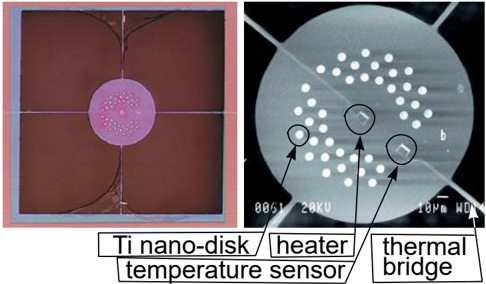
A microcalorimeter is a thin circular silicon nitride membrane, thermally isolated from the surroundings, except that it is thermally connected to the wafer by four thin and narrow thermal bridges (see Figure). The microcalorimeter is equipped with a small heater in the middle of the membrane and a similar structure on the edge of the membrane working as a thermometer. This microcalorimeter is used to study the thermal properties of nanoscale Ti disks (light tiny dots in Fig). The thermal power of the heater depends sinusoidally on time, (negative power implies a withdrawal of heat). The circular frequency is sufficiently low, so that for any moment of time , the temperature of the microcalorimeter can be considered constant across its entire surface, and the temperature profile along the thermal bridges can be considered linear. The wafer, to which the bridges are connected, is large and thick enough, so that its temperature can be considered to be constant all the time. Each of the four bridges have length and cross sectional area of ; the thermal conductance of them is . Thermal conductance is defined as the heat flux (measured in Watts) per surface area, assuming that the temperature drop is C per m. The heat capacity of the microcalorimeter (with Ti-disks) is .
-
Find the thermal resistance between the microcalorimeter and the wafer (i.e. the ratio of the temperature difference and heat flux). For questions (ii) and (iii), use quantity , without substituting it via the answer of question (i).
-
Write down the heat balance equation for the microcalorimeter and find the temperature of the microcalorimeter as a function of time [you may seek it in the form ].
-
In order to study the thermal properties of the Ti-nanodisks, the amplitude of the sinusoidal oscillations of should change by as large as possible value, as a response to a small change of (which is caused by the Ti-disks). Find the optimal circular frequency .
-
We have assumed that the temperature profile along the bridges is linear, i.e. their heat capacity can be neglected. For high frequencies , this is not the case. Estimate the critical frequency in terms of , , specific heat and density of the bridge material.
Topic: Thermodynamics Metodi: Differential Equations, First Law of Thermodynamics Competenze: Mathematical Modeling, Physical Reasoning Objects: Membrane Fonte: Testo (PDF)
Un microcalorimetro è una membrana sottile circolare di nitruro di silicio, termicamente isolata dall’ambiente circostante, tranne che è termicamente collegata alla vaffa da quattro ponti termici sottili e stretti (vedere figura). Il microcalorimetro è dotato di un piccolo riscaldatore nel mezzo della membrana e di una struttura simile sul bordo della membrana che agisce come termometro. Questo microcalorimetro è utilizzato per studiare le proprietà termiche dei dischi Ti a nanoscale (piccoli punti leggeri in Fig). La potenza termica del riscaldatore dipende sinusoidalmente dal tempo, (potenza negativa implica un ritiro del calore). La frequenza circolare è sufficientemente bassa, in modo che per qualsiasi momento di tempo la temperatura del microcalorimetro possa essere considerata costante su tutta la sua superficie e il profilo di temperatura lungo i ponti termici può essere considerato lineare. La valigia, alla quale sono collegati i ponti, è sufficientemente grande e spessa da poter considerare la temperatura costante in ogni momento. Ciascuno dei quattro ponti ha una lunghezza e una superficie trasversale ; la loro conduttività termica è . La conduttività termica è definita come il flusso di calore (misurato in Watts) per superficie, supponendo che la caduta di temperatura sia C per m. La capacità termico del microcalorimetro (con dischi Ti) è .
-
Trova la resistenza termica tra il microcalorimetro e la valigia (cioè il rapporto tra la differenza di temperatura e il flusso di calore). Per le domande ii) e iii), utilizzare la quantità , senza sostituirla con la risposta alla domanda i).
-
Scrivere l’equazione di equilibrio termico per il microcalorimetro e trovare la temperatura del microcalorimetro come funzione del tempo [potete cercarla nella forma ].
-
Per studiare le proprietà termiche dei nanodischi Ti, l’ampiezza delle oscillazioni sinusoidali di deve cambiare il più possibile, in risposta a un piccolo cambiamento di (causato dai dischi Ti). Trova la frequenza circolare ottimale .
-
Abbiamo supposto che il profilo di temperatura lungo i ponti sia lineare, cioè la loro capacità termico può essere trascurata. Per le frequenze elevate , questo non è il caso. Estimare la frequenza critica in termini di , , calore specifico e densità del materiale ponte.
Topic: Thermodynamics Metodi: Differential Equations, First Law of Thermodynamics Competenze: Mathematical Modeling, Physical Reasoning Objects: Membrane Fonte: Testo (PDF)
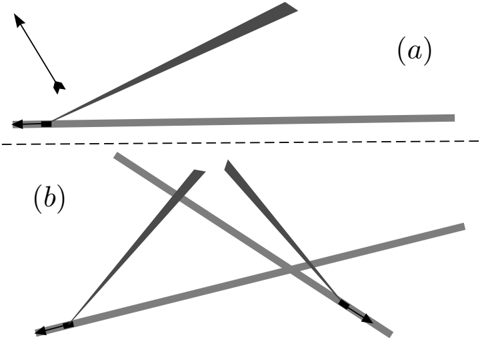
Provided sketches (a) and (b) are made on the basis of satellite images, preserving proportions. They represent tractors, together with their smoke trails. The tractors were moving along the roads in the direction indicated by the arrows. The velocity of all the tractors was km/h. For sketch (a), the direction of wind is indicated by another arrow.
-
Using the provided sketch, find the wind speed for case (a).
-
Using the provided sketch, find the wind speed for case (b).
Topic: Newtonian Mechanics Metodi: Vector Decomposition, Kinematic Equations Competenze: Diagrammatic Reasoning, Mathematical Modeling Objects: - Fonte: Testo (PDF)
A condizione che gli schizzi a) e b) siano realizzati sulla base di immagini satellitari, mantenendo le proporzioni. Rappresentano i trattori, insieme alle loro tracce di fumo. I trattori si muovevano lungo le strade nella direzione indicata dalle frecce. La velocità di tutti i trattori era km/h. Per lo schema (a), la direzione del vento è indicata da un’altra freccia.
-
Con l’esatto fornito, si trova la velocità del vento per il caso (a).
-
Con il disegno fornito, si trova la velocità del vento per il caso (b).
Topic: Newtonian Mechanics Metodi: Vector Decomposition, Kinematic Equations Competenze: Diagrammatic Reasoning, Mathematical Modeling Objects: - Fonte: Testo (PDF)
Magnetic field with inductance (parallel to the -axis) fills the region . Let us consider an electron of velocity (where is its charge and its mass).
-
Sketch the trajectory of the particle, if initially it moves along the line towards the region filled with magnetic field.
-
How long time does the electron spend inside the magnetic field?
-
Now, let us consider the situation, when initially the electron moves along the line (). Find the angle , by which the electron is inclined after passing through magnetic field.
Topic: Magnetism Metodi: Lorentz Force Analysis Competenze: Mathematical Modeling, Diagrammatic Reasoning Objects: Electron, Particle Beam Fonte: Testo (PDF)
Il campo magnetico con induttanza (parallelmente all’asse ) riempie la regione . Consideriamo un elettrone di velocità (dove è la sua carica e la sua massa).
-
Segnare la traiettoria della particella, se inizialmente si muove lungo la linea verso la regione riempita di campo magnetico.
-
Quanto tempo spende l’elettrone all’interno del campo magnetico?
-
Ora, consideriamo la situazione, quando inizialmente l’elettrone si muove lungo la linea (). Trova l’angolo , per il quale l’elettrone è inclinato dopo aver attraversato il campo magnetico.
Topic: Magnetism Metodi: Lorentz Force Analysis Competenze: Mathematical Modeling, Diagrammatic Reasoning Objects: Electron, Particle Beam Fonte: Testo (PDF)
Equipment: ruler, a glass ball, sheet of paper, marker.
Find the coefficient of friction between the glass ball and the ruler. Estimate the uncertainty of your result.
Topic: Newtonian Mechanics Metodi: Free-Body Diagram, Experimental Data Analysis Competenze: Experimental Data Analysis, Measurement & Instrumentation Objects: Ball Fonte: Testo (PDF)
**Equipaggiamento: ** gomma, palla di vetro, foglio di carta, marcatore.
Trova il coefficiente di attrito tra la palla di vetro e la regola. Estima l’incertezza del tuo risultato.
Topic: Newtonian Mechanics Metodi: Free-Body Diagram, Experimental Data Analysis Competenze: Experimental Data Analysis, Measurement & Instrumentation Objects: Ball Fonte: Testo (PDF)
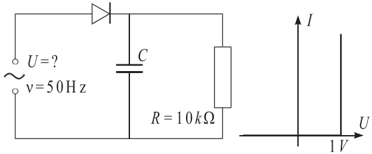
A voltage rectifier is made according to the circuit depicted in Figure. The load is fed with DC, equal to mA. In what follows we approximate the U-I characteristic of the diode with the curve depicted in Figure. The relative variation of the current at the load has to satisfy the condition .
-
Find the average power dissipation at the diode at the working regime of such a circuit.
-
Determine the amplitude of the AC voltage (with frequency Hz), which has to be applied at the input of the circuit.
-
Find the required capacitance .
-
Find the average power dissipation at the diode during the first period (of AC input voltage) immediately following the application of AC voltage to the input of the circuit.
Topic: Circuits Metodi: Kirchhoff’s Laws, Equivalent Circuit Reduction Competenze: Mathematical Modeling, Graph Linearization Objects: Capacitor, Resistor Fonte: Testo (PDF)
Un rettificatore di tensione è realizzato secondo il circuito descritto nella figura. Il carico viene alimentato con corrente continua, pari a mA. In quanto segue approssimamo la caratteristica U-I della dioda con la curva raffigurata nella figura. La variazione relativa della corrente al carico deve soddisfare la condizione .
-
Trova la media di dissipazione di potenza del diodo al regime di funzionamento di tale circuito.
-
Determinare l’ampiezza della tensione a corrente alternata (con frequenza Hz), che deve essere applicata all’entrata del circuito.
-
Trova la capacità richiesta .
-
Trova la media di dissipazione di potenza al diodo durante il primo periodo (di tensione di ingresso CA) immediatamente dopo l’applicazione di tensione AC all’input del circuito.
Topic: Circuits Metodi: Kirchhoff’s Laws, Equivalent Circuit Reduction Competenze: Mathematical Modeling, Graph Linearization Objects: Capacitor, Resistor Fonte: Testo (PDF)
There is wet wood burning in a fireplace on the ground. Seven meters above ground, the smoke is at a temperature of C. Disregard the exchange of heat with the surrounding air and assume that the atmospheric pressure at the ground is constant in time and equal to hPa; the air temperature C is independent of height. Assume that the smoke represents an ideal gas of a molar mass (i.e. equal to the molar mass of the air), and of a molar specific heat at constant volume ; universal gas constant . How high will the smoke column rise?
Topic: Thermodynamics, Fluid Mechanics Metodi: Ideal Gas Law, Hydrostatic Equilibrium Competenze: Mathematical Modeling, Estimation & Approximation Objects: Gas Fonte: Testo (PDF)
C’è legno umido che brucia in un camino a terra. A sette metri di altezza, il fumo è a una temperatura di C. Non si deve considerare lo scambio di calore con l’aria circostante e presumere che la pressione atmosferica sul suolo sia costante nel tempo ed è uguale a hPa; la temperatura dell’aria C è indipendente dall’altezza. Supponiamo che il fumo rappresenti un gas ideale di massa molare (cioè di massa molare dell’aria) e di calore specifico molare a volume costante ; costante universale del gas . Quanto in alto salire la colonna di fumo?
Topic: Thermodynamics, Fluid Mechanics Metodi: Ideal Gas Law, Hydrostatic Equilibrium Competenze: Mathematical Modeling, Estimation & Approximation Objects: Gas Fonte: Testo (PDF)
An electron rests at the origin. At the moment of time , an electric field is switched in: its modulus is constant and equal to , but its direction rotates with a constant circular velocity in the - plane. At the moment , it is directed along the -axis.
-
Find the average velocity of the electron over a long time interval for .
-
Sketch the trajectory of the electron and calculate the geometrical characteristics of it.
Topic: Electrostatics Metodi: Kinematic Equations, Vector Decomposition Competenze: Mathematical Modeling, Physical Reasoning Objects: Electron Fonte: Testo (PDF)
Un elettrone riposa all’origine. Nel momento del tempo , viene attivato un campo elettrico: il suo modulo è costante ed è uguale a , ma la sua direzione ruota con una velocità circolare costante nel piano -. Al momento , è diretto lungo l’asse .
-
Trova la velocità media dell’elettrone su un lungo intervallo di tempo per .
-
Segnare la traiettoria dell’elettrone e calcolare le sue caratteristiche geometriche.
Topic: Electrostatics Metodi: Kinematic Equations, Vector Decomposition Competenze: Mathematical Modeling, Physical Reasoning Objects: Electron Fonte: Testo (PDF)
It is believed that the impacts of the Earth with asteroids have played an important role in the history of Earth. In this problem, you are required to study such an impact. As an example, let us use the orbital data of the Apollo asteroid. Its perihelion is 0.65 AU, i.e. its closest distance from the Sun is , where and denotes the radius of the Earth’s orbit; its aphelion is 2.3 AU, i.e. its farthest distance from the Sun is , where . In your calculations, you may use the orbital velocity of Earth, km/s, Earth radius km, and the free fall acceleration at the Earth’s surface, . You may also use the formula , expressing the total energy of a body of mass , which moves along an elliptic orbit of longer semiaxis , in the gravity field of a much heavier body of mass . You may assume that the orbital planes of the Earth and of the asteroid coincide, and that they rotate in the same direction around the Sun.
-
Find the velocity of the asteroid in the vicinity of the Earth, in the Sun’s system of reference, neglecting the effect of Earth’s attraction.
-
Find the radial and tangential components and of that velocity (i.e. the components, respectively parallel and perpendicular to the vector, drawn from the centre of the Sun to current position of the asteroid).
-
Find the same velocity components and in the Earth’s system of reference.
-
Find the velocity of the asteroid , immediately before entering the Earth’s atmosphere (at the height km from the Earth’s surface).
Topic: Gravitation Metodi: Kepler’s Laws, Conservation of Energy, Conservation of Momentum Competenze: Mathematical Modeling, Physical Reasoning Objects: Planet, Star Fonte: Testo (PDF)
Si ritiene che gli impatti della Terra con gli asteroidi abbiano svolto un ruolo importante nella storia della Terra. In questo problema, è necessario studiare tale impatto. Ad esempio, usiamo i dati orbitali dell’asteroide Apollo. Il suo perielione è di 0,65 AU, cioè la sua distanza più vicina al Sole è , dove e indicano il raggio di orbita terrestre; il suo afelione è di 2,3 UA, cioè la sua distanza più lontana dal Sole è , dove . Nei suoi calcoli, si può usare la velocità orbitale della Terra, km/s, il raggio terrestre km, e l’accelerazione della caduta libera alla superficie terrestre, . È possibile anche usare la formula , che esprime l’energia totale di un corpo di massa , che si muove lungo un’orbita ellittica di semiaxia più lunga , nel campo gravitazionale di un corpo di massa molto più pesante. Potreste supporre che i piani orbitali della Terra e dell’asteroide coincidano e che ruotino nella stessa direzione intorno al Sole.
-
Trova la velocità dell’asteroide nelle vicinanze della Terra, nel sistema di riferimento del Sole, trascurando l’effetto dell’attrazione terrestre.
-
Trovare le componenti radiali e tangenziali e di tale velocità (cioè i componenti, rispettivamente paralleli e perpendicolari al vettore, tracciati dal centro del Sole alla posizione corrente dell’asteroide).
-
Trova gli stessi componenti di velocità e nel sistema di riferimento terrestre.
-
Trova la velocità dell’asteroide , immediatamente prima di entrare nell’atmosfera terrestre (all’altezza km dalla superficie terrestre).
Topic: Gravitation Metodi: Kepler’s Laws, Conservation of Energy, Conservation of Momentum Competenze: Mathematical Modeling, Physical Reasoning Objects: Planet, Star Fonte: Testo (PDF)
Equipment: Laser ( nm), thin glass plate, lens, ruler. NB! the glass plate is fixed to a stand; avoid touching the glass itself (because its edges are sharp, and because it can break easily).
Find the thickness of the plate and estimate the uncertainty of the result. Draw the scheme of your experimental setup.
Topic: Wave Optics Metodi: Interference & Diffraction Analysis, Experimental Data Analysis Competenze: Experimental Data Analysis, Measurement & Instrumentation Objects: Lens, Slit Fonte: Testo (PDF)
**Equipaggiamento: ** Laser ( nm), lastra di vetro sottile, lente, regola. NB! la piastra di vetro è fissata a un supporto; evitare di toccare il vetro stesso (perché i bordi sono taglienti e può rompersi facilmente).
Trova lo spessore della piastra e stima l’incertezza del risultato. Disegna il schema della tua configurazione sperimentale.
Topic: Wave Optics Metodi: Interference & Diffraction Analysis, Experimental Data Analysis Competenze: Experimental Data Analysis, Measurement & Instrumentation Objects: Lens, Slit Fonte: Testo (PDF)