Use N/kg throughout this contest.
A bird flying in a straight line, initially at 10 m/s, uniformly increases its speed to 18 m/s while covering a distance of 40 m. What is the magnitude of the acceleration of the bird?
- A. m/s
- B. m/s
- C. m/s
- D. m/s
- E. m/s
Topic: Newtonian Mechanics Metodi: Kinematic Equations Competenze: Physical Reasoning Objects: - Fonte: Testo (PDF) - p.3
Utilizzare N/kg durante tutto il concorso.
Un uccello che vola in linea retta, inizialmente a 10 m/s, aumenta uniformemente la sua velocità a 18 m/s mentre copre una distanza di 40 m. Qual è l’ampiezza dell’accelerazione dell’uccello?
- A. m/s
- B. m/s
- C. m/s
- D. m/s
- E. m/s
Topic: Newtonian Mechanics Metodi: Kinematic Equations Competenze: Physical Reasoning Objects: - Fonte: Testo (PDF) - p.3
A cockroach is crawling along the walls inside a cubical room that has an edge length of 3 m. If the cockroach starts from the back lower left hand corner of the cube and finishes at the front upper right hand corner, what is the magnitude of the displacement of the cockroach?
- A. m
- B. m
- C. m
- D. m
- E. m
Topic: Newtonian Mechanics Metodi: Vector Decomposition Competenze: Physical Reasoning, Mathematical Modeling Objects: - Fonte: Testo (PDF) - p.3
Un scarafaggio si arrasta lungo le pareti di una stanza cubica che ha una lunghezza di bordo di 3 metri. Se la scarafaggio parte dall’angolo posteriore inferiore sinistro del cubo e termina nell’angolo anteriore superiore destro, quale è l’entità del spostamento della scarafaggio?
- A. m
- B. m
- C. m
- D. m
- E. m
Topic: Newtonian Mechanics Metodi: Vector Decomposition Competenze: Physical Reasoning, Mathematical Modeling Objects: - Fonte: Testo (PDF) - p.3
The position vs. time graph for an object moving in a straight line is shown below. What is the instantaneous velocity at s?
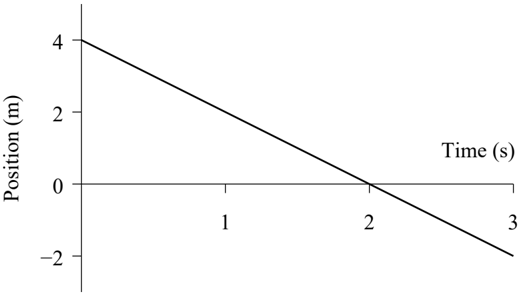
- A. m/s
- B. m/s
- C. m/s
- D. m/s
- E. m/s
Topic: Newtonian Mechanics Metodi: Kinematic Equations Competenze: Physical Reasoning, Diagrammatic Reasoning Objects: - Fonte: Testo (PDF) - p.3
La posizione contro . Il grafico temporale di un oggetto che si muove in linea retta è mostrato qui sotto. Qual è la velocità istantanea a s?
- A. m/s
- B. m/s
- C. m/s
- D. m/s
- E. m/s
Topic: Newtonian Mechanics Metodi: Kinematic Equations Competenze: Physical Reasoning, Diagrammatic Reasoning Objects: - Fonte: Testo (PDF) - p.3
The information below is for the next two problems.
Shown below is the velocity vs. time graph for a toy car moving along a straight line.
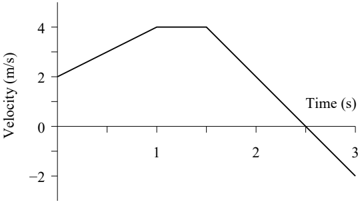
What is the maximum displacement from start for the toy car?
- A. m
- B. m
- C. m
- D. m
- E. m
Topic: Newtonian Mechanics Metodi: Kinematic Equations Competenze: Physical Reasoning, Diagrammatic Reasoning Objects: Cart Fonte: Testo (PDF) - p.4
Le informazioni riportate qui sotto riguardano i due seguenti problemi.
Spetta la velocità contro la velocità. grafico temporale per un’auto giocattolo che si muove lungo una linea retta.
Qual è il massimo spostamento da inizio per la macchina da giocattoli?
- A. m
- B. m
- C. m
- D. m
- E. m
Topic: Newtonian Mechanics Metodi: Kinematic Equations Competenze: Physical Reasoning, Diagrammatic Reasoning Objects: Cart Fonte: Testo (PDF) - p.4
The information below is for this problem (velocity vs. time graph for the toy car of the previous problem).
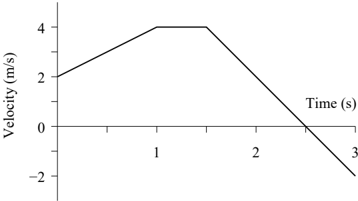
Which of the following acceleration vs. time graphs most closely represents the acceleration of the toy car? Choose among the graphs (a)-(e) shown below.
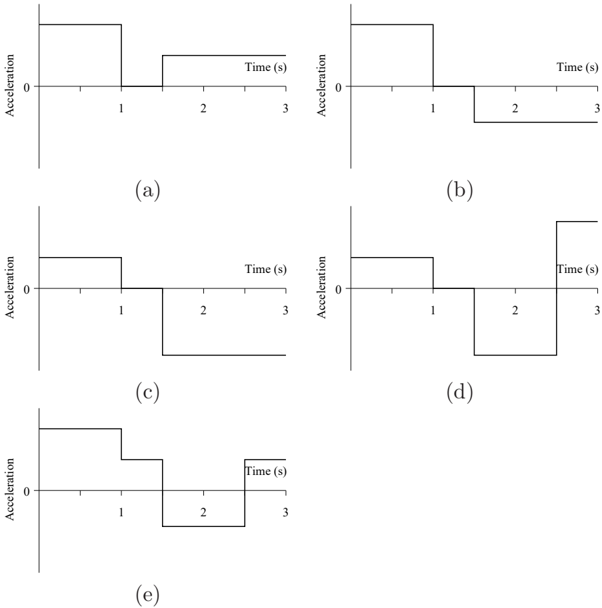
- A. graph (a)
- B. graph (b)
- C. graph (c)
- D. graph (d)
- E. graph (e)
Topic: Newtonian Mechanics Metodi: Kinematic Equations Competenze: Physical Reasoning, Diagrammatic Reasoning Objects: Cart Fonte: Testo (PDF) - p.4
Le informazioni di seguito sono per questo problema (velocità vs. grafico temporale per l’auto giocattolo del problema precedente).
Qual è l’accelerazione di cui sopra vs. I grafici temporali rappresentano più strettamente l’accelerazione della macchina giocattolo? Scegli tra i grafici (a) - (e) mostrati di seguito.
- A. grafico (a)
- B. grafico (b)
- C. grafico (c)
- D. grafico (d)
- E. grafico (e)
Topic: Newtonian Mechanics Metodi: Kinematic Equations Competenze: Physical Reasoning, Diagrammatic Reasoning Objects: Cart Fonte: Testo (PDF) - p.4
A cannon fires projectiles on a flat range at a fixed speed but with variable angle. The maximum range of the cannon is . What is the range of the cannon when it fires at an angle above the horizontal? Ignore air resistance.
- A.
- B.
- C.
- D.
- E.
Topic: Newtonian Mechanics Metodi: Kinematic Equations, Vector Decomposition Competenze: Physical Reasoning Objects: Projectile Fonte: Testo (PDF) - p.4
Un cannone lancia proiettili su un raggio piatto a velocità fissa ma con angolo variabile. La portata massima del cannone è . Qual è l’intervallo del cannone quando viene sparato ad un angolo sopra l’orizzontale? Ignora la resistenza dell’aria.
- A.
- B.
- C.
- D.
- E.
Topic: Newtonian Mechanics Metodi: Kinematic Equations, Vector Decomposition Competenze: Physical Reasoning Objects: Projectile Fonte: Testo (PDF) - p.4
A toboggan sled is traveling at 2.0 m/s across the snow. The sled and its riders have a combined mass of 120 kg. Another child ( kg) headed in the opposite direction jumps on the sled from the front. She has a speed of 5.0 m/s immediately before she lands on the sled. What is the new speed of the sled? Neglect any effects of friction.
- A. m/s
- B. m/s
- C. m/s
- D. m/s
- E. m/s
Topic: Conservation of Momentum Metodi: Conservation of Momentum Competenze: Physical Reasoning Objects: - Fonte: Testo (PDF) - p.4
Una slitta scivolante sta viaggiando a 2,0 m/s attraverso la neve. Il trenino e i suoi cavalieri hanno una massa complessiva di 120 kg. Un altro bambino ( kg) diretto nella direzione opposta salta sul baglione dalla parte anteriore. Ha una velocità di 5,0 m/s immediatamente prima di atterrare sul trenino. Qual è la nuova velocità del trenino? Non si deve considerare gli effetti dell’attrito.
- A. m/s
- B. m/s
- C. m/s
- D. m/s
- E. m/s
Topic: Conservation of Momentum Metodi: Conservation of Momentum Competenze: Physical Reasoning Objects: - Fonte: Testo (PDF) - p.4
Riders in a carnival ride stand with their backs against the wall of a circular room of diameter 8.0 m. The room is spinning horizontally about an axis through its center at a rate of 45 rev/min when the floor drops so that it no longer provides any support for the riders. What is the minimum coefficient of static friction between the wall and the rider required so that the rider does not slide down the wall?
- A.
- B.
- C.
- D.
- E.
Topic: Newtonian Mechanics Metodi: Free-Body Diagram, Vector Decomposition Competenze: Physical Reasoning Objects: - Fonte: Testo (PDF) - p.5
I cavalieri in un giro di carnevale si schierano con le spalle contro la parete di una stanza circolare di 8,0 m di diametro. La sala gira orizzontalmente intorno ad un asse attraverso il suo centro a una velocità di 45 giri al minuto quando il pavimento scende in modo che non fornisca più alcun supporto ai piloti. Qual è il coefficiente minimo di attrito statico tra il muro e il ciclista richiesto affinché il ciclista non scivoli giù dal muro?
- A.
- B.
- C.
- D.
- E.
Topic: Newtonian Mechanics Metodi: Free-Body Diagram, Vector Decomposition Competenze: Physical Reasoning Objects: - Fonte: Testo (PDF) - p.5
A ball of mass travels along the -axis in the positive direction with an initial speed of . It collides with a ball of mass that is originally at rest. After the collision, the ball of mass has velocity and the ball of mass has velocity .
Consider the following five statements:
- I)
- II)
- III)
- IV)
- V)
Of these five statements, the system must satisfy
- A. I and II
- B. III and V
- C. II and V
- D. III and IV
- E. I and III
Topic: Conservation of Momentum Metodi: Conservation of Momentum, Vector Decomposition Competenze: Physical Reasoning Objects: Ball Fonte: Testo (PDF) - p.5
Una palla di massa percorre l’asse in direzione positiva con una velocità iniziale di . Colpisce con una palla di massa che è originariamente in riposo. Dopo la collisione, la sfera di massa ha velocità e la sfera di massa ha velocità .
Considerate le seguenti cinque affermazioni:
- I)
- II)
- III)
- IV)
- V)
Di queste cinque affermazioni, il sistema deve soddisfare le esigenze
- A. I e II
- B. III e V
- C. II e V
- D. III e IV
- E. I e III
Topic: Conservation of Momentum Metodi: Conservation of Momentum, Vector Decomposition Competenze: Physical Reasoning Objects: Ball Fonte: Testo (PDF) - p.5
The following information applies to the next two problems.
An experiment consists of pulling a heavy wooden block across a level surface with a spring force meter. The constant force for each try is recorded, as is the acceleration of the block. The data are shown below.
| Force in Newtons | 3.05 | 3.45 | 4.05 | 4.45 | 5.05 |
|---|---|---|---|---|---|
| acceleration in m/s | 0.095 | 0.205 | 0.295 | 0.405 | 0.495 |
Which is the best value for the mass of the block?
- A. kg
- B. kg
- C. kg
- D. kg
- E. kg
Topic: Newtonian Mechanics Metodi: Graph Linearization, Experimental Data Analysis Competenze: Physical Reasoning, Experimental Data Analysis, Graph Linearization Objects: Block Fonte: Testo (PDF) - p.5
Le seguenti informazioni si applicano ai due seguenti problemi.
Un esperimento consiste nel trascinare un pesante blocco di legno su una superficie piatta con un contatore di forza di molla. La forza costante per ogni tentativo viene registrata, così come l’accelerazione del blocco. I dati sono riportati di seguito.
| Force in Newtons | 3.05 | 3.45 | 4.05 | 4.45 | 5.05 |
|---|---|---|---|---|---|
| acceleration in m/s | 0.095 | 0.205 | 0.295 | 0.405 | 0.495 |
Qual è il miglior valore per la massa del blocco?
- A. kg
- B. kg
- C. kg
- D. kg
- E. kg
Topic: Newtonian Mechanics Metodi: Graph Linearization, Experimental Data Analysis Competenze: Physical Reasoning, Experimental Data Analysis, Graph Linearization Objects: Block Fonte: Testo (PDF) - p.5
The following information applies to this problem.
An experiment consists of pulling a heavy wooden block across a level surface with a spring force meter. The constant force for each try is recorded, as is the acceleration of the block. The data are shown below.
| Force in Newtons | 3.05 | 3.45 | 4.05 | 4.45 | 5.05 |
|---|---|---|---|---|---|
| acceleration in m/s | 0.095 | 0.205 | 0.295 | 0.405 | 0.495 |
Which is the best value for the coefficient of friction between the block and the surface?
- A.
- B.
- C.
- D.
- E.
Topic: Newtonian Mechanics Metodi: Experimental Data Analysis, Free-Body Diagram Competenze: Physical Reasoning, Experimental Data Analysis Objects: Block Fonte: Testo (PDF) - p.5
Le seguenti informazioni si applicano a questo problema.
Un esperimento consiste nel trascinare un pesante blocco di legno su una superficie piatta con un contatore di forza di molla. La forza costante per ogni tentativo viene registrata, così come l’accelerazione del blocco. I dati sono riportati di seguito.
| Force in Newtons | 3.05 | 3.45 | 4.05 | 4.45 | 5.05 |
|---|---|---|---|---|---|
| acceleration in m/s | 0.095 | 0.205 | 0.295 | 0.405 | 0.495 |
Qual è il miglior valore per il coefficiente di attrito tra il blocco e la superficie?
- A.
- B.
- C.
- D.
- E.
Topic: Newtonian Mechanics Metodi: Experimental Data Analysis, Free-Body Diagram Competenze: Physical Reasoning, Experimental Data Analysis Objects: Block Fonte: Testo (PDF) - p.5
A uniform disk rotates at a fixed angular velocity on an axis through its center normal to the plane of the disk, and has kinetic energy . If the same disk rotates at the same angular velocity about an axis on the edge of the disk (still normal to the plane of the disk), what is its kinetic energy?
- A.
- B.
- C.
- D.
- E.
Topic: Rotational Dynamics Metodi: Torque & Angular Momentum Analysis Competenze: Physical Reasoning Objects: Disk Fonte: Testo (PDF) - p.6
Un disco uniforme ruota a una velocità angolare fissa su un asse attraverso il suo centro normale al piano del disco, e ha energia cinetica . Se lo stesso disco ruota alla stessa velocità angolare intorno ad un asse sul bordo del disco (anche normale per il piano del disco), qual è la sua energia cinetica?
- A.
- B.
- C.
- D.
- E.
Topic: Rotational Dynamics Metodi: Torque & Angular Momentum Analysis Competenze: Physical Reasoning Objects: Disk Fonte: Testo (PDF) - p.6
A mass is attached to the wall by a spring of constant . When the spring is at its natural length, the mass is given a certain initial velocity, resulting in oscillations of amplitude . If the spring is replaced by a spring of constant , and the mass is given the same initial velocity, what is the amplitude of the resulting oscillation?
- A.
- B.
- C.
- D.
- E.
Topic: Oscillations & Waves Metodi: Simple Harmonic Motion Analysis, Conservation of Energy, Hooke’s Law Competenze: Physical Reasoning Objects: Spring Fonte: Testo (PDF) - p.6
Una massa è fissata al muro da una molla di costante . Quando la molla è a sua lunghezza naturale, la massa riceve una certa velocità iniziale, con conseguente oscillazione di amplitudine . Se la molla viene sostituita da una molla di costante , e la massa viene data la stessa velocità iniziale, qual è l’ampiezza dell’oscillazione risultante?
- A.
- B.
- C.
- D.
- E.
Topic: Oscillations & Waves Metodi: Simple Harmonic Motion Analysis, Conservation of Energy, Hooke’s Law Competenze: Physical Reasoning Objects: Spring Fonte: Testo (PDF) - p.6
A spaceborne energy storage device consists of two equal masses connected by a tether and rotating about their center of mass. Additional energy is stored by reeling in the tether; no external forces are applied. Initially the device has kinetic energy and rotates at angular velocity . Energy is added until the device rotates at angular velocity . What is the new kinetic energy of the device?
- A.
- B.
- C.
- D.
- E.
Topic: Rotational Dynamics Metodi: Torque & Angular Momentum Analysis, Conservation Laws Competenze: Physical Reasoning Objects: - Fonte: Testo (PDF) - p.6
Un dispositivo di stoccaggio di energia trasportato nello spazio è costituito da due masse uguali collegate da un legame e che ruotano intorno al loro centro di massa. L’energia aggiuntiva viene immagazzinata per rotolamento nel legame; non vengono applicate forze esterne. Inizialmente il dispositivo ha energia cinetica e ruota a velocità angolare . L’energia viene aggiunta fino a quando il dispositivo ruota a velocità angolare . Qual è la nuova energia cinetica del dispositivo?
- A.
- B.
- C.
- D.
- E.
Topic: Rotational Dynamics Metodi: Torque & Angular Momentum Analysis, Conservation Laws Competenze: Physical Reasoning Objects: - Fonte: Testo (PDF) - p.6
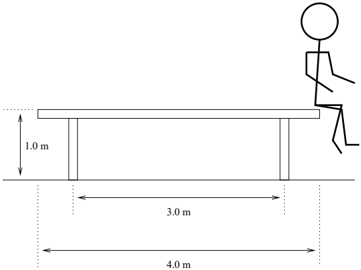
A uniform round tabletop of diameter 4.0 m and mass 50.0 kg rests on massless, evenly spaced legs of length 1.0 m and spacing 3.0 m. A carpenter sits on the edge of the table. What is the maximum mass of the carpenter such that the table remains upright? Assume that the force exerted by the carpenter on the table is vertical and at the edge of the table.
- A. kg
- B. kg
- C. kg
- D. kg
- E. kg
Topic: Rigid Body Statics Metodi: Torque & Angular Momentum Analysis, Free-Body Diagram Competenze: Physical Reasoning, Diagrammatic Reasoning Objects: - Fonte: Testo (PDF) - p.6
Un tavolo rotondo uniforme di diametro di 4,0 m e massa di 50,0 kg si fonda su gambe senza massa, spaziate uniformemente, di lunghezza di 1,0 m e spazi di 3,0 m. Un falegname siede sul bordo del tavolo. Qual è la massa massima del falegname in modo che il tavolo rimanga in verticale? Supponiamo che la forza esercitata dal falegname sul tavolo sia verticale e sul bordo del tavolo.
- A. kg
- B. kg
- C. kg
- D. kg
- E. kg
Topic: Rigid Body Statics Metodi: Torque & Angular Momentum Analysis, Free-Body Diagram Competenze: Physical Reasoning, Diagrammatic Reasoning Objects: - Fonte: Testo (PDF) - p.6
A massless spring with spring constant is vertically mounted so that the bottom end is firmly attached to the ground, and the top end free. A ball with mass falls vertically down on the top end of the spring, becoming attached, so that the ball oscillates vertically on the spring. What equation describes the acceleration of the ball when it is at a height above the original position of the top end of the spring? Let down be negative, and neglect air resistance; is the magnitude of the acceleration of free fall.
- A.
- B.
- C.
- D.
- E.
Topic: Oscillations & Waves Metodi: Simple Harmonic Motion Analysis, Hooke’s Law, Free-Body Diagram Competenze: Physical Reasoning Objects: Spring, Ball Fonte: Testo (PDF) - p.7
Una molla senza massa con costante molla è montata verticalmente in modo che l’estremità inferiore sia saldamente attaccata al suolo e l’estremità superiore libera. Una palla di massa cade verticalmente sulla parte superiore della molla, diventando attaccata, in modo che la palla oscilla verticalmente sulla molla. Quale equazione descrive l’accelerazione della palla quando è ad un’altezza sopra la posizione originale dell’estremità superiore della molla? Lasciare il calo negativo e trascurare la resistenza all’aria; è la magnitudine dell’accelerazione della caduta libera.
- A.
- B.
- C.
- D.
- E.
Topic: Oscillations & Waves Metodi: Simple Harmonic Motion Analysis, Hooke’s Law, Free-Body Diagram Competenze: Physical Reasoning Objects: Spring, Ball Fonte: Testo (PDF) - p.7
A mass is resting at equilibrium suspended from a vertical spring of natural length and spring constant inside a box as shown:
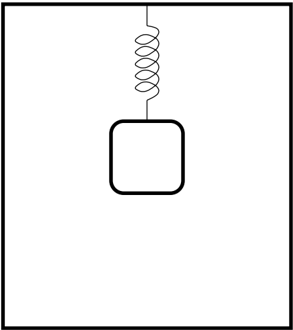
The box begins accelerating upward with acceleration . How much closer does the equilibrium position of the mass move to the bottom of the box?
- A.
- B.
- C.
- D.
- E.
Topic: Newtonian Mechanics Metodi: Hooke’s Law, Free-Body Diagram Competenze: Physical Reasoning, Diagrammatic Reasoning Objects: Spring Fonte: Testo (PDF) - p.7
Una massa si trova in equilibrio sospesa da una molla verticale di lunghezza naturale e costante di molla all’interno di una scatola come mostrato:
La scatola inizia ad accelerare verso l’alto con l’accelerazione . Quanto più vicino si avvicina la posizione di equilibrio della massa al fondo della scatola?
- A.
- B.
- C.
- D.
- E.
Topic: Newtonian Mechanics Metodi: Hooke’s Law, Free-Body Diagram Competenze: Physical Reasoning, Diagrammatic Reasoning Objects: Spring Fonte: Testo (PDF) - p.7
A uniform circular ring of radius is fixed in place. A particle is placed on the axis of the ring at a distance much greater than and allowed to fall towards the ring under the influence of the ring’s gravity. The particle achieves a maximum speed . The ring is replaced with one of the same (linear) mass density but radius , and the experiment is repeated. What is the new maximum speed of the particle?
- A.
- B.
- C.
- D.
- E.
Topic: Gravitation Metodi: Newton’s Law of Gravitation, Conservation of Energy Competenze: Physical Reasoning Objects: - Fonte: Testo (PDF) - p.7
Si fissa un anello circolare uniforme di raggio . Una particella viene collocata sull’asse dell’anello ad una distanza molto maggiore di e lasciata cadere verso l’anello sotto l’influenza della gravità dell’anello. La particella raggiunge una velocità massima . L’anello viene sostituito da uno della stessa densità di massa (lineare) ma di raggio , e l’esperimento viene ripetuto. Qual è la nuova velocità massima della particella?
- A.
- B.
- C.
- D.
- E.
Topic: Gravitation Metodi: Newton’s Law of Gravitation, Conservation of Energy Competenze: Physical Reasoning Objects: - Fonte: Testo (PDF) - p.7
A car has an engine which delivers a constant power. It accelerates from rest at time , and at its acceleration is . What is its acceleration at ? Ignore energy loss due to friction.
- A.
- B.
- C.
- D.
- E.
Topic: Conservation of Energy Metodi: Conservation of Energy, Calculus-Integration Competenze: Physical Reasoning Objects: - Fonte: Testo (PDF) - p.7
Un’auto ha un motore che fornisce una potenza costante. Accelera dal riposo al tempo e a la sua accelerazione è . Qual è la sua accelerazione a ? Ignorare la perdita di energia dovuta alla frizione.
- A.
- B.
- C.
- D.
- E.
Topic: Conservation of Energy Metodi: Conservation of Energy, Calculus-Integration Competenze: Physical Reasoning Objects: - Fonte: Testo (PDF) - p.7
The Young’s modulus, , of a material measures how stiff it is; the larger the value of , the more stiff the material. Consider a solid, rectangular steel beam which is anchored horizontally to the wall at one end and allowed to deflect under its own weight. The beam has length , vertical thickness , width , mass density , and Young’s modulus ; the acceleration due to gravity is . What is the distance through which the other end moves? (Hint: you are expected to solve this problem by eliminating implausible answers. All of the choices are dimensionally correct.)
- A.
- B.
- C.
- D.
- E.
Topic: Elasticity & Materials Metodi: Dimensional Analysis Competenze: Physical Reasoning, Estimation & Approximation Objects: Beam Fonte: Testo (PDF) - p.7
Il modulo del Young, , di un materiale misura quanto rigido sia; più grande è il valore di , più rigido è il materiale. Considerate un fascio di acciaio solido e rettangolare che è ancorato orizzontalmente alla parete ad una estremità e che può deviare sotto il proprio peso. Il fascio ha lunghezza , spessore verticale , larghezza , densità di massa e modulo di Young ; l’accelerazione dovuta alla gravità è . Qual è la distanza attraverso cui si muove l’altra estremità? (Signore: si prevede che risolverete questo problema eliminando risposte improbabili. Tutte le scelte sono dimensionalmente corrette.)
- A.
- B.
- C.
- D.
- E.
Topic: Elasticity & Materials Metodi: Dimensional Analysis Competenze: Physical Reasoning, Estimation & Approximation Objects: Beam Fonte: Testo (PDF) - p.7
Consider a particle at rest which may decay into two (daughter) particles or into three (daughter) particles. Which of the following is true in the two-body case but false in the three-body case? (There are no external forces.)
- A. The velocity vectors of the daughter particles must lie in a single plane.
- B. Given the total kinetic energy of the system and the mass of each daughter particle, it is possible to determine the speed of each daughter particle.
- C. Given the speed(s) of all but one daughter particle, it is possible to determine the speed of the remaining particle.
- D. The total momentum of the daughter particles is zero.
- E. None of the above.
Topic: Conservation of Momentum Metodi: Conservation of Momentum, Symmetry Argument Competenze: Physical Reasoning Objects: - Fonte: Testo (PDF) - p.8
Considerate una particella in riposo che può decomporsi in due (figlie) particelle o in tre (figlie) particelle. Quale delle seguenti cose è vera nel caso dei due corpi ma falsa nel caso dei tre corpi? (Non ci sono forze esterne.)
- A. I vettori di velocità delle particelle figlie devono essere situati in un unico piano.
- B. Data l’energia cinetica totale del sistema e la massa di ciascuna particella figlia, è possibile determinare la velocità di ciascuna particella figlia.
- C. Dato il tasso di velocità di tutte le particelle, tranne una, è possibile determinare il tasso di velocità della particella rimanente.
- D. Il momento totale delle particelle figlie è zero.
- E. Nessuna delle seguenti.
Topic: Conservation of Momentum Metodi: Conservation of Momentum, Symmetry Argument Competenze: Physical Reasoning Objects: - Fonte: Testo (PDF) - p.8
A bullet of mass strikes a pendulum of mass suspended from a pivot by a string of length with a horizontal velocity . The collision is perfectly inelastic and the bullet sticks to the bob. Find the minimum velocity such that the bob (with the bullet inside) completes a circular vertical loop.
- A.
- B.
- C.
- D.
- E.
Topic: Conservation of Momentum Metodi: Conservation of Momentum, Conservation of Energy Competenze: Physical Reasoning Objects: Pendulum, Ball Fonte: Testo (PDF) - p.8
Un proiettile di massa colpisce un pendolo di massa sospeso da un pivot con una stringa di lunghezza con una velocità orizzontale . La collisione e’ perfettamente inelastica e il proiettile si attacca al bob. Trova la velocità minima tale che il bob (con il proiettile all’interno) compia un ciclo circolare verticale.
- A.
- B.
- C.
- D.
- E.
Topic: Conservation of Momentum Metodi: Conservation of Momentum, Conservation of Energy Competenze: Physical Reasoning Objects: Pendulum, Ball Fonte: Testo (PDF) - p.8
Consider two uniform spherical planets of equal density but unequal radius. Which of the following quantities is the same for both planets?
- A. The escape velocity from the planet’s surface.
- B. The acceleration due to gravity at the planet’s surface.
- C. The orbital period of a satellite in a circular orbit just above the planet’s surface.
- D. The orbital period of a satellite in a circular orbit at a given distance from the planet’s center.
- E. None of the above.
Topic: Gravitation Metodi: Newton’s Law of Gravitation, Kepler’s Laws Competenze: Physical Reasoning Objects: Planet, Satellite Fonte: Testo (PDF) - p.8
Considerate due pianeti sferici uniformi di uguale densità ma di raggio diseguale. Quale delle seguenti quantità è lo stesso per entrambi i pianeti?
- **A ** La velocità di fuga dalla superficie del pianeta.
- B. L’accelerazione dovuta alla gravità sulla superficie del pianeta.
- C. Il periodo orbitale di un satellite in orbita circolare appena sopra la superficie del pianeta.
- D. Il periodo orbitale di un satellite in orbita circolare a una data distanza dal centro del pianeta.
- E. Nessuna delle seguenti.
Topic: Gravitation Metodi: Newton’s Law of Gravitation, Kepler’s Laws Competenze: Physical Reasoning Objects: Planet, Satellite Fonte: Testo (PDF) - p.8
A ball is launched upward from the ground at an initial vertical speed of and begins bouncing vertically. Every time it rebounds, it loses a proportion of the magnitude of its velocity due to the inelastic nature of the collision, such that if the speed just before hitting the ground on a bounce is , then the speed just after the bounce is , where is a constant. Calculate the total length of time that the ball remains bouncing, assuming that any time associated with the actual contact of the ball with the ground is negligible.
- A.
- B.
- C.
- D.
- E.
Topic: Newtonian Mechanics Metodi: Kinematic Equations, Approximation & Series Expansion Competenze: Physical Reasoning, Mathematical Modeling Objects: Ball Fonte: Testo (PDF) - p.8
Una palla viene lanciata verso l’alto dal terreno a una velocità verticale iniziale di e inizia a saltare verticalmente. Ogni volta che rimbalza, perde una percentuale della sua velocità a causa della natura inelastica della collisione, in modo che se la velocità appena prima di colpire il terreno su un rimbalzo è , allora la velocità subito dopo il rimbalzo è , dove è una costante. Calcolare la durata totale del tempo che la palla rimane in rimbalzo, supponendo che qualsiasi tempo associato al contatto effettivo della palla con il terreno sia trascurabile.
- A.
- B.
- C.
- D.
- E.
Topic: Newtonian Mechanics Metodi: Kinematic Equations, Approximation & Series Expansion Competenze: Physical Reasoning, Mathematical Modeling Objects: Ball Fonte: Testo (PDF) - p.8
Two satellites are launched at a distance from a planet of negligible radius. Both satellites are launched in the tangential direction. The first satellite launches correctly at a speed and enters a circular orbit. The second satellite, however, is launched at a speed . What is the minimum distance between the second satellite and the planet over the course of its orbit?
- A.
- B.
- C.
- D.
- E.
Topic: Gravitation Metodi: Newton’s Law of Gravitation, Conservation Laws, Kepler’s Laws Competenze: Physical Reasoning Objects: Satellite, Planet Fonte: Testo (PDF) - p.8
Due satelliti vengono lanciati a una distanza da un pianeta di raggio trascurabile. Entrambi i satelliti sono lanciati nella direzione tangenziale. Il primo satellite si lancia correttamente a una velocità e entra in orbita circolare. Il secondo satellite, tuttavia, viene lanciato a una velocità . Qual è la distanza minima tra il secondo satellite e il pianeta nel corso della sua orbita?
- A.
- B.
- C.
- D.
- E.
Topic: Gravitation Metodi: Newton’s Law of Gravitation, Conservation Laws, Kepler’s Laws Competenze: Physical Reasoning Objects: Satellite, Planet Fonte: Testo (PDF) - p.8