A charged particle with charge and mass is given an initial kinetic energy at the middle of a uniformly charged spherical region of total charge and radius . and have opposite signs. The spherically charged region is not free to move. Throughout this problem consider electrostatic forces only.
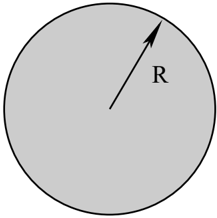
(a) Find the value of such that the particle will just reach the boundary of the spherically charged region.
(b) How much time does it take for the particle to reach the boundary of the region if it starts with the kinetic energy found in part (a)?
Topic: Electrostatics Metodi: Gauss’s Law Conservation of Energy Simple Harmonic Motion Analysis Competenze: Physical Reasoning Mathematical Modeling Objects: Point Charge Sphere Fonte: Testo (PDF) - p.1
Una particella carica con carica e massa riceve un’energia cinetica iniziale al centro di una regione sferica uniformemente carica di carica totale e di raggio . e presentano segni opposti. La regione con carica sferica non è libera di muoversi. In tutto questo problema si considerano solo le forze elettrostatiche.
(a) Trova il valore di in modo tale che la particella raggiunga solo il limite della regione con carica sferica.
b) Quanto tempo ci vuole per raggiungere il limite della regione se inizia con l’energia cinetica di cui alla lettera a)?
Topic: Electrostatics Metodi: Gauss’s Law Conservation of Energy Simple Harmonic Motion Analysis Competenze: Physical Reasoning Mathematical Modeling Objects: Point Charge Sphere Fonte: Testo (PDF) - p.1
A uniform pool ball of radius and mass begins at rest on a pool table. The ball is given a horizontal impulse of fixed magnitude at a distance above its center, where . The coefficient of kinetic friction between the ball and the pool table is . You may assume the ball and the table are perfectly rigid. Ignore effects due to deformation. (The moment of inertia about the center of mass of a solid sphere of mass and radius is .)
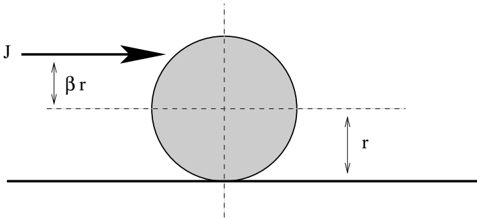
(a) Find an expression for the final speed of the ball as a function of , , and .
(b) For what value of does the ball immediately begin to roll without slipping, regardless of the value of ?
Topic: Rotational Dynamics Conservation of Momentum Metodi: Impulse-Momentum Theorem Torque & Angular Momentum Analysis Competenze: Physical Reasoning Diagrammatic Reasoning Objects: Ball Fonte: Testo (PDF) - p.1
Una palla da billardo uniforme di raggio e massa inizia a riposo su un tavolo da billardo. La palla riceve un impulso orizzontale di magnitudo fissa a una distanza sopra il suo centro, dove . Il coefficiente di attrito cinetico tra la palla e il tavolo da biliardo è . Potete supporre che la palla e il tavolo siano perfettamente rigidi. Ignorare gli effetti dovuti alla deformazione. (Il momento di inerzia intorno al centro di massa di una sfera solida di massa e di raggio è .)
(a) Trovare un’espressione per la velocità finale della palla come funzione di , e .
b) Per quale valore di la palla inizia immediatamente a rotolare senza scivolare, indipendentemente dal valore di ?
Topic: Rotational Dynamics Conservation of Momentum Metodi: Impulse-Momentum Theorem Torque & Angular Momentum Analysis Competenze: Physical Reasoning Diagrammatic Reasoning Objects: Ball Fonte: Testo (PDF) - p.1
A block of mass slides on a circular track of radius whose wall and floor both have coefficient of kinetic friction with the block. The size of the block is small compared to the radius of the track. The floor lies in a horizontal plane and the wall is vertical. The block is in constant contact with both the wall and the floor. The block has initial speed .
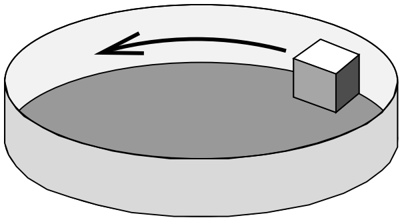
(a) Let the block have kinetic energy after traveling through an angle . Derive an expression for in terms of , , , and .
(b) Suppose the block circles the track exactly once before coming to a halt. Determine in terms of , , and .
Topic: Newtonian Mechanics Conservation of Energy Metodi: Free-Body Diagram Differential Equations Energy Conservation Method Competenze: Physical Reasoning Mathematical Modeling Objects: Block Fonte: Testo (PDF) - p.2
Un blocco di massa scivola su una pista circolare di raggio la cui parete e pavimento hanno entrambi un coefficiente di attrito cinetico con il blocco. Le dimensioni del blocco sono piccole rispetto al raggio della pista. Il pavimento si trova in piano orizzontale e la parete verticale. Il blocco è in costante contatto con il muro e il pavimento. Il blocco ha una velocità iniziale .
a) Lasciare che il blocco abbia energia cinetica dopo aver attraversato un angolo . Derivare un’espressione per in termini di , , , e .
b) Supponiamo che il blocco circonda la pista esattamente una volta prima di fermarsi. Determinare in termini di , e .
Topic: Newtonian Mechanics Conservation of Energy Metodi: Free-Body Diagram Differential Equations Energy Conservation Method Competenze: Physical Reasoning Mathematical Modeling Objects: Block Fonte: Testo (PDF) - p.2
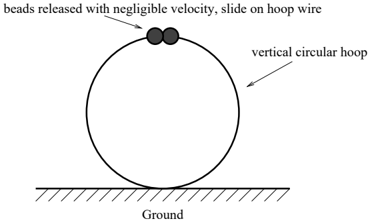
Two beads, each of mass , are free to slide on a rigid, vertical hoop of mass . The beads are threaded on the hoop so that they cannot fall off of the hoop. They are released with negligible velocity at the top of the hoop and slide down to the bottom in opposite directions. The hoop remains vertical at all times. What is the maximum value of the ratio such that the hoop always remains in contact with the ground? Neglect friction.
Topic: Newtonian Mechanics Conservation of Energy Metodi: Conservation of Energy Free-Body Diagram Symmetry Argument Competenze: Physical Reasoning Mathematical Modeling Objects: - Fonte: Testo (PDF) - p.2
Due perle, ciascuna di massa , possono scivolare liberamente su un cerchio rigido e verticale di massa . Le perle sono infilate sul cerchio in modo che non cadano dal cerchio. Sono rilasciate con velocità trascurabile in cima all’orlo e scivolavano verso il basso in direzioni opposte. L’orlo rimane sempre verticale. Qual è il valore massimo del rapporto tale che l’orlo rimanga sempre in contatto con il terreno? - Non si tratta di attrito.
Topic: Newtonian Mechanics Conservation of Energy Metodi: Conservation of Energy Free-Body Diagram Symmetry Argument Competenze: Physical Reasoning Mathematical Modeling Objects: - Fonte: Testo (PDF) - p.2