Question 1 A large container ship is coming in to port and must be pushed by a tugboat. While the tug and the container ship being pushed are speeding up to cruising speed, (A) the amount of force with which the tug pushes against the container ship is equal to the amount of force with which the container ship pushes back against the tug. (B) the amount of force with which the tug pushes against the container ship is smaller than the amount of force with which the container ship pushes back against the tug. (C) the amount of force with which the tug pushes against the container ship is greater than the amount of force with which the container ship pushes back against the tug. (D) the tug’s engine is running so the tug pushes against the container ship, but the container ship’s engine is not running so it can’t push back against the tug. (E) neither the tug nor the container ship exert any force on the other. The container ship is pushed forward simply because it is in the way of the tug.
Topic: Newtonian Mechanics Metodi: Free-Body Diagram, Physical Modeling Competenze: Physical Reasoning Objects: — Fonte: Testo (PDF) — p.2
Domanda 1 Una grande nave container sta arrivando al porto e deve essere spinta da un rimorchiatore. Mentre il remucchio e la nave contenitore che viene spinta si sta accelerando alla velocità di crociera, (A) la forza con cui il rimorchio spinge contro la nave contenitore è pari alla forza di la forza con cui la nave container spinge contro il rimorchio. b) la forza con cui il rimorchio spinge contro la nave contenitore è inferiore a la forza con cui la nave container spinge contro il rimorchio. C) la forza con cui il remucchio spinge contro la nave contenitore è superiore a la forza con cui la nave container spinge contro il rimorchio. (D) il motore dei remolchi è in funzione, quindi il remolco spinge contro la nave contenitore, ma il contenitore Il motore della nave non funziona, quindi non può respingere il rimorchio. (E) né il rimorchio né la nave contenitore esercitano alcuna forza sull’altro. La nave container è Il sistema di trasporto è stato spinto in avanti semplicemente perché si trovava in mezzo al remucchio.
Topic: Newtonian Mechanics Metodi: Free-Body Diagram, Physical Modeling Competenze: Physical Reasoning Objects: — Fonte: Testo (PDF) — p.2
Question 2 A large container ship is coming in to port and must be pushed by a tugboat. After the tug and the container ship being pushed have reached a constant cruising speed, (A) the amount of force with which the tug pushes against the container ship is equal to the amount of force with which the container ship pushes back against the tug. (B) the amount of force with which the tug pushes against the container ship is smaller than the amount of force with which the container ship pushes back against the tug. (C) the amount of force with which the tug pushes against the container ship is greater than the amount of force with which the container ship pushes back against the tug. (D) the tug’s engine is running so the tug pushes against the container ship, but the container ship’s engine is not running so it can’t push back against the tug. (E) neither the tug nor the container ship exert any force on the other. The container ship is pushed forward simply because it is in the way of the tug.
If then a plot of versus is a straight line with slope . For the next two questions, consider the equation
Topic: Newtonian Mechanics, Oscillations & Waves Metodi: Free-Body Diagram, Physical Modeling Competenze: Physical Reasoning Objects: — Fonte: Testo (PDF) — p.2
Domanda 2 Una grande nave container sta arrivando al porto e deve essere spinta da un rimorchiatore. Dopo il traino e il container che viene spinto ha raggiunto una velocità di crociera costante, (A) la forza con cui il rimorchio spinge contro la nave contenitore è pari alla forza di la forza con cui la nave container spinge contro il rimorchio. b) la forza con cui il rimorchio spinge contro la nave contenitore è inferiore a la forza con cui la nave container spinge contro il rimorchio. C) la forza con cui il remucchio spinge contro la nave contenitore è superiore a la forza con cui la nave container spinge contro il rimorchio. (D) il motore dei remolchi è in funzione, quindi il remolco spinge contro la nave contenitore, ma il contenitore Il motore della nave non funziona, quindi non può respingere il rimorchio. (E) né il rimorchio né la nave contenitore esercitano alcuna forza sull’altro. La nave container è Il sistema di trasporto è stato spinto in avanti semplicemente perché si trovava in mezzo al remucchio.
Se , allora un tratto di contro è una linea retta con pendenza . Per le prossime due domande, Considerare l’equazione
Topic: Newtonian Mechanics, Oscillations & Waves Metodi: Free-Body Diagram, Physical Modeling Competenze: Physical Reasoning Objects: — Fonte: Testo (PDF) — p.2
Question 3 What is the slope of a plot of versus ? Assume that the other quantities in the equation above are constant.
- A.
- B.
- C. The plot will not be a straight line.
- D.
- E.
Topic: Oscillations & Waves Metodi: Graph Linearization, Simple Harmonic Motion Analysis Competenze: Graph Linearization, Mathematical Modeling Objects: — Fonte: Testo (PDF) — p.3
Domanda 3 Qual è la pendenza di un plot di rispetto a ? Supponiamo che le altre quantità nell’equazione Le dimensioni superiori sono costanti.
- A.
- B.
- C. La trama non sarà rettilinea.
- D.
- E.
Topic: Oscillations & Waves Metodi: Graph Linearization, Simple Harmonic Motion Analysis Competenze: Graph Linearization, Mathematical Modeling Objects: — Fonte: Testo (PDF) — p.3
Question 4 What is the slope of a plot of versus ? Assume that the other quantities in the equation above are constant.
- A.
- B.
- C. The plot will not be a straight line.
- D.
- E.
Topic: Oscillations & Waves Metodi: Graph Linearization, Simple Harmonic Motion Analysis Competenze: Graph Linearization, Mathematical Modeling Objects: — Fonte: Testo (PDF) — p.3
Domanda 4 Qual è la pendenza di un plot di contro ? Supponiamo che le altre quantità nell’equazione Le dimensioni superiori sono costanti.
- A.
- B.
- C. La trama non sarà rettilinea.
- D.
- E.
Topic: Oscillations & Waves Metodi: Graph Linearization, Simple Harmonic Motion Analysis Competenze: Graph Linearization, Mathematical Modeling Objects: — Fonte: Testo (PDF) — p.3
Question 5 A large chicken catches a lightweight paper plane while both are in midair. Which of the chicken and the paper plane undergoes the smaller change in momentum?
- A. The chicken does.
- B. The paper plane does.
- C. The change in momentum is the same for both the chicken and the paper plane.
- D. You can’t tell without knowing the final velocity of the combined chicken-plane mass.
- E. The result depends on the energy absorbed by the crumpling of the paper plane in the chicken’s beak.
Topic: Conservation of Momentum, Newtonian Mechanics Metodi: Conservation of Momentum, Impulse-Momentum Theorem Competenze: Physical Reasoning Objects: — Fonte: Testo (PDF) — p.3
Domanda 5 Un grande pollo cattura un piano di carta leggero mentre entrambi sono in mezzo all’aria. Qual è il numero di il pollo e il piano di carta subiscono il minor cambiamento di impulso?
- A. Il pollo lo fa.
- ** B.** Il piano di carta lo fa.
- C. Il cambiamento di impulso è lo stesso sia per il pollo che per il piano di carta.
- D. Non si può dire senza conoscere la velocità finale della massa di pollo-piano combinato.
- E. Il risultato dipende dall’energia assorbita dal cromparsi del piano di carta nel
- Il becco del pollo.
Topic: Conservation of Momentum, Newtonian Mechanics Metodi: Conservation of Momentum, Impulse-Momentum Theorem Competenze: Physical Reasoning Objects: — Fonte: Testo (PDF) — p.3
Question 6 Someone analysing an electric circuit obtains the equations Note that V is the unit volts, and is the unit Ohms. How do the magnitudes of the three currents , and compare?
- A.
- B.
- C.
- D.
- E.
Topic: Circuits Metodi: Kirchhoff’s Laws Competenze: Mathematical Modeling, Diagrammatic Reasoning Objects: Resistor, Battery Fonte: Testo (PDF) — p.4
Domanda 6 Qualcuno che analizza un circuito elettrico ottiene le equazioni Si noti che V è l’unità volti e è l’unità Ohms. Come si fanno le magnitudini dei tre le correnti , e si confrontano?
- A.
- B.
- C.
- D.
- E.
Topic: Circuits Metodi: Kirchhoff’s Laws Competenze: Mathematical Modeling, Diagrammatic Reasoning Objects: Resistor, Battery Fonte: Testo (PDF) — p.4
Question 7 If you look through a piece of red-tinted glass, everything is seen in shades of red. Similarly, if you look through a piece of blue-tinted glass, everything will be seen in shades of blue. Consider the following statements: (I) The tinting process makes the glass absorb the corresponding colour, i.e. red-tinted glass strongly absorbs red light, making everything appear red. (II) The tinting process makes the glass absorb all colours except the corresponding colour, i.e. red-tinted glass will strongly absorb blue and green, but not red. (III) If you stack the red and blue tinted pieces of glass and look through them, everything will look quite dark. Which of these statements is/are true?
- A. I and II
- B. I and III
- C. II and III
- D. I only
- E. II only
Topic: Wave Optics, Geometric Optics Metodi: Physical Modeling, Superposition Principle Competenze: Physical Reasoning Objects: — Fonte: Testo (PDF) — p.4
Domanda 7 Se guardi attraverso un pezzo di vetro colorato rosso, tutto si vede in sfumature di rosso. Allo stesso modo, se se guardi attraverso un pezzo di vetro colorato blu, tutto verrà visto in sfumature di blu. Considerate le seguenti dichiarazioni: I) Il processo di tintura consente al vetro di assorbire il colore corrispondente, cioè vetro colorato rosso assorbe fortemente la luce rossa, facendo sembrare tutto rosso.
- il processo di tintura consente di assorbire tutti i colori, eccetto il colore corrispondente, i.e. il vetro colorato rosso assorbe fortemente il blu e il verde, ma non il rosso. (III) Se si accumulano i pezzi di vetro colorati rosso e blu e si guardano attraverso di loro, tutto si rivela Sembra piuttosto scuro. Quali di queste affermazioni sono/sono vere?
- A. I e II
- B. I e III
- C. II e III
- D. Solo
- solo E. II
Topic: Wave Optics, Geometric Optics Metodi: Physical Modeling, Superposition Principle Competenze: Physical Reasoning Objects: — Fonte: Testo (PDF) — p.4
Question 8 A teacher collects science projects from a class and finds that one page has fallen out. All that it contains is this plot without any axis labels or scales. Since the plot was unlabeled the teacher has to ask the class if anyone thinks it is theirs to work out whose assignment it came from. Even though they won’t get many marks for an unlabeled plot five students claim it as their work, making the following statements. To whom does it belong? (A) I plotted the number of birds on the island versus time over many years. The number was constant for the first few years but then decreased greatly over a single year because of a disease. After that the number increased more slowly until eventually it was greater than it had originally been.
- B. I plotted the height of a swing above the ground against horizontal distance.
- C. I plotted the volume of water in a jug as I poured out a glass of water, then stopped pouring, then poured another and so on until I had poured four glasses and then filled up the jug from the tap so it had enough water for another four glasses. (D) I added different masses of compound A to some of compound B so the total initial mass was fixed and measured how much of A was left after they reacted. I plotted the amount of A left against the amount of A I added. When I only added a little A there wasn’t much left at the end, but as I added more the amount left first increased and then decreased before increasing again. (E) I plotted the temperature of my water and ice mixture versus time. First I had room temperature water, then I added ice and stirred until the mixture reached . It stayed at until the ice had all melted and then slowly increased back up to room temperature.
Topic: Thermodynamics Metodi: First Law of Thermodynamics Competenze: Physical Reasoning, Diagrammatic Reasoning Objects: — Fonte: Testo (PDF) — p.5
Domanda 8 Un insegnante raccoglie progetti scientifici da una classe e scopre che una pagina è caduta. Tutto questo contiene questa traccia senza etichette o scale di asse. Poiché il complotto non è stato etichettato l’insegnante deve chiedere alla classe se qualcuno pensa che sia il suo lavoro
- E’ stato il mio primo lavoro. Anche se non otterranno molti voti per un non etichettato Cinque studenti lo rivendicano come loro lavoro, facendo le seguenti dichiarazioni. A chi è successo ?
- Che cosa? (A) Ho tracciato il numero di uccelli sull’isola rispetto al tempo per molti anni. Il numero era La crescita dei prezzi è stata costante per i primi anni, ma è diminuita notevolmente in un solo anno a causa di un aumento del tasso di cambio.
- Malattia. Dopo questo il numero è aumentato più lentamente fino a quando alla fine è stato superiore a Era stato originariamente.
- B. Ho tracciato l’altezza di uno swing sopra il terreno contro la distanza orizzontale.
- C. Ho tracciato il volume di acqua in un vaso mentre versò un bicchiere d’acqua, poi mi sono fermata versando, poi versando un altro e così via fino a quando non avevo versato quattro bicchieri e poi riempito la ciotola del rubinetto, così che avesse abbastanza acqua per altri quattro bicchieri. (D) Ho aggiunto diverse masse di composto A a alcune di composto B così la massa iniziale totale La quantità di A rimasta dopo la reazione è stata fissata e misurata. Ho tracciato l’importo di A sinistra rispetto all’importo di A I aggiunto. Quando ho aggiunto solo un piccolo A non c’era E’ stato molto meno alla fine, ma quando ho aggiunto di più, la quantità rimasta è aumentata prima e poi diminuito prima di aumentare di nuovo. (E) Ho tracciato la temperatura della mia miscela di acqua e ghiaccio rispetto al tempo. Prima avevo spazio. l’acqua a temperatura, poi aggiungo ghiaccio e mescolato fino a quando la miscela raggiunge . E’ rimasto . a fino a quando il ghiaccio non si era sciolto e poi lentamente aumentato fino alla stanza temperatura.
Topic: Thermodynamics Metodi: First Law of Thermodynamics Competenze: Physical Reasoning, Diagrammatic Reasoning Objects: — Fonte: Testo (PDF) — p.5
Question 9 Delightra and her sister Gladell bought a new book together, and are arguing over who gets to read it first. Gladell offers to toss a coin, but Delightra is suspicious because Gladell seems to have been winning coin tosses an awful lot lately. Delightra says “Gladell, you’re a cheat. Whatever I call, you know whether to catch it just a bit earlier or not to make sure that you win. Your coin always spins at the same rate, and you must know exactly what position to catch it.” Gladell is outraged, and replies “I can’t believe you think I’m cheating! Yes, my coin always spins at the same rate, but that doesn’t make me a cheat. You’re just jealous because I’m luckier than you!” After complaining to her physicist mother, and making her mother observe one of Gladell’s coin tosses, Delightra is told that it is completely implausible for Gladell to be cheating in this manner, as the coin rotates once for each coin-length it moves upwards. Which of the following is the best explanation of why? (A) Although Gladell can flip the coin to the same height each time and accurately judge this height, quantum mechanics tells us that there will be some inherent uncertainty in the coin’s and her hand’s position, and the sum of these is greater than a coin length so the coin may flip an extra time. (B) Even if Gladell tries to flick the coin exactly the same way each time, the small differences in the initial vertical velocity mean that the height of the toss isn’t accurate to within a coin length, so it might flip an extra time before she catches it. (C) Because the coin rotates once per coin length, the chaotic eddy currents in the air slow the coin’s spin, so although Gladell can get the position right to within a coin length, the coin may have flipped an extra time. (D) Although Gladell can flick the coin to the same height within a coin length each time, she cannot measure that constant height to within a coin length and so she can’t calculate where to put her hand. (E) Even if Gladell flicks the coin to the same height within a coin length each time, she will give it some slight horizontal velocity, so the time for which the coin is in the air changes and it might flip an extra time before she catches it.
Topic: Newtonian Mechanics, Oscillations & Waves Metodi: Kinematic Equations, Physical Modeling Competenze: Physical Reasoning, Estimation & Approximation Objects: — Fonte: Testo (PDF) — p.6
Domanda 9 Delightra e sua sorella Gladell hanno comprato un nuovo libro insieme, e si stanno litigando su chi può Leggilo prima. Gladell si offre di lanciare una moneta, ma Delightra è sospettosa perché Gladell sembra Ho vinto un sacco di lanci di monete ultimamente. Delightra dice che sei un truffatore. Qualunque cosa chiami, sai se prenderlo un po’ prima o non per assicurarti che tu
- Vengono. La tua moneta ruota sempre allo stesso ritmo, e devi sapere esattamente quale posizione Capisci. Gladell è indignato e risponde: “Non posso credere che tu pensi che io stia ingannando! Sì, la mia moneta. ruota sempre allo stesso ritmo, ma non mi fa essere un truffatore. Sei solo geloso perché Sono più fortunato di te! Dopo aver lamentato la sua madre fisica, e aver fatto osservare una delle monete di Gladell Delightra ha detto che è completamente improbabile che Gladell stia tradendo in questo La moneta ruota una volta per ogni lunghezza, si muove verso l’alto. Qual è di seguito indicato: e’ la migliore spiegazione del perché? (A) Anche se Gladell può girare la moneta alla stessa altezza ogni volta e giudicare con precisione questo L’altezza, la meccanica quantistica ci dice che ci sarà una certa incertezza intrinseca nel Le monete e la posizione della mano, e la somma di questi è maggiore di una lunghezza di moneta così la La moneta potrebbe essere spinta un’altra volta. (B) Anche se Gladell cerca di girare la moneta esattamente nello stesso modo ogni volta, le piccole differenze In questo caso, la velocità verticale iniziale significa che l’altezza del lancio non è accurata a lunghezza della moneta, quindi potrebbe girare un tempo in piu’ prima che la catturi. (C) Poiché la moneta ruota una volta per ogni lunghezza, le correnti caotiche nell’aria rallentano la moneta gira, quindi anche se Gladell può ottenere la posizione destra entro una lunghezza della moneta, la La moneta potrebbe aver fatto un tempo in più. (D) Anche se Gladell può spostare la moneta alla stessa altezza all’interno di una lunghezza di moneta ogni volta, lei non può misurare quella altezza costante entro una lunghezza di moneta e quindi non può calcolare Dove metterla la mano. (E) Anche se Gladell lancia la moneta alla stessa altezza all’interno di una moneta lunghezza ogni volta, dare una leggera velocità orizzontale, così il tempo per il quale la moneta è in aria cambia E potrebbe cambiare un po’ di tempo prima che la catturi.
Topic: Newtonian Mechanics, Oscillations & Waves Metodi: Kinematic Equations, Physical Modeling Competenze: Physical Reasoning, Estimation & Approximation Objects: — Fonte: Testo (PDF) — p.6
Question 10 An equation is dimensionally correct if the quantities on both sides have the same physical dimensions, e.g. length (L), mass (M), time (T), and combinations. For example, distance, , is a length and speed, , is a length per unit time, so is dimensionally correct if represents a time. Equations cannot be physically correct unless they are dimensionally correct. The average speed of a particle in an ideal gas depends only on the mass of the particle , the pressure , and the number density (number of particles per unit volume) of particles in the gas. Pressure has the dimensions . Which of the following equations is dimensionally correct?
- A.
- B.
- C.
- D.
- E.
Topic: Kinetic Theory, Thermodynamics Metodi: Dimensional Analysis, Kinetic Theory of Gases Competenze: Mathematical Modeling Objects: Gas Fonte: Testo (PDF) — p.6
Domanda 10 Un’equazione è dimensionalmente corretta se le quantità su entrambi i lati hanno la stessa fisica dimensioni, ad esempio: lunghezza (L), massa (M), tempo (T) e combinazioni. Per esempio, la distanza, , è una lunghezza e velocità, , è una lunghezza per unità di tempo, quindi è dimensionalmente corretta se rappresenta
- Un tempo. Le equazioni non possono essere corrette fisicamente se non sono corrette dimensionalmente. La velocità media di una particella in un gas ideale dipende solo dalla massa della particella , la pressione e la densità numerica (numero di particelle per unità di volume) delle particelle in Il gas. La pressione ha le dimensioni . Qual è l’equazione seguente Dimensionalmente corretta?
- A.
- B.
- C.
- D.
- E.
Topic: Kinetic Theory, Thermodynamics Metodi: Dimensional Analysis, Kinetic Theory of Gases Competenze: Mathematical Modeling Objects: Gas Fonte: Testo (PDF) — p.6
Question 11 Suggested time: 15 minutes A solid object floats in water if its average density is less than that of water. If its average density is greater than the density of water it sinks. If its average density is equal to that of water then it has no nett force acting on it when it is submerged. A boy floating in a swimming pool notices that he can float easily if he holds his breath but that as he breathes out, no matter how slowly he does it, he ends up just under water once he has finished exhaling. If he breathes out by blowing a fast stream of air directly upwards he goes under water even sooner and ends up further under water and is still moving down towards the bottom of the pool after he has finished exhaling. The difference between the volume of air in his lungs when full and empty is and he has mass . The density of water is and the density of air is much less than water. (a) Draw a free body diagram showing the forces acting on the boy when his lungs are empty after breathing out slowly. Indicate the magnitude of the forces acting on the boy by the size of the arrows you draw to represent the forces.
- B. What is the boy’s average density when his lungs are empty? Explain your answer.
- C. What is the boy’s average density when his lungs are full?
- D. Draw a free body diagram of the boy as he is moving downwards just after he finished emptying his lungs by blowing a fast stream of air upwards. Again indicate the magnitude of the forces acting on the boy by the size of the arrows you draw to represent the forces. (e) Why does the boy end up further under water in this case?
Topic: Fluid Mechanics, Newtonian Mechanics Metodi: Free-Body Diagram, Hydrostatic Equilibrium, Conservation of Momentum Competenze: Physical Reasoning, Diagrammatic Reasoning Objects: — Fonte: Testo (PDF) — p.7
Domanda 11 Tempo di lavoro: 15 minuti Un oggetto solido galleggia nell’acqua se la sua densità media è inferiore a quella dell’acqua. Se la sua media La densità è maggiore della densità dell’acqua che affonda. Se la densità media è pari a quella di l’acqua non ha forza di rete che agisce su di essa quando è sommersa. Un ragazzo che galleggia in una piscina nota che può galleggiare facilmente se tiene il respiro ma che mentre respira fuori, non importa quanto lentamente lo faccia, finisce appena sotto l’acqua ha finito di esaltare. Se si esalta soffia un flusso di aria diretto verso l’alto E’ ancora più veloce e finisce più sotto l’acqua e si sta ancora spostando verso il basso. il fondo della piscina dopo aver finito di esaltare. La differenza tra il volume di aria nei polmoni quando è pieno e vuoto è e ha massa . La densità dell’acqua è e la densità dell’aria è molto inferiore a quella dell’acqua. (a) Disegna un diagramma del corpo libero che mostra le forze che agiscono sul ragazzo quando i polmoni sono vuoti dopo aver respiro lentamente. Indicare l’entità delle forze che agiscono sul ragazzo dimensioni delle frecce che disegni per rappresentare le forze.
- B. Qual è la densità media del ragazzo quando i polmoni sono vuoti? Spiega la tua risposta.
- C. Qual è la densità media del ragazzo quando i polmoni sono pieni?
- D. Disegna un diagramma del corpo libero del ragazzo mentre si muove verso il basso appena ha finito svuotando i polmoni soffiando un flusso veloce di aria verso l’alto. Indicare ancora una volta la grandezza delle forze che agiscono sul ragazzo per la dimensione delle frecce che disegni per rappresentare le forze. e) Perché il ragazzo finisce più in profondità in questo caso?
Topic: Fluid Mechanics, Newtonian Mechanics Metodi: Free-Body Diagram, Hydrostatic Equilibrium, Conservation of Momentum Competenze: Physical Reasoning, Diagrammatic Reasoning Objects: — Fonte: Testo (PDF) — p.7
Question 12 Suggested time: 25 minutes Ben has built a toy car. He has worked hard at reducing the friction in the wheels, so much so that it can be considered negligible. The car is, however, subject to a drag force where is the speed of the car and . The car has mass and cross-sectional area . Take the acceleration due to gravity to be . Ben places the car at the top of a ramp of length inclined at an angle to the horizontal. He pushes it for time with a force such that the nett force acting on the car is . He then lets the car travel down the ramp and along a flat track. (a) Consider the car at time , when Ben stops pushing and find (i) , the speed of the car and (ii) , the distance the car has traveled. (b) Find an expression for , the speed of the car when it reaches the bottom of the ramp. Drawing a free body diagram of the car will help you. Note that is approximately . (c) After he has released the car, Ben notices that there is a large block on the track, a distance from the bottom of the ramp. Find , the velocity of the car when it hits the block. Useful Information If the acceleration of a body, , is related to the velocity by , the velocity is related to the position, by for some constant, . In physics it is often useful to make approximations. This can simplify your calculations, and if the approximation you make is appropriate, it won’t change your result appreciably. For example, if you know that and that is much, much smaller than , you may be able to say that and get the same result as you would have using . If you make an approximation you must demonstrate that it is valid.
Topic: Newtonian Mechanics, Conservation of Energy Metodi: Free-Body Diagram, Kinematic Equations, Energy Conservation Method, Approximation & Series Expansion Competenze: Mathematical Modeling, Diagrammatic Reasoning, Physical Reasoning Objects: Cart, Inclined Plane, Block Fonte: Testo (PDF) — p.8
Domanda 12 Tempo di lavoro: 25 minuti Ben ha costruito una macchina da giocattoli. Ha lavorato sodo per ridurre la friczione nelle ruote, tanto che che può essere considerata trascurabile. Tuttavia, l’auto è soggetta a una forza di trazione in cui è la velocità della vettura e . La massa del veicolo è e la sezione trasversale area . Prendete l’accelerazione dovuta alla gravità come . Ben pone l’auto in cima ad una rampa di lunghezza inclinata ad un angolo verso il
- L’orizzontale. He pushes it for time with a force such that the nett force acting on the auto è . Poi lascia che l’auto scenda la rampa e percorra una pista piatta. (a) Considerare l’auto al tempo , quando Ben smette di spingere e trova (i) , la velocità della vettura e (ii) , la distanza percorsa dal veicolo. b) Trova un’espressione per , la velocità dell’auto quando raggiunge la parte inferiore della rampa. Disegnare un diagramma del corpo libero dell’auto ti aiuterà. Nota che è approssimativamente . (c) Dopo aver rilasciato l’auto, Ben nota che c’è un grande blocco sulla pista, un blocco che si sta Distanza dalla parte inferiore della rampa. Trova , la velocità dell’auto quando si
- Colpisce il blocco. Informazioni utili Se l’accelerazione di un corpo, , è correlata alla velocità di , la velocità è correlata a la posizione, per per una costante, . In fisica è spesso utile fare approssimazioni. Questo può semplificare i vostri calcoli, e se L’approssimazione che si fa è appropriata, non cambierà significativamente il risultato. Per Ad esempio, se sapete che e che è molto, molto più piccolo di , potreste essere able to say that and get the same result as you would have using . Se tu
- che si deve dimostrare che è valida.
Topic: Newtonian Mechanics, Conservation of Energy Metodi: Free-Body Diagram, Kinematic Equations, Energy Conservation Method, Approximation & Series Expansion Competenze: Mathematical Modeling, Diagrammatic Reasoning, Physical Reasoning Objects: Cart, Inclined Plane, Block Fonte: Testo (PDF) — p.8
Question 13 Suggested time: 15 minutes Elizabeth wants to find the gravitational field strength in her bedroom using a pendulum. The equation she will use assumes that the pendulum consists of a massless string attached at one end to a fixed point and at the other to a point mass, that is a mass that has no volume. It also assumes that the angle between the string and the vertical is always small. She takes a hair ribbon, about 20 cm long, measures it with a ruler and then ties one end to her hair brush. She realises that she doesn’t have enough hands to do the experiment on her own, so she asks her sister Claire to hold the other end of the ribbon. Elizabeth asks Claire to rest her arm on a book case to make sure that she holds the ribbon very still. This forms Elizabeth’s pendulum. Elizabeth pulls the hair brush to the side and counts that it passes four thick books as she pulls it. She then releases it and lets it swing. She gets out her mobile phone and uses the stopwatch on it to time the pendulum. She times ten periods instead of one because she thinks this will be more accurate. She watches to see when the pendulum reaches the fourth book because it is moving very slowly here so she has more time to press the button on her phone. Thinking that she’ll get a better result if she takes more data and plots a graph, she repeats the experiment with ribbons of different lengths, pulling it past the same four thick books before letting it go each time. (a) Consider Elizabeth’s experimental method. What did she do that could have adversely affected her results? Suggest a simple modification to the experiment that could solve each problem. (b) Estimate the percentage uncertainty in the length for a 20 cm ribbon and for a 1 m ribbon using Elizabeth’s original method. Repeat the estimate for your revised method, if it is different.
Topic: Oscillations & Waves, Gravitation Metodi: Simple Harmonic Motion Analysis, Error Propagation Competenze: Experimental Data Analysis, Error Propagation, Estimation & Approximation Objects: Pendulum Fonte: Testo (PDF) — p.9
Domanda 13 Tempo di lavoro: 15 minuti Elizabeth vuole trovare la forza del campo gravitazionale nella sua camera da letto usando un pendolo. Il L’equazione che userà presuppone che il pendolo sia costituito da una corda senza massa attaccata a una finisce ad un punto fisso e all’altro ad una massa puntaria, cioè una massa che non ha volume. Anche presuppone che l’angolo tra la corda e la verticale sia sempre piccolo. Prende una nastro di capelli, lunga circa 20 cm, lo misura con una regola e poi le lega una estremità spazzola per capelli. Si rende conto che non ha abbastanza mani per fare l’esperimento da sola, Quindi chiede a sua sorella Claire di tenere l’altra estremità del nastro. Elizabeth chiede a Claire di riposarsi il braccio su una custodia per assicurarsi che tenga il nastro molto ferma. Questo forma Elizabeths pendolo. Elizabeth tira il pennello di capelli a lato e conta che passa quattro libri spessi mentre tira it. Poi lo rilascia e lo lascia svolgere. Lei prende il cellulare e usa l’orologio
- E’ il momento di mettere il pendolo. Moltiplica dieci periodi invece di uno perché pensa che questo sarà
- Più accurata. Guarda per vedere quando il pendolo raggiunge il quarto libro perché è Si muove molto lentamente qui, cosi’ ha piu’ tempo per premere il pulsante del suo telefono. Pensando che ottenga un risultato migliore se prende più dati e traccia un grafico, ripete il sperimentare con nastri di lunghezza diversa, tirando oltre gli stessi quattro libri spessi prima
- E’ che ogni volta la lasci andare. (a) Considerate il metodo sperimentale di Elizabeth. Cosa ha fatto che potrebbe aver causato danni ha influenzato i suoi risultati? Suggerire una semplice modifica all’esperimento che potrebbe risolvere ogni problema. b) Estimare l’incertezza percentuale nella lunghezza di un nastro da 20 cm e di un nastro da 1 m
- Il nastro che utilizza il metodo originale di Elizabeth. Ripetere la stima del metodo rivisto, se
- E’ diverso.
Topic: Oscillations & Waves, Gravitation Metodi: Simple Harmonic Motion Analysis, Error Propagation Competenze: Experimental Data Analysis, Error Propagation, Estimation & Approximation Objects: Pendulum Fonte: Testo (PDF) — p.9
Question 14 Suggested time: 30 minutes Joseph wants to measure the latent heat of vaporization of substance X, which is the amount of energy required per unit mass to turn substance X from a liquid to a gas at its boiling point. He begins by putting approximately 200 mL of liquid X in a beaker on a combined hotplate and scale. He inserts a thermometer, turns on the hotplate at min and records the liquid’s temperature as well as the combined mass of the liquid, beaker and thermometer every minute. After 24 minutes, there is no more liquid in the beaker. Joseph’s results are shown in the table below. Time (min) 0 1 2 3 4 5 6 7 8 Temperature (C) 24 25 28 37 50 64 77 90 102 Mass (g) 310 310 310 310 310 310 310 310 310 Time (min) 9 10 11 12 13 14 15 16 17 Temperature (C) 113 124 134 143 152 158 160 160 159 Mass (g) 310 310 307 307 305 302 288 264 241 Time (min) 18 19 20 21 22 23 24 Temperature (C) 160 160 160 161 160 161
Mass (g) 214 190 165 138 110 79 69 Joseph notices that the temperature increases at a different rate at different temperatures. To show this variation, he plots the difference between two successive temperature measurements divided by the time between them, i.e. the rate of change of the temperature, versus the temperature at the first of these measurement times. His graph (Graph 1) is shown over the page, along with a graph (Graph 2) of the temperature of the liquid as a function of time. (a) Explain the shape of Graph 1, by giving reasons for the initial increase, the gradual decline over a wide temperature range and the sharp decrease near . (Hint: Graph 2 might help you interpret the regions of Graph 1.) (b) By drawing an appropriate graph, find the average rate at which liquid X boils, in . (c) In a previous experiment, Joseph measured the specific heat capacity of liquid X to be . This means that it takes 2.19 kJ of energy to raise the temperature of 1 kg of liquid X by 1 K (which is equal to ). (i) Pick the point on Graph 1 that gives the most information about the rate at which heat is transferred to the liquid at its boiling point. Explain how you chose this point and why it is the most appropriate. (ii) Using the information above and your answer to part (i), find the power being transferred to liquid X as it boils, in . (d) Using your answers to the previous parts, find the latent heat of vaporization of substance X, in .
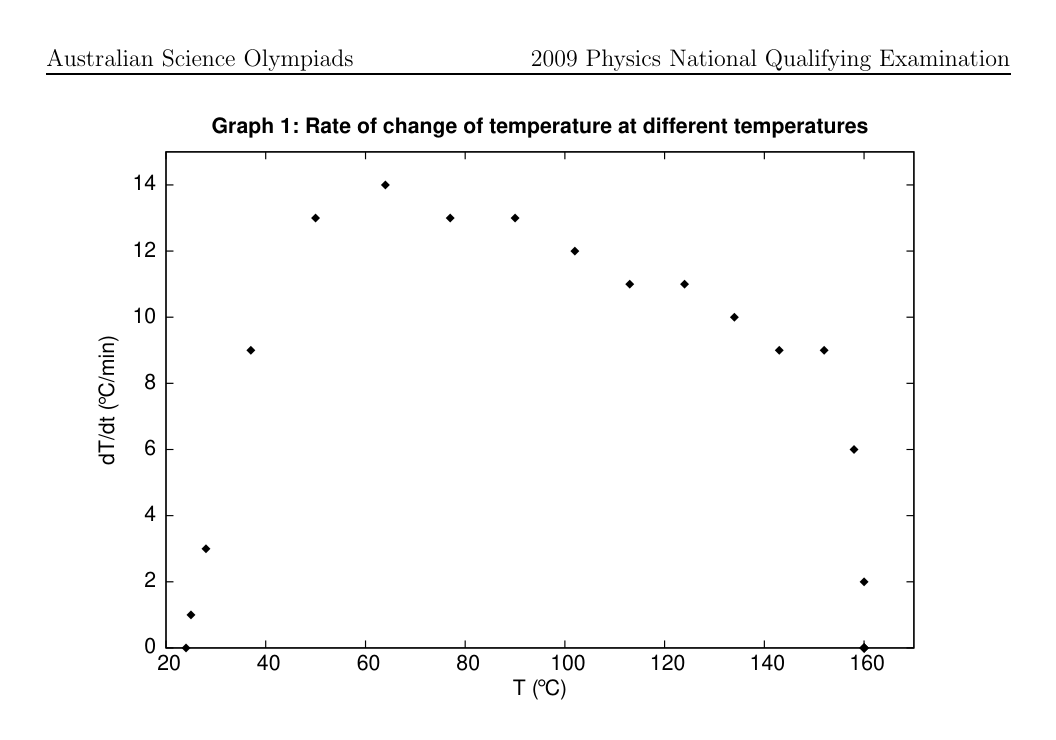 dT/dt vs temperatura liquido X
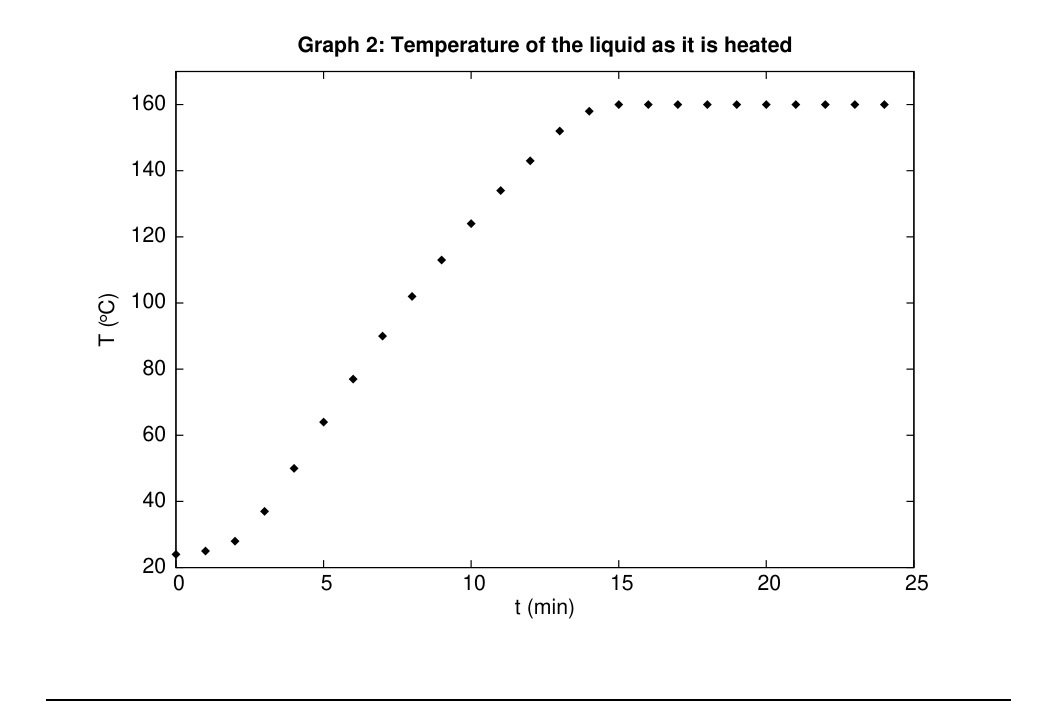 temperatura liquido X vs tempo
Topic: Thermodynamics Metodi: First Law of Thermodynamics, Experimental Data Analysis, Graph Linearization Competenze: Experimental Data Analysis, Graph Linearization, Mathematical Modeling Objects: Container Fonte: Testo (PDF) — p.10
Domanda 14 Tempo di lavoro: 30 minuti Joseph vuole misurare il calore latente della vaporizzazione della sostanza X, che è la quantità di energia necessaria per unità di massa per trasformare la sostanza X da liquido in gas al punto di ebollizione. He inizia mettendo circa 200 ml di liquido X in una tazza su una caldaie combinata e
- La scala. Inserisce un termometro, accende la placca a min e registra i liquidi temperatura e massa combinata del liquido, del calice e del termometro ogni minuto. Dopo 24 minuti, non c’è più liquido nella tazza. I risultati di Joseph sono riportati nella tabella
- Qui sotto. Tempo (min) 0 1 2 3 4 5 6 7 8 Temperatura (C) 24 25 28 37 50 64 77 90 102 Massa (g) 310 310 310 310 310 310 310 310 310 Tempo (min) 9 10 11 12 13 14 15 16 17 Temperatura (C) 113 124 134 143 152 158 160 160 159 Massa (g) 310 310 307 307 305 302 288 264 241 Tempo (min) 18 19 20 21 22 23 24 Temperatura (C) 160 160 160 161 160 161
Massa (g) 214 190 165 138 110 79 69 Joseph nota che la temperatura aumenta a velocità diverse a temperature diverse. To mostrare questa variazione, traccia la differenza tra due successive misurazioni di temperatura diviso per il tempo tra di loro, cioè il tasso di variazione della temperatura, rispetto al la temperatura al primo di questi tempi di misurazione. Il suo grafico (grafico 1) è mostrato sopra il pagina, insieme a un grafico (grafico 2) della temperatura del liquido in funzione del tempo. (a) Spiega la forma del grafico 1 fornendo le ragioni dell’aumento iniziale, il calo su un ampio intervallo di temperature e la forte diminuzione vicino a . (Signore: grafico 2 (per esempio, la definizione di un’area di riferimento può essere utilizzata per la definizione di una regione di riferimento, che può essere utilizzata per interpretare le regioni della grafica 1.) b) Tracciando un grafico appropriato, si trova la velocità media di bollio del liquido X, in . (c) In un esperimento precedente, Joseph ha misurato la capacità termico specifica del liquido X per . Ciò significa che ci vuole 2,19 kJ di energia per aumentare la temperatura di 1 °C. kg di liquido X per 1 K (equivalente a ).
- Selezionare il punto del grafico 1 che fornisce la maggior quantità di informazioni sul tasso di il calore viene trasferito al liquido al punto di ebollizione. Spiegami come hai scelto questo. Il punto di vista e il motivo per cui è il più appropriato. (ii) Sfruttando le informazioni di cui sopra e la risposta alla parte (i), si può trovare che la potenza è trasferito al liquido X in modo fervente, in . (d) Usando le risposte alle parti precedenti, trovare il calore latente della vaporizzazione della sostanza X, in .
*dT/dt vs temperatura liquido X *
*temperatura liquida X vs tempo *
Topic: Thermodynamics Metodi: First Law of Thermodynamics, Experimental Data Analysis, Graph Linearization Competenze: Experimental Data Analysis, Graph Linearization, Mathematical Modeling Objects: Container Fonte: Testo (PDF) — p.10
Question 15 Suggested time: 20 minutes The intensity, power per unit area, of light falling on a surface in three dimensions can be understood by thinking about light rays coming from a point source in all directions. The total power of the light falling on a given surface is proportional to the number of rays hitting that surface. The intensity at some point is therefore proportional to the density of the rays, or how many rays pass through a given area. The total number of rays leaving the point source depends only on the total power emitted by that source. One of the consequences of this is that the intensity due to a single point source is inversely proportional to the square of the distance from the source, where is the power emitted by the source. This is because at radius , a constant number of rays must be spread over an area of (the surface area of the sphere of radius ), giving a density of rays proportional to . (a) How would intensity depend on distance in a universe with only two spatial dimensions, like a sheet of paper? Explain your answer. This concept works for some other physical quantities, such as electric field lines. The same arguments apply; the strength of the electric field due to a single point charge is inversely proportional to the square of the distance from the charge . The electrostatic force on an object with charge due to the electric field of a point charge is where is a constant. Charges of opposite sign attract, and charges of the same sign repel one another. (b) An object will move in uniform circular motion only if a centripetal force (i.e. a force acting towards the centre of the circle) is applied. The size of this force must be where is the mass of the object, is its speed and is the radius of the circle. If an electron with mass and charge orbits a helium nucleus with charge at radius , what will the orbital speed of the orbit be? Assume that the orbit is circular. (c) If two electrons are orbiting the helium nucleus, still at radius , will their orbital speed be larger or smaller than that of a single electron orbiting? Explain your answer. Integrity of the Competition To ensure the integrity of the competition and to identify outstanding students, the competition organisers reserve the right to re-examine or disqualify any student or group of students before determining a mark or award where there is evidence of collusion or other academic dishonesty. Markers’ decisions are final. © Australian Science Innovations Incorporated ABN 81 731 558 309
Topic: Electrostatics, Geometric Optics Metodi: Coulomb’s Law, Symmetry Argument Competenze: Physical Reasoning, Mathematical Modeling Objects: Electron, Nucleus, Point Charge Fonte: Testo (PDF) — p.12
Domanda 15 Tempo di lavoro: 20 minuti L’intensità, potenza per unità di superficie, della luce che cade su una superficie in tre dimensioni può essere che viene da una fonte di luce in tutte le direzioni. Il totale la potenza della luce che cade su una determinata superficie è proporzionale al numero di raggi che colpiscono quella superficie superficie. L’intensità di un certo punto è quindi proporzionale alla densità dei raggi, o come molti raggi passano attraverso una determinata area. Numero totale di raggi che usciranno dalla fonte del punto Dipende solo dalla potenza totale emessa da tale fonte. Una delle conseguenze di questo è che l’intensità dovuta a una singola fonte di punto è inversa proporzionale al quadrato della distanza dalla fonte, in cui è la potenza emessa dalla fonte. Questo perché al raggio , un numero costante di I raggi devono essere distribuiti su una superficie di (la superficie della sfera di raggio ), dando un densità dei raggi proporzionale a . (a) Come dipenderebbe l’intensità dalla distanza in un universo con solo due dimensioni spaziali, Come un foglio di carta? Spiega la tua risposta. Questo concetto funziona per alcune altre quantità fisiche, come le linee di campo elettrico. Lo stesso si applicano argomenti; la forza del campo elettrico a causa di una carica di un singolo punto è inversa proporzionale al quadrato della distanza dalla carica . La forza elettrostatica su un l’oggetto con carica a causa del campo elettrico di una carica puntaria è in cui è una costante. Le cariche del segno opposto attirano, e le cariche dello stesso segno respingono uno
- Un altro. b) Un oggetto si muoverà in movimento circolare uniforme solo se una forza centripeta (cioè una forza La circolazione si svolge in direzione del centro del cerchio. La dimensione di questa forza deve essere se è la massa dell’oggetto, è la sua velocità e è il raggio del cerchio. Se un elettrone di massa e carica orbita intorno a un nucleo di elio con carica al Il raggio , qual sarà la velocità orbitale dell’orbita? Supponiamo che l’orbita sia circolare. (c) Se due elettroni orbitano intorno al nucleo di elio, ancora a raggio , la loro velocità orbitale sarà essere più grande o più piccolo di quello di un singolo elettrone in orbita? Spiega la tua risposta. L’integrità della concorrenza Per garantire l’integrità del concorso e identificare studenti eccezionali, gli organizzatori del concorso si riserva il diritto di riesaminare o squalificare qualsiasi prima di determinare un premio o un premio, se esiste prova di collusione o di altra disonestà accademica. Le decisioni sui marcatori sono definitive. © Australian Science Innovations Incorporated ABN 81 731 558 309
Topic: Electrostatics, Geometric Optics Metodi: Coulomb’s Law, Symmetry Argument Competenze: Physical Reasoning, Mathematical Modeling Objects: Electron, Nucleus, Point Charge Fonte: Testo (PDF) — p.12