- Boat (9 points) Consider a boat of effective mass , which moves along the (horizontal) -axes, and for which the friction force of the water is given by , where is the velocity of the boat. (Effective mass is somewhat larger than the real mass, because any change of the boat’s velocity incurs a velocity change of those regions of water, which are close to the boat; hence, the boat’s inertia is complemented by the inertia of the surrounding water.) i) Prove that during this motion, , and find the factor . ii) Now, a boy of mass moves inside the boat, back and forth, with velocity (also, along the -axis). What term must be added to the conservation law , to describe this situation? iii) Now, let the boat rest initially close to the coast and ready to depart. The boy jumps from the coast into the boat, turns around and jumps back to the coast. The horizontal component of the boy’s velocity during the first jump was , and during the second jump . What is the maximum distance travelled by the boat? Neglect the effect of a vertical motion on the horizontal friction force of the water.
Topic: Newtonian Mechanics, Conservation of Momentum Metodi: Differential Equations, Conservation of Momentum, Free-Body Diagram Competenze: Mathematical Modeling, Physical Reasoning Objects: Cart Fonte: Testo (PDF) — p.1
- Barca (9 punti) Considerare una barca di massa effettiva , che si muove lungo gli assi (orizzontali) , e per i quali la frizione la forza dell’acqua è data da , dove è la velocità della barca. (La massa effettiva è un po’ più grande della massa reale, Perché ogni cambiamento della velocità della barca incurre un cambiamento di velocità La Commissione ha inoltre adottato una decisione che stabilisce che le regioni idriche situate vicino alla nave l’inerzia della barca è completata dall’inerzia del acqua.) i) dimostrare che durante la mozione, , e trovare il fattore . ii) Ora, un ragazzo di massa si muove all’interno della barca, avanti e indietro, con velocità (anche lungo l’asse ). Che termine deve essere aggiunto alla legge sulla conservazione , per descrivere questo La situazione? iii) Ora, lasciate che la barca riposi inizialmente vicino alla costa e pronta a
- Andate via. Il ragazzo salta dalla costa nella barca, si gira e salta di nuovo verso la costa. La componente orizzontale della La velocità del ragazzo durante il primo salto era , e durante il secondo salto salto . Qual è la distanza massima percorsa dalla barca ? Negliodare l’effetto di un movimento verticale sulla frizione orizzontale la forza dell’acqua.
Topic: Newtonian Mechanics, Conservation of Momentum Metodi: Differential Equations, Conservation of Momentum, Free-Body Diagram Competenze: Mathematical Modeling, Physical Reasoning Objects: Cart Fonte: Testo (PDF) — p.1
- Nanoclock (10 points) Nanotechnology allows controllable fabrication of very small structures. Let us consider a tiny homogeneously charged thin ring, having a radius and carrying a positive net charge . i) Find the electric potential at a point , which is on the axes of the ring, at a distance from the centre of the ring. ii) Find the electric field at the point . iii) Show that the force acting on an electron moving along the symmetry axes in the vicinity of the centre of the ring () is harmonic (i.e. depends linearly on ). iv) Define the frequency of oscillations of such an electron. Use numerical values and C. v) Now, let us assume that the electron can perform also off-axis movements. Is the position at the symmetry centre of the ring (on-axis, ) stable or unstable? Motivate your answer. Hint: You may use the approximate formula .
Topic: Electrostatics, Oscillations & Waves Metodi: Electric Potential Method, Approximation & Series Expansion, Simple Harmonic Motion Analysis Competenze: Mathematical Modeling, Physical Reasoning Objects: Electron Fonte: Testo (PDF) — p.1
- Nanoorologio (10 punti) La nanotecnologia consente la fabbricazione controllabile di strutture. Considerate un piccolo magro con una carica omogenea un anello, con raggio e carico netto positivo . i) Trovare il potenziale elettrico in un punto , che si trova sugli assi di un anello, a una distanza dal centro dell’anello. ii) Trova il campo elettrico al punto . iii) Indicare che la forza che agisce su un elettrone che si muove lungo il assi di simmetria nei pressi del centro dell’anello () è armonica (cioè dipende linearmente da ). iv) Definire la frequenza di oscillazioni di un tale elettrone. Utilizzare i valori numerici e C. v) Ora, supponiamo che l’elettrone può eseguire anche fuori asse
- Movimenti. La posizione al centro di simmetria dell’anello (sulla asse, ) è stabile o instabile? Motiva la tua risposta. Suggerimento: si può usare la formula approssimativa .
Topic: Electrostatics, Oscillations & Waves Metodi: Electric Potential Method, Approximation & Series Expansion, Simple Harmonic Motion Analysis Competenze: Mathematical Modeling, Physical Reasoning Objects: Electron Fonte: Testo (PDF) — p.1
- Ball (8 points) A homogeneous ball of radius and mass is thrown horizontally onto a table at the moment of time . Its initial velocity before contact is purely horizontal and equal to ; it is non-rotating. Coefficient of kinetic friction between the table and the ball is . i) Find the moment of time , when the ball stops sliding, i.e. starts rolling without sliding. ii) Calculate the angular velocity of the ball and its total mechanical energy at the moment when it stops sliding. In the case of a hollow sphere, would the energy be larger or smaller than in the case of a homogeneous ball? iii) Now, assume that the horizontal surface is treated so that the coefficient of kinetic friction depends on the horizontal coordinate as (with ). Find the expression for the terminal mechanical energy in this new case. iv) Now, let us return to the case of constant kinetic friction coefficient . However, let us assume that the surface is not perfectly rigid (e.g. covered by a felt cloth). This gives rise to a second friction force — the rolling friction force . Unlike the kinetic friction force, it is not tangential to the touching point of the ball and the surface. Instead, it can be interpreted as the horizontal component of the surface reaction force (the entire reaction force is, of course, normal to the surface), see Fig. Find the expression for the terminal mechanical energy in this case. What is the most important (qualitative) difference between the expressions for and ? Hint: The moment of inertia of a ball is .
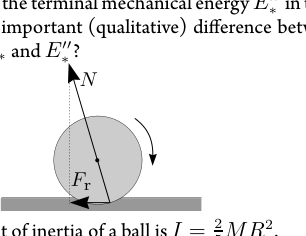 palla su piano con forze Fr e N
Topic: Newtonian Mechanics, Rotational Dynamics, Conservation of Energy Metodi: Free-Body Diagram, Torque & Angular Momentum Analysis, Energy Conservation Method, Kinematic Equations Competenze: Mathematical Modeling, Physical Reasoning, Diagrammatic Reasoning Objects: Ball, Sphere Fonte: Testo (PDF) — p.1
- Ball (8 punti) Una palla omogenea di raggio e massa è gettato orizzontalmente su un tavolo al momento del tempo . Il suo la velocità iniziale prima del contatto è puramente orizzontale ed è uguale a ; non è rotante. Coefficiente di attrito cinetico tra la tabella e la palla è . i) Trovare il momento del tempo , quando la palla smette di scivolare, cioè inizia Rotolare senza scivolare. ii) Calcolare la velocità angolare della palla e il suo totale energia meccanica nel momento in cui si ferma il glisso. Nel in caso di sfera vuota, l’energia sarebbe maggiore o minore che nel caso di una palla omogenea? iii) Ora, supponiamo che la superficie orizzontale sia trattata in modo tale che il coefficiente di attrito cinetico dipende dalla linea orizzontale coordinate come (con ). Trova il espressione per l’energia meccanica terminale in questo nuovo caso. iv) Ora, torniamo al caso della costante attrito cinetico il coefficiente . Tuttavia, supponiamo che la superficie non sia perfetto rigido (es. ricoperto di un panno di feltro). Questo dà luogo a un la seconda forza di attrito la forza di attrito di rotazione . A differenza della forza di attrito cinetica, non è tangenziale al tocco punto della palla e della superficie. Invece, può essere interpretata come la componente orizzontale della forza di reazione superficiale (l’intero La forza di reazione è, naturalmente, normale alla superficie), vedere figura. Trova l’espressione per l’energia meccanica terminale in questo caso. Qual è la differenza più importante (qualitativa) tra le espressioni per e ? Suggerimento: il momento di inerzia di una palla è .
Palla su pianoforze conforze F e N
Topic: Newtonian Mechanics, Rotational Dynamics, Conservation of Energy Metodi: Free-Body Diagram, Torque & Angular Momentum Analysis, Energy Conservation Method, Kinematic Equations Competenze: Mathematical Modeling, Physical Reasoning, Diagrammatic Reasoning Objects: Ball, Sphere Fonte: Testo (PDF) — p.1
- Black box (9 points) Equipment: electrical black box with three outlets, battery, voltmeter. It is known that inside the black box, there are three resistors (connected with wires in an unknown manner), the smallest of which is . Find the value of the largest resistor . What can be said about the middle-valued resistor ? Estimate the uncertainties of your results.
Topic: Circuits Metodi: Kirchhoff’s Laws, Equivalent Circuit Reduction, Error Propagation Competenze: Experimental Data Analysis, Measurement & Instrumentation, Error Propagation Objects: Resistor, Battery, Galvanometer Fonte: Testo (PDF) — p.1
- Scatola nera (9 punti) Attrezzatura: scatola nera elettrica con tre prese di corrente, batteria, voltmeter. È noto che all’interno della scatola nera ci sono tre resistenti (connesso con fili in modo sconosciuto), il più piccolo di che è . Trova il valore della resistenza più grande . Che cosa si può dire della resistenza di valore medio ? Estimato Le incertezze dei risultati.
Topic: Circuits Metodi: Kirchhoff’s Laws, Equivalent Circuit Reduction, Error Propagation Competenze: Experimental Data Analysis, Measurement & Instrumentation, Error Propagation Objects: Resistor, Battery, Galvanometer Fonte: Testo (PDF) — p.1
- Pencil (6 points) Equipment: pencil, paper, ruler. Determine the coefficient of friction of the pencil’s graphite core against the paper. Estimate the uncertainty.
Topic: Newtonian Mechanics Metodi: Free-Body Diagram, Physical Modeling Competenze: Measurement & Instrumentation, Error Propagation, Experimental Data Analysis Objects: — Fonte: Testo (PDF) — p.2
- Penzene (6 punti) Attrezzature: penna, carta, reggente. Determinare il coefficiente di attrito del grafite
- Il nucleo contro la carta. - Stima l’incertezza.
Topic: Newtonian Mechanics Metodi: Free-Body Diagram, Physical Modeling Competenze: Measurement & Instrumentation, Error Propagation, Experimental Data Analysis Objects: — Fonte: Testo (PDF) — p.2
- Spring (7 points) Equipment: helical spring of known mass g, measuring tape, a load of unknown mass. Determine the mass of the load. Estimate the uncertainty.
Topic: Oscillations & Waves, Newtonian Mechanics Metodi: Simple Harmonic Motion Analysis, Physical Modeling Competenze: Measurement & Instrumentation, Error Propagation, Experimental Data Analysis Objects: Spring Fonte: Testo (PDF) — p.2
- Provincia (7 punti) Attrezzature: provenza a elica di massa nota g, nastro di misura, carico di massa sconosciuta. Determina la massa del carico. - Stima l’incertezza.
Topic: Oscillations & Waves, Newtonian Mechanics Metodi: Simple Harmonic Motion Analysis, Physical Modeling Competenze: Measurement & Instrumentation, Error Propagation, Experimental Data Analysis Objects: Spring Fonte: Testo (PDF) — p.2
- Soap film (6 points) Lord Rayleigh had in 1891 a lecture about taking photos of physical processes. Among others, he showed a photo of a soap film, which is falling apart (see Fig.). Instead of a flash, he used an electric spark (well, nowadays the flashes are also based on electric sparks). Estimate, how precise must have been the timing, i.e. estimate the time for a soap film to fall apart. Let the thickness of the soap film be , the ring diameter cm and the surface tension N/m. Hint: you may use a model, according to which the already broken part of the soap film gathers into a single front and moves all together towards the still preserved part of the film.
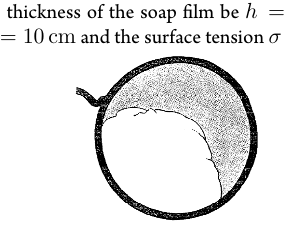 foto pellicola di sapone che cade
Topic: Fluid Mechanics, Conservation of Momentum Metodi: Conservation of Momentum, Physical Modeling, Order-of-Magnitude Estimation Competenze: Estimation & Approximation, Physical Reasoning, Mathematical Modeling Objects: Membrane Fonte: Testo (PDF) — p.2
- Il film di sapone (6 punti) Lord Rayleigh ha tenuto nel 1891 una conferenza sul Foto di processi fisici. Tra gli altri, ha mostrato un foto di un film di sapone che sta crollando (vedi figura). Invece di un Flash, ha usato una scintilla elettrica (buona, oggi i flash sono anche basato su scintille elettriche). - Stima quanto deve essere stato preciso. il tempo, cioè - stima il tempo di caduta di un film di sapone. Lascia che lo spessore del film di sapone è , il diametro dell’anello cm e la tensione superficiale N/m. Suggerimento: si può utilizzare un modello secondo il quale la parte rotta del film di sapone si riunisce in un unico fronte e si muove Tutti insieme verso la parte ancora conservata del film.
foto pellicola di sapone che cade
Topic: Fluid Mechanics, Conservation of Momentum Metodi: Conservation of Momentum, Physical Modeling, Order-of-Magnitude Estimation Competenze: Estimation & Approximation, Physical Reasoning, Mathematical Modeling Objects: Membrane Fonte: Testo (PDF) — p.2
- Magnetic pulse (7 points) Consider an electric circuit consisting of a coil of negligibly small inductance, consisting of turns and with the surface area of a single loop ), resistors , capacitor F, and an inductance H, connected as shown in Fig. At the moment of time , a magnetic field, parallel to the axis of the coil is switched on. The inductance of the magnetic field starts growing linearly, starting from until the maximal value T is achieved at ms. Further, the inductance of the magnetic field remains constant (and equal to 1 T). i) Find the current through the resistors and at the moment of time ms. ii) Find the current through the resistors and at the moment of time ms. iii) What is the net charge passing through the resistor ?
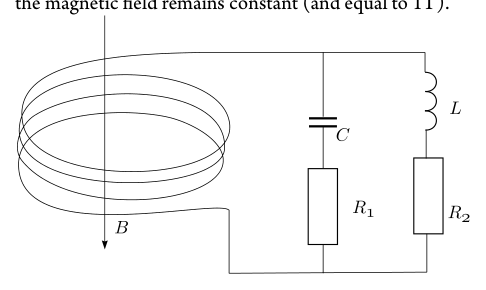 solenoide e circuito R1 R2 C L
Topic: Electromagnetic Induction, Circuits Metodi: Faraday’s Law of Induction, Kirchhoff’s Laws, Lenz’s Law Competenze: Mathematical Modeling, Diagrammatic Reasoning Objects: Coil, Resistor, Capacitor, Inductor Fonte: Testo (PDF) — p.2
- Pulso magneto (7 punti) Considerate un circuito elettrico di una massa di 0,5% o più di 0,5% di massa di carbonio giri e con superficie di un singolo ciclo ), resistori , condensatore F, e una induttanza H, collegata come mostrato alla figura. Al momento di tempo , un campo magnetico, parallelo all’asse di la bobina è accesa. L’induttanza del campo magnetico inizia crescendo in modo lineare, a partire da fino al valore massimo T is achieved at ms. Inoltre, l’induttanza di il campo magnetico rimane costante (e pari a 1 T). i) Trova la corrente attraverso le resistenze e al momento di tempo ms. ii) Trova la corrente attraverso le resistenze e al punto di momento di tempo ms. iii) Qual è la carica netta che passa attraverso la resistenza ?
- solenoide e circuito R1 R2 C L *
Topic: Electromagnetic Induction, Circuits Metodi: Faraday’s Law of Induction, Kirchhoff’s Laws, Lenz’s Law Competenze: Mathematical Modeling, Diagrammatic Reasoning Objects: Coil, Resistor, Capacitor, Inductor Fonte: Testo (PDF) — p.2
- Stratostat (5 points) i) Show that the pressure of an isothermal gas of molar mass follows the law , where is the pressure at the origin, and is the height. Find the constant . The temperature is , the free fall acceleration is . ii) Consider a stratostat, the envelope of which (a freely deformable non-elastic sack) is filled at the Earth’s surface by helium to the volume fraction of . At which height does the helium expand so that it fills the entire volume of the stratostat? The molar masses of the air and helium are g/mol and g/mol, respectively. You may neglect the temperature variations of the atmosphere, and use the value K.
Topic: Thermodynamics, Fluid Mechanics Metodi: Ideal Gas Law, Hydrostatic Equilibrium, Differential Equations Competenze: Mathematical Modeling, Physical Reasoning Objects: Gas Fonte: Testo (PDF) — p.2
- Stratostat (5 punti) i) Indicare che la pressione di un gas isotermo di massa molare segue la legge , dove è la pressione all’origine, e è l’altezza. Trova la costante . La temperatura è , la temperatura è di l’accelerazione della caduta libera è . ii) Considerare uno stratostat, il cui involucro (un diformabile non elastico) è riempito alla superficie terrestre da gliolio alla frazione di volume di . Al quale altezza L’elio si espandono in modo da riempire l’intero volume del
- Stratostat? Le masse molari dell’aria e dell’elio sono rispettivamente g/mol e g/mol. Potresti trascurare le variazioni di temperatura dell’atmosfera e utilizzare il valore K.
Topic: Thermodynamics, Fluid Mechanics Metodi: Ideal Gas Law, Hydrostatic Equilibrium, Differential Equations Competenze: Mathematical Modeling, Physical Reasoning Objects: Gas Fonte: Testo (PDF) — p.2
- Wedge (5 points) A wedge of mass is kept at rest on an horizontal surface, and a block of mass is kept on the wedge at the height from the surface. The angle of the wedge is , see Fig. There is no friction neither between the block and wedge nor between the surface and the wedge. The system is released into a free motion. Find the time needed for the block to reach the surface.
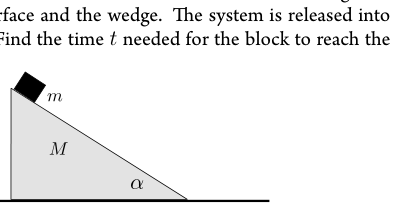 cuneo M con blocco m su piano
Topic: Newtonian Mechanics Metodi: Free-Body Diagram, Vector Decomposition, Kinematic Equations Competenze: Mathematical Modeling, Diagrammatic Reasoning Objects: Wedge, Block Fonte: Testo (PDF) — p.2
- 5 punti) Una ciglia di massa è tenuta in riposo su un superficie orizzontale e un blocco di massa è tenuto sulla ciglia a l’altezza dalla superficie. L’angolo della ciglia è , cfr. Fig. - Cosa? Non c’è attrito né tra il blocco e la cucina né tra tra la superficie e la cuneo. Il sistema viene rilasciato in
- Una libera circolazione. Trova il tempo necessario per raggiungere il blocco superficie.
*cuneio M con blocco m su pianoforte *
Topic: Newtonian Mechanics Metodi: Free-Body Diagram, Vector Decomposition, Kinematic Equations Competenze: Mathematical Modeling, Diagrammatic Reasoning Objects: Wedge, Block Fonte: Testo (PDF) — p.2