- A apple falls from rest through a height of onto a flat surface. Upon impact, the apple comes to rest in , and of the apple comes into contact with the surface during the impact. What is the average pressure exerted on the apple during the impact? Ignore air resistance.
- A. 67,000 Pa
- B. 21,000 Pa
- C. 6,700 Pa
- D. 210 Pa
- E. 67 Pa The following information is used for questions 2 and 3. Three blocks of identical mass are placed on a frictionless table as shown. The center block is at rest, whereas the other two blocks are moving directly towards it at identical speeds . The center block is initially closer to the left block than the right one. All motion takes place along a single horizontal line.
Topic: Newtonian Mechanics, Fluid Mechanics Metodi: Kinematic Equations, Impulse-Momentum Theorem, Free-Body Diagram Competenze: Mathematical Modeling, Physical Reasoning Objects: — Fonte: Testo (PDF) — p.2
- Una mela cade dal riposo ad un’altezza di su una superficie piatta. Al colpo, la mela arriva. to rest in , and of the apple comes into contact with the surface during the impact. Che cos’è la pressione media esercitata sulla mela durante l’impatto? Ignora la resistenza dell’aria.
- A. 67,000 Pa
- B. 21,000 Pa
- C. 6,700 Pa
- D. 210 Pa
- E. 67 Pa Le seguenti informazioni sono utilizzate per le domande 2 e 3. Tre blocchi di massa identica sono posizionati su una tavola senza attrito come mostrato. Il blocco centrale è in riposo, mentre gli altri due blocchi si muovono direttamente verso di esso a velocità identiche . Il blocco centrale è inizialmente più vicino a sinistra di quello a destra. Tutto il movimento avviene lungo una sola linea orizzontale.
Topic: Newtonian Mechanics, Fluid Mechanics Metodi: Kinematic Equations, Impulse-Momentum Theorem, Free-Body Diagram Competenze: Mathematical Modeling, Physical Reasoning Objects: — Fonte: Testo (PDF) — p.2
- Suppose that all collisions are instantaneous and perfectly elastic. After a long time, which of the following is true?
- A. The center block is moving to the left.
- B. The center block is moving to the right.
- C. The center block is at rest somewhere to the left of its initial position.
- D. The center block is at rest at its initial position.
- E. The center block is at rest somewhere to the right of its initial position.
Topic: Conservation of Momentum, Conservation of Energy Metodi: Conservation Laws, Conservation of Momentum, Conservation of Energy Competenze: Physical Reasoning, Mathematical Modeling Objects: Block Fonte: Testo (PDF) — p.2
- Supponiamo che tutte le collisioni siano istantanee e perfettamente elastic. Dopo un lungo periodo, quale delle seguenti
- E’ vero?
- A. Il blocco centrale si sta spostando a sinistra.
- B. Il blocco centrale si sta spostando a destra.
- C. Il blocco centrale è in riposo da qualche parte a sinistra della sua posizione iniziale.
- D. Il blocco centrale è in riposo nella sua posizione iniziale.
- E. Il blocco centrale è in riposo da qualche parte a destra della sua posizione iniziale.
Topic: Conservation of Momentum, Conservation of Energy Metodi: Conservation Laws, Conservation of Momentum, Conservation of Energy Competenze: Physical Reasoning, Mathematical Modeling Objects: Block Fonte: Testo (PDF) — p.2
- Suppose, instead, that all collisions are instantaneous and perfectly inelastic. After a long time, which of the following is true?
- A. The center block is moving to the left.
- B. The center block is moving to the right.
- C. The center block is at rest somewhere to the left of its initial position.
- D. The center block is at rest at its initial position.
- E. The center block is at rest somewhere to the right of its initial position.
Topic: Conservation of Momentum Metodi: Conservation Laws, Conservation of Momentum, Impulse-Momentum Theorem Competenze: Physical Reasoning, Mathematical Modeling Objects: Block Fonte: Testo (PDF) — p.2
- Supponiamo invece che tutte le collisioni siano istantanee e perfettamente inelasche. Dopo un lungo periodo, quale di è vero il seguente?
- A. Il blocco centrale si sta spostando a sinistra.
- B. Il blocco centrale si sta spostando a destra.
- C. Il blocco centrale è in riposo da qualche parte a sinistra della sua posizione iniziale.
- D. Il blocco centrale è in riposo nella sua posizione iniziale.
- E. Il blocco centrale è in riposo da qualche parte a destra della sua posizione iniziale.
Topic: Conservation of Momentum Metodi: Conservation Laws, Conservation of Momentum, Impulse-Momentum Theorem Competenze: Physical Reasoning, Mathematical Modeling Objects: Block Fonte: Testo (PDF) — p.2
- A spaceman of mass is sitting in a spacecraft near the surface of the Earth. The spacecraft is accelerating upward at five times the acceleration due to gravity. What is the force of the spaceman on the spacecraft?
- A. 4800 N
- B. 4000 N
- C. 3200 N
- D. 800 N
- E. 400 N
Topic: Newtonian Mechanics Metodi: Free-Body Diagram, Vector Decomposition Competenze: Physical Reasoning, Mathematical Modeling Objects: — Fonte: Testo (PDF) — p.2
- Un spaziaman di massa si trova seduto in una sonda spaziale vicino alla superficie terrestre. La sonda spaziale è Accelerazione verso l’alto a cinque volte l’accelerazione dovuta alla gravità. Qual è la forza dello spaziale sul Nave spaziali?
- A. 4800 N
- B. 4000 N
- C. 3200 N
- D. 800 N
- E. 400 N
Topic: Newtonian Mechanics Metodi: Free-Body Diagram, Vector Decomposition Competenze: Physical Reasoning, Mathematical Modeling Objects: — Fonte: Testo (PDF) — p.2
- Three equal mass satellites , , and are in coplanar orbits around a planet as shown in the figure. The magnitudes of the angular momenta of the satellites as measured about the planet are , , and . Which of the following statements is correct?
- A.
- B.
- C.
- D.
- E. The relationship between the magnitudes is different at various instants in time.
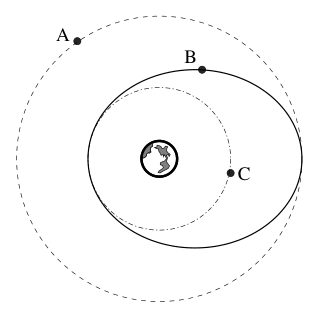 tre satelliti in orbita attorno a pianeta
Topic: Gravitation, Rotational Dynamics Metodi: Torque & Angular Momentum Analysis, Newton’s Law of Gravitation, Kepler’s Laws Competenze: Physical Reasoning, Diagrammatic Reasoning Objects: Satellite, Planet Fonte: Testo (PDF) — p.3
- Tre satelliti di massa uguale , e sono in orbite coplanari attorno a un pianeta come mostrato nella figura. Il Le magnitudini dei momenti angolari dei satelliti misurati intorno al pianeta sono , e . Quale delle seguenti affermazioni è corretta?
- A.
- B.
- C.
- D.
- E. La relazione tra le magnitudini è diversa in vari istanti di tempo.
tre satelliti in orbita attorno a una pianeta
Topic: Gravitation, Rotational Dynamics Metodi: Torque & Angular Momentum Analysis, Newton’s Law of Gravitation, Kepler’s Laws Competenze: Physical Reasoning, Diagrammatic Reasoning Objects: Satellite, Planet Fonte: Testo (PDF) — p.3
- An object is thrown with a fixed initial speed at various angles relative to the horizon. At some constant height above the launch point the speed of the object is measured as a function of the initial angle . Which of the following best describes the dependence of on ? (Assume that the height is achieved, and assume that there is no air resistance.)
- A. will increase monotonically with .
- B. will increase to some critical value and then decrease.
- C. will remain constant, independent of .
- D. will decrease to some critical value and then increase.
- E. None of the above.
Topic: Newtonian Mechanics, Conservation of Energy Metodi: Kinematic Equations, Energy Conservation Method, Vector Decomposition Competenze: Mathematical Modeling, Physical Reasoning Objects: Projectile Fonte: Testo (PDF) — p.3
- Un oggetto viene lanciato con una velocità iniziale fissa ad angoli diversi rispetto all’orizzonte. A una costante Altezza al di sopra del punto di lancio la velocità dell’oggetto viene misurata in funzione dell’angolo iniziale . Qual è la migliore descrizione della dipendenza di da ? (Supponiamo che l’altezza sia raggiunta, e assumere che non vi sia resistenza all’aria.)
- A. aumenterà monotonicamente con .
- B. aumenterà a un certo valore critico e diminuirà.
- C. rimarrà costante, indipendente da .
- D. diminuirà a un certo valore critico e poi aumenterà.
- E. Nessuna delle seguenti.
Topic: Newtonian Mechanics, Conservation of Energy Metodi: Kinematic Equations, Energy Conservation Method, Vector Decomposition Competenze: Mathematical Modeling, Physical Reasoning Objects: Projectile Fonte: Testo (PDF) — p.3
- A bird is flying in a straight line initially at . It uniformly increases its speed to while covering a distance of . What is the magnitude of the acceleration of the bird?
- A.
- B.
- C.
- D.
- E. The following information is used for questions 8 and 9. A flat disk rotates about an axis perpendicular to the plane of the disk and through the center of the disk with an angular velocity as shown in the graph below.
Topic: Newtonian Mechanics Metodi: Kinematic Equations Competenze: Mathematical Modeling Objects: — Fonte: Testo (PDF) — p.3
- Un uccello vola in linea retta inizialmente a . Aumenta uniformemente la sua velocità a , mentre copre una distanza di . Qual è l’ampiezza dell’accelerazione dell’uccello?
- A.
- B.
- C.
- D.
- E. Le seguenti informazioni sono utilizzate per le domande 8 e 9. Un disco piatto ruota intorno ad un asse perpendicolare al piano del disco e attraverso il centro del disco con velocità angolare come mostrato nel grafico di seguito.
Topic: Newtonian Mechanics Metodi: Kinematic Equations Competenze: Mathematical Modeling Objects: — Fonte: Testo (PDF) — p.3
- Determine the angular acceleration of the disk when .
- A. .
- B. .
- C. .
- D. .
- E. .
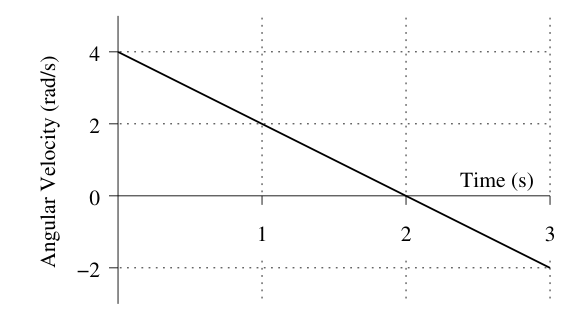 velocità angolare in funzione del tempo
Topic: Rotational Dynamics Metodi: Torque & Angular Momentum Analysis, Physical Modeling Competenze: Graph Linearization, Physical Reasoning Objects: Disk Fonte: Testo (PDF) — p.4
- Determinare l’accelerazione angolare del disco quando .
- A. .
- B. .
- C. .
- D. .
- E. .
velocità angolare in funzione del tempo
Topic: Rotational Dynamics Metodi: Torque & Angular Momentum Analysis, Physical Modeling Competenze: Graph Linearization, Physical Reasoning Objects: Disk Fonte: Testo (PDF) — p.4
- Through what net angle does the disk turn during the 3 seconds?
- A. 9 rad.
- B. 8 rad.
- C. 6 rad.
- D. 4 rad.
- E. 3 rad.
Topic: Rotational Dynamics Metodi: Torque & Angular Momentum Analysis, Physical Modeling, Calculus-Integration Competenze: Physical Reasoning, Mathematical Modeling Objects: Disk Fonte: Testo (PDF) — p.4
- In quale angolo si gira il disco durante i 3 secondi?
- A. 9 rad.
- ** B.** 8 rad.
- C. 6 rad.
- D. 4 rad.
- E. 3 rad.
Topic: Rotational Dynamics Metodi: Torque & Angular Momentum Analysis, Physical Modeling, Calculus-Integration Competenze: Physical Reasoning, Mathematical Modeling Objects: Disk Fonte: Testo (PDF) — p.4
- A person standing on the edge of a fire escape simultaneously launches two apples, one straight up with a speed of and the other straight down at the same speed. How far apart are the two apples 2 seconds after they were thrown, assuming that neither has hit the ground?
- A. 14 m
- B. 20 m
- C. 28 m
- D. 34 m
- E. 56 m
Topic: Newtonian Mechanics Metodi: Kinematic Equations, Vector Decomposition Competenze: Physical Reasoning, Mathematical Modeling Objects: Projectile Fonte: Testo (PDF) — p.4
- Una persona che sta al bordo di una scala antincendio lancia contemporaneamente due mele, una dritta con un velocità e l’altra dritta verso il basso alla stessa velocità. Quanto sono distanti le due mele 2 secondi dopo che sono stati gettati, presumendo che nessuno di loro abbia colpito il terreno?
- A. 14 m
- B. 20 m
- C. 28 m
- D. 34 m
- E. 56 m
Topic: Newtonian Mechanics Metodi: Kinematic Equations, Vector Decomposition Competenze: Physical Reasoning, Mathematical Modeling Objects: Projectile Fonte: Testo (PDF) — p.4
- A mass undergoes an acceleration as shown below. How much work is done on the mass?
- A. 36 J
- B. 22 J
- C. 5 J
- D. -17 J
- E. -36 J
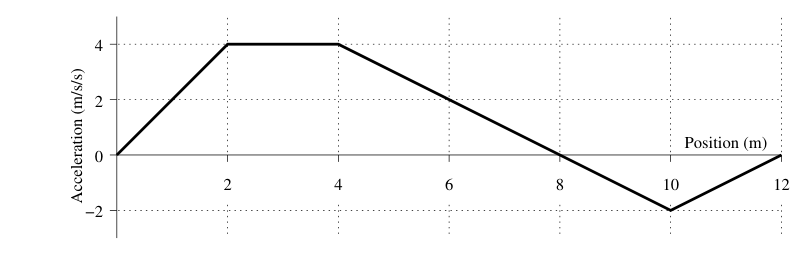 accelerazione in funzione della posizione
Topic: Newtonian Mechanics, Conservation of Energy Metodi: Energy Conservation Method, Calculus-Integration, Free-Body Diagram Competenze: Mathematical Modeling, Physical Reasoning Objects: Block Fonte: Testo (PDF) — p.5
- Una massa subisce un’accelerazione come mostrato di seguito. Quanto lavoro si fa sulla messa?
- A. 36 J
- B. 22 J
- C. 5 J
- D. -17 J
- E. -36 J
accelerazione in funzione della posizione
Topic: Newtonian Mechanics, Conservation of Energy Metodi: Energy Conservation Method, Calculus-Integration, Free-Body Diagram Competenze: Mathematical Modeling, Physical Reasoning Objects: Block Fonte: Testo (PDF) — p.5
- Batman, who has a mass of , climbs to the roof of a building and then lowers one end of a massless rope to his sidekick Robin. Batman then pulls Robin, who has a mass of , up the roof of the building. Approximately how much total work has Batman done after Robin is on the roof?
- A. 60 J
- B. J
- C. J
- D. 600 J
- E. J
Topic: Conservation of Energy Metodi: Energy Conservation Method Competenze: Physical Reasoning, Mathematical Modeling, Estimation & Approximation Objects: String Fonte: Testo (PDF) — p.5
- Batman, che ha una massa di , sale sul tetto di un edificio e poi abbassa un’estremità di una corda senza massa per il suo compagno Robin. Batman poi tira Robin, che ha una massa di , sul tetto dell’edificio. Quanti lavori ha fatto Batman dopo che Robin è sul tetto?
- A. 60 J
- B. J
- C. J
- D. 600 J
- E. J
Topic: Conservation of Energy Metodi: Energy Conservation Method Competenze: Physical Reasoning, Mathematical Modeling, Estimation & Approximation Objects: String Fonte: Testo (PDF) — p.5
- Lucy (mass ), Henry (mass ), and Mary (mass ) sit on a lightweight seesaw at evenly spaced intervals (in the order in which they are listed; Henry is between Lucy and Mary) so that the seesaw balances. Who exerts the most torque (in terms of magnitude) on the seesaw? Ignore the mass of the seesaw.
- A. Henry
- B. Lucy
- C. Mary
- D. They all exert the same torque.
- E. There is not enough information to answer the question.
Topic: Rigid Body Statics Metodi: Torque & Angular Momentum Analysis, Free-Body Diagram Competenze: Diagrammatic Reasoning, Physical Reasoning Objects: Lever Fonte: Testo (PDF) — p.5
- Lucy (massa ), Henry (massa ) e Mary (massa ) si siedono su una scaffa leggera a parità di peso Intervalli spaziati (nell’ordine in cui sono elencati; Henry è tra Lucy e Mary) in modo che la
- Si’, e’ il mio amico. Chi esercita la maggior parte della coppia (in termini di magnitudine) sulla scopa? Ignorare la massa di
- Il segnale.
- A. Henry
- B. Lucy
- C. Maria
- D. Esercitano tutti la stessa coppia.
- E. Non ci sono informazioni sufficienti per rispondere alla domanda.
Topic: Rigid Body Statics Metodi: Torque & Angular Momentum Analysis, Free-Body Diagram Competenze: Diagrammatic Reasoning, Physical Reasoning Objects: Lever Fonte: Testo (PDF) — p.5
- A wooden block (mass ) is hung from a peg by a massless rope. A speeding bullet (with mass and initial speed ) collides with the block at time and embeds in it. Let be the system consisting of the block and bullet. Which quantities are conserved between and ?
- A. The total linear momentum of .
- B. The horizontal component of the linear momentum of .
- C. The mechanical energy of .
- D. The angular momentum of as measured about a perpendicular axis through the peg.
- E. None of the above are conserved.
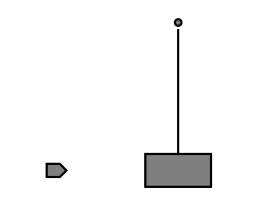 proiettile e blocco appeso al piolo
Topic: Conservation of Momentum, Rotational Dynamics Metodi: Conservation Laws, Torque & Angular Momentum Analysis, Impulse-Momentum Theorem Competenze: Physical Reasoning, Mathematical Modeling Objects: Block, String, Projectile Fonte: Testo (PDF) — p.6
- Un blocco di legno (massa ) è appeso a un colletto con una corda senza massa. Un proiettile ad alta velocità (con massa e velocità iniziale ) colpisce il blocco al momento e si inserisce in esso. Il sistema è costituito da: Il blocco e il proiettile. Quali quantità sono conservate tra e ?
- A. La dinamica lineare totale di .
- B. La componente orizzontale del momento lineare di .
- C. L’energia meccanica di .
- D. Il momento angolare di misurato attorno ad un asse perpendicolare attraverso la colletta.
- E. Nessuna delle indicazioni sopra riportate è conservata.
proiettile e blocco appeso al piolo
Topic: Conservation of Momentum, Rotational Dynamics Metodi: Conservation Laws, Torque & Angular Momentum Analysis, Impulse-Momentum Theorem Competenze: Physical Reasoning, Mathematical Modeling Objects: Block, String, Projectile Fonte: Testo (PDF) — p.6
- A suitcase is dragged in a straight line at a constant speed of across a level airport floor by a student on the way to the 40th IPhO in Merida, Mexico. The individual pulls with a N force along a handle with makes an upward angle of degrees with respect to the horizontal. What is the coefficient of kinetic friction between the suitcase and the floor?
- A.
- B.
- C.
- D.
- E.
Topic: Newtonian Mechanics Metodi: Free-Body Diagram, Vector Decomposition Competenze: Diagrammatic Reasoning, Mathematical Modeling Objects: Block Fonte: Testo (PDF) — p.6
- Una valigia viene trascinata in linea retta a una velocità costante di su un pavimento di un aeroporto a livello da uno studente in viaggio per la 40a IPhO a Merida, in Messico. L’individuo tira con un N la forza lungo una maniglia con un angolo ascendente di gradi rispetto all’orizzontale. Che cos’è ? il coefficiente di attrito cinetico tra la valigia e il pavimento?
- A.
- B.
- C.
- D.
- E.
Topic: Newtonian Mechanics Metodi: Free-Body Diagram, Vector Decomposition Competenze: Diagrammatic Reasoning, Mathematical Modeling Objects: Block Fonte: Testo (PDF) — p.6
- Two identical objects of mass are placed at either end of a spring of spring constant and the whole system is placed on a horizontal frictionless surface. At what angular frequency does the system oscillate?
- A.
- B.
- C.
- D.
- E.
Topic: Oscillations & Waves, Newtonian Mechanics Metodi: Simple Harmonic Motion Analysis, Hooke’s Law, Free-Body Diagram Competenze: Mathematical Modeling, Physical Reasoning Objects: Spring, Block Fonte: Testo (PDF) — p.6
- Due oggetti identici di massa sono posizionati in entrambe le estremità di una resina di costante resorte e l’intero il sistema è posizionato su una superficie orizzontale senza attrito. A quale frequenza angolare oscilla il sistema?
- A.
- B.
- C.
- D.
- E.
Topic: Oscillations & Waves, Newtonian Mechanics Metodi: Simple Harmonic Motion Analysis, Hooke’s Law, Free-Body Diagram Competenze: Mathematical Modeling, Physical Reasoning Objects: Spring, Block Fonte: Testo (PDF) — p.6
- You are given a standard kilogram mass and a tuning fork that is calibrated in Hz. You are also provided with a complete collection of laboratory equipment, but none of it is calibrated in SI units. You do not know the values of any fundamental constants. Which of the following quantities could you measure in SI units?
- A. The acceleration due to gravity.
- B. The speed of light in a vacuum.
- C. The density of room temperature water.
- D. The spring constant of a given spring.
- E. The air pressure in the room.
Topic: Order-of-Magnitude Estimation, Newtonian Mechanics Metodi: Dimensional Analysis, Physical Modeling Competenze: Estimation & Approximation, Physical Reasoning, Measurement & Instrumentation Objects: Tuning Fork, Spring Fonte: Testo (PDF) — p.6
- Vi viene data una massa di chilogrammo standard e una forchetta di sintonia calibrata in Hz. Vi sono anche fornite con una raccolta completa di attrezzature di laboratorio, ma nessuna delle quali è calibrata in unità SI. Non lo sai. i valori di qualsiasi costante fondamentale. Quale delle seguenti quantità potresti misurare in unità SI?
- A. L’accelerazione dovuta alla gravità.
- B. La velocità della luce in vuoto.
- C. La densità dell’acqua a temperatura ambiente.
- D. La costante di primavera di una data primavera.
- E. La pressione dell’aria nella stanza.
Topic: Order-of-Magnitude Estimation, Newtonian Mechanics Metodi: Dimensional Analysis, Physical Modeling Competenze: Estimation & Approximation, Physical Reasoning, Measurement & Instrumentation Objects: Tuning Fork, Spring Fonte: Testo (PDF) — p.6
- A simple pendulum of length is constructed from a point object of mass suspended by a massless string attached to a fixed pivot point. A small peg is placed a distance directly below the fixed pivot point so that the pendulum would swing as shown in the figure below. The mass is displaced 5 degrees from the vertical and released. How long does it take to return to its starting position?
- A.
- B.
- C.
- D.
- E.
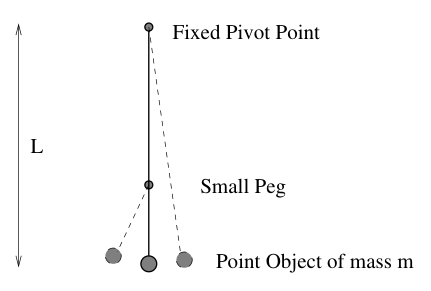 pendolo semplice con piolo fisso
Topic: Oscillations & Waves Metodi: Simple Harmonic Motion Analysis, Small-Angle Approximation, Superposition Principle Competenze: Mathematical Modeling, Physical Reasoning Objects: Pendulum Fonte: Testo (PDF) — p.7
- Un semplice pendolo di lunghezza è costruito da un oggetto puntino di massa sospeso da una corda senza massa collegati a un punto di pivotamento fisso. Un piccolo cerchio è posto a una distanza direttamente al di sotto del punto di pivotaggio fisso in modo che il pendolo oscilla come mostrato nella figura di seguito. La massa è spostata 5 gradi dal verticale e rilasciato. Quanto tempo ci vuole per tornare alla posizione di partenza?
- A.
- B.
- C.
- D.
- E.
pendolo semplice con piolo fisso
Topic: Oscillations & Waves Metodi: Simple Harmonic Motion Analysis, Small-Angle Approximation, Superposition Principle Competenze: Mathematical Modeling, Physical Reasoning Objects: Pendulum Fonte: Testo (PDF) — p.7
- A certain football quarterback can throw a football a maximum range of 80 meters on level ground. What is the highest point reached by the football if thrown this maximum range? Ignore air friction.
- A. 10 m
- B. 20 m
- C. 30 m
- D. 40 m
- E. 50 m
Topic: Newtonian Mechanics, Conservation of Energy Metodi: Kinematic Equations, Energy Conservation Method, Vector Decomposition Competenze: Mathematical Modeling, Physical Reasoning Objects: Projectile Fonte: Testo (PDF) — p.7
- Un certo quarterback di calcio può lanciare un calcio a un raggio massimo di 80 metri su terreno piatto. Che cosa ? il punto più alto raggiunto dal calcio se lanciato questo raggio massimo? Ignora l’attrito dell’aria.
- A. 10 m
- B. 20 m
- C. 30 m
- D. 40 m
- E. 50 m
Topic: Newtonian Mechanics, Conservation of Energy Metodi: Kinematic Equations, Energy Conservation Method, Vector Decomposition Competenze: Mathematical Modeling, Physical Reasoning Objects: Projectile Fonte: Testo (PDF) — p.7
- Consider a completely inelastic collision between two lumps of space goo. Lump 1 has mass and originally moves directly north with a speed . Lump 2 has mass and originally moves directly east with speed . What is the final speed of the masses after the collision? Ignore gravity, and assume the two lumps stick together after the collision.
- A.
- B.
- C.
- D.
- E. The following information is used for questions 21 and 22. Two stars orbit their common center of mass as shown in the diagram below. The masses of the two stars are and . The distance between the stars is .
Topic: Conservation of Momentum Metodi: Conservation Laws, Conservation of Momentum, Vector Decomposition Competenze: Mathematical Modeling, Physical Reasoning Objects: — Fonte: Testo (PDF) — p.7
- Considerate una collisione completamente inelastica tra due pezzi di gomma spaziale. Lump 1 ha massa e originariamente si muove direttamente a nord con una velocità . Lump 2 ha massa e si muove originariamente direttamente ad est con velocità . Qual è la velocità finale delle masse dopo la collisione? Ignora la gravità e assume i due grumi restano uniti dopo la collisione.
- A.
- B.
- C.
- D.
- E. Le seguenti informazioni sono utilizzate per le domande 21 e 22. Due stelle orbitano intorno al loro centro di massa comune come mostrato nel diagramma di seguito. Le masse delle due stelle sono e . La distanza tra le stelle è .
Topic: Conservation of Momentum Metodi: Conservation Laws, Conservation of Momentum, Vector Decomposition Competenze: Mathematical Modeling, Physical Reasoning Objects: — Fonte: Testo (PDF) — p.7
- What is the value of the gravitational potential energy of the two star system?
- A.
- B.
- C.
- D.
- E.
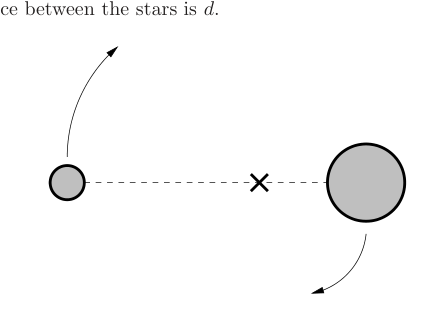 sistema binario di stelle in orbita
Topic: Gravitation Metodi: Newton’s Law of Gravitation, Energy Conservation Method Competenze: Mathematical Modeling, Physical Reasoning Objects: Star Fonte: Testo (PDF) — p.8
- Qual è il valore dell’energia potenziale gravitazionale del sistema a due stelle?
- A.
- B.
- C.
- D.
- E.
sistema binario di stelle in orbita
Topic: Gravitation Metodi: Newton’s Law of Gravitation, Energy Conservation Method Competenze: Mathematical Modeling, Physical Reasoning Objects: Star Fonte: Testo (PDF) — p.8
- Determine the period of orbit for the star of mass .
- A.
- B.
- C.
- D.
- E.
Topic: Gravitation Metodi: Newton’s Law of Gravitation, Kepler’s Laws Competenze: Mathematical Modeling, Physical Reasoning Objects: Star Fonte: Testo (PDF) — p.8
- Determinare il periodo di orbita della stella di massa .
- A.
- B.
- C.
- D.
- E.
Topic: Gravitation Metodi: Newton’s Law of Gravitation, Kepler’s Laws Competenze: Mathematical Modeling, Physical Reasoning Objects: Star Fonte: Testo (PDF) — p.8
- A mass is attached to an ideal spring. At time the spring is at its natural length and the mass is given an initial velocity; the period of the ensuing (one-dimensional) simple harmonic motion is . At what time is the power delivered to the mass by the spring first a maximum?
- A.
- B.
- C.
- D.
- E.
Topic: Oscillations & Waves, Conservation of Energy Metodi: Simple Harmonic Motion Analysis, Energy Conservation Method Competenze: Mathematical Modeling, Physical Reasoning Objects: Spring Fonte: Testo (PDF) — p.8
- Una massa è attaccata ad una sorgente ideale. Al tempo la molla è alla sua lunghezza naturale e la massa è data una velocità iniziale; il periodo del successivo (unidimensionario) semplice movimento armonico è . A che ora ? la potenza fornita * a * la massa prima della primavera è massima?
- A.
- B.
- C.
- D.
- E.
Topic: Oscillations & Waves, Conservation of Energy Metodi: Simple Harmonic Motion Analysis, Energy Conservation Method Competenze: Mathematical Modeling, Physical Reasoning Objects: Spring Fonte: Testo (PDF) — p.8
- A uniform rectangular wood block of mass , with length and height , rests on an incline as shown. The incline and the wood block have a coefficient of static friction, . The incline is moved upwards from an angle of zero through an angle . At some critical angle the block will either tip over or slip down the plane. Determine the relationship between , , and such that the block will tip over (and not slip) at the critical angle. The box is rectangular, and .
- A.
- B.
- C.
- D.
- E.
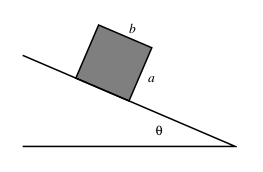 blocco rettangolare su piano inclinato
Topic: Rigid Body Statics, Newtonian Mechanics Metodi: Torque & Angular Momentum Analysis, Free-Body Diagram, Vector Decomposition Competenze: Diagrammatic Reasoning, Mathematical Modeling Objects: Block, Inclined Plane Fonte: Testo (PDF) — p.9
- Un blocco di legno rettangolare uniforme di massa , con lunghezza e altezza , si posa su una pendenza come mostrato. L’inclinazione e il blocco di legno hanno un coefficiente di attrito statico . L’inclinazione si sposta verso l’alto da un angolo di zero attraverso un angolo . In un angolo critico il blocco si inclinerà o scivola giù
- Aereo. Determinare la relazione tra , e in modo tale che il blocco si inclinerà (e non scivolerà) a l’angolo critico. La scatola è rettangolare e .
- A.
- B.
- C.
- D.
- E.
*blocco rettangolare su pianoforte inclinato *
Topic: Rigid Body Statics, Newtonian Mechanics Metodi: Torque & Angular Momentum Analysis, Free-Body Diagram, Vector Decomposition Competenze: Diagrammatic Reasoning, Mathematical Modeling Objects: Block, Inclined Plane Fonte: Testo (PDF) — p.9
- Two discs are mounted on thin, lightweight rods oriented through their centers and normal to the discs. These axles are constrained to be vertical at all times, and the discs can pivot frictionlessly on the rods. The discs have identical thickness and are made of the same material, but have differing radii and . The discs are given angular velocities of magnitudes and , respectively, and brought into contact at their edges. After the discs interact via friction it is found that both discs come exactly to a halt. Which of the following must hold? Ignore effects associated with the vertical rods.
- A.
- B.
- C.
- D.
- E.
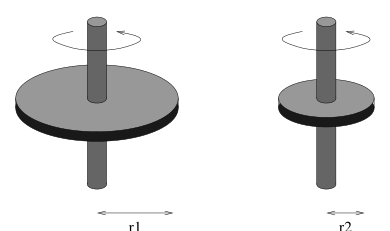 due dischi rotanti su aste verticali
Topic: Rotational Dynamics, Conservation of Momentum Metodi: Torque & Angular Momentum Analysis, Conservation Laws Competenze: Mathematical Modeling, Physical Reasoning Objects: Disk, Rod Fonte: Testo (PDF) — p.9
- Due dischi sono montati su righe sottili e leggere orientate attraverso i loro centri e normali ai dischi. Questi assi sono costretti ad essere sempre verticali e i dischi possono girare senza attrito sulle barre. Il i dischi hanno lo stesso spessore e sono realizzati dallo stesso materiale, ma hanno radii diversi e . Il i dischi hanno velocità angolari di magnitudine e rispettivamente e sono messi in contatto al loro
- Le spalle. Dopo che i dischi interagiscono attraverso l’attrito si scopre che entrambi i dischi si fermano esattamente. Qual è il numero di
- La prossima cosa deve essere fatta? Ignorare gli effetti associati alle barre verticali.
- A.
- B.
- C.
- D.
- E.
- dovuta a dischi rotanti su aste verticali *
Topic: Rotational Dynamics, Conservation of Momentum Metodi: Torque & Angular Momentum Analysis, Conservation Laws Competenze: Mathematical Modeling, Physical Reasoning Objects: Disk, Rod Fonte: Testo (PDF) — p.9