- Below is an image of Fomalhaut b, the first extrasolar planet to be observed directly by visible light, obtained by the Hubble Space Telescope. Astronomy Picture of the Day 2008 November 14 http://antwrp.gsfc.nasa.gov/apod/ap081114.html Image Credit: NASA, ESA, P. Kalas, J. Graham, E. Chiang, E. Kite (Univ. California, Berkeley), M. Clampin (NASA/Goddard), M. Fitzgerald (Lawrence Livermore NL), K. Stapelfeldt, J. Krist (NASA/JPL) The scale of the larger diagram is shown on the lower left; the 13” refers to the angle, in arc-second, subtended by 100 AU at the distance of Fomalhaut. The scale of the inset can be determined by size of the small box. (a) A planet is in a circular orbit of radius R and period T. Derive an expression for the mass of a star in terms of R, T, and the gravitational constant G. You may assume that the mass of the planet is much, much less than the mass of the star. (b) From the image, estimate the mass of the star Fomalhaut in solar masses. You may assume that the orbit of Fomalhaut b is circular and ignore any errors associated with the fact that the plane of the image is not coincident with the plane of the orbit. Recall that the radius of the Earth’s orbit around the Sun is 1 AU. You do not need to do an error analysis, but the number of significant digits in your answer ought reflect the accuracy of your answer. Copyright c⃝2009 American Association of Physics Teachers 2009 Quarter-final Exam 4
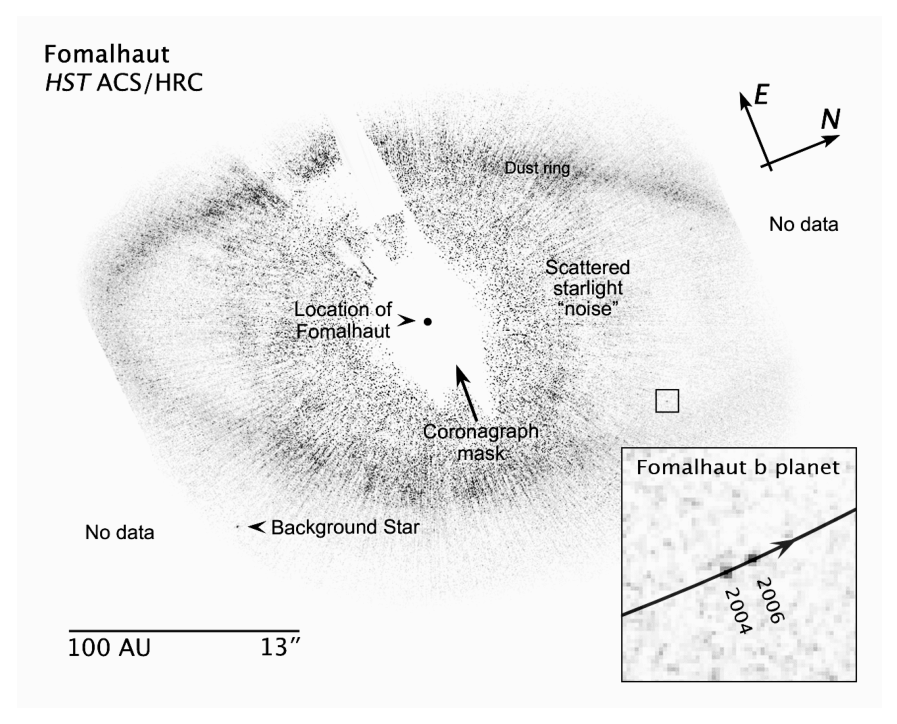 Immagine astronomica di Fomalhaut b
Topic: Gravitation, Astrophysics Metodi: Newton’s Law of Gravitation, Kepler’s Laws, Order-of-Magnitude Estimation Competenze: Mathematical Modeling, Estimation & Approximation Objects: Planet, Star Fonte: Testo (PDF) — p.3
- Qui sotto c’è un’immagine di Fomalhaut b, il primo pianeta extra solare da osservare direttamente da un’area visibile. luce, ottenuta dal telescopio spaziale Hubble. Foto dell’Astronomia del Giorno 2008 14 novembre http://antwrp.gsfc.nasa.gov/apod/ap081114.html Foto di credito: NASA, ESA, P. Kalas, J. Graham, E. Chiang, E. Città di Città di Città di Città di Città di Città di Città di Città di Città di Città di Città di Città di Città di Città di Città di Città di Città di Città di Città di Città di Città di Città di Città di Città di Città di Città di Città di Città di Città di Città di Città di Città di Città di Città di Città di Città di Città di Città di Città di Città di Città di Città di Città di Città di Città di Città di Città di Città di Città di Città di Città di Città di Città di Città di Città di Città di Città di Città di Città di Città di Città di Città di Città di Città di Città di Città di Città di Città di Città di Città di Città di Città di Città di Città di Città di Città di Città di Città di Città di Città di Città di Città di Città di Città di Città di Città di Città di Città di Città di Città di Città di Città di Città di Città di Città di Città di Città di Città di Città di Città di Città di Città di Città di Città di Città di Città di Città di Città di Città di Città di Città di Città di Città di Città di Città di Città di Città di Città di Città di Città di Città di Città di Città di Città di Città di Città di Città di Città California, Berkeley), M. Clampin (NASA/Goddard), M. Fitzgerald (Lawrence Livermore NL), K. Stapelfeldt, J. Krist (NASA/JPL) La scala del diagramma più grande è mostrata in basso a sinistra; il 13 si riferisce all’angolo, in arc-second, sottoscritto da 100 AU a distanza da Fomalhaut. La scala dell’insetto può essere determinato in base alla dimensione della scatola. (a) Un pianeta è in orbita circolare di raggio R e periodo T. Derivare un’espressione per il massa di una stella in termini di R, T e costante gravitazionale G. Potreste presumere che la massa del pianeta è molto, molto inferiore alla massa della stella. b) Sulla foto, calcoli la massa della stella Fomalhaut in masse solari. Puoi farlo. presumere che l’orbita di Fomalhaut b sia circolare e ignorare eventuali errori associati a il fatto che il piano dell’immagine non coincida con il piano dell’orbita. Ricordate che il raggio di orbita della Terra intorno al Sole è di 1 UA. Non devi farlo Un’analisi di errore, ma il numero di cifre significative nella tua risposta dovrebbe riflettere il l’accuratezza della tua risposta. Copyright c2009 American Association of Physics Teachers Esame di Quarter-final 2009 4
Immagine astronomica di Fomalhaut b
Topic: Gravitation, Astrophysics Metodi: Newton’s Law of Gravitation, Kepler’s Laws, Order-of-Magnitude Estimation Competenze: Mathematical Modeling, Estimation & Approximation Objects: Planet, Star Fonte: Testo (PDF) — p.3
- A ball of mass m is thrown vertically upward with a speed of v0. The ball is subject to an air resistance force that is proportional to the velocity, F = . The ball rises up to height of h and then returns to the starting point after some total time tf. The acceleration of free fall is g. Determine the following:
- A. An expression for the velocity as a function of time in terms of any or all of the constants.
- B. Sketch the graph of velocity vs time. On the sketch indicate the time to rise to the highest point, tr, and the total time of flight, tf. You do not need to find either tr or tf at this point, but your graph should reflect relative positions of both. (c) Find the time to rise, tr, to the highest point, h, in terms of any or all of the constants.
Topic: Newtonian Mechanics Metodi: Differential Equations, Free-Body Diagram, Kinematic Equations Competenze: Mathematical Modeling, Diagrammatic Reasoning, Physical Reasoning Objects: Ball Fonte: Testo (PDF) — p.4
- Una palla di massa m viene lanciata verticalmente verso l’alto con una velocità di v0. La palla è soggetta a un forza di resistenza aerea proporzionale alla velocità, F = . La palla si alza fino in altezza di h e poi torna al punto di partenza dopo un certo tempo totale tf. L’accelerazione del libero caduta è G. Determinare quanto segue:
- A. Espressione della velocità come funzione del tempo in termini di una o tutte le costanti.
- B. Segna il grafico della velocità vs tempo. Il disegno indica il tempo di ascesa al punto più alto, tr, e tempo totale di volo, tf. Non è necessario trovare né tr né tf In questo punto, ma il grafico dovrebbe riflettere le posizioni relative di entrambi. (c) Trovare il tempo per salire, tr, al punto più alto, h, in termini di una o tutte le costanti.
Topic: Newtonian Mechanics Metodi: Differential Equations, Free-Body Diagram, Kinematic Equations Competenze: Mathematical Modeling, Diagrammatic Reasoning, Physical Reasoning Objects: Ball Fonte: Testo (PDF) — p.4
- A parallel plate capacitor is made of two square parallel plates of area A, and separated by a distance d A. The capacitor is connected to a battery with potential V and allowed to fully charge. The battery is then disconnected. A square metal conducting slab also with area A but thickness d/2 is then fully inserted between the plates, so that it is always parallel to the plates. How much work has been done on the metal slab while it is being inserted?
Topic: Electrostatics, Conservation of Energy Metodi: Electric Potential Method, Energy Conservation Method, Gauss’s Law Competenze: Physical Reasoning, Mathematical Modeling Objects: Capacitor, Battery Fonte: Testo (PDF) — p.4
- Un condensatore di piastre parallele è costituito da due piastre parallele quadrate di area A, separate da una distanza d A. Il condensatore è collegato a una batteria con potenziale V e consentito per caricare completamente. La batteria viene poi scollegata. Una lastra di conduttore di metallo quadrata anche con area A ma spessore d/2 viene quindi inserito completamente tra le piastre, in modo che sia sempre parallelo
- Al piatto. Quanto lavoro è stato fatto sulla lastra metallica mentre viene inserita?
Topic: Electrostatics, Conservation of Energy Metodi: Electric Potential Method, Energy Conservation Method, Gauss’s Law Competenze: Physical Reasoning, Mathematical Modeling Objects: Capacitor, Battery Fonte: Testo (PDF) — p.4
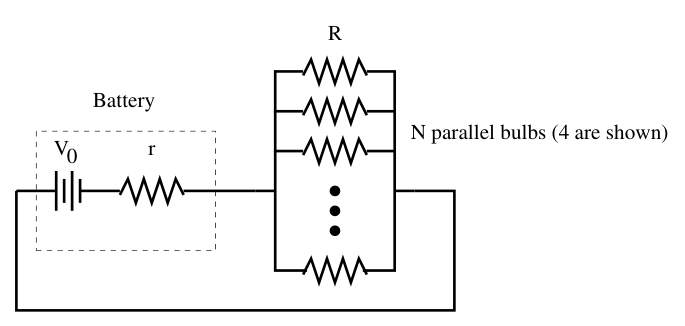
- A certain electric battery is not quite ideal. It can be thought of as a perfect cell with constant output voltage V0 connected in series to a resistance r, but there is no way to remove this internal resistance from the battery. V r R Battery 0 N parallel bulbs (4 are shown) The battery is connected to N identical lightbulbs in parallel. The bulbs each have a fixed resistance R, independent of the current through them. (a) Derive an expression for the total power dissipated by the N bulbs in terms of r, R, and V0. (b) It is observed that the configuration dissipates more total power through the bulbs when N = 5 than it does for any other value of N. In terms of R, what range of values is possible for r? Copyright c⃝2009 American Association of Physics Teachers
 Circuito batteria con N lampadine parallelo
Topic: Circuits Metodi: Kirchhoff’s Laws, Equivalent Circuit Reduction, Physical Modeling Competenze: Mathematical Modeling, Physical Reasoning Objects: Battery, Resistor Fonte: Testo (PDF) — p.4
- Una certa batteria elettrica non è perfetta. Si può pensare che sia una cellula perfetta con una costante voltazione di uscita V0 collegata in serie ad una resistenza r, ma non c’è modo di rimuovere questo resistenza interna della batteria. V r R Batteria 0 N lampadine parallele (4 sono mostrate) La batteria è collegata in parallelo a N lampadine identiche. Le lampadine hanno una fissazione resistenza R, indipendente dalla corrente che li attraversa. (a) Derivare un’espressione per la potenza totale dissipata dalle lampadine N in termini di r, R e V0. b) Si osserva che la configurazione dissipa più potenza totale attraverso le lampadine quando N = 5 rispetto a qualsiasi altro valore di N. In termini di R, quale gamma di valori è possibili per r? Copyright c2009 American Association of Physics Teachers
*Circuito batterico con N lampadina parallelo *
Topic: Circuits Metodi: Kirchhoff’s Laws, Equivalent Circuit Reduction, Physical Modeling Competenze: Mathematical Modeling, Physical Reasoning Objects: Battery, Resistor Fonte: Testo (PDF) — p.4