A hollow cylinder has length , radius , and thickness , where , and is made of a material with resistivity . A time-varying current flows through the cylinder in the tangential direction. Assume the current is always uniformly distributed along the length of the cylinder. The cylinder is fixed so that it cannot move; assume that there are no externally generated magnetic fields during the time considered for the problems below.
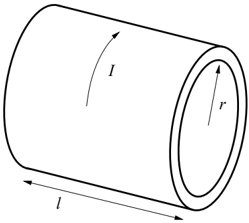
a. What is the magnetic field strength inside the cylinder in terms of , the dimensions of the cylinder, and fundamental constants?
b. Relate the emf developed along the circumference of the cylinder to the rate of change of the current , the dimensions of the cylinder, and fundamental constants.
c. Relate to the current , the resistivity , and the dimensions of the cylinder.
d. The current at is . What is the current for ?
Topic: Electromagnetic Induction Metodi: Ampere’s Law, Faraday’s Law of Induction, Differential Equations Competenze: Physical Reasoning, Mathematical Modeling Objects: Solenoid Fonte: Testo (PDF) - p.3
Un cilindro vuoto ha lunghezza , raggio e spessore , dove , ed è costituito da un materiale con resistività . Una corrente variabile nel tempo scorre attraverso il cilindro nella direzione tangenziale. Supponiamo che la corrente sia sempre distribuita uniformemente lungo la lunghezza del cilindro. Il cilindro è fissato in modo tale che non possa muoversi; supponiamo che non ci siano campi magnetici generati esternamente durante il tempo considerato per i problemi di seguito.
a. Qual è la resistenza del campo magnetico all’interno del cilindro in termini di , dimensioni del cilindro e costanti fondamentali?
b. Relazionare l’emf sviluppato lungo la circonferenza del cilindro al tasso di variazione della corrente , le dimensioni del cilindro e le costanti fondamentali.
c. Relazionare alla corrente , alla resistività e alle dimensioni del cilindro.
d. La corrente a è . Qual è la corrente per ?
Topic: Electromagnetic Induction Metodi: Ampere’s Law, Faraday’s Law of Induction, Differential Equations Competenze: Physical Reasoning, Mathematical Modeling Objects: Solenoid Fonte: Testo (PDF) - p.3
A mixture of P and S (two beta emitters widely used in biochemical research) is placed next to a detector and allowed to decay, resulting in the data below. The detector has equal sensitivity to the beta particles emitted by each isotope, and both isotopes decay into stable daughters.
You should analyze the data graphically. Error estimates are not required.
| Day | Activity | Day | Activity | Day | Activity |
|---|---|---|---|---|---|
| 0 | 64557 | 40 | 12441 | 200 | 1121 |
| 5 | 51714 | 60 | 6385 | 250 | 673 |
| 10 | 41444 | 80 | 3855 | 300 | 467 |
| 20 | 27020 | 100 | 2734 | ||
| 30 | 18003 | 150 | 1626 |
a. Determine the half-life of each isotope. S has a significantly longer half-life than P.
b. Determine the ratio of the number of P atoms to the number of S atoms in the original sample.
Topic: Nuclear & Particle Physics Metodi: Radioactive Decay Law, Graph Linearization, Experimental Data Analysis Competenze: Physical Reasoning, Experimental Data Analysis, Graph Linearization Objects: Nucleus Fonte: Testo (PDF) - p.3
Una miscela di P e S (due beta emittenti ampiamente utilizzati nella ricerca biochimica) viene posizionata accanto a un rilevatore e lasciata decadere, dando luogo ai dati di seguito. Il rilevatore ha uguale sensibilità alle particelle beta emesse da ciascun isotopo, e entrambi gli isotopi si decompongono in figlie stabili.
Dovresti analizzare i dati in modo grafico. Non sono necessarie stime di errore.
Giorno # Attività # Giorno # Attività # Giorno # Attività
|-----|----------|-----|----------|-----|----------| | 0 | 64557 | 40 | 12441 | 200 | 1121 | | 5 | 51714 | 60 | 6385 | 250 | 673 | | 10 | 41444 | 80 | 3855 | 300 | 467 | | 20 | 27020 | 100 | 2734 | | | | 30 | 18003 | 150 | 1626 | | |
a. Determinare la metavita di ciascun isotopo. S ha una semivita significativamente più lunga di P.
b. Determinare il rapporto tra il numero di atomi P e il numero di atomi S nel campione originale.
Topic: Nuclear & Particle Physics Metodi: Radioactive Decay Law, Graph Linearization, Experimental Data Analysis Competenze: Physical Reasoning, Experimental Data Analysis, Graph Linearization Objects: Nucleus Fonte: Testo (PDF) - p.3
Two stars, each of mass and separated by a distance , orbit about their center of mass. A planetoid of mass () moves along the axis of this system perpendicular to the orbital plane.
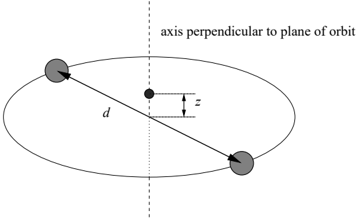
Let be the period of simple harmonic motion for the planetoid for small displacements from the center of mass along the -axis, and let be the period of motion for the two stars. Determine the ratio .
This problem was adapted from a problem by French in Newtonian Mechanics.
Topic: Gravitation Metodi: Newton’s Law of Gravitation, Simple Harmonic Motion Analysis, Small-Angle Approximation Competenze: Physical Reasoning, Mathematical Modeling Objects: Star, Planet Fonte: Testo (PDF) - p.3
Due stelle, ciascuna di massa e separate da una distanza , orbitano intorno al loro centro di massa. Un pianetoide di massa () si muove lungo l’asse di questo sistema perpendicolare al piano orbitale.
Che sia il periodo di semplice movimento armonico del pianetoide per piccoli spostamenti dal centro di massa lungo l’asse , e che sia il periodo di movimento per le due stelle. Determinare il rapporto .
Questo problema è stato adattato da un problema di francese in Meccanica di Newton.
Topic: Gravitation Metodi: Newton’s Law of Gravitation, Simple Harmonic Motion Analysis, Small-Angle Approximation Competenze: Physical Reasoning, Mathematical Modeling Objects: Star, Planet Fonte: Testo (PDF) - p.3
A potato gun fires a potato horizontally down a half-open cylinder of cross-sectional area . When the gun is fired, the potato slug is at rest, the volume between the end of the cylinder and the potato is , and the pressure of the gas in this volume is . The atmospheric pressure is , where . The gas in the cylinder is diatomic; this means that and . The potato moves down the cylinder quickly enough that no heat is transferred to the gas. Friction between the potato and the barrel is negligible and no gas leaks around the potato.
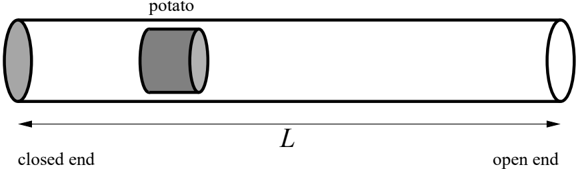
The parameters , , , and are fixed, but the overall length of the barrel may be varied.
a. What is the maximum kinetic energy with which the potato can exit the barrel? Express your answer in terms of , , and .
b. What is the length in this case? Express your answer in terms of , , , and .
Topic: Thermodynamics Metodi: First Law of Thermodynamics, Ideal Gas Law, Calculus-Integration Competenze: Physical Reasoning, Mathematical Modeling Objects: Piston, Gas Fonte: Testo (PDF) - p.4
Una pistola a patate spara una patata orizzontalmente in un cilindro a metà aperto di superficie trasversale . Quando il fucile viene sparato, la proiettile di patata è in riposo, il volume tra la parte finale del cilindro e la patata è e la pressione del gas in questo volume è . La pressione atmosferica è , dove . Il gas presente nel cilindro è diatomico, il che significa che e . La patata si sposta lungo il cilindro abbastanza velocemente da non trasferire calore al gas. La frizione tra la patata e il barile è insignificante e non si scorre gas intorno alla patata.
I parametri , , e sono fissi, ma la lunghezza complessiva del barile può variare.
a. Qual è l’energia cinetica massima con cui la patata può uscire dal barile? Esprimere la risposta in termini di , e .
b. Qual è la lunghezza in questo caso? Esprimere la risposta in termini di , , e .
Topic: Thermodynamics Metodi: First Law of Thermodynamics, Ideal Gas Law, Calculus-Integration Competenze: Physical Reasoning, Mathematical Modeling Objects: Piston, Gas Fonte: Testo (PDF) - p.4
A bowling ball and a golf ball are dropped together onto a flat surface from a height . The bowling ball is much more massive than the golf ball, and both have radii much less than . The bowling ball collides with the surface and immediately thereafter with the golf ball; the balls are dropped so that all motion is vertical before the second collision, and the golf ball hits the bowling ball at an angle from its uppermost point, as shown in the diagram. All collisions are perfectly elastic, and there is no surface friction between the bowling ball and the golf ball.
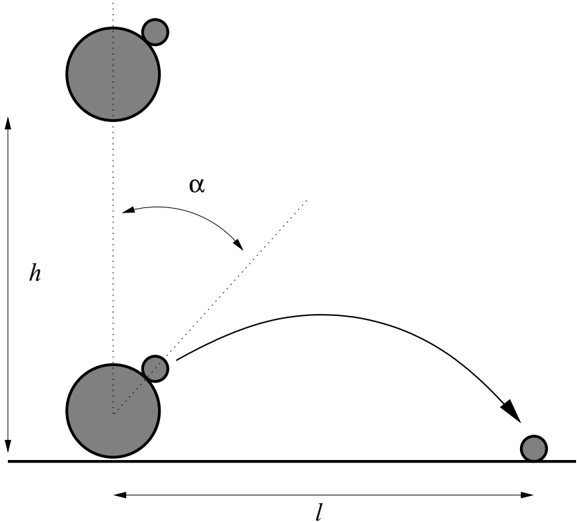
After the collision the golf ball travels in the absence of air resistance and lands a distance away. The height is fixed, but may be varied. What is the maximum possible value of , and at what angle is it achieved?
You may present your results as decimals, but remember that you are not allowed to use graphical or algebraic functions of your calculator.
Topic: Conservation of Momentum, Conservation of Energy Metodi: Conservation of Momentum, Conservation of Energy, Kinematic Equations, Vector Decomposition Competenze: Physical Reasoning, Mathematical Modeling Objects: Ball Fonte: Testo (PDF) - p.6
Una palla da bowling e una palla da golf vengono gettate insieme su una superficie piatta da un’altezza . La palla da bowling è molto più massiccia della palla da golf, e entrambe hanno radii molto inferiori a . La palla di bowling colpisce la superficie e immediatamente successivamente con la palla da golf; le palle vengono abbassate in modo che tutto il movimento sia verticale prima della seconda collisione, e la palla da golf colpisce la palla da bowling ad un angolo dal suo punto più alto, come mostrato nel diagramma. Tutte le collisioni sono perfettamente elastiche e non c’è attrito superficiale tra la palla da bowling e la palla da golf.
Dopo la collisione la palla da golf viaggia in assenza di resistenza all’aria e atterra a una distanza . L’altezza è fissa, ma può variare. Qual è il valore massimo possibile di e a quale angolo viene raggiunto?
Potete presentare i risultati come decimali, ma ricordate che non è consentito utilizzare funzioni grafiche o algebriche della calcolatrice.
Topic: Conservation of Momentum, Conservation of Energy Metodi: Conservation of Momentum, Conservation of Energy, Kinematic Equations, Vector Decomposition Competenze: Physical Reasoning, Mathematical Modeling Objects: Ball Fonte: Testo (PDF) - p.6
An electric dipole consists of two charges of equal magnitude and opposite sign, held rigidly apart by a distance . The dipole moment is defined by .
Now consider two identical, oppositely oriented electric dipoles, separated by a distance , as shown in the diagram.
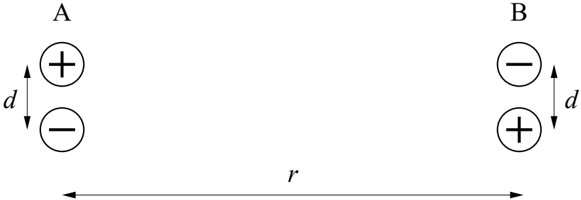
a. It is convenient when considering the interaction between the dipoles to choose the zero of potential energy such that the potential energy is zero when the dipoles are very far apart from each other. Using this convention, write an exact expression for the potential energy of this arrangement in terms of , , , and fundamental constants.
b. Assume that . Give an approximation of your expression for the potential energy to lowest order in . Rewrite this approximation in terms of only , , and fundamental constants.
c. What is the force (magnitude and direction) exerted on one dipole by the other? Continue to make the assumption that , and again express your result in terms of only , , and fundamental constants.
d. What is the electric field near dipole B produced by dipole A? Continue to make the assumption that and express your result in terms of only , , and fundamental constants.
Topic: Electrostatics Metodi: Coulomb’s Law, Electric Potential Method, Approximation & Series Expansion Competenze: Physical Reasoning, Mathematical Modeling Objects: Point Charge Fonte: Testo (PDF) - p.7
Un dipolo elettrico è costituito da due cariche di uguale magnitudo e segno opposto, rigidamente distanti da una distanza . Il momento di dipolo è definito da .
Ora, considerate due dipoli elettrici identici, orientati in modo opposto, separati da una distanza , come mostrato nel diagramma.
a. È conveniente quando si considera l’interazione tra i dipoli scegliere lo zero di energia potenziale in modo che l’energia potenziale sia zero quando i dipoli sono molto lontani l’uno dall’altro. Utilizzando questa convenzione, scrivere un’espressione esatta per l’energia potenziale di questo sistema in termini di , , e costanti fondamentali.
b. Supponiamo che . Fornire un’approssimazione della sua espressione per l’energia potenziale al più basso ordine in . Riscrivere questa approssimazione in termini di sole , e costanti fondamentali.
c. Qual è la forza (magnità e direzione) esercitata su un dipolo dall’altro? Continua a supporre che , e esprimi ancora il tuo risultato in termini di solo , , e costanti fondamentali.
d. Qual è il campo elettrico vicino al dipolo B prodotto dal dipolo A? Continuare a supporre che e esprimere il risultato in termini di solo , e costanti fondamentali.
Topic: Electrostatics Metodi: Coulomb’s Law, Electric Potential Method, Approximation & Series Expansion Competenze: Physical Reasoning, Mathematical Modeling Objects: Point Charge Fonte: Testo (PDF) - p.7