P1 Flying bottle
A hole with an area of has been made in the bottom of a half-liter bottle. The bottle has grams of water in it. The lid of the bottle is removed and the bottle is thrown in the air with a starting speed of . How fast is the water flowing out of the hole when the bottle is still moving up? How fast is it flowing out when the bottle is falling down? Explain.
Topic: Newtonian Mechanics, Fluid Mechanics Metodi: Free-Body Diagram, Physical Modeling Competenze: Physical Reasoning Objects: Container Fonte: Testo (PDF) — p.5
P1 Bottiglia volante
È stato creato un buco con una superficie nel fondo di una bottiglia da mezzo litro. La bottiglia contiene grammi di acqua. Il coperchio della bottiglia viene rimosso e la bottiglia viene lanciata in aria con una velocità di partenza . Quanto velocemente l’acqua scorre dal buco quando la bottiglia si muove ancora in su? Quanto velocemente scorre quando la bottiglia cade? - Spiegami.
Topic: Newtonian Mechanics, Fluid Mechanics Metodi: Free-Body Diagram, Physical Modeling Competenze: Physical Reasoning Objects: Container Fonte: Testo (PDF) — p.5
P2 Cheburashka and nuts
Cheburashka is sitting on the roof of the last wagon of the train and is throwing down nuts. He throws two nuts, one of them flying horizontally opposite to the motion of the train with an initial speed , and the other one perpendicularly to the line of motion with the same initial speed . The train is moving uniformly and rectilinearly with a velocity of and the nuts are thrown at a height of from the ground. How far from each other will the nuts land? Do not account for air resistance.
Topic: Newtonian Mechanics Metodi: Kinematic Equations, Vector Decomposition Competenze: Mathematical Modeling, Physical Reasoning Objects: Projectile Fonte: Testo (PDF) — p.5
P2 Cheburashka e noci
Cheburashka è seduto sul tetto dell’ultimo vagone del treno e sta gettando noci. Egli lancia due noci, una di cui vola orizzontalmente opposta al movimento del treno con una velocità iniziale , e l’altra perpendicolare alla linea di movimento con la stessa velocità iniziale . Il treno si muove uniformemente e rettinariamente con una velocità di e le noci vengono gettate ad un’altezza di dal terreno. Quanto lontano si atterranno le noci? Non tenere conto della resistenza all’aria.
Topic: Newtonian Mechanics Metodi: Kinematic Equations, Vector Decomposition Competenze: Mathematical Modeling, Physical Reasoning Objects: Projectile Fonte: Testo (PDF) — p.5
P3 Curve
A car with a speed of km/h is driving through a curve of radius m. How big must the road’s sideways slant be in degrees so that the people in the car wouldn’t feel any side force from the curve? The gravitational acceleration is m/s².
Topic: Newtonian Mechanics Metodi: Free-Body Diagram, Kinematic Equations Competenze: Physical Reasoning Objects: — Fonte: Testo (PDF) — p.5
P3 Curve
Una vettura con velocità km/h si sposta attraverso una curva di raggio m. Quanto deve essere grande l’inclinazione laterale della strada in gradi in modo che le persone in macchina non sentano alcuna forza laterale dalla curva? L’accelerazione gravitazionale è m/s2.
Topic: Newtonian Mechanics Metodi: Free-Body Diagram, Kinematic Equations Competenze: Physical Reasoning Objects: — Fonte: Testo (PDF) — p.5
P4 Lost wallet
A ski jumping hill’s track is situated on a slope with an angle of . The track’s take-off platform is horizontal. The ski jumper began the in-run at a height of relative to the take-off platform, but right at the start, his wallet fell out of his pocket. How far from the take-off will the wallet land (along the horizontal axis) if the wallet is moving without friction?
Topic: Newtonian Mechanics Metodi: Kinematic Equations, Conservation of Energy Competenze: Mathematical Modeling Objects: Inclined Plane Fonte: Testo (PDF) — p.5
P4 Portafoglio perso
La pista di salto di sci è situata su una pendice con un angolo di . La piattaforma di decollo della pista è orizzontale. Il salpista ha iniziato la corsa ad un’altezza di rispetto alla piattaforma di decollo, ma subito all’inizio, il suo portafoglio è caduto dalla tasca. Quanto lontano dal decollo atterrà il portafoglio (lungo l’asse orizzontale) se il portafoglio si muove senza attrito?
Topic: Newtonian Mechanics Metodi: Kinematic Equations, Conservation of Energy Competenze: Mathematical Modeling Objects: Inclined Plane Fonte: Testo (PDF) — p.5
P5 Rock
Juku found a hemispherical rock sticking up from the ground. Measuring its circumference with a tape he got a result of m. Next he took a match box and started to slowly move it down from top of the hemisphere, until the box finally slid off the rock. Measuring along the hemisphere with a tape, Juku found that the distance from the tip of the rock to the point where the box slid off was cm. What was the coefficient of friction between the rock and the match box?
Topic: Newtonian Mechanics Metodi: Free-Body Diagram, Physical Modeling Competenze: Physical Reasoning, Mathematical Modeling Objects: Sphere Fonte: Testo (PDF) — p.5
P5 Rock
Juku ha trovato una roccia emisfera che si appicciava dal terreno. Misurando la sua circonferenza con un nastro ha ottenuto un risultato di m. Poi prese una scatola di fiammiferi e cominciò a spostarla lentamente giù dall’emisfero fino a quando la scatola finalmente scivolò dalla roccia. Misurando l’emisfero con un nastro, Juku scoprì che la distanza dalla punta della roccia al punto in cui la scatola sfiorò era cm. Qual era il coefficiente di attrito tra la roccia e la scatola di fiammiferi?
Topic: Newtonian Mechanics Metodi: Free-Body Diagram, Physical Modeling Competenze: Physical Reasoning, Mathematical Modeling Objects: Sphere Fonte: Testo (PDF) — p.5
P6 Sledge
The time it took a kid to sledge down from an evenly sloped hill of height m was s. What was the minimal angle of inclination of the hill if the kid started to sledge from rest?
Topic: Newtonian Mechanics Metodi: Kinematic Equations, Free-Body Diagram Competenze: Physical Reasoning Objects: Inclined Plane Fonte: Testo (PDF) — p.6
P6 Sledge
Il tempo necessario per scivolare un bambino da una collina di altezza uguale m era s. What was the minimal angle of inclination of the hill if the kid started to sledge from rest?
Topic: Newtonian Mechanics Metodi: Kinematic Equations, Free-Body Diagram Competenze: Physical Reasoning Objects: Inclined Plane Fonte: Testo (PDF) — p.6
P7 Ball
Madis studied an audio recording of a bouncing ball with a computer program and got a graph shown below which shows the shape of the audio signal. Find the maximal height of the ball after the first bounce if it is known that the ball rose exactly 1 m high after the third bounce.
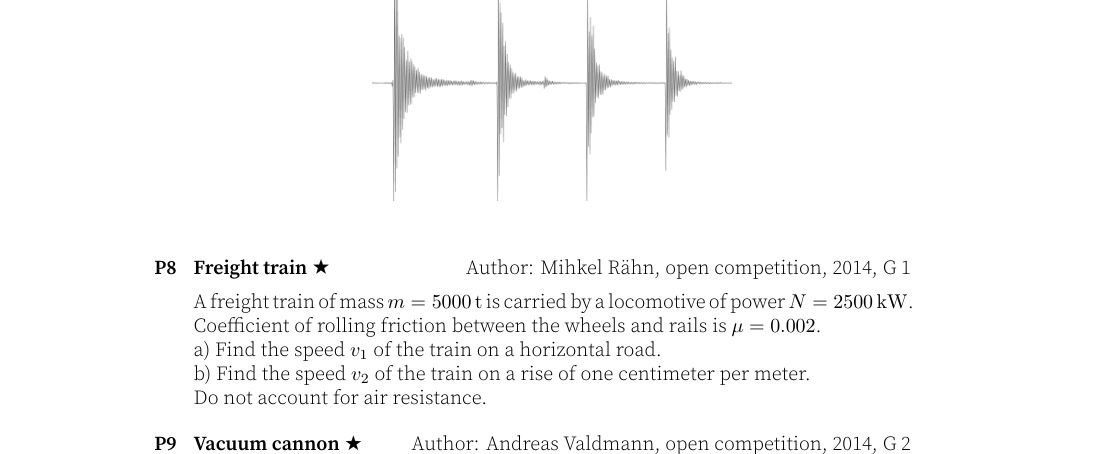 Audio signal of bouncing ball
Topic: Newtonian Mechanics Metodi: Kinematic Equations, Experimental Data Analysis Competenze: Graph Linearization, Physical Reasoning Objects: Ball Fonte: Testo (PDF) — p.6
P7 Ball
Madis studiò un’archipazione audio di una palla che rimbalzava con un programma informatico e ottenne un grafico mostrato sotto che mostra la forma del segnale audio. Trova l’altezza massima della palla dopo il primo rimbalzo se si sa che la palla è salita esattamente 1 m di altezza dopo il terzo rimbalzo.
Signal audio di palla rimbalzata
Topic: Newtonian Mechanics Metodi: Kinematic Equations, Experimental Data Analysis Competenze: Graph Linearization, Physical Reasoning Objects: Ball Fonte: Testo (PDF) — p.6
P8 Freight train
A freight train of mass t is carried by a locomotive of power kW. Coefficient of rolling friction between the wheels and rails is .
a) Find the speed of the train on a horizontal road.
b) Find the speed of the train on a rise of one centimeter per meter.
Do not account for air resistance.
Topic: Newtonian Mechanics Metodi: Free-Body Diagram, Energy Conservation Method Competenze: Physical Reasoning, Mathematical Modeling Objects: — Fonte: Testo (PDF) — p.6
P8 Treno merci
Un treno merci di massa t è trasportato da una locomotiva di potenza kW. Il coefficiente di attrito di rotolamento tra le ruote e le rotaie è .
a) Trova la velocità del treno su una strada orizzontale.
b) Trova la velocità del treno ad un’altezza di un centimetro per metro.
Non tenere conto della resistenza all’aria.
Topic: Newtonian Mechanics Metodi: Free-Body Diagram, Energy Conservation Method Competenze: Physical Reasoning, Mathematical Modeling Objects: — Fonte: Testo (PDF) — p.6
P9 Vacuum cannon
Pictured below is a so-called vacuum cannon. To load it, a ball meant for ammunition is put into the left end of the vacuum cannon. Next, both ends of the tube are covered with an easily rupturing airproof membrane, for example foil, and then the air is pumped out of the tube. The vacuum cannon is now ready for firing. For firing, the membrane on the left is intentionally ruptured. As a result the ball starts to charge towards the right end of the tube. If the tube is long enough the ball ruptures the membrane on the right end and is fired out of the tube. Let us say that the diameter of the ball is equal to the inner diameter of the tube cm, the ball’s mass is g and before the firing the ball is positioned at a distance cm from the right end of the tube. What is the speed of the ball directly before rupturing the membrane on the right? Air pressure is kPa. Do not account for friction.
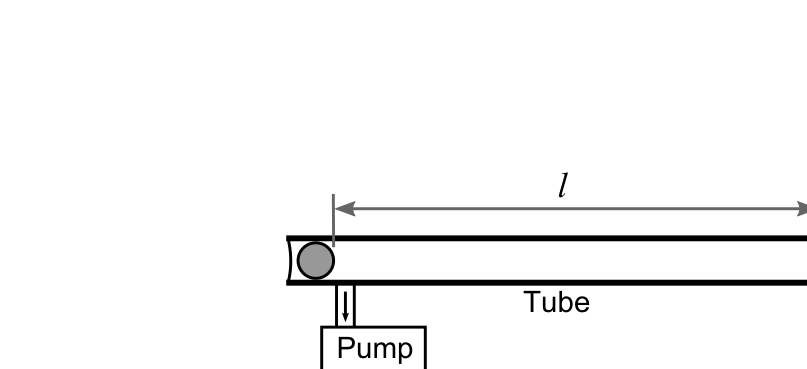 Vacuum cannon diagram with pump
Topic: Newtonian Mechanics, Fluid Mechanics Metodi: Kinematic Equations, Physical Modeling Competenze: Physical Reasoning, Mathematical Modeling Objects: Tube, Ball, Membrane Fonte: Testo (PDF) — p.6
P9 cannone a vuoto
Nella foto qui sotto c’è un cosiddetto cannone a vuoto. Per caricarla, una palla destinata alle munizioni viene messa nella parte sinistra del cannone a vuoto. Successivamente, entrambe le estremità del tubo sono coperte da una membrana a prova d’aria facilmente rotta, ad esempio una pellicola, e poi l’aria viene pompata fuori dal tubo. Il cannone a vuoto è pronto per il fuoco. Per il fuoco, la membrana sinistra viene intenzionalmente rotta. Di conseguenza, la palla inizia a caricare verso l’estremità destra del tubo. Se il tubo è abbastanza lungo la palla rompe la membrana alla fine destra e viene sparata fuori dal tubo. Diciamo che il diametro della palla è uguale al diametro interno del tubo cm, la massa della palla è g e prima del tiro la palla è posizionata a una distanza cm dalla fine destra del tubo. Qual è la velocità della palla prima di rompere la membrana a destra? La pressione dell’aria è kPa. Non considerare il frattamento.
Diagramma di cannone a vuoto con pompa
Topic: Newtonian Mechanics, Fluid Mechanics Metodi: Kinematic Equations, Physical Modeling Competenze: Physical Reasoning, Mathematical Modeling Objects: Tube, Ball, Membrane Fonte: Testo (PDF) — p.6
P10 Toy cannon
A rubber ball is fired out of a toy cannon so that the ball bounces perpendicularly to an inclined surface distanced horizontally from the cannon. The ball bounces off from the inclined surface to a distance (see figure). Find what fraction of the energy got absorbed during the bounce. The surface’s angle of inclination is .
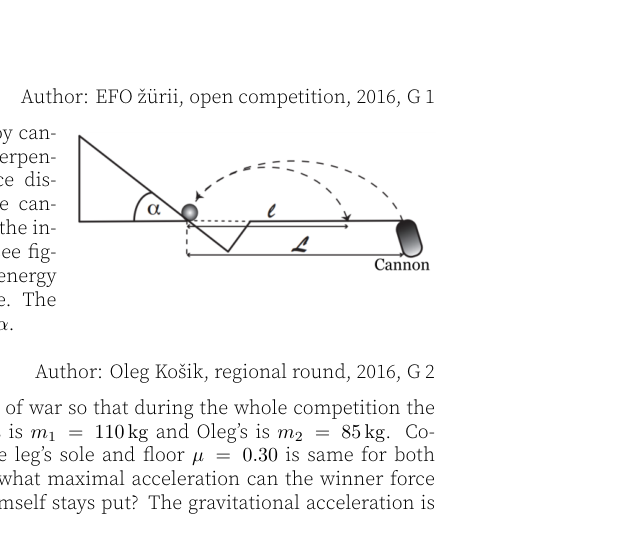 Ball bouncing off inclined surface
Topic: Newtonian Mechanics, Conservation of Energy Metodi: Kinematic Equations, Energy Conservation Method Competenze: Physical Reasoning, Mathematical Modeling Objects: Ball, Inclined Plane, Projectile Fonte: Testo (PDF) — p.7
P10 cannone da giocattoli
Una palla di gomma viene sparata da un cannone da giocattoli in modo che la palla rimbalzi perpendicolare a una superficie inclinata distante orizzontalmente dal cannone. La palla rimbalza dalla superficie inclinata a una distanza (vedi figura). Scopri quale frazione dell’energia è stata assorbita durante il rimbalzo. L’angolo di inclinazione della superficie è .
Ripuntamento della palla dalla superficie inclinata
Topic: Newtonian Mechanics, Conservation of Energy Metodi: Kinematic Equations, Energy Conservation Method Competenze: Physical Reasoning, Mathematical Modeling Objects: Ball, Inclined Plane, Projectile Fonte: Testo (PDF) — p.7
P11 Tug of war
Eero and Oleg compete in a tug of war so that during the whole competition the rope is horizontal. Eero’s mass is kg and Oleg’s is kg. Coefficient of friction between the leg’s sole and floor is same for both men. Which man wins? With what maximal acceleration can the winner force the loser to move, so that he himself stays put? The gravitational acceleration is m/s².
Topic: Newtonian Mechanics Metodi: Free-Body Diagram, Kinematic Equations Competenze: Physical Reasoning Objects: String Fonte: Testo (PDF) — p.7
Il gruppo di lavoro ha partecipato alla riunione del Consiglio di sicurezza.
Eero e Oleg si competono in un tirocinio di guerra in modo che durante tutta la gara la corda sia orizzontale. La massa di Eero è kg e di Oleg è kg. Il coefficiente di attrito tra la suola della gamba e il pavimento è lo stesso per entrambi gli uomini. Quale uomo vince? Con quale massima accelerazione il vincitore può costringere il perdente a muoversi, così che lui stesso rimanga posto? L’accelerazione gravitazionale è m/s2.
Topic: Newtonian Mechanics Metodi: Free-Body Diagram, Kinematic Equations Competenze: Physical Reasoning Objects: String Fonte: Testo (PDF) — p.7
P12 Fastelavn slide
Juss found a hill for Fastelavn (a carnival tradition and holiday in Northern Europe) sliding. The hill’s cross-cut consists of two line segments, as shown in the figure. After the hill there is a horizontal ground. The height of the hill’s first part is m and its inclination is . The length of the second part is m and inclination . The mass of Juss and the sledge is kg and coefficient of friction between the snow and the sledge is , gravitational acceleration is m/s². Find how long is Juss’s slide.
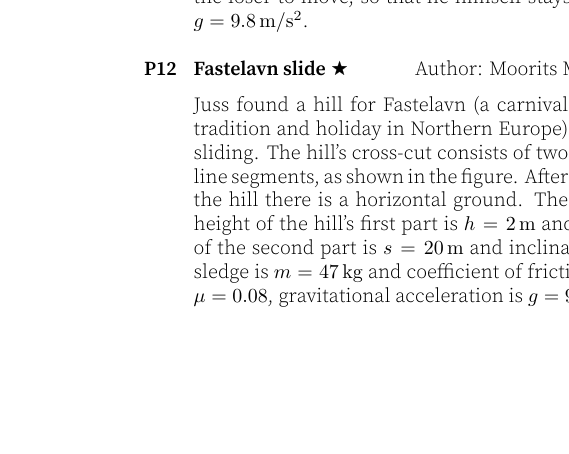 Two-part hill cross section
Topic: Newtonian Mechanics, Conservation of Energy Metodi: Kinematic Equations, Free-Body Diagram, Energy Conservation Method Competenze: Mathematical Modeling, Physical Reasoning Objects: Inclined Plane Fonte: Testo (PDF) — p.7
P12 Fastelavn slide
Juss trovò una collina per Fastelavn (una tradizione di carnevale e festa nell’Europa settentrionale) scivolato. La croce della collina è composta da due segmenti di linea, come mostrato nella figura. Dopo la collina c’è un terreno orizzontale. L’altezza della prima parte della collina è m e la sua inclinazione è . La lunghezza della seconda parte è m e l’inclinazione . La massa di Juss e la sciarpa è kg e il coefficiente di attrito tra la neve e la sciarpa è , l’accelerazione gravitazionale è m/s2. Scopri quanto dura la glissiera di Juss.
Sezione di croce di due parti di collina
Topic: Newtonian Mechanics, Conservation of Energy Metodi: Kinematic Equations, Free-Body Diagram, Energy Conservation Method Competenze: Mathematical Modeling, Physical Reasoning Objects: Inclined Plane Fonte: Testo (PDF) — p.7
P13 Alpinist
An alpinist with a mass of kg is fastened to an elastic rope with a length of m. The other side of the rope is attached to a cliff. After climbing to a height of 6 meters from the attachment point the alpinist falls. Find the rope’s maximal elasticity coefficient , knowing that a maximal pulling force of the rope that a human can tolerate is . Do not account for air resistance.
Topic: Newtonian Mechanics, Conservation of Energy Metodi: Energy Conservation Method, Hooke’s Law Competenze: Mathematical Modeling Objects: String, Spring Fonte: Testo (PDF) — p.8
P13 Alpinista
Un alpinista di massa kg è fissato a una corda elastica di m di lunghezza. L’altro lato della corda è attaccato a una scogliera. Dopo aver salito ad un’altezza di 6 metri dal punto di attaccamento l’alpinista cade. Trova il coefficiente di elasticità massima della corda , sapendo che la forza di trazione massima della corda che un essere umano può tollerare è . Non tenere conto della resistenza all’aria.
Topic: Newtonian Mechanics, Conservation of Energy Metodi: Energy Conservation Method, Hooke’s Law Competenze: Mathematical Modeling Objects: String, Spring Fonte: Testo (PDF) — p.8
P14 Parachute jump
Juku with a mass kg and his father Juhan with a mass kg decided to make a parachute jump. They put on the same parachutes with a mass of kg and then they were pushed off from the plane. Both of their parachutes opened at an exact same height , after which the jumpers obtained a constant speed with negligible time and reached the ground with that speed. The time it took Juku to reach the ground from the point where he opened his parachute was s. How much time did it take for Juhan? The drag force applied by the air to the parachute is proportional to the speed of falling squared. The air resistance applied to the jumpers themselves is negligible.
Topic: Newtonian Mechanics, Fluid Mechanics Metodi: Free-Body Diagram, Kinematic Equations Competenze: Mathematical Modeling, Physical Reasoning Objects: — Fonte: Testo (PDF) — p.8
**P14 Salto in paracadute **
Juku con una massa kg e suo padre Juhan con una massa kg decisero di fare un salto in paracaduta. Hanno messo gli stessi paracadut con una massa di kg e poi sono stati spinti fuori dall’aereo. Entrambi i loro paracaduti si aprirono ad una stessa altezza , dopo di che i saltatori ottennero una velocità costante con un tempo trascurabile e raggiunsero il terreno con quella velocità. Il tempo necessario per raggiungere il suolo dal punto in cui aprì il paracadute fu s. How much time did it take for Juhan? La forza di trazione applicata dall’aria al paracadutista è proporzionale alla velocità di caduta al quadrato. La resistenza all’aria applicata ai saltatori è trascurabile.
Topic: Newtonian Mechanics, Fluid Mechanics Metodi: Free-Body Diagram, Kinematic Equations Competenze: Mathematical Modeling, Physical Reasoning Objects: — Fonte: Testo (PDF) — p.8
P15 Sledge
Juku wants to cross an ice covered river on a sledge. He starts from a shore covered with snow, its slope has an angle of inclination . The width of the river is m, coefficient of friction between the sledge and the snow is and between the sledge and the ice . What must be the height of the shore with respect to the water’s surface so that Juku would slide to the other shore?
Topic: Newtonian Mechanics, Conservation of Energy Metodi: Energy Conservation Method, Free-Body Diagram Competenze: Mathematical Modeling Objects: Inclined Plane Fonte: Testo (PDF) — p.8
P15 Sledge
Juku vuole attraversare un fiume ricoperto di ghiaccio su una slitta. Si parte da una riva ricoperta di neve, la sua pendenza ha un angolo di inclinazione . La larghezza del fiume è m, il coefficiente di attrito tra la sciga e la neve è e tra la sciga e il ghiaccio . Qual’e’ l’altezza della riva rispetto alla superficie dell’acqua per far scivolare Juku all’altra riva?
Topic: Newtonian Mechanics, Conservation of Energy Metodi: Energy Conservation Method, Free-Body Diagram Competenze: Mathematical Modeling Objects: Inclined Plane Fonte: Testo (PDF) — p.8
P16 Car’s braking
A car is driving on a road, the road’s change of height per road length is . With a same initial speed and braking force the car stops during a distance m while driving uphill, while downhill during a distance m. What is the value of the car’s initial speed ? Gravitational acceleration is m/s².
Topic: Newtonian Mechanics, Conservation of Energy Metodi: Energy Conservation Method, Kinematic Equations Competenze: Mathematical Modeling Objects: Inclined Plane Fonte: Testo (PDF) — p.8
P16 frenatura dell’auto
Una macchina guida su una strada, il cambiamento di altezza della strada per lunghezza è . Con la stessa velocità iniziale e la stessa forza di frenata, l’auto si ferma durante una distanza m mentre si conduce verso l’alto, mentre si ferma verso il basso durante una distanza m. Qual è il valore della velocità iniziale della vettura ? L’accelerazione gravitazionale è m/s2.
Topic: Newtonian Mechanics, Conservation of Energy Metodi: Energy Conservation Method, Kinematic Equations Competenze: Mathematical Modeling Objects: Inclined Plane Fonte: Testo (PDF) — p.8
P17 Cannonball
Juku calculated during a school lesson that the maximal height of a cannonball that is shot from a very powerful cannon is km. But he did not consider that at those heights the gravitational field’s change is significant and that the gravity force cannot be assumed to be constant. Find how high the ball would actually fly. Earth’s radius is km. Do not account for air resistance.
Topic: Newtonian Mechanics, Gravitation Metodi: Energy Conservation Method, Newton’s Law of Gravitation Competenze: Mathematical Modeling, Physical Reasoning Objects: Projectile, Planet Fonte: Testo (PDF) — p.8
P17 cannonball
Juku calcolatore durante una lezione di scuola che l’altezza massima di una palla di cannone che viene sparato da un cannone molto potente è km. Ma non considerava che a quelle altezze il cambiamento del campo gravitazionale fosse significativo e che la forza gravitazionale non potesse essere presunta costante. Scopri quanto in alto sarebbe stata la palla. Il raggio di radio della Terra è km. Non tenere conto della resistenza all’aria.
Topic: Newtonian Mechanics, Gravitation Metodi: Energy Conservation Method, Newton’s Law of Gravitation Competenze: Mathematical Modeling, Physical Reasoning Objects: Projectile, Planet Fonte: Testo (PDF) — p.8
P18 Pendulum
A pendulum made from a string and a weight is swinging so that at the amplitude position the angle between the string and the vertical direction is . How many times do the maximal and minimal tensions differ in the string during the swinging?
Topic: Oscillations & Waves, Newtonian Mechanics Metodi: Energy Conservation Method, Free-Body Diagram Competenze: Mathematical Modeling Objects: Pendulum Fonte: Testo (PDF) — p.9
P18 Pendolo
Un pendolo fatto di una corda e di un peso si oscilla in modo tale che, nella posizione di amplitudine, l’angolo tra la corda e la direzione verticale sia . Quante volte le tensioni massime e minime differiscono nella corda durante lo swing?
Topic: Oscillations & Waves, Newtonian Mechanics Metodi: Energy Conservation Method, Free-Body Diagram Competenze: Mathematical Modeling Objects: Pendulum Fonte: Testo (PDF) — p.9
P19 Mountain’s slope
What is the maximal angle of inclination of a mountain so that it is possible to drive on it upwards with a bicycle while maintaining a constant speed? The mass of a cyclist is , bicycle’s mass is , pedal’s crank length is , the front gear wheel’s radius is , rear gear wheel’s radius is , radius of the wheel is . Assume that during the cycling the cyclist’s center of mass is still with respect to the bicycle and that all of the cyclist’s mass is applied to a sinking pedal. Coefficient of friction between the ground and the wheel is big enough to avoid sliding. Do not account for mechanical friction during the force transmission and the coefficient of rolling resistance is negligible. Assume that the average speed of the bicycle is constant and that the relative change in speed is negligible during a quarter of pedaling period.
Note: The problem’s text has been adjusted compared to the version that appeared in the olympiad.
Topic: Newtonian Mechanics, Rotational Dynamics Metodi: Torque & Angular Momentum Analysis, Free-Body Diagram Competenze: Physical Reasoning, Mathematical Modeling Objects: Wheel, Gear Fonte: Testo (PDF) — p.9
P19 Ponta di montagna
Qual è l’angolo massimo di inclinazione di una montagna in modo da poterla guidare verso l’alto con una bicicletta mantenendo una velocità costante? La massa di un ciclista è , la massa della bicicletta è , la lunghezza della manopola del pedal è , il raggio della ruota della marcia anteriore è , il raggio della ruota della marcia posteriore è , il raggio della ruota è . Supponiamo che durante il ciclismo il centro di massa del ciclista sia ancora rispetto alla bicicletta e che tutta la massa del ciclista sia applicata a un pedale che affonda. Il coefficiente di attrito tra il terreno e la ruota è sufficientemente grande da evitare il scivolamento. Non si deve tenere conto della friczione meccanica durante la trasmissione della forza e il coefficiente di resistenza al rotolamento è trascurabile. Supponiamo che la velocità media della bicicletta sia costante e che il relativo cambiamento di velocità sia trascurabile durante un quarto del periodo di pedalazione.
Nota: il testo del problema è stato aggiustato rispetto alla versione che è apparsa nelle Olimpiadi.
Topic: Newtonian Mechanics, Rotational Dynamics Metodi: Torque & Angular Momentum Analysis, Free-Body Diagram Competenze: Physical Reasoning, Mathematical Modeling Objects: Wheel, Gear Fonte: Testo (PDF) — p.9
P20 Truck
There is a liquid in a truck’s crate of height , the liquid’s surface height from the crate’s bottom is , moreover . What can the truck’s maximal acceleration be, so that the liquid will not flow out of the crate? The length of the truck’s crate is .
Note: The truck is accelerating uniformly, thanks to that the liquid is not going to sway.
Topic: Fluid Mechanics, Newtonian Mechanics Metodi: Free-Body Diagram, Physical Modeling Competenze: Physical Reasoning, Mathematical Modeling Objects: Container Fonte: Testo (PDF) — p.9
P20 Truck
Nel cassetto del camion c’è un liquido di altezza , l’altezza della superficie del liquido dal fondo della cassetta è , oltre a . Qual è la massima accelerazione del camion , in modo che il liquido non esca dalla cassa? La lunghezza della cassa del camion è .
Nota: il camion accelera uniformemente, grazie al quale il liquido non si sta spostando.
Topic: Fluid Mechanics, Newtonian Mechanics Metodi: Free-Body Diagram, Physical Modeling Competenze: Physical Reasoning, Mathematical Modeling Objects: Container Fonte: Testo (PDF) — p.9
P21 Loop-the-loop track
A toy car’s track is shown in the figure. The car begins from a resting position on top of the inclined track. The car accelerates while driving down and finally drives through a loop. What is the minimal height so that the car will not drop down while driving through the loop? The loop’s diameter is . Do not account for friction.
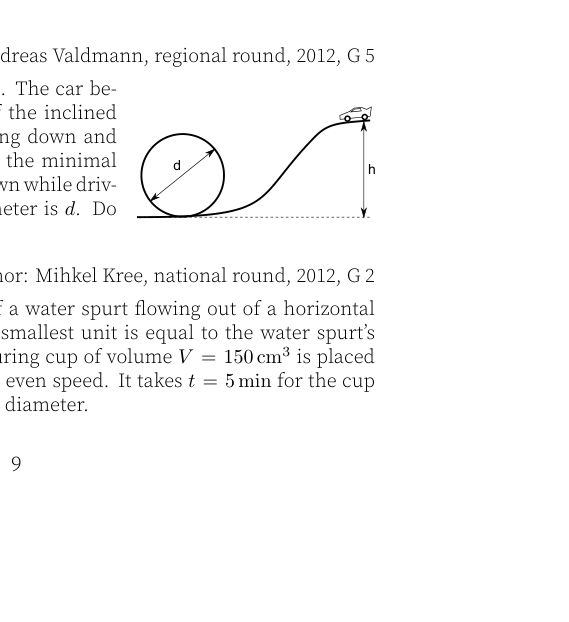 Loop-the-loop track with height h
Topic: Newtonian Mechanics, Conservation of Energy Metodi: Energy Conservation Method, Free-Body Diagram Competenze: Physical Reasoning Objects: Cart Fonte: Testo (PDF) — p.9
P21 Traccia di ciclo di ciclo
La pista di una macchina da gioco è mostrata nella figura. L’auto parte da una posizione di riposo in cima alla pista inclinata. L’auto accelera mentre si fa scendere e alla fine attraversa un circuito. Qual è l’altezza minima in modo che l’auto non cadga mentre si guida attraverso il circuito? Il diametro del ciclo è . Non considerare il frattamento.
Scorsa di circuito con altezza h
Topic: Newtonian Mechanics, Conservation of Energy Metodi: Energy Conservation Method, Free-Body Diagram Competenze: Physical Reasoning Objects: Cart Fonte: Testo (PDF) — p.9
P22 Water spurt
In the figure below there is a photo of a water spurt flowing out of a horizontal tube and a coordinate grid, the grid’s smallest unit is equal to the water spurt’s diameter on its initial height. A measuring cup of volume cm³ is placed below the spurt, which is flowing with even speed. It takes min for the cup to fill completely. Find the tube’s inner diameter.
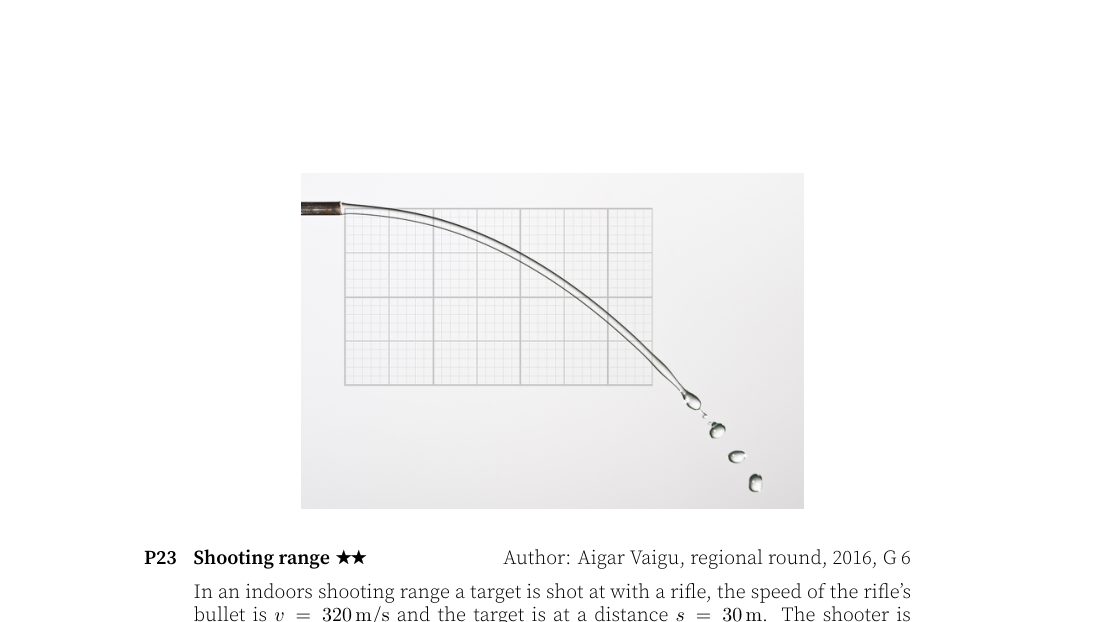 Water spurt photo with coordinate grid
Topic: Fluid Mechanics, Newtonian Mechanics Metodi: Kinematic Equations, Physical Modeling Competenze: Estimation & Approximation, Physical Reasoning Objects: Tube Fonte: Testo (PDF) — p.9
P22 Spruto di acqua
Nella figura seguente è riportata una foto di un pulsante d’acqua che scorre da un tubo orizzontale e una griglia di coordinate, la più piccola unità della griglia è uguale al diametro del pulsante d’acqua sulla sua altezza iniziale. Si colloca sotto lo sprucio una tazza di misurazione di volume cm3 che scorre a velocità uniforme. Ci vuole min per riempire completamente la tazza. Trova il diametro interno del tubo.
Foto di spunt di acqua con griglia di coordinate
Topic: Fluid Mechanics, Newtonian Mechanics Metodi: Kinematic Equations, Physical Modeling Competenze: Estimation & Approximation, Physical Reasoning Objects: Tube Fonte: Testo (PDF) — p.9
P23 Shooting range
In an indoors shooting range a target is shot at with a rifle, the speed of the rifle’s bullet is m/s and the target is at a distance m. The shooter is aiming the rifle at the target which is at the same height as the rifle and shoots the target exactly in the middle. Evaluate how far from the target would the bullet land if the rifle is turned 180 degrees around the aiming axis. Do not account for air resistance.
Topic: Newtonian Mechanics Metodi: Kinematic Equations Competenze: Physical Reasoning, Estimation & Approximation Objects: Projectile Fonte: Testo (PDF) — p.10
P23 Distanza di tiro
In un campo di tiro interno un bersaglio viene colpito con un fucile, la velocità del proiettile è m/s e il bersaglio è a una distanza m. Il tiratore punta il fucile verso l’obiettivo che è alla stessa altezza del fucile e spara l’obiettivo esattamente nel mezzo. Valutare quanto lontano dal bersaglio il proiettile atterrerebbe se il fucile fosse girato 180 gradi attorno all’asse di mira. Non tenere conto della resistenza all’aria.
Topic: Newtonian Mechanics Metodi: Kinematic Equations Competenze: Physical Reasoning, Estimation & Approximation Objects: Projectile Fonte: Testo (PDF) — p.10
P24 Cylinder
A cylinder of mass and radius is sliding on a plane with a speed and an angular velocity . When the sliding ends the cylinder moves with the speed to the opposite direction with respect to the initial speed. Find the cylinder’s initial angular velocity.
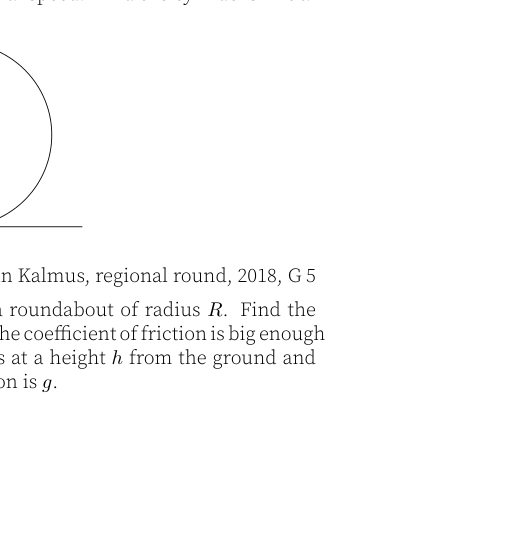 Cylinder sliding with angular velocity
Topic: Newtonian Mechanics, Rotational Dynamics Metodi: Conservation of Momentum, Torque & Angular Momentum Analysis Competenze: Mathematical Modeling Objects: Cylinder Fonte: Testo (PDF) — p.10
P24 cilindro
Un cilindro di massa e di raggio si scivola su un piano con velocità e velocità angolare . Quando la scorrevolezza termina, il cilindro si muove con la velocità nella direzione opposta rispetto alla velocità iniziale. Trova la velocità angolare iniziale del cilindro.
Cilindro scivolante a velocità angolare
Topic: Newtonian Mechanics, Rotational Dynamics Metodi: Conservation of Momentum, Torque & Angular Momentum Analysis Competenze: Mathematical Modeling Objects: Cylinder Fonte: Testo (PDF) — p.10
P25 Truck on a roundabout
A truck is driving with a uniform speed on a roundabout of radius . Find the truck’s maximal possible speed provided that the coefficient of friction is big enough to avoid sliding. The truck’s center of mass is at a height from the ground and the truck’s width is . Gravitational acceleration is .
Topic: Newtonian Mechanics, Rotational Dynamics Metodi: Free-Body Diagram, Torque & Angular Momentum Analysis Competenze: Physical Reasoning, Mathematical Modeling Objects: — Fonte: Testo (PDF) — p.10
P25 Truck in rotonda
Un camion guida a velocità uniforme su una rotonda di raggio . Trova la velocità massima possibile del camion a condizione che il coefficiente di attrito sia sufficientemente grande per evitare il scivolamento. Il centro di massa del camion è a un’altezza dal terreno e la larghezza del camion è . L’accelerazione gravitazionale è .
Topic: Newtonian Mechanics, Rotational Dynamics Metodi: Free-Body Diagram, Torque & Angular Momentum Analysis Competenze: Physical Reasoning, Mathematical Modeling Objects: — Fonte: Testo (PDF) — p.10
P26 Chlorine’s molecule
Chlorine’s molecule, which is moving with a velocity m/s, absorbs a photon with a wavelength nm and is divided into two atoms. The first atom’s velocity is measured to be m/s, which perpendicular to the molecule’s initial velocity. Find the chlorine molecule’s binding energy if all the particles were at a state with minimal inner energy. Planck constant is J·s, speed of light is m/s, chlorine’s atomic mass is 35 and Avogadro constant is mol⁻¹. Photon’s energy is defined as . It is presumed that a photon’s momentum is negligible compared to chlorine’s momentum.
Topic: Modern-Quantum Physics, Conservation of Momentum Metodi: Conservation of Momentum, Photon Energy Relation, Conservation of Energy Competenze: Mathematical Modeling Objects: Photon, Atom Fonte: Testo (PDF) — p.11
P26 Molcola di cloro
La molecola di cloro, che si muove a velocità m/s, assorbe un fotone con una lunghezza d’onda nm e si divide in due atomi. La velocità del primo atomo è misurata a m/s, che è perpendicolare alla velocità iniziale della molecola. Trova l’energia di legame della molecola di cloro se tutte le particelle fossero in uno stato con una minima energia interna. La costante di Planck è J·s, la velocità della luce è m/s, la massa atomica del cloro è 35 e la costante di Avogadro è mol−1. L’energia del fotone è definita come . Si presume che la dinamica di un fotone sia trascurabile rispetto alla dinamica del cloro.
Topic: Modern-Quantum Physics, Conservation of Momentum Metodi: Conservation of Momentum, Photon Energy Relation, Conservation of Energy Competenze: Mathematical Modeling Objects: Photon, Atom Fonte: Testo (PDF) — p.11
P27 Swing
On one end of the swing at a length from the swing’s rotation axis there is a mass . On the other end of the swing, which is away from the rotation axis, falls a mass from a height . The collision is completely inelastic and the swing is horizontal at the moment of collision. The swing’s mass is very small and it does not have to be taken into account. How fast does the first mass move right after the collision?
Topic: Rotational Dynamics, Conservation of Momentum Metodi: Torque & Angular Momentum Analysis, Conservation of Momentum Competenze: Mathematical Modeling Objects: Lever, Block Fonte: Testo (PDF) — p.11
P27 Swing
In una estremità dello swing, a una lunghezza dall’asse di rotazione dello swing, c’è una massa . L’altra estremità dello swing, che è lontano dall’asse di rotazione, cade una massa da un’altezza . La collisione è completamente inelastica e lo swing è orizzontale al momento della collisione. La massa dello swing è molto piccola e non deve essere presa in considerazione. Quanto veloce si muove la prima massa subito dopo la collisione?
Topic: Rotational Dynamics, Conservation of Momentum Metodi: Torque & Angular Momentum Analysis, Conservation of Momentum Competenze: Mathematical Modeling Objects: Lever, Block Fonte: Testo (PDF) — p.11
P28 Hydrogen’s ionization
What is the smallest kinetic energy of a free proton that is able to ionize a hydrogen atom? Assume that the electron inside the hydrogen atom is still and that the electromagnetic interaction between the atomic nucleus and the free proton is negligible. Hydrogen’s binding energy is eV, proton’s mass is kg and electron’s mass kg.
Topic: Modern-Quantum Physics, Conservation of Momentum Metodi: Conservation of Momentum, Conservation of Energy, Bohr Model & Quantization Competenze: Mathematical Modeling Objects: Atom, Electron Fonte: Testo (PDF) — p.11
P28 Ionizzazione dell’idrogeno
Qual è la più piccola energia cinetica di un protone libero in grado di ionizzare un atomo di idrogeno? Supponiamo che l’elettrone all’interno dell’atomo di idrogeno sia ancora presente e che l’interazione elettromagnetica tra il nucleo atomico e il protone libero sia trascurabile. L’energia di legame dell’idrogeno è eV, la massa del protone è kg e la massa dell’elettrone kg.
Topic: Modern-Quantum Physics, Conservation of Momentum Metodi: Conservation of Momentum, Conservation of Energy, Bohr Model & Quantization Competenze: Mathematical Modeling Objects: Atom, Electron Fonte: Testo (PDF) — p.11
P29 Water pipe
A water pipe with a length is fixed to a wall so that it can freely rotate on the vertical plane. The water pipe’s mass together with the water it is filled with is . The cross-sectional area of the pipe’s end is . The end is turned 90 degrees with respect to the rest of the pipe (see figure). Water flows out of the end of the pipe with a speed and density . What is the angle between the vertical direction and the pipe’s axis? Gravitational acceleration is .
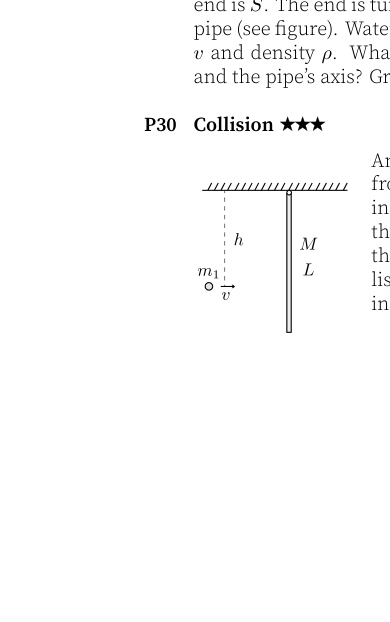 Pipe fixed to wall with bent end
Topic: Fluid Mechanics, Newtonian Mechanics Metodi: Torque & Angular Momentum Analysis, Conservation of Momentum Competenze: Physical Reasoning, Mathematical Modeling Objects: Tube Fonte: Testo (PDF) — p.11
P29 Tubo d’acqua
Un tubo d’acqua di lunghezza è fissato a una parete in modo che possa girare liberamente sul piano verticale. La massa del tubo d’acqua insieme all’acqua con cui è riempito è . L’area trasversale della fine del tubo è . L’estremità è girata 90 gradi rispetto al resto del tubo (vedere figura). L’acqua scorre dall’estremità del tubo con velocità e densità . Qual è l’angolo tra la direzione verticale e l’asse del tubo? L’accelerazione gravitazionale è .
Più che è fissato alla parete con fine piegato
Topic: Fluid Mechanics, Newtonian Mechanics Metodi: Torque & Angular Momentum Analysis, Conservation of Momentum Competenze: Physical Reasoning, Mathematical Modeling Objects: Tube Fonte: Testo (PDF) — p.11
P30 Collision
An initially resting rod of mass and length is hanging from the ceiling so that its upper tip is fixed with a freely rotating attachment. The rod’s moment of inertia with respect to the tip is . A steel ball with a mass flies against the rod and hits it at a distance from the fixed tip. The collision is elastic, which means there is no heat loss. Interestingly, the ball stays put for a moment after the collision and then starts to fall down vertically. Find the value of so that such a moment of stillness is possible.
Topic: Rotational Dynamics, Conservation of Momentum Metodi: Torque & Angular Momentum Analysis, Conservation of Energy, Conservation of Momentum Competenze: Mathematical Modeling Objects: Rod, Ball Fonte: Testo (PDF) — p.11
P30 Collisione
Una barra di riposo iniziale di massa e lunghezza è appesa al soffitto in modo che la sua punta superiore sia fissata con un attaccamento in rotazione libera. Il momento di inerzia della canna rispetto alla punta è . Una palla di acciaio di massa vola contro la canna e la colpisce a una distanza dalla punta fissa. La collisione è elastica, il che significa che non c’è perdita di calore. È interessante notare che la palla rimane messa per un momento dopo la collisione e poi inizia a cadere verticalmente. Trova il valore di in modo che sia possibile un tale momento di quiete.
Topic: Rotational Dynamics, Conservation of Momentum Metodi: Torque & Angular Momentum Analysis, Conservation of Energy, Conservation of Momentum Competenze: Mathematical Modeling Objects: Rod, Ball Fonte: Testo (PDF) — p.11
P31 Cyclist
A cyclist with a mass kg rides without pedaling down a hill with an angle of inclination of (angle between the horizontal and the hill) and notices that if the hill is long enough his final speed would be km/h. However, if the mountain is two times smaller () his final speed would be smaller by km/h. Find how big must be the cyclist pedaling power so he would maintain a speed of km/h on a horizontal road. What fraction of the power does it take to overcome the air resistance? Assume that there is a windless weather and that the gravitational acceleration is m/s².
Note: You should take into account the friction force that does not depend on the speed and also the wind resistance which is proportional to speed squared.
Topic: Newtonian Mechanics, Conservation of Energy Metodi: Energy Conservation Method, Physical Modeling Competenze: Mathematical Modeling, Physical Reasoning Objects: — Fonte: Testo (PDF) — p.12
P31 Ciclista
Un ciclista di massa kg si sposta senza pedalare su una collina con un angolo di inclinazione di (angolo tra orizzontale e collina) e si accorge che se la collina è abbastanza lunga la sua velocità finale sarebbe km/h. Tuttavia, se la montagna è due volte più piccola (), la sua velocità finale sarebbe inferiore di km/h. Scopri quanto deve essere grande la potenza pedalistica del ciclista per mantenere una velocità di km/h su una strada orizzontale. Quanta frazione di energia serve per superare la resistenza dell’aria? Supponiamo che ci sia un clima senza vento e che l’accelerazione gravitazionale sia m/s2.
Nota: si deve tenere conto della forza di attrito che non dipende dalla velocità e anche della resistenza del vento che è proporzionale alla velocità al quadrato.
Topic: Newtonian Mechanics, Conservation of Energy Metodi: Energy Conservation Method, Physical Modeling Competenze: Mathematical Modeling, Physical Reasoning Objects: — Fonte: Testo (PDF) — p.12
P32 Two balls and a spring
Small balls are fixed to both ends of a spring, the first ball’s mass is and the mass of the other one is unknown. The whole system is made to rotate so that the distance of the unknown mass from the rotation center is equal to the spring’s initial length. What is the period of such a rotation if the spring’s stiffness is ? The spring’s mass is negligible with respect to the masses of the balls.
Topic: Oscillations & Waves, Rotational Dynamics Metodi: Simple Harmonic Motion Analysis, Hooke’s Law Competenze: Mathematical Modeling Objects: Spring, Ball Fonte: Testo (PDF) — p.12
P32 Due palle e una molla
Le piccole palle sono fissate alle entrambe estremità di una molla, la massa della prima palla è e la massa dell’altra è sconosciuta. L’intero sistema è fatto per ruotare in modo che la distanza della massa sconosciuta dal centro di rotazione sia uguale alla lunghezza iniziale della molla. Qual è il periodo di tale rotazione se la rigidità della molla è ? La massa della primavera è trascurabile rispetto alle masse delle palle.
Topic: Oscillations & Waves, Rotational Dynamics Metodi: Simple Harmonic Motion Analysis, Hooke’s Law Competenze: Mathematical Modeling Objects: Spring, Ball Fonte: Testo (PDF) — p.12
P33 Passenger train
A passenger train drives on a railway’s circular arc-shaped section while slowing down evenly. The length of the section is and the time it takes the train to drive through it is . After driving through the section the train’s direction has changed by an angle and at the beginning of the section the train’s speed was times bigger than it was at the end of the section. Find the relationship between the mass of a passenger sitting in the train and the passenger’s weight at the moment when the train is in the midpoint of the section. Find the passenger’s mass if N, km, s, , and m/s².
Topic: Newtonian Mechanics, Rotational Dynamics Metodi: Kinematic Equations, Vector Decomposition Competenze: Mathematical Modeling Objects: — Fonte: Testo (PDF) — p.12
P33 Treno passeggeri
Un treno passeggeri si sposta sulla sezione circolare di una ferrovia mentre rallenta uniformemente. La lunghezza della sezione è e il tempo necessario per attraversare il treno è . Dopo aver attraversato la sezione, la direzione del treno è cambiata di un angolo e all’inizio della sezione la velocità del treno è stata volte maggiore di quella che era alla fine della sezione. Trova la relazione tra la massa di un passeggero seduto nel treno e il peso del passeggero nel momento in cui il treno si trova nel punto medio della sezione. Trova la massa del passeggero se N, km, s, , e m/s2.
Topic: Newtonian Mechanics, Rotational Dynamics Metodi: Kinematic Equations, Vector Decomposition Competenze: Mathematical Modeling Objects: — Fonte: Testo (PDF) — p.12
P34 Pendulum with two parts
A thread of length is fixed to a point and a small ball is hanging at the end of the thread. The ball is brought to the side and is released at the position 1 without additional force. When the ball reaches the position 2 the thread meets a rod at the point , the rod is perpendicular to the drawing’s plane. In the same vertical the point is at a length from the point . Find for what value of is the thread’s tension (position 3). Do not account for air resistance or friction.
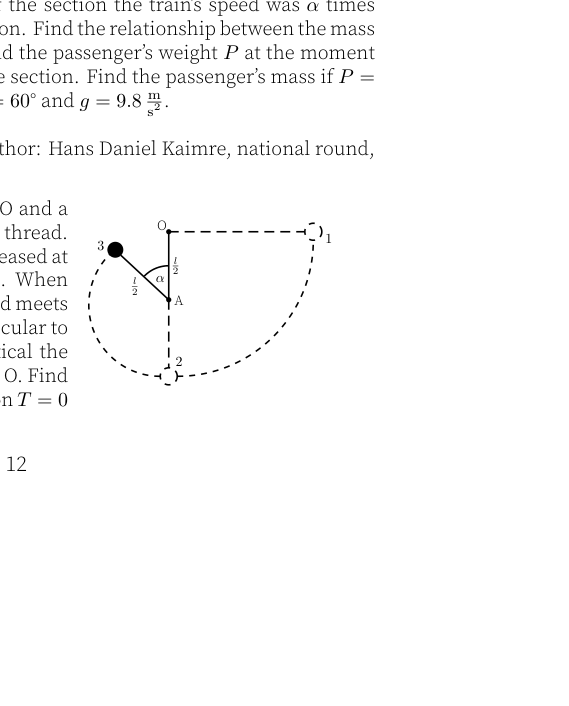 Pendulum with rod constraint diagram
Topic: Oscillations & Waves, Newtonian Mechanics Metodi: Energy Conservation Method, Free-Body Diagram Competenze: Mathematical Modeling, Diagrammatic Reasoning Objects: Pendulum, String, Rod Fonte: Testo (PDF) — p.12
P34 Pendolo a due parti
Un filo di lunghezza è fissato a un punto e un piccolo pallone è appeso alla fine del filo. La palla viene portata sul lato e rilasciata in posizione 1 senza forza aggiuntiva. Quando la palla raggiunge la posizione 2, il filo incontra una canna al punto , la canna è perpendicolare al piano del disegno. Nella stessa verticale il punto è a una lunghezza dal punto . Trova per quale valore è la tensione del filo (posizione 3). Non tenere conto della resistenza all’aria o della frizione.
Pendolo con diagramma di restrizione della canna
Topic: Oscillations & Waves, Newtonian Mechanics Metodi: Energy Conservation Method, Free-Body Diagram Competenze: Mathematical Modeling, Diagrammatic Reasoning Objects: Pendulum, String, Rod Fonte: Testo (PDF) — p.12
P35 Rolling ball
A semi-cylindrical piece of radius is cut out from a tile. The tile is standing on a smooth frictionless horizontal surface (see figure). The tile’s mass is . A small ball of radius and mass is pushed down from the point to move along the cylindrical surface. How much has the tile moved by the moment when the ball reaches the point ?
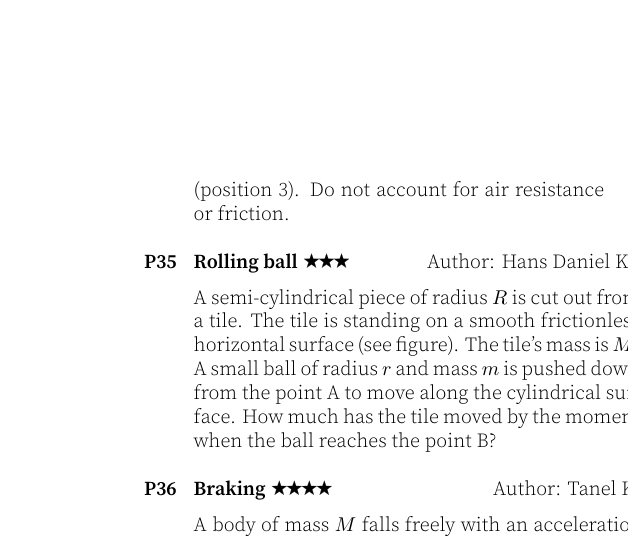 Tile with semi-cylindrical cavity, ball at A
Topic: Newtonian Mechanics, Conservation of Momentum Metodi: Conservation of Momentum, Physical Modeling Competenze: Mathematical Modeling Objects: Ball Fonte: Testo (PDF) — p.13
P35 Ballina rotolante
Si taglia da una piastrella un pezzo semicilindrico di raggio . La piastrella è in posizione su una superficie orizzontale liscia senza attrito (vedi figura). La massa della piastrella è . Una piccola sfera di raggio e massa viene spinta verso il basso dal punto per muoversi lungo la superficie cilindrica. Quanto si è spostata la piastrella al momento in cui la palla raggiunge il punto ?
Tile con cavità semicilindrica, palla a A
Topic: Newtonian Mechanics, Conservation of Momentum Metodi: Conservation of Momentum, Physical Modeling Competenze: Mathematical Modeling Objects: Ball Fonte: Testo (PDF) — p.13
P36 Braking
A body of mass falls freely with an acceleration . Trying to change its speed, someone fires small balls of mass directly up from the ground after each seconds. The balls bounce elastically directly back. How big has to be the speed of the balls so that after each collision the speed of the falling body is exactly the same, ? You can assume that the change in the speed of the balls is negligible under gravitation and that .
Topic: Newtonian Mechanics, Conservation of Momentum Metodi: Conservation of Momentum, Impulse-Momentum Theorem Competenze: Physical Reasoning, Mathematical Modeling Objects: Ball Fonte: Testo (PDF) — p.13
P36 frenata
Un corpo di massa cade liberamente con un’accelerazione . Cercando di cambiare la sua velocità, qualcuno spara piccole palle di massa direttamente dal suolo dopo ogni secondo. Le palle rimbalzano elasticamente direttamente indietro. Quanto deve essere grande la velocità delle palle in modo che dopo ogni collisione la velocità del corpo cadente sia esattamente la stessa, ? Si può supporre che il cambiamento della velocità delle palle sia trascurabile sotto la gravità e che .
Topic: Newtonian Mechanics, Conservation of Momentum Metodi: Conservation of Momentum, Impulse-Momentum Theorem Competenze: Physical Reasoning, Mathematical Modeling Objects: Ball Fonte: Testo (PDF) — p.13
P37 Robin Hood
Robin Hood is in an archery competition where he has to hit a target at a distance m. At what angle with respect to the horizontal direction has to Robin shoot with his bow so he would hit the target exactly in the middle? While straining the bow Robin’s work is J and the bow’s coefficient of efficiency is . The arrow’s mass is g and it is shot cm higher than the target’s center is. Do not account for air resistance. Gravitational acceleration is m/s².
Topic: Newtonian Mechanics, Conservation of Energy Metodi: Kinematic Equations, Energy Conservation Method Competenze: Mathematical Modeling Objects: Projectile Fonte: Testo (PDF) — p.13
P37 Robin Hood
Robin Hood è in una competizione di tiro con l’arco dove deve colpire un bersaglio a una distanza m. At what angle with respect to the horizontal direction has to Robin shoot with his bow so he would hit the target exactly in the middle? Mentre si sforza l’arco, il lavoro di Robin è J e il coefficiente di efficienza dell’arco è . La massa della freccia è g e viene sparata cm più in alto del centro del bersaglio. Non tenere conto della resistenza all’aria. L’accelerazione gravitazionale è m/s2.
Topic: Newtonian Mechanics, Conservation of Energy Metodi: Kinematic Equations, Energy Conservation Method Competenze: Mathematical Modeling Objects: Projectile Fonte: Testo (PDF) — p.13
P38 Sports car
Find the maximal acceleration of a front-wheel drive car. The car’s mass is , the distance between the axes of the front and rear wheels is , the center of mass is at a height and the horizontal distance of the center of mass from the rear axis is . Coefficient of friction between the wheels and the ground is .
Topic: Newtonian Mechanics Metodi: Free-Body Diagram, Torque & Angular Momentum Analysis Competenze: Mathematical Modeling Objects: Wheel Fonte: Testo (PDF) — p.13
P38 Auto sportivo
Trova la massima accelerazione di un’auto a trazione anteriore. La massa della vettura è , la distanza tra gli assi delle ruote anteriori e posteriori è , il centro di massa è ad un’altezza e la distanza orizzontale del centro di massa dall’asse posteriore è . Il coefficiente di attrito tra le ruote e il terreno è .
Topic: Newtonian Mechanics Metodi: Free-Body Diagram, Torque & Angular Momentum Analysis Competenze: Mathematical Modeling Objects: Wheel Fonte: Testo (PDF) — p.13
P39 Slat
A long slat that is lying on a horizontal plane is pushed from one end with a constant speed, perpendicularly to the slat. How far from that slat’s end is the rotation axis of the slat? The length of the slat is . Coefficient of friction between the slat and the plane is the same everywhere.
Topic: Rotational Dynamics, Newtonian Mechanics Metodi: Torque & Angular Momentum Analysis, Physical Modeling Competenze: Mathematical Modeling, Physical Reasoning Objects: Rod Fonte: Testo (PDF) — p.13
P39 Slat
Una lunga canna che si trova in un piano orizzontale viene spinta da un’estremità con una velocità costante, perpendicolare alla canna. Quanto è lontano dall’estremità della canna l’asse di rotazione della canna? La lunghezza della lamina è . Il coefficiente di attrito tra la canna e il piano è lo stesso ovunque.
Topic: Rotational Dynamics, Newtonian Mechanics Metodi: Torque & Angular Momentum Analysis, Physical Modeling Competenze: Mathematical Modeling, Physical Reasoning Objects: Rod Fonte: Testo (PDF) — p.13
P40 Hollow ball
Juku has an iron ball ( g/cm³) of radius cm and mass kg. Juku knows that inside the ball there is a spherical hollowness and he wants to find the distance from the center of the ball to the center of the hollowness. To do that he hanged the ball to a thread two times, using two opposite points on the ball as the hanging points. At the first time, the axis that connected the two hanging points formed an angle with respect to the horizontal axis, the second time that angle was . Find .
Topic: Rigid Body Statics, Newtonian Mechanics Metodi: Torque & Angular Momentum Analysis, Symmetry Argument Competenze: Mathematical Modeling, Physical Reasoning Objects: Sphere, String Fonte: Testo (PDF) — p.14
P40 Ballon vuoto
Il Juku ha una sfera di ferro ( g/cm3) di raggio cm e massa kg. Juku sa che all’interno della palla c’è una vuotola sferica e vuole trovare la distanza dal centro della palla al centro della vuotola. Per farlo appese la palla due volte a un filo, usando due punti opposti sulla palla come punti di appesa. La prima volta, l’asse che collegava i due punti di sospensione ha formato un angolo rispetto all’asse orizzontale, la seconda volta quell’angolo è stato . Trova .
Topic: Rigid Body Statics, Newtonian Mechanics Metodi: Torque & Angular Momentum Analysis, Symmetry Argument Competenze: Mathematical Modeling, Physical Reasoning Objects: Sphere, String Fonte: Testo (PDF) — p.14
P41 Football players
Two football players tried a trick move, where two balls would collide in the air. The players stood from each other at a distance m and hit their balls at the same time, both giving the ball an initial speed of m/s. In what area could the balls collide during the flight? To answer, make a figure from top view where the locations of the players are marked and the area of all the possible collision points. Also give the dimensions of that area. You do not have to find at what height from the ground the possible collision points are. Gravitational acceleration is m/s².
Topic: Newtonian Mechanics Metodi: Kinematic Equations, Symmetry Argument Competenze: Diagrammatic Reasoning, Mathematical Modeling Objects: Projectile, Ball Fonte: Testo (PDF) — p.14
P41 Calciatori di calcio
Due calciatori hanno provato una mossa truccata, dove due palle si schierano in aria. I giocatori si sono distanziati l’uno dall’altro a una distanza m e hanno colpito le loro palle allo stesso tempo, dando alla palla una velocità iniziale di m/s. In che zona potrebbero collidere le palle durante il volo? Per rispondere, si deve fare una figura dalla vista in alto dove sono segnate le posizioni dei giocatori e l’area di tutti i possibili punti di collisione. Indicare anche le dimensioni di quella zona. Non è necessario scoprire a quale altezza dal suolo si trovano i possibili punti di collisione. L’accelerazione gravitazionale è m/s2.
Topic: Newtonian Mechanics Metodi: Kinematic Equations, Symmetry Argument Competenze: Diagrammatic Reasoning, Mathematical Modeling Objects: Projectile, Ball Fonte: Testo (PDF) — p.14
P42 Wrench
Let us take a look at a wrench that can be regulated. How big has to be the number of its grooves per unit of length, , so that the nuts can be firmly fixed? The coefficient of friction between the touching surfaces is and the radius from the regulator’s axis to the touching surfaces is .
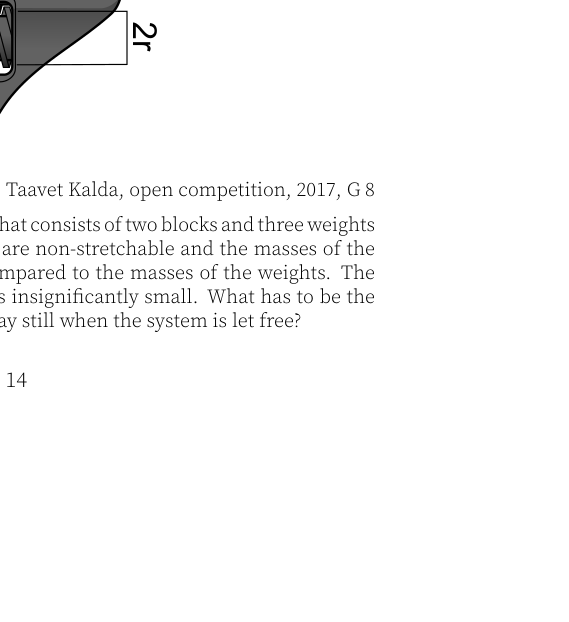 Wrench regulator with groove detail
Topic: Rigid Body Statics, Newtonian Mechanics Metodi: Torque & Angular Momentum Analysis, Free-Body Diagram Competenze: Physical Reasoning, Mathematical Modeling Objects: — Fonte: Testo (PDF) — p.14
Clicca di scatto ** P42
Diamo un’occhiata a una chiave che può essere regolata. Quanto grande deve essere il numero di solchi per unità di lunghezza, , in modo che le noci possano essere fissate saldamente? Il coefficiente di attrito tra le superfici di tocco è e il raggio dall’asse del regolatore alle superfici di tocco è .
Regulatore della chiave con dettaglio sul groove
Topic: Rigid Body Statics, Newtonian Mechanics Metodi: Torque & Angular Momentum Analysis, Free-Body Diagram Competenze: Physical Reasoning, Mathematical Modeling Objects: — Fonte: Testo (PDF) — p.14
P43 Blocks
In the figure there is depicted a system that consists of two blocks and three weights of masses , and . The strings are non-stretchable and the masses of the strings and blocks are insignificant compared to the masses of the weights. The friction between a block and a string is insignificantly small. What has to be the value of so that would initially stay still when the system is let free?
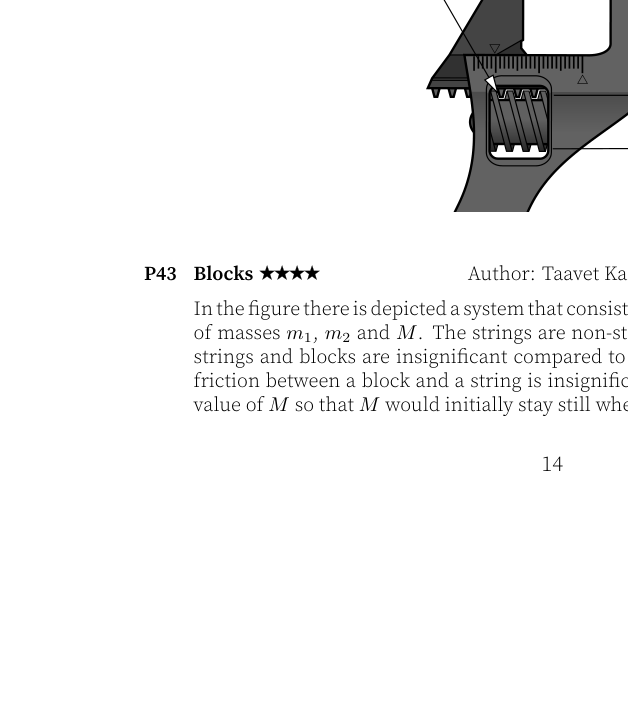 Pulley block system with three masses
Topic: Newtonian Mechanics Metodi: Free-Body Diagram, Physical Modeling Competenze: Diagrammatic Reasoning, Mathematical Modeling Objects: Pulley, Block, String Fonte: Testo (PDF) — p.14
P43 Blocchi
Nella figura è raffigurato un sistema composto da due blocchi e tre pesi di massa , e . Le corde non sono estensibili e le masse delle corde e dei blocchi sono insignificanti rispetto alle masse dei pesi. L’attrito tra un blocco e una corda è insignificante. Qual è il valore di in modo che rimanga fermo quando il sistema viene rilasciato?
Sistema di blocco di pollice a tre masse
Topic: Newtonian Mechanics Metodi: Free-Body Diagram, Physical Modeling Competenze: Diagrammatic Reasoning, Mathematical Modeling Objects: Pulley, Block, String Fonte: Testo (PDF) — p.14
P44 Toy car
The distance between a toy car’s axes is , the center of mass is equally distanced from the axes and it is at a height from the horizontal plane. The front wheels of the car can freely turn and their masses are insignificant. The rear wheels, however, do not turn at all. The car is lying on a horizontal plane, the coefficient of friction between the wheel and the horizontal plane is and the gravitational acceleration is .
The horizontal plane starts to move back and forth with a high frequency. At the first half-period the surface’s velocity vector is directed from the car’s rear wheel towards the front wheel and at the second half-period the direction is the opposite; during both of the half-periods the speed stays constant; during the oscillation the surface is moved so fast that the car always slides either one way or another with respect to the surface. With what average acceleration does the car start to move?
Topic: Newtonian Mechanics Metodi: Free-Body Diagram, Physical Modeling Competenze: Physical Reasoning, Mathematical Modeling Objects: Wheel Fonte: Testo (PDF) — p.15
P44 Auto da giocattoli
La distanza tra gli assi di un’auto da giocattoli è , il centro di massa è altrettanto distante dagli assi e è ad un’altezza dal piano orizzontale. Le ruote anteriori della macchina possono girare liberamente e le loro masse sono insignificanti. Le ruote posteriori, tuttavia, non si girano affatto. L’auto è disposta su un piano orizzontale, il coefficiente di attrito tra la ruota e il piano orizzontale è e l’accelerazione gravitazionale è .
Il piano orizzontale inizia a muoversi avanti e indietro con una alta frequenza. Nella prima metà del periodo il vettore di velocità della superficie è diretto dalla ruota posteriore della vettura verso la ruota anteriore e nella seconda metà del periodo la direzione è l’opposto; durante entrambi i semiperiodi la velocità rimane costante; durante l’oscillazione la superficie si muove così velocemente che la macchina scivola sempre in una direzione o nell’altra rispetto alla superficie. Con quale velocità media inizia a muoversi l’auto?
Topic: Newtonian Mechanics Metodi: Free-Body Diagram, Physical Modeling Competenze: Physical Reasoning, Mathematical Modeling Objects: Wheel Fonte: Testo (PDF) — p.15
P45 Fragments
A clay ball of mass 10 g fell vertically down to a smooth horizontal ground and broke into three fragments. The fragments scattered on the ground and stopped at points that are given in the figure (top view, the cross represents the falling point). Find the masses of the fragments. You can make additional designs on the drawing (on a separate paper) and take additional measurements. You can assume that the fragments started to slide right after the fall without bouncing upwards, the air friction is insignificant and that the coefficient of kinetic friction does not depend on the speed.
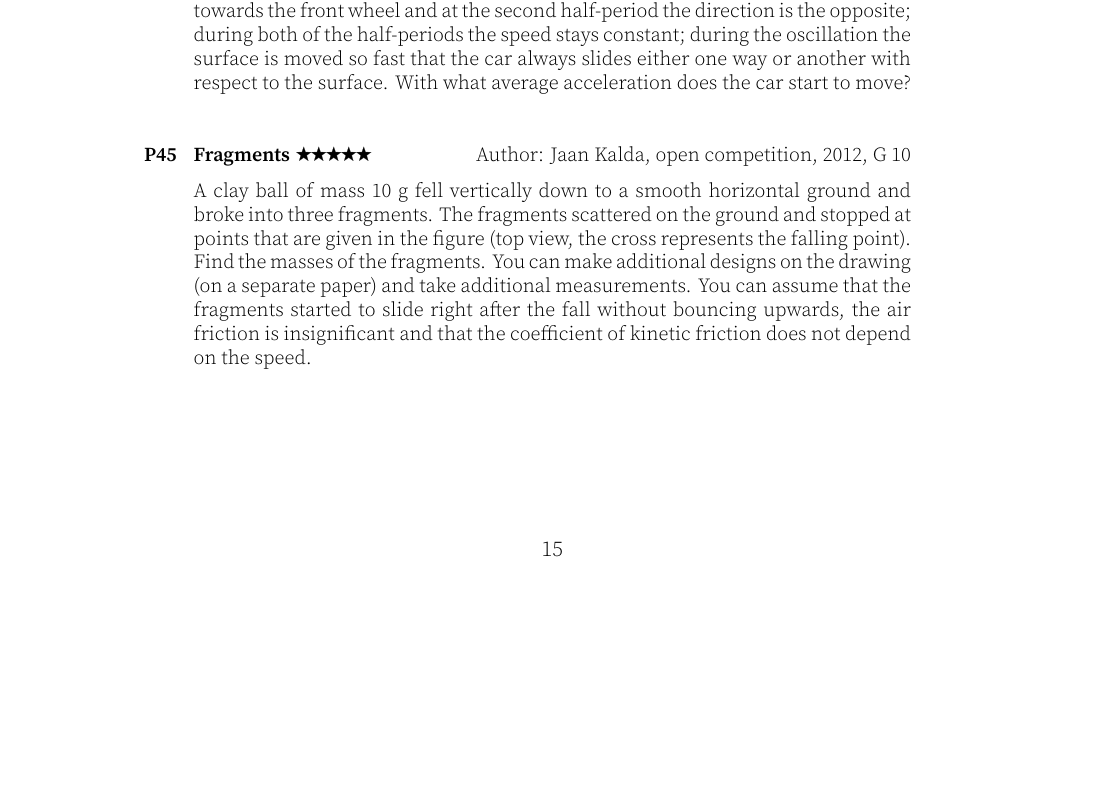 Top view of fragment positions from clay ball
Topic: Newtonian Mechanics, Conservation of Momentum Metodi: Conservation of Momentum, Physical Modeling Competenze: Diagrammatic Reasoning, Physical Reasoning Objects: Ball Fonte: Testo (PDF) — p.15
P45 Fragmenti
Una palla di argilla di massa di 10 g è caduta verticalmente su un terreno liscio e orizzontale e si è spezzata in tre frammenti. I frammenti si spargevano sul terreno e si fermavano nei punti indicati nella figura (la croce rappresenta il punto di caduta). Trova la massa dei frammenti. È possibile fare disegni aggiuntivi sul disegno (su carta separata) e effettuare ulteriori misure. Si può supporre che i frammenti abbiano iniziato a scivolare subito dopo la caduta senza saltare verso l’alto, che l’attrito dell’aria sia insignificante e che il coefficiente di attrito cinetico non dipenda dalla velocità.
Vista superiore delle posizioni dei frammenti dalla palla di argilla
Topic: Newtonian Mechanics, Conservation of Momentum Metodi: Conservation of Momentum, Physical Modeling Competenze: Diagrammatic Reasoning, Physical Reasoning Objects: Ball Fonte: Testo (PDF) — p.15
P46 Hourglass
Let us study an hourglass model. The hourglass consists of a cylindrical tube of length , the tube is separated with a plate in the middle and the plate is evenly covered with holes. The sand can flow through these holes. In a good approximation the mass flow rate of the sand flowing through the holes does not depend on the amount of sand in the upper part of the tube. The hourglass is put on a scale while the sand is flowing and again when the sand has flown down. What is the difference between the scale readings? The sand’s density is and the area of the tube’s cross section is . Assume that the mass of the falling sand is insignificant compared to the sand’s whole mass.
Topic: Newtonian Mechanics, Fluid Mechanics Metodi: Free-Body Diagram, Physical Modeling Competenze: Physical Reasoning, Mathematical Modeling Objects: Cylinder Fonte: Testo (PDF) — p.16
P46 Orologio di sabbia
Studiamo un modello di orologio di sabbia. Il cerchio di sabbia è costituito da un tubo cilindrico di lunghezza , il tubo è separato con una piastra al centro e la piastra è uniformemente coperta di fori. La sabbia può fluire attraverso questi buchi. In una buona approssimazione il flusso di massa della sabbia che scorre attraverso i fori non dipende dalla quantità di sabbia nella parte superiore del tubo. Il relogio di sabbia viene messo su una scala mentre la sabbia scorre e di nuovo quando la sabbia è scesa. Qual è la differenza tra le letture della scala? La densità della sabbia è e la superficie della sezione trasversale del tubo è . Supponiamo che la massa della sabbia cadente sia insignificante rispetto all’intera massa della sabbia.
Topic: Newtonian Mechanics, Fluid Mechanics Metodi: Free-Body Diagram, Physical Modeling Competenze: Physical Reasoning, Mathematical Modeling Objects: Cylinder Fonte: Testo (PDF) — p.16
P47 Cylindrical vessels
A cylindrical vessel of inside radius mm is filled with water. Another empty cylindrical vessel of radius mm and with an insignificantly small mass is coaxially pressed into the bigger cylinder so that the length of the part in the water is mm (see figure). Find the acceleration of the inner cylinder right after when it is let free. You do not have to account for the water’s surface tension or viscosity.
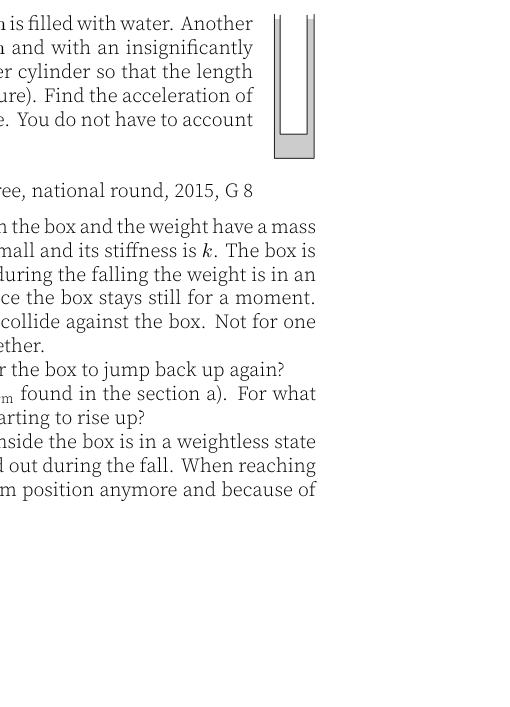 Coaxial cylinders in water
Topic: Fluid Mechanics, Newtonian Mechanics Metodi: Hydrostatic Equilibrium, Physical Modeling Competenze: Mathematical Modeling Objects: Cylinder, Container Fonte: Testo (PDF) — p.16
P47 Canti cilindrici
Un recipiente cilindrico di raggio interno mm è riempito di acqua. Un altro recipiente cilindrico vuoto di raggio mm e di massa insignificante è premuto coaxialmente nel cilindro più grande in modo che la lunghezza della parte in acqua sia mm (vedere figura). Trova l’accelerazione del cilindro interno subito dopo che viene rilasciato. Non è necessario tenere conto della tensione superficiale o della viscosità dell’acqua.
Cilindri coassiali in acqua
Topic: Fluid Mechanics, Newtonian Mechanics Metodi: Hydrostatic Equilibrium, Physical Modeling Competenze: Mathematical Modeling Objects: Cylinder, Container Fonte: Testo (PDF) — p.16
P48 Spring
In a box there is a weight fixed to a spring. Both the box and the weight have a mass . The mass of the spring is insignificantly small and its stiffness is . The box is dropped down freely from a height so that during the falling the weight is in an equilibrium state. Colliding with a soft surface the box stays still for a moment. The box is high enough for the weight not to collide against the box. Not for one moment is the spring completely pressed together.
a) What is the smallest dropping height for the box to jump back up again?
b) The box was dropped from a height found in the section a). For what time will the box be on the ground before starting to rise up?
Topic: Oscillations & Waves, Conservation of Energy Metodi: Simple Harmonic Motion Analysis, Energy Conservation Method, Hooke’s Law Competenze: Mathematical Modeling, Physical Reasoning Objects: Spring, Block Fonte: Testo (PDF) — p.16
P48 Primavera
In una scatola c’è un peso fissato a una molla. Sia la scatola che il peso hanno una massa . La massa della molla è insignificante e la sua rigidità è . La scatola viene abbassata liberamente da un’altezza in modo che durante la caduta il peso sia in stato di equilibrio. Collidendo con una superficie morbida, la scatola rimane ferma per un momento. La scatola è abbastanza alta per non colpirsi con il peso. Non per un momento la primavera è completamente premuta.
a) Qual è la più piccola altezza di caduta per il salto di nuovo della scatola?
b) La scatola è stata scartata da un’altezza riportata nella sezione a). For what time will the box be on the ground before starting to rise up?
Topic: Oscillations & Waves, Conservation of Energy Metodi: Simple Harmonic Motion Analysis, Energy Conservation Method, Hooke’s Law Competenze: Mathematical Modeling, Physical Reasoning Objects: Spring, Block Fonte: Testo (PDF) — p.16
P49 Rods
In the given figure a hinged construction is pictured, it consists of two rods with a length . One of the rod’s tip is fixed to an unmoving point and the other rod’s tip moves with a constant velocity along a direction which passes the point at the distance . Find the acceleration of the connection point of the rods during the moment when the distance between the points and is .
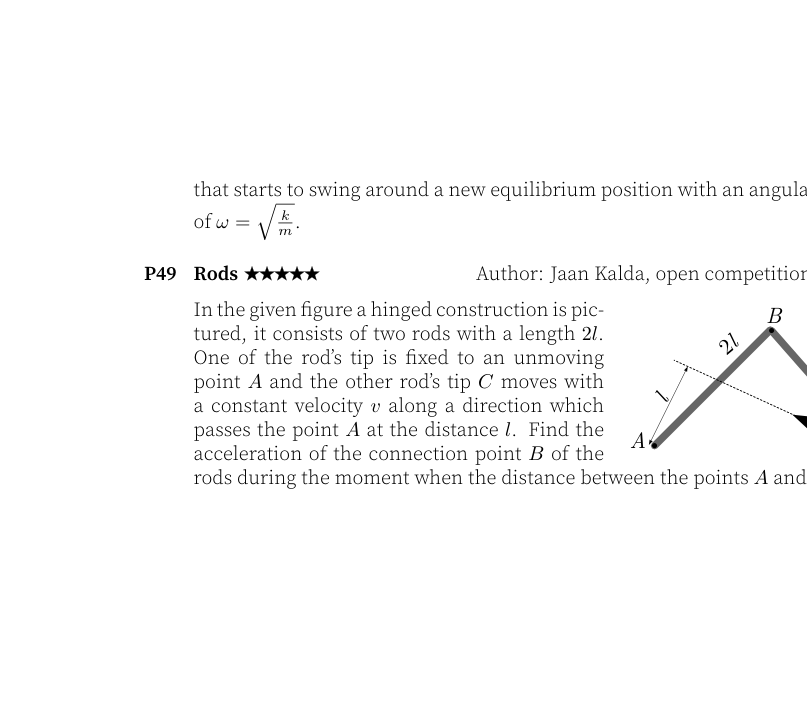 Hinged rod construction with points A, B, C
Topic: Newtonian Mechanics Metodi: Kinematic Equations, Vector Decomposition Competenze: Mathematical Modeling, Diagrammatic Reasoning Objects: Rod Fonte: Testo (PDF) — p.17
P49 Rods
Nella figura riportata è rappresentata una costruzione a biscotti, costituita da due bastone di lunghezza . Una punta della canna è fissata a un punto immobile e l’altra punta si muove con una velocità costante in una direzione che passa il punto alla distanza . Trova l’accelerazione del punto di connessione delle barre nel momento in cui la distanza tra i punti e è .
Construzione di bastone a cinghia con punti A, B, C
Topic: Newtonian Mechanics Metodi: Kinematic Equations, Vector Decomposition Competenze: Mathematical Modeling, Diagrammatic Reasoning Objects: Rod Fonte: Testo (PDF) — p.17
P50 Voltmeters
In a circuit diagram there is a voltage source of voltage V and four identical voltmeters. What is the reading of each voltmeter?
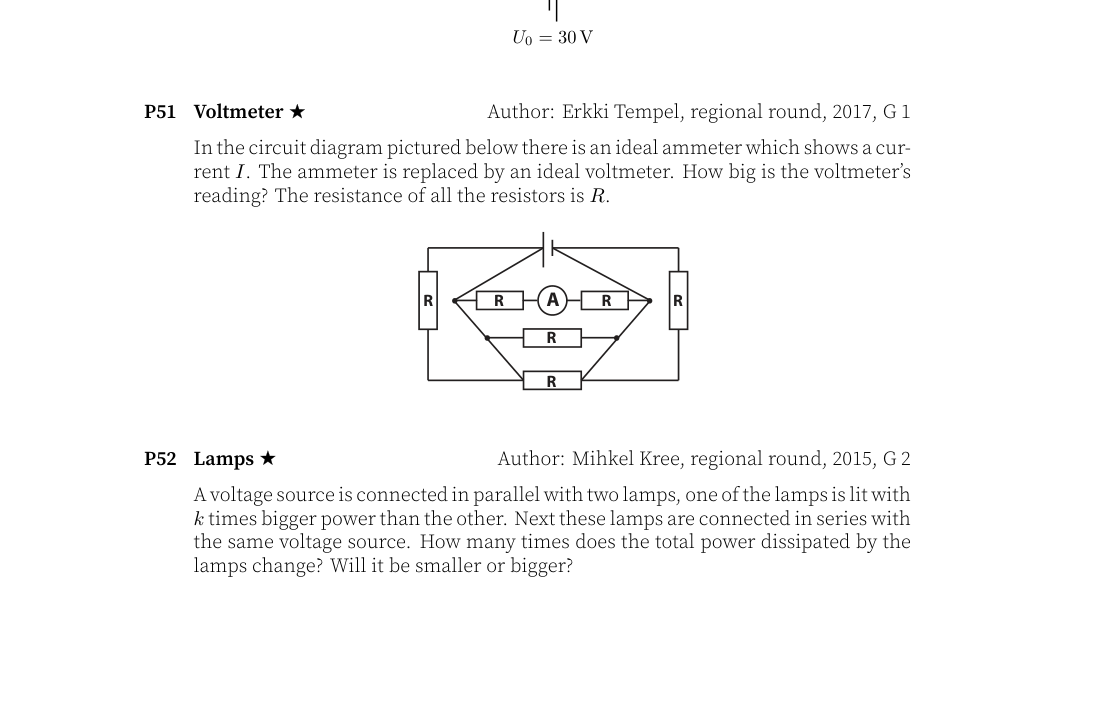 Circuit with voltage source and four voltmeters
Topic: Circuits Metodi: Kirchhoff’s Laws, Equivalent Circuit Reduction Competenze: Diagrammatic Reasoning, Physical Reasoning Objects: Battery Fonte: Testo (PDF) — p.18
P50 Voltmetri
In un diagramma di circuito si trova una fonte di tensione di tensione V e quattro voltometri identici. Qual è la lettura di ogni voltmeter?
Circuito con sorgente di tensione e quattro voltometri
Topic: Circuits Metodi: Kirchhoff’s Laws, Equivalent Circuit Reduction Competenze: Diagrammatic Reasoning, Physical Reasoning Objects: Battery Fonte: Testo (PDF) — p.18