- Charges in E (8 points) Two particles (the blue and the red) of mass are connected with a spring, the stress-free length of which is and stiffness ; the blue carries charge () and the red is chargeless. In the region , there is an homogeneous electric field , antiparallel to the -axis; In the region , there is no electric field. Initially, the “dumbbell” of charges moves in region with velocity , parallel to the -axis; the dumbbell’s axis is also parallel to the -axis and the spring is stress-free. It is known that afer a while, the dumbbell moves in the region with velocity , and that the red particle never enters the region . Also, the spring’s length achieves minimum only once. i) (2.5 pt) How long time does the blue particle spend in the region ? Te process takes place exactly as described, if one equality and one inequality are satisfied for the quantities , , , , and . ii) (3 pt) Which equality must be satisfied? iii) (2.5 pt) Which inequality must be satisfied?
Topic: Newtonian Mechanics, Electrostatics, Conservation of Energy Metodi: Kinematic Equations, Free-Body Diagram, Energy Conservation Method Competenze: Mathematical Modeling, Physical Reasoning Objects: Spring, Point Charge Fonte: Testo (PDF) — p.1
- Cariche in E (8 punti) Due particelle (il blu e il rosso) di massa sono collegati a una molla, la lunghezza senza stress di che è e rigidità ; il blu porta carica () e il rosso è senza carica. Nella regione , vi è un’industria di campo elettrico omogeneo , antiparallelle all’asse ; regione , non vi è campo elettrico. Inizialmente, il dumbbell di carica si muove in regione con velocità , parallelo alla L’asse di ; l’asse delle maniche è anche parallelo all’asse di e la La primavera è senza stress. È noto che dopo un po’, il dumbbell si muove nella regione con velocità , e che il rosso la particella non entra mai nella regione . Inoltre, la lunghezza della primavera
- si raggiunge il minimo solo una volta. I) (2.5 p) Quanto tempo trascorre la particella blu nella Regione ? Il processo si svolge esattamente come descritto, se una parità e una disuguaglianza è soddisfatta per i quantitativi , , , , e . (ii) (3 p) Quale uguaglianza deve essere soddisfatta? iii) (2.5 p) Quale disuguaglianza deve essere soddisfatta?
Topic: Newtonian Mechanics, Electrostatics, Conservation of Energy Metodi: Kinematic Equations, Free-Body Diagram, Energy Conservation Method Competenze: Mathematical Modeling, Physical Reasoning Objects: Spring, Point Charge Fonte: Testo (PDF) — p.1
- Termos botle (6 points) In order to study the thermal properties of a thermos botle, let us model it as two concentric spherical vessels, with radii cm and cm. Te gap between the walls of the vessels contains vacuum (hence, the heat conductivity can be neglected). i) (3,5 pt) Find the radiative heat flux (i.e. transmited heat per unit time) between the walls of the botle, assuming that the ambient temperature is K and the inner sphere is filled with liquid nitrogen at the boiling temperature K. Te emissivities of all the surfaces are equal to that of stainless steel: . Remark: Te emited heat flux per unit area is given Stefan-Boltzmann’s law , where (assuming that is independent of the wavelength. ii) (2,5 pt) Estimate, how long time does it take for a full evaporization of the liquid nitrogen (the vapor escapes through an over pressure valve). For the liquid nitrogen, density g/l and latent heat for vaporization kJ/mol). NB! If you were unable to find (for question i), express the evaporization time symbolically (i.e. using the symbol ).
Topic: Thermodynamics Metodi: Physical Modeling, First Law of Thermodynamics, Calculus-Integration Competenze: Mathematical Modeling, Estimation & Approximation Objects: Container, Sphere Fonte: Testo (PDF) — p.1
- Termos botle (6 punti) Per studiare la temperatura Proprietà di una bellezza termico, modelliamo come due concentrici vascelli sferici, con radii cm e cm. Te La distanza tra le pareti dei vasi contiene il vuoto (quindi, il la conducibilità termico può essere trascurata). i) (3,5 pt) Trova il flusso di calore radiativo (cioè calore trasmesso per L’unità di tempo) tra le pareti del botle, presumendo che il la temperatura ambientale è K e la sfera interna è riempito di azoto liquido a temperatura di ebollizione K. Le emissioni di tutte le superfici sono uguali a quelle di inossidabili acciaio: . Nota: Flux di calore emesso per unità di superficie è data la legge di Stefan-Boltzmann , dove (assuming that è indipendente dalla lunghezza d’onda. (ii) (2,5 p) Estimare quanto tempo ci vorrà per un’intera evaporazione dell’azoto liquido (il vapore scorre attraverso un sopra la valvola a pressione). Per l’azoto liquido, densità g/l e calore latente per la vaporizzazione kJ/mol). NB! Se tu non sono stati in grado di trovare (per la domanda i), esprimere il tempo di evaporazione simbolicamente (cioè con il simbolo ).
Topic: Thermodynamics Metodi: Physical Modeling, First Law of Thermodynamics, Calculus-Integration Competenze: Mathematical Modeling, Estimation & Approximation Objects: Container, Sphere Fonte: Testo (PDF) — p.1
Tyrannosaur (T. Rex) (6 points) Paleontologists have discovered tracks of a tyrannosaur where the footprints of the same leg are meters apart. Tey have also recovered a piece of a tyrannosaur leg bone that has bone cross-sectionalo area times that of a chicken (which the tyrannosaur is related to). i) (3 pt) Knowing that the chicken leg is approximately cm tall, estimate the length of a tyrannosaur leg . You may assume that the length of a leg scales as the length of the whole animal, and that the bone stress (force per area) is the same for both animals. Is your result consistent with the step length ? ii) (3 pt) Estimate the natural walking speed of the tyrannosaur by approximating the walking motion of a leg with a freely oscillating pendulum motion. State clearly all the assumptions you make.
Topic: Newtonian Mechanics, Oscillations & Waves Metodi: Simple Harmonic Motion Analysis, Dimensional Analysis, Physical Modeling Competenze: Estimation & Approximation, Mathematical Modeling Objects: Pendulum Fonte: Testo (PDF) — p.1
Tyrannosaur (T. Rex) (6 punti)
- le impronte di un tirannosauro la stessa gamba è distante metri. Tey si è anche ripreso. un pezzo di osso della gamba di tirannosauro che ha un’ossa sezione incrociata La superficie volte quella di un pollo (che il tirannosauro (in particolare, il numero di persone che hanno un’attività di lavoro) i) (3 pt) Sapendo che la gamba di pollo è approssimativamente cm tall, estimate the length of a tyrannosaur leg . Puoi farlo. presumere che la lunghezza di una gamba si bilanci come la lunghezza dell’insieme di animali, e che la tensione ossea (forza per area) sia la stessa per Entrambi gli animali. Il risultato è coerente con la lunghezza del passaggio ? (ii) (3 p) Estimare la velocità di cammino naturale del tirannosauro approssimazione del movimento di una gamba con un movimento oscillante movimento del pendolo. Dichiara chiaramente tutte le ipotesi che fai.
Topic: Newtonian Mechanics, Oscillations & Waves Metodi: Simple Harmonic Motion Analysis, Dimensional Analysis, Physical Modeling Competenze: Estimation & Approximation, Mathematical Modeling Objects: Pendulum Fonte: Testo (PDF) — p.1
- Ball (6 points) Massive spherical ball has a mass kg; an atempt is made to roll the ball upwards, along a vertical wall, by applying a force to some point P on the ball. Te coefficient of friction between the wall and the ball is . i) (5 pt) What is the minimal force required to achieve this goal? ii) (1 pt) On a side view of the ball and the wall, construct geometrically the point P, where the force has to be applied to, together with the direction of the applied force.
Topic: Newtonian Mechanics, Rigid Body Statics Metodi: Free-Body Diagram, Torque & Angular Momentum Analysis, Vector Decomposition Competenze: Diagrammatic Reasoning, Mathematical Modeling Objects: Ball Fonte: Testo (PDF) — p.1
- Ball (6 punti) Ball sferica massiccia ha una massa kg; si fa un tentativo di rotolare la palla verso l’alto, lungo una parete verticale, applicando una forza a un punto P della palla. Coefficiente di di attrito tra il muro e la palla è . i) (5 pt) Qual è la forza minima necessaria per ottenere questo
- Il gol? ii) (1 p) In una vista laterale della palla e della parete, costruzione geometricamente il punto P, al quale deve essere applicata la forza, insieme alla direzione della forza applicata.
Topic: Newtonian Mechanics, Rigid Body Statics Metodi: Free-Body Diagram, Torque & Angular Momentum Analysis, Vector Decomposition Competenze: Diagrammatic Reasoning, Mathematical Modeling Objects: Ball Fonte: Testo (PDF) — p.1
- Elastic thread (10 points) Equipment: ruler, tape, an elastic thread, a wooden rod, marker, a known weight. Te purpose of this problem is to study the elastic properties of an elastic thread for large relative deformations , where and are the lengths in initial and stretched states, respectively. If the Hook’s law were valid, the ratio of the elastic force and would be constant: , where is the cross-section area of the thread and — the Young modulus of the thread material. i) Collect the data needed to plot the ratio as a function , up to . Plot the appropriate graph, and indicate the uncertainties. ii) By making assumption that the Young modulus remains constant, study, how does the volume of the thread depend on . Plot the appropriate graph.
Topic: Elasticity & Materials Metodi: Stress-Strain Analysis, Hooke’s Law, Graph Linearization Competenze: Experimental Data Analysis, Graph Linearization, Mathematical Modeling Objects: String Fonte: Testo (PDF) — p.1
- Filo elastico (10 punti) Attrezzature: reggetta, nastro, un filo elastico filo, una canna di legno, un marchio, un peso noto. Lo scopo di questo problema è quello di studiare le proprietà elastiche di un filo elastico per le grandi deformazioni relative l_0)/l_0l_0lF/\epsilonF\epsilonF/\epsilon = SESEF/\epsilon\epsilon\epsilon \approx 4$. Tracciare il grafico appropriato e indicare il
- Le incertezze. ii) Supponendo che il modulo Young rimane costante, studio, come si fa il volume del filo dipendono da . Tracciate il grafico appropriato.
Topic: Elasticity & Materials Metodi: Stress-Strain Analysis, Hooke’s Law, Graph Linearization Competenze: Experimental Data Analysis, Graph Linearization, Mathematical Modeling Objects: String Fonte: Testo (PDF) — p.1
- Charges in B (5 points) Tere is an homogeneous, parallel to the -axis magnetic field of inductance in region . In region , there is no field. Tere are two particles of mass and charge . Initially, the particles have coordinates , and respectively and (with ). Initial velocity of both particles is , along the -axis, towards the magnetic field. Neglect the electrostatic repulsion force of the two charges. i) (1,5 pt) Sketch the trajectory of the first particle, and the dependance of its -coordinate on time. ii) (3,5 pt) Sketch the distance between the particles as a function of time , assuming that . What is the minimal distance ?
Topic: Magnetism, Newtonian Mechanics Metodi: Lorentz Force Analysis, Kinematic Equations, Simple Harmonic Motion Analysis Competenze: Diagrammatic Reasoning, Mathematical Modeling Objects: Point Charge Fonte: Testo (PDF) — p.2
- Le cariche in B (5 punti) Tere è un’omogenea, parallela a il campo magnetico -asse di induzione nella regione . In regione , non vi è campo. Tere sono due particelle di massa e carica . Inizialmente, le particelle hanno coordinate , e rispettivamente e (con ). La velocità iniziale di entrambe le particelle è , lungo l’asse , verso il campo magnetico. Ignorare la forza di repulsione elettrostatica dei due
- Le accuse. I) (1,5 p) Segnare la traiettoria della prima particella e il la dipendenza della sua coordinata dal tempo. (ii) (3,5 p) Segnare la distanza tra le particelle come una funzione di tempo , supponendo che . Che cos’è Distanza minima ?
Topic: Magnetism, Newtonian Mechanics Metodi: Lorentz Force Analysis, Kinematic Equations, Simple Harmonic Motion Analysis Competenze: Diagrammatic Reasoning, Mathematical Modeling Objects: Point Charge Fonte: Testo (PDF) — p.2
- Satellite (5 points) i) (3 pt) A large ball of mass is kept at the height from the floor (so that the center of the ball is at the height , where is its diameter). A small ball of mass is placed upon the large one, and the system is released (so that it starts falling). To which height (from the floor) will the small ball rise, assuming that the collision between the lower ball and ground, and the collision between the balls are absolutely elastic, and ? ii) (2 pt) Consider the following satellite launching project. Tere are absolutely elastic balls of masses : the first ball (the heaviest) is the lowest; the second ball is placed on top of the first; the third — on top of the second etc. Te upmost ball is supposed to become a satellite, i.e. to obtain the velocity km/s). Te lowest ball is at the height m from the floor, and the system is released. What should be the number of balls ? What should be the mass of the lowest ball, if , and the mass of the satellite kg?
Topic: Conservation of Momentum, Conservation of Energy Metodi: Conservation of Momentum, Conservation of Energy, Approximation & Series Expansion Competenze: Physical Reasoning, Mathematical Modeling, Estimation & Approximation Objects: Ball, Satellite Fonte: Testo (PDF) — p.2
- Satellite (5 punti) i) (3 pt) Una grande sfera di massa è tenuta all’altezza dal pavimento (così che il centro della palla sia all’altezza , dove è il suo diametro). Si colloca su un’altra palla di massa un grande, e il sistema viene rilasciato (in modo che comincia a cadere). To che altezza (dal pavimento) la piccola palla si alzerà, supponendo che la collisione tra la palla inferiore e il terreno e la collisione tra le palle sono assolutamente elastiche, e ? ii) (2 p) Considerate il seguente progetto di lancio di satelliti. - Oh, tesoro. sono sfere assolutamente elastiche di massa : la prima palla (la più pesante) è la più bassa; la seconda palla è il terzo è posto sopra il primo, il terzo sopra il secondo, ecc. La palla superiore dovrebbe diventare un satellite, cioè per ottenere la velocità km/s). La palla più bassa è in alto m dal pavimento e il sistema viene rilasciato. Cosa dovrebbe essere il numero di palle ? Qual è la massa del più basso la sfera, se , e la massa del satellite kg?
Topic: Conservation of Momentum, Conservation of Energy Metodi: Conservation of Momentum, Conservation of Energy, Approximation & Series Expansion Competenze: Physical Reasoning, Mathematical Modeling, Estimation & Approximation Objects: Ball, Satellite Fonte: Testo (PDF) — p.2
- Sprinkler (3 points) A sprinkler has a shape of hemisphere, which has small holes drilled into the spherical part of its surface. From these small holes, water flows out with velocity m/s. Near the sprinkler, the water flow is distributed evenly over all the directions of the upper half-space. Te sprinkler is installed at the ground level so that its axis is vertical. In what follows, the air resistance can be neglected, and the dimensions of the sprinkler can be assumed to be very small. i) (1.5 pt) Find the surface area of the ground watered by the sprinkler. ii) (1.5 pt) At which distance from the sprinkler is the watering intensity (mm/h) the highest?
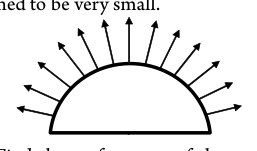 Irrigatore emisferrico con getti d’acqua
Topic: Newtonian Mechanics, Fluid Mechanics Metodi: Kinematic Equations, Calculus-Integration, Physical Modeling Competenze: Mathematical Modeling, Physical Reasoning Objects: — Fonte: Testo (PDF) — p.2
- Sprinkler (3 punti) Un sprinkler ha la forma di un emisfero, che ha piccoli fori perforazione nella parte sferica della sua superficie. Da questi piccoli per le forature, l’acqua scorre con velocità m/s.
- Pronto il sprinkler, il flusso d’acqua è distribuito uniformemente su tutte le direzioni della metà superiore dello spazio. Te sprinkler è installato al livello del suolo in modo che il suo asse sia verticale. In quanto segue, l’aria la resistenza può essere trascurata e le dimensioni del sprinkler si può presumere molto piccola. I) (1,5 pt) Indicare la superficie del suolo irrigato dalla
- La sprinkler. ii) (1,5 p) A quale distanza dal sprinkler si trova l’irrigato intensità (mm/h) massima?
*Irrigatore emisferrico con getti d’acqua *
Topic: Newtonian Mechanics, Fluid Mechanics Metodi: Kinematic Equations, Calculus-Integration, Physical Modeling Competenze: Mathematical Modeling, Physical Reasoning Objects: — Fonte: Testo (PDF) — p.2
- Power supply (6 points) i) (2 pt) Consider the cirquit given in Fig (a), where the diode can be assumed to be ideal (i.e. having zero resistance for forward current and infinite resistance for reverse current. Te key is switched on for a time and then switched off, again. Te input and output voltages are during the whole process constant and equal to and , respectively (). Plot the graphs of input and output currents as functions of time. ii) (2 pt) Now, the key is switched on and offperiodically; each time, the key is kept closed for time interval and open — also for . Find the average output current. iii) (2 pt) Now, cirquit (a) is substituted by cirquit (b); the switch is switched on and offas in part ii. What will be the voltage on the load , when a stationary working regime has been reached? You may assume that , i.e. the voltage variation on the load (and capacitor) is negligible during the whole period (i.e. the charge on the capacitor has no time to change significantly).
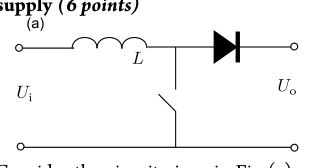 Circuito (a) con induttore e diodo
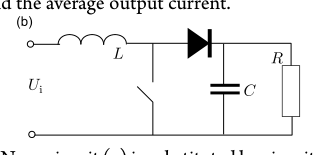 Circuito (b) con condensatore e resistore
Topic: Circuits Metodi: Kirchhoff’s Laws, Equivalent Circuit Reduction, Physical Modeling Competenze: Diagrammatic Reasoning, Physical Reasoning, Mathematical Modeling Objects: Inductor, Capacitor, Resistor, Switch Fonte: Testo (PDF) — p.2
- Fornace elettrica (6 punti) i) (2 p) Considerare il circolo di cui alla figura a), dove il diodo Si può presumere che sia ideale (cioè: con resistenza zero per il futuro corrente e resistenza infinita per corrente inversa. La chiave è: si accende per un certo tempo e poi si spegne, di nuovo. Input e le tensioni di uscita sono costanti durante l’intero processo e pari rispettivamente a e (). Tracciare i grafici di corrente di ingresso e di uscita come funzioni del tempo. (ii) (2 p) Ora, la chiave viene attivata e disattivata periodicamente; tempo, la chiave è tenuta chiusa per un intervallo di tempo e aperta anche per . Trova la corrente media di uscita. (iii) (2 p) Ora, il circolo (a) è sostituito dal circolo (b); il switch è acceso e disattivato nella parte ii. Qual è la tensione di il carico , quando è stato raggiunto un regime di lavoro stazionario? Si può supporre che , cioè la variazione di tensione della il carico (e il condensatore) è trascurabile durante l’intero periodo (cioè il la carica del condensatore non ha tempo di cambiare significativamente).
*Circuito (a) con diodo *
*Circuito (b) con condensatore e resistore *
Topic: Circuits Metodi: Kirchhoff’s Laws, Equivalent Circuit Reduction, Physical Modeling Competenze: Diagrammatic Reasoning, Physical Reasoning, Mathematical Modeling Objects: Inductor, Capacitor, Resistor, Switch Fonte: Testo (PDF) — p.2
- Ice-rally (7 points) Te car accelerates on a slippery ground so that the wheels are always at the limit of slipping (e.g. via using an electronic traction control). Such an acceleration would result in the velocity vs time graph as given in the Figure. i) (2 pt) What is the coefficient of friction, assuming a four-wheel drive? Because of a manual gear change, there is time period of s, during which there is no driving force (so that the car decelerates due to air friction). Except for that period, the acceleration follows the law given by the graph. As a result, the terminal velocity m/s is reached s later than it would have been reached, if there were no delay caused by the gear change. Upon reaching the terminal velocity, the car continues moving at constant speed. In your calculations, you can assume that the air friction was constant during the gear change period. ii) (2,5 pt) At which speed the gear was changed? iii) (2,5 pt) How many meters shorter distance will be covered during the first 100 seconds, as compared to ideal acceleration (i.e. without the delay due to the gear change)?
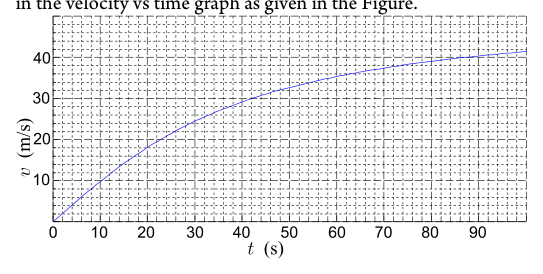 Grafico velocità-tempo auto su ghiaccio
Topic: Newtonian Mechanics Metodi: Kinematic Equations, Free-Body Diagram, Calculus-Integration Competenze: Graph Linearization, Mathematical Modeling, Experimental Data Analysis Objects: Wheel Fonte: Testo (PDF) — p.2
- Rally sul ghiaccio (7 punti) La macchina accelera su un terreno scivoloso in modo che le ruote siano sempre al limite di scivolare (ad esempio: con l’utilizzazione un controllo elettronico della trazione). Una tale accelerazione avrebbe nella velocità vs grafico del tempo come indicato nella figura. I) (2 pt) Qual è il coefficiente di attrito, se si assume che una ruota a quattro ruote
- La guida? A causa di un cambio manuale di marcia, vi è un periodo di tempo di s, during which there is no driving force (so that the la velocità dell’auto rallenta a causa della friczione dell’aria). Con l’eccezione di tale periodo, il L’accelerazione segue la legge data dal grafico. Di conseguenza, il la velocità terminale m/s è raggiunta s più tardi di essa sarebbe stato raggiunto, se non ci fosse stato ritardo causato dal dispositivo
- Cambiare. Al raggiungimento della velocità terminale, l’auto continua in movimento a velocità costante. Nel suo calcolo, si può presumere che la frizione dell’aria è stata costante durante il periodo di cambio di marcia. (ii) (2,5 p) A che velocità è stato cambiato il cambio? iii) (2,5 p) Quanti metri di distanza più breve saranno percorsi durante i primi 100 secondi, rispetto all’accelerazione ideale (cioè senza il ritardo dovuto al cambio di velocità)?
Grafico velocità-tempo auto su ghiaccio
Topic: Newtonian Mechanics Metodi: Kinematic Equations, Free-Body Diagram, Calculus-Integration Competenze: Graph Linearization, Mathematical Modeling, Experimental Data Analysis Objects: Wheel Fonte: Testo (PDF) — p.2
- Black box (10 points) Equipment: a black box, multimeter, batery, timer (on the screen). Determine the electrical scheme inside the black box, and the values of all the resistors inside it. Estimate the characteristics of other electrical components. It is known that apart from the wires, the total number of components is three.
Topic: Circuits Metodi: Kirchhoff’s Laws, Equivalent Circuit Reduction, Experimental Data Analysis Competenze: Experimental Data Analysis, Measurement & Instrumentation, Diagrammatic Reasoning Objects: Resistor, Battery Fonte: Testo (PDF) — p.2
- Cassa nera (10 punti) Attrezzature: una scatola nera, un multimetro, batterie, timer (sullo schermo). Determina il sistema elettrico all’interno della scatola nera e il Valori di tutte le resistenze all’interno. Valutare le caratteristiche di altri componenti elettrici. È noto che, a parte i fili, il numero totale dei componenti è di tre.
Topic: Circuits Metodi: Kirchhoff’s Laws, Equivalent Circuit Reduction, Experimental Data Analysis Competenze: Experimental Data Analysis, Measurement & Instrumentation, Diagrammatic Reasoning Objects: Resistor, Battery Fonte: Testo (PDF) — p.2