Questions 1 to 3 refer to the figure below which shows a representation of the motion of a squirrel as it runs in a straight-line along a telephone wire. The letters A through E refer to the indicated times.
If the graph is a graph of POSITION vs. TIME, then the squirrel has the greatest speed at what time(s) or during what time interval(s)?
- A. From A to B
- B. From B to C only
- C. From B to D
- D. From C to D only
- E. From D to E
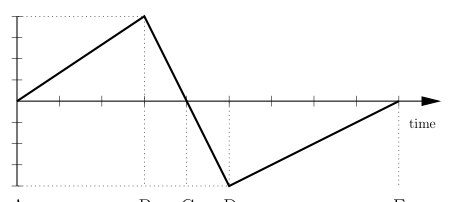 Position-time graph squirrel on wire
Topic: Newtonian Mechanics Metodi: Kinematic Equations Competenze: Physical Reasoning, Diagrammatic Reasoning Objects: Wire Fonte: Testo (PDF) — p.2
Le domande da 1 a 3 si riferiscono alla figura che segue, che mostra un’immagine del movimento di un scoiattolo che corre in linea retta lungo un filo telefonica. Le lettere da A a E si riferiscono ai tempi indicati.
Se il grafico è un grafico di POSITION vs. Tempo, allora l’esquirro ha la massima velocità in che ora o durante che intervalli di tempo?
- A. Da A a B
- B. Solo da B a C
- C. Da B a D
- D. Solo da C a D
- E. Da D a E
Squirrel grafico di posizione-tempo su filo
Topic: Newtonian Mechanics Metodi: Kinematic Equations Competenze: Physical Reasoning, Diagrammatic Reasoning Objects: Wire Fonte: Testo (PDF) — p.2
If, instead, the graph is a graph of VELOCITY vs. TIME, then the squirrel has the greatest speed at what time(s) or during what time interval(s)?
- A. at B
- B. at C
- C. at D
- D. at both B and D
- E. From C to D
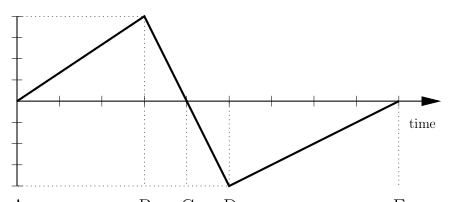 Velocity-time graph squirrel on wire
Topic: Newtonian Mechanics Metodi: Kinematic Equations Competenze: Physical Reasoning, Diagrammatic Reasoning Objects: Wire Fonte: Testo (PDF) — p.2
Se invece, il grafico è un grafico di VELOCITY vs. Tempo, allora l’esquirro ha la massima velocità in che ora o durante che intervalli di tempo?
- A. at B
- B. at C
- C. at D
- D. sia a livello B che a livello D
- E. Da C a D
Squirrel grafico velocità-tempo su filo
Topic: Newtonian Mechanics Metodi: Kinematic Equations Competenze: Physical Reasoning, Diagrammatic Reasoning Objects: Wire Fonte: Testo (PDF) — p.2
If, instead, the graph is a graph of ACCELERATION vs. TIME and the squirrel starts from rest, then the squirrel has the greatest speed at what time(s) or during what time interval?
- A. at B
- B. at C
- C. at D
- D. at both B and D
- E. From C to D
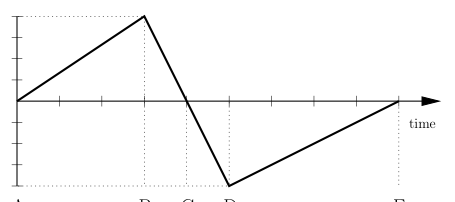 Acceleration-time graph squirrel on wire
Topic: Newtonian Mechanics Metodi: Kinematic Equations, Calculus-Integration Competenze: Physical Reasoning, Diagrammatic Reasoning Objects: Wire Fonte: Testo (PDF) — p.2
Se invece, il grafico è un grafico di accelerazione vs. Il tempo e l’esquirro partono dal riposo, quindi l’esquirro ha la massima velocità a che ora o durante quale intervallo di tempo?
- A. at B
- B. at C
- C. at D
- D. sia a livello B che a livello D
- E. Da C a D
Squirrel grafico di accelerazione nel tempo su filo
Topic: Newtonian Mechanics Metodi: Kinematic Equations, Calculus-Integration Competenze: Physical Reasoning, Diagrammatic Reasoning Objects: Wire Fonte: Testo (PDF) — p.2
Two teams of movers are lowering a piano from the window of a 10 floor apartment building. The rope breaks when the piano is 30 meters above the ground. The movers on the ground, alerted by the shouts of the movers above, first notice the piano when it is 14 meters above the ground. How long do they have to get out of the way before the piano hits the ground?
- A. 0.66 sec
- B. 0.78 sec
- C. 1.67 sec
- D. 1.79 sec
- E. 2.45 sec
Topic: Newtonian Mechanics Metodi: Kinematic Equations, Free-Body Diagram Competenze: Mathematical Modeling, Physical Reasoning Objects: — Fonte: Testo (PDF) — p.2
Due squadre di traslocatori stanno abbassando un pianoforte dalla finestra di un edificio di appartamenti a 10 piani. La corda si rompe quando il pianoforte è a 30 metri dal suolo. I moventi a terra, avvisati dai gridi dei moventi sopra, notano per primo il pianoforte quando è a 14 metri sopra il terreno. Quanto tempo devono perdere prima che il pianoforte colpisca il terreno?
- A. 0,66 sec
- ** B.** 0,78 sec
- C. 1,67 sec
- D. 1,79 secondi
- E. 2,45 sec
Topic: Newtonian Mechanics Metodi: Kinematic Equations, Free-Body Diagram Competenze: Mathematical Modeling, Physical Reasoning Objects: — Fonte: Testo (PDF) — p.2
Two projectiles are launched from a 35 meter ledge as shown in the diagram. One is launched from a 37 degree angle above the horizontal and the other is launched from 37 degrees below the horizontal. Both of the launches are given the same initial speed of m/s.
The difference in the times of flight for these two projectiles, , is closest to
- A. 3 s
- B. 5 s
- C. 6 s
- D. 8 s
- E. 10 s
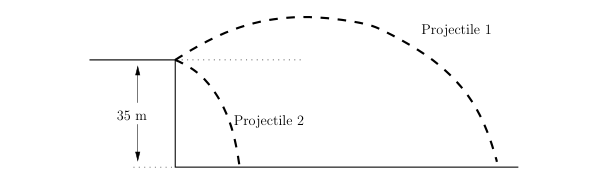 Two projectiles launched from 35 m ledge
Topic: Newtonian Mechanics Metodi: Kinematic Equations, Vector Decomposition Competenze: Mathematical Modeling, Physical Reasoning Objects: Projectile Fonte: Testo (PDF) — p.3
Due proiettili vengono lanciati da un bordo di 35 metri come mostrato nel diagramma. Uno viene lanciato da un angolo di 37 gradi sopra l’orizzontale e l’altro viene lanciato da 37 gradi sotto l’orizzontale. Entrambi i lanci hanno la stessa velocità iniziale di m/s.
La differenza dei tempi di volo di questi due proiettili, , è più vicina a
- A. 3 s
- B. 5 s
- C. 6 s
- D. 8 s
- E. 10 s
Due proiettili lanciati da 35 m di bordo
Topic: Newtonian Mechanics Metodi: Kinematic Equations, Vector Decomposition Competenze: Mathematical Modeling, Physical Reasoning Objects: Projectile Fonte: Testo (PDF) — p.3
A projectile is launched across flat ground at an angle to the horizontal and travels in the absence of air resistance. It rises to a maximum height and lands a horizontal distance away. What is the ratio ?
- A.
- B.
- C.
- D.
- E.
Topic: Newtonian Mechanics Metodi: Kinematic Equations, Vector Decomposition Competenze: Mathematical Modeling, Physical Reasoning Objects: Projectile Fonte: Testo (PDF) — p.3
Un proiettile viene lanciato su terreno piatto ad un angolo orizzontale e viaggia in assenza di resistenza all’aria. Si eleva ad un’altezza massima e atterra a distanza orizzontale . Qual è il rapporto ?
- A.
- B.
- C.
- D.
- E.
Topic: Newtonian Mechanics Metodi: Kinematic Equations, Vector Decomposition Competenze: Mathematical Modeling, Physical Reasoning Objects: Projectile Fonte: Testo (PDF) — p.3
Harry Potter is sitting 2.0 meters from the center of a merry-go-round when Draco Malfoy casts a spell that glues Harry in place and then makes the merry-go-round start spinning on its axis. Harry has a mass of 50.0 kg and can withstand 5.0 g’s of acceleration before passing out. What is the magnitude of Harry’s angular momentum when he passes out?
- A.
- B.
- C.
- D.
- E.
Topic: Rotational Dynamics Metodi: Torque & Angular Momentum Analysis Competenze: Mathematical Modeling, Physical Reasoning Objects: Disk Fonte: Testo (PDF) — p.3
Harry Potter si trova a due metri dal centro di un merry-go-round quando Draco Malfoy lancia un incantesimo che incolla Harry e poi fa girare il merry-go-round sul suo asse. Harry ha una massa di 50,0 kg e può resistere a 5,0 g di accelerazione prima di svenire. Qual è l’entità del momento angolare di Harry quando svenisce?
- A.
- B.
- C.
- D.
- E.
Topic: Rotational Dynamics Metodi: Torque & Angular Momentum Analysis Competenze: Mathematical Modeling, Physical Reasoning Objects: Disk Fonte: Testo (PDF) — p.3
A car attempts to accelerate up a hill at an angle to the horizontal. The coefficient of static friction between the tires and the hill is . What is the maximum acceleration the car can achieve (in the direction upwards along the hill)? Neglect the rotational inertia of the wheels.
- A.
- B.
- C.
- D.
- E.
Topic: Newtonian Mechanics Metodi: Free-Body Diagram, Vector Decomposition Competenze: Physical Reasoning, Mathematical Modeling Objects: Wheel Fonte: Testo (PDF) — p.3
Una macchina tenta di accelerare una collina in un angolo orizzontale. Il coefficiente di attrito statico tra le gomme e la collina è . Qual è la massima accelerazione che l’auto può raggiungere (in direzione verso l’alto lungo la collina)? Non si deve pensare all’inerzia rotazionale delle ruote.
- A.
- B.
- C.
- D.
- E.
Topic: Newtonian Mechanics Metodi: Free-Body Diagram, Vector Decomposition Competenze: Physical Reasoning, Mathematical Modeling Objects: Wheel Fonte: Testo (PDF) — p.3
A point object of mass hangs from the ceiling of a car from a massless string of length . It is observed to make an angle from the vertical as the car accelerates uniformly from rest. Find the acceleration of the car in terms of , , , and .
- A.
- B.
- C.
- D.
- E.
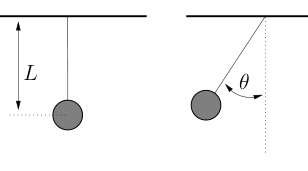 Pendulum hanging in accelerating car
Topic: Newtonian Mechanics Metodi: Free-Body Diagram, Vector Decomposition Competenze: Physical Reasoning, Mathematical Modeling Objects: Pendulum, String Fonte: Testo (PDF) — p.4
Un oggetto puntino di massa è appeso al soffitto di un’auto da una catena senza massa di lunghezza . Si osserva che l’angolo dal verticale si accelera uniformemente dal riposo. Trova l’accelerazione dell’auto in termini di , , e .
- A.
- B.
- C.
- D.
- E.
Pendolo appeso in auto ad accelerare
Topic: Newtonian Mechanics Metodi: Free-Body Diagram, Vector Decomposition Competenze: Physical Reasoning, Mathematical Modeling Objects: Pendulum, String Fonte: Testo (PDF) — p.4
A block of mass is on top of a block of mass . The lower block is on a horizontal surface, and a rope can pull horizontally on the lower block. The coefficient of kinetic friction for all surfaces is . What is the resulting acceleration of the lower block if a force is applied to the rope? Assume that is sufficiently large so that the top block slips on the lower block.
- A.
- B.
- C.
- D.
- E.
 Two stacked blocks with applied force F
Topic: Newtonian Mechanics Metodi: Free-Body Diagram, Kinematic Equations Competenze: Physical Reasoning, Mathematical Modeling Objects: Block, String Fonte: Testo (PDF) — p.4
Un blocco di massa è situato sopra un blocco di massa . Il blocco inferiore è su una superficie orizzontale e una corda può tirare orizzontale sul blocco inferiore. Il coefficiente di attrito cinetico per tutte le superfici è . Qual è l’accelerazione del blocco inferiore risultante se la corda viene applicata una forza ? Supponiamo che sia sufficientemente grande da far scivolare il blocco superiore sul blocco inferiore.
- A.
- B.
- C.
- D.
- E.
Due blocchi impilati con forza applicata F
Topic: Newtonian Mechanics Metodi: Free-Body Diagram, Kinematic Equations Competenze: Physical Reasoning, Mathematical Modeling Objects: Block, String Fonte: Testo (PDF) — p.4
The three masses shown in the accompanying diagram are equal. The pulleys are small, the string is lightweight, and friction is negligible. Assuming the system is in equilibrium, what is the ratio ? The figure is not drawn to scale!
- A.
- B.
- C.
- D.
- E.
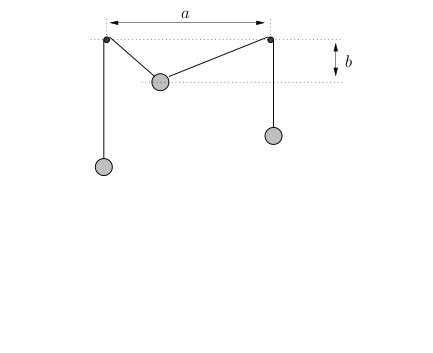 Three equal masses on pulley system
Topic: Newtonian Mechanics, Rigid Body Statics Metodi: Free-Body Diagram, Vector Decomposition Competenze: Diagrammatic Reasoning, Physical Reasoning Objects: Pulley, String Fonte: Testo (PDF) — p.4
Le tre masse mostrate nel diagramma di seguito sono uguali. Le polli sono piccole, la corda è leggera e la frizione è trascurabile. Supponendo che il sistema sia in equilibrio, qual è il rapporto ? La cifra non è fatta in scala!
- A.
- B.
- C.
- D.
- E.
Tre masse uguali sul sistema di pollice
Topic: Newtonian Mechanics, Rigid Body Statics Metodi: Free-Body Diagram, Vector Decomposition Competenze: Diagrammatic Reasoning, Physical Reasoning Objects: Pulley, String Fonte: Testo (PDF) — p.4
A ball with mass projected horizontally off the end of a table with an initial kinetic energy . At a time after it leaves the end of the table it has kinetic energy . What is ? Neglect air resistance.
- A.
- B.
- C.
- D.
- E.
Topic: Newtonian Mechanics, Conservation of Energy Metodi: Kinematic Equations, Energy Conservation Method Competenze: Mathematical Modeling, Physical Reasoning Objects: Ball Fonte: Testo (PDF) — p.5
Una palla di massa proiettata orizzontalmente dall’estremità di una tavola con un’energia cinetica iniziale . In un momento dopo aver lasciato la fine della tabella ha energia cinetica . Che cos’è ? - Non si tratta di resistenza all’aria.
- A.
- B.
- C.
- D.
- E.
Topic: Newtonian Mechanics, Conservation of Energy Metodi: Kinematic Equations, Energy Conservation Method Competenze: Mathematical Modeling, Physical Reasoning Objects: Ball Fonte: Testo (PDF) — p.5
A ball of mass and radius has a moment of inertia of . The ball is released from rest and rolls down the ramp with no frictional loss of energy. The ball is projected vertically upward off a ramp as shown in the diagram, reaching a maximum height above the point where it leaves the ramp. Determine the maximum height of the projectile in terms of .
- A.
- B.
- C.
- D.
- E.
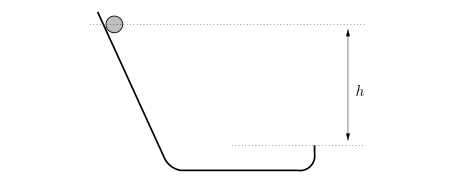 Ball rolling down ramp, launched vertically
Topic: Rotational Dynamics, Conservation of Energy Metodi: Energy Conservation Method, Torque & Angular Momentum Analysis Competenze: Physical Reasoning, Mathematical Modeling Objects: Ball, Inclined Plane Fonte: Testo (PDF) — p.5
Una palla di massa e di raggio ha un momento di inerzia di . La palla viene rilasciata dal riposo e ruota giù per la rampa senza perdita di energia da attrito. La palla è proiettata verticalmente verso l’alto da una rampa come mostrato nel diagramma, raggiungendo un’altezza massima sopra il punto in cui lascia la rampa. Determinare l’altezza massima del proiettile in termini di .
- A.
- B.
- C.
- D.
- E.
Bolla che va in discesa, lanciata verticalmente
Topic: Rotational Dynamics, Conservation of Energy Metodi: Energy Conservation Method, Torque & Angular Momentum Analysis Competenze: Physical Reasoning, Mathematical Modeling Objects: Ball, Inclined Plane Fonte: Testo (PDF) — p.5
A 5.0 kg block with a speed of 8.0 m/s travels 2.0 m along a horizontal surface where it makes a head-on, perfectly elastic collision with a 15.0 kg block which is at rest. The coefficient of kinetic friction between both blocks and the surface is 0.35. How far does the 15.0 kg block travel before coming to rest?
- A. 0.76 m
- B. 1.79 m
- C. 2.29 m
- D. 3.04 m
- E. 9.14 m
Topic: Newtonian Mechanics, Conservation of Momentum Metodi: Conservation of Momentum, Energy Conservation Method, Kinematic Equations Competenze: Mathematical Modeling, Physical Reasoning Objects: Block Fonte: Testo (PDF) — p.5
Un blocco di 5,0 kg con una velocità di 8,0 m/s percorre 2,0 m lungo una superficie orizzontale, dove si verifica una collisione frontale perfettamente elastica con un blocco di 15,0 kg che si trova a riposo. Il coefficiente di attrito cinetico tra entrambi i blocchi e la superficie è di 0,35. Quanto viaggia il blocco di 15,0 kg prima di riposare?
- A. 0.76 m
- B. 1.79 m
- C. 2.29 m
- D. 3.04 m
- E. 9.14 m
Topic: Newtonian Mechanics, Conservation of Momentum Metodi: Conservation of Momentum, Energy Conservation Method, Kinematic Equations Competenze: Mathematical Modeling, Physical Reasoning Objects: Block Fonte: Testo (PDF) — p.5
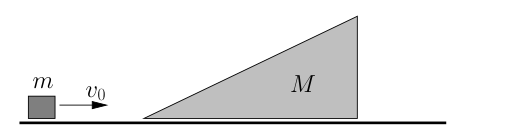
The following figure shows a small block of mass moving on a horizontal table surface at initial speed . It then moves smoothly onto a sloped big block of mass . The big block can also move on the table surface. Assume that everything moves without friction.
A small block moving with initial speed moves smoothly onto a sloped big block of mass . After the small block reaches the height on the slope, it slides down. Find the height .
- A.
- B.
- C.
- D.
- E.
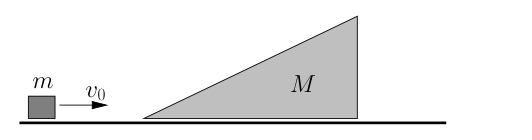 Small block slides onto sloped big block
Topic: Conservation of Momentum, Conservation of Energy Metodi: Conservation of Momentum, Energy Conservation Method Competenze: Physical Reasoning, Mathematical Modeling Objects: Block, Wedge Fonte: Testo (PDF) — p.6
La figura seguente mostra un piccolo blocco di massa che si muove su una superficie orizzontale della tavola a velocità iniziale . Si sposta quindi senza problemi su un grande blocco inclinato di massa . Il grande blocco può anche muoversi sulla superficie del tavolo. Supponiamo che tutto si muova senza attrito.
Un piccolo blocco in movimento con velocità iniziale si muove senza intoppi su un grande blocco inclinato di massa . Dopo che il piccolo blocco raggiunge l’altezza sulla pendenza, scende. Trova l’altezza .
- A.
- B.
- C.
- D.
- E.
Il piccolo blocco scivola su un blocco grande inclinato
Topic: Conservation of Momentum, Conservation of Energy Metodi: Conservation of Momentum, Energy Conservation Method Competenze: Physical Reasoning, Mathematical Modeling Objects: Block, Wedge Fonte: Testo (PDF) — p.6
Following the previous set up (small block of mass at initial speed moving onto frictionless sloped big block of mass ), find the speed of the small block after it leaves the slope.
- A.
- B.
- C.
- D.
- E.
 Small block slides onto sloped big block
Topic: Conservation of Momentum, Conservation of Energy Metodi: Conservation of Momentum, Energy Conservation Method Competenze: Physical Reasoning, Mathematical Modeling Objects: Block, Wedge Fonte: Testo (PDF) — p.6
Dopo la configurazione precedente (piccolo blocco di massa alla velocità iniziale che si sposta verso un grande blocco inclinato senza attrito di massa ), trovare la velocità del piccolo blocco dopo che lascia la pendenza.
- A.
- B.
- C.
- D.
- E.
Il piccolo blocco scivola su un blocco grande inclinato
Topic: Conservation of Momentum, Conservation of Energy Metodi: Conservation of Momentum, Energy Conservation Method Competenze: Physical Reasoning, Mathematical Modeling Objects: Block, Wedge Fonte: Testo (PDF) — p.6
Four masses are arranged at the vertices of a tetrahedron of side length . What is the gravitational potential energy of this arrangement?
- A.
- B.
- C.
- D.
- E.
Topic: Gravitation Metodi: Newton’s Law of Gravitation, Electric Potential Method Competenze: Mathematical Modeling, Physical Reasoning Objects: — Fonte: Testo (PDF) — p.6
Quattro masse sono disposte alle vertici di un tetraedro di lunghezza laterale . Qual è l’energia gravitazionale potenziale di questo sistema?
- A.
- B.
- C.
- D.
- E.
Topic: Gravitation Metodi: Newton’s Law of Gravitation, Electric Potential Method Competenze: Mathematical Modeling, Physical Reasoning Objects: — Fonte: Testo (PDF) — p.6
The following graph of potential energy is used for questions 18 through 20.
Which of the following represents the force corresponding to the given potential?
- A. [graph A]
- B. [graph B]
- C. [graph C]
- D. [graph D]
- E. [graph E]
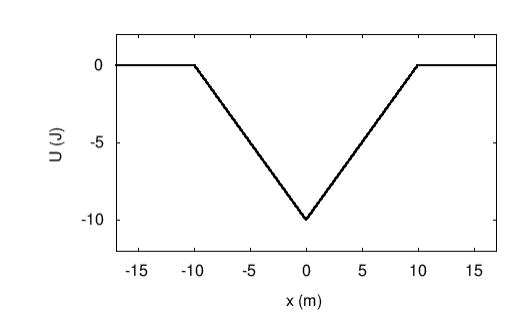 Potential energy vs position graph
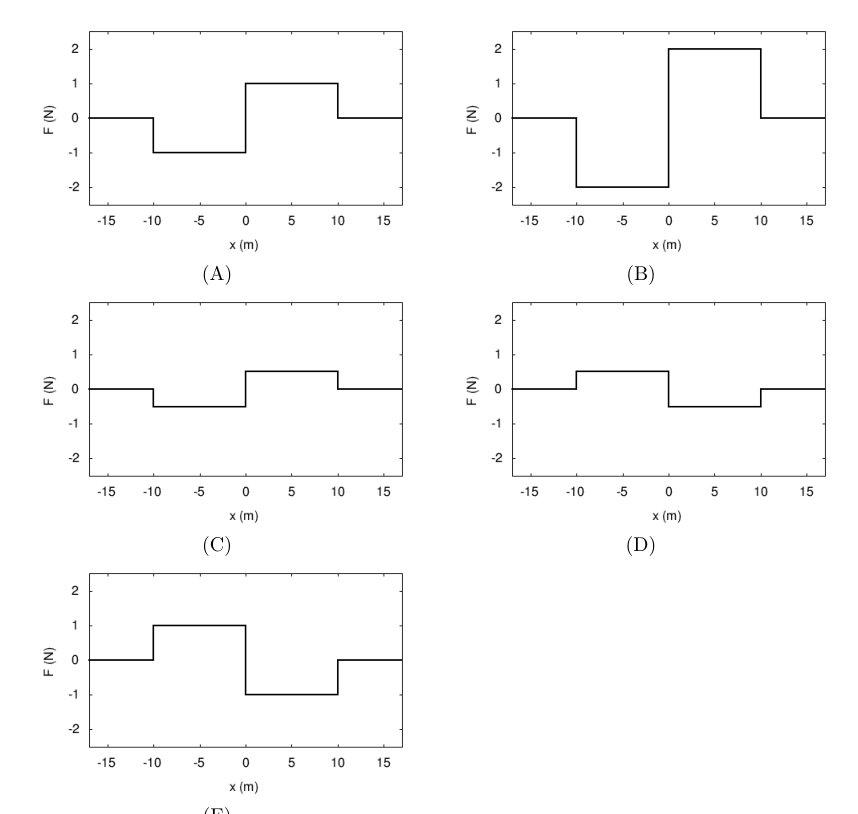 Five candidate force vs position graphs
Topic: Conservation of Energy, Newtonian Mechanics Metodi: Energy Conservation Method, Calculus-Integration Competenze: Diagrammatic Reasoning, Physical Reasoning Objects: — Fonte: Testo (PDF) — p.7
Il seguente grafico di energia potenziale è utilizzato per le domande da 18 a 20.
Quale delle seguenti rappresenta la forza corrispondente al dato potenziale?
- A. [grafico A]
- B. [grafico B]
- C. [grafico C]
- D. [grafico D]
- E. [grafico E]
Grafico di energia potenziale vs posizione
*Quattro grafici di forza contro posizione *
Topic: Conservation of Energy, Newtonian Mechanics Metodi: Energy Conservation Method, Calculus-Integration Competenze: Diagrammatic Reasoning, Physical Reasoning Objects: — Fonte: Testo (PDF) — p.7
Consider the following graphs of position vs. time.
I. II. III.
Which of the graphs could be the motion of a particle in the given potential (shown on the previous page)?
- A. I
- B. III
- C. I and II
- D. I and III
- E. I, II, and III
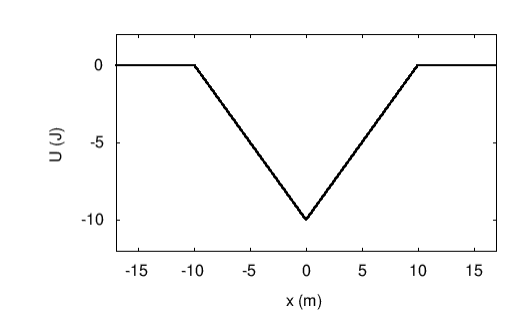 Potential energy vs position graph (reference)
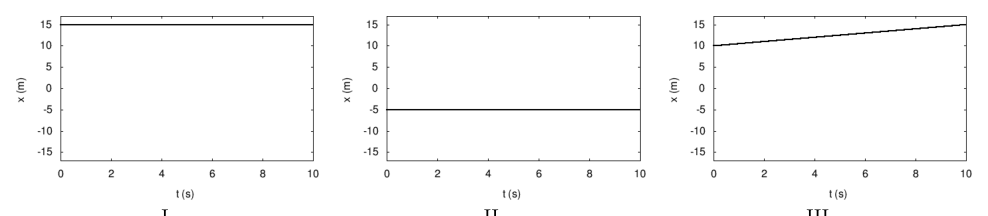 Three position vs time graphs I, II, III
Topic: Conservation of Energy, Newtonian Mechanics Metodi: Energy Conservation Method, Calculus-Integration Competenze: Diagrammatic Reasoning, Physical Reasoning Objects: — Fonte: Testo (PDF) — p.8
Considerate i seguenti grafici di posizione vs. - Il tempo.
I. II. III. Il
Quale dei grafici potrebbe essere il movimento di una particella nel dato potenziale (visto nella pagina precedente)?
- A. I
- B. III
- C. I e II
- D. I e III
- E. I, II e III
*Grafico di energia potenziale vs posizione (referenza) *
Tre posizioni vs grafici temporali I, II, III
Topic: Conservation of Energy, Newtonian Mechanics Metodi: Energy Conservation Method, Calculus-Integration Competenze: Diagrammatic Reasoning, Physical Reasoning Objects: — Fonte: Testo (PDF) — p.8
Consider the following graph of position vs. time, which represents the motion of a certain particle in the given potential (shown on page 7).
What is the total energy of the particle?
- A. J
- B. J
- C. J
- D. J
- E. J
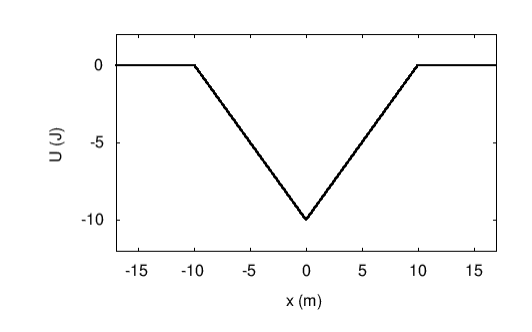 Potential energy vs position graph (reference)
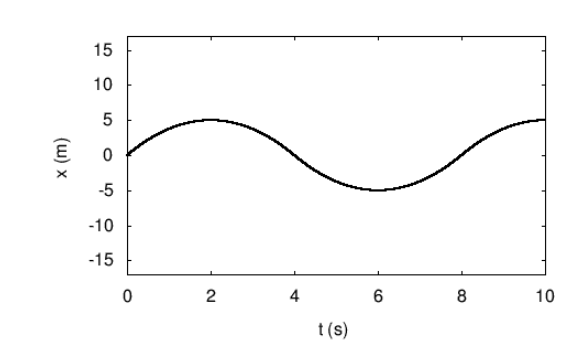 Position vs time for particle in potential
Topic: Conservation of Energy, Newtonian Mechanics Metodi: Energy Conservation Method Competenze: Diagrammatic Reasoning, Physical Reasoning Objects: — Fonte: Testo (PDF) — p.8
Considerate il seguente grafico di posizione vs. tempo, che rappresenta il movimento di una determinata particella nel dato potenziale (visto a pagina 7).
Qual è l’energia totale della particella?
- A. J
- B. J
- C. J
- D. J
- E. J
*Grafico di energia potenziale vs posizione (referenza) *
Posizione vs tempo per le particelle in potenziale
Topic: Conservation of Energy, Newtonian Mechanics Metodi: Energy Conservation Method Competenze: Diagrammatic Reasoning, Physical Reasoning Objects: — Fonte: Testo (PDF) — p.8
The gravitational self potential energy of a solid ball of mass density and radius is . What is the gravitational self potential energy of a ball of mass density and radius ?
- A.
- B.
- C.
- D.
- E.
Topic: Gravitation Metodi: Newton’s Law of Gravitation, Dimensional Analysis Competenze: Physical Reasoning, Mathematical Modeling Objects: Sphere Fonte: Testo (PDF) — p.9
L’energia gravitazionale auto-potenziale di una sfera solida di densità di massa e di raggio è . Qual è l’energia di gravità di una sfera di densità di massa e di raggio ?
- A.
- B.
- C.
- D.
- E.
Topic: Gravitation Metodi: Newton’s Law of Gravitation, Dimensional Analysis Competenze: Physical Reasoning, Mathematical Modeling Objects: Sphere Fonte: Testo (PDF) — p.9
A balloon filled with helium gas is tied by a light string to the floor of a car; the car is sealed so that the motion of the car does not cause air from outside to affect the balloon. If the car is traveling with constant speed along a circular path, in what direction will the balloon on the string lean towards?
- A. A
- B. B
- C. C
- D. D
- E. Remains vertical
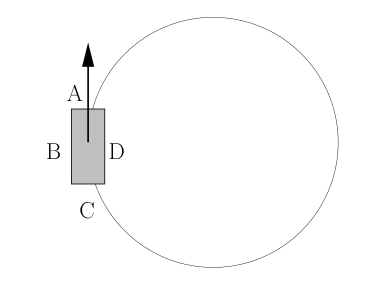 Balloon in sealed car on circular path
Topic: Fluid Mechanics, Newtonian Mechanics Metodi: Free-Body Diagram, Hydrostatic Equilibrium Competenze: Physical Reasoning, Diagrammatic Reasoning Objects: Bubble, Gas, String Fonte: Testo (PDF) — p.9
Un pallone pieno di gas elio è legato con una corda leggera al pavimento di un’auto; l’auto è sigillata in modo che il movimento dell’auto non faccia sì che l’aria dall’esterno influisca sul pallone. Se l’auto si muove con una velocità costante lungo un percorso circolare, in che direzione si inclinerà il pallone sulla corda?
- A. A
- B. B
- C. C
- D. D
- E. Rimane verticale
Ballone in auto sigillata su percorso circolare
Topic: Fluid Mechanics, Newtonian Mechanics Metodi: Free-Body Diagram, Hydrostatic Equilibrium Competenze: Physical Reasoning, Diagrammatic Reasoning Objects: Bubble, Gas, String Fonte: Testo (PDF) — p.9
Two streams of water flow through the U-shaped tubes shown. The tube on the left has cross-sectional area , and the speed of the water flowing through it is ; the tube on the right has cross-sectional area . If the net force on the tube assembly is zero, what must be the speed of the water flowing through the tube on the right? Neglect gravity, and assume that the speed of the water in each tube is the same upon entry and exit.
- A.
- B.
- C.
- D.
- E.
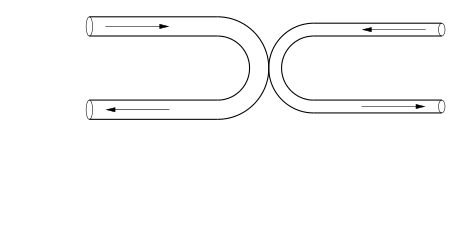 U-shaped tubes with different cross sections
Topic: Fluid Mechanics Metodi: Continuity Equation, Conservation of Momentum Competenze: Physical Reasoning, Mathematical Modeling Objects: Tube Fonte: Testo (PDF) — p.9
Due flussi d’acqua attraversano i tubi a forma di U. Il tubo a sinistra ha una superficie trasversale e la velocità dell’acqua che attraversa è ; il tubo a destra ha una superficie trasversale . Se la forza netta sul tubo è zero, quale deve essere la velocità dell’acqua che scorre attraverso il tubo a destra? Ignorate la gravità e supponete che la velocità dell’acqua in ogni tubo sia la stessa all’ingresso e all’uscita.
- A.
- B.
- C.
- D.
- E.
tubi a forma di U con diverse sezioni incrociate
Topic: Fluid Mechanics Metodi: Continuity Equation, Conservation of Momentum Competenze: Physical Reasoning, Mathematical Modeling Objects: Tube Fonte: Testo (PDF) — p.9
A uniform circular disk of radius begins with a mass ; about an axis through the center of the disk and perpendicular to the plane of the disk the moment of inertia is . A hole is cut in the disk as shown in the diagram. In terms of the radius and the mass of the original disk, what is the moment of inertia of the resulting object about the axis shown?
- A.
- B.
- C.
- D.
- E.
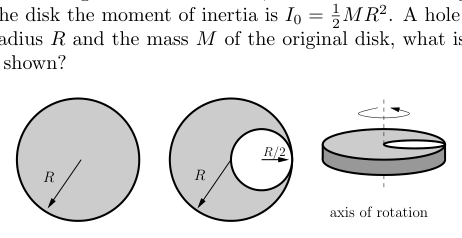 Circular disk with hole, rotation axis marked
Topic: Rotational Dynamics Metodi: Torque & Angular Momentum Analysis, Superposition Principle Competenze: Mathematical Modeling, Physical Reasoning Objects: Disk Fonte: Testo (PDF) — p.10
Un disco circolare uniforme di raggio inizia con una massa ; circa un asse attraverso il centro del disco e perpendicolare al piano del disco il momento di inerzia è . Si taglia un buco nel disco come mostrato nel diagramma. In termini di raggio e massa del disco originale, qual è il momento di inerzia dell’oggetto risultante intorno all’asse mostrato?
- A.
- B.
- C.
- D.
- E.
*Disco circolare con buco, asse di rotazione segnalato *
Topic: Rotational Dynamics Metodi: Torque & Angular Momentum Analysis, Superposition Principle Competenze: Mathematical Modeling, Physical Reasoning Objects: Disk Fonte: Testo (PDF) — p.10
Spaceman Fred’s spaceship (which has negligible mass) is in an elliptical orbit about Planet Bob. The minimum distance between the spaceship and the planet is ; the maximum distance between the spaceship and the planet is . At the point of maximum distance, Spaceman Fred is traveling at speed . He then fires his thrusters so that he enters a circular orbit of radius . What is his new speed?
- A.
- B.
- C.
- D.
- E.
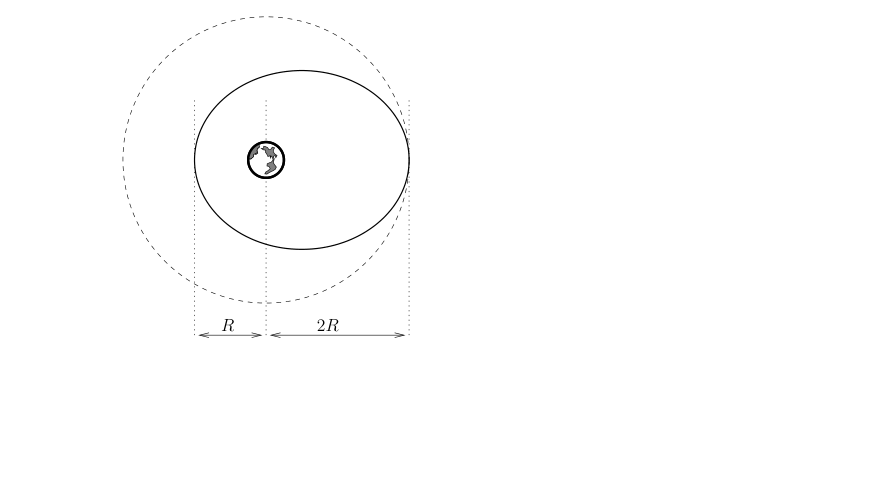 Elliptical orbit radius R to 2R, circular orbit
Topic: Gravitation, Conservation of Energy Metodi: Kepler’s Laws, Conservation of Energy, Conservation of Momentum Competenze: Mathematical Modeling, Physical Reasoning Objects: Satellite, Planet Fonte: Testo (PDF) — p.10
La nave spaziale dello spaziale Fred (che ha una massa trascurabile) è in orbita ellittica attorno al pianeta Bob. La distanza minima tra la nave spaziale e il pianeta è ; la distanza massima tra la nave spaziale e il pianeta è . Al punto della distanza massima, lo spaziale Fred viaggia a velocità . Poi spara i suoi propulsori in modo che entri in un’orbita circolare di raggio . Qual è la sua nuova velocità?
- A.
- B.
- C.
- D.
- E.
Radius di orbita ellittica R a 2R, orbita circolare
Topic: Gravitation, Conservation of Energy Metodi: Kepler’s Laws, Conservation of Energy, Conservation of Momentum Competenze: Mathematical Modeling, Physical Reasoning Objects: Satellite, Planet Fonte: Testo (PDF) — p.10