An object of mass is sitting at the northernmost edge of a stationary merry-go-round of radius . The merry-go-round begins rotating clockwise (as seen from above) with constant angular acceleration of . The coefficient of static friction between the object and the merry-go-round is .
a. Derive an expression for the magnitude of the object’s velocity at the instant when it slides off the merry-go-round in terms of , , , and any necessary fundamental constants.
b. For this problem assume that , rad/s, and m. At what angle, as measured clockwise from north, is the direction of the object’s velocity at the instant when it slides off the merry-go-round? Report your answer to the nearest degree in the range to .
Topic: Rotational Dynamics Metodi: Free-Body Diagram, Kinematic Equations, Vector Decomposition Competenze: Physical Reasoning, Mathematical Modeling Objects: Disk, Block Fonte: Testo (PDF) - p.3
Un oggetto di massa si trova al bordo più settentrionale di un giro fermo di raggio . Il merry-go-round inizia a ruotare nel senso orario (come visto dall’alto) con un’accelerazione angolare costante di . Il coefficiente di attrito statico tra l’oggetto e il merry-go-round è .
a. Derivare un’espressione per la grandezza della velocità dell’oggetto nell’istante in cui si scivola dal merry-go-round in termini di , , e di eventuali costanti fondamentali necessarie.
b. Per questo problema supponiamo che , rad/s, e m. A quale angolo, misurato nel senso nordico, si trova la direzione della velocità dell’oggetto all’istante in cui si scivola dal merry-go-round? Relata la tua risposta al grado più vicino nella gamma a .
Topic: Rotational Dynamics Metodi: Free-Body Diagram, Kinematic Equations, Vector Decomposition Competenze: Physical Reasoning, Mathematical Modeling Objects: Disk, Block Fonte: Testo (PDF) - p.3
A spherical shell of inner radius and outer radius is made of a material of resistivity and negligible dielectric activity. A single point charge is located at the center of the shell. At time all of the material of the shell is electrically neutral, including both the inner and outer surfaces. What is the total charge on the outer surface of the shell as a function of time for ? Ignore any effects due to magnetism or radiation; do not assume that is small.
Topic: Electrostatics Metodi: Gauss’s Law, Differential Equations, Electric Potential Method Competenze: Physical Reasoning, Mathematical Modeling Objects: Point Charge, Conducting Sphere Fonte: Testo (PDF) - p.3
Un guscio sferico di raggio interno e raggio esterno è costituito da un materiale di resistività e di attività dielettrica trascurabile. Una carica a singolo punto si trova al centro della conchiglia. At time all of the material of the shell is electrically neutral, including both the inner and outer surfaces. Qual è la carica totale sulla superficie esterna della conchiglia in funzione del tempo per ? Ignorare eventuali effetti dovuti al magnetismo o alle radiazioni; non supporre che sia piccolo.
Topic: Electrostatics Metodi: Gauss’s Law, Differential Equations, Electric Potential Method Competenze: Physical Reasoning, Mathematical Modeling Objects: Point Charge, Conducting Sphere Fonte: Testo (PDF) - p.3
A cylindrical pipe contains a movable piston that traps mols of air. Originally, the air is at one atmosphere of pressure, a volume , and at a temperature of K. First (process A) the air in the cylinder is compressed at constant temperature to a volume of . Then (process B) the air is allowed to expand adiabatically to a volume of L. After this (process C) this piston is withdrawn allowing the gas to expand to the original volume while maintaining a constant temperature. Finally (process D) while maintaining a fixed volume, the gas is allowed to return to the original temperature . Assume air is a diatomic ideal gas, no air flows into, or out of, the pipe at any time, and that the temperature outside the pipe remains constant always. Possibly useful information: , , atm Pa.
a. Draw a P-V diagram of the whole process.
b. How much work is done on the trapped air during process A?
c. What is the temperature of the air at the end of process B?
Topic: Thermodynamics Metodi: First Law of Thermodynamics, Ideal Gas Law, Thermodynamic Cycle Analysis Competenze: Physical Reasoning, Diagrammatic Reasoning Objects: Piston, Gas, Cylinder Fonte: Testo (PDF) - p.3
Un tubo cilindrico contiene un pistone mobile che intrappola mol di aria. In origine, l’aria è ad una atmosfera di pressione, un volume , e a una temperatura di K. Prima (processo A) l’aria contenuta nel cilindro viene compressa a temperatura costante a un volume di . Poi (processo B) si permette all’aria di espandersi adiabaticamente a un volume di L. Dopo questo (processo C) questo pistone viene ritirato consentendo al gas di espandersi al volume originale mantenendo una temperatura costante. Infine (processo D), mantenendo un volume fisso, il gas può tornare alla temperatura originale . Supponiamo che l’aria sia un gas ideale diatomico, che l’aria non scorra in nessun momento nel tubo o fuori di esso e che la temperatura fuori dal tubo rimanga costante. Informazioni possibilmente utili: , , atm Pa.
a. Disegna un diagramma P-V dell’intero processo.
b. Quanto lavoro viene fatto sull’aria intrappolata durante il processo A?
c. Qual è la temperatura dell’aria alla fine del processo B?
Topic: Thermodynamics Metodi: First Law of Thermodynamics, Ideal Gas Law, Thermodynamic Cycle Analysis Competenze: Physical Reasoning, Diagrammatic Reasoning Objects: Piston, Gas, Cylinder Fonte: Testo (PDF) - p.3
The energy radiated by the Sun is generated primarily by the fusion of hydrogen into helium-4. In stars the size of the Sun, the primary mechanism by which fusion takes place is the proton-proton chain. The chain begins with the following reactions:
The amounts listed in parentheses are the total kinetic energy carried by the products, including gamma rays. is a proton, is a positron, is a gamma ray, and , , and are particles for you to identify.
The density of electrons in the Sun’s core is sufficient that the positron is annihilated almost immediately, releasing an energy :
Subsequently, two major processes occur simultaneously. The ‘pp I branch’ is the single reaction
which releases an energy . The ‘pp II branch’ consists of three reactions:
where is the energy released in step A4-6 (the second of these three reactions).
a. Identify through . and are neutral particles of negligible mass. It is useful to know that the first few elements, in order of atomic number, are H, He, Li, Be, B, C, N, O.
b. The mass of the electron is MeV/, the mass of the proton is MeV/, and the mass of the helium-4 nucleus is MeV/. Find the energy released during the production of one helium-4 nucleus, including the kinetic energy of all products and all energy carried by gamma rays.
c. Find the unknown energies and above.
d. Step (A4-6) does not proceed as follows because there is insufficient energy.
What constraint does this fact place on ?
e. In which of the reaction steps is the energy carried by any given product the same every time the step occurs? Assume that the kinetic energy carried in by the reactants in each step is negligible, and that the products are in the ground state.
Topic: Nuclear & Particle Physics Metodi: Mass-Energy Equivalence, Conservation Laws Competenze: Physical Reasoning Objects: Nucleus, Photon, Electron, Star Fonte: Testo (PDF) - p.4
L’energia irradiata dal Sole viene generata principalmente dalla fusione dell’idrogeno in elio-4. Nelle stelle della dimensione del Sole, il meccanismo primario attraverso il quale si verifica la fusione è la catena protone-protone. La catena inizia con le seguenti reazioni:
Le quantità elencate tra parentesi rappresentano l’energia cinetica totale trasportata dai prodotti, compresi i raggi gamma. è un protone, è un positrone, è un raggio gamma, e , e sono particelle da identificare.
La densità degli elettroni nel nucleo del Sole è sufficiente a far annientare quasi immediatamente il positrone, rilasciando un’energia :
Successivamente, due processi principali si verificano contemporaneamente. Il “pp I rami” è la reazione singola
che rilascia un’energia . Il “filiale pp II” è costituito da tre reazioni:
dove è l’energia rilasciata in fase A4-6 (la seconda di queste tre reazioni).
a. Identificare attraverso . e sono particelle neutre di massa trascurabile. È utile sapere che i primi pochi elementi, nell’ordine del numero atomico, sono H, He, Li, Be, B, C, N, O.
b. La massa dell’elettrone è MeV/, la massa del protone è MeV/ e la massa del nucleo dell’elio-4 è MeV/. Trova l’energia rilasciata durante la produzione di un nucleo di elio-4, compresa l’energia cinetica di tutti i prodotti e tutta l’energia trasportata dai raggi gamma.
c. Trova le energie sconosciute e sopra.
d. La fase (A4-6) non procede come segue perché non c’è energia sufficiente.
Qual è la limitazione che questo fatto impone a ?
e. In quali fasi della reazione l’energia trasportata da un prodotto è la stessa ogni volta che si verifica il passo? Supponiamo che l’energia cinetica trasportata dai reagenti in ogni fase sia trascurabile e che i prodotti siano in stato di base.
Topic: Nuclear & Particle Physics Metodi: Mass-Energy Equivalence, Conservation Laws Competenze: Physical Reasoning Objects: Nucleus, Photon, Electron, Star Fonte: Testo (PDF) - p.4
A thin plank of mass and length rotates about a pivot at its center. A block of mass slides on the top of the plank. The system moves without friction. Initially, the plank makes an angle with the horizontal, the block is at the upper end of the plank, and the system is at rest. Throughout the problem you may assume that , and that the physical dimensions of the block are much, much smaller than the length of the plank.
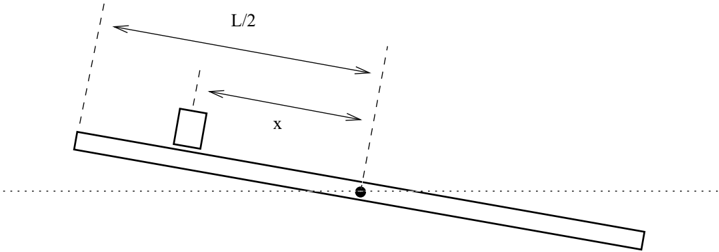
Let be the displacement of the block along the plank, as measured from the pivot, and let be the angle between the plank and the horizontal. You may assume that centripetal acceleration of the block is negligible compared with the linear acceleration of the block up and down the plank.
a. For a certain value of , throughout the motion, where is a constant. What is this value of ? Express your answer in terms of , , and any fundamental constants that you require.
b. Given that takes this special value, what is the period of oscillation of the system? Express your answer in terms of , , and any fundamental constants that you require.
c. Determine the maximum value of the ratio between the centripetal acceleration of the block and the linear acceleration of the block along the plank, writing your answer in terms of and , therefore justifying our approximation.
Topic: Rotational Dynamics, Oscillations & Waves Metodi: Torque & Angular Momentum Analysis, Simple Harmonic Motion Analysis, Differential Equations Competenze: Physical Reasoning, Mathematical Modeling Objects: Rod, Block Fonte: Testo (PDF) - p.6
Una sottile tavola di massa e lunghezza ruota intorno a un pivot al suo centro. Un blocco di massa si scivola sulla parte superiore della tavola. Il sistema si muove senza attrito. Inizialmente, la tavola fa un angolo con l’orizzontale, il blocco è all’estremità superiore della tavola e il sistema è a riposo. Durante tutto il problema si può presumere che , e che le dimensioni fisiche del blocco sono molto, molto più piccole della lunghezza della tavola.
Il deve essere il spostamento del blocco lungo la tavola, misurato dal pivot, e deve essere l’angolo tra la tavola e l’orizzontale. Si può presumere che l’accelerazione centripetale del blocco sia trascurabile rispetto all’accelerazione lineare del blocco su e giù per la tavola.
a. Per un certo valore di , durante tutto il movimento, dove è una costante. Qual è questo valore di ? Esprimere la risposta in termini di , e di eventuali costanti fondamentali che richiedono.
b. Dato che assume questo valore speciale, qual è il periodo di oscillazione del sistema? Esprimere la risposta in termini di , e di eventuali costanti fondamentali che richiedono.
c. Determina il valore massimo del rapporto tra l’accelerazione centripetale del blocco e l’accelerazione lineare del blocco lungo la tavola, scrivendo la tua risposta in termini di e , giustificando quindi il nostro approssimo.
Topic: Rotational Dynamics, Oscillations & Waves Metodi: Torque & Angular Momentum Analysis, Simple Harmonic Motion Analysis, Differential Equations Competenze: Physical Reasoning, Mathematical Modeling Objects: Rod, Block Fonte: Testo (PDF) - p.6
These three parts can be answered independently.
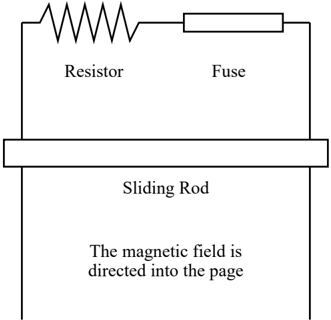
a. One pair of ends of two long, parallel wires are connected by a resistor, , and a fuse that will break instantaneously if amperes of current pass through it. The other pair of ends are unconnected. A conducting rod of mass is free to slide along the wires under the influence of gravity. The wires are separated by cm, and the rod starts out cm from the resistor and fuse. The whole system is placed in a uniform, constant magnetic field of T as shown in the figure. The resistance of the rod and the wires is negligible. When the rod is released it falls under the influence of gravity, but never loses contact with the long parallel wires.
- i. What is the smallest mass needed to break the fuse?
- ii. How fast is the mass moving when the fuse breaks?
b. A fuse is composed of a cylindrical wire with length and radius . The resistivity (not resistance!) of the fuse is small, and given by . Assume that a uniform current flows through the fuse. Write your answers below in terms of , , , , and any fundamental constants.
- i. What is the magnitude and direction of the electric field on the surface of the fuse wire?
- ii. What is the magnitude and direction of the magnetic field on the surface of the fuse wire?
- iii. The Poynting vector, is a measure of the rate of electromagnetic energy flow through a unit surface area; the vector gives the direction of the energy flow. Since , where is the permeability of free space and and are the electric and magnetic field vectors, find the magnitude and direction of the Poynting vector associated with the current in the fuse wire.
c. A fuse will break when it reaches its melting point. We know from modern physics that a hot object will radiate energy (approximately) according to the black body law , where is the temperature in Kelvin, the surface area, and is the Stefan-Boltzmann constant. If K is the melting point of the metal for the fuse wire, with resistivity , and A is the desired breaking current, what should be the radius of the wire ?
Topic: Electromagnetic Induction, Electromagnetism Metodi: Faraday’s Law of Induction, Ampere’s Law, Lorentz Force Analysis Competenze: Physical Reasoning, Mathematical Modeling Objects: Rod, Wire, Resistor Fonte: Testo (PDF) - p.7
Queste tre parti possono essere risposte in modo indipendente.
a. Una coppia di estremità di due fili paralleli lunghi è collegata da una resistenza, , e da un fusibile che si rompe istantaneamente se amperes di corrente passano attraverso di essa. Le altre estremità non sono connesse. Una canna di conduttore di massa può scivolare liberamente lungo i fili sotto l’influenza della gravità. I fili sono separati da cm e la canna parte cm dalla resistenza e dal fusibile. L’intero sistema è posizionato in un campo magnetico uniforme e costante di T come mostrato nella figura. La resistenza della canna e dei fili è trascurabile. Quando la canna viene rilasciata, cade sotto l’influenza della gravità, ma non perde mai il contatto con i lunghi fili paralleli.
- i. Qual è la più piccola massa necessaria per rompere il fusibile?
- ii. Quanto veloce si muove la massa quando si rompe il fusibile?
b. Un fusibile è composto da un filo cilindrico di lunghezza e di raggio . La resistività (non la resistenza!) del fusibile è piccola e data da . Supponiamo che una corrente uniforme fluisca attraverso il fusibile. Scrivi le tue risposte di seguito in termini di , , , e di eventuali costanti fondamentali.
- i. Qual è la magnitudine e la direzione del campo elettrico sulla superficie del filo di fusione?
- ii. Qual è la magnitudine e la direzione del campo magnetico sulla superficie del filo di fusione?
- III. Il vettore di Poynting, è una misura del tasso di flusso di energia elettromagnetica attraverso un’area di superficie unità; il vettore dà la direzione del flusso di energia. Poiché , dove è la permeabilità dello spazio libero e e sono i vettori del campo elettrico e magnetico, trovare la magnitudine e la direzione del vettore di Poynting associati alla corrente nel filo di fusione.
c. Un fusibile si romperà quando raggiungerà il punto di fusione. Sappiamo dalla fisica moderna che un oggetto caldo irradia energia (circa) secondo la legge del corpo nero , dove è la temperatura in Kelvin, l’area superficiale, e è la costante di Stefan-Boltzmann. Se K è il punto di fusione del metallo per il filo di fusione, con resistività , e A è la corrente di rottura desiderata, quale dovrebbe essere il raggio del filo ?
Topic: Electromagnetic Induction, Electromagnetism Metodi: Faraday’s Law of Induction, Ampere’s Law, Lorentz Force Analysis Competenze: Physical Reasoning, Mathematical Modeling Objects: Rod, Wire, Resistor Fonte: Testo (PDF) - p.7