Question 1 A ball is dropped from a height . It hits the ground and bounces back up with a momentum loss of 10% due to the impact. The maximum height it will reach is
- A. ;
- B. ;
- C. ;
- D. .
Topic: Conservation of Energy, Conservation of Momentum Metodi: Conservation of Energy, Conservation of Momentum, Kinematic Equations Competenze: Physical Reasoning, Mathematical Modeling Objects: Ball Fonte: Testo (PDF) — p.2
Domanda 1 Una palla viene abbassata da un’altezza . Colpisce il terreno e… Rilancia con una perdita di impulso del 10% a causa del l’impatto. L’ altezza massima raggiungerà è
- A. ;
- B. ;
- C. ;
- D. .
Topic: Conservation of Energy, Conservation of Momentum Metodi: Conservation of Energy, Conservation of Momentum, Kinematic Equations Competenze: Physical Reasoning, Mathematical Modeling Objects: Ball Fonte: Testo (PDF) — p.2
Question 2 A mass rests on a frictionless surface. It is attached to mass by a light string which passes over a massless, frictionless pulley, as shown in the figure. The system is released from rest. The initial acceleration of is given by
a) ;
b) ;
c) ;
d) .
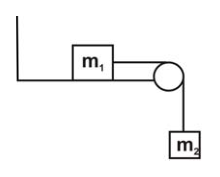 sistema Atwood m1 su piano m2 appeso
Topic: Newtonian Mechanics Metodi: Free-Body Diagram, Kinematic Equations, Vector Decomposition Competenze: Diagrammatic Reasoning, Mathematical Modeling Objects: Block, String, Pulley Fonte: Testo (PDF) — p.2
Domanda 2 Una massa si basa su una macchina senza attrito superficie. È fissato a massa con una corda leggera che passa, su una massa senza attrito, La polla, come mostrato nella figura. Il sistema è libero dal riposo. L’accelerazione iniziale di è data da
a) ;
b) ;
c) ;
d) .
Sistema Atwood m1 su pianoforte m2 appeso
Topic: Newtonian Mechanics Metodi: Free-Body Diagram, Kinematic Equations, Vector Decomposition Competenze: Diagrammatic Reasoning, Mathematical Modeling Objects: Block, String, Pulley Fonte: Testo (PDF) — p.2
Question 3 The system in question 2 is attached to a spring of spring constant which in turn is attached to a vertical wall, as shown to the right. The spring is neither stretched nor compressed. The system is released from rest. The mass falls and then oscillates about a mean displacement from its original position before release given by
a) ;
b) ;
c) ;
d) .
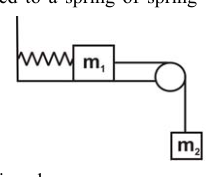 sistema Atwood con molla a parete
Topic: Oscillations & Waves, Newtonian Mechanics Metodi: Simple Harmonic Motion Analysis, Free-Body Diagram, Energy Conservation Method Competenze: Physical Reasoning, Mathematical Modeling Objects: Block, Spring, Pulley Fonte: Testo (PDF) — p.2
Domanda 3 Il sistema di cui alla domanda 2 è collegato a una sorgente di primavera costante che a sua volta è collegata per un muro verticale, come mostrato al
- Sì, certo. La primavera non è né allungato e compresso. Il il sistema viene rilasciato dal riposo. Il massa cade e oscilla circa un spostamento medio da la sua posizione originale prima della liberazione data da
a) ;
b) ;
c) ;
d) .
*sistema Atwood con molla a parete *
Topic: Oscillations & Waves, Newtonian Mechanics Metodi: Simple Harmonic Motion Analysis, Free-Body Diagram, Energy Conservation Method Competenze: Physical Reasoning, Mathematical Modeling Objects: Block, Spring, Pulley Fonte: Testo (PDF) — p.2
Question 4 Four 100 ohm resistors and a 1 V battery are connected as shown in the circuit diagram. The potential difference between points and is given by
- A. 0.250 V;
- B. 0.333 V;
- C. .500 V;
- D. 0.667 V.
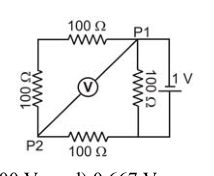 circuito quattro resistori e batteria
Topic: Circuits Metodi: Kirchhoff’s Laws, Equivalent Circuit Reduction Competenze: Diagrammatic Reasoning, Mathematical Modeling Objects: Resistor, Battery Fonte: Testo (PDF) — p.2
Domanda 4 Quattro resistori da 100 ohm e un 1 V la batteria è collegata come indicato in il diagramma del circuito. Il potenziale differenza tra i punti e è data da
- A. 0.250 V;
- B. 0.333 V;
- C. .500 V;
- D. 0.667 V.
circuito quattro resistori e batterie
Topic: Circuits Metodi: Kirchhoff’s Laws, Equivalent Circuit Reduction Competenze: Diagrammatic Reasoning, Mathematical Modeling Objects: Resistor, Battery Fonte: Testo (PDF) — p.2
Question 5 A heavy plate is held horizontal resting on two frictionless pistons, each of which is placed in the opening of an asymmetric U tube filled with an incompressible fluid, as shown in the figure. Once the restraints on the plate are released, then
a) piston will rise and will fall; b) piston will rise and will fall; c) the plate will remain level and not move; d) the plate will remain level and both pistons will sink a similar small distance.
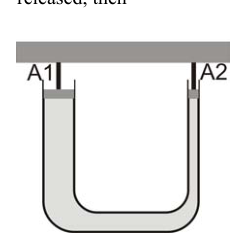 tubo a U con pistoni A1 e A2
Topic: Fluid Mechanics Metodi: Hydrostatic Equilibrium, Free-Body Diagram, Physical Modeling Competenze: Physical Reasoning, Diagrammatic Reasoning Objects: Piston, Tube Fonte: Testo (PDF) — p.2
Domanda 5 Una piastra pesante è tenuta orizzontale appoggiata su due piastre senza attrito Pistoni, ognuno dei quali collocato nell’apertura di un tubo U asimmetrico riempito di un liquido incompressibile, come Il numero di persone che hanno ricevuto il diploma è stato indicato nella figura. Una volta che i rivestimenti sul piatto sono rilasciato, quindi
a) il pistone si alzerà e cadrà; b) il pistone si alzerà e cadrà; c) la piastra rimarrà a piatto e non muoversi; d) la piastra rimarrà a piatto e entrambi i pistoni affonderanno un distanza simile.
Tuti a pistoni A1 e A2
Topic: Fluid Mechanics Metodi: Hydrostatic Equilibrium, Free-Body Diagram, Physical Modeling Competenze: Physical Reasoning, Diagrammatic Reasoning Objects: Piston, Tube Fonte: Testo (PDF) — p.2
Question 6 Two identical glasses, one completely filled with water, and the other filled with vodka, are viewed directly from above. The refractive index of vodka is slightly greater than the refractive index of water. Which glass appears to have a greater depth of fluid?
- A. the water glass;
- B. the vodka glass;
- C. neither glass because the apparent depth is the same as the real depth in both glasses; d) neither glass, because the effect of the clear fluid is to reduce the apparent depth by the same factor in both glasses.
Topic: Geometric Optics Metodi: Snell’s Law, Physical Modeling Competenze: Physical Reasoning Objects: Container Fonte: Testo (PDF) — p.2
Domanda 6 Due bicchieri identici, uno completamente riempito di acqua, e l’altro pieno di vodka, sono visti direttamente dall’alto. L’indice di rifrazione della vodka è leggermente superiore a quello della indice di rifrazione dell’acqua. Che bicchiere sembra avere un una maggiore profondità di fluido?
- A. il vetro d’acqua;
- B. il bicchiere di vodka;
- C. né vetro perché la profondità apparente è la stessa di quella di la profondità reale di entrambi i bicchieri; d) né vetro, poiché l’effetto del liquido trasparente è di ridurre la profondità apparente dello stesso fattore in entrambe le
- Gli occhiali.
Topic: Geometric Optics Metodi: Snell’s Law, Physical Modeling Competenze: Physical Reasoning Objects: Container Fonte: Testo (PDF) — p.2
Question 7 The drawing shows a crown glass slab of refractive index 1.5 with a rectangular cross section. As illustrated, a laser beam strikes the upper surface at an angle of . After reflecting from the upper surface, the beam reflects from the side and bottom surfaces. If the glass is surrounded by air, determine at which point part of the beam first exits the glass.
- A. A;
- B. B;
- C. C;
- D. none of the above.
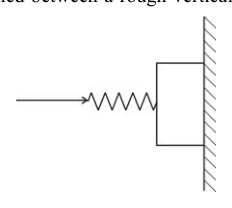
Question 8 A block of mass is sandwiched between a rough vertical wall and a horizontally oriented spring with spring constant . If the spring is compressed a distance beyond its uncompressed length, then the minimum coefficient of static friction for which the block does not fall is
- A. ;
- B. ;
- C. ;
- D. .
Question 9 A light wave has a high enough frequency to ionize an atom. If the amplitude of the light wave is tripled, the chance of an atom being ionized by the light wave increases by a factor of
- A. 1;
- B. ;
- C. 3;
- D. 9.
Question 10 A 100-kg student eats a 200-calorie doughnut. To ‘burn off the sugar high’, he decides to climb the steps of a tall building. How high would he have to climb to expend an equivalent amount of work? (1 food calorie = calories ~ 4200 J).
- A. 273 m;
- B. 428 m;
- C. 857 m;
- D. 8400 m.
Question 11 In an insulated vessel, 250 g of ice at is added to 600 g of water at . The latent heat of fusion is ~ J/kg. The amount of ice remaining when the system reaches thermal equilibrium is
- A. 0 g;
- B. 114 g;
- C. 136 g;
- D. 45.2 g.
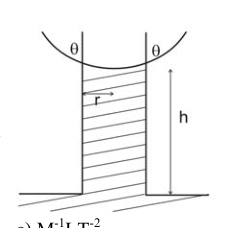
Question 12 A liquid will rise in a narrow tube (capillary action) if the adhesive forces between the molecules of the liquid and the molecules of the tube are greater than the cohesive forces between the molecules of the liquid. The height of a column of liquid of density drawn up a tube of radius is given by
where is the contact angle between the surface of the liquid and the tube, is the acceleration due to gravity, and is a constant that depends on a number of parameters. The dimensions of are given by
- A. ;
- B. ;
- C. ;
- D. ;
- E. none of the above.
Question 13 If the Earth’s polar land-based glaciers melted, water would be redistributed on the planet, and the depression in the earth’s crust made by the weight of the ice would rebound, as the land rises when the weight of the glaciers is removed (an effect known as Post-Glacial Rebound or Glacial Isostatic Adjustment). Following post-glacial rebound, the length of day would
- A. increase;
- B. decrease;
- C. remain the same as the present length of day;
- D. at first increase but then shortly return to the present length of day; e) at first decrease but then shortly return to the present length of day.
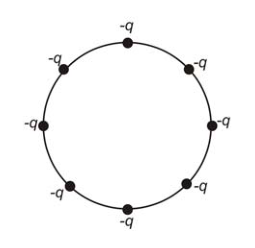
Question 14 Eight identical negative charges are arranged symmetrically on a circle of radius , each equidistant from the next. Assume the point charges have zero potential at infinity. If the constant of proportionality in Coulomb’s law is , then the magnitude of the electric field and the electrostatic potential at the centre of the circle are given by
a) , ;
b) , ;
c) , ;
d) , ;
e) , .
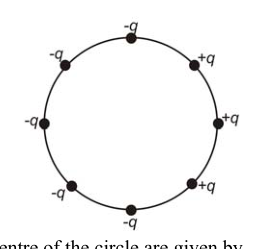
Question 15 Three of the negative charges in the previous questions are replaced with positive charges with the same magnitude, and are arranged as in the figure. The magnitude of the electric field and the electrostatic potential at the centre of the circle are given by
a) , ;
b) , ;
c) , ;
d) , ;
e) None of the above.
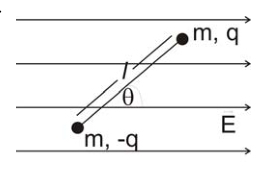
Question 16 An electric dipole consists of two small particles. Each has mass but opposite electric charge . They are separated by a light, nonconducting rod of length . The dipole is placed in a uniform electric field such that it forms an angle to the field, then is released. Its initial angular acceleration about its centre of mass is given by
- A. ;
- B. ;
- C. ;
- D. ;
- E. .
Question 17 At time a block of mass moves with momentum along a rough horizontal surface. If it comes to a complete stop in time , then the coefficient of kinetic friction is given by
- A. ;
- B. ;
- C. ;
- D. ;
- E. None of the above.
Question 18 A fish swimming in water with constant velocity experiences a viscous drag force that is proportional to the square of its velocity (i.e. ). If the fish doubles its velocity, then the thrust force that it must generate to maintain this new velocity is related to the fish’s original thrust force via
- A. ;
- B. ;
- C. ;
- D. ;
- E. None of the above.
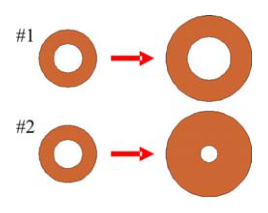
Question 19 A solid object has a hole in it. Which of these illustrations more correctly shows how the size of the object and the hole change as the temperature increases?
- A. illustration #1;
- B. illustration #2;
- C. The answer depends on the material of which the object is made; d) The answer depends on how much the temperature increases; e) Both c) and d) are correct.
Question 20 Two gear wheels of the same thickness, but with one twice the diameter of the other, are mounted on parallel light axles far enough apart not to mesh the teeth of the wheels. The larger wheel is spun with angular velocity and the wheels are then moved together so they mesh. What is the subsequent angular velocity of the larger wheel?
- A. ;
- B. ;
- C. ;
- D. .
Question 21 For the meshed rotating gears of the previous question, what fraction of the original energy is lost?
- A. 1/4;
- B. 1/8;
- C. 1/5;
- D. 2/5.
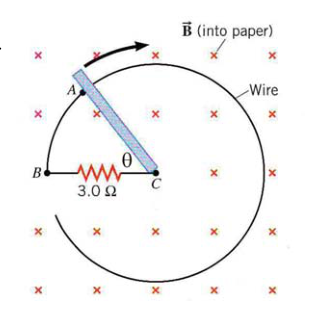
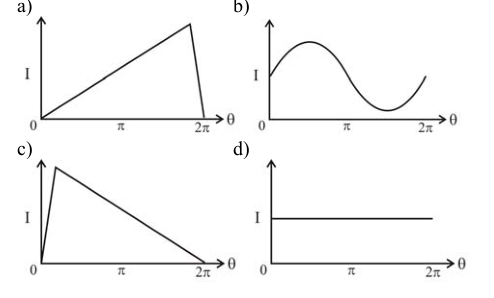
Question 22 The drawing shows a copper wire (of negligible resistance) bent into a circular shape with a radius of . The radial section BC is fixed in place, while the copper bar AC sweeps around at an angular speed of . The bar makes electrical contact with the wire at all times. The wire and the bar have negligible resistance. A uniform magnetic field exists everywhere, is perpendicular to the plane of the circle, and has a magnitude of . Which of the following shows the magnitude of the current as a function of ?
a) b) c) d)
Part B: Problems
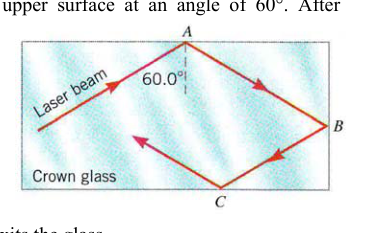 lastra di crown glass con raggio laser
Topic: Geometric Optics, Electrostatics, Rotational Dynamics Metodi: Ray Tracing, Coulomb’s Law, Electric Potential Method, Torque & Angular Momentum Analysis, Faraday’s Law of Induction, Dimensional Analysis, Conservation of Energy Competenze: Physical Reasoning, Mathematical Modeling, Diagrammatic Reasoning Objects: Prism, Point Charge, Magnetic Dipole, Gear, Wire Fonte: Testo (PDF) — p.2
Domanda 7 Il disegno mostra una lastra di vetro di corona di indice di rifrazione 1.5 con sezione trasversale rettangolare. Come illustrato, un laser il fascio colpisce la superficie superiore ad un angolo di . Dopo riflettendo dalla superficie superiore, il fascio riflette da parte e da fondo. Se il vetro è circondato da aria, determinare a quale punto parte Il primo raggione che esce dal vetro.
- A. A;
- B. B;
- C. C;
- D. nessuna delle seguenti.
Domanda 8 Un blocco di massa è inserito tra una verticale ruvida parete e un’armatura orizzontale primavera orientata con primavera costante . Se la primavera è compressa a distanza oltre il suo non compresso lunghezza, quindi il minimo coefficiente di attrito statico per che il blocco non cade è
- A. ;
- B. ;
- C. ;
- D. .
Domanda 9 Un’onda di luce ha una frequenza sufficientemente alta da ionizzare un
-
Atomico. Se l’ampiezza dell’onda luminosa è triplicata, il aumenta la probabilità che un atomo sia ionizzato dall’onda di luce per un fattore di
-
A. 1;
-
B. ;
-
C. 3;
-
D. 9.
Domanda 10 Uno studente di 100 kg mangia una ciambella di 200 calorie. Per ’ bruciare ’ Il zucchero è alto, decide di salire le scale di un alto
-
La costruzione. Quanto alto dovrebbe essere il suo altiere per spendere un un’entità equivalente di lavoro? 1 calorie alimentari = calorie 4200 J).
-
A. 273 m;
-
B. 428 m;
-
C. 857 m;
-
D. 8400 m.
Domanda 11 In un recipiente isolato, 250 g di ghiaccio vengono aggiunti a 600 g di acqua a . Il calore latente della fusione è ~ J/kg. La quantità di ghiaccio rimasta quando il sistema raggiunge l’equilibrio termico è
- A. 0 g;
- B. 114 g;
- C. 136 g;
- D. 45.2 g.
Domanda 12 Un liquido si alzerà in un tubo stretto (azione capillare) se il le forze adesive tra le molecole del liquido e il Le molecole del tubo sono più grandi delle forze coesive tra le molecole del liquido. L’altezza di una colonna di liquido di densità costituito da un tubo di raggio è dato da
dove è l’angolo di contatto tra la superficie del liquido e il tubo, è l’accelerazione a causa della gravità, e è una costante che dipende da un certo numero di
-
I parametri. Le dimensioni di sono dati da
-
A. ;
-
B. ;
-
C. ;
-
D. ;
-
E. nessuna delle seguenti.
Domanda 13 Se i ghiacciai polari della Terra fondessero, l’acqua La crisi economica e la crisi economica la crosta terrestre fatta dal peso del ghiaccio rimbalzerebbe, quando la terra si alza quando il peso dei ghiacciai viene rimosso (un effetto noto come rimbalzo post-glaciale o glaciale Regolazione isostatica). Dopo il rimbalzo postglaciale, il La durata del giorno
- aumento di MSK0/>A.**;
- B. diminuzione;
- C. rimane la stessa durata di giornata attuale;
- D. all’inizio dell’aumento ma poi presto ritorno al presente durata della giornata; e) all’inizio diminuire ma poi tornare presto al presente
- La durata della giornata.
Domanda 14 Otto negativi identici Sono organizzati i costi simmetricamente su un cerchio di radius , ogni distanza pari
- Dalla prossima. Supponiamo che le cariche puntate hanno zero Potenzialmente infinito. Se il costante di proporzionalità in legge di Coulomb è , quindi la grandezza dell’elettricità campo e l’elettrostatico Potenzialmente, il potenziale al centro del cerchio è dato da
a) , ;
b) , ;
c) , ;
d) , ;
e) , .
Domanda 15 Tre dei negativi
- le spese in precedenza le domande sono sostituite dal
- le spese positive con il la stessa magnitudo e sono
- il sistema di controllo è stato riordinato come nella figura. L’entità della campo elettrico e Potenzialmente, il potenziale elettrostatico al centro del cerchio è dato da
a) , ;
b) , ;
c) , ;
d) , ;
e) Nessuna delle seguenti.
Domanda 16 Un dipolo elettrico è costituito da: due piccole particelle. Ciascuno ha massa ma opposta elettrica carica . Sono separati da una canna leggera non conduttiva di lunghezza . Il dipolo è collocato in un campo elettrico uniforme tale da formare un angolo con il campo, poi viene rilasciato. La sua accelerazione angolare iniziale circa il suo centro di massa è dato da
- A. ;
- B. ;
- C. ;
- D. ;
- E. .
Domanda 17 In tempo un blocco di massa si muove con impulso lungo una superficie orizzontale ruvida. Se si tratta di un completo la fermata in tempo , quindi il coefficiente di attrito cinetico è data da
- A. ;
- B. ;
- C. ;
- D. ;
- E. Nessuna delle seguenti.
Domanda 18 Pesce che nuota in acqua con velocità costante si verifica una forza di trazione viscosa proporzionale alla quadrato della sua velocità (cioè ). Se il pesce si raddoppia la sua velocità, quindi la forza di spinta che deve generare per mantenere questa nuova velocità è correlata alla pesca originale forza di spinta via
- A. ;
- B. ;
- C. ;
- D. ;
- E. Nessuna delle seguenti.
Domanda 19 Un oggetto solido ha un buco in it. Quale di queste illustrativi più Il testo di cui al punto 1. dimensioni dell’oggetto e il buco cambia come il l’aumento della temperatura?
- A. illustrazione n. 1;
- B. illustrazione n. 2;
- C. La risposta dipende dal materiale di cui l’oggetto è stato è realizzato; d) La risposta dipende da quanto la temperatura incrementi; e) Sia c) che d) sono corrette.
Domanda 20 Due ruote di ingranaggio dello stesso spessore, ma con una due volte il diametro dell’altro, sono montati su assi di luce paralleli abbastanza distanti da non farsi intrecciare i denti delle ruote. Il una ruota più grande è girata con velocità angolare e le ruote sono poi spostate insieme in modo da mescolare. Che cos’è velocità angolare successiva della ruota più grande?
- A. ;
- B. ;
- C. ;
- D. .
Domanda 21 Per le reti rotative messe della domanda precedente, cosa Una frazione dell’energia originale è persa?
- A. 1/4;
- B. 1/8;
- C. 1/5;
- D. 2/5.
Domanda 22 I disegni mostrano di cui al punto 1.6.1 negligente resistenza) inclinata in forma circolare con un raggio di . La sezione radial BC è fissato in luogo, mentre il bar di rame AC
- Si spazza intorno a un velocità angolare . Il bar fa contatto elettrico con il filo in ogni momento. Il filo e il
- le barre hanno una resistenza trascurabile. Un campo magnetico uniforme esiste ovunque, è perpendicolare al piano del cerchio, e ha una magnitudine di . Qual è il numero di la grandezza della corrente in funzione di ?
a) b) c) d)
Parte B: Problemi
lastra di vetro di corona con laser di raggio
Topic: Geometric Optics, Electrostatics, Rotational Dynamics Metodi: Ray Tracing, Coulomb’s Law, Electric Potential Method, Torque & Angular Momentum Analysis, Faraday’s Law of Induction, Dimensional Analysis, Conservation of Energy Competenze: Physical Reasoning, Mathematical Modeling, Diagrammatic Reasoning Objects: Prism, Point Charge, Magnetic Dipole, Gear, Wire Fonte: Testo (PDF) — p.2
Problem 1 A double inclined plane is in the form of a wedge of weight 10 g, held on the ground with its base horizontal and rough faces inclined at and respectively to the horizontal. A 5 g particle on the face inclined at is connected by a mass less, flexible, inextensible string over a smooth mass less pulley at the ridge of the wedge to a 7 g particle on the other face. If the coefficient of friction between each of the particles and the wedge is 1/5, find the accelerations of the particles and the magnitude of the vertical force between the wedge and the ground.
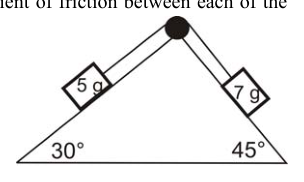 piano doppio inclinato 30 e 45 gradi
Topic: Newtonian Mechanics Metodi: Free-Body Diagram, Vector Decomposition, Kinematic Equations Competenze: Diagrammatic Reasoning, Mathematical Modeling Objects: Wedge, Inclined Plane, Pulley, String Fonte: Testo (PDF) — p.5
Problema 1 Un piano a doppia inclinazione è in forma di un cuneo di peso 10 g, tenuti a terra con la base orizzontale e rugosa le facce incline rispettivamente a e orizzontale. Una particella di 5 g sulla faccia inclinata a è collegata da un massa inferiore, stringhe flessibili e inestensibili su una massa liscia meno pollice alla cresta della ciglia a una particella di 7 g sulla l’altra faccia. Se il coefficiente di attrito tra ciascuna delle due particelle e la cuneo è 1/5, trovare il Accelerazioni del Particelle e La grandezza della forza verticale tra la cucina e la
- A terra.
piano doppio inclinato 30 e 45 gradi
Topic: Newtonian Mechanics Metodi: Free-Body Diagram, Vector Decomposition, Kinematic Equations Competenze: Diagrammatic Reasoning, Mathematical Modeling Objects: Wedge, Inclined Plane, Pulley, String Fonte: Testo (PDF) — p.5
Problem 2 Oceanographers have deployed an array of instruments off the west coast of Vancouver Island, connected together by cables carrying power and communication. The power is supplied through a single DC line. The return path is through the sea water. The grounds at each end of the line are large metal spheres.
Consider two copper spheres, radii , buried in an infinite medium of resistivity . Current flows out of one sphere and is collected by the second sphere. The current flow in vicinity of each sphere can be considered radially uniform as the distance between the spheres is large compared with .
a) By considering the series resistance of many thin spherical shells around a sphere show graphically (or by direct integration) that much of the resistance between the spheres is due to material within a radius of each sphere and thereby estimate the total resistance between the spheres. b) If the current flow between the spheres is 1 A, calculate the charge in coulombs on each one.
Topic: Electrostatics, Circuits Metodi: Gauss’s Law, Calculus-Integration, Electric Potential Method Competenze: Mathematical Modeling, Physical Reasoning Objects: Conducting Sphere Fonte: Testo (PDF) — p.5
Il problema 2 Gli oceanografi hanno distribuito una serie di strumenti la costa occidentale dell’isola di Vancouver, collegata da cavi di alimentazione e di comunicazione. Il potere è fornito attraverso una singola linea di corrente continua. Il percorso di ritorno è attraverso l’acqua del mare. I motivi di ogni fine della linea sono grandi sfere metalliche.
Considerate due sfere di rame, radii , sepolte in un infinito media di resistività . Flussi di corrente da una sfera e La seconda sfera è la collettività. Il flusso di corrente in la vicinanza di ciascuna sfera può essere considerata radialmente uniforme La distanza tra le sfere è grande rispetto a .
a) Considerando la resistenza di serie di molti Le conchiglie sferiche intorno a una sfera si mostrano graficamente (o per La maggior parte delle le sfere sono dovute a materiali all’interno di un raggio di ciascuna di una sfera e quindi stimare la resistenza totale tra Le sfere. b) Se il flusso di corrente tra le sfere è di 1 A, calcolare l’accusa in coulombs su ciascuno di loro.
Topic: Electrostatics, Circuits Metodi: Gauss’s Law, Calculus-Integration, Electric Potential Method Competenze: Mathematical Modeling, Physical Reasoning Objects: Conducting Sphere Fonte: Testo (PDF) — p.5
Problem 3 Sir Ernest Rutherford, a very famous New Zealander who worked at McGill University in Montreal and the Cavendish Laboratory in Cambridge, won the Nobel Prize for his studies of the disintegration of nuclei. He established an important relationship for a nuclear reaction, in which a parent atom disintegrates into a daughter atom, which is called the Rutherford – Soddy law of radioactive disintegration. This law states that if is the number of radioactive nuclei present at some instant, the number of nuclei that decay in a time is given by:
where is called the decay constant. We can integrate this expression to get the relationship
where represents the number of radioactive nuclei at time .
a) Show that the time taken for (known as the half-life), is given by .
Potassium-argon (K-Ar) dating is used in earth science to determine the age of a rock sample. The potassium isotope is radioactive and decays over time to the argon isotope . When a rock is molten the argon gas is released into the atmosphere but as the rock cools and crystallizes, the daughter argon atoms are trapped within the rock matrix. Time since crystallization is calculated by measuring the ratio of the amount of accumulated to the amount of remaining.
The two possible nuclear reaction for to change to are:
b) Describe the physical process that is occurring in these reactions. c) Which of the two is the more likely to occur? d) Most of the potassium (89.1%) decays to . What is the equation for this reaction?
The approximate ratio of the amount of to that of is directly related to the time elapsed since the rock was cool enough to trap the argon by the following equation:
Where is the half-life of , is the amount of remaining in the sample, and is the amount of found in the sample.
e) If a rock sample has remained undisturbed for 50 million years and the half-life of is years, what ratio of Ar/K should be measured in the sample?
Topic: Nuclear & Particle Physics Metodi: Radioactive Decay Law, Differential Equations, Conservation Laws Competenze: Mathematical Modeling, Physical Reasoning Objects: Nucleus, Atom Fonte: Testo (PDF) — p.5
Figure
Figure
Figure
Figure
Figure
Figure
Figure
Figure
Figure
Figure
Figure
Figure
Figure
Figure
Figure
p.3 — tubo capillare angolo contatto h e r
p.3 — blocco compresso tra molla e parete
p.3 — otto cariche negative su cerchio
p.3 — cinque cariche negative tre positive su cerchio
p.4 — dipolo elettrico in campo uniforme
p.4 — filo circolare con sbarra rotante campo B
p.4 — quattro grafici corrente vs angolo theta
p.4 — solido con foro espansione termica illustrazioni
Il problema 3 Sir Ernest Rutherford, un famoso neozelandese che ha lavorato presso la McGill University di Montreal e il Cavendish Laboratorio di Cambridge, vinse il Premio Nobel per la sua studi sulla disintegrazione dei nuclei. Ha istituito un Relazione importante per una reazione nucleare, in cui un l’atomo genitore si disintegra in un atomo figlia, che è chiamato la legge di Rutherford Soddy di radioattivo
- la disintegrazione. La legge stabilisce che se è il numero di I nuclei radioattivi presenti in un istante, il numero di nuclei che si decompongono in un tempo sono dati da:
dove è chiamata costante di decadimento. Possiamo integrare questo espressione per ottenere la relazione
in cui rappresenta il numero di nuclei radioattivi in tempo .
a) Indicare che il tempo impiegato per (noto come il tempo di La durata di semivita’ (Half-Life) è data da .
La datazione potassio-argonico (K-Ar) è utilizzata nella scienza della terra per determinare l’età di un campione di roccia. Isotopo di potassio è radioattivo e si decompone nel tempo all’argon isotopo . Quando una roccia è fuso il gas argone è la temperatura del pianeta è aumentata, La struttura di argone è costituita da atomi di argone. La rock matrix. Il tempo dal momento della cristallizzazione è calcolato da misura il rapporto tra la quantità di accumulata a l’importo di rimanente.
Le due reazioni nucleari possibili per per cambiare a sono:
b) Descrivere il processo fisico che si verifica in questi
- le reazioni. c) Quale di queste due è più probabile che si verifichi? d) La maggior parte del potassio (89,1%) si decompone fino a . Qual è l’equazione di questa reazione?
Il rapporto * approssimativo * della quantità di a quello di è direttamente correlato al tempo trascorso dal momento della roccia era abbastanza fresco da intrappolare l’argon con le seguenti Equazione:
Se è la semivita di , è la quantità di restante nel campione e è la quantità di trovati nel campione.
e) Se un campione di roccia è rimasto in stato di non disturbo per 50 anni milioni di anni e la semivita di è La misurazione del rapporto di R/K deve essere effettuata in
- campione?
Topic: Nuclear & Particle Physics Metodi: Radioactive Decay Law, Differential Equations, Conservation Laws Competenze: Mathematical Modeling, Physical Reasoning Objects: Nucleus, Atom Fonte: Testo (PDF) — p.5
Figura
Figura
Figura
Figura
Figura
Figura
Figura
Figura
Figura
Figura
Figura
Figura
Figura
Figura
Figura
**p.3 ** tubo capillare angolo contatto h e r
** p.3 ** blocco compresso tra molla e parete
**p.3 ** otto cariche negativo su cerchio
** p.3 ** cinque cariche negative tre positive su cerchio
**p.4 ** dipolo elettrico in campo uniforme
P.4 Filo circolare con sbarra rotante campo B
quattro grafici corrente vs angolo theta
S. 4 S. 1 solido con foro espansione termica illustrazioni