Question 1 A gentleman is swinging his monocle, by its attached light chain, around in a horizontal circle with constant speed. Consider the following forces: (I) a gravitational force acting downwards (II) a force directed inwards, towards the centre of the circle (III) a force in the direction of motion of the monocle (IV) a force directed outwards, away from the centre of the circle Which of the above forces is/are acting on the monocle?
- A. I only.
- B. I and II.
- C. I and III.
- D. I, II and III.
- E. I, III and IV.
Topic: Newtonian Mechanics Metodi: Free-Body Diagram, Physical Modeling, Vector Decomposition Competenze: Physical Reasoning Objects: Pendulum, String Fonte: Testo (PDF) — p.2
Domanda 1 Un signore sta oscillare il suo monocolo, per la sua catena di luce attaccata, intorno in un cerchio orizzontale con velocità costante. Considerate le seguenti forze: (I) una forza gravitazionale che agisce verso il basso
- una forza diretta verso l’interno, verso il centro del cerchio (III) una forza nella direzione del movimento del monocolo (IV) una forza diretta verso l’esterno, lontano dal centro del cerchio Quale delle forze sopra indicate agisce sul monocolo?
- **A ** Solo io.
- B. I e II.
- C. I e III.
- D. I, II e III.
- E. I, III e IV.
Topic: Newtonian Mechanics Metodi: Free-Body Diagram, Physical Modeling, Vector Decomposition Competenze: Physical Reasoning Objects: Pendulum, String Fonte: Testo (PDF) — p.2
Question 2 The speed of light in a vacuum, , depends on two fundamental constants; the permeability of free space, , and the permittivity of free space, . The speed of light is related to these constants by The SI units of are . Recall that a force of 1 N accelerates a mass of 1 kg at . The units of are
- A.
- B.
- C.
- D.
- E.
Topic: Electromagnetism Metodi: Dimensional Analysis Competenze: Unit Conversion, Physical Reasoning Objects: — Fonte: Testo (PDF) — p.2
Domanda 2 La velocità della luce in vuoto, , dipende da due costanti fondamentali: la permeabilità dello spazio libero, , e la permissività dello spazio libero, . La velocità della luce è correlata a queste costanti da Le unità SI di sono . Ricordiamo che una forza di 1 N accelera una massa di 1 kg a . Le unità di sono
- A.
- B.
- C.
- D.
- E.
Topic: Electromagnetism Metodi: Dimensional Analysis Competenze: Unit Conversion, Physical Reasoning Objects: — Fonte: Testo (PDF) — p.2
Question 3 A heavy, decrepit bus has broken down and a small car with a public–spirited driver is pushing it to a garage. While the vehicles are speeding up to cruising speed, a. the amount of force with which the small car pushes against the bus is equal to the amount of force with which the bus pushes back against the small car. b. the amount of force with which the small car pushes against the bus is smaller than the amount of force with which the bus pushes back against the small car. c. the amount of force with which the small car pushes against the bus is greater than the amount of force with which the bus pushes back against the small car. d. the small car’s engine is running so the small car pushes against the bus, but the bus’s engine is not running so it can’t push back against the small car. e. neither the small car nor the bus exert any force on the other. The bus is pushed forward simply because it is in the way of the small car.
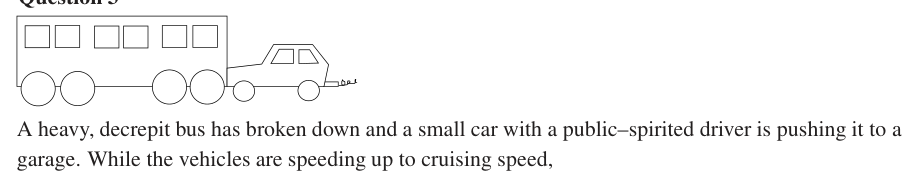 autobus e auto in movimento
Topic: Newtonian Mechanics Metodi: Free-Body Diagram, Physical Modeling Competenze: Physical Reasoning Objects: — Fonte: Testo (PDF) — p.3
Domanda 3 Un pesante autobus decretato si è rotto e una piccola macchina con un conducente pubblico lo sta spingendo verso un’osta.
- Garage. Mentre i veicoli si accelano fino alla velocità di crociera, a. la forza con cui la piccola auto spinge contro l’autobus è pari alla quantità di la forza con cui l’autobus spinge indietro contro la piccola macchina. b. la forza con cui la piccola auto spinge contro l’autobus è inferiore alla forza di la forza con cui l’autobus spinge indietro contro la piccola macchina. c. la forza con cui la piccola auto spinge contro l’autobus è superiore alla forza di la forza con cui l’autobus spinge indietro contro la piccola macchina. d. il motore della piccola auto è in funzione così la piccola auto spinge contro l’autobus, ma il motore dell’autobus non è Correrà così che non possa spingere contro la piccola macchina. e. né la piccola macchina né l’autobus esercitano alcuna forza l’uno sull’altro. L’autobus viene spinto avanti semplicemente Perché è in mezzo alla piccola macchina.
*autobus e auto in movimento *
Topic: Newtonian Mechanics Metodi: Free-Body Diagram, Physical Modeling Competenze: Physical Reasoning Objects: — Fonte: Testo (PDF) — p.3
Question 4 A heavy, decrepit bus has broken down and a small car with a public–spirited driver is pushing it to a garage. After the vehicles have reached a constant cruising speed, a. the amount of force with which the small car pushes against the bus is equal to the amount of force with which the bus pushes back against the small car. b. the amount of force with which the small car pushes against the bus is smaller than the amount of force with which the bus pushes back against the small car. c. the amount of force with which the small car pushes against the bus is greater than the amount of force with which the bus pushes back against the small car. d. the small car’s engine is running so the small car pushes against the bus, but the bus’s engine is not running so it can’t push back against the small car. e. neither the small car nor the bus exert any force on the other. The bus is pushed forward simply because it is in the way of the small car. Page 3 of 12 2011 Physics National Qualifying Examination c⃝Australian Science Innovations 2011 ABN 81731558309
 autobus e auto a velocità costante
Topic: Newtonian Mechanics Metodi: Free-Body Diagram, Physical Modeling Competenze: Physical Reasoning Objects: — Fonte: Testo (PDF) — p.3
Domanda 4 Un pesante autobus decretato si è rotto e una piccola macchina con un conducente pubblico lo sta spingendo verso un’osta.
- Garage. Dopo che i veicoli hanno raggiunto una velocità di crociera costante, a. la forza con cui la piccola auto spinge contro l’autobus è pari alla quantità di la forza con cui l’autobus spinge indietro contro la piccola macchina. b. la forza con cui la piccola auto spinge contro l’autobus è inferiore alla forza di la forza con cui l’autobus spinge indietro contro la piccola macchina. c. la forza con cui la piccola auto spinge contro l’autobus è superiore alla forza di la forza con cui l’autobus spinge indietro contro la piccola macchina. d. il motore della piccola auto è in funzione così la piccola auto spinge contro l’autobus, ma il motore dell’autobus non è Correrà così che non possa spingere contro la piccola macchina. e. né la piccola macchina né l’autobus esercitano alcuna forza l’uno sull’altro. L’autobus viene spinto avanti semplicemente Perché è in mezzo alla piccola macchina. Pagina 3 di 12 2011 Fisica Esame di qualificazione nazionale cAustralia Scienza Innovazioni 2011 ABN 81731558309
*autobus e auto a velocità costante *
Topic: Newtonian Mechanics Metodi: Free-Body Diagram, Physical Modeling Competenze: Physical Reasoning Objects: — Fonte: Testo (PDF) — p.3
Question 5 A chunky tree frog jumps from a tree in an attempt to catch a small, speedy fly. Both are in mid–air and have the same kinetic energy. Which of the following statements is true?
- A. The fly has a greater speed than the tree frog.
- B. The tree frog has a greater speed than the fly.
- C. The fly and the tree frog have the same speed.
- D. The kinetic energy cannot give information about their speeds.
- E. The direction of the fly and the tree frog must be taken into account to compare their speeds.
Topic: Newtonian Mechanics, Conservation of Energy Metodi: Energy Conservation Method Competenze: Physical Reasoning, Mathematical Modeling Objects: — Fonte: Testo (PDF) — p.4
Domanda 5 Una rana di albero sbalza da un albero per cercare di catturare una mosca piccola e veloce. Entrambi sono in mezzo all’aria e hanno la stessa energia cinetica. Quale delle seguenti affermazioni è vera?
- A. La mosca ha una velocità superiore alla rana dell’ albero.
- B. La rana dell’ albero ha una velocità superiore alla mosca.
- C. La mosca e la rana albera hanno la stessa velocità.
- D. L’energia cinetica non può fornire informazioni sulle loro velocità.
- E. Per confrontare le loro velocità deve essere presa in considerazione la direzione della mosca e della rana dell’albero.
Topic: Newtonian Mechanics, Conservation of Energy Metodi: Energy Conservation Method Competenze: Physical Reasoning, Mathematical Modeling Objects: — Fonte: Testo (PDF) — p.4
Question 6 The frog and the fly are approaching each other head on in mid–air, so that their velocities are in opposite directions. The chunky tree frog sticks out his sticky tongue and grabs the light, unfortunate fly, combining the two into a single tree frog — fly object. The kinetic energies of the two creatures before the collision were equal. Which of the following statements is true in the instant after the collision?
- A. The object moves in the same direction as the fly’s original motion.
- B. The object moves in the same direction as the tree frog’s original motion.
- C. The object stops dead in the air.
- D. As soon as they collide they must move directly downwards.
- E. It depends on how hard the tree frog grabs the fly. Page 4 of 12 2011 Physics National Qualifying Examination c⃝Australian Science Innovations 2011 ABN 81731558309
Topic: Conservation of Momentum Metodi: Conservation of Momentum, Impulse-Momentum Theorem Competenze: Physical Reasoning, Mathematical Modeling Objects: — Fonte: Testo (PDF) — p.4
Domanda 6 La rana e la mosca si avvicinano in aria, in modo che le loro velocità siano direzioni opposte. La rana dell’albero grossa… tira fuori la sua lingua appiccicosa e afferra la luce, la mosca sfortunata, combinando le due in un unico oggetto di rana di albero. Le energie cinetiche delle due creature prima La collisione era uguale. Quale delle seguenti affermazioni è vera all’istante dopo la collisione?
- A. L’oggetto si muove nella stessa direzione del movimento originale della mosca.
- B. L’oggetto si muove nella stessa direzione del movimento originale della rana dell’albero.
- C. L’oggetto si ferma morto nell’aria.
- D. Non appena si colpiscono devono muoversi direttamente verso il basso.
- E. Dipende da quanto forte la rana dell’albero afferri la mosca. Pagina 4 di 12 2011 Fisica Esame di qualificazione nazionale cAustralia Scienza Innovazioni 2011 ABN 81731558309
Topic: Conservation of Momentum Metodi: Conservation of Momentum, Impulse-Momentum Theorem Competenze: Physical Reasoning, Mathematical Modeling Objects: — Fonte: Testo (PDF) — p.4
Question 7 A spherical drop of mercury with charge 8Q splits into eight identical spherical droplets, each with the same charge and radius. The electrostatic potential energy of a conducting sphere of radius and charge is , where is a constant. After the droplets are separated far apart so that they no longer interact, the percentage of the initial electrical energy that has been converted into other forms of energy is
- A. 0%
- B. 12.5%
- C. 25%
- D. 50%
- E. 75%
Topic: Electrostatics, Conservation of Energy Metodi: Energy Conservation Method, Coulomb’s Law Competenze: Mathematical Modeling, Physical Reasoning Objects: Droplet, Conducting Sphere Fonte: Testo (PDF) — p.5
Domanda 7 Una goccia sferica di mercurio con carica 8Q si divide in otto gocce sferiche identiche, ognuna con il la stessa carica e il medesimo raggio. L’energia potenziale elettrostatica di una sfera conduttrice di raggio e carica è , dove è una costante. Dopo che le gocce sono separate lontano da sé in modo che non più interagire, la percentuale dell’energia elettrica iniziale che è stata convertita in altre forme di energia is
- A. 0%
- B. 12.5%
- C. 25%
- D. 50%
- E. 75%
Topic: Electrostatics, Conservation of Energy Metodi: Energy Conservation Method, Coulomb’s Law Competenze: Mathematical Modeling, Physical Reasoning Objects: Droplet, Conducting Sphere Fonte: Testo (PDF) — p.5
Question 8 A marauding possum dislodges a tile from the roof of a single–storey house. The tile a. reaches a maximum speed quite soon after release and then falls at a constant speed the rest of the way to the ground. b. speeds up during its entire fall to the ground because the gravitational attraction gets considerably stronger as the brick gets closer to the Earth. c. speeds up during its entire fall to the ground because of an almost constant force of gravity acting on it. d. falls to the ground because of the natural tendency of all objects to rest on the surface of the Earth. e. falls to the ground because of the combined effects of the force of gravity pushing it downward and the force of the air pushing it downward.
Topic: Newtonian Mechanics Metodi: Kinematic Equations, Free-Body Diagram Competenze: Physical Reasoning Objects: — Fonte: Testo (PDF) — p.5
Domanda 8 Un possum di rapina si allontana da un tetto di una casa a un piano. La piastrella a. raggiunge una velocità massima abbastanza presto dopo il rilascio e poi cade a una velocità costante il resto del
- In fondo. b. si accelera durante tutta la sua caduta a terra perché l’attrazione gravitazionale diventa considerevolmente più forte quando il mattone si avvicina alla Terra. c. si accelera durante tutta la sua caduta a terra a causa di una forza di gravità quasi costante che agisce on it. d. cade a terra a causa della naturale tendenza di tutti gli oggetti a riposare sulla superficie della Terra. e. cade a terra a causa degli effetti combinati della forza di gravità che lo spinge verso il basso e la forza dell’aria che lo spinge verso il basso.
Topic: Newtonian Mechanics Metodi: Kinematic Equations, Free-Body Diagram Competenze: Physical Reasoning Objects: — Fonte: Testo (PDF) — p.5
Question 9 A spirit level contains a bubble in a liquid. The level is suddenly jerked forward. Relative to the spirit level and liquid, the bubble moves
- A. backwards, due to its inertia.
- B. backwards, due to a pressure gradient in the liquid.
- C. forwards, due to its inertia.
- D. forwards, due to a pressure gradient in the liquid.
- E. not at all. The bubble and liquid move together. Page 5 of 12 2011 Physics National Qualifying Examination c⃝Australian Science Innovations 2011 ABN 81731558309
Topic: Fluid Mechanics, Newtonian Mechanics Metodi: Hydrostatic Equilibrium, Free-Body Diagram Competenze: Physical Reasoning Objects: Bubble Fonte: Testo (PDF) — p.5
Domanda 9 Un livello di spirito contiene una bolla in un liquido. Il livello è improvvisamente trascinato in avanti. Relativamente allo spirito livello e liquido, la bolla si muove
- A. a causa della sua inerzia.
- B. a ritroso, a causa di un gradiente di pressione nel liquido.
- C., in virtù della sua inerzia.
- D. in avanti, a causa di un gradiente di pressione nel liquido.
- E. non per niente. La bolla e il liquido si muovono insieme. Pagina 5 di 12 2011 Fisica Esame di qualificazione nazionale cAustralia Scienza Innovazioni 2011 ABN 81731558309
Topic: Fluid Mechanics, Newtonian Mechanics Metodi: Hydrostatic Equilibrium, Free-Body Diagram Competenze: Physical Reasoning Objects: Bubble Fonte: Testo (PDF) — p.5
Question 10 The positions of two joggers, Heloise and Abelard, are shown below. The joggers are shown at successive 0.20–second time intervals, and they are moving towards the right. Heloise Abelard 1 1 2 2 3 3 4 4 5 5 6 6 7 7 8 Do Heloise and Abelard ever have the same speed?
- A. No.
- B. Yes, at instant 2.
- C. Yes. at instant 5.
- D. Yes, at instants 2 and 5.
- E. Yes at some time during the interval 3 to 4. Page 6 of 12 2011 Physics National Qualifying Examination c⃝Australian Science Innovations 2011 ABN 81731558309 SECTION B: WRITTEN ANSWER QUESTIONS USE THE ANSWER BOOKLET PROVIDED
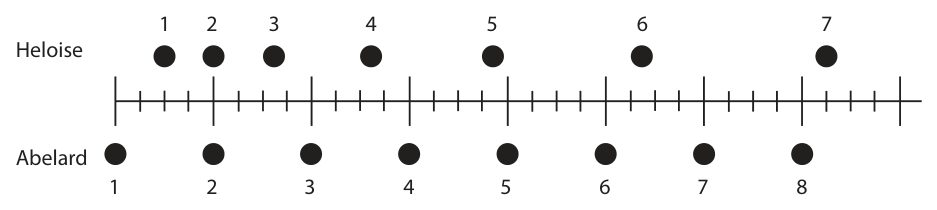 posizioni di due corridori nel tempo
Topic: Newtonian Mechanics Metodi: Kinematic Equations Competenze: Physical Reasoning, Diagrammatic Reasoning Objects: — Fonte: Testo (PDF) — p.6
Domanda 10 Le posizioni di due jogger, Heloise e Abelard, sono riportate di seguito. I joggers sono mostrati al I due gruppi sono stati identificati in una serie di intervalli di tempo successivi di 0,20secondo, e si muovono verso destra. Heloise Abelard 1 1 2 2 3 3 4 4 5 5 6 6 7 7 8 Heloise e Abelard hanno mai la stessa velocità?
- A. No.
- B. Sì, all’ istante 2.
- C. Sì. all’ istante 5.
- D. Sì, nei momenti 2 e 5.
- E. Sì in qualche momento nell’intervallo da 3 a 4. Pagina 6 di 12 2011 Fisica Esame di qualificazione nazionale cAustralia Scienza Innovazioni 2011 ABN 81731558309 PARTE B: Risposte scritte Utilizzate il volantino di risposta fornito
posizioni di corridoi dovuti nel tempo
Topic: Newtonian Mechanics Metodi: Kinematic Equations Competenze: Physical Reasoning, Diagrammatic Reasoning Objects: — Fonte: Testo (PDF) — p.6
Question 11 One end of a spring with spring constant k is fixed at the top of a rough plane inclined at an angle to the horizontal. The other end is attached to a block of mass m and the coefficient of kinetic friction between the block and the slope is . The coefficient of friction is small and the friction is a weak effect, but should be treated exactly. a) Find the extension of the spring from its unstretched length at the position where the system is in equilibrium. You may neglect the influence of friction in this part only. b) Find the potential energy of the system as a function of the displacement from the equilibrium position. c) The spring is now displaced from its equilibrium position by a distance up the plane, and released. Sketch a graph of the displacement of the mass on the spring as a function of time. d) Find the difference in position along the slope between successive points where the mass is stationary and about to move down the slope, and hence determine the maximum number of such points that can occur. Page 7 of 12 2011 Physics National Qualifying Examination c⃝Australian Science Innovations 2011 ABN 81731558309
Topic: Newtonian Mechanics, Oscillations & Waves, Conservation of Energy Metodi: Hooke’s Law, Free-Body Diagram, Energy Conservation Method, Simple Harmonic Motion Analysis Competenze: Mathematical Modeling, Physical Reasoning, Diagrammatic Reasoning Objects: Spring, Block, Inclined Plane Fonte: Testo (PDF) — p.7
Domanda 11 Un’estremità di una molla con costante molla k è fissata in cima a un piano a ruota inclinata ad un angolo a l’orizzontale. L’altra estremità è collegata a un blocco di massa m e al coefficiente di attrito cinetico tra il blocco e la pendenza è . Il coefficiente di attrito è piccolo e la frizione è debole.
- l’effetto, ma deve essere trattato esattamente. a) Trova l’estensione della molla dalla sua lunghezza non allungata nella posizione in cui il sistema si trova in
- l’equilibrio. Potresti trascurare l’influenza della friczione solo in questa parte. b) Trova l’energia potenziale del sistema in funzione del spostamento dall’equilibrio
- La posizione. c) La molla è ora spostata dalla sua posizione di equilibrio per una distanza verso l’alto del piano, e
- E’ stato rilasciato. Segna un grafico del spostamento della massa sulla sorgente in funzione del tempo. d) Trova la differenza di posizione lungo la pendenza tra i punti successivi in cui la massa è di questo tipo di punti che possono verificarsi. Pagina 7 di 12 2011 Fisica Esame di qualificazione nazionale cAustralia Scienza Innovazioni 2011 ABN 81731558309
Topic: Newtonian Mechanics, Oscillations & Waves, Conservation of Energy Metodi: Hooke’s Law, Free-Body Diagram, Energy Conservation Method, Simple Harmonic Motion Analysis Competenze: Mathematical Modeling, Physical Reasoning, Diagrammatic Reasoning Objects: Spring, Block, Inclined Plane Fonte: Testo (PDF) — p.7
Question 12 An empty tin can has radius mm, height mm and wall, base and lid of uniform thickness which lies within the range mm. Wound around its circumference is a string, which is attached to a winch. The can is placed on a slope at angle to the horizontal so that the string runs up the slope as in figure 1. The winch has radius and can be set to turn a fixed number of turns with a constant torque. Both the number of turns and torque can be adjusted. The torque applied by the winch is equal to the winch radius times the force applied to the winching string. The can is initially held stationary and is then released, with the winch set to wind turns of rope. The time taken is measured for a range of different torques, . The force applied by the winching rope is related to the mass of the can and the acceleration of the centre of the can by and also obeys the relationship where is the acceleration of the rope and is a constant. to winch Figure 1: Tin can on a slope attached to a winch a) Given that the density of tin is , find the mass of the tin can and its uncertainty. Also comment on whether you could easily determine the mass more accurately using common household devices. Note that when two values are added or subtracted the uncertainty in the final value is the sum of the uncertainties of the two values. However, when two values are multiplied or divided the fractional uncertainty (the uncertainty divided by the value) of the product or quotient is the sum of the fractional uncertainties of the two values. b) Find combinations of the quantities and t which may be plotted so that the data fall on a straight line and the unknowns I and may be determined from the slope and y-intercept of a line of best fit. Hint: a graph of y vs. x is linear if y is the sum of a term proportional to x and a constant. c) Find I and in terms of the slope and y-intercept of the graph you suggested plotting in the previous part. Page 8 of 12 2011 Physics National Qualifying Examination c⃝Australian Science Innovations 2011 ABN 81731558309
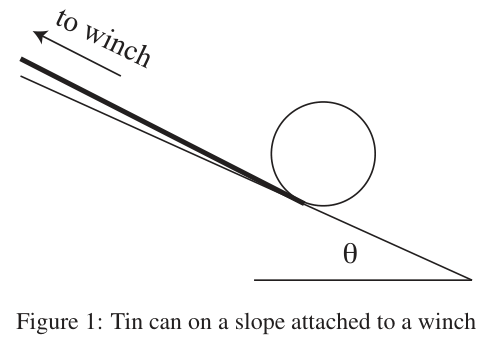 barattolo su piano inclinato con verricello
Topic: Rotational Dynamics Metodi: Torque & Angular Momentum Analysis, Error Propagation, Graph Linearization Competenze: Error Propagation, Graph Linearization, Mathematical Modeling Objects: Cylinder, Inclined Plane, String Fonte: Testo (PDF) — p.8
Domanda 12 Una scatola vuota ha un raggio mm, un’altezza mm e una parete, una base e un coperchio uniformi spessore che si trova nell’intervallo mm. Circondato dalla sua circonferenza è una corda, che è attaccato a un guinzaglio. La lattina è collocata su una pendenza all’angolo orizzontale in modo che la corda sia si alza sulla pendice come nella figura 1. Il guinzaglio ha un raggio e può essere impostato per girare un numero fisso di giri con una coppia costante. Si possono regolare sia il numero di giri che la coppia. La coppia applicata dalla il vincolo è uguale al raggio di vincolo per la forza applicata alla corda di vincolo. La lattina viene inizialmente tenuta fermata e poi rilasciata, con il guinzaglio impostato per far girare le ruote della corda. Il il tempo impiegato è misurato per un intervallo di coppia diversa, . La forza applicata dalla corda a vincere è Relativamente alla massa della lattina e all’accelerazione del centro della lattina, e obbedisce anche alla relazione in cui è l’accelerazione della corda e è una costante. per la vincia Figura 1: Palla di latta su una pendenza attaccata a un guinzaglio a) Considerando che la densità dell’ottico è , si trova la massa della scatola diottico e la sua massa di l’incertezza. Inoltre, commenta se si potrebbe facilmente determinare la massa con più precisione utilizzando dispositivi domestici comuni. Si noti che quando due valori vengono aggiunti o sottratti l’incertezza nel valore finale è la somma di le incertezze dei due valori. Tuttavia, quando due valori sono moltiplicati o divisi, il l’incertezza frazionaria (l’incertezza divisa per il valore) del prodotto o del quotiente è la somma di incertezza frazionaria dei due valori. b) Trovare combinazioni delle quantità e t che possono essere tracciate in modo che i dati cadano su una linea retta linee e le incognite I e possono essere determinate dalla pendenza e dall’intersezione di una linea di best
- Si’, va bene. Suggerimento: un grafico di y vs. x è lineare se y è la somma di un termine proporzionale a x e a una costante. c) Trova I e in termini di pendenza e intersezione y del grafico che hai suggerito di tracciare nel parte precedente. Pagina 8 di 12 2011 Fisica Esame di qualificazione nazionale cAustralia Scienza Innovazioni 2011 ABN 81731558309
*barattolo su pianoforte inclinato con verricello *
Topic: Rotational Dynamics Metodi: Torque & Angular Momentum Analysis, Error Propagation, Graph Linearization Competenze: Error Propagation, Graph Linearization, Mathematical Modeling Objects: Cylinder, Inclined Plane, String Fonte: Testo (PDF) — p.8
Question 13 Pressure is the force per unit area exerted uniformly in all directions by a small volume of fluid on its surrounds. h d r Figure 2: A cylinder containing water d r r’ Figure 3: A conical flask containing water a) Draw a free body diagram showing the forces on the shaded volume of water in figure 2 and hence find the pressure at a depth h below the surface of the water. b) (i) What are the forces exerted by each of the flat bases of the two vessels shown above on the water in that vessel? The circular bases of the two vessels have equal radii, and both vessels are filled to the same depth. (ii) For each case, is this force equal to the total force exerted by the vessel on the water it contains? Explain whether or not you expect the force exerted by the base to equal to the total force in each case, giving physical reasoning for your answer. Also explain any differences between the two cases. Diverting Data: Air pressure at sea level Pa Density of air at sea level Density of water Acceleration due to gravity at sea level Page 9 of 12 2011 Physics National Qualifying Examination c⃝Australian Science Innovations 2011 ABN 81731558309
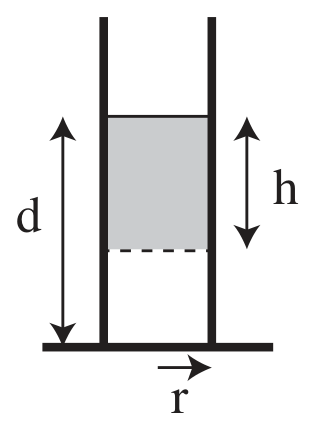 cilindro contenente acqua con etichette
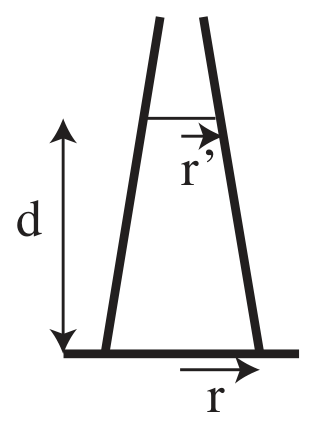 fiasco conico contenente acqua
Topic: Fluid Mechanics Metodi: Hydrostatic Equilibrium, Free-Body Diagram Competenze: Physical Reasoning, Diagrammatic Reasoning, Mathematical Modeling Objects: Container, Cylinder Fonte: Testo (PDF) — p.9
Domanda 13 La pressione è la forza per unità di superficie esercitata uniformemente in tutte le direzioni da un piccolo volume di fluido su
- Circondati. h d r Figura 2: cilindro contenente acqua d r r’ Figura 3: Un flacone conico contenente acqua a) Disegnare un diagramma del corpo libero che mostri le forze sul volume ombroso di acqua nella figura 2 e quindi trovare la pressione a una profondità h sotto la superficie dell’acqua. b)
- Quali sono le forze esercitate da ciascuna delle basi piatte delle due navi sopra indicate sulla acqua in quel recipiente? Le basi circolari delle due navi hanno uguali raggi e entrambe le navi sono riempite alla stessa profondità.
- per ciascun caso, questa forza è pari alla forza totale esercitata dalla nave sull’acqua che essa
- che contiene? Spiegate se si prevede che la forza esercitata dalla base sia pari o meno alla
- In ogni caso, dare un ragionamento fisico per la tua risposta. Spiegare anche Le differenze tra i due casi. Dati di deviazione: Pressione dell’aria al livello del mare Pa Densità dell’aria al livello del mare Densità dell’acqua Accelerazione dovuta alla gravità al livello del mare Pagina 9 di 12 2011 Fisica Esame di qualificazione nazionale cAustralia Scienza Innovazioni 2011 ABN 81731558309
- cilindro contenente acqua con etichetta *
fiasco conico contenente acqua
Topic: Fluid Mechanics Metodi: Hydrostatic Equilibrium, Free-Body Diagram Competenze: Physical Reasoning, Diagrammatic Reasoning, Mathematical Modeling Objects: Container, Cylinder Fonte: Testo (PDF) — p.9
Question 14 Argon atoms are special because they stay in the atmosphere for a very long time. They are not recycled like oxygen and nitrogen. The aim of this problem is to estimate how many of the argon atoms in each of your breaths were once in Galileo Galilei’s lungs. An average breath inhales around 0.5 L of air and people breath on average around once every five seconds. Air is about 1% argon and has density . Assume all air particles have a mass of approximately kg. Take the atmosphere to have constant density and be around 20 km thick. The radius of the Earth is m. Note:
- A. Estimate the number of argon atoms inhaled with each breath.
- B. Estimate the total number of argon atoms that passed through Galileo’s lungs in his 77 years of life. You may assume that when a person breathes, half of the argon atoms in each breath have never been in that person’s lungs before. c) Estimate the total number of argon atoms in the Earth’s atmosphere. d) Assuming that the argon breathed by Galileo is now mixed uniformly through the atmosphere, estimate the number of argon atoms in each of your breaths that were once in Galileo’s lungs. Page 10 of 12 2011 Physics National Qualifying Examination c⃝Australian Science Innovations 2011 ABN 81731558309 There are no further questions in this examination. Page 11 of 12 2011 Physics National Qualifying Examination c⃝Australian Science Innovations 2011 ABN 81731558309 Integrity of Competition If there is evidence of collusion or other academic dishonesty, students will be disqualified. Markers’ decisions are final. Page 12 of 12 2011 Physics National Qualifying Examination c⃝Australian Science Innovations 2011 ABN 81731558309
Topic: Order-of-Magnitude Estimation, Kinetic Theory Metodi: Order-of-Magnitude Estimation, Ideal Gas Law Competenze: Estimation & Approximation, Mathematical Modeling Objects: Atom Fonte: Testo (PDF) — p.10
Domanda 14 Gli atomi di argone sono speciali perché rimangono nell’atmosfera per molto tempo. Non sono riciclati come l’ossigeno e l’azoto. L’obiettivo di questo problema è stimare quanti atomi di argone ciascuno di I tuoi respiri erano una volta nei polmoni di Galileo Galilei. Un respiro medio inala circa 0,5 litri di aria e le persone respirano in media circa una volta ogni cinque
- Segondi. L’aria è di circa l’ 1% di argone e ha una densità . Supponiamo che tutte le particelle di aria abbiano una massa di circa kg. Prendiamo l’atmosfera per avere una densità costante e avere circa 20 km di spessore. Il raggio di radius della Terra è m. Nota:
- A. Estimare il numero di atomi di argone inalati con ogni respiro.
- B. Estima il numero totale di atomi di argone che hanno attraversato i polmoni di Galileo durante i suoi 77 anni di vita La vita. Potresti supporre che quando una persona respira, metà degli atomi di argone in ogni respiro hanno Non sono mai stato nei polmoni di quella persona prima. c) Estimare il numero totale di atomi di argone nell’atmosfera terrestre. d) Supponendo che l’argon respirato da Galileo sia ora mescolato uniformemente nell’atmosfera, stimare il numero di atomi di argone in ciascuno dei vostri respiri che una volta erano nei polmoni di Galileo. Pagina 10 di 12 2011 Fisica Esame di qualificazione nazionale cAustralia Scienza Innovazioni 2011 ABN 81731558309 Non ci sono altre domande in questo esame. Pagina 11 di 12 2011 Fisica Esame di qualificazione nazionale cAustralia Scienza Innovazioni 2011 ABN 81731558309 Integrità della concorrenza Se ci sono prove di collusione o di altre disonestà accademiche, gli studenti saranno Disqualificato. Le decisioni sui marcatori sono definitive. Pagina 12 di 12 2011 Fisica Esame di qualificazione nazionale cAustralia Scienza Innovazioni 2011 ABN 81731558309
Topic: Order-of-Magnitude Estimation, Kinetic Theory Metodi: Order-of-Magnitude Estimation, Ideal Gas Law Competenze: Estimation & Approximation, Mathematical Modeling Objects: Atom Fonte: Testo (PDF) — p.10