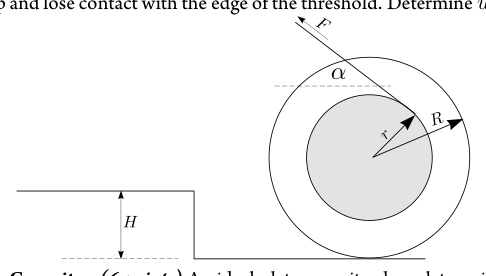
- Spool (12 points) A spool with inner radius and outer radius lies on a horizontal table; the axis of the spool is horizontal. A weightless rope is wound around the inner part as shown in the picture. The loose end of the rope makes an angle with the horizont (the angle can be also negative). The moment of inertia of the spool is and mass — . In what follows you may assume that the spool rolls on the table without slipping. i) (2 pts ) We pull the loose end of the rope with velocity (parallel to the loose part of the rope; that loose part can be thought to be very long). What is the velocity of the spool? ii) (3 pts) Suppose now that the spool is at rest, and we apply force to the loose end of the rope (parallel to the loose part of the rope). What is the acceleration of axis of the spool? iii) (2 pts) How large does the coefficient of friction need to be (as a function of ) to ensure that there is no slipping between the spool and the table? iv) (1.5 pts) Now the spool rolls, again, with velocity ; however there is no rope. The spool hits a threshold of height (see Figure); the impact is perfectly inelastic. What is the speed of the spool immediately after the impact? v) (1.5 pts) What is the speed of the spool after rolling over the threshold? Assume that is such that the spool will roll over the threshold without losing contact with its edge. vi) (2 pts) If the speed is too large, , the spool will jump up and lose contact with the edge of the threshold. Determine .
 bobina con fune su gradino
Topic: Rotational Dynamics, Newtonian Mechanics Metodi: Torque & Angular Momentum Analysis, Free-Body Diagram, Conservation of Energy, Kinematic Equations Competenze: Diagrammatic Reasoning, Mathematical Modeling, Physical Reasoning Objects: Cylinder, String Fonte: Testo (PDF) — p.1
- Svolino (12 punti) Svolino con raggio interno e raggio esterno si trova su una tavola orizzontale; l’asse del bobino è orizzontale. A la corda senza peso è rotulata intorno alla parte interna come mostrato nella
- Immagine. L’estremità sciolta della corda crea un angolo con l’orizzonte (l’angolo può essere anche negativo). Il momento di inerzia di il spool è e la massa . In quanto segue potreste presumere che il spool ruoli sul tavolo senza scivolare. i) (2 punti) Si tira l’estremità sciolta della corda con velocità (parallelle alla parte sciolta della corda; si può pensare che la parte sciolta
- molto lungo). Qual è la velocità del bobino? II) (3 punti) Supponiamo che il spool sia in riposo e applichiamo la forza alla fine sciolta della corda (parallelamente alla parte sciolta della corda) corde). Qual è l’accelerazione dell’asse del bobino? iii) (2 punti) Quanto deve essere grande il coefficiente di attrito (come funzione di ) per garantire che non vi sia alcuna scorregazione tra i
- Il spool e il tavolo? (iv) (1,5 pts) Ora la bobina ruota, di nuovo, con velocità ; tuttavia, Non c’è corda. Il spool raggiunge una soglia di altezza (vedi figura); l’impatto è perfettamente inelastico. Qual è la velocità del
- Una bobina immediatamente dopo l’impatto? v) (1,5 pts) Qual è la velocità del spool dopo il rotolamento della
- La soglia? Supponiamo che sia tale che il spool si arrotolli sul il soglio senza perdere contatto con il suo bordo. vi) (2 pts) Se la velocità è troppo grande, , il spool salterà
- E’ un’idea che non si può fare. Determina .
bobina con fune su gradino
Topic: Rotational Dynamics, Newtonian Mechanics Metodi: Torque & Angular Momentum Analysis, Free-Body Diagram, Conservation of Energy, Kinematic Equations Competenze: Diagrammatic Reasoning, Mathematical Modeling, Physical Reasoning Objects: Cylinder, String Fonte: Testo (PDF) — p.1
- Capacitor (6 points) An ideal plate capacitor has plates with area and separation and is charged so that the electric field between the plates equals to . i) (2 pts) Find the energy density of the electric field inside the capacitor and the total energy of the field. ii) (1.5 pts) What is the force required to keep the plates separated? iii) (2.5 pts) Now, this capacitor is submerged into distilled water of dielectric permittivity ; the electric field between the plates equals still to . What is the hydrostatic pressure between the plates if the atmospheric pressure is and the pressure of the water column can be neglected?
Topic: Electrostatics, Fluid Mechanics Metodi: Electric Potential Method, Gauss’s Law, Hydrostatic Equilibrium Competenze: Physical Reasoning, Mathematical Modeling Objects: Capacitor Fonte: Testo (PDF) — p.1
- Capacitore (6 punti) Un condensatore ideale di piastre ha piastre con area e separazione e è caricata in modo che il campo elettrico tra le piastre è . i) (2 pts) Trova la densità energetica del campo elettrico all’interno del il condensatore e l’energia totale del campo. (ii) (1.5 punti) Qual è la forza necessaria per mantenere le lastre separate? (iii) (2.5 pts) Ora, questo condensatore è immerso in acqua distillata of dielectric permittivity ; the electric field between the le piastre sono ancora . Qual è la pressione idrostatica tra le piastre se la pressione atmosferica è e la pressione del La colonna d’acqua può essere trascurata?
Topic: Electrostatics, Fluid Mechanics Metodi: Electric Potential Method, Gauss’s Law, Hydrostatic Equilibrium Competenze: Physical Reasoning, Mathematical Modeling Objects: Capacitor Fonte: Testo (PDF) — p.1
- Charged cylinder (8 points) Dielectric cylinder of radius carries a charge of surface density on its cylindrical surface and rotates with angular velocity . i) (3 pts) Determine the magnetic induction inside the cylinder. Remark: if you wish, you can use the expression for the inductance of a solenoidal coil of radius , length , area of cross-section and number of loops . ii) (3 pts) A radial conducting wire connects the axis of the cylinder with the cylindrical surface (it rotates together with the cylinder). Find the electromotive force (voltage) between the ends of the wire. iii) (2 pts) Suppose that the wire connecting the axis of the cylinder with the cylindrical surface is not radial and has an arbitary shape (still, there are no segments protruding outside the cylinder). Show that does not depend on the shape of the wire.
Topic: Magnetism, Electromagnetic Induction, Electrostatics Metodi: Ampère’s Law, Faraday’s Law of Induction, Symmetry Argument Competenze: Mathematical Modeling, Physical Reasoning, Diagrammatic Reasoning Objects: Cylinder, Wire Fonte: Testo (PDF) — p.1
- cilindro carico (8 punti) cilindro dielettrico di raggio porta una carica di densità superficiale sulla sua superficie cilindrica e ruota con velocità angolare . i) (3 punti) Determina l’induzione magnetica all’interno del cilindro. Nota: se si desidera, si può usare l’espressione per l’inductanza di una bobina solenoidale di raggio , lunghezza , superficie di sezione trasversale e numero di cicli . ii) (3 punti) Un filo radial conduttore collega l’asse del cilindro alla superficie cilindrica (rotta insieme al cilindro). Trova la forza elettromotrice (voltaggio) tra le estremità di un filo. iii) (2 pts) Supponiamo che il filo che collega l’asse del cilindro con la superficie cilindrica non sia radiale e abbia un arbitrio forma (ancora non ci sono segmenti che si protolgono fuori dal cilindro). Indicare che non dipende dalla forma del filo.
Topic: Magnetism, Electromagnetic Induction, Electrostatics Metodi: Ampère’s Law, Faraday’s Law of Induction, Symmetry Argument Competenze: Mathematical Modeling, Physical Reasoning, Diagrammatic Reasoning Objects: Cylinder, Wire Fonte: Testo (PDF) — p.1
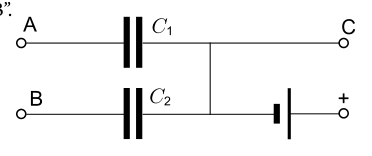
- Black box (10 points) Equipment: a black box with three terminals, voltmeter, timer. Inside the black box, there are two capacitors and a battery, connected as shown in Figure. The capacitance ; you are asked to determine the capacitance and estimate the ucertainty. Remark: the terminal “+” is a wire, long enough to be conected to either terminal “A” or terminal “B”.
 circuito scatola nera C1 C2 batteria
Topic: Circuits, Electrostatics Metodi: Kirchhoff’s Laws, Experimental Data Analysis, Error Propagation Competenze: Experimental Data Analysis, Error Propagation, Mathematical Modeling Objects: Capacitor, Battery, Wire Fonte: Testo (PDF) — p.1
- Cassa nera (10 punti) Attrezzatura: una scatola nera con tre terminali, voltmeter, timer. All’interno della scatola nera ci sono due condensatori e una batteria, collegati come mostrato nella figura. La capacità ; è richiesto di determinare il Capacità e stima l’incertezza. Nota: il terminal
- è un filo, abbastanza lungo da essere collegato a un terminale A o terminal B.
circuito scatola nera C1 C2 batterie
Topic: Circuits, Electrostatics Metodi: Kirchhoff’s Laws, Experimental Data Analysis, Error Propagation Competenze: Experimental Data Analysis, Error Propagation, Mathematical Modeling Objects: Capacitor, Battery, Wire Fonte: Testo (PDF) — p.1
- Plutonium decay (3 points) Plutonium is an unstable element, a atom decays with a half-life of years by creating smaller nuclei, including an -particle. Find the - particle flux density (i.e the number of passing nuclei per unit time and per unit cross-sectional area) near the surface of a plate of . The plate has thickness ; its width and length are much larger than that. The density of plutonium . Remark: half-life is the period of time it takes for a substance undergoing decay to decrease in size (in the number of particles) by half. The mass of an atom of is .
Topic: Nuclear & Particle Physics Metodi: Radioactive Decay Law, Physical Modeling, Order-of-Magnitude Estimation Competenze: Mathematical Modeling, Estimation & Approximation Objects: Nucleus Fonte: Testo (PDF) — p.2
- Decadimento del plutonio (3 punti) Il plutonio è un elemento instabile, a decompone un atomo con una emivita di anni mediante la creazione di nuclei più piccoli, compresa una particella . Trova il - densità di flusso di particelle (cioè il numero di nuclei che passano per unità) tempo e per unità di area di sezione trasversale) vicino alla superficie di una piastra of . Il disegno ha spessore ; la sua larghezza e Le lunghezze sono molto più grandi di questo. La densità del plutonio . Nota: la meta-vita è il periodo di tempo necessario per una sostanza in decomposizione, diminuire di metà la dimensione (nel numero di particelle). La massa di un atomo di è .
Topic: Nuclear & Particle Physics Metodi: Radioactive Decay Law, Physical Modeling, Order-of-Magnitude Estimation Competenze: Mathematical Modeling, Estimation & Approximation Objects: Nucleus Fonte: Testo (PDF) — p.2
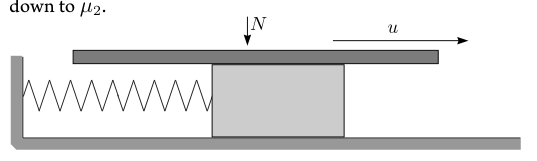
- Violin string (9 points) The motion of a bow puts a violin string into a periodic motion. Let us make a simplified model of this process. The string has elasticity and inertia, so we substitute it by a block of mass , fixed via a spring of stiffness to a motionless wall and laying on a frictionless horizontal surface. The bow is substituted by a horizontal plate, which is pressed with constant force downwards, and which moves with a constant velocity , parallel to the axis of the spring, see Figure. The static coefficient of friction between the plate and the block is , and the kinetic coefficient of friction is . So, as long as the plate does not slide with respect to the block, the coefficient of friction equals to ; as soon as there is some slip, it decreases down to . i) (2 pts) For questions (i) and (ii), let us assume that the speed of the plate is very small as compared to the maximal velocity of the block. What is the maximal velocity of the block (maximized over time)? ii) (2 pts) Sketch qualitatively the graph of the displacement of the block as a function of time and indicate on the graph the durations of the prominent stages of the block motion (graph segments). iii) (1,5 pts) Now, let us abandon the assumption about the smallness of . Sketch qualitatively the graph of the velocity of the block as a function of time. iv) (2,5 pts) Determine the amplitude of the block’s oscillations. v) (1 pt) Which condition (strong inequality, or ) must be satisfied for in order to ensure that the oscillations will be almost harmonic?
 blocco su molla con piatto N e u
Topic: Oscillations & Waves, Newtonian Mechanics Metodi: Simple Harmonic Motion Analysis, Free-Body Diagram, Differential Equations Competenze: Diagrammatic Reasoning, Mathematical Modeling, Physical Reasoning Objects: Block, Spring Fonte: Testo (PDF) — p.2
- String di violino (9 punti) Il movimento di un arco mette un violino string in un movimento periodico. Facciamo un modello semplificato di
- Questo processo. La corda ha elasticità e inerzia, quindi sostituiremo il blocco è stato fissato con un blocco di massa , fissato attraverso una molla di rigidità a una parete immobile e posizionato su una superficie orizzontale senza attrito. Il il pregio è sostituito da una piastra orizzontale, che viene premuta con forza costante verso il basso, e che si muove con una forza costante velocità , parallela all’asse della molla, vedere figura. La statica il coefficiente di attrito tra la piastra e il blocco è , e il coefficiente cinetico di attrito è . Quindi, finché il la piastra non scivola rispetto al blocco, il coefficiente di la frizione è uguale a ; non appena si verifica un certo scivolamento, diminuisce a . I) (2 punti) Per le domande (i) e (ii), supponiamo che la velocità di di è molto piccola rispetto alla velocità massima di Il quartiere. Qual è la velocità massima del blocco (massimizzata nel tempo)?
- (2 punti) Sfogliare qualitativamente il grafico del spostamento del blocco in funzione del tempo e indicare sul grafico le durate di fasi importanti del movimento dei blocchi (segmenti grafici). iii) (1,5 punti) Abbandoniamo ora l’ipotesi della piccolezza di . Segna qualitativamente il grafico della velocità del blocco come funzione del tempo. iv) (2,5 punti) Determinare l’ampiezza delle oscillazioni dei blocchi. V) (1 p) Quali sono le condizioni (stretta disuguaglianza, o ) soddisfatto per per garantire che le oscillazioni siano quasi Armonica?
*blocco su molla con piatto N e u *
Topic: Oscillations & Waves, Newtonian Mechanics Metodi: Simple Harmonic Motion Analysis, Free-Body Diagram, Differential Equations Competenze: Diagrammatic Reasoning, Mathematical Modeling, Physical Reasoning Objects: Block, Spring Fonte: Testo (PDF) — p.2
- Vacuum bulb (8 points) Let us study how a vacuum can be created inside a bulb by pumping. Let the volume of the bulb be , and the pump consist in a piston moving inside a cylinder of volume , where . The pumping cycles starts with piston being pulled up; when the pressure inside the cylinder becomes smaller than inside the bulb, a valve (connecting the cylinder and the bulb) opens and remains open as long as the piston moves up. When piston is released, it starts moving down, at that moment, the valve closes. As long as the valve is open, the pressures of the bulb and the cylinder can be considered as equal to each other. When the piston moves down, the pressure in the cylinder increases adiabatically until becoming equal to the outside pressure ; at that moment, another valve opens leting the gas out of the cylinder. When the piston reaches the botommost position, there is no residual air left inside the cylinder. Now, the piston is ready for being lift up: the valve closes and opens, marking the beginning of the next pumping cycle. The air inside the bulb can be considered isothermal, with the temperature being equal to the surrondin temperature . The adiabatic exponent of air . i) (2 pts) How many pumping cycles needs to be done to reduce the pressure inside bulb from down to , where ? ii) (2 pts) What is the net mechanical work done during such a pumping (covering all the cycles)? iii) (2 pts) What is the temperature of the air released from the cylinder to the surroundings at the end of the pumping process (when the pressure inside the bulb has become equal to )? iv) (2 pts) According to the above described pumping scheme, there is a considerable loss of mechanical work during the period when the piston is released and moves down. Such a loss can be avoided if there is another pump, which moves in an opposite phase: the force due to outside air pressure pushing the piston down can be transmited to the other pump for lifing the piston up. What is the net mechanical work done when such a pumping scheme is used?
Topic: Thermodynamics, Conservation of Energy Metodi: Ideal Gas Law, First Law of Thermodynamics, Thermodynamic Cycle Analysis Competenze: Mathematical Modeling, Physical Reasoning, Estimation & Approximation Objects: Container, Piston, Cylinder, Gas Fonte: Testo (PDF) — p.2
- La lampadina a vuoto (8 punti) Studiamo come può essere un vuoto creato all’interno di una lampadina pompando. Lascia che il volume della lampadina sia , e la pompa è costituita da un pistone che si muove all’interno di un cilindro di volume , dove . I cicli di pompaggio iniziano con il pistone quando la pressione all’interno del cilindro diventa più piccolo dell’interno della lampadina, una valvola (connessione del cilindro) e la lampadina) si apre e rimane aperta finché il pistone si muove up. Quando il pistone viene rilasciato, inizia a muoversi verso il basso, in quel momento la valvola si chiude. Finché la valvola è aperta, la le pressioni della lampadina e del cilindro possono essere considerate uguali
- Un altro. Quando il pistone si sposta verso il basso, la pressione nella il cilindro aumenta adiabaticamente fino a raggiungere la pressione esterna ; in quel momento, un’altra valvola si apre il gas che esce dal cilindro. Quando il pistone raggiunge La posizione inferiore è la più alta, non rimane aria residua all’interno della
- Il cilindro. Ora, il pistone è pronto per essere sollevato: la valvola chiude e si apre, segnando l’inizio della prossima pompaggio ciclo. L’aria all’interno della lampadina può essere considerata isotermica, con la temperatura è pari alla temperatura di circondamento . Il esponente adiabatico dell’aria . i) (2 punti) Quanti cicli di pompaggio occorrono per ridurre la pressione all’interno dell’ampolla da a , dove ? (ii) (2 punti) Qual è il lavoro meccanico netto svolto durante tale pompaggio (che copre tutti i cicli )? iii) (2 pts) Qual è la temperatura dell’aria rilasciata dalla il cilindro verso l’ambiente circostante alla fine del processo di pompaggio (quando la pressione all’interno della lampadina è stata uguale a )? iv) (2 punti) Secondo il sistema di pompaggio descritto sopra, c’è una perdita considerevole di lavoro meccanico durante il periodo quando il pistone viene rilasciato e si muove verso il basso. Una perdita del genere può evitare se c’è un’altra pompa, che si muove in una fase opposta: la forza dovuta alla pressione esterna dell’aria che spinge il pistone può essere trasmesso all’altra pompa per la ripresa del pistone up. Qual è il lavoro meccanico netto svolto quando tale pompaggio
- Si usa lo schema?
Topic: Thermodynamics, Conservation of Energy Metodi: Ideal Gas Law, First Law of Thermodynamics, Thermodynamic Cycle Analysis Competenze: Mathematical Modeling, Physical Reasoning, Estimation & Approximation Objects: Container, Piston, Cylinder, Gas Fonte: Testo (PDF) — p.2
- Heat sink (6 points) Consider a heat sink in the form of a copper plate of a constant thickness (much smaller than the diameter of the plate). An electronic component is fixed to the plate, and a temperature sensor is fixed to the plate at some distance from that compnent. You may assume that the heat flux (i.e. power per unit area) from the plate to the surrounding air is proportional to the difference of the plate temperature at the given point (the coefficient of proportionality is constant over the entire plate, including the site of the electronic component). i) (2 pts) The electronic component has been dissipating energy with a constant power of for a long time, and the average plate temperature has stabilized at the value . Now, the component is switched off, and the average plate temperature starts dropping; it takes to reach the value . Determine the heat capacity (units ) of the plate. The capacities of the electronic component and the temperature sensor are negligible. ii) (4 pts) Now, the electronic component has been switched off for a long time; at the moment , a certain amount of heat is dissipated at it during a very short time. In the Figure and Table, the temperature is given as a function of time, as recorded by the sensor. Determine the dissipated heat amount .
| (s) | 0 | 20 | 30 | 100 | 200 | 300 |
|---|---|---|---|---|---|---|
| (C) | 20.0 | 20.0 | 20.4 | 32.9 | 41.6 | 42.2 |
| (s) | 400 | 600 | 800 | 1000 | 1200 | 1400 |
|---|---|---|---|---|---|---|
| (C) | 39.9 | 33.4 | 27.9 | 24.4 | 22.3 | 21.2 |
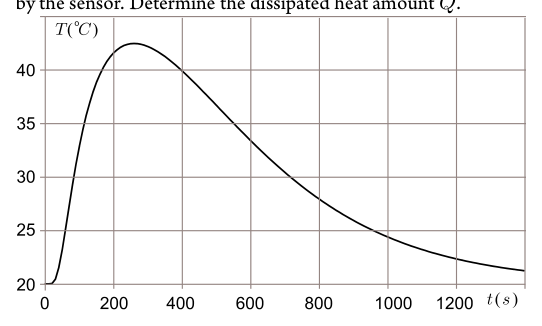 grafico T(t) dissipazione calore
Topic: Thermodynamics, Conservation of Energy Metodi: First Law of Thermodynamics, Experimental Data Analysis, Graph Linearization Competenze: Experimental Data Analysis, Graph Linearization, Mathematical Modeling Objects: — Fonte: Testo (PDF) — p.2
- Sciacquatore di calore (6 punti) Considera un scarico di calore in forma di piastra di rame di spessore costante (molto inferiore al diametro) della piastra). Un componente elettronico è fissato alla targa e un il sensore di temperatura è fissato alla piastra ad una certa distanza da quella
- Non è vero. Si può presumere che il flusso di calore (cioè potenza per unità La superficie della superficie della piastra è proporzionale all’aria circostante. differenza di temperatura della piastra al punto specificato (il coefficiente di proporzionalità è costante su tutta la piastra, incluso il sito del componente elettronico). i) (2 Pts) La componente elettronica ha dissipato energia con una potenza costante di per un lungo periodo e la temperatura media della piastra si è stabilizzata al valore . Ora, il componente è spento, e la temperatura media della piastra inizia a scendere; ci vuole per raggiungere il valore . Determinare la capacità termico (unità ) della
- Piatto. Le capacità del componente elettronico e del sensore di temperatura sono trascurabili. (ii) (4 punti) Ora, il componente elettronico è stato spento per un lungo periodo; al momento , una certa quantità di calore Il viene dissipato in esso in un tempo molto breve. Nella figura e Tabella, la temperatura è data come funzione del tempo, come registrato
- Il sensore. Determinare la quantità di calore dissipato .
| (s) | 0 | 20 | 30 | 100 | 200 | 300 |
|---|---|---|---|---|---|---|
| (C) | 20.0 | 20.0 | 20.4 | 32.9 | 41.6 | 42.2 |
| (s) | 400 | 600 | 800 | 1000 | 1200 | 1400 |
|---|---|---|---|---|---|---|
| (C) | 39.9 | 33.4 | 27.9 | 24.4 | 22.3 | 21.2 |
grafico T) dissipazione calore
Topic: Thermodynamics, Conservation of Energy Metodi: First Law of Thermodynamics, Experimental Data Analysis, Graph Linearization Competenze: Experimental Data Analysis, Graph Linearization, Mathematical Modeling Objects: — Fonte: Testo (PDF) — p.2
- Coefficient of refraction (10 points) Equipment: A thick glass plate having the shape of a half-cylinder, a glass prism, a container with an unknown liquid, a laser pointer, graph paper, ruler. i) (5 pts) Determine the coefficient of refraction of the halfcylindrical glass plate and estimate the uncertainty of the result. ii) (5 pts) Determine the coefficient of refraction of the liquid and estimate the uncertainty of the result.
Topic: Geometric Optics Metodi: Snell’s Law, Physical Modeling, Error Propagation Competenze: Experimental Data Analysis, Measurement & Instrumentation, Error Propagation Objects: Prism, Cylinder Fonte: Testo (PDF) — p.2
- Coefficiente di rifrazione (10 punti) Attrezzatura: vetro spessore piastrelle a forma di semicilindro, prisma di vetro, contenitore con un liquido sconosciuto, un puntatore laser, carta grafica, regolare. i) (5 punti) Determinare il coefficiente di rifrazione della piastra di vetro semicilindrica e stimare l’incertezza del risultato. ii) (5 punti) Determinare il coefficiente di rifrazione del liquido e stimare l’incertezza del risultato.
Topic: Geometric Optics Metodi: Snell’s Law, Physical Modeling, Error Propagation Competenze: Experimental Data Analysis, Measurement & Instrumentation, Error Propagation Objects: Prism, Cylinder Fonte: Testo (PDF) — p.2