Question A1
Single bubble sonoluminescence occurs when sound waves cause a bubble suspended in a fluid to collapse so that the gas trapped inside increases in temperature enough to emit light. The bubble actually undergoes a series of expansions and collapses caused by the sound wave pressure variations.
We now consider a simplified model of a bubble undergoing sonoluminescence. Assume the bubble is originally at atmospheric pressure . When the pressure in the fluid surrounding the bubble is decreased, the bubble expands isothermally to a radius of . When the pressure increases again, the bubble collapses to a radius of so quickly that no heat can escape. Between the collapse and subsequent expansion, the bubble undergoes isochoric (constant volume) cooling back to its original pressure and temperature. For a bubble containing a monatomic gas, suspended in water of , find
a. the number of moles of gas in the bubble,
b. the pressure after the expansion,
c. the pressure after collapse,
d. the temperature after the collapse, and
e. the total work done on the bubble during the whole process.
You may find the following useful: the specific heat capacity at constant volume is and the ratio of specific heat at constant pressure to constant volume is for a monatomic gas.
Topic: Thermodynamics, Kinetic Theory Metodi: Ideal Gas Law, Thermodynamic Cycle Analysis, First Law of Thermodynamics Competenze: Physical Reasoning, Mathematical Modeling Objects: Bubble, Gas Fonte: Testo (PDF) — p.3
La domanda A1
La sola bolla sonoluminescenza si verifica quando le onde sonore causano il collasso di una bolla sospesa in un fluido in modo che il gas intrappolato all’interno aumenta la temperatura sufficiente ad emettere luce. La bolla subisce una serie di espansioni e crolli causati dalle variazioni di pressione delle onde sonore.
Ora consideriamo un modello semplificato di una bolla sottoposta a sonoluminescenza. Supponiamo che la bolla sia originariamente a pressione atmosferica . Quando la pressione nel fluido che circonda la bolla è diminuita, la bolla si espande isotericamente a un raggio di . Quando la pressione aumenta di nuovo, la bolla crolla fino a un raggio di così rapidamente che non può sfuggire alcun calore. Tra il crollo e la successiva espansione, la bolla subisce un raffreddamento isochorico (volume costante) fino alla pressione e alla temperatura originali. Per una bolla contenente un gas monatomo, sospesa in acqua di , si trova
a. il numero di mole di gas nella bolla,
b. la pressione dopo l’espansione,
c. la pressione dopo il crollo,
d. la temperatura dopo il crollo, e
e. il lavoro totale svolto sulla bolla durante l’intero processo.
Potrebbe essere utile il seguente: la capacità termico specifica a volume costante è e il rapporto tra calore specifico a pressione costante e volume costante è per un gas monatomo.
Topic: Thermodynamics, Kinetic Theory Metodi: Ideal Gas Law, Thermodynamic Cycle Analysis, First Law of Thermodynamics Competenze: Physical Reasoning, Mathematical Modeling Objects: Bubble, Gas Fonte: Testo (PDF) — p.3
Question A2
A thin, uniform rod of length and mass is suspended from a point a distance away from its center of mass. When the end of the rod is displaced slightly and released it executes simple harmonic oscillation. The period, , of the oscillation is timed using an electronic timer. The following data is recorded for the period as a function of . What is the local value of ? Do not assume it is the canonical value of . What is the length, , of the rod? No estimation of error in either value is required. The moment of inertia of a rod about its center of mass is .
| (m) | (s) | (m) | (s) |
|---|---|---|---|
| 0.050 | 3.842 | 0.211 | 2.074 |
| 0.075 | 3.164 | 0.302 | 1.905 |
| 0.102 | 2.747 | 0.387 | 1.855 |
| 0.156 | 2.301 | 0.451 | 1.853 |
| 0.198 | 2.115 | 0.588 | 1.900 |
You must show your work to obtain full credit. If you use graphical techniques then you must plot the graph; if you use linear regression techniques then you must show all of the formulae and associated workings used to obtain your result.
Topic: Oscillations & Waves, Rotational Dynamics Metodi: Simple Harmonic Motion Analysis, Graph Linearization, Experimental Data Analysis Competenze: Graph Linearization, Experimental Data Analysis Objects: Rod, Pendulum Fonte: Testo (PDF) — p.3
La domanda A2
Una sottile e uniforme canna di lunghezza e massa è sospesa da un punto a distanza dal suo centro di massa. Quando l’estremità della canna viene spostata leggermente e rilasciata esegue una semplice oscillazione armonica. Il periodo, , dell’oscillazione è cronometrato utilizzando un timer elettronico. I seguenti dati sono registrati per il periodo in funzione di . Qual è il valore locale di ? Non supporre che sia il valore canonico di . Qual è la lunghezza, , della canna? Non è richiesta alcuna stima di errore in entrambi i valori. Il momento di inerzia di una canna intorno al suo centro di massa è .
| (m) | (s) | (m) | (s) |
|---|---|---|---|
| 0.050 | 3.842 | 0.211 | 2.074 |
| 0.075 | 3.164 | 0.302 | 1.905 |
| 0.102 | 2.747 | 0.387 | 1.855 |
| 0.156 | 2.301 | 0.451 | 1.853 |
| 0.198 | 2.115 | 0.588 | 1.900 |
Devi mostrare il tuo lavoro per ottenere il pieno credito. Se si utilizzano tecniche grafiche, allora si deve tracciare il grafico; se si utilizzano tecniche di regressione lineare, allora si deve mostrare tutte le formule e le funzioni associate utilizzate per ottenere il risultato.
Topic: Oscillations & Waves, Rotational Dynamics Metodi: Simple Harmonic Motion Analysis, Graph Linearization, Experimental Data Analysis Competenze: Graph Linearization, Experimental Data Analysis Objects: Rod, Pendulum Fonte: Testo (PDF) — p.3
Question A3
A light bulb has a solid cylindrical filament of length and radius , and consumes power . You are to design a new light bulb, using a cylindrical filament of the same material, operating at the same voltage, and emitting the same spectrum of light, which will consume power . What are the length and radius of the new filament? Assume that the temperature of the filament is approximately uniform across its cross-section; the filament doesn’t emit light from the ends; and energy loss due to convection is minimal.
Topic: Electromagnetism, Thermodynamics Metodi: Dimensional Analysis, Physical Modeling, Conservation of Energy Competenze: Physical Reasoning, Mathematical Modeling Objects: Wire Fonte: Testo (PDF) — p.4
La domanda A3
Una lampadina ha un filamento cilindrico solido di lunghezza e di raggio e consuma energia . Si deve progettare una nuova lampadina, utilizzando un filamento cilindrico dello stesso materiale, che opera alla stessa tensione e emette lo stesso spettro di luce, che consumerà di potenza. Qual è la lunghezza e il raggio del nuovo filamento? Supponiamo che la temperatura del filamento sia approssimativamente uniforme attraverso la sua sezione trasversale; il filamento non emette luce dalle estremità; e la perdita di energia a causa della convezione è minima.
Topic: Electromagnetism, Thermodynamics Metodi: Dimensional Analysis, Physical Modeling, Conservation of Energy Competenze: Physical Reasoning, Mathematical Modeling Objects: Wire Fonte: Testo (PDF) — p.4
Question A4
In this problem we consider a simplified model of the electromagnetic radiation inside a cubical box of side length . In this model, the electric field has spatial dependence
where one corner of the box lies at the origin and the box is aligned with the , , and axes. Let be Planck’s constant, be Boltzmann’s constant, and be the speed of light.
a. The electric field must be zero everywhere at the sides of the box. What condition does this impose on , , and ? (Assume that any of these may be negative, and include cases where one or more of the is zero, even though this causes to be zero.)
b. In the model, each permitted value of the triple corresponds to a quantum state. These states can be visualized in a state space, which is a notional three-dimensional space with axes corresponding to , , and . How many states occupy a volume of state space, if is large enough that the discreteness of the states can be ignored?
c. Each quantum state, in turn, may be occupied by photons with frequency , where
In the model, if the temperature inside the box is , no photon may have energy greater than . What is the shape of the region in state space corresponding to occupied states?
d. As a final approximation, assume that each occupied state contains exactly one photon. What is the total energy of the photons in the box, in terms of , , , , and the volume of the box ? Again, assume that the temperature is high enough that there are a very large number of occupied states. (Hint: divide state space into thin regions corresponding to photons of the same energy.)
Note that while many details of this model are extremely inaccurate, the final result is correct except for a numerical factor.
Topic: Modern-Quantum Physics, Electromagnetism Metodi: Calculus-Integration, Photon Energy Relation, Symmetry Argument Competenze: Physical Reasoning, Mathematical Modeling Objects: Photon Fonte: Testo (PDF) — p.4
Question A4
In questo problema consideriamo un modello semplificato della radiazione elettromagnetica all’interno di una scatola cubica di lunghezza laterale . In questo modello, il campo elettrico ha una dipendenza spaziale
dove un angolo della scatola si trova all’origine e la scatola è allineata agli assi , e . Che sia la costante di Planck, sia la costante di Boltzmann e sia la velocità della luce.
a. Il campo elettrico deve essere zero ovunque ai lati della scatola. Qual è la condizione che questo impone a , e ? (Supponiamo che uno qualsiasi di questi possa essere negativo e includono i casi in cui uno o più dei sono zero, anche se ciò provoca a zero.)
b. Nel modello, ogni valore ammesso del triplo corrisponde a uno stato quantistico. Questi stati possono essere visualizzati in uno spazio di stato, che è uno spazio tridimensionale nozionale con assi corrispondenti a , e . Quanti stati occupano un volume di spazio statale , se è sufficientemente grande da poter ignorare la discrezione degli stati?
c. Ogni stato quantistico, a sua volta, può essere occupato da fotoni con frequenza , dove
Nel modello, se la temperatura all’interno della scatola è , nessun fotone può avere un’energia superiore a . Qual è la forma della regione nello spazio dello Stato corrispondente agli Stati occupati?
d. Come approssimazione finale, supponiamo che ogni stato occupato contenga esattamente un fotone. Qual è l’energia totale dei fotoni nella scatola, in termini di , , , , e del volume della scatola ? Supponiamo di nuovo che la temperatura sia abbastanza alta da permettere di occupare un gran numero di stati. (Signore: dividere lo spazio di stato in regioni sottili corrispondenti a fotoni della stessa energia.)
Si noti che, sebbene molti dettagli di questo modello siano estremamente imprecisi, il risultato finale è corretto, ad eccezione di un fattore numerico.
Topic: Modern-Quantum Physics, Electromagnetism Metodi: Calculus-Integration, Photon Energy Relation, Symmetry Argument Competenze: Physical Reasoning, Mathematical Modeling Objects: Photon Fonte: Testo (PDF) — p.4
Question B1
An AC power line cable transmits electrical power using a sinusoidal waveform with frequency 60 Hz. The load receives an RMS voltage of 500 kV and requires 1000 MW of average power. For this problem, consider only the cable carrying current in one of the two directions, and ignore effects due to capacitance or inductance between the cable and with the ground.
a. Suppose that the load on the power line cable is a residential area that behaves like a pure resistor.
i. What is the RMS current carried in the cable?
ii. The cable has diameter 3 cm, is 500 km long, and is made of aluminum with resistivity . How much power is lost in the wire?
b. A local rancher thinks he might be able to extract electrical power from the cable using electromagnetic induction. The rancher constructs a rectangular loop of length and width , consisting of turns of wire. One edge of the loop is to be placed on the ground; the wire is straight and runs parallel to the ground at a height much less than the length of the wire. Write the current in the wire as , and assume the return wire is far away.
i. Determine an expression for the magnitude of the magnetic field at a distance from the power line cable in terms of , , and fundamental constants.
ii. Where should the loop be placed, and how should it be oriented, to maximize the induced emf in the loop?
iii. Assuming the loop is placed in this way, determine an expression for the emf induced in the loop (as a function of time) in terms of any or all of , , , , , , , and fundamental constants.
iv. Suppose that , , and . How many turns of wire does the rancher need to generate an RMS emf of 120 V?
c. The load at the end of the power line cable changes to include a manufacturing plant with a large number of electric motors. While the average power consumed remains the same, it now behaves like a resistor in parallel with a 0.25 H inductor.
i. Does the power lost in the power line cable increase, decrease, or stay the same? (You need not calculate the new value explicitly, but you should show some work to defend your answer.)
ii. The power company wishes to make the load behave as it originally did by installing a capacitor in parallel with the load. What should be its capacitance?
Topic: Circuits, Electromagnetic Induction Metodi: Ampère’s Law, Faraday’s Law of Induction, Kirchhoff’s Laws Competenze: Physical Reasoning, Mathematical Modeling Objects: Wire, Capacitor, Inductor, Resistor Fonte: Testo (PDF) — p.6
La domanda B1
Un cavo di linea di corrente AC trasmette energia elettrica utilizzando una forma d’onda sinusoidale con frequenza 60 Hz. Il carico riceve una tensione RMS di 500 kV e richiede 1000 MW di potenza media. Per questo problema, si deve considerare solo il cavo che trasporta corrente in una delle due direzioni e ignorare gli effetti dovuti alla capacità o all’induzione tra il cavo e il terreno.
a. Supponiamo che il carico sul cavo di linea elettrica sia un’area residenziale che si comporta come una pura resistenza.
i. Qual è la corrente RMS trasportata nel cavo?
ii. Il cavo ha un diametro di 3 cm, ha una lunghezza di 500 km e è in alluminio con resistività . Quanta energia e’ persa nel cavo?
b. Un contadino locale pensa di poter estrarre energia elettrica dal cavo usando l’induzione elettromagnetica. Il rancher costruisce un ciclo rettangolare di lunghezza e larghezza , costituito da giri di filo . Un bordo del cerchio deve essere posto sul terreno; il filo è retto e corre parallelo al terreno ad un’altezza molto inferiore alla lunghezza del filo. Scrivi la corrente nel filo come e supponi che il filo di ritorno sia lontano.
i. Determinare un’espressione della grandezza del campo magnetico a una distanza dal cavo della linea elettrica in termini di , e costanti fondamentali.
ii. Dove dovrebbe essere posizionato il circuito e come dovrebbe essere orientato, per massimizzare l’emf indotto nel circuito?
iii. Supponendo che il loop sia posizionato in questo modo, determinare un’espressione per l’emf indotta nel loop (come funzione di tempo) in termini di una o tutte delle costanti , , , , , , e fondamentali.
iv. Supponiamo che , e . Quante volte di filo ha bisogno il ranchero per generare un RMS emf di 120 V?
c. Il carico alla fine del cavo di linea elettrica cambia per includere un impianto di produzione con un gran numero di motori elettrici. Mentre la potenza media consumata rimane la stessa, ora si comporta come una resistenza in parallelo con un induttore di 0,25 H.
i. L’energia perduta nel cavo della linea elettrica aumenta, diminuisce o rimane uguale? (Non è necessario calcolare esplicitamente il nuovo valore, ma si dovrebbe mostrare qualche lavoro per difendere la risposta.)
ii. La società elettrica desidera che il carico si comporti come aveva fatto originariamente installaendo un condensatore in parallelo con il carico. Qual dovrebbe essere la sua capacità?
Topic: Circuits, Electromagnetic Induction Metodi: Ampère’s Law, Faraday’s Law of Induction, Kirchhoff’s Laws Competenze: Physical Reasoning, Mathematical Modeling Objects: Wire, Capacitor, Inductor, Resistor Fonte: Testo (PDF) — p.6
Question B2
A particle is constrained to move on the inner surface of a frictionless parabolic bowl whose cross-section has equation . The particle begins at a height above the bottom of the bowl with a horizontal velocity along the surface of the bowl. The acceleration due to gravity is .
a. For a particular value of horizontal velocity , which we will name , the particle moves in a horizontal circle. What is in terms of , , and/or ?
b. Suppose that the initial horizontal velocity is now . What is the maximum height reached by the particle, in terms of , , and/or ?
c. Suppose that the particle now begins at a height above the bottom of the bowl with an initial velocity .
i. Assuming that is small enough so that the motion can be approximated as simple harmonic, find the period of the motion in terms any or all of the mass of the particle , , , and/or .
ii. Assuming that is not small, will the actual period of motion be greater than, less than, or equal to your simple harmonic approximation above? (You need not calculate the new value explicitly, but you should show some work to defend your answer.)
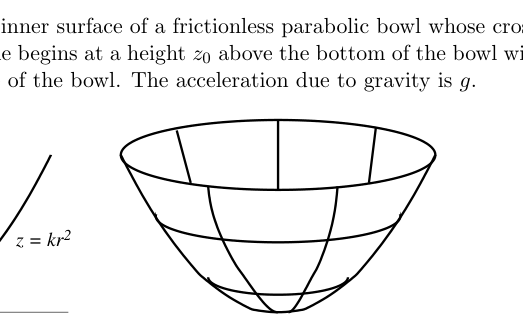 Parabolic bowl cross-section z=kr²
Topic: Newtonian Mechanics, Oscillations & Waves Metodi: Conservation Laws, Small-Angle Approximation, Free-Body Diagram Competenze: Physical Reasoning, Mathematical Modeling Objects: — Fonte: Testo (PDF) — p.7
La domanda B2
Una particella è costretta a muoversi sulla superficie interna di una ciotola parabolica senza attrito la cui sezione trasversale ha l’equazione . La particella inizia ad un’altezza sopra il fondo della ciotola con una velocità orizzontale lungo la superficie della ciotola. L’accelerazione dovuta alla gravità è .
a. Per un particolare valore di velocità orizzontale , che chiameremo , la particella si muove in un cerchio orizzontale. Qual è in termini di , e/o ?
b. Supponiamo che la velocità orizzontale iniziale sia ora . Qual è l’altezza massima raggiunta dalla particella in termini di , , e/o ?
c. Supponiamo che la particella comincia ora ad un’altezza sopra il fondo della ciotola con una velocità iniziale .
i. Supponendo che sia abbastanza piccola da poter approssimare il movimento come semplice armonico, si trova il periodo del movimento in termini di parte o di tutta la massa della particella , , e/o .
ii. Supponendo che non sia piccola, il periodo di movimento effettivo sarà maggiore, inferiore o uguale alla semplice approssimazione armonica sopra? (Non è necessario calcolare esplicitamente il nuovo valore, ma si dovrebbe mostrare qualche lavoro per difendere la risposta.)
Sezione trasversale della ciotola parabolica z=kr2
Topic: Newtonian Mechanics, Oscillations & Waves Metodi: Conservation Laws, Small-Angle Approximation, Free-Body Diagram Competenze: Physical Reasoning, Mathematical Modeling Objects: — Fonte: Testo (PDF) — p.7