- A cyclist travels at a constant speed of 22.0 km/hr except for a 20 minute stop. The cyclist’s average speed was 17.5 km/hr. How far did the cyclist travel?
- A. 28.5 km
- B. 30.3 km
- C. 31.2 km
- D. 36.5 km
- E. 38.9 km Questions 2 to 4 refer to the three graphs below which show velocity of three objects as a function of time. Each object is moving only in one dimension.
Topic: Newtonian Mechanics Metodi: Kinematic Equations, Physical Modeling Competenze: Physical Reasoning, Mathematical Modeling Objects: — Fonte: Testo (PDF) — p.2
- Un ciclista viaggia a una velocità costante di 22,0 km/h, tranne una sosta di 20 minuti. La velocità media del ciclista era 17.5 km/hr. Quanto lontano ha viaggiato il ciclista?
- A. 28.5 km
- B. 30.3 km
- C. 31.2 km
- D. 36.5 km
- E. 38.9 km Le domande da 2 a 4 si riferiscono ai tre grafici che mostrano la velocità di tre oggetti come funzione
- Non è tempo. Ogni oggetto si muove solo in una dimensione.
Topic: Newtonian Mechanics Metodi: Kinematic Equations, Physical Modeling Competenze: Physical Reasoning, Mathematical Modeling Objects: — Fonte: Testo (PDF) — p.2
- Rank the magnitudes of the average acceleration during the ten second interval.
- A. I > II > III
- B. II > I > III
- C. III > II > I
- D. I > II = III
- E. I = II = III
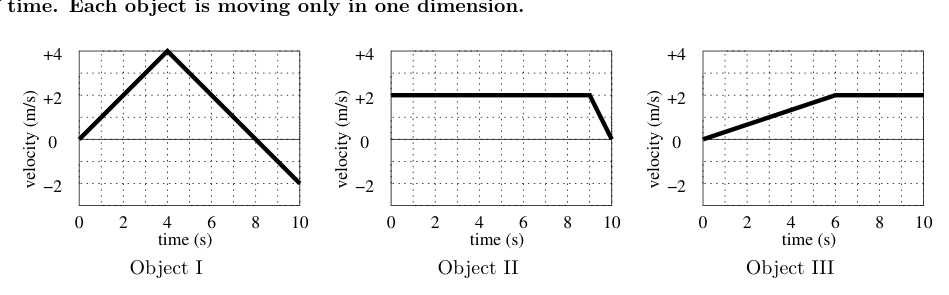 Tre grafici velocita-tempo oggetti I II III
Topic: Newtonian Mechanics Metodi: Kinematic Equations, Free-Body Diagram Competenze: Physical Reasoning, Diagrammatic Reasoning Objects: — Fonte: Testo (PDF) — p.2
- Rendi le magnitudini dell’accelerazione media durante l’intervallo di dieci secondi.
- A. I > II > III
- B. II > I > III
- C. III > II > I
- D. I > II = III
- E. I = II = III
Tre grafici velocita-tempo oggetti I II III
Topic: Newtonian Mechanics Metodi: Kinematic Equations, Free-Body Diagram Competenze: Physical Reasoning, Diagrammatic Reasoning Objects: — Fonte: Testo (PDF) — p.2
- Rank the magnitudes of the maximum velocity achieved during the ten second interval.
- A. I > II > III
- B. II > I > III
- C. III > II > I
- D. I > II = III
- E. I = II = III
Topic: Newtonian Mechanics Metodi: Kinematic Equations, Physical Modeling Competenze: Physical Reasoning, Diagrammatic Reasoning Objects: — Fonte: Testo (PDF) — p.2
- Rango le magnitudini della velocità massima raggiunta durante l’intervallo di dieci secondi.
- A. I > II > III
- B. II > I > III
- C. III > II > I
- D. I > II = III
- E. I = II = III
Topic: Newtonian Mechanics Metodi: Kinematic Equations, Physical Modeling Competenze: Physical Reasoning, Diagrammatic Reasoning Objects: — Fonte: Testo (PDF) — p.2
- Rank the magnitudes of the distance traveled during the ten second interval.
- A. I > II > III
- B. II > I > III
- C. III > II > I
- D. I = II > III
- E. I = II = III
Topic: Newtonian Mechanics Metodi: Kinematic Equations, Calculus-Integration Competenze: Physical Reasoning, Diagrammatic Reasoning Objects: — Fonte: Testo (PDF) — p.2
- Rango le magnitudini della distanza percorsa durante l’intervallo di dieci secondi.
- A. I > II > III
- B. II > I > III
- C. III > II > I
- D. I = II > III
- E. I = II = III
Topic: Newtonian Mechanics Metodi: Kinematic Equations, Calculus-Integration Competenze: Physical Reasoning, Diagrammatic Reasoning Objects: — Fonte: Testo (PDF) — p.2
- A crude approximation is that the Earth travels in a circular orbit about the Sun at constant speed, at a distance of 150,000,000 km from the Sun. Which of the following is the closest for the acceleration of the Earth in this orbit?
- A. exactly
- B.
- C.
- D.
- E.
Topic: Gravitation, Newtonian Mechanics Metodi: Kinematic Equations, Newton’s Law of Gravitation Competenze: Physical Reasoning, Mathematical Modeling Objects: Planet, Star Fonte: Testo (PDF) — p.3
- Un’approssimazione grezza è che la Terra viaggia in orbita circolare attorno al Sole a velocità costante, a una distanza di 150 milioni di chilometri dal Sole. Quale delle seguenti è il più vicino all’accelerazione della Terra in questa orbita?
- A. esattamente
- B.
- C.
- D.
- E.
Topic: Gravitation, Newtonian Mechanics Metodi: Kinematic Equations, Newton’s Law of Gravitation Competenze: Physical Reasoning, Mathematical Modeling Objects: Planet, Star Fonte: Testo (PDF) — p.3
- A child is sliding out of control with velocity across a frozen lake. He runs head-on into another child, initially at rest, with 3 times the mass of the first child, who holds on so that the two now slide together. What is the velocity of the couple after the collision?
- A.
- B.
- C.
- D.
- E.
Topic: Conservation of Momentum Metodi: Conservation of Momentum, Conservation Laws Competenze: Physical Reasoning, Mathematical Modeling Objects: — Fonte: Testo (PDF) — p.3
- Un bambino si sta scivolando fuori controllo con velocità attraverso un lago congelato. Si incrocia di fronte ad un altro bambino, inizialmente in riposo, con 3 volte la massa del primo bambino, che si tiene così che i due ora scivolare insieme. Che cos’è velocità della coppia dopo la collisione?
- A.
- B.
- C.
- D.
- E.
Topic: Conservation of Momentum Metodi: Conservation of Momentum, Conservation Laws Competenze: Physical Reasoning, Mathematical Modeling Objects: — Fonte: Testo (PDF) — p.3
- An ice skater can rotate about a vertical axis with an angular velocity by holding her arms straight out. She can then pull in her arms close to her body so that her angular velocity changes to , without the application of any external torque. What is the ratio of her final rotational kinetic energy to her initial rotational kinetic energy?
- A.
- B. 2
- C.
- D. 4
- E. 8
Topic: Rotational Dynamics, Conservation of Energy Metodi: Torque & Angular Momentum Analysis, Conservation Laws, Energy Conservation Method Competenze: Physical Reasoning, Mathematical Modeling Objects: — Fonte: Testo (PDF) — p.3
- Un pattinatore di ghiaccio può ruotare intorno ad un asse verticale con una velocità angolare tenendo le braccia dritte. Lei… può poi tirare le braccia vicino al corpo in modo che la velocità angolare cambi a , senza l’applicazione di qualsiasi coppia esterna. Qual è il rapporto tra la sua energia cinetica di rotazione finale e la sua energia cinetica iniziale?
- A.
- B. 2
- C.
- D. 4
- E. 8
Topic: Rotational Dynamics, Conservation of Energy Metodi: Torque & Angular Momentum Analysis, Conservation Laws, Energy Conservation Method Competenze: Physical Reasoning, Mathematical Modeling Objects: — Fonte: Testo (PDF) — p.3
- When a block of wood with a weight of 30 N is completely submerged under water the buoyant force on the block of wood from the water is 50 N. When the block is released it floats at the surface. What fraction of the block will then be visible above the surface of the water when the block is floating?
- A. 1/15
- B. 1/5
- C. 1/3
- D. 2/5
- E. 3/5
Topic: Fluid Mechanics Metodi: Hydrostatic Equilibrium, Free-Body Diagram Competenze: Physical Reasoning, Mathematical Modeling Objects: Block Fonte: Testo (PDF) — p.3
- Quando un blocco di legno di peso di 30 N è completamente sommerso sotto l’acqua, la forza galleggiante sul blocco di legno proveniente dall’acqua è di 50 N. Quando il blocco viene rilasciato galleggia sulla superficie. Che frazione del blocco e poi essere visibile sopra la superficie dell’acqua quando il blocco è galleggiante?
- A. 1/15
- B. 1/5
- C. 1/3
- D. 2/5
- E. 3/5
Topic: Fluid Mechanics Metodi: Hydrostatic Equilibrium, Free-Body Diagram Competenze: Physical Reasoning, Mathematical Modeling Objects: Block Fonte: Testo (PDF) — p.3
- A spring has an equilibrium length of 2.0 meters and a spring constant of 10 newtons/meter. Alice is pulling on one end of the spring with a force of 3.0 newtons. Bob is pulling on the opposite end of the spring with a force of 3.0 newtons, in the opposite direction. What is the resulting length of the spring?
- A. 1.7 m
- B. 2.0 m
- C. 2.3 m
- D. 2.6 m
- E. 8.0 m
Topic: Newtonian Mechanics Metodi: Hooke’s Law, Free-Body Diagram Competenze: Physical Reasoning, Mathematical Modeling Objects: Spring Fonte: Testo (PDF) — p.3
- Una molla ha una lunghezza di equilibrio di 2,0 metri e una costante di molla di 10 newtons/metro. Alice sta continuando . una estremità della primavera con una forza di 3,0 newtons. Bob sta tirando sull’estremità opposta della primavera con una forza di 3,0 newtons, nella direzione opposta. Qual è la lunghezza della primavera?
- A. 1.7 m
- B. 2.0 m
- C. 2.3 m
- D. 2.6 m
- E. 8.0 m
Topic: Newtonian Mechanics Metodi: Hooke’s Law, Free-Body Diagram Competenze: Physical Reasoning, Mathematical Modeling Objects: Spring Fonte: Testo (PDF) — p.3
- Which of the following changes will result in an increase in the period of a simple pendulum?
- A. Decrease the length of the pendulum
- B. Increase the mass of the pendulum
- C. Increase the amplitude of the pendulum swing
- D. Operate the pendulum in an elevator that is accelerating upward
- E. Operate the pendulum in an elevator that is moving downward at constant speed.
Topic: Oscillations & Waves Metodi: Simple Harmonic Motion Analysis, Physical Modeling Competenze: Physical Reasoning, Mathematical Modeling Objects: Pendulum Fonte: Testo (PDF) — p.4
- Quali delle seguenti modifiche porteranno ad un aumento del periodo di un semplice pendolo?
- A. Riduce la lunghezza del pendolo
- B. Aumentare la massa del pendolo
- C. Aumentare l’ampiezza dello swing del pendolo
- D. Operare il pendolo in un ascensore che si accelera verso l’alto
- E. Operare il pendolo in un ascensore che si muove verso il basso a velocità costante.
Topic: Oscillations & Waves Metodi: Simple Harmonic Motion Analysis, Physical Modeling Competenze: Physical Reasoning, Mathematical Modeling Objects: Pendulum Fonte: Testo (PDF) — p.4
- A large metal cylindrical cup floats in a rectangular tub half-filled with water. The tap is placed over the cup and turned on, releasing water at a constant rate. Eventually the cup sinks to the bottom and is completely submerged. Which of the following five graphs could represent the water level in the sink as a function of time? (A) (B) (C) (D) (E)
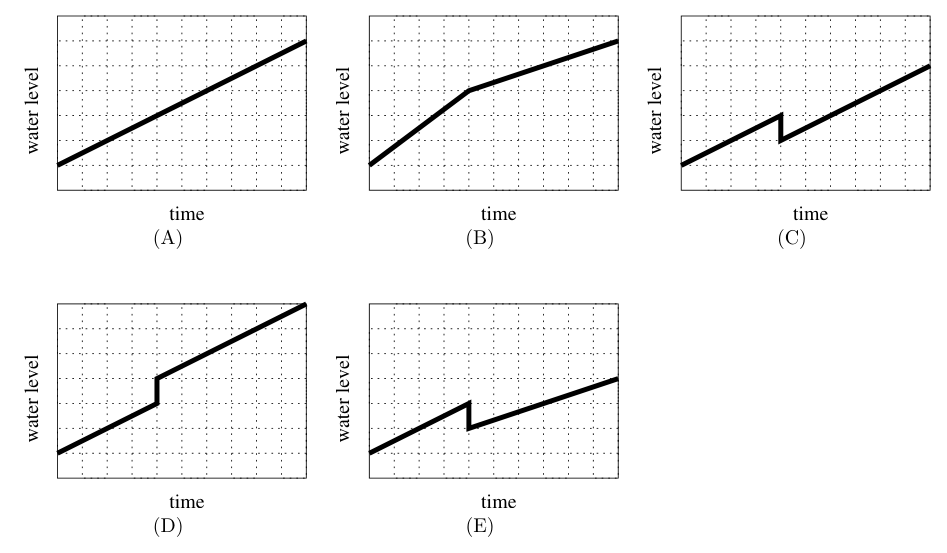 Cinque grafici livello acqua nel tempo
Topic: Fluid Mechanics Metodi: Hydrostatic Equilibrium, Physical Modeling Competenze: Physical Reasoning, Diagrammatic Reasoning Objects: Container Fonte: Testo (PDF) — p.4
- Una grande tazza cilindrica di metallo galleggia in una vasca rettangolare a metà piena di acqua. Il rubinetto è posto sopra la tazza e si accende, rilasciando acqua a una velocità costante. Alla fine la tazza si affonda al fondo e si immerge completamente. Quale dei cinque grafici seguenti potrebbe rappresentare il livello dell’acqua nel lavandino in funzione del tempo? (A) (B) (C) (D) (E)
5 livelli grafici familiari nel tempo
Topic: Fluid Mechanics Metodi: Hydrostatic Equilibrium, Physical Modeling Competenze: Physical Reasoning, Diagrammatic Reasoning Objects: Container Fonte: Testo (PDF) — p.4
- You are given a large collection of identical heavy balls and lightweight rods. When two balls are placed at the ends of one rod and interact through their mutual gravitational attraction (as is shown on the left), the compressive force in the rod is . Next, three balls and three rods are placed at the vertexes and edges of an equilateral triangle (as is shown on the right). What is the compressive force in each rod in the latter case?
- A.
- B.
- C.
- D.
- E.
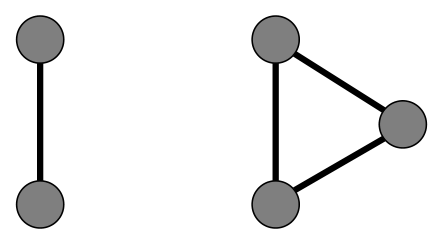 Barre con sfere: asta e triangolo equilatero
Topic: Gravitation, Rigid Body Statics Metodi: Newton’s Law of Gravitation, Vector Decomposition, Symmetry Argument Competenze: Physical Reasoning, Mathematical Modeling Objects: Ball, Rod Fonte: Testo (PDF) — p.5
- Vi viene data una grande collezione di palle pesanti e bastone leggere identiche. Quando due palle sono poste alle estremità La pressione di un’unica canna e interagiscono attraverso la loro attrazione gravitazionale reciproca (come mostrato a sinistra), la compressione la forza della canna è . Successivamente, tre palle e tre bastone sono posizionate ai vertici e ai bordi di un triangolo equilaterale (come è mostrato a destra). Qual è la forza di compressione di ciascuna canna in quest’ultimo caso?
- A.
- B.
- C.
- D.
- E.
Barre con sfera: ast e triangolo equilatero
Topic: Gravitation, Rigid Body Statics Metodi: Newton’s Law of Gravitation, Vector Decomposition, Symmetry Argument Competenze: Physical Reasoning, Mathematical Modeling Objects: Ball, Rod Fonte: Testo (PDF) — p.5
- The apparatus in the diagram consists of a solid cylinder of radius 1 cm attached at the center to two disks of radius 2 cm. It is placed on a surface where it can roll, but will not slip. A thread is wound around the central cylinder. When the thread is pulled at the angle to the horizontal (directly up), the apparatus rolls to the right. Which below is the largest value of for which it will not roll to the right when pulling on the thread?
- A.
- B.
- C.
- D.
- E. None, the apparatus will always roll to the right
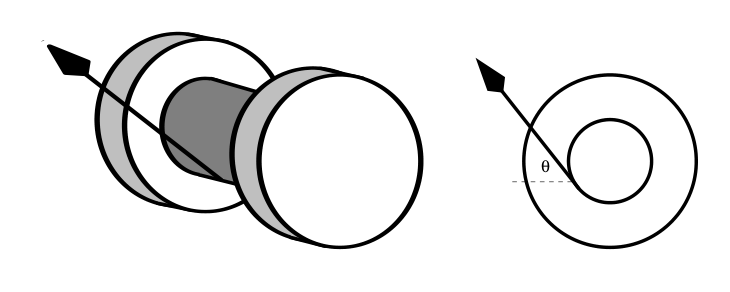 Cilindro con dischi su superficie, filo angolo theta
Topic: Rotational Dynamics, Newtonian Mechanics Metodi: Torque & Angular Momentum Analysis, Free-Body Diagram, Vector Decomposition Competenze: Physical Reasoning, Diagrammatic Reasoning, Mathematical Modeling Objects: Cylinder, Disk, String Fonte: Testo (PDF) — p.5
- L’apparecchio del diagramma è costituito da un cilindro solido di raggio di 1 cm attaccato al centro a due dischi di radio di 2 cm. Si colloca su una superficie in cui può rotolare, ma non scivola. Un filo è rotto intorno al centro
- Il cilindro. Quando il filo viene tirato all’angolo verso l’orizzontale (direttamente verso l’alto), l’apparecchio ruota verso il
- Sì, certo. Qual è il valore più grande di per il quale non si rulla a destra quando si tira il filo?
- A.
- B.
- C.
- D.
- E. Nessun, l’apparecchio ruoterà sempre a destra
Cilindro con superficie, filo angolo theta
Topic: Rotational Dynamics, Newtonian Mechanics Metodi: Torque & Angular Momentum Analysis, Free-Body Diagram, Vector Decomposition Competenze: Physical Reasoning, Diagrammatic Reasoning, Mathematical Modeling Objects: Cylinder, Disk, String Fonte: Testo (PDF) — p.5
- You have 5 different strings with weights tied at various point, all hanging from the ceiling, and reaching down to the floor. The string is released at the top, allowing the weights to fall. Which one will create a regular, uniform beating sound as the weights hit the floor? (A) (B) (C) (D) (E)
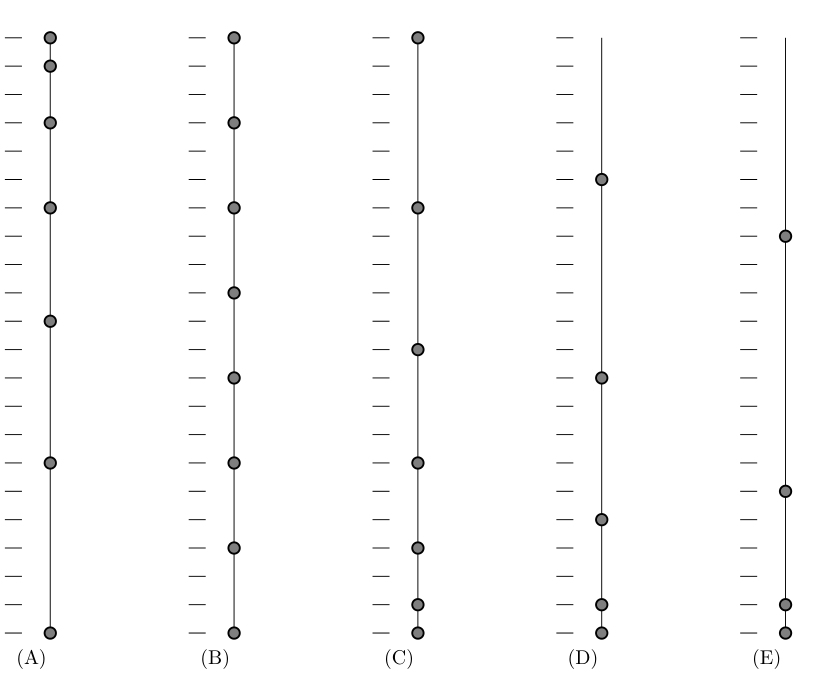 Cinque fili con pesi a distanze diverse
Topic: Newtonian Mechanics Metodi: Kinematic Equations, Physical Modeling Competenze: Physical Reasoning, Mathematical Modeling Objects: String Fonte: Testo (PDF) — p.6
- Avete 5 corde diverse con pesanti legati in vari punti, tutti appesi dal soffitto, e raggiungendo fino a
- Il pavimento. La corda viene rilasciata in cima, permettendo ai pesi di cadere. Quale creerà una regolare, uniforme battendo il suono quando i pesi colpiscono il pavimento? (A) (B) (C) (D) (E)
5 fili con peso a distanza diversa
Topic: Newtonian Mechanics Metodi: Kinematic Equations, Physical Modeling Competenze: Physical Reasoning, Mathematical Modeling Objects: String Fonte: Testo (PDF) — p.6
- A vertical mass-spring oscillator is displaced 2.0 cm from equilibrium. The 100 g mass passes through the equilibrium point with a speed of 0.75 m/s. What is the spring constant of the spring?
- A. 90 N/m
- B. 100 N/m
- C. 110 N/m
- D. 140 N/m
- E. 160 N/m Questions 16 and 17 refer to the information and diagram below. Jonathan is using a rope to lift a box with Becky in it; the box is hanging off the side of a bridge, Jonathan is on top. A rope is hooked up from the box and passes a fixed railing; Jonathan holds the box up by pressing the rope against the railing with a massless, frictionless physics textbook. The static friction coefficient between the rope and railing is ; the kinetic friction coefficient between the rope and railing is ; the mass of the box and Becky combined is ; and the initial height of the bottom of the box above the ground is . Assume a massless rope.
Topic: Oscillations & Waves, Conservation of Energy Metodi: Simple Harmonic Motion Analysis, Energy Conservation Method Competenze: Mathematical Modeling, Physical Reasoning Objects: Spring, Block Fonte: Testo (PDF) — p.6
- Un oscillatore di massa verticale è spostato a 2,0 cm dall’equilibrio. La massa di 100 g passa attraverso il punto di equilibrio con una velocità di 0,75 m/s. Qual è la costante di primavera della primavera?
- A. 90 N/m
- B. 100 N/m
- C. 110 N/m
- D. 140 N/m
- E. 160 N/m Le domande 16 e 17 si riferiscono alle informazioni e al diagramma di seguito. Jonathan sta usando una corda per sollevare una scatola con Becky nella quale la scatola è appesa sul lato di un ponte, Jonathan è in cima. Una corda è collegata da la scatola e passa un barriere fisso; Jonathan tiene la scatola in alto premendo la corda contro la baraglia con un libro di fisica senza massa e frizione. Il coefficiente di attrito statico tra la corda e il il rallineamento è ; il coefficiente di attrito cinetico tra la corda e il ralline sono ; la massa della scatola e Becky combinato è ; e l’altezza iniziale della parte inferiore della casella sopra il terreno è . Supponiamo una corda senza massa.
Topic: Oscillations & Waves, Conservation of Energy Metodi: Simple Harmonic Motion Analysis, Energy Conservation Method Competenze: Mathematical Modeling, Physical Reasoning Objects: Spring, Block Fonte: Testo (PDF) — p.6
- What magnitude force does Jonathan need to exert on the physics book to keep the rope from slipping?
- A.
- B.
- C.
- D.
- E.
Topic: Newtonian Mechanics Metodi: Free-Body Diagram, Vector Decomposition Competenze: Physical Reasoning, Mathematical Modeling Objects: String Fonte: Testo (PDF) — p.7
- Che forza di grandezza deve esercitare Jonathan sul libro di fisica per impedire che la corda scivoli?
- A.
- B.
- C.
- D.
- E.
Topic: Newtonian Mechanics Metodi: Free-Body Diagram, Vector Decomposition Competenze: Physical Reasoning, Mathematical Modeling Objects: String Fonte: Testo (PDF) — p.7
- Jonathan applies a normal force that is just enough to keep the rope from slipping. Becky makes a small jump, barely leaving contact with the floor of the box. Upon landing on the box, the force of the impact causes the rope to start slipping from Jonathan’s hand. At what speed does the box smash into the ground? Assume Jonathan’s normal force does not change.
- A.
- B.
- C.
- D.
- E.
Topic: Newtonian Mechanics, Conservation of Energy Metodi: Free-Body Diagram, Kinematic Equations, Energy Conservation Method Competenze: Mathematical Modeling, Physical Reasoning Objects: String, Container Fonte: Testo (PDF) — p.7
- Jonathan usa una forza normale che basta per impedire che la corda scivoli. Becky fa un piccolo salto, Lasciando a malapena il contatto con il pavimento della scatola. Al momento dell’atterraggio sulla scatola, la forza dell’impatto provoca la corda per iniziare a scivolare dalla mano di Jonathan. A che velocità la scatola si schianta a terra? Supponiamo quello di Jonathan La forza normale non cambia.
- A.
- B.
- C.
- D.
- E.
Topic: Newtonian Mechanics, Conservation of Energy Metodi: Free-Body Diagram, Kinematic Equations, Energy Conservation Method Competenze: Mathematical Modeling, Physical Reasoning Objects: String, Container Fonte: Testo (PDF) — p.7
- A block of mass slides down one ramp, and then up a second ramp. The coefficient of kinetic friction between the block and each ramp is . The block begins at a height above the horizontal. Both ramps are at a incline above the horizontal. To what height above the horizontal does the block rise on the second ramp?
- A. 0.18 m
- B. 0.52 m
- C. 0.59 m
- D. 0.69 m
- E. 0.71 m
Topic: Newtonian Mechanics, Conservation of Energy Metodi: Free-Body Diagram, Energy Conservation Method, Kinematic Equations Competenze: Mathematical Modeling, Physical Reasoning Objects: Block, Inclined Plane Fonte: Testo (PDF) — p.7
- Un blocco di massa scende su una rampa e poi su una seconda rampa. Il coefficiente di attrito cinetico tra il blocco e ogni rampa è . Il blocco inizia ad un’altezza sopra l’orizzontale. Entrambe le rampe sono inclinate sopra l’orizzontale. A che altezza sopra l’orizzontale il blocco si alza La seconda rampa?
- A. 0.18 m
- B. 0.52 m
- C. 0.59 m
- D. 0.69 m
- E. 0.71 m
Topic: Newtonian Mechanics, Conservation of Energy Metodi: Free-Body Diagram, Energy Conservation Method, Kinematic Equations Competenze: Mathematical Modeling, Physical Reasoning Objects: Block, Inclined Plane Fonte: Testo (PDF) — p.7
Questions 19 and 20 refer to the following information A particle of mass 2.00 kg moves under a force given by where and are unit vectors in the and directions. The particle is placed at the origin with an initial velocity .
- After how much time will the particle first return to the origin?
- A. 0.785 s
- B. 1.26 s
- C. 1.57 s
- D. 2.00 s
- E. 3.14 s
Topic: Oscillations & Waves, Newtonian Mechanics Metodi: Simple Harmonic Motion Analysis, Differential Equations, Vector Decomposition Competenze: Mathematical Modeling, Physical Reasoning Objects: — Fonte: Testo (PDF) — p.8
Le domande 19 e 20 si riferiscono alle seguenti informazioni: Una particella di massa di 2,00 kg si muove con una forza data da dove e sono vettori unitari nelle direzioni e . La particella viene collocata all’origine con una velocità iniziale .
- Dopo quanto tempo la particella tornerà all’origine?
- A. 0.785 s
- B. 1.26 s
- C. 1.57 s
- D. 2.00 s
- E. 3.14 s
Topic: Oscillations & Waves, Newtonian Mechanics Metodi: Simple Harmonic Motion Analysis, Differential Equations, Vector Decomposition Competenze: Mathematical Modeling, Physical Reasoning Objects: — Fonte: Testo (PDF) — p.8
- What is the maximum distance between the particle and the origin?
- A. 2.00 m
- B. 2.50 m
- C. 3.50 m
- D. 5.00 m
- E. 7.00 m
Topic: Oscillations & Waves, Newtonian Mechanics Metodi: Simple Harmonic Motion Analysis, Energy Conservation Method, Vector Decomposition Competenze: Mathematical Modeling, Physical Reasoning Objects: — Fonte: Testo (PDF) — p.8
- Qual è la distanza massima tra la particella e l’origine?
- A. 2.00 m
- B. 2.50 m
- C. 3.50 m
- D. 5.00 m
- E. 7.00 m
Topic: Oscillations & Waves, Newtonian Mechanics Metodi: Simple Harmonic Motion Analysis, Energy Conservation Method, Vector Decomposition Competenze: Mathematical Modeling, Physical Reasoning Objects: — Fonte: Testo (PDF) — p.8
- An engineer is given a fixed volume of metal with which to construct a spherical pressure vessel. Interestingly, assuming the vessel has thin walls and is always pressurized to near its bursting point, the amount of gas the vessel can contain, (measured in moles), does not depend on the radius of the vessel; instead it depends only on (measured in ), the temperature (measured in K), the ideal gas constant (measured in ), and the tensile strength of the metal (measured in ). Which of the following gives in terms of these parameters?
- A.
- B.
- C.
- D.
- E.
Topic: Thermodynamics, Elasticity & Materials Metodi: Dimensional Analysis, Ideal Gas Law, Stress-Strain Analysis Competenze: Mathematical Modeling, Physical Reasoning Objects: Container, Gas, Sphere Fonte: Testo (PDF) — p.8
- Un ingegnere riceve un volume fisso di metallo con cui costruire un recipiente a pressione sferica. È interessante notare che presumendo che il recipiente abbia pareti sottili e sia sempre pressurizzato fino a raggiungere il punto di scoppio, la quantità di gas che il recipiente può contenere (misurato in mol), non dipende dal raggio della nave; invece dipende solo da (misurato in ), la temperatura (misurato in K), la costante di gas ideale (misurato in ), e il resistenza alla trazione del metallo (misurata in ). Qual è il risultato di in termini di questi parametri?
- A.
- B.
- C.
- D.
- E.
Topic: Thermodynamics, Elasticity & Materials Metodi: Dimensional Analysis, Ideal Gas Law, Stress-Strain Analysis Competenze: Mathematical Modeling, Physical Reasoning Objects: Container, Gas, Sphere Fonte: Testo (PDF) — p.8
- This graph depicts the torque output of a hypothetical gasoline engine as a function of rotation frequency. The engine is incapable of running outside of the graphed range. At what engine RPM (revolutions per minute) does the engine produce maximum power?
- A. I
- B. At some point between I and II
- C. II
- D. At some point between II and III
- E. III
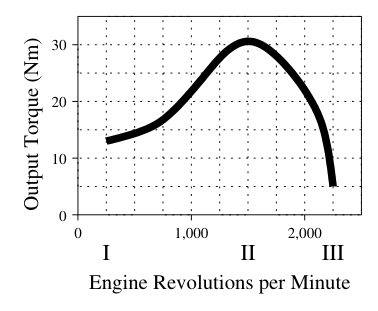 Grafico coppia motore vs giri al minuto
Topic: Rotational Dynamics Metodi: Torque & Angular Momentum Analysis, Physical Modeling Competenze: Physical Reasoning, Diagrammatic Reasoning, Mathematical Modeling Objects: Heat Engine Fonte: Testo (PDF) — p.9
- Questo grafico raffigura la coppia di uscita di un motore a benzina ipotetico come funzione della frequenza di rotazione. Il il motore non è in grado di funzionare al di fuori della gamma di funzionamento graficata. A che velocità di rotazione al minuto produce il motore la massima potenza?
- A. I
- B. A un certo punto tra I e II
- C. II
- D. A un certo punto tra II e III
- E. III
Grafico coppia motore vs giri al minuto
Topic: Rotational Dynamics Metodi: Torque & Angular Momentum Analysis, Physical Modeling Competenze: Physical Reasoning, Diagrammatic Reasoning, Mathematical Modeling Objects: Heat Engine Fonte: Testo (PDF) — p.9
- A particle is launched from the surface of a uniform, stationary spherical planet at an angle to the vertical. The particle travels in the absence of air resistance and eventually falls back onto the planet. Spaceman Fred describes the path of the particle as a parabola using the laws of projectile motion. Spacewoman Kate recalls from Kepler’s laws that every bound orbit around a point mass is an ellipse (or circle), and that the gravitation due to a uniform sphere is identical to that of a point mass. Which of the following best explains the discrepancy? (A) Because the experiment takes place very close to the surface of the sphere, it is no longer valid to replace the sphere with a point mass.
- B. Because the particle strikes the ground, it is not in orbit of the planet and therefore can follow a nonelliptical path.
- C. Kate disregarded the fact that motions around a point mass may also be parabolas or hyperbolas.
- D. Kepler’s laws only hold in the limit of large orbits.
- E. The path is an ellipse, but is very close to a parabola due to the short length of the flight relative to the distance from the center of the planet.
Topic: Gravitation, Newtonian Mechanics Metodi: Kepler’s Laws, Newton’s Law of Gravitation, Kinematic Equations Competenze: Physical Reasoning, Mathematical Modeling Objects: Projectile, Planet Fonte: Testo (PDF) — p.9
- Una particella viene lanciata dalla superficie di un pianeta sferico uniforme e stazionario in un angolo verticale. Il La particella viaggia in assenza di resistenza dell’aria e alla fine cade di nuovo sul pianeta. Lo spaziale Fred descrive il percorso della particella come parabola utilizzando le leggi del movimento del proiettile. La donna spaziale Kate si ricorda di Kepler Leggi che ogni orbita intorno a una massa puntaria è un’ellisse (o cerchio), e che la gravitazione dovuta a un’uniforme la sfera è identica a quella di una massa puntaria. Quale delle seguenti spiega meglio la discrepanza? A) Poiché l’esperimento si svolge molto vicino alla superficie della sfera, non è più valido sostituire la sfera con massa puntata.
- B. Poiché la particella colpisce il terreno, non è in orbita del pianeta e può quindi seguire un percorso non ellittico.
- C. Kate ha trascurato il fatto che i movimenti attorno a una massa puntaria possono essere anche parabole o iperbole. Le leggi di Kepler si applicano solo al limite delle orbite di grandi dimensioni.
- E. Il percorso è un’ellisse, ma è molto vicino a una parabola a causa della breve lunghezza del volo rispetto alla Distanza dal centro del pianeta.
Topic: Gravitation, Newtonian Mechanics Metodi: Kepler’s Laws, Newton’s Law of Gravitation, Kinematic Equations Competenze: Physical Reasoning, Mathematical Modeling Objects: Projectile, Planet Fonte: Testo (PDF) — p.9
- A turntable is supported on a Teflon ring of inner radius and outer radius (), as shown in the diagram. To rotate the turntable at a constant rate, power must be supplied to overcome friction. The manufacturer of the turntable wishes to reduce the power required without changing the rotation rate, the weight of the turntable, or the coefficient of friction of the Teflon surface. Engineers propose two solutions: increasing the width of the bearing (increasing ), or increasing the radius (increasing ). What are the effects of these proposed changes?
- A. Increasing has no significant effect on the required power; increasing increases the required power.
- B. Increasing has no significant effect on the required power; increasing decreases the required power.
- C. Increasing increases the required power; increasing has no significant effect on the required power.
- D. Increasing decreases the required power; increasing has no significant effect on the required power.
- E. Neither change has a significant effect on the required power.
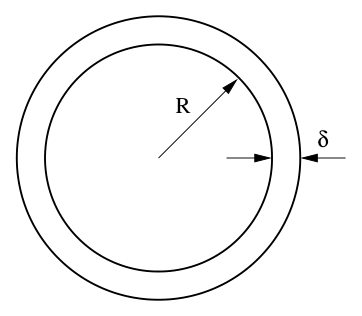 Sezione giradischi su anello in Teflon
Topic: Rotational Dynamics, Newtonian Mechanics Metodi: Torque & Angular Momentum Analysis, Free-Body Diagram, Calculus-Integration Competenze: Mathematical Modeling, Physical Reasoning, Diagrammatic Reasoning Objects: Disk Fonte: Testo (PDF) — p.10
- Un giradischi è supportato su un anello Teflon di raggio interno e raggio esterno (), come mostrato nel diagramma. Per girare il giradischi a velocità costante, deve essere fornita energia per superare l’attrito. Il fabbricante della il giradischi vuole ridurre la potenza richiesta senza modificare il tasso di rotazione, il peso del giradischi, o il coefficiente di attrito della superficie del Teflon. Gli ingegneri propongono due soluzioni: aumentare la larghezza del cuscinetto (aumentando ), o aumentando il raggio (aumentando ). Quali sono gli effetti di questi cambiamenti proposti?
- A. L’aumento di non ha alcun effetto significativo sulla potenza richiesta; l’aumento di aumenta la potenza richiesta.
- B. L’aumento di non ha alcun effetto significativo sulla potenza richiesta; l’aumento di riduce la potenza richiesta.
- C. Aumentare aumenta la potenza richiesta; aumentare non ha alcun effetto significativo sulla potenza richiesta.
- D. Aumentare riduce la potenza richiesta; aumentare non ha alcun effetto significativo sulla potenza richiesta.
- E. Nessuna delle due variazioni ha un effetto significativo sulla potenza richiesta.
Sezione giradischi su anello in teflone
Topic: Rotational Dynamics, Newtonian Mechanics Metodi: Torque & Angular Momentum Analysis, Free-Body Diagram, Calculus-Integration Competenze: Mathematical Modeling, Physical Reasoning, Diagrammatic Reasoning Objects: Disk Fonte: Testo (PDF) — p.10
- A hollow cylinder with a very thin wall (like a toilet paper tube) and a block are placed at rest at the top of a plane with inclination above the horizontal. The cylinder rolls down the plane without slipping and the block slides down the plane; it is found that both objects reach the bottom of the plane simultaneously. What is the coefficient of kinetic friction between the block and the plane?
- A. 0
- B.
- C.
- D.
- E.
Topic: Rotational Dynamics, Newtonian Mechanics Metodi: Free-Body Diagram, Kinematic Equations, Torque & Angular Momentum Analysis Competenze: Mathematical Modeling, Physical Reasoning, Diagrammatic Reasoning Objects: Cylinder, Block, Inclined Plane Fonte: Testo (PDF) — p.10
- Un cilindro vuoto con una parete molto sottile (come un tubo di carta igienica) e un blocco sono posti a riposo in cima a un piatto con inclinazione sopra l’orizzontale. Il cilindro ruota giù per il piano senza scivolare e il blocco scivola giù per il piano; si scopre che entrambi gli oggetti raggiungono contemporaneamente il fondo del piano. Che cos’è Coefficiente di attrito cinetico tra il blocco e il piano?
- A. 0
- B.
- C.
- D.
- E.
Topic: Rotational Dynamics, Newtonian Mechanics Metodi: Free-Body Diagram, Kinematic Equations, Torque & Angular Momentum Analysis Competenze: Mathematical Modeling, Physical Reasoning, Diagrammatic Reasoning Objects: Cylinder, Block, Inclined Plane Fonte: Testo (PDF) — p.10