Question 1
Incandescent light bulbs are notorious for being relatively inefficient in producing visible light. The tungsten wire inside such a bulb is at a temperature of approximately 3000 K and the emission spectrum is very similar to that of a blackbody. The efficiency is so low because
- A. Most of the electrons are absorbed in the tungsten wire.
- B. Most of the power is lost due to the resistance of the bulb.
- C. The electric power actually is efficiently transformed into radiation but at 3000 K, most of it is infrared.
- D. A blackbody absorbs more light than it emits, hence it appears black.
Topic: Thermodynamics, Modern-Quantum Physics Metodi: Physical Modeling, Order-of-Magnitude Estimation Competenze: Physical Reasoning Objects: Wire Fonte: Testo (PDF) — p.2
Questa 1
Le lampadine incandescenti sono note per essere relativamente inefficienti nel produrre luce visibile. Il filo di tungsteno all’interno di tale lampadina è a una temperatura di circa 3000 K e lo spettro di emissioni è molto simile a quello di un corpo nero. L’efficienza è così bassa perché
- A. La maggior parte degli elettroni è assorbita nel filo di tungsteno.
- B. La maggior parte della potenza viene persa a causa della resistenza dell’ampolla.
- C. L’energia elettrica viene effettivamente trasformata in radiazioni in modo efficiente ma a 3000 K, la maggior parte è infrarossa.
- D. Un corpo nero assorbe più luce di quanto emetta, quindi appare nero.
Topic: Thermodynamics, Modern-Quantum Physics Metodi: Physical Modeling, Order-of-Magnitude Estimation Competenze: Physical Reasoning Objects: Wire Fonte: Testo (PDF) — p.2
Question 2
A solar panel installed on a spaceship has a maximum energy output of 5 kW near the Earth. What is the maximum energy output of the solar panel when the spaceship is near Mars? (The distance from the Earth to the Sun is 1 A.U. and from Mars to the Sun is 1.5 A.U.)
- A. 3.3 kW;
- B. 2.2 kW;
- C. 1.0 kW;
- D. 0.55 kW;
- E. 0.20 kW.
Topic: Astrophysics, Electromagnetism Metodi: Physical Modeling, Dimensional Analysis Competenze: Physical Reasoning, Mathematical Modeling Objects: Satellite, Planet Fonte: Testo (PDF) — p.2
La domanda 2
Un pannello solare installato su una nave spaziale ha una potenza massima di energia di 5 kW vicino alla Terra. Qual è la massima energia prodotta dal pannello solare quando la nave spaziale è vicino a Marte? (La distanza dalla Terra al Sole è di 1 AU. e da Marte al Sole è di 1,5 AU).
- A. 3.3 kW;
- B. 2.2 kW;
- C. 1.0 kW;
- D. 0.55 kW;
- E. 0.20 kW.
Topic: Astrophysics, Electromagnetism Metodi: Physical Modeling, Dimensional Analysis Competenze: Physical Reasoning, Mathematical Modeling Objects: Satellite, Planet Fonte: Testo (PDF) — p.2
Question 3
A scientist measured a current in an area of a human brain. Unlike current in metals which is carried by free electrons, the current in the brain is mainly carried by potassium ions. Each potassium ion has one unit of charge . This current corresponds to the flow of how many potassium ions per second?
- A. ;
- B. ;
- C. ;
- D. ;
- E. .
Topic: Circuits, Electrostatics Metodi: Dimensional Analysis, Physical Modeling Competenze: Unit Conversion, Physical Reasoning Objects: — Fonte: Testo (PDF) — p.2
La domanda 3
Uno scienziato ha misurato una corrente in un’area del cervello umano. A differenza della corrente dei metalli che viene trasportata dagli elettroni liberi, la corrente nel cervello è principalmente trasportata dagli ioni di potassio. Ogni ione di potassio ha una unità di carica . Questa corrente corrisponde al flusso di quanti ioni di potassio al secondo?
- A. ;
- B. ;
- C. ;
- D. ;
- E. .
Topic: Circuits, Electrostatics Metodi: Dimensional Analysis, Physical Modeling Competenze: Unit Conversion, Physical Reasoning Objects: — Fonte: Testo (PDF) — p.2
Question 4
The gas supply to your physics professor’s house suddenly stops due to a gas line failure. It is winter and the temperature outside is and constant. Assuming all the doors and windows remain closed, which of these graphs best describes how the temperature in the house changes with time after the gas supply stops?
- A. Temperature starts near , decreases and asymptotically approaches (exponential decay).
- B. Temperature decreases linearly and then remains constant at .
- C. Temperature first increases slightly then decreases asymptotically toward (S-shaped).
- D. Temperature decreases in two linear segments (two different slopes).
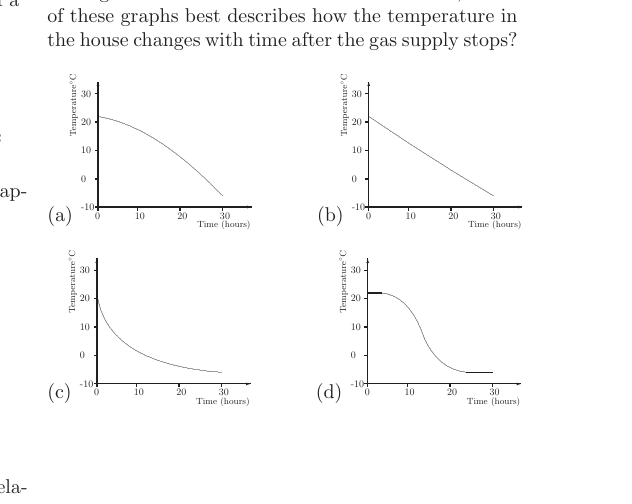 Four Temperature-vs-time graphs options a–d
Topic: Thermodynamics Metodi: Physical Modeling, First Law of Thermodynamics Competenze: Physical Reasoning, Diagrammatic Reasoning Objects: — Fonte: Testo (PDF) — p.2
La domanda 4
L’approvvigionamento di gas alla casa del tuo professore di fisica si ferma improvvisamente a causa di un guasto della linea di gas. È inverno e la temperatura estera è e costante. Supponendo che tutte le porte e le finestre rimangano chiuse, quale di queste figure descrive meglio come la temperatura nella casa cambia nel tempo dopo che l’approvvigionamento di gas si ferma?
- A. La temperatura inizia vicino a , diminuisce e si avvicina asimptoticamente a (decaimento esponenziale).
- B. La temperatura diminuisce linealmente e quindi rimane costante a .
- C. La temperatura aumenta prima leggermente e poi diminuisce assintoticamente verso (a forma di S).
- D. La temperatura diminuisce in due segmenti lineari (due pendici diversi).
Quattro opzioni grafici Temperatura-versus-time ad
Topic: Thermodynamics Metodi: Physical Modeling, First Law of Thermodynamics Competenze: Physical Reasoning, Diagrammatic Reasoning Objects: — Fonte: Testo (PDF) — p.2
Question 5
The ray of light travelling in air hits the parallel glass plate as shown. Which are the possible continuations of the light ray?
- A. 4 only.
- B. both 2 and 4.
- C. both 3 and 6.
- D. both 1 and 5.
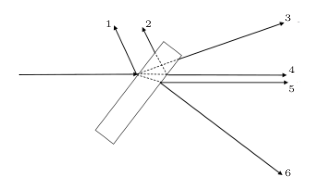 Ray hitting parallel glass plate, numbered exits
Topic: Geometric Optics Metodi: Snell’s Law, Ray Tracing Competenze: Diagrammatic Reasoning, Physical Reasoning Objects: — Fonte: Testo (PDF) — p.3
La domanda 5
Il raggio di luce che viaggia nell’aria colpisce la piastra di vetro parallela come mostrato. Quali sono le possibili continuazioni del raggio di luce?
- solo A. 4.
- B. sia 2 che 4.
- C. sia 3 che 6.
- D. sia 1 che 5.
Ray colpisce piastra di vetro parallela, uscite numerate
Topic: Geometric Optics Metodi: Snell’s Law, Ray Tracing Competenze: Diagrammatic Reasoning, Physical Reasoning Objects: — Fonte: Testo (PDF) — p.3
Question 6
Approximately, what fraction of the energy emitted by the Sun reaches the Earth?
- A. ;
- B. ;
- C. ;
- D. .
Topic: Astrophysics, Order-of-Magnitude Estimation Metodi: Order-of-Magnitude Estimation, Dimensional Analysis Competenze: Estimation & Approximation, Physical Reasoning Objects: Star, Planet Fonte: Testo (PDF) — p.3
La domanda 6
Circa quale frazione dell’energia emessa dal Sole raggiunge la Terra?
- A. ;
- B. ;
- C. ;
- D. .
Topic: Astrophysics, Order-of-Magnitude Estimation Metodi: Order-of-Magnitude Estimation, Dimensional Analysis Competenze: Estimation & Approximation, Physical Reasoning Objects: Star, Planet Fonte: Testo (PDF) — p.3
Question 7
The resistance of the tungsten in a light bulb increases with temperature. Which of the following graphs shows the current as a function of voltage for the light bulb?
- A. Linear – (straight line through origin).
- B. Concave-up curve (current increases faster than linear).
- C. Concave-down curve (current increases slower than linear, sublinear).
- D. Current decreases as voltage increases.
- E. S-shaped curve.
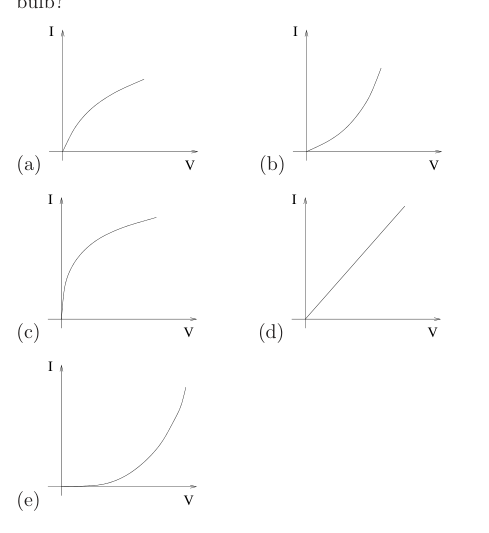 Five I–V characteristic graphs for light bulb
Topic: Circuits, Electromagnetism Metodi: Physical Modeling, Dimensional Analysis Competenze: Diagrammatic Reasoning, Physical Reasoning Objects: — Fonte: Testo (PDF) — p.3
La domanda 7
La resistenza del tungsteno in una lampadina aumenta con la temperatura. Quale dei grafici seguenti mostra la corrente come funzione della tensione per la lampadina?
- A. Lineare I$$V (linea dritta attraverso l’origine).
- B. Curva concavata verso l’alto (la corrente aumenta più velocemente di quella lineare).
- C. Curva concava verso il basso (la corrente aumenta più lentamente rispetto alla linea, sottolineare).
- D. La corrente diminuisce con l’aumento della tensione.
- E. Curva a forma di S.
*Cinque grafici caratteristici IV per lampadina *
Topic: Circuits, Electromagnetism Metodi: Physical Modeling, Dimensional Analysis Competenze: Diagrammatic Reasoning, Physical Reasoning Objects: — Fonte: Testo (PDF) — p.3
Question 8
A fast rocket travels directly upwards at (half the speed of light). There is an explosion directly below the rocket. If astronauts manage to measure how fast the light produced by the explosion is moving relative to their spacecraft, they will find the light to be moving:
- A. Upwards at speed .
- B. Upwards at speed .
- C. Upwards at speed .
- D. Downwards at speed .
- E. Downwards at speed .
Topic: Special Relativity Metodi: Lorentz Transformation, Physical Modeling Competenze: Physical Reasoning Objects: — Fonte: Testo (PDF) — p.3
La domanda 8
Un razzo veloce viaggia direttamente verso l’alto a (metà della velocità della luce). C’è un’esplosione proprio sotto il razzo. Se gli astronauti riusciranno a misurare la velocità con cui la luce prodotta dall’esplosione si muove rispetto alla loro astronave, troveranno che la luce si muove:
- A. In salita a velocità .
- B. In salita a velocità .
- C. In salita a velocità .
- D. In discesa a velocità .
- E. In discesa a velocità .
Topic: Special Relativity Metodi: Lorentz Transformation, Physical Modeling Competenze: Physical Reasoning Objects: — Fonte: Testo (PDF) — p.3
Question 9
Two identical clocks are set to the same time as one passes the other at very high (relativistic) velocity as shown in the top figure. Which of the other figures represents a possible observation of the clocks at some later time in the reference frame of the stationary clock?
Initial state: both clocks read 2:00, moving clock has velocity .
- A. Stationary clock: 2:02; moving clock: 1:59.
- B. Stationary clock: 2:02; moving clock: 2:00.
- C. Stationary clock: 2:02; moving clock: 2:01.
- D. Stationary clock: 2:02; moving clock: 2:02.
- E. Stationary clock: 2:02; moving clock: 2:03.
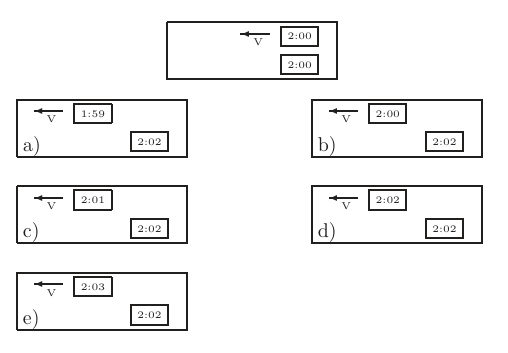 Clock pairs at rest and moving frames
Topic: Special Relativity Metodi: Lorentz Transformation, Physical Modeling Competenze: Physical Reasoning, Diagrammatic Reasoning Objects: — Fonte: Testo (PDF) — p.3
La domanda 9
Due orologi identici sono impostati allo stesso tempo in cui uno passa l’altro ad una velocità molto alta (relativistica) come mostrato nella figura superiore. Quale delle altre figure rappresenta una possibile osservazione degli orologi in un momento successivo nel quadro di riferimento dell’orologio stazionario?
Stato iniziale: entrambi gli orologi hanno la lettura di 2:00, l’orologio in movimento ha velocità .
- A. Orologio fisso: 2:02; orologio in movimento: 1:59.
- B. Orologio fisso: 2:02; orologio in movimento: 2:00.
- C. Orologio fisso: 2:02; orologio in movimento: 2:01.
- D. Orologio fisso: 2:02; orologio in movimento: 2:02.
- E. Orologio fisso: 2:02; orologio in movimento: 2:03.
classici in riposo e quadri in movimento
Topic: Special Relativity Metodi: Lorentz Transformation, Physical Modeling Competenze: Physical Reasoning, Diagrammatic Reasoning Objects: — Fonte: Testo (PDF) — p.3
Question 10
For the statements:
- Mass can be directly converted into kinetic energy.
- Kinetic energy can be directly converted into mass.
- A. Only first is true.
- B. Only second is true.
- C. Both are true.
- D. Neither is true.
Topic: Special Relativity, Nuclear & Particle Physics Metodi: Mass-Energy Equivalence, Physical Modeling Competenze: Physical Reasoning Objects: — Fonte: Testo (PDF) — p.3
La domanda 10
Per le dichiarazioni:
- La massa può essere direttamente convertita in energia cinetica.
- L’energia cinetica può essere direttamente convertita in massa.
- A. Solo la prima è vera.
- B. Solo il secondo è vero.
- C. Entrambi sono veri.
- D. Né è vero.
Topic: Special Relativity, Nuclear & Particle Physics Metodi: Mass-Energy Equivalence, Physical Modeling Competenze: Physical Reasoning Objects: — Fonte: Testo (PDF) — p.3
Question 11
A stable Helium-4 nucleus has two protons and two neutrons. If the mass of Helium-4 nucleus, proton and neutron are denoted by , and respectively, we can conclude that:
- A. .
- B. .
- C. .
- D. Any of the above may be true.
Topic: Nuclear & Particle Physics, Special Relativity Metodi: Mass-Energy Equivalence, Physical Modeling Competenze: Physical Reasoning Objects: Nucleus Fonte: Testo (PDF) — p.3
La domanda 11
Un nucleo stabile di Elio-4 ha due protoni e due neutroni. Se la massa del nucleo di Elio-4, del protone e del neutrone sono indicati rispettivamente da , e , possiamo concludere che:
- A. .
- B. .
- C. .
- D. Qualsiasi di questi elementi può essere vero.
Topic: Nuclear & Particle Physics, Special Relativity Metodi: Mass-Energy Equivalence, Physical Modeling Competenze: Physical Reasoning Objects: Nucleus Fonte: Testo (PDF) — p.3
Question 12
A clean metal surface is placed in a vacuum. The surface is irradiated with monochromatic light of variable intensity (number of photons per unit area) and frequency . We measure the maximum kinetic energy of electrons emitted from the metal due to the photoelectric effect. How does behave when increases?
- A. increases.
- B. is constant.
- C. decreases.
- D. Impossible to determine.
Topic: Modern-Quantum Physics Metodi: Photon Energy Relation, Physical Modeling Competenze: Physical Reasoning Objects: Photon, Electron Fonte: Testo (PDF) — p.3
La domanda 12
Una superficie metallica pulita viene messa in vuoto. La superficie è irradiata con luce monocromatica di intensità variabile (numero di fotoni per unità di superficie) e frequenza . Misuriamo l’energia cinetica massima degli elettroni emessi dal metallo a causa dell’effetto fotoelettrico. Come si comporta quando aumenta?
- A. aumenta.
- B. è costante.
- C. diminuisce.
- D. Impossibile da determinare.
Topic: Modern-Quantum Physics Metodi: Photon Energy Relation, Physical Modeling Competenze: Physical Reasoning Objects: Photon, Electron Fonte: Testo (PDF) — p.3
Question 13
A point mass is moving in the plane. Its acceleration is a constant vector perpendicular to the axis, then:
- A. only is constant.
- B. only is constant.
- C. only the acceleration is constant.
- D. the acceleration and are constant.
- E. the position and are constant.
Topic: Newtonian Mechanics Metodi: Kinematic Equations, Free-Body Diagram Competenze: Physical Reasoning, Mathematical Modeling Objects: — Fonte: Testo (PDF) — p.3
La domanda 13
Una massa puntologica si muove nel piano . La sua accelerazione è un vettore costante perpendicolare all’asse , quindi:
- A. solo è costante.
- B. solo è costante.
- C. solo l’accelerazione è costante.
- D. l’accelerazione e sono costanti.
- E. la posizione e sono costanti.
Topic: Newtonian Mechanics Metodi: Kinematic Equations, Free-Body Diagram Competenze: Physical Reasoning, Mathematical Modeling Objects: — Fonte: Testo (PDF) — p.3
Question 14
A huge case, attached to a cable, is descending at a constant velocity. The tension in the cable is (neglecting the air resistance):
- A. greater than the weight of the case.
- B. smaller than the weight of the case.
- C. equal to the weight of the case.
- D. we cannot tell since we don’t know the weight of the case.
Topic: Newtonian Mechanics Metodi: Free-Body Diagram, Newton’s Law of Gravitation Competenze: Physical Reasoning Objects: String Fonte: Testo (PDF) — p.4
La domanda 14
Un enorme cassonetto, collegato a un cavo, scende a velocità costante. La tensione del cavo è (senza tenere conto della resistenza dell’aria):
- A. superiore al peso del caso.
- B. inferiore al peso della custodia.
- C. pari al peso del caso.
- D. non possiamo dire dato che non conosciamo il peso del caso.
Topic: Newtonian Mechanics Metodi: Free-Body Diagram, Newton’s Law of Gravitation Competenze: Physical Reasoning Objects: String Fonte: Testo (PDF) — p.4
Question 15
Objects A and B, isolated from the environment, are initially separated from each other and are then placed in thermal contact. Their initial temperatures are and . The heat capacity of B is twice the one of A. After a certain time, the system reaches equilibrium. The final temperatures are:
- A. .
- B. .
- C. .
- D. .
- E. .
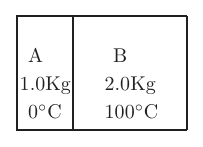 Blocks A (0°C, 1 kg) and B (100°C, 2 kg)
Topic: Thermodynamics Metodi: Conservation of Energy, Physical Modeling Competenze: Physical Reasoning, Mathematical Modeling Objects: Block Fonte: Testo (PDF) — p.4
Questione 15
Gli oggetti A e B, isolati dall’ambiente, vengono inizialmente separati l’uno dall’altro e poi messi in contatto termico. Le loro temperature iniziali sono e . La capacità termico di B è doppia di quella di A. Dopo un certo tempo, il sistema raggiunge l’equilibrio. Le temperature finali sono:
- A. .
- B. .
- C. .
- D. .
- E. .
*Blocchi A (0°C, 1 kg) e B (100°C, 2 kg) *
Topic: Thermodynamics Metodi: Conservation of Energy, Physical Modeling Competenze: Physical Reasoning, Mathematical Modeling Objects: Block Fonte: Testo (PDF) — p.4
Question 16
When a car is starting, its driving wheels experience:
- A. The force of kinetic friction directed backward.
- B. The force of static friction directed backward.
- C. The force of kinetic friction directed forward.
- D. The force of static friction directed forward.
Topic: Newtonian Mechanics Metodi: Free-Body Diagram, Physical Modeling Competenze: Physical Reasoning Objects: Wheel Fonte: Testo (PDF) — p.4
La domanda 16
Quando una macchina si avvia, le ruote di guida sperimentano:
- A. La forza di attrito cinetico diretta verso l’indietro.
- B. La forza di attrito statico diretta verso l’indietro.
- C. La forza di attrito cinetico diretta in avanti.
- D. La forza di attrito statico diretta in avanti.
Topic: Newtonian Mechanics Metodi: Free-Body Diagram, Physical Modeling Competenze: Physical Reasoning Objects: Wheel Fonte: Testo (PDF) — p.4
Question 17
An aquarium partly filled with water accelerates down an incline which is at an angle with respect to the horizon. The surface of water in the aquarium:
- A. is horizontal.
- B. is parallel to the plane of the incline.
- C. forms an angle with the horizon, where .
- D. forms an angle with horizon, where .
Topic: Fluid Mechanics, Newtonian Mechanics Metodi: Hydrostatic Equilibrium, Free-Body Diagram Competenze: Physical Reasoning, Diagrammatic Reasoning Objects: Container Fonte: Testo (PDF) — p.4
La domanda 17
Un acquario in parte riempito di acqua accelera verso un’inclinazione che si trova ad un angolo rispetto all’orizzonte. La superficie dell’acqua nell’acquario:
- A. è orizzontale.
- B. è parallelo al piano dell’inclinazione.
- C. forma un angolo con l’orizzonte, dove .
- D. forma un angolo con orizzonte, dove .
Topic: Fluid Mechanics, Newtonian Mechanics Metodi: Hydrostatic Equilibrium, Free-Body Diagram Competenze: Physical Reasoning, Diagrammatic Reasoning Objects: Container Fonte: Testo (PDF) — p.4
Question 18
Objects around us have different colours. This is because
- A. They are at different temperatures.
- B. They are non-thermal radiation sources.
- C. Different materials or paints reflect light at different speeds.
- D. Different materials or paints reflect different wavelengths.
Topic: Geometric Optics, Modern-Quantum Physics Metodi: Physical Modeling Competenze: Physical Reasoning Objects: — Fonte: Testo (PDF) — p.4
La domanda 18
Gli oggetti intorno a noi hanno colori diversi. Questo è perché
- A. Sono a temperature diverse.
- B. Sono fonti di radiazioni non termiche.
- C. Diversi materiali o vernici riflettono la luce a velocità diverse.
- D. Diversi materiali o vernici riflettono lunghezze d’onda diverse.
Topic: Geometric Optics, Modern-Quantum Physics Metodi: Physical Modeling Competenze: Physical Reasoning Objects: — Fonte: Testo (PDF) — p.4
Question 19
This graph shows the average temperature inside a room. At time the heater is turned on. We want to compare the power input to the room () and the power output from the room (). For which region(s) on the graph is ?
Region I: before (steady state); Region II: between and (rising temperature); Region III: after (new steady state).
- A. Only region I.
- B. Only region II.
- C. Only region III.
- D. Only regions I & III.
- E. Regions I, II & III.
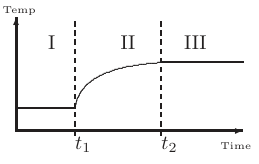 Temperature vs. time graph with regions I, II, III
Topic: Thermodynamics Metodi: First Law of Thermodynamics, Physical Modeling Competenze: Physical Reasoning, Diagrammatic Reasoning Objects: — Fonte: Testo (PDF) — p.4
La domanda 19
Questo grafico mostra la temperatura media all’interno di una stanza. In tempo il riscaldatore è acceso. Vogliamo confrontare la potenza di ingresso nella stanza () e la potenza di uscita dalla stanza (). Per quale regione (s) del grafico è ?
Regione I: prima di (stato stabile); Regione II: tra e (aumento della temperatura); Regione III: dopo (nuovo stato stabile).
- A. Solo regione I.
- B. Solo per la regione II.
- C. Solo per la regione III.
- D. Solo le regioni I & III.
- E. Regioni I, II e III.
Temperatura vs. grafico temporale con regioni I, II, III*
Topic: Thermodynamics Metodi: First Law of Thermodynamics, Physical Modeling Competenze: Physical Reasoning, Diagrammatic Reasoning Objects: — Fonte: Testo (PDF) — p.4
Question 20
A spherical asteroid with a radius of 1 km is illuminated by sunlight. In order to calculate the solar power absorbed by the asteroid, what area should be used?
- A. .
- B. .
- C. .
- D. Answer cannot be determined from the available data.
Topic: Astrophysics, Electromagnetism Metodi: Physical Modeling, Order-of-Magnitude Estimation Competenze: Physical Reasoning, Mathematical Modeling Objects: — Fonte: Testo (PDF) — p.4
La domanda 20
Un asteroide sferico con un raggio di 1 km è illuminato dalla luce solare. Per calcolare l’energia solare assorbita dall’asteroide, quale area dovrebbe essere utilizzata?
- A. .
- B. .
- C. .
- D. La risposta non può essere determinata dai dati disponibili.
Topic: Astrophysics, Electromagnetism Metodi: Physical Modeling, Order-of-Magnitude Estimation Competenze: Physical Reasoning, Mathematical Modeling Objects: — Fonte: Testo (PDF) — p.4
Question 21
If you toss a ball up, at the highest point
- A. The velocity changes direction.
- B. The acceleration changes direction.
- C. The acceleration is zero.
- D. Both velocity and acceleration are zero.
- E. More than one of the above is correct.
Topic: Newtonian Mechanics Metodi: Kinematic Equations, Free-Body Diagram Competenze: Physical Reasoning Objects: Ball Fonte: Testo (PDF) — p.4
La domanda 21
Se lanci una palla in alto, al punto più alto
- A. La velocità cambia direzione.
- B. L’accelerazione cambia direzione.
- C. L’accelerazione è zero.
- D. Sia la velocità che l’accelerazione sono zero.
- E. Più di una delle indicazioni sopra esposte è corretta.
Topic: Newtonian Mechanics Metodi: Kinematic Equations, Free-Body Diagram Competenze: Physical Reasoning Objects: Ball Fonte: Testo (PDF) — p.4
Question 22
Many cars are now equipped with anti-lock brakes (ABS), which prevents locking of the wheels during emergency braking. What is the main advantage?
- A. This saves the tires. Otherwise too much rubber is left on the road.
- B. Provides more control over the car but stopping distance increases slightly.
- C. This leads to a shorter stopping distance because tires exert rolling friction which is larger than kinetic friction.
- D. This leads to a shorter stopping distance because tires exert rolling friction which is larger than static friction.
- E. This leads to a shorter stopping distance because tires exert static friction which is larger than kinetic friction.
Topic: Newtonian Mechanics Metodi: Free-Body Diagram, Physical Modeling Competenze: Physical Reasoning Objects: Wheel Fonte: Testo (PDF) — p.4
La domanda 22
Molte auto sono ora dotate di freni antiblocco (ABS), che impediscono il blocco delle ruote durante il frenaggio di emergenza. Qual è il principale vantaggio?
- A. Questo risparmia le gomme. Altrimenti rimane troppo gomma sulla strada.
- B. Fornisce un maggiore controllo sulla vettura ma aumenta leggermente la distanza di fermo.
- C. Questo porta a una distanza di arresto più breve perché le gomme esercitano un attrito di rotolamento maggiore di quello cinetico.
- D. Questo porta a una distanza di arresto più breve perché le gomme esercitano un attrito di rotazione maggiore di quello statico.
- E. Questo porta a una distanza di arresto più breve perché le gomme esercitano un attrito statico maggiore di quello cinetico.
Topic: Newtonian Mechanics Metodi: Free-Body Diagram, Physical Modeling Competenze: Physical Reasoning Objects: Wheel Fonte: Testo (PDF) — p.4
Question 23
Rank in order, from brightest to dimmest, the identical bulbs A to D.
- A. .
- B. .
- C. .
- D. .
- E. .
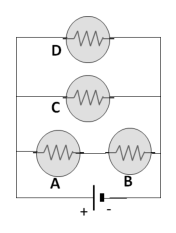 Circuit diagram with four bulbs A, B, C, D
Topic: Circuits Metodi: Kirchhoff’s Laws, Equivalent Circuit Reduction Competenze: Diagrammatic Reasoning, Physical Reasoning Objects: Resistor, Battery, Wire Fonte: Testo (PDF) — p.4
La domanda 23
Rango in ordine, dal più luminoso al più sottile, le lampadine identiche A a D.
- A. .
- B. .
- C. .
- D. .
- E. .
Diagramma di circuito con quattro lampadine A, B, C, D
Topic: Circuits Metodi: Kirchhoff’s Laws, Equivalent Circuit Reduction Competenze: Diagrammatic Reasoning, Physical Reasoning Objects: Resistor, Battery, Wire Fonte: Testo (PDF) — p.4
Problem 1
Last year, a customer tried to compare two cars. A manufacturer of the USA car claims fuel efficiency of 30 mpg (miles per gallon). The manufacturer of the European car states the fuel efficiency of 7.8 l/100km (liters per hundred kilometers).
(a) Which car is more efficient and by how much?
This year, still undecided, this customer noticed that both manufacturers improved their fuel efficiency numbers by 20%.
(b) Which car is more efficient now, and by how much?
Figure 1 shows the velocity as a function of time graph for a trip you took with your car.
(c) Determine the total distance travelled during this two hour trip.
(d) Figure 2 displays the air drag force as a function of velocity. What is the total work done by the drag force on the car during this two hour trip?
(e) Each liter of gasoline has 35 MJ of energy. The efficiency of the motor as a function of the car’s speed is shown on Figure 3. How much gasoline is used to overcome the air drag during this two hour trip?
(f) In which part of the trip the fuel was used most efficiently (least gasoline used per kilometer travelled)?
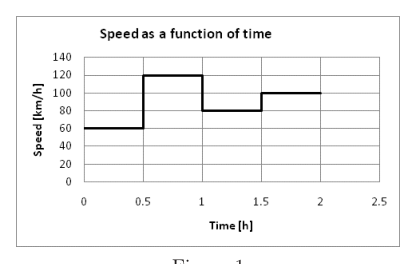 Figure 1: velocity vs. time for car trip
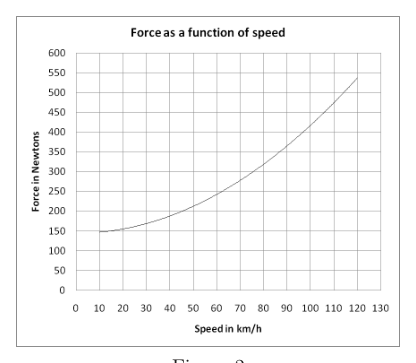 Figure 2: drag force vs. velocity
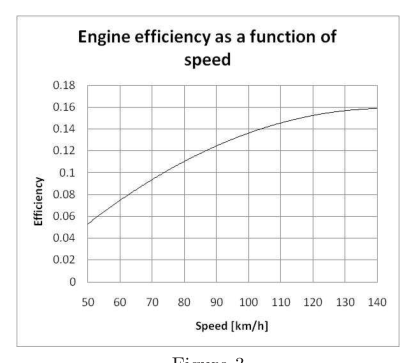 Figure 3: motor efficiency vs. speed
Topic: Newtonian Mechanics, Order-of-Magnitude Estimation Metodi: Dimensional Analysis, Calculus-Integration Competenze: Unit Conversion, Mathematical Modeling, Estimation & Approximation Objects: — Fonte: Testo (PDF) — p.5
Il problema 1
L’anno scorso, un cliente ha provato a confrontare due auto. Un produttore di auto statunitense afferma di avere un’efficienza di carburante di 30 mpg (miles per gallone). Il costruttore della vettura europea dichiara che l’efficienza del carburante è di 7,8 l/100 km (litrini per cento chilometri).
(a) Quale auto è più efficiente e per quanto?
Quest’anno, ancora indeciso, questo cliente ha notato che entrambi i produttori hanno migliorato il loro numero di efficienza del carburante del 20%.
(b) Quale auto è più efficiente oggi, e per quanto?
La figura 1 mostra la velocità come funzione del grafico temporale per un viaggio fatto con la macchina.
c) Determinare la distanza totale percorsa durante il viaggio di due ore.
d) La figura 2 mostra la forza di resistenza dell’aria come funzione della velocità. Qual è il lavoro totale svolto dalla forza di trazione sulla macchina durante questo viaggio di due ore?
e) Ogni litro di benzina ha 35 MJ di energia. L’efficienza del motore in funzione della velocità dell’auto è mostrata nella figura 3. Quanto benzina viene utilizzata per superare la resistenza dell’aria durante questo viaggio di due ore?
f) In quale parte del viaggio il combustibile è stato utilizzato più efficientemente (minimo consumo di benzina per chilometro percorso)?
Figura 1: velocità vs. tempo per il viaggio in auto
Figura 2: forza di trazione contro forza di trazione velocità*
Figura 3: efficienza motoria vs. velocità
Topic: Newtonian Mechanics, Order-of-Magnitude Estimation Metodi: Dimensional Analysis, Calculus-Integration Competenze: Unit Conversion, Mathematical Modeling, Estimation & Approximation Objects: — Fonte: Testo (PDF) — p.5
Problem 2
Photo A shows a pendulum for a grandfather clock. It consists of very thin sets of iron and zinc rods and the pendulum bob. At room temperature there is one iron rod of length , two iron rods of length and two zinc rods of length connected as in diagram B. Both sets of rods are of negligible weight compared to the pendulum bob. The thickness of the connecting pieces is negligible compared to the length of the rods. The bob is attached to the iron rod. The pendulum length is then , .
Given: , .
(a) Does the position of the rods in diagram B correspond to a warmer day or a colder day compared to their position in diagram C?
(b) Find and if the pendulum period does not change when the temperature changes.
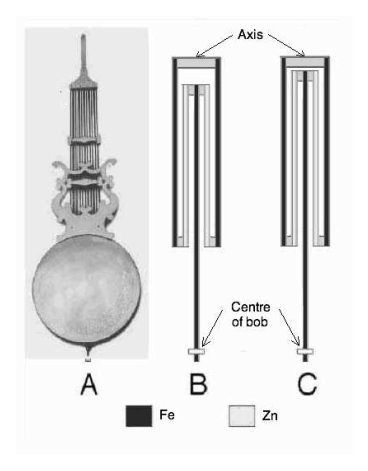 Diagrams B and C of iron and zinc rod arrangement
Topic: Oscillations & Waves, Elasticity & Materials Metodi: Simple Harmonic Motion Analysis, Physical Modeling, Stress-Strain Analysis Competenze: Mathematical Modeling, Physical Reasoning Objects: Pendulum, Rod Fonte: Testo (PDF) — p.5
Problema 2
La foto A mostra un pendolo per un orologio di nonno. È costituito da serie molto sottili di barre di ferro e zinco e dalla bobina del pendolo. A temperatura ambiente sono collegate una canna di ferro di lunghezza , due canna di ferro di lunghezza e due canna di zinco di lunghezza come nel diagramma B. Entrambe le barre hanno un peso insignificante rispetto alla bobina del pendolo. Lo spessore dei pezzi di connessione è trascurabile rispetto alla lunghezza delle barre. Il bob è attaccato alla canna di ferro. La lunghezza del pendolo è quindi , .
Date: , .
(a) La posizione delle barre del diagramma B corrisponde a una giornata più calda o a una giornata più fredda rispetto alla loro posizione del diagramma C?
b) Trova e se il periodo del pendolo non cambia quando la temperatura cambia.
Diagrammi B e C di arrangiamento delle barre di ferro e zinco
Topic: Oscillations & Waves, Elasticity & Materials Metodi: Simple Harmonic Motion Analysis, Physical Modeling, Stress-Strain Analysis Competenze: Mathematical Modeling, Physical Reasoning Objects: Pendulum, Rod Fonte: Testo (PDF) — p.5
Problem 3
Two radio antennas are 100 m apart on a north-south line. They broadcast identical radio waves at a frequency of 3.0 MHz. Your job is to monitor the signal strength with a handheld receiver. To get to your first measuring point, you walk 800 m east from the midpoint between the antennas, then 600 m north.
(a) What is the phase difference between the waves at this point?
(b) Is the interference at this point maximally constructive, perfectly destructive, or somewhere in between? Explain.
(c) If you now begin to walk further north, does the signal strength increase, decrease, or stay the same? Sketch the amplitude of the signal as a function of the distance.
Topic: Oscillations & Waves, Wave Optics Metodi: Interference & Diffraction Analysis, Superposition Principle, Wave Equation Competenze: Mathematical Modeling, Physical Reasoning Objects: — Fonte: Testo (PDF) — p.6
**Problema 3 **
Due antenne radio sono a 100 metri di distanza su una linea nord-sud. Trasmettono onde radio identiche a frequenza di 3,0 MHz. Il tuo lavoro e’ monitorare la forza del segnale con un ricevitore portatile. Per arrivare al primo punto di misura, si cammina 800 m a est dal punto medio tra le antenne, poi 600 m a nord.
(a) Qual è la differenza di fase tra le onde a questo punto?
(b) L’interferenza in questo punto è al massimo costruttiva, perfettamente distruttiva, o da qualche parte in mezzo? - Spiegami.
(c) Se ora inizi a camminare più a nord, la forza del segnale aumenta, diminuisce o rimane la stessa? Segna l’ampiezza del segnale in funzione della distanza.
Topic: Oscillations & Waves, Wave Optics Metodi: Interference & Diffraction Analysis, Superposition Principle, Wave Equation Competenze: Mathematical Modeling, Physical Reasoning Objects: — Fonte: Testo (PDF) — p.6