Q1
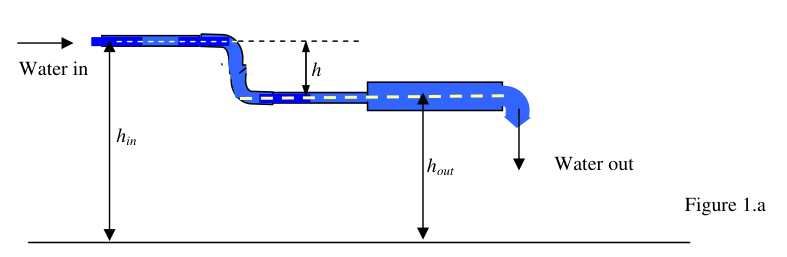
(a) Figure 1.a shows a schematic drawing of part of a water system. The cross sectional area of the in pipe is ai and the cross sectional area of the out pipe is ao. What characteristics distinguish this system from similar pipes that contain a gas rather than water? Bernoulli’s equation gives: constant 2 1 2
gh v p
Write down an equation that relates pin,vin,hin to pout,vout,hout , What does Bernoulli’s equation assume?
(b)
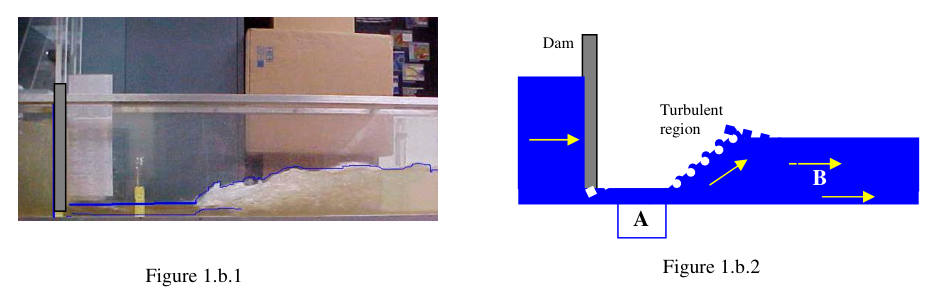
Figure 1.b.1 and Figure 1.b.2 show the action of water flowing under an obstacle (dam).
(1b) Figure 1.b.1 shows a photograph of a hydraulic jump with a turbulent region where the water rises and Figure 1.b.2 is a diagram that shows the principal features of a hydraulic jump. Assuming that the width of the channel is constant, write down equations that predict the flow speed immediately before (region A) and after the turbulent region (region B).
(c) Describe in detail the energy changes that occur to the water in the channel.
Part (d) follows on page 3
Figure 1.a h Water in Water out hout hin Turbulent region Dam B Figure 1.b.1 Figure 1.b.2
p, pressure , density A 3
(d) Read the following passage and answer the questions at the end.
D-D fuel cycle Though more difficult to facilitate than the deuterium-tritium reaction, fusion can also be achieved through the reaction of deuterium with itself. This reaction has two branches that occur with nearly equal probability:
2H+2H 3H +p + 4.0MeV 2H+2H 3He +n +3.3MeV The optimum temperature for this reaction is 15 keV, only slightly higher than the optimum for the D-T reaction. The first branch does not produce neutrons, but it does produce tritium (3H), so that a D-D reactor will not be completely tritium free, even though it does not require an input of tritium (3H) or lithium.
3H +n +18.3MeV
Most of the tritium produced will be burned before leaving the reactor, which reduces the tritium handling required, but also means that more neutrons are produced and that some of these are very energetic. The neutron from the second branch has an energy of only 2.45 MeV (0.393 pJ), whereas the neutron from the D-T reaction has an energy of 14.1 MeV (2.26 pJ), resulting in a wider range of isotope production and material damage.
The primary advantage of the D-D fuel cycle is that tritium breeding is not required. Other advantages are independence from limitations of lithium resources and a somewhat softer neutron spectrum. The price to pay compared to D-T is that the energy confinement (at a given pressure) must be 30 times better and the power produced (at a given pressure and volume) is 68 times less.
Questions
(i) Explain what is meant by “The optimum temperature for this reaction is 15 keV” .
(ii) What is this temperature in Kelvin?
(iii) Paraffin wax is good at stopping neutrons. Why?
(iv) Explain why the neutron from the D-T reaction has an energy of 14.1 MeV.
(v) Why is tritium difficult to handle?
(vi) What does “a somewhat softer neutron spectra” mean?
One way of bringing the deuterium to the point of criticality is to compress a small spherical capsule of it using multiple laser beams. Derive an expression for the momentum of light quanta of frequency f. Find the pressure produced on a 1mm diameter sphere using a laser of power 1MW with multiple beams that are spread around the sphere giving a uniform symmetrical pressure, see Figure 1.d.a.
(n is a neutron) Figure1.d.a N.B. D is the same as 2H (p is a proton) 4
 schema tubi acqua con sezioni
 salto idraulico foto e schema
Topic: Fluid Mechanics, Nuclear & Particle Physics, Modern-Quantum Physics Metodi: Bernoulli’s Equation, Continuity Equation, Conservation of Energy, Photon Energy Relation, Kinetic Theory of Gases Competenze: Physical Reasoning, Mathematical Modeling, Estimation & Approximation Objects: Tube, Nucleus, Photon Fonte: Testo (PDF) — p.2
Q1
(a) La figura 1.a mostra un disegno schematico di una parte di un sistema idrico. L’area trasversale del tubo in Ai e all’area trasversale del tubo di uscita è AO. Quali caratteristiche distinguono questo sistema da simili tubi che contengono gas piuttosto che acqua? L’equazione di Bernoulli dà: costante 2 1 2
gh v p
Scrivi un’equazione che relaziona pin,vin,hin a pout,vout,hout, cosa presuppone l’equazione di Bernoulli?
(b)
Le figure 1.b.1 e 1.b.2 mostrano l’azione dell’acqua che scorre sotto un ostacolo (barra).
(1b) La figura 1.b.1 mostra una fotografia di un salto idraulico con una regione turbolenta in cui l’acqua sale e La figura 1.b.2 è un diagramma che mostra le principali caratteristiche di un salto idraulico. Supponendo che la larghezza di il canale è costante, scrivete equazioni che prevedono la velocità di flusso immediatamente prima (regione A) e dopo la regione turbolenta (regione B).
(c) Descrivi in dettaglio i cambiamenti energetici che si verificano nell’acqua del canale.
La parte d) segue la pagina 3
Figura 1.a h Acqua dentro Acqua fuori cotta di cui Turbolento regione
- La diga B Figura 1.b.1 Figura 1.b.2
p, pressione , densità A 3
(d) Leggi il seguente passaggio e rispondi alle domande alla fine.
Ciclo di combustibile D-D Anche se più difficile da facilitare della reazione deuterio-tricio, la fusione può essere raggiunta anche attraverso la reazione del deuterio con se stesso. Questa reazione ha due rami che si verificano con quasi uguale probabilità:
2H+2H 3H+p+4,0MeV 2H + 2H 3He +n +3.3MeV La temperatura ottimale per questa reazione è di 15 keV, leggermente superiore a quella ottimale per la D-T.
- La reazione. Il primo ramo non produce neutroni, ma produce tritio (3H), in modo che un reattore D-D non sarà completamente privo di tritio, anche se non richiede un’ingressa di tritio (3H) o litio.
3H +n +18,3MeV
La maggior parte del tritio prodotto verrà bruciato prima di uscire dal reattore, riducendo così la gestione del tritio La produzione di neutroni è necessaria, ma significa anche che vengono prodotti più neutroni e che alcuni di questi sono molto energetici. Il Il neutrone del secondo ramo ha un’energia di solo 2,45 MeV (0,393 pJ), mentre il neutrone del La reazione D-T ha un’energia di 14,1 MeV (2,26 pJ), con conseguente ampliamento della produzione di isotopi e di danni materiali.
Il vantaggio principale del ciclo del carburante D-D è che non è necessaria l’allevamento del tritio. Altri vantaggi sono: l’indipendenza dalle limitazioni delle risorse di litio e da uno spettro di neutroni leggermente più morbido. Il prezzo di La differenza tra il contenuto energetico e il contenuto energetico (a una determinata pressione) è che il contenuto energetico deve essere 30 volte migliore e il contenuto energetico deve essere la potenza prodotta (a una determinata pressione e volume) è 68 volte inferiore.
Domande
(i) Spiegate cosa si intende per La temperatura ottimale per questa reazione è di 15 keV .
(ii) Qual e’ la temperatura a Kelvin?
(iii) La cera di paraffina è buona per fermare i neutroni. - Perché? - Perché?
(iv) Spiega perché il neutrone della reazione D-T ha un’energia di 14,1 MeV.
(v) Perché il trizio è difficile da gestire?
(vi) Cosa significa uno spettro di neutroni leggermente più morbido?
Un modo per portare il deuterio al punto di criticalità è comprimere una piccola capsula sferica di esso con più raggi laser. Derivare un’espressione per il momento dei quanti di luce di frequenza f. Trova la pressione prodotta su una sfera di diametro di 1 mm utilizzando un laser di potenza di 1 MW con più travi che sono distribuiti intorno alla sfera, dando una pressione simmetrica uniforme, vedere figura 1.d.a.
(n è un neutrone) Figura 1.d.a N.B. D è uguale a 2H (p è un protone) 4
- schema di conoscenza *
salto idraulico foto e schema
Topic: Fluid Mechanics, Nuclear & Particle Physics, Modern-Quantum Physics Metodi: Bernoulli’s Equation, Continuity Equation, Conservation of Energy, Photon Energy Relation, Kinetic Theory of Gases Competenze: Physical Reasoning, Mathematical Modeling, Estimation & Approximation Objects: Tube, Nucleus, Photon Fonte: Testo (PDF) — p.2
Q2
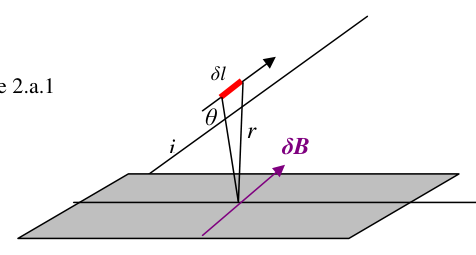
(a) Figure 2.a.1
The law of Biot-Savart states that if a current i is flowing in a wire at an angle to a plane then the magnetic flux density ,as shown, is given by:
2 0 4 sin r l i B
See Figure 2.a.1.
Hence show that a current i flowing through a single straight very long wire will cause a field of r i B 2 0
as shown in Figure 2.a.2.
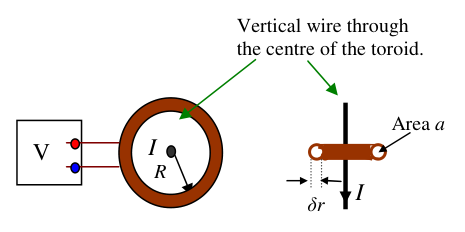
(b) Figure 2.b.1
A copper wire carrying a current of I is shown in Figure 2.b.1. A toroidal coil, radius R, wound with copper wire carries a current I. The toroid has N turns of wire and the cross sectional area of the ring is a, diameter . If the current in the vertical wire changes at a rate of dt dI , what will the voltmeter read? (Assume << R).
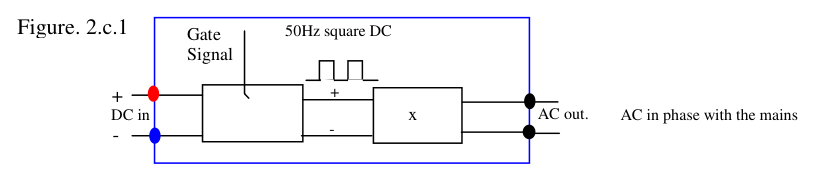
(c) A device called an inverter can be use to change DC into AC. A “tied” inverter connects a DC supply to the 240V 50Hz mains so that the p.d. produced by the inverter is sinusoidal and in phase with the mains. An example of the use of an inverter is to enable a photovoltaic panel to supply power to the grid. A block diagram of the type of circuit that could be used in an inverter is illustrated in Figure 2.c.1.
The steady DC is interrupted by the gate signal that produces an interrupted DC signal in phase with the mains. Suggest components that should be inserted in the box (x) to make the output sinusoidal and justify this choice by numerical calculations if appropriate. i r
Figure 2.a.2
Gate Signal DC in
50Hz square DC AC in phase with the mains x AC out. Figure. 2.c.1 r i B V I I R Vertical wire through the centre of the toroid. Area a 5
( (a) An electron is accelerated in an evacuated chamber. Sketch lines that illustrate how the
magnetic field produced by the electron will vary with time.
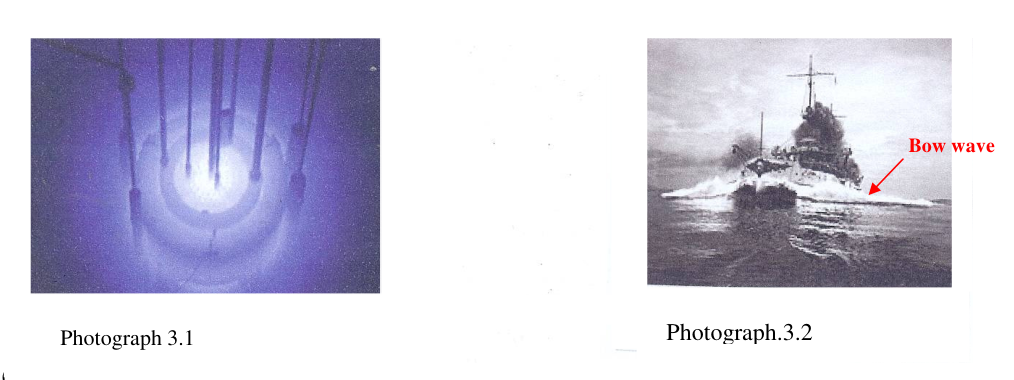
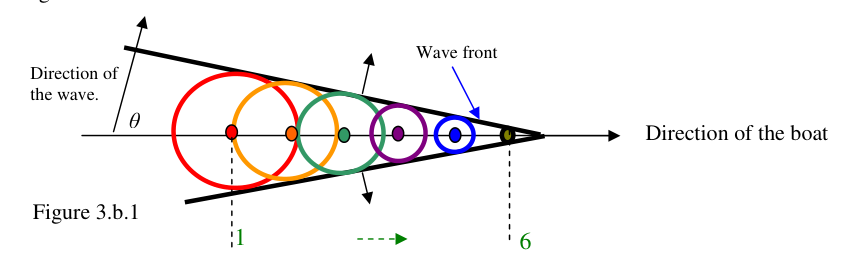
(b) It is possible that charged particles can go through a medium such as water or glass faster than the speed of light in that medium. Consider a boat travelling along on the surface of the water, the disturbance (the bow wave Photograph 3.2) will spread in a way similar to the wave produced by series of circles caused by small stones dropped in the water in succession, 1 to 6, equally spaced in time and distance. This is shown in Figure 3.b.1.
Find the value of the angle, , that the bow waves make with direction of the boat given that the speed of the boat is 5 ms-1 and the speed of the waves is 2ms-1. The bow wave is illustrated in Photograph 3.2.
(c) Photograph 3.1 shows Cherenkov radiation, in the form of blue light, being produced by radioactive particles moving through water faster than the speed of light through water. Find a formula that relates the speed of the particles, vp, to the refractive index of water,
= c v p and . Theta ) is the angle that the emerging light makes with the incoming particle. Why is blue light observed?
(d) Use a very simple model to find how the Earth’s temperature should vary with latitude. Comment how your model compares with what is observed.
Direction of the boat Photograph 3.1 Photograph.3.2 Bow wave
 geometria Biot-Savart elemento di corrente
 filo rettilineo infinito campo B
 solenoide toroidale con filo verticale
 schema a blocchi inverter DC-AC
Topic: Magnetism, Electromagnetic Induction, Circuits Metodi: Biot-Savart Law, Faraday’s Law of Induction, Calculus-Integration, Equivalent Circuit Reduction Competenze: Mathematical Modeling, Physical Reasoning, Diagrammatic Reasoning Objects: Wire, Coil, Electron Fonte: Testo (PDF) — p.4
Q2
(a) Figura 2.a.1
La legge di Biot-Savart afferma che se una corrente i sta fluendo in un filo ad un angolo verso un piano allora la corrente magnetica la densità di flusso , come indicato, è data da:
2 0 4 il peccato r l i B
V. figura 2.a.1.
Quindi mostrare che una corrente i che scorre attraverso un singolo filo molto lungo dritto causerà un campo di r i B 2 0
come mostrato alla figura 2.a.2.
(b) Figura 2.b.1
Un filo di rame con corrente di I è mostrato alla figura 2.b.1. Una bobina toroidale, di raggio R, ferita con rame il filo porta una corrente I. Il toroide ha N giri di filo e la superficie trasversale dell’anello è di un diametro di . Se la corrente nel filo verticale cambia a un ritmo di dt DI, cosa leggera’ il voltmeter? (Supponiamo che << R).
(c) Un dispositivo chiamato inverter può essere utilizzato per cambiare DC in AC. Un inverter tied collega un alimentatore di corrente continua al 240V 50Hz, in modo che il P.D. L’inverter è sinusoidale e in fase con la rete. An un esempio di utilizzo di un inverter è quello di consentire a un pannello fotovoltaico di fornire energia alla rete. Un blocco il diagramma del tipo di circuito che potrebbe essere utilizzato in un inverter è illustrato alla figura 2.c.1.
Il corrente continua stazionaria viene interrotta dal segnale di portale che produce un segnale di corrente continua interrotta in fase con il
- La corrente. Suggerire componenti da inserire nella casella (x) per rendere sinusoidale la produzione e giustificare la scelta mediante calcoli numerici, se del caso. i r
Figura 2.a.2
Porta Segnale DC in
50 Hz di corrente continua quadrata AC in fase con la rete elettrica x
- Cambio di aria.
- Sì, certo. 2.c.1 r i B V I I R Fonte di trasporto il centro della toroide. Area a 5
( (a) Un elettrone viene accelerato in una camera evacuata. Sketch linee che illustrano come
Il campo magnetico prodotto dall’elettrone varia con il tempo.
(b) È possibile che le particelle cariche possano attraversare un mezzo come l’acqua o il vetro più velocemente della velocità di luce in quel mezzo. Considerate una barca che viaggia lungo la superficie dell’acqua, la distruzione (l’arco) L’onda Fotografia 3.2) si diffonderà in modo simile all’onda prodotta da serie di cerchi causati da piccole le pietre sono cadute nell’acqua in sequenza, da 1 a 6, spaziate nello stesso tempo e in distanza. Questo è mostrato in Figura 3.b.1.
Trova il valore dell’angolo, , che le onde di arco producono con la direzione della barca, dato che la velocità della La velocità delle onde è di 2 ms-1. L’onda di arco è illustrata nella fotografia 3.2.
(c) La fotografia 3.1 mostra la radiazione di Cherenkov, sotto forma di luce blu, prodotta da le particelle che si muovono attraverso l’acqua più velocemente della velocità della luce attraverso l’acqua. Trova una formula che relazioni velocità delle particelle, vp, all’indice di rifrazione dell’acqua,
= c v p e . Theta ) è l’angolo che il la luce emergente si fa con la particella in entrata. Perché si osserva la luce blu?
(d) Utilizzare un modello molto semplice per scoprire come la temperatura della Terra dovrebbe variare con la latitudine. Commento su come il tuo modello si confronta con quello che si osserva.
Direzione della barca Foto 3.1 Foto.3.2 L’onda di arco
geometria Biot-Savart elemento di corrente
*filo rettilineo infinito campo B *
- solenoide toroidale con filo verticale*
schema a blocchi inverter DC-AC
Topic: Magnetism, Electromagnetic Induction, Circuits Metodi: Biot-Savart Law, Faraday’s Law of Induction, Calculus-Integration, Equivalent Circuit Reduction Competenze: Mathematical Modeling, Physical Reasoning, Diagrammatic Reasoning Objects: Wire, Coil, Electron Fonte: Testo (PDF) — p.4
Q3 1 6 Figure 3.b.1 Direction of the wave. Wave front END OF PAPER.
Please make sure you have numbered your pages. Fill in the Paper 3 cover sheet and make sure it is firmly attached to your script.
 fotografie onde di prua barca
 cono di Mach fronte d’onda barca
Topic: Oscillations & Waves, Geometric Optics, Astrophysics Metodi: Superposition Principle, Snell’s Law, Order-of-Magnitude Estimation Competenze: Physical Reasoning, Mathematical Modeling, Estimation & Approximation Objects: — Fonte: Testo (PDF) — p.5
Q3 1 6 Figura 3.b.1 Direzione di l’onda. Fronte d’onda Finita la carta.
Si prega di fare i numeri delle pagine. Compilare la scheda di copertura del foglio 3 e assicurati che sia saldamente attaccato alla tua sceneggiatura.
fotografie onde di prua barca
Conoscere il lavoro di un’impresa
Topic: Oscillations & Waves, Geometric Optics, Astrophysics Metodi: Superposition Principle, Snell’s Law, Order-of-Magnitude Estimation Competenze: Physical Reasoning, Mathematical Modeling, Estimation & Approximation Objects: — Fonte: Testo (PDF) — p.5