In a circuit the following resistor combination is found (Figure 1.a).
All the resistors in Figure 1.a have resistance ohms. What is the total resistance across (i) AC and (ii) AB?
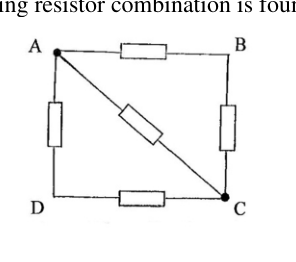 Resistor network Figure 1.a
Topic: Circuits Metodi: Equivalent Circuit Reduction Competenze: Physical Reasoning Objects: Resistor Fonte: Testo (PDF) — p.3
In un circuito si trova la seguente combinazione di resistori (Figura 1.a).
Tutte le resistenze di cui alla figura 1.a hanno una resistenza ohm. Qual è la resistenza totale di (i) AC e (ii) AB?
Rete di resistenza Figura 1.a
Topic: Circuits Metodi: Equivalent Circuit Reduction Competenze: Physical Reasoning Objects: Resistor Fonte: Testo (PDF) — p.3
The energy levels, , of the hydrogen atom are given by
where is a positive integer.
(i) What is the ionization energy of the atom?
(ii) What is the wavelength of the H line, which is due to transitions from the to level?
Topic: Modern-Quantum Physics Metodi: Bohr Model & Quantization, Photon Energy Relation Competenze: Physical Reasoning, Mathematical Modeling Objects: Atom, Photon Fonte: Testo (PDF) — p.3
I livelli di energia, , dell’atomo di idrogeno sono dati da:
dove è un intero positivo.
(i) Qual è l’energia di ionizzazione dell’atomo?
(ii) Qual è la lunghezza d’onda della linea H, che è dovuta a transizioni dal livello al livello ?
Topic: Modern-Quantum Physics Metodi: Bohr Model & Quantization, Photon Energy Relation Competenze: Physical Reasoning, Mathematical Modeling Objects: Atom, Photon Fonte: Testo (PDF) — p.3
You are challenged to construct a bridge using two identical uniform rectangular blocks, length 24 cm, which overhang a table as indicated in Figure 1.c. The lower block overhangs the table by cm and the upper block overhangs the lower block by 6.0 cm. Under what condition will one or both blocks collapse?
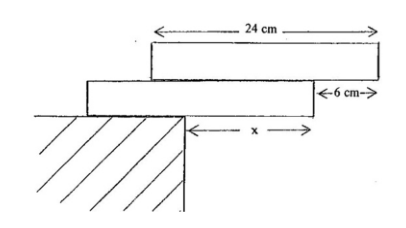 Two overhanging blocks Figure 1.c
Topic: Rigid Body Statics Metodi: Torque & Angular Momentum Analysis, Free-Body Diagram Competenze: Physical Reasoning, Mathematical Modeling Objects: Block Fonte: Testo (PDF) — p.3
Vi viene sfidato a costruire un ponte utilizzando due blocchi rettangolari uniformi identici, lunghi 24 cm, che superano una tavola come indicato nella figura 1.c. Il blocco inferiore si estende sopra il tavolo di cm e il blocco superiore si estende sopra il blocco inferiore di 6,0 cm. In che condizioni collasseranno uno o entrambi i blocchi?
Due blocchi sovrapposti Figura 1.c
Topic: Rigid Body Statics Metodi: Torque & Angular Momentum Analysis, Free-Body Diagram Competenze: Physical Reasoning, Mathematical Modeling Objects: Block Fonte: Testo (PDF) — p.3
A proton travelling with a velocity of m s collides with an oxygen nucleus, of mass kg that is at rest, and is scattered through an angle of 90°. Calculate the velocity and direction of the oxygen nucleus using Newtonian mechanics.
Topic: Conservation of Momentum, Newtonian Mechanics Metodi: Conservation of Momentum, Vector Decomposition Competenze: Mathematical Modeling, Physical Reasoning Objects: Nucleus Fonte: Testo (PDF) — p.3
Un protone che viaggia con una velocità di m s si schianta con un nucleo di ossigeno, di massa kg, che è in riposo, e è sparso attraverso un angolo di 90°. Calcolare la velocità e la direzione del nucleo di ossigeno utilizzando la meccanica newtoniana.
Topic: Conservation of Momentum, Newtonian Mechanics Metodi: Conservation of Momentum, Vector Decomposition Competenze: Mathematical Modeling, Physical Reasoning Objects: Nucleus Fonte: Testo (PDF) — p.3
A submerged wreck, mass kg and mean density kg m, is lifted out of the water by a crane with a steel cable 10 m long, cross-sectional area 5 cm and Young’s modulus N m. Determine the change in the extension of the cable as the wreck is lifted clear of the water.
Topic: Elasticity & Materials, Fluid Mechanics Metodi: Stress-Strain Analysis, Hydrostatic Equilibrium Competenze: Mathematical Modeling, Physical Reasoning Objects: String Fonte: Testo (PDF) — p.3
Un relitto sommerso, di massa kg e densità media kg m, viene sollevato dall’acqua da una gru con un cavo in acciaio lungo 10 m, con superficie trasversale di 5 cm e modulo di Young N m. Determinare il cambiamento nell’estensione del cavo quando il relitto viene sollevato fuori dall’acqua.
Topic: Elasticity & Materials, Fluid Mechanics Metodi: Stress-Strain Analysis, Hydrostatic Equilibrium Competenze: Mathematical Modeling, Physical Reasoning Objects: String Fonte: Testo (PDF) — p.3
MM’, Figure 1.f, is a plane mirror. A and B are points in front of the mirror and O is a variable point on the mirror. B’ is the image of B in the mirror. Prove geometrically that:
(i) the paths AOB and AOB’ are equal.
(ii) the path length of the ray reflected in the mirror has the minimum possible value of AOB.
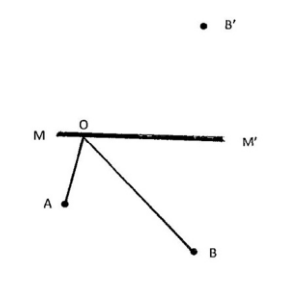 Plane mirror geometry Figure 1.f
Topic: Geometric Optics Metodi: Ray Tracing, Superposition Principle Competenze: Diagrammatic Reasoning, Physical Reasoning Objects: Mirror Fonte: Testo (PDF) — p.4
MM’, figura 1.f, è uno specchio a piano. A e B sono punti davanti allo specchio e O è un punto variabile sullo specchio. B’ è l’immagine di B nello specchio. Prove geometricamente che:
-
i percorsi AOB e AOB’ sono uguali.
-
la lunghezza del percorso del raggio riflesso nello specchio ha il minimo valore possibile di AOB.
Geometria dello specchio di piano Figura 1.f
Topic: Geometric Optics Metodi: Ray Tracing, Superposition Principle Competenze: Diagrammatic Reasoning, Physical Reasoning Objects: Mirror Fonte: Testo (PDF) — p.4
An exoplanet is discovered by the Kepler mission. It has a mass with angular velocity . A small moon of mass and radius orbits the planet at a centre to centre distance of . What is the condition for this circular orbit?
If is the reaction force on a loose rock on the moon’s surface, write down the equation for the ‘equilibrium’ of the rock on the moon’s surface. Assume that the moon orbits the planet always keeping the same face towards the planet. Deduce the condition, independent of , to be satisfied by , for the rock to be lifted off the moon by the planet’s gravitational attraction.
Topic: Gravitation, Newtonian Mechanics Metodi: Newton’s Law of Gravitation, Conservation of Energy Competenze: Physical Reasoning, Mathematical Modeling Objects: Planet, Satellite Fonte: Testo (PDF) — p.4
Un esoplaneta è stato scoperto dalla missione Kepler. Ha una massa con velocità angolare . Una piccola luna di massa e di raggio orbita il pianeta a una distanza dal centro al centro di . Qual è la condizione di questa orbita circolare?
Se è la forza di reazione su una roccia sciolta sulla superficie lunare, scrivere l’equazione per l‘“equilibrio” della roccia sulla superficie lunare. Supponiamo che la luna orbita il pianeta mantenendo sempre la stessa faccia verso il pianeta. Riduzione della condizione, indipendente da , da soddisfare da , per il sollevamento della roccia dalla luna dall’attrazione gravitazionale del pianeta.
Topic: Gravitation, Newtonian Mechanics Metodi: Newton’s Law of Gravitation, Conservation of Energy Competenze: Physical Reasoning, Mathematical Modeling Objects: Planet, Satellite Fonte: Testo (PDF) — p.4
A beaker is fitted with a heating coil and stirrer and contains 40.0 cm of liquid A. When the power dissipated in the heating coil is 4.80 W, the temperature of the contents rises from 15.0°C to 35.0°C in 400 s. The experiment is repeated using 20.0 cm of liquid A mixed with 20.0 cm of liquid B. It is found that, with a heater power of 4.90 W, the temperature again rises from 15.0°C to 35.0°C in 400 s.
Determine
(i) the specific heat capacity, , of B and
(ii) the heat lost, , in both experiments.
Density of A is kg m, Specific heat capacity of A is J kg K, Density of B is kg m.
Topic: Thermodynamics Metodi: First Law of Thermodynamics, Experimental Data Analysis Competenze: Mathematical Modeling, Physical Reasoning Objects: Calorimeter, Coil Fonte: Testo (PDF) — p.4
A beaker is fitted with a heating coil and stirrer and contains 40.0 cm of liquid A. Quando la potenza dissipata nella bobina di riscaldamento è di 4,80 W, la temperatura del contenuto sale da 15.0°C a 35.0°C in 400 s. L’esperimento è ripetuto utilizzando 20,0 cm di liquido A miscelato con 20,0 cm di liquido B. Si è scoperto che, con una potenza di riscaldamento di 4,90 W, la temperatura aumenta di nuovo da 15.0°C a 35.0°C in 400 s.
Determinazione
-
la capacità termico specifica, , di B e
-
il calore perso, , in entrambi gli esperimenti.
La densità di A è kg m, la capacità termico specifica di A è J kg K, la densità di B è kg m.
Topic: Thermodynamics Metodi: First Law of Thermodynamics, Experimental Data Analysis Competenze: Mathematical Modeling, Physical Reasoning Objects: Calorimeter, Coil Fonte: Testo (PDF) — p.4
The electron gun of a cathode ray tube consists of a small hot filament F which is located at , Figure 1.i, and which produces electrons in the - plane of the page with a very small range of velocities. A typical electron has velocity components and . Between and there is a horizontal uniform electric field, , which accelerates the electrons produced at the filament to velocities which are much greater than and . The electrons emerge from the field, beyond , travelling in straight lines. Show that the paths of the emerging electrons, when projected back, appear to have come from a point along the axis at approximately .
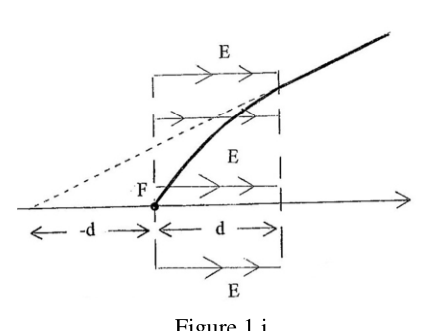 Electron gun geometry Figure 1.i
Topic: Electrostatics, Newtonian Mechanics Metodi: Kinematic Equations, Electric Potential Method Competenze: Mathematical Modeling, Physical Reasoning Objects: Electron Fonte: Testo (PDF) — p.4
Il cannone elettronico di un tubo a raggi catodici è costituito da un piccolo filamento caldo F che si trova a , figura 1.i, e che produce elettroni nel piano - della pagina con un intervallo di velocità molto piccolo. Un elettrone tipico ha componenti di velocità e . Tra e esiste un campo elettrico orizzontale uniforme, , che accelera gli elettroni prodotti al filamento a velocità molto superiori a e . Gli elettroni emergono dal campo, oltre , viaggiando in linee rette. Mostra che i percorsi degli elettroni emergenti, quando proiettati indietro, sembrano essere venuti da un punto lungo l’asse a circa .
Geometria delle pistole elettroniche Figura 1.i
Topic: Electrostatics, Newtonian Mechanics Metodi: Kinematic Equations, Electric Potential Method Competenze: Mathematical Modeling, Physical Reasoning Objects: Electron Fonte: Testo (PDF) — p.4
Determine the binding energy per nucleon, in MeV, of an alpha particle.
Mass of proton u
Mass of neutron u
Mass of alpha particle u
MeV/
Topic: Nuclear & Particle Physics, Modern-Quantum Physics Metodi: Mass-Energy Equivalence Competenze: Mathematical Modeling, Unit Conversion Objects: Nucleus Fonte: Testo (PDF) — p.5
Determinare l’energia di legame per nucleone, in MeV, di una particella alfa.
Massa di protone u
Massa di neutroni u
Massa di particella alfa u
MeV/
Topic: Nuclear & Particle Physics, Modern-Quantum Physics Metodi: Mass-Energy Equivalence Competenze: Mathematical Modeling, Unit Conversion Objects: Nucleus Fonte: Testo (PDF) — p.5
An organ pipe has one end closed and at the other end is a vibrating diaphragm, which is a displacement antinode. When the frequency of the diaphragm is 2,000 Hz a stationary or standing wave pattern is set up in the tube. The distance between adjacent nodes is 8.0 cm. As the frequency is slowly reduced the stationary wave pattern disappears, but another stationary wave pattern reappears at frequency 1,600 Hz.
Calculate:
(i) the speed of sound in air
(ii) the distance between adjacent nodes at 1,600 Hz
(iii) the length of the tube
(iv) the next frequency below 1,600 Hz at which a stationary pattern occurs
Topic: Oscillations & Waves Metodi: Wave Equation, Simple Harmonic Motion Analysis Competenze: Physical Reasoning, Mathematical Modeling Objects: Tube, Membrane Fonte: Testo (PDF) — p.5
Un tubo di organo ha una estremità chiusa e all’altra è un diaframma vibrante, che è un antinodo di spostamento. Quando la frequenza del diaframma è di 2.000 Hz, nel tubo viene creato un modello di onde stazionarie o in piedi. La distanza tra i nodi adiacenti è di 8,0 cm. Man mano che la frequenza si riduce lentamente, il modello di onde stazionarie scompare, ma un altro modello di onde stazionarie riappare a frequenza 1.600 Hz.
Calcola:
-
la velocità del suono nell’aria
-
la distanza tra i nodi adiacenti a 1.600 Hz
-
la lunghezza del tubo
-
la frequenza successiva inferiore a 1.600 Hz a cui si verifica un modello stazionario
Topic: Oscillations & Waves Metodi: Wave Equation, Simple Harmonic Motion Analysis Competenze: Physical Reasoning, Mathematical Modeling Objects: Tube, Membrane Fonte: Testo (PDF) — p.5
A rescue helicopter of mass 810 kg, supports itself in a stationary position by imparting a downward velocity, , to the air in a circle of radius 4.0 m. The density of the air is 1.20 kg m.
Calculate:
(i) the value of
(ii) the power, , required to support the helicopter
Topic: Fluid Mechanics, Newtonian Mechanics Metodi: Continuity Equation, Conservation of Momentum Competenze: Physical Reasoning, Mathematical Modeling Objects: — Fonte: Testo (PDF) — p.5
Un elicottero di salvataggio di massa 810 kg, si sostiene in posizione stazionaria, trasmettendo una velocità verso il basso, , all’aria in un cerchio di raggio di 4,0 m. La densità dell’aria è di 1,20 kg m.
Calcola:
(i) il valore di
- la potenza, , necessaria per sostenere l’elicottero
Topic: Fluid Mechanics, Newtonian Mechanics Metodi: Continuity Equation, Conservation of Momentum Competenze: Physical Reasoning, Mathematical Modeling Objects: — Fonte: Testo (PDF) — p.5
A radioactive substance, with a half-life of , contains a particular nucleus that has NOT decayed over an observational period of . What is the probability that it will decay over a further period of (i) and (ii) ?
Topic: Nuclear & Particle Physics Metodi: Radioactive Decay Law Competenze: Physical Reasoning, Mathematical Modeling Objects: Nucleus Fonte: Testo (PDF) — p.5
Una sostanza radioattiva, con una semivita di , contiene un particolare nucleo che non si è decaduto nel corso di un periodo di osservazione di . Qual è la probabilità che si decadera’ in un ulteriore periodo di i) e ii) ?
Topic: Nuclear & Particle Physics Metodi: Radioactive Decay Law Competenze: Physical Reasoning, Mathematical Modeling Objects: Nucleus Fonte: Testo (PDF) — p.5
A rectangular block has a mass of 1.5 kg with an uncertainty of magnitude 0.03 kg, and a volume of , with uncertainties of magnitude 1 mm in each dimension. Determine the magnitude of the fractional uncertainty in the density of the block.
Topic: Order-of-Magnitude Estimation Metodi: Error Propagation, Dimensional Analysis Competenze: Error Propagation, Significant Figures Objects: Block Fonte: Testo (PDF) — p.6
Un blocco rettangolare ha una massa di 1,5 kg con un’incertezza di magnitudo 0,03 kg e un volume di , con un’incertezza di magnitudo 1 mm in ogni dimensione. Determinare la grandezza dell’incertezza frazionaria nella densità del blocco.
Topic: Order-of-Magnitude Estimation Metodi: Error Propagation, Dimensional Analysis Competenze: Error Propagation, Significant Figures Objects: Block Fonte: Testo (PDF) — p.6