Q2
(a) In Figure 2.a a battery of emf 12.6 V and internal resistance 0.10 ohms is being charged from a solar panel of emf 24.0 V and internal resistance 1.00 ohms. and are voltmeters, that give the value and sign of the voltage, and is a fixed resistor.
(i) If the charging current is 5.00 A, determine the value of .
(ii) If is changed to 0.90 ohms, what would be the readings on the voltmeters? [5]
(b) In the circuit in Figure 2.b, determine the resistance if there is no current flowing through . [3]
(c) In Figure 2.c all resistors have resistance . If a pd is applied across AB:
(i) Explain why the potentials at C and D are equal.
(ii) What is the outcome of joining C and D by a conducting wire?
(iii) Keeping C and D connected, draw a simplified circuit by combining those resistors which are in parallel.
(iv) What is the pd across CO?
(v) Determine the resistance across AB, . [7]
(d) Determine the resistance across AO, , in Figure 2.c. [5]
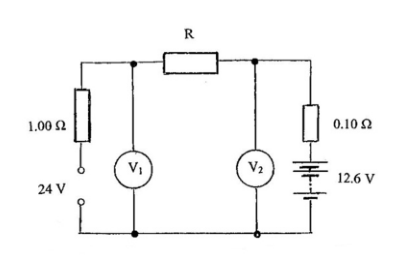 Figure 2.a: battery charging circuit
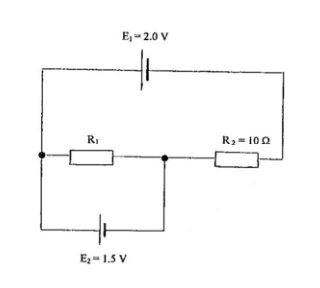 Figure 2.b: bridge circuit with E2
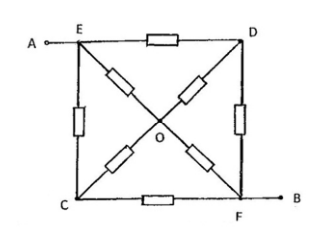 Figure 2.c: resistor network
Topic: Circuits Metodi: Kirchhoff’s Laws, Equivalent Circuit Reduction Competenze: Physical Reasoning, Mathematical Modeling Objects: Battery, Resistor, Wire, Galvanometer Fonte: Testo (PDF) — p.3
Q2
(a) Nella figura 2.a, una batteria di emf 12,6 V e resistenza interna di 0,10 ohms viene caricata da un pannello solare di emf 24,0 V e resistenza interna di 1,00 ohms. e sono voltometri, che danno il valore e il segnale della tensione, e è una resistenza fissa.
(i) Se la corrente di carica è di 5,00 A, determinare il valore di .
(ii) Se il viene modificato a 0,90 ohms, quali sarebbero le letture dei voltometri? [5]
b) Nel circuito della figura 2.b, determinare la resistenza se non c’è corrente che scorre attraverso . [3]
c) Nella figura 2.c, tutte le resistenze hanno una resistenza . Se viene applicato un pd in AB:
(i) Spiegare perché i potenziali di C e D sono uguali.
(ii) Qual è il risultato di unire C e D con un filo conduttore?
- mantenendo collegati i C e i D, disegnare un circuito semplificato combinando quelle resistenze che sono parallele.
(iv) Qual è il pd di CO?
(v) Determina la resistenza di AB, . [7]
d) Determinare la resistenza attraverso l’AO, , nella figura 2.c. [5]
Figura 2.a: circuito di ricarica della batteria
Figura 2.b: circuito ponte con E2
Figura 2.c: rete di resistenza
Topic: Circuits Metodi: Kirchhoff’s Laws, Equivalent Circuit Reduction Competenze: Physical Reasoning, Mathematical Modeling Objects: Battery, Resistor, Wire, Galvanometer Fonte: Testo (PDF) — p.3
Q3
(a) A train is travelling along a straight section of railway line at a constant speed . It sounds its whistle, of frequency , continuously. It passes under a low bridge. Obtain an expression for the frequency heard by an observer on the bridge as it approaches and recedes. The velocity of sound is . [6]
(b) The frequency of a vibrating violin string, constant tension , fixed at both ends, of length and mass per unit length , is given by
When a tuning fork of frequency is struck, and the wire plucked, beats are heard. For three different increasing values of which are, , , and , the number of beats heard in a second is, respectively, , and , where . , , are expressed in terms of a constant tension, .
(i) Sketch a graph of against indicating qualitatively, with an explanation from the data, the possible region(s) where is located.
(ii) Express in terms of for the first two sets of results.
(iii) Deduce the value of .
(iv) Express in terms of for the third set of results.
(v) For the second set of results, , with no change in tension, what percentage change in is necessary for the string and tuning fork to sound in unison? [14]
Topic: Oscillations & Waves Metodi: Wave Equation, Simple Harmonic Motion Analysis Competenze: Mathematical Modeling, Physical Reasoning Objects: String, Tuning Fork Fonte: Testo (PDF) — p.4
Q3
a) Un treno percorre una sezione retta di linea ferroviaria a velocità costante . Suona il suo fischio, di frequenza , continuamente. Passa sotto un basso ponte. Ottenere un’espressione per la frequenza che un osservatore su un ponte sente mentre si avvicina e si allontana. La velocità del suono è . [6]
b) La frequenza di una corda vibrante per violino, tensione costante , fissa a entrambe le estremità, di lunghezza e massa per unità di lunghezza , è data da:
Quando viene colpito un forchetto di sintonia di frequenza e il filo viene strappato, si sentono i battiti. Per tre valori di aumento differenti di , i quali sono , e , il numero di battiti ascoltati in secondo è rispettivamente , e , dove . , , sono espressi in termini di tensione costante, .
(i) Segnare un grafico di contro che indichi qualitativamente, con una spiegazione dei dati, la possibile regione (s) in cui si trova.
(ii) Esprimere in termini di per le prime due serie di risultati.
- Riduzione del valore di .
(iv) Esprimere in termini di per il terzo insieme di risultati.
(v) Per il secondo set di risultati, , senza variazione della tensione, quale variazione percentuale di è necessaria per rendere sonoro all’unisono la corda e la forchetta di sintonia? [14]
Topic: Oscillations & Waves Metodi: Wave Equation, Simple Harmonic Motion Analysis Competenze: Mathematical Modeling, Physical Reasoning Objects: String, Tuning Fork Fonte: Testo (PDF) — p.4
Q4
A simple pendulum in a 19th century Swiss clock has a period of oscillation s, a bob of mass and suspension wire of length . It is located on the surface of the Earth at a temperature of 15°C.
(a) If the temperature is kept at 20°C, over a period of a week, by how much will the pendulum lose or gain time? The coefficient of thermal expansion of the suspension K. ( is the fractional increase in length of the pendulum per unit temperature rise.) [5]
(b) If the pendulum is taken to a height of 20.0 m, by how much will it lose or gain time in the period of a week? Assume the temperature remains at 15°C. [4]
(c) Explain why the tension, , in the suspension of a simple pendulum is not constant. If is the angle the suspension makes with the vertical, determine the tension in it and compare it with the weight of the bob when it is at:
(i) maximum amplitude
(ii) [5]
(d) Some sand is sprinkled on a loud speaker lying on its back which can be made to vibrate vertically with simple harmonic motion. When the amplitude is 0.015 cm the sand begins to lose contact with the membrane. Calculate the frequency of vibration at which this occurs. [6]
Topic: Oscillations & Waves, Newtonian Mechanics Metodi: Simple Harmonic Motion Analysis, Kinematic Equations, Free-Body Diagram Competenze: Mathematical Modeling, Physical Reasoning Objects: Pendulum, Membrane Fonte: Testo (PDF) — p.5
Q4
Un semplice pendolo in un orologio svizzero del XIX secolo ha un periodo di oscillazione s, un bob di massa e un filo sospensionato di lunghezza . Si trova sulla superficie terrestre a una temperatura di 15°C.
(a) Se la temperatura è mantenuta a 20°C, per un periodo di una settimana, per quanto il pendolo perderà o guadagnerà tempo? Il coefficiente di espansione termica della sospensione K. ( è l’aumento frazionato della lunghezza del pendolo per aumento unitario di temperatura.) [5]
b) Se il pendolo viene portato ad un’altezza di 20,0 m, per quanto perderà o guadagnerà tempo nel periodo di una settimana? Supponiamo che la temperatura rimanga a 15°C. [4]
c) Spiega perché la tensione, , nella sospensione di un semplice pendolo non è costante. Se è l’angolo che la sospensione fa con la verticale, determinare la tensione in essa e confrontarla con il peso della bobina quando è a:
(i) amplitudine massima
(ii) [5]
d) Un po’ di sabbia viene spruzzata su un altoparlante che si trova sulla schiena e che può vibrare verticalmente con un semplice movimento armonico. Quando l’amplitudine è di 0,015 cm la sabbia inizia a perdere contatto con la membrana. Calcolare la frequenza di vibrazione a cui si verifica. [6]
Topic: Oscillations & Waves, Newtonian Mechanics Metodi: Simple Harmonic Motion Analysis, Kinematic Equations, Free-Body Diagram Competenze: Mathematical Modeling, Physical Reasoning Objects: Pendulum, Membrane Fonte: Testo (PDF) — p.5
Q5
A technician is measuring the quality of rectangular medical thin glass plates by looking at the interference of light between two plates. One plate has a straight length of wire, diameter 0.0050 cm, resting on it parallel to an edge at one end. Another identical glass plate is supported by the wire at one end, with the other end resting on the horizontal plate, forming an air wedge of angle . Interference fringes are produced by monochromatic light of wavelength , incident normally on the plates.
(a) Explain, with a diagram, how the interference arises assuming the incident and reflected light is normal to the horizontal plate, and derive the conditions for constructive and destructive interference when the air gap is of thickness . If 200 fringes are observed across the glass plate, what is the wavelength of the light? [6]
(b) What would be observed if white light replaced the monochromatic light? How would the conditions for monochromatic interference alter if a transparent liquid of refractive index replaced the air in the wedge? [4]
(c) If you had an optically flat glass slide of thickness and a similar one that was defective in this respect, containing areas with thickness less than , how would you determine the extent of its deviation from an optical flat and produce a contour map of its surface deviation from a plane surface? [4]
(d) If you were provided with two monochromatic sources, of different wavelengths, one of which was known, how could you determine the wavelength of the unknown source? [6]
Topic: Wave Optics Metodi: Interference & Diffraction Analysis, Superposition Principle Competenze: Physical Reasoning, Diagrammatic Reasoning Objects: Wire Fonte: Testo (PDF) — p.6
Q5
Un tecnico sta misurando la qualità delle piastrelle di vetro sottili mediche rettangolari osservando l’interferenza della luce tra due piastrelle. Una piastra ha una lunghezza dritta di filo, di diametro 0,0050 cm, che si posa su di essa parallela ad un bordo ad una estremità. Un’altra piastra di vetro identica è sostenuta dal filo ad una estremità, con l’altra estremità appoggiata sulla piastra orizzontale, formando un cuneo d’aria di angolo . Le margini di interferenza sono prodotte da luce monocromatica di lunghezza d’onda , che normalmente si trova sulle placche.
a) Spiegare, con un diagramma, come si verifica l’interferenza, se si presume che l’incidente e la luce riflessa siano normali per la piastra orizzontale, e derivare le condizioni per l’interferenza costruttiva e distruttiva quando il gap di aria è di spessore . Se si osservano 200 margini sulla piastra di vetro, quale è la lunghezza d’onda della luce? [6]
(b) Cosa si osserverebbe se la luce bianca sostituisse la luce monocromatica? Come cambierebbero le condizioni di interferenza monocromatica se un liquido trasparente di indice di rifrazione sostituisse l’aria nella cuccia? [4]
c) Se si dispone di una lastra di vetro otticamente piatta di spessore e di una simile che è difettosa a questo proposito, contenente aree di spessore inferiore a , come si determina la misura della sua deviazione da una piatta ottica e si produce una mappa di contorno della sua deviazione superficiale da una superficie piatta? [4]
(d) Se vi fossero state fornite due fonti monocromatiche di lunghezze d’onda diverse, una delle quali era nota, come potreste determinare la lunghezze d’onda della fonte sconosciuta? [6]
Topic: Wave Optics Metodi: Interference & Diffraction Analysis, Superposition Principle Competenze: Physical Reasoning, Diagrammatic Reasoning Objects: Wire Fonte: Testo (PDF) — p.6
Q6
(a) A block of wood, mass , rests on a smooth horizontal table. A gun is fired horizontally at the block and the bullet, mass , passes through it, emerging with half its initial speed. Determine the fraction of the initial kinetic energy that is lost in the collision. [5]
(b) A particle, mass , is placed at the top of a smooth sphere of radius . The particle is disturbed and slides down the side gaining speed at a vertical height above the centre of the sphere. At what value of will it leave the surface of the sphere? [6]
(c) Figure 6.c shows two 45° wedges, the smaller wedge has a horizontal top face. It can slide down the larger wedge , which is on a horizontal table. All the surfaces are smooth. A mass sits on the top face of the upper wedge. Describe qualitatively the motion of the system once it is released from rest. [4]
(d) Two trains are travelling away from a common station at speeds of and , in directions that are at an angle 60° to each other. What is the velocity of the train with speed relative to an observer in the other train? [5]
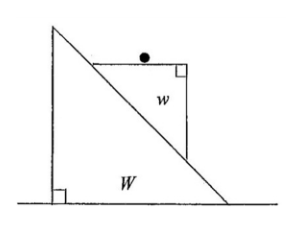 Figure 6.c: two wedges on table
Topic: Newtonian Mechanics, Conservation of Momentum Metodi: Conservation of Momentum, Conservation of Energy, Free-Body Diagram Competenze: Physical Reasoning, Mathematical Modeling Objects: Block, Projectile, Sphere, Wedge Fonte: Testo (PDF) — p.7
Q6
a) Un blocco di legno di massa si fonda su una tavola orizzontale liscia. Una pistola viene sparata orizzontalmente al blocco e il proiettile, di massa , lo attraversa, emerge con la metà della sua velocità iniziale. Determinare la frazione di energia cinetica iniziale che viene persa nella collisione. [5]
b) Una particella, di massa , è collocata in cima a una sfera liscia di raggio . La particella si disturba e scivola verso il lato, raggiungendo velocità ad un’altezza verticale sopra il centro della sfera. A quale valore di lascerà la superficie della sfera? [6]
c) La figura 6.c mostra due cucine 45°, la cucina più piccola ha una superficie superiore orizzontale. Può scivolare giù la ciglia più grande , che si trova su una tavola orizzontale. Tutte le superfici sono lisce. Una massa si trova sulla parte superiore della cuccia superiore. Descrivere qualitativamente il movimento del sistema una volta rilasciato dal riposo. [4]
d) Due treni si allontanano da una stazione comune a velocità e , in direzioni che si trovano all’angolo 60° l’uno dell’altro. Qual è la velocità del treno con velocità rispetto ad un osservatore nell’altro treno? [5]
Figura 6.c: due cucine sul tavolo
Topic: Newtonian Mechanics, Conservation of Momentum Metodi: Conservation of Momentum, Conservation of Energy, Free-Body Diagram Competenze: Physical Reasoning, Mathematical Modeling Objects: Block, Projectile, Sphere, Wedge Fonte: Testo (PDF) — p.7
Q7
In order to send a space vehicle to the Moon, the vehicle is first placed in a ‘parking orbit’ near the Earth.
(a) Calculate the speed of the vehicle when it is in the parking orbit close to the Earth (you may neglect the height of the orbit compared to the radius of the Earth). [3]
(b) Explain how the rotation of the Earth affects the initial energy required to launch the vehicle from the surface of the Earth. [3]
(c) When the vehicle is in the parking orbit close to the Earth, in the outer layers of the Earth’s atmosphere, friction causes a gradual reduction in its total energy. However it is observed that the vehicle increases its speed. How is this explained using Newtonian mechanics? [7]
(d) A star, with mass equal to that of our Sun, is located near the outer edge of a spherical galaxy, ly from the centre. (1 ly is the distance light travels in 1 year.) Its orbital speed around the centre of the galaxy is 250 km s. Estimate, stating any assumptions made, the order of magnitude of:
(i) the mass of the galaxy.
(ii) the number of stars in the galaxy. [7]
Topic: Gravitation, Astrophysics Metodi: Newton’s Law of Gravitation, Kepler’s Laws, Order-of-Magnitude Estimation Competenze: Physical Reasoning, Estimation & Approximation Objects: Satellite, Planet, Star Fonte: Testo (PDF) — p.8
Q7
Per inviare un veicolo spaziale sulla Luna, il veicolo viene prima posizionato in un’orbita di parcheggio vicino alla Terra.
(a) Calcolare la velocità del veicolo quando si trova in orbita di parcheggio vicina alla Terra (si può trascurare l’altezza dell’orbita rispetto al raggio terrestre). [3]
b) Spiegare come la rotazione della Terra influisce sull’energia iniziale necessaria per lanciare il veicolo dalla superficie terrestre. [3]
c) Quando il veicolo si trova in orbita di parcheggio vicino alla Terra, negli strati esterni dell’atmosfera terrestre, l’attrito provoca una graduale riduzione della sua energia totale. Tuttavia si osserva che il veicolo aumenta la sua velocità. Come si spiega questo usando la meccanica newtoniana? [7]
d) Una stella, di massa pari a quella del nostro Sole, si trova vicino al bordo esterno di una galassia sferica, ly dal centro. (1 ly è la distanza che la luce percorre in 1 anno) La sua velocità orbitale intorno al centro della galassia è di 250 km s. Estimare, con le ipotesi formulate, l’ordine di grandezza di:
-
la massa della galassia.
-
il numero di stelle nella galassia. [7]
Topic: Gravitation, Astrophysics Metodi: Newton’s Law of Gravitation, Kepler’s Laws, Order-of-Magnitude Estimation Competenze: Physical Reasoning, Estimation & Approximation Objects: Satellite, Planet, Star Fonte: Testo (PDF) — p.8
Q8
The scattering of photons (Compton scattering) can be used to identify the composition of materials by the intensity of the scattered radiation. The scattered radiation is at a different frequency and in this problem you are asked to find out what happens when a photon is scattered off at an angle.
An incident photon, frequency , momentum , is scattered by a stationary electron producing a scattered photon of frequency , where is small compared with . This photon travels in a direction that makes an angle with the direction of the incident photon. The electron, mass , acquires a non-relativistic speed .
(a) Draw a labelled vector triangle of the momenta of the particles. [3]
(b) Write down the equation relating the magnitude of the momentum of the electron to that of the photons. [4]
(c) Obtain the equation for energy conservation. [2]
(d) Deduce an equation for . When is much less than and much less than , obtain the approximation:
[7]
(e) Sketch graphs of:
(i) against for constant
(ii) against for constant
For what angle(s) is greatest? State the value(s) of . [4]
Topic: Modern-Quantum Physics Metodi: Photon Energy Relation, Conservation of Momentum, Conservation of Energy Competenze: Mathematical Modeling, Diagrammatic Reasoning Objects: Photon, Electron Fonte: Testo (PDF) — p.9
Q8
La dispersione dei fotoni (compton scattering) può essere utilizzata per identificare la composizione dei materiali per l’intensità della radiazione dispersa. La radiazione dispersa è a una frequenza diversa e in questo problema ti viene chiesto di scoprire cosa succede quando un fotone è disperso ad un angolo.
Un fotone incidente, frequenza , impulso , è disperso da un elettrone stazionario che produce un fotone disperso di frequenza , dove è piccolo rispetto a . Questo fotone viaggia in una direzione che fa un angolo con la direzione del fotone incidente. L’elettrone, massa , acquista una velocità non relativistica .
a) Disegnare un triangolo vettoriale etichettato del momento delle particelle. [3]
b) Scrivi l’equazione che relaziona la grandezza del momento dell’elettrone a quella dei fotoni. [4]
(c) Ottenere l’equazione per la conservazione dell’energia. [2]
d) Riduzione di un’equazione per . Quando è molto inferiore a e molto inferiore a , si ottiene l’approssimazione:
[7]
e) Sketch grafici di:
(i) contro per la costante
(ii) contro per la costante
Per quale angolo (s) è il massimo ? Indicare il valore ((s) di . [4]
Topic: Modern-Quantum Physics Metodi: Photon Energy Relation, Conservation of Momentum, Conservation of Energy Competenze: Mathematical Modeling, Diagrammatic Reasoning Objects: Photon, Electron Fonte: Testo (PDF) — p.9
Q9
The charge distribution along a complex molecule can be simplified to the following arrangement of charges.
Two charges of magnitude and are separated by a distance , and located at A and B respectively. O is the mid-point of AB, Figure 9.a.
(a) Determine the potential and field strength along the perpendicular bisector of AB through O, at a point P a distance from O. [5]
(b) Determine the potential, , and the field strength, , at the point S with coordinates . [10]
(c) A circular wire, radius , centre C, has a charge uniformly distributed around it. An insulating rod of length and mass is initially at rest and situated along the axis of the circle. It has a point charge of at one end and at the other end, being from C and being from C. Determine the velocity of the charges when reaches C. [5]
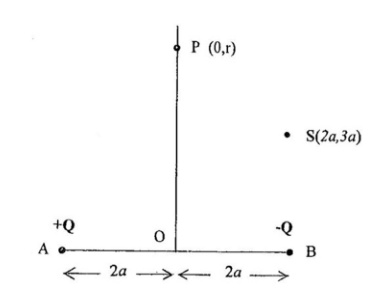 Figure 9.a: dipole charge arrangement
Topic: Electrostatics Metodi: Coulomb’s Law, Electric Potential Method, Conservation of Energy Competenze: Mathematical Modeling, Physical Reasoning Objects: Point Charge, Rod, Wire Fonte: Testo (PDF) — p.10
Q9
La distribuzione delle cariche lungo una molecola complessa può essere semplificata con la seguente disposizione delle cariche.
Due cariche di magnitudo e sono separate da una distanza e si trovano rispettivamente a A e B. O è il punto medio di AB, figura 9.a.
a) Determinare il potenziale e la resistenza del campo lungo il bisector perpendicolare di AB a O, in un punto P a distanza da O. [5]
b) Determinare il potenziale, , e la resistenza del campo, , al punto S con coordinate . [10]
c) Un filo circolare, di raggio , centro C, ha una carica uniformemente distribuita attorno a esso. Una barra isolante di lunghezza e massa è inizialmente in riposo e situata lungo l’asse del cerchio. Ha una carica puntologica di ad una estremità e all’altra, essendo da C e essendo da C. Determinare la velocità delle cariche quando raggiunge C. [5]
Figura 9.a: sistema di carica di dipole
Topic: Electrostatics Metodi: Coulomb’s Law, Electric Potential Method, Conservation of Energy Competenze: Mathematical Modeling, Physical Reasoning Objects: Point Charge, Rod, Wire Fonte: Testo (PDF) — p.10