Problem 1. Asteroid (14 points) Consider a hypothetical asteroid of mass and radius , which moves along an elliptical orbit around the Sun (of mass ) in the same direction as Earth. Let us assume that the Earth’s orbit is a circle of radius (neglecting thus its eccentricity) and that the two orbits lay in the same plane. The asteroid’s shortest distance to the Sun (at its perihelion) and the longest distance (at the apohelion) (you may use the approximate value to simplify your calculations). The orbital velocity of the Earth km/s. You can also use the following numerical values: the radius of the Earth km, free fall acceleration at the Earth’s surface , angular diameter of the Sun as seen from the Earth , duration of one year days, the temperature of the Sun’s surface K, free fall acceleration at the Sun’s surface , Stefan Boltzmann constant , the speed of light m/s. The asteroid is of a spherical shape, its radius m and mass kg; both the Sun and the asteroid can be considered as perfectly black bodies. Part A. Collision with Earth (5 points) i. (2 pts) Suppose that the asteroid will collide with the Earth and is already very close, at a distance from the Earth’s surface; what is the velocity of the asteroid with respect to the Earth assuming that (a) ; (b) . ii. (2 pts) Impact parameter is defined in the Earth’s reference frame as the distance between the Earth and a line, tangent to the asteroid’s trajectory at a point which is far enough (at a distance , ). Determine the maximal value of the impact parameter for which the asteroid will still collide with the Earth. iii. (1 pt) According to calculations, the asteroid is going to hit the Earth centrally after orbital periods. In order to avert the collision, the period of the asteroid needs to be changed; by how many seconds? (Assume simplifyingly that the intersection point of the two orbits remains at rest.) Part B. Changing the solar pull (9 points) Theoretically, it is possible to change the asteroid’s period by making use of the pressure of the solar radiation. Let us study, how realistic is such a project. The Sun pulls the asteroid with the gravitational force equal to , where is the gravitational constant and is the distance between the Sun and the asteroid at the given moment of time. Let us denote , so that . Suppose that when the asteroid is at its perihelion, the constant is decreased instantaneously, down to a new value , which remains constant during the subsequent motion. i. (2 pts) Find the new apohelion distance of the asteroid; express it in terms of . ii. (2 pts) Find the change of the asteroid’s orbital period assuming that (express it in terms of ). iii. (4 pts) Suppose that at its perihelion, the asteroid is coated with a perfectly retro-reflective paint (which directs all the incident light directly back, towards the source). Such a painting will result in a change of the effective pull of the asteroid towards the Sun; find the respective value of (provide also a numerical estimate). iv. (1 pt) Estimate, is it realistic to avert the collision with this asteroid using the retroreflective paint.
Topic: Gravitation, Astrophysics, Electromagnetism Metodi: Kepler’s Laws, Newton’s Law of Gravitation, Conservation Laws, Energy Conservation Method Competenze: Mathematical Modeling, Physical Reasoning, Estimation & Approximation Objects: Planet, Star Fonte: Testo (PDF) — p.1
Problema 1. Asteroide (14 punti) Considera un ipotetico asteroide di massa e raggio , che si muove lungo un’orbita ellittica attorno al Sole (di massa ) nella stessa direzione della Terra. Supponiamo che L’orbita terrestre è un cerchio di raggio (negliendosi quindi il suo La sua eccentricità è la stessa di quella di un’orbita. La distanza più breve dell’asteroide dal Sole (al suo perielione) e la distanza più lunga (all’apohelione) (potete utilizzare il valore approssimativo per semplificare i vostri calcoli). La velocità orbitale della Terra km/s. È possibile utilizzare anche i seguenti valori numerici: il raggio della Terra km, l’accelerazione della caduta libera alla superficie della Terra , il diametro angolare di Sole visto dalla Terra , durata di un anno giorni, temperatura della superficie del Sole K, accelerazione della caduta libera alla superficie del Sole , Costante di Stefan Boltzmann , la velocità della luce m/s. L’asteroide ha una forma sferica, il suo raggio m e la sua massa kg; sia il Sole che l’asteroide possono essere considerati perfetti Corpi neri. Parte A. Collisione con la Terra (5 punti) i. Supponiamo che l’ asteroide colpisca la Terra e è già molto vicino, a una distanza dalle Terres superficie; qual è la velocità dell’asteroide rispetto alla superficie del Terra, supponendo che (a) ; (b) . ii. (2 pts) Il parametro di impatto è definito nel quadro di riferimento della Terra come la distanza tra la Terra e una linea, tangente alla traiettoria dell’asteroide in un punto abbastanza lontano (a distanza , ). Determina il valore massimo di un parametro di impatto per il quale l’asteroide continuerà a Collidono con la Terra. iii. Secondo i calcoli, l’asteroide colpisce la Terra in modo centrale dopo i periodi orbiti . In ordine Per evitare la collisione, il periodo dell’asteroide deve essere cambiato; per quanti secondi? (Supponiamo, in modo semplificato, che il punto di intersezione delle due orbite rimane in riposo.) Parte B. Cambiamento della forza solare (9 punti) In teoria, è possibile cambiare il periodo dell’asteroide utilizzando la pressione della radiazione solare. Lasciateci La Commissione ha inoltre esaminato la realizzazione di un progetto di questo tipo. Il Sole tira l’asteroide con la forza gravitazionale uguale a , dove è la costante gravitazionale e è la distanza tra il Sole e l’asteroide nel momento dato. Indichiamo , in modo che . Supponiamo che quando l’asteroide è al suo perielio, la costante diminuisca istantaneamente, fino a un nuovo valore , Il Parlamento europeo ha adottato una proposta di risoluzione che resta costante durante la successiva mozione. i. (2 punti) Trova la nuova distanza di apohelione dell’asteroide; esprimala in termini di . ii. (2 punti) Trova il cambiamento del periodo orbitale dell’ asteroide presumendo che (esprimendo in termini di ). iii. (4 punti) Supponiamo che al suo perielione l’asteroide sia rivestito con una vernice perfettamente retrorflettiva (che dirige tutta la luce incidente direttamente verso la fonte). Che quadro . Il valore di (fornisce anche un stima numerica). iv. (1 pt) La stima è realistica per evitare la collisione con Questo asteroide utilizza la vernice retroreflettiva.
Topic: Gravitation, Astrophysics, Electromagnetism Metodi: Kepler’s Laws, Newton’s Law of Gravitation, Conservation Laws, Energy Conservation Method Competenze: Mathematical Modeling, Physical Reasoning, Estimation & Approximation Objects: Planet, Star Fonte: Testo (PDF) — p.1
Problem 2. Thermodynamic cycle (5 points) Calculate the thermal efficiency of an ideal-gas cycle consisting of two isotherms at temperatures and , and two isochores joining them. (An isochore is a constant-volume process.) The engine is constructed so that the heat released during the cooling isochore is used for feeding the heating isochore.
Topic: Thermodynamics Metodi: First Law of Thermodynamics, Thermodynamic Cycle Analysis, Ideal Gas Law Competenze: Mathematical Modeling Objects: Gas, Heat Engine Fonte: Testo (PDF) — p.1
Il problema 2. Ciclo termodinamico (5 punti) Calcolare l’efficienza termica di un ciclo di gas ideale composto da due isotermi a temperature e , e due Gli isocori si uniscono a loro. (Un isocore è un processo a volume costante.) Il motore è costruito in modo che il calore rilasciato durante l’isocore di raffreddamento sia utilizzato per alimentare l’isocore di riscaldamento.
Topic: Thermodynamics Metodi: First Law of Thermodynamics, Thermodynamic Cycle Analysis, Ideal Gas Law Competenze: Mathematical Modeling Objects: Gas, Heat Engine Fonte: Testo (PDF) — p.1
Problem 3. Bars and rod (5 points) Two cylindrical horizontal bars are fixed one above the other; the distance between the axes of the bars is , where is the diameter of the rod. Between the bars, a cylindrical rod of diameter is placed as shown in Figure (this is a vertical cross-section of the system). The coefficient of friction between the rod and the bars is . If the rod is long enough, it will remain in equilibrium in such a position. What is the minimal length of the rod required for such an equilibrium?
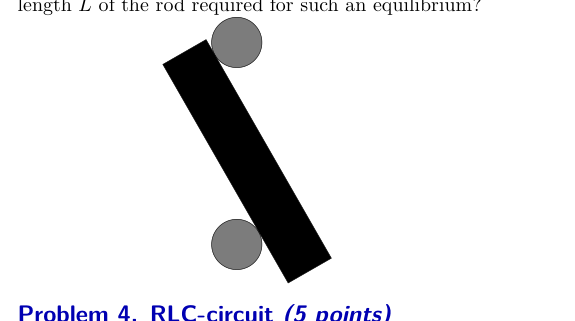 sezione verticale barre e sbarra
Topic: Newtonian Mechanics, Rigid Body Statics Metodi: Free-Body Diagram, Torque & Angular Momentum Analysis, Vector Decomposition Competenze: Diagrammatic Reasoning, Mathematical Modeling Objects: Rod, Cylinder Fonte: Testo (PDF) — p.1
Problema 3. Barre e bastone (5 punti) Due barre orizzontali cilindriche sono fissate una sopra la altri; la distanza tra gli assi delle barre è , dove è il diametro della canna. Tra le barre, una canna cilindrica di diametro è posizionato come mostrato nella figura (si tratta di una verticale intersezione del sistema). Il coefficiente di attrito tra la canna e le barre sono . Se la canna è abbastanza lunga, restano in equilibrio in tale posizione. Qual è il minimo lunghezza della canna necessaria per tale equilibrio?
sezione verticale barre e sbarra
Topic: Newtonian Mechanics, Rigid Body Statics Metodi: Free-Body Diagram, Torque & Angular Momentum Analysis, Vector Decomposition Competenze: Diagrammatic Reasoning, Mathematical Modeling Objects: Rod, Cylinder Fonte: Testo (PDF) — p.1
Problem 4. RLC-circuit (5 points) For the circuit shown in Figure, , , , and . The electromotive force of the battery is . Initially the switch is closed and the system is operating in a stationary regime. i. (1 pt) Find the reading of the voltmeter in the stationary regime. ii. (2 pts) Now, the switch is opened. Find the reading of the voltmeter immediately after the opening. iii. (2 pts) Find the total amount of heat which will be dissipated on each of the resistors after opening the switch, and until a new equilibrium state is achieved.
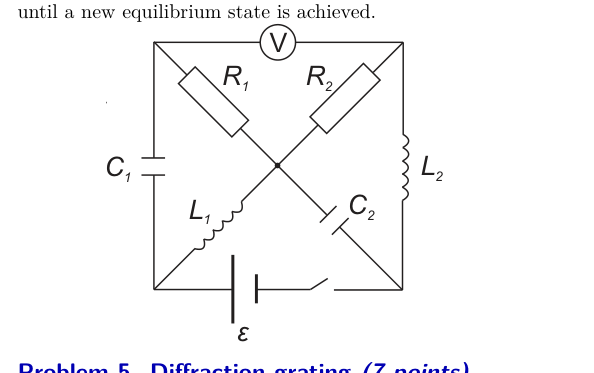 circuito RLC con batteria e switch
Topic: Circuits, Oscillations & Waves Metodi: Kirchhoff’s Laws, Conservation of Energy, Equivalent Circuit Reduction Competenze: Mathematical Modeling, Diagrammatic Reasoning Objects: Resistor, Capacitor, Inductor, Battery, Switch Fonte: Testo (PDF) — p.1
Il problema 4. Circuito RLC (5 punti) per il circuito indicato nella figura , , e . La forza elettromotrice di batteria è . Inizialmente il interruttore è chiuso e il sistema opera in regime stazionario. i. (1 pt) Trova la lettura del voltmeter nel stazionario regime. ii. (2 punti) Ora, il interruttore è aperto. Trova la lettura del Voltmeter immediatamente dopo l’apertura. iii. (2 punti) Indicare la quantità totale di calore che sarà dissipata su ciascuna delle resistenze dopo aver aperto il interruttore, e fino a che non si raggiunga un nuovo stato di equilibrio.
*circuito RLC con batterie e interruttore *
Topic: Circuits, Oscillations & Waves Metodi: Kirchhoff’s Laws, Conservation of Energy, Equivalent Circuit Reduction Competenze: Mathematical Modeling, Diagrammatic Reasoning Objects: Resistor, Capacitor, Inductor, Battery, Switch Fonte: Testo (PDF) — p.1
Problem 5. Diffraction grating (7 points) Determine the pitch (the distance between the neighbouring lines) of the reflecting diffraction grating; estimate the uncertainty of the result. Equipment: a reflecting diffraction grating, green laser ( nm), ruler, a stand for holding the laser.
Topic: Wave Optics Metodi: Interference & Diffraction Analysis, Error Propagation Competenze: Experimental Data Analysis, Measurement & Instrumentation, Error Propagation Objects: Diffraction Grating Fonte: Testo (PDF) — p.1
Problema 5. Rati di diffrazione (7 punti) Determina il campo di riferimento (la distanza tra le parti vicine L’indicazione della presenza di una rete di diffrazione riflettente (linee) deve essere effettuata in base a una valutazione del risultato. Apparecchiature: una griglia di diffrazione riflettente, laser verde ( nm), regola, supporto per tenere il laser.
Topic: Wave Optics Metodi: Interference & Diffraction Analysis, Error Propagation Competenze: Experimental Data Analysis, Measurement & Instrumentation, Error Propagation Objects: Diffraction Grating Fonte: Testo (PDF) — p.1
Problem 6. Uranium decay (7 points) Natural uranium consists of 99.3% , and in this problem we can ignore the presence of other isotopes. decays according to the table at the bottom of the page, where an isotope decays into the isotope indicated in its neighbouring cell (to the right), the decay energy is given in the cell below in megaelectronvolts (MeV), J, and the last row indicates the logarithm of the respective half-life in seconds, (so that 17.15 below means that the half-life of is s s. You may also use the value of the Avogadro number , and the following physical properties of uranium: melting point K, density , thermal conductivity , molar mass kg/mol. It can be assumed that the radon which appears in the chain of nuclear decays does not escape the bulk of uranium. Remark: thermal conductivity is the coefficient of proportionality between the heat flux density () and (temperature drop per unit distance). i. (2 pts) Assuming that the only source of natural is the decay chain of , what is the percentage of in the natural uranium ore? ii. (2 pts) Determine the heat production volume rate of natural uranium (in watts per cubic meter) due to nuclear decay. iii. (3 pts) If the radius of a uranium ball is large enough, it will melt inside. How large radius is needed for such a melting, if ambient temperature is K?
Topic: Nuclear & Particle Physics, Thermodynamics Metodi: Radioactive Decay Law, Conservation of Energy, Differential Equations Competenze: Mathematical Modeling, Physical Reasoning Objects: Nucleus, Sphere Fonte: Testo (PDF) — p.2
Problema 6. Decadimento dell’uranio (7 punti) Natural uranium consists of 99.3% , and in this problem we can ignore the presence of other isotopes. decadimenti In base alla tabella in basso della pagina, dove un l’isotopo si decompone nell’isotopo indicato nella sua vicina cellula (a destra), l’energia di decadimento è data nella cellula di sotto in megaelettronvolti (MeV), J, e l’ultima riga indica il logaritmo della rispettiva emivita In secondi, (in modo che sotto il 17,15 si intende che il La durata di emivita di è s s. Puoi anche usare il valore del numero di Avogadro , e le seguenti proprietà fisiche dell’uranio: punto di fusione K, densità , conducibilità termica , massa molare kg/mol. Si può presumere che il il radone che appare nella catena di decadi nucleari non sfuggire alla maggior parte dell’uranio. Nota: la conducibilità termica è il coefficiente di proporzionalità tra la densità del flusso di calore () e (crescita di temperatura per unità di distanza). i. (2 punti) Supponendo che l’unica fonte di naturale sia la catena di decomposizione di , quale è la percentuale di nella minerali di uranio naturali? ii. (2 punti di cui al punto 1) Determinare il volume di produzione di calore dell’uranio naturale (in watt per metro cubo) a causa della decomposizione nucleare. iii. (3 punti) Se il raggio di una sfera di uranio è sufficientemente grande,
- Si scioglierà dentro. Quanto grande raggio è necessario per tale Fusione, se la temperatura ambiente è K?
Topic: Nuclear & Particle Physics, Thermodynamics Metodi: Radioactive Decay Law, Conservation of Energy, Differential Equations Competenze: Mathematical Modeling, Physical Reasoning Objects: Nucleus, Sphere Fonte: Testo (PDF) — p.2
Problem 7. Lifting by current (7 points) Consider a loop of freely deformable conducting wire with insulation of length , the two ends of which are fixed (permanently) to the ceiling. A load of mass is fixed to the middle of the wire (the mass of the wire is negligible). There is also a horizontal magnetic field of induction ; free fall acceleration is . A current is lead through the wire. Neglect the field induced by the wires. i. (2 pts) Sketch the shape of the wire. ii. (2 pts) What is the maximal height by which the load can be lifted in such a way (increasing the current, if necessary)? iii. (2 pts) Write an equation from which it is possible to determine the lifting height . iv. (1 pt) How large current is needed to lift the load by ?
Topic: Magnetism, Newtonian Mechanics Metodi: Lorentz Force Analysis, Free-Body Diagram, Calculus-Integration Competenze: Mathematical Modeling, Diagrammatic Reasoning Objects: Wire, Block Fonte: Testo (PDF) — p.2
Problema 7. Sollevamento a corrente (7 punti) Considerare un ciclo di filo conduttore liberamente deformabile con isolamento di lunghezza , le due estremità di cui sono fissati sul soffitto. A il carico di massa è fissato al centro del filo (la massa del filo è trascurabile). C’è anche un campo magnetico orizzontale di induzione ; caduta libera l’accelerazione è . Una corrente è condotta attraverso il
- Cable. Ignorare il campo indotto dai fili. i. (2 punti) Segna la forma del filo. ii. (2 punti) Qual è l’altezza massima con cui il carico può essere essere sollevato in questo modo (aumentando la corrente, se necessario)? iii. (2 punti) Scrivi un’equazione da cui è possibile determinare l’altezza di sollevamento . iv. (1 pt) Quanto è necessaria una corrente di grandezza per sollevare il carico per ?
Topic: Magnetism, Newtonian Mechanics Metodi: Lorentz Force Analysis, Free-Body Diagram, Calculus-Integration Competenze: Mathematical Modeling, Diagrammatic Reasoning Objects: Wire, Block Fonte: Testo (PDF) — p.2
Problem 8. Elastic collision (7 points) Consider a perfectly elastic collision of two balls, one of which has mass and is moving with velocity . The other has mass and stays initially at rest. The collision is not necessarily central. The surface of the balls is slippery, so the balls will not rotate. i. (1 pt) What are the momenta of the balls before the collision in the frame of reference where the centre of mass of the whole system stays at rest? ii. (3 pts) What are the momenta of the balls (by moduli) after the collision in the mass centre’s frame of reference? iii. (3 pts) What is the maximal angle by which the trajectory of the initially moving ball can be inclined as a result of the collision?
Topic: Newtonian Mechanics, Conservation of Momentum Metodi: Conservation Laws, Conservation of Momentum, Vector Decomposition Competenze: Mathematical Modeling, Diagrammatic Reasoning, Physical Reasoning Objects: Ball Fonte: Testo (PDF) — p.2
Problema 8. Collizione elastica (7 punti) Considerate una collisione perfettamente elastica di due palle, una di che ha massa e si muove con velocità . L’altro ha massa e rimane inizialmente a riposo. La collisione è non necessariamente centrale. La superficie delle palle è scivolosa, quindi… Le palle non gireranno. i. (1 pt) Quali sono i momenti delle palle prima della collisione nel quadro di riferimento in cui il centro di massa della palla è Tutto il sistema resta a riposo? ii. (3 punti) Quali sono i momenti delle palle (di moduli) dopo la collisione nel centro di massa? iii. (3 punti) Qual è l’angolo massimo con cui la traiettoria della palla in movimento iniziale può essere inclinata in conseguenza di della collisione?
Topic: Newtonian Mechanics, Conservation of Momentum Metodi: Conservation Laws, Conservation of Momentum, Vector Decomposition Competenze: Mathematical Modeling, Diagrammatic Reasoning, Physical Reasoning Objects: Ball Fonte: Testo (PDF) — p.2
Problem 9. Power lines (7 points) i. (2 pts) Consider a rope of linear density (mass per unit length), which is stretched so as to maintain a mechanical tension in the rope. Show that along such a rope, perturbations (eg. waves) will travel with the speed , and find the coefficient . ii. (2 pts) Now, consider a power line between two poles, the distance between of which is ; the linear density of the wire is , and the middle point of the wire hangs below the horizontal level at which the wire is fixed to the poles by a distance . Find the tension in the wires assuming that . Hint: make use of the torque balance for a half of the wire. iii. (3 pts) Find the lowest frequency of free oscillations of such a power line (the amplitude of the oscillations is so small that the tension in the wire remains essentially constant).
Topic: Oscillations & Waves, Newtonian Mechanics Metodi: Wave Equation, Free-Body Diagram, Simple Harmonic Motion Analysis, Torque & Angular Momentum Analysis Competenze: Mathematical Modeling, Physical Reasoning Objects: String, Wire Fonte: Testo (PDF) — p.2
Problema 9. Linee elettriche (7 punti) i. (2 punti) Considerare una corda di densità lineare (massa per unità) lunghezza), che viene allungata in modo da mantenere una tensione meccanica nella corda. Mostrate che lungo una corda, le perturbazioni (eg. Le onde) viaggieranno con la velocità e troveranno il il coefficiente . ii. (2 punti) Ora, consideriamo una linea di corrente tra due poli, il di cui la distanza è ; la densità lineare del filo è , e il punto medio del filo è appeso al di sotto della linea orizzontale livello al quale il filo è fissato ai poli da una distanza . Trova la tensione nei fili supponendo che . - Insignia: utilizzare il pareggio della coppia per metà del filo. iii. (3 punti) Trova la frequenza più bassa di oscillazioni libere di una tale linea di corrente (l’ampiezza delle oscillazioni è così piccola che la tensione del filo rimanga essenzialmente costante).
Topic: Oscillations & Waves, Newtonian Mechanics Metodi: Wave Equation, Free-Body Diagram, Simple Harmonic Motion Analysis, Torque & Angular Momentum Analysis Competenze: Mathematical Modeling, Physical Reasoning Objects: String, Wire Fonte: Testo (PDF) — p.2
Problem 10. Black box (8 points) Determine the electric circuit inside the black box. It is known that apart from the wires and two resistors, the electric circuit includes four components. Equipment: black box with four output leads, a piece of wire.
| U238 | Th234 | Pa234 | U234 | Th230 | Ra226 | Rn222 | Po218 | Pb214 | Bi214 | Po214 | Pb210 | Bi210 | Po210 | Pb206 |
|---|---|---|---|---|---|---|---|---|---|---|---|---|---|---|
| 4.27 | 0.27 | 2.27 | 4.86 | 4.77 | 4.87 | 5.59 | 6.12 | 1.02 | 3.27 | 7.88 | 0.06 | 1.43 | 5.41 | |
| 17.15 | 6.32 | 4.38 | 12.89 | 12.38 | 10.70 | 5.52 | 2.27 | 3.21 | 3.08 | -3.78 | 8.85 | 5.64 | 7.08 | stable |
Topic: Circuits Metodi: Kirchhoff’s Laws, Equivalent Circuit Reduction Competenze: Experimental Data Analysis, Diagrammatic Reasoning, Measurement & Instrumentation Objects: Resistor, Wire Fonte: Testo (PDF) — p.2
Il problema 10. Scatola nera (8 punti) Determina il circuito elettrico all’interno della scatola nera. It is Si sa che, oltre ai fili e a due resistori, il Il circuito comprende quattro componenti. Attrezzature: scatola nera con quattro condotti di uscita, un pezzo di filo.
| U238 | Th234 | Pa234 | U234 | Th230 | Ra226 | Rn222 | Po218 | Pb214 | Bi214 | Po214 | Pb210 | Bi210 | Po210 | Pb206 |
|---|---|---|---|---|---|---|---|---|---|---|---|---|---|---|
| 4.27 | 0.27 | 2.27 | 4.86 | 4.77 | 4.87 | 5.59 | 6.12 | 1.02 | 3.27 | 7.88 | 0.06 | 1.43 | 5.41 |
# # # # # # # # # # # # # # # # # # # # # # # # # # # # # # # # # # # # # # # # # # # # # # # # # # # # # # # # # # # # # # # # # # # # # # # # # # # # # # # # # # # # # # # # # # # # # # # # # # # # # # # # # # # # # # # # # # # # # # # # # # # # # # # # # # # # # # # # # # # # # # # # # # # # # # # # # # # # # # # # # # # # # # # # # # # # # # # # # # # # # # # # # # # # # # # # # # # # # # # # # # # # # # # # # # # # # # # # # # # # # # # # # # # # # # # # # # # # # # # # # # # # # # # # # # # # # # # # # # # # # # # # # # # # # # # # # # # # # # # # # # # # # # # # # # # # # # # # # # # # # # # # # # # # # # # # # # # # # # # # # # # # # # # # # # # # # # # # # # # # # # # # # # # # # # # # # # # # # # # # # # # # # # # # # # # # # # # # # # # # # # # # # # # # # # # # # # # # # # # # # # # # # # # # # # # # # # # # # # # # # # # # # # # # # # # # # # # # # # # # # # # # # # # # # # # # # # # # # # # # # # # # # # # # # # # # # # # # # # # # # # # # # # # # # # # # # # # # # # # # # # # # # # # # #
Topic: Circuits Metodi: Kirchhoff’s Laws, Equivalent Circuit Reduction Competenze: Experimental Data Analysis, Diagrammatic Reasoning, Measurement & Instrumentation Objects: Resistor, Wire Fonte: Testo (PDF) — p.2